






Abstract
Over the past several years, diversity, equity, and inclusion (DEI) efforts in schools have garnered increasing backlash from right-wing parents. In this article, I analyze these school board meetings, paying specific attention to how racial ideology works in this context. I ask: What racial ideologies are at play in parent debates over DEI efforts in suburban schools? How are these ideologies leveraged to political ends in school board meetings? Specifically, how do parents use their racial ideologies to argue against their school districts’ decision about DEIs? To answer these questions, I analyze data from school board meetings and parent Facebook groups from 2020 to 2022 at three school districts in the suburbs of Philadelphia. I find that while districts use diversity ideology to advocate for DEI efforts, critical parents weaponize color-evasiveness to oppose these efforts. I describe this weaponization, arguing that it occurs in three parts: moral claims, statements of harm, and demands for recompense. By analyzing how people use racial ideologies in conflict, I illustrate how dominant ideologies are dynamic tools that can be leveraged to achieve political goals.
Attention to racial justice increased following George Floyd’s murder in 2020, leading to a considerable backlash. I analyze this backlash in the context of suburban school board meetings, focusing on the racial ideologies at play in the conflict. Racial ideology, or how people “make sense of the racial data” in their everyday lives (Mayorga 2019:1802), is significant for understanding both support for, and opposition against, efforts toward racial justice. Famously, Eduardo Bonilla-Silva (2021) described post-civil-rights-movement racial ideology as a “colorblind racism,” 1 in which White people held to the claim that they were not racist, while simultaneously upholding racist structures in society. Scholars have expanded on this claim, illustrating that diversity ideology has emerged in recent years as a competing racial ideology, especially among White liberals (Mayorga 2019). Diversity ideology is race-conscious, acknowledging race and racism without challenging racist structures (Mayorga 2019). Here, I examine how parents weaponize color-evasiveness in school board meetings in response to school districts’ diversity ideology.
In 2020, school districts rushed to implement new (or advertise old) diversity, equity, and inclusion (DEI) efforts. As has happened throughout history, increased attention to racial justice precipitated a backlash from the political right (Hughey 2014; Pierce 2013). Republican strategists launched an apparatus of attacks against racial justice, one arm of which attacked school curricula that they claimed, without evidence, taught critical race theory. Here, I leverage this case to better understand how this movement worked against DEI efforts. I ask: What racial ideologies are at play in parent debates over diversity, equity, and inclusion efforts in suburban schools? How are these ideologies leveraged to political ends in school board meetings? Specifically, how do parents use their racial ideologies to argue against their school districts’ decision about DEIs? I analyze data from school board meetings and parent Facebook groups from 2020 to 2022 at three school districts in the suburbs of Philadelphia, famously a political battleground area.
I find that school districts subscribe to diversity ideology as they conceptualize and support DEI initiatives: these are race-conscious initiatives that only rarely go beyond “happy talk” (Bell and Hartmann 2007). Parents who opposed these DEI initiatives did so by leveraging their color-evasive racial ideology. In this battle for ideological dominance, conservative parents made several discursive moves, which I call weaponized color-evasiveness. I argue that the weaponization process includes three discursive moves: they make moral claims, they make statements of harm, and they demand recompense from the districts, in ways that allow them to maintain their children’s racial ignorance (Mills 2007; Mueller 2017, 2020).
I illustrate how color-evasive racial ideology is used within the specific political context of school board meetings. This weaponization emerged as they argued against the districts’ use of diversity ideology, which, as scholars have illustrated, has gained tenuous dominance in many, but not all, schools (Freidus 2025). Schools and school board meetings are often battlegrounds for ideological dominance, making this a fruitful case for examining competing racial ideologies (Labaree 2008; Sampson and Bertrand 2022). The ensuing conflict illustrates that racial ideologies can be used as tools—or weapons—to advocate for institutions to revert to the preferred dominant lens of color-evasiveness. Racial ideologies should, then, be analyzed not as static beliefs, but as tools that can be used for political action. This article illustrates not only the racial ideologies that are being deployed in these school board meetings, but how parents weaponize age-old beliefs about race, contributing to our theoretical understanding of how racial ideology works to maintain power. In addition, this article contributes to our empirical understanding of the consequences of the anti-“critical race theory” narrative for schools.
Background
White Parents and Public Schools
White parents are well-known for their attempts to control what happens in their children’s schools. These efforts sometimes happen under the radar, through complaints to guidance counselors or administrators, or efforts to stop equity efforts parents perceive as threatening to their own children’s status at school (Lewis and Diamond 2025). White parents can even end up further marginalizing parents and children of color through their efforts to “improve” how a school is running (Cucchiara and Horvat 2009).
However, attempts to exert control over public schooling can be more brazen than the examples in the research above. Public schools have consistently played a central political role, acting as a key battleground for the Civil Rights Movement (Baldwin Clark 2023). White parents have a long history of virulently, and often violently, resisting efforts to create educational equity (Baldwin Clark 2023). One of the most widely known images from the Civil Rights Movement is of five-year-old Ruby Bridges, escorted by federal marshals through a jeering, explicitly racist crowd of White parents trying to prevent her from getting an education (Pinkston 2019). These protests were not a one-off event, but a hallmark of life following the Brown v. Board of Education decision (Gillespie McRae 2018). Violent uproar over school integration was also not limited to the south—integration attempts in Boston, for example, were also met with mass protests, which were physically violent at times (Wolff 2025). This culture of resisting efforts to create racial equity in public schools has continued in myriad ways. Most recently, White parents have engaged in a virulent backlash against DEI efforts in schools—often using the term “critical race theory” to describe them. It is this cultural moment I analyze here, but it should be understood in historical context as a new iteration of White parents attempting to control public schools to achieve an explicitly racist agenda.
Conservative Backlash against Diversity, Equity, and Inclusion Efforts
In 2020, following the murder of George Floyd, there was an upsurge in attention to racial justice that included diversity, equity, and inclusion initiatives in suburban school districts. In response, conservative media, politicians, and influencers waged a “conflict campaign” to curtail efforts to teach about racism in public schools, among other legislative efforts to obstruct racial justice (Baldwin Clark 2023; Pollock et al. 2020). Pollock et al. (2022:vi) describe an effort that was “manufactured,” to both support conservative political projects and stop public school districts from teaching students about ongoing racism.
This “manufactured conflict” is the latest in a long history of right-wing strategists using schools as a central chess piece in their attempts to exert control. Conservative strategists have attempted to undermine public education through a push for vouchers and school choice (Schneider and Berkshire 2020) and through attempts at curricular control (Lewandowski 2011). It is not surprising, then, that as attention to ongoing structural racism increased, conservative strategists would zero-in on K–12 schools to foment a backlash.
In many ways, this “manufactured conflict” embodies the properties of a moral panic: a phenomenon defined by concern, hostility, consensus, volatility, and disproportion—often taking the form of rumored harm being done to children or other innocents (Goode and Ben Yehuda 2012). Conservative strategists fomented panic around the idea that school DEI efforts were really “critical race theory,” and that this was dangerous to their children (Rufo 2021b; Wallace-Wells 2021). This was not done covertly: strategists explicitly stated that it was a political goal. For example, one key conservative activist tweeted, “the goal is to have the public read something crazy in the newspaper and immediately think ‘critical race theory.’ We have decodified the term and will recodify it to annex the entire range of cultural constructions that are popular with Americans” (Rufo 2021a). This is one example of a broader political strategy to construct what Reed (2015) calls a “metanarrative,” or an “overarching” story about the issue that can be applied to various settings and that instructs people in making sense of the significance of the phenomenon in question. In this case, the conservative communications apparatus quickly adopted a “metanarrative” about critical race theory, emphasizing that DEI efforts were indoctrinating students into a “critical race theory” ideology (Pollock et al. 2020). The content of this “metanarrative” was not surprising: it fit in well with the history of White backlash against racial justice movements that tends to occur when movements begin gaining traction on issues of racial justice (Baldwin Clark 2023; Hughey 2014; Pierce 2013).
After its uptake by the conservative communications apparatus, the “metanarrative” about “critical race theory” spread easily on Facebook, Twitter, and in everyday conversations. This moral panic serves as the context within which the parents in this study debated DEI initiatives in their children’s schools. Scholars have described the growing far-right movement, helping us better understand the rise of extremism (Miller-Idriss 2022) and how far-right radicalization impacts mothers in particular (Pappano 2024). In this article, my focus is regular, “run of the mill” conservative parents: no one offered explicitly White supremacist statements, and there was not a major Moms for Liberty chapter in any of the three districts. One administrator I interviewed explained, though, that she could predict the state of her email inbox by what Tucker Carlson said the night before on television (interview notes, 2021). Similarly, by observing activity on multiple conservative community Facebook groups, I could clearly see this “metanarrative” reproduced in shared posts and comments. This aligns with previous research, which has demonstrated how political ideology spreads—for example, Binder and Wood (2012) argue that people develop political identities both in relationship with their local communities and with distal ideologies they encounter. Hagerman (2024) has described how this tumultuous time period has impacted how children make sense of race.
However, it is still unclear how everyday parents leverage this distal “metanarrative” in their interactions with their school districts. It also remains unclear how their belief in this “metanarrative” relates to their racial ideology.
Racial Ideologies in the United States
While the aforementioned moral panic has garnered quite a lot of attention in recent years (Pollock et al. 2020), scholars have yet to fully describe the racial ideologies at play in these debates around schooling. Public schools have long played a central role in how people make sense of social problems and advocate for political change, making public discussions about the purpose and direction of public education an important case for understanding how racial ideologies develop (Labaree 2008).
Many scholars have analyzed racial ideologies. Following the Civil Rights Movement, scholars found that White people no longer identified with explicit, “old-fashioned” racism. Many scholars have worked to unpack this shift, observing that while explicit racism might have fallen out of fashion, structural racism was still a powerful force in the United States. As DiTomaso (2013:6) observes, “one of the most important privileges of being White in the United States is not having to be racist in order to enjoy racial advantage.” Scholars across disciplines have discussed this as modern or symbolic racism, as opposed to old-fashioned racism (Kinder 1986; McConahay 1986); laissez-faire racism as opposed to Jim Crow racism (Bobo, Kluegel, and Smith 1997); and aversive racism as opposed to conscious, explicit racism (Gaertner and Dovidio 2005). In sociology, though, the dominant theoretical explanation for this phenomenon has become colorblind racism (Bonilla-Silva 2021; Doane 2006; Forman and Lewis 2015; Mueller 2017).
Bonilla-Silva (2021) argued that colorblind racism has four discursive tenets: abstract liberalism, naturalization, cultural racism, and minimization of racism. He and others (e.g., Forman and Lewis 2015) have argued that White people use these four tenets to distance themselves from any responsibility for ongoing racism in the United States. Bonilla-Silva noted that despite colorblind ideology’s dominance, there were still some overt White supremacists who operate under a different, explicitly racist ideology he called “old-fashioned” racism. Importantly, Bonilla-Silva explained colorblind racism as a deviation from this previous norm, indicating that racial ideologies can develop and change in conjunction with or in opposition to power. Several scholars have showcased color-evasive racism in school contexts, demonstrating that this dominant ideology carries over to this context as well (Cobb 2017; Turner 2020).
Scholars have argued that White people aligned with both the Democratic and Republican parties subscribe to colorblind ideology. De Leon (2011) details how a colorblind ideology has been a key aspect of partisan maneuvering for decades. Burke (2017) compares colorblind ideology among far-right and liberal groups, finding that despite divergent political beliefs, both groups share this understanding of race. Bonilla-Silva (2021) corroborates this, arguing that conservative rhetoric like Trump’s falls within the bounds of colorblind racism. He argues that Trump’s claims to not be racist provide evidence for the dominance of this racial ideology. Blee and Yates (2015) also argue that White-majority conservative movements like the Tea Party are aligned with colorblindness, while more extreme neo-Nazi groups are explicitly racist. Recently, Brooks (2024) looked specifically at conservative online discourses and argued for a “theory of politicized racetalk” he calls Colorblind Nationalism: a new formulation of color-evasiveness that has emerged among conservatives online in this political era. Within this racial ideology, conservatives talk about Black people as victims of the left—identifying them as part of the conservative ingroup. He demonstrates that conservatives online paint Democrats’ concern for Black people as strictly a disingenuous political maneuver. This literature seems to establish that both Democrats and Republicans rely on color-evasive ideology, to divergent ends. However, as Burke (2017) argues, as political dynamics continue to shift, this tenuous alignment in racial ideology is subject to change as well.
Recently, scholars have offered evidence of racial ideologies that do not align with either color-evasiveness or explicit racism. Ranita Ray (2023) studies one urban school district and finds a distinct racial ideology that she calls “race-conscious racism.” Teachers acknowledge racism but treat it as an inevitability, using “antiracist” language to reproduce racism in the school. Underhill and Simms (2022) also find that White parents use a “color-conscious” racial ideology to teach their children to be good allies. Mayorga (2019) makes the case that the dominant racial ideology in the United States among educated, White millennials is now a diversity ideology. While her work focuses on defining this ideology, rather than explicating its origins, it is likely related to affirmative action and subsequent increase in diversity initiatives in organizations (for commentary on the effectiveness of diversity initiatives, see Dobbin et al. 2015). This diversity ideology is reflected in data from White parents who support diversity, equity, and inclusion efforts (Handsman and Siegler 2025; Mayorga 2019).
Other scholars have also described what Mayorga (2019) calls diversity ideology: Bell and Hartmann (2007) describe it as “happy talk,” and Ahmed (2012) details how the diversity approach can cause more harm than good. Evans (2024) illustrates how White parents’ diversity ideology reproduces racist ideas. Diversity ideology and color-evasive racism share significant effects: both ideologies ultimately uphold racist structures. However, they function in different ways. While color-evasive racism is predicated on people evading acknowledgment of race and racism, diversity ideology, as Mayorga defines it, is race-conscious, and is predicated on people acknowledging that racism is still an issue, but in a way that still deflects responsibility or action to fix this problem. Here, I illustrate how a clash unfolds between school districts and parents that espouse diversity ideology, and parents who weaponize the longer-standing dominant ideology of color-evasiveness to fight against that newer approach.
Beyond this extensive work categorizing and describing racial ideologies, scholars have illustrated how these ideologies can be fluid. Doane (2006) finds that racial ideology can change in response to triggers he calls “racial events,” like the racial justice protests in 2020. Other scholars examine this fluidity at the micro and meso levels. Hagerman (2014) notes that children reinterpret colorblindness as they make sense of their world, indicating that racial ideology itself might shift depending on individual circumstances. Cobb (2017) demonstrates how specific organizational characteristics of schools influence the way teachers interpret the dominant racial ideology. Handsman and Siegler (2025) find that sector-specific institutional myths can influence the way racial ideologies unfold. LaFleur (2021) argues that space itself mediates how we understand race. School board meetings are important sites for meaning-making about race, and in fact might create new iterations of racial ideologies. Altogether, this body of scholarship suggests that racial ideologies can operate in distinct ways, depending on the institutional, organizational, or political context.
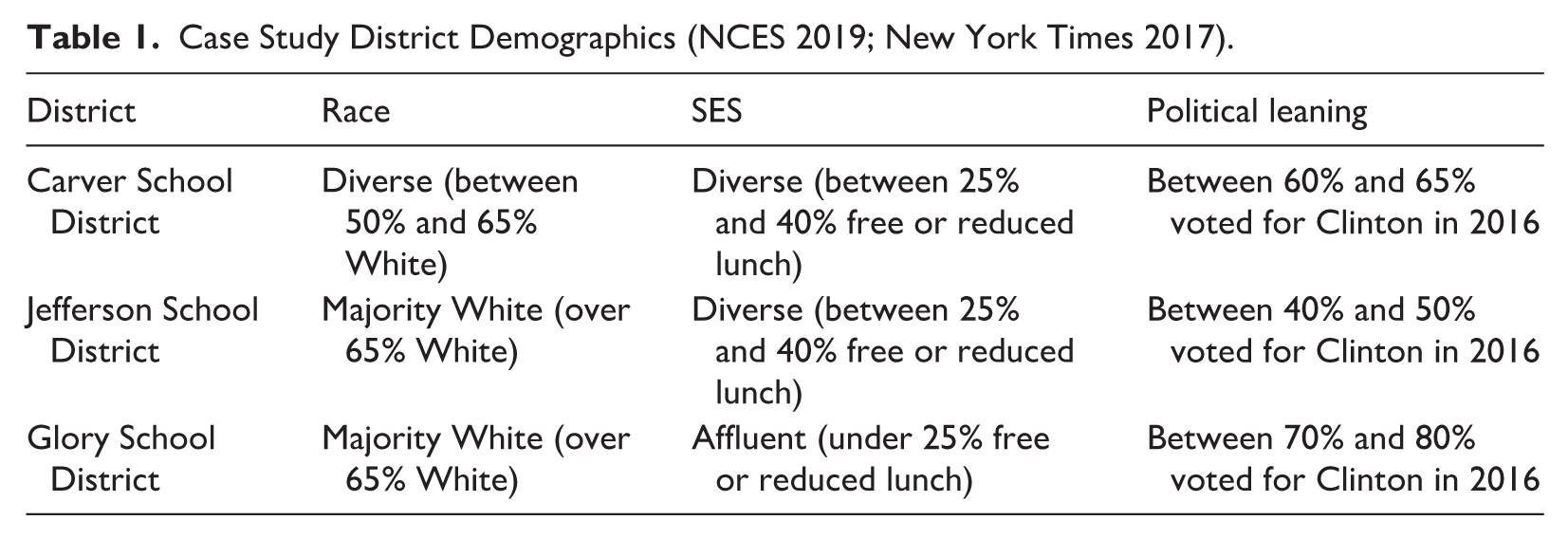
Case Study District Demographics (NCES 2019; New York Times 2017).
Carter, Lippard, and Baird (2019) go a step further, illustrating how people use racial ideologies to increase racial animosity within the context of legal documents about affirmative action. Mueller (2017) also examines how participants use their racial ideologies, finding that students use “epistemic maneuvers” to reinforce their colorblindness and maintain their racial ignorance. In later work, Mueller (2020) argues that racial ideology, as a construct, is limited by its reified central frames, which do not easily allow for relational analysis. She argues that racial ideology is limited by focusing on “era-defined structures,” and thereby misses the way “ongoing historical processes” impact racial beliefs. In response, she suggests building on theories of racial ignorance, which she argues is a more holistic approach to studying racial beliefs.
Similarly, I argue that racial ideologies cannot be properly understood as “era-defined,” and must be analyzed in context. Instead of moving away from racial ideology, I examine color-evasive ideology as it is expressed in conflict with a competing racial ideology that happens to be dominant in the specific institutional space of K–12 school districts: diversity ideology (Freidus 2025). Diversity ideology is marked by race-consciousness, and does not fit neatly into the construct of racial ignorance. My approach allows for consideration of these two competing ideologies, and a deeper understanding of how these ideologies are used. They are not simply static tools for people to pick up and use to interpret the world, but beliefs that can be sharpened into weapons to maintain dominance. I contribute to the literature by illustrating how racial ideologies operate in conflict, and how they can be weaponized to political ends. I argue that weaponization is a three-part process that involves making moral claims, making statements of harm, and demanding recompense, often—as the literature might predict—in the form of demands for racial ignorance (Mills 2007; Mueller 2017, 2020).
Data and Methods
The data for this article come from a four-year study (2019–2023) of three school districts in the Philadelphia suburbs. My broader dataset includes interviews, document analysis, and observations of school board meetings and parent Facebook groups. In this article, I largely rely on the observations from school board meetings, with some data from the Facebook groups. The three districts were selected purposefully for variation in student race and socioeconomic status, as well as town political leaning. The first district, Carver, is racially and socioeconomically diverse, and slightly left-leaning. The second district, Jefferson, is majority White, socioeconomically diverse, and politically diverse. The third district, Glory, is majority White, majority affluent, and majority left-leaning.
I observed school board meetings between 2020 and 2022. School board meetings are public events, and in the 2020–2022 period, they took place on Zoom or similar services. This form of digital ethnography afforded a level of anonymity that is rare for school ethnographies. I could observe participants closely without my own presence impacting their behavior. However, observing through the screen limits some of the thick description that adds depth to ethnographic data. I cannot comment on the temperature of the room, the casual chats before or after the meeting, or people’s facial expressions, all of which would have added richness to this ethnography. Meetings I observed include regular school board meetings and special committee meetings dedicated to equity, or diversity, equity, and inclusion topics. To determine which were relevant for my project, I read four meeting minutes from each committee at each district. I excluded committee meetings that looked specifically at budget, transportation, or legal concerns, but I included all general meetings that occurred between April 2020 and January 2022. The meetings were around one hour each, but ranged from 30 minutes to two hours. At Carver, I observed General Board meetings (n = 14), Equity Taskforce meetings (n = 4), Curriculum Committee meetings (n = 4), and miscellaneous meetings (n = 3). At Jefferson, I observed School Board Action meetings (n = 15), Education Committee meetings (n = 15), and miscellaneous meetings (n = 2). At Glory, I observed General Board meetings (n = 32), Academic Affairs Committee meetings (n = 4), and Equitable Practices meetings (n = 4). This led to a total of 97 meetings observed.
Parents often came out in force at meetings that were seen as related to the anti-CRT “metanarrative” described above. For example: Jefferson parents raised objections to an equity audit and new diversified curriculum, Glory parents came to speak out against a specific picture book read in elementary schools, and Carver parents came to criticize a one-book program centered around Stamped. At school board meetings in all three school districts, parents speak one at a time, during a section of the meeting reserved for public comment. At Glory and Carver, administrators responded to public comments directly, while at Jefferson, they decided not to respond. Parents do not speak to, or argue with, one another directly. As such, while many of the comments made center around specific themes or curricular interventions, they are best understood as individual claims rather than back-and-forth interactions.
In addition to observing meetings, I analyzed parent Facebook groups. I included two groups from each district and tried to find variation in political leaning. However, I was only able to find this variation for Carver and Jefferson; Glory leans too heavily Democratic to have an active, Republican-leaning parent Facebook group. These groups all required admission by the moderators. In the form I disclosed that I was a graduate student conducting research on the districts. I also posted in each group introducing myself.
I analyzed these fieldnotes in Atlas.ti using an approach derived from Deterding and Waters (2021) known as the flexible coding method. This method was devised for interview data, but because I analyzed these meetings within a larger dataset that included interviews, I chose to keep the analytic method the same. The attribute, index, and analytic codes for this article were directly influenced by my larger data set. Attribute codes included interviewee and parent demographics, and index codes included topics related to diversity, equity, academic achievement, tracking, curriculum, partisan politics, and race. Within these index codes, I used ideas about racial ideology to approach analytic coding for this article. At first, I looked for Mayorga’s tenets of diversity ideology (acceptance, intent, commodity, liability) and Bonilla Silva’s tenets of colorblind racism (abstract liberalism, naturalization, cultural racism, and minimization of racism). Once I realized that I was finding ideology used in a different way, I began coding for moral claims, claims of harm, and attempts at control.
My positionality as a White, left-leaning sociologist certainly influenced how I observed, analyzed, and wrote about this data. Unlike in interviews or in-person ethnographies, my physical presence did not shape the data itself. However, my political beliefs, as well as my academic interest in DEI, certainly shaped my interpretations of these parents’ complaints. Before I began these observations, I predicted that I would feel angry, confused, or frustrated by anti-DEI comments. I challenged myself to stay curious about these comments instead and tried to understand the internal logic of these parents’ fears. During analysis, I focused on the text of the comments, rather than attributing feelings, motivations, or biases to these parents that were not explicitly stated.
Findings
By observing parent responses to district DEI initiatives, as well as the districts’ framing of such initiatives, I find that there are two main racial ideologies at play in suburban school districts. The first is a diversity ideology, whereby the districts acknowledge race and racism but do not significantly challenge the underlying structures that perpetuate inequality. The second ideology is a color-evasive ideology. Parents weaponize this ideology, using it for political ends. In the next section, I describe the districts’ diversity ideology. In the following section, I demonstrate the process of weaponization, which I argue has three parts: moral assertions, claims of harm, and demands for recompense from the districts.
Diversity Ideology
In response to the racial justice protests of 2020, Carver, Jefferson, and Glory expanded upon and publicized their ongoing DEI initiatives. While all three districts had been engaged in DEI work before 2020, it was mostly an under-the radar element of initiatives geared toward creating proportionality in academic outcomes across different student demographics. In 2020, all three districts instituted, or continued, DEI efforts that promoted a race-conscious “amorphous diversity” (Mayorga 2019) in response to ongoing racial inequality in their schools. At this moment, DEI efforts focused solely on race.
Although their attempts at DEI began far before 2020, administrators and teachers explicitly recognized the social impact of the racial justice protests following George Floyd’s murder. At Carver, for example, the Supervisor of Special Education addressed a group of teachers, administrators, and community members at the district’s inaugural Equity Taskforce meeting, saying, “Our country is in a state of social unrest right now, so I think that made people’s eyes open to some harsh realities of some inequities in this country, particularly in our school systems.” She went on to clarify that this moment was an opportunity to
“. . . memorialize the work we’ve already done.” In her brief speech, she emphasized that while the current moment might be prompting more of a focus on DEI work, this work was already happening in the district but needed to be concretized in a document for the public to see.
In another case, during a Jefferson school board meeting in February 2021, one administrator stated the following: “I think it’s important to simply recognize that this [DEI] has been our district’s established mission. And we’ve noted our proud traditions and our diverse community. So this focus on equity and cultural proficiency is not new, it’s just a little bit more focused.” Here, this administrator explains that while the work was already happening, it was now going to be both more focused and better resourced. Parents sometimes came to school board meetings to express support for these initiatives, but in this article, I will focus mainly on the parents who attended meetings in opposition to the initiatives.
Before 2020, all three districts were engaged in DEI initiatives. By the fall of 2020, Carver and Jefferson had new equity-oriented committees but were mostly continuing with efforts they had started in the past, like working with local educational equity organizations, participating in equity audits, and working to diversify both their curriculum and their staff. All three districts acknowledged that there was more urgency behind their DEI work in 2020, but despite this, none made extreme changes to the kind of DEI work they were doing—their efforts remained focused on representational diversity, and did not challenge real structural inequalities, a position clearly aligned with diversity ideology. Despite the familiar nature of DEI work in the districts post-2020, the racial justice protests and backlash prompted increased parent engagement (both positive and negative) with these initiatives.
Weaponized Color-Evasiveness
While ignorance, indifference, or tacit support for the districts’ DEI work was the norm before 2020, following the summer of 2020, critical parents began attending school board meetings to register their concern about these initiatives. These parents weaponized their color-evasiveness at these meetings. While racial ideologies are oftentimes described as static beliefs about race that participants express in interviews, in this case, color-evasiveness was dynamic because it was leveraged against diversity ideology. I find that the process of weaponization has three parts: moral claims, statements of harm, and demands for recompense. In the following sections, I will provide evidence for each of these parts of the process.
Moral Claims
In order to weaponize color-evasiveness against DEI initiatives in the districts, parents first claimed color-evasiveness as the true moral position and labeled any acknowledgment of race as the immoral position. The center of this moral claim was that color-evasiveness was the non-racist position. Importantly, much like classic color-evasive racism, these parents identified themselves as non-racist. In addition to this core claim, they attached other morally salient touchstones to color-evasiveness, including Christianity and Martin Luther King, Jr.
Parents established color-evasiveness as non-racist in several ways, some more explicit than others. For example, one parent stated simply: “those of us who believe in colorblind education are not racist.” However, it was much more common for parents to make this moral claim in opposition to the diversity ideology they perceived the districts to be operating within, which required them to restate their perceptions of the districts’ racial beliefs. They asserted that adherence to diversity ideology—through DEI initiatives—was not only irrelevant or distasteful, but immoral. In doing so, they weaponized color-evasiveness against diversity ideology, in parallel to how color-evasive ideology was once used in opposition to explicit, “old-fashioned” racism. One parent described DEI initiatives as designed to teach children to “view every aspect of human life through the lens of race.” Another stated, “they’re teaching kids how to be racist and always see color. All kids, all colors.” Here, this parent clearly stated the position: “seeing color” in any way is the true racism, making color-evasiveness the only moral approach to teaching and learning about race.
Parents explored this claim in more detail, describing DEI efforts as communicating a specific, immoral narrative about race, beyond just teaching students to see color. One parent stated, “This curriculum [DEI initiative] attempts to mold our children at a young age to believe that their skin color is all that matters, and that White children are bad and Black children are victims. That skin color defines them.” Another parent echoed this, saying, “[children] are being taught that they are either victims or victimizers. It creates a wedge between students, and it’s divisive.” A third parent stated similarly, “children are made to feel either oppressor or oppressed based upon nothing but skin color, not character.” A fourth parent elaborated, saying, “[through DEI] White [students] are condemned as being oppressors and another body of people [defined] by their blackness are irreparably oppressed. That, my friends, is racism and bigotry. How dare you try to fight racism with more racism?” Here, this parent makes it clear that they view race consciousness as the true racism. Similarly to the parents above, these parents express concern regarding the emphasis on race, or skin color, which they characterize as evidently racist. They elaborated on this concern, though, to explain more deeply why an emphasis on race is immoral, arguing that through this emphasis on race, schools are teaching students to attach victimization to whiteness and victimhood to blackness.
Other parents took these moral claims against DEI in a slightly different—though resonant—direction, advocating against efforts to level the playing field in the districts. One parent explained that the district plans, “to level the playing field by taking resources already available to all, from one group, and giving more to another, smaller group and calling it justice.” This parent started out by claiming that attempts to “level the playing field” by providing additional access to resources were inherently unfair. He implied that not only did one group (presumably, White students) already have more resources than the other, but that this status quo is how things should be, because it would be unfair to take these resources away from that group. He continued, explaining, “the equity lens sees the students in the minority, oppressed group as not being able to do the work to succeed and not able to perform scholastically as well as the supposed oppressors: a process that is the essence of racism.” Here, he suggests that by providing support for students of color to overcome structural barriers, the districts were acting from racist beliefs about students’ potential. Another parent made a resonant claim, saying, “In fact, by identifying a group as oppressed, there is an implication that they cannot achieve on their own merits.” Both parents argued that DEI efforts actively undermine BIPOC students’ merit and abilities, implying that DEI efforts are themselves racist.
In post-Civil Rights Movement America, there is moral cachet in asserting oneself as not racist. So, it makes sense that parents leveraged their belief in color-evasiveness as non-racist to make a moral claim. They also used two other touchstones with moral cachet to make their claims: Martin Luther King, Jr. and Christianity. This discursive tactic is not new for conservative social movements or for color-evasive racism—historically, both White conservatives and White liberals have leveraged MLK, Jr. to justify color-evasiveness (Yazdiha 2023). One parent explained, “we want to transcend these types of differences . . . This is a giant step backward away from the great advances of the civil rights era, the shining figurehead of which was Dr. Martin Luther King, Jr.” Here, this mother positioned herself as against DEI, because the moral approach to matters of race is to “transcend” it, not address it. She positioned herself as supportive of civil rights by mentioning Dr. King and arguing that DEI work goes against his legacy. Another parent took this logic further, stating, “it just occurred to me that that [DEI] is an inversion of Martin Luther King’s message that we should be colorblind. And we should be evaluating people based upon their deeds and words, and not upon the color of their skin.” This parent referenced the famous excerpt from Dr. King’s “I Have a Dream” speech, interpreting the lines as a desire for color-evasiveness. By leveraging a figure seen as unequivocally morally good, this parent made a moral claim against DEI. In one final example, one parent positioned himself as Dr. King, stating, “I have a dream about Jefferson going back to how it was.” Here, this parent implied that the current DEI initiatives were akin to the racist structures Dr. King sought to overturn in his famous 1963 address, neatly drawing a correlation between race-conscious DEI efforts and explicit, “old-fashioned” racism.
Parents also attempted to establish color-evasiveness as the moral alternative to DEI by aligning it with Christianity. One parent stated, “As colorblind believers in Jesus, we believe all humans are created as equals under G-d” and noted further that, “the answers CRT provides are very different than those Christianity offers.” Another parent echoed this, explaining, “While I am respectful to all religions, I can only speak of my own Christianity. The tenets of Christianity are diametrically opposed to the tenets of critical race theory.” She argued that because what she saw as “critical race theory” is opposed to Christianity, it should not be taught in school. A third parent echoed this position, explaining, “I don’t want to push the school to push my worldview, but the school district shouldn’t push anti-Christian views and race/gender views of the world.” This parent claimed they did not want to push their worldview on anyone, while simultaneously opposing any effort that did not reflect a Christian worldview. Altogether, parents used references to Christianity and Dr. King to lend moral force to their central claim that race-conscious DEI initiatives are the true racism.
Statements of Harm
A moral claim can be powerful in and of itself, but to truly weaponize color-evasiveness to pursue political goals, parents had to show that the immorality of DEI initiatives caused harm. Many parents identified division as the harmful result of DEI. This explanation of division built on the moral claims described in the previous section, which often included a concern about bifurcating the students into “victims and victimizers.” Parents argued that teaching children about structural oppression meant teaching that some groups were “oppressed,” thereby making the others “the oppressors,” and that this was inherently harmful. Sometimes they used slightly different language, speaking about “victims” and “victimizers,” or division more broadly. They characterized any type of DEI initiative as aligned with this narrative and broadly panned it as both immoral and directly harmful.
Parents expressed concerns about harm through division in several ways. One parent simply asked, “How does Carver plan to avoid division and resentment in the student body?” Another posed the question, “How is teaching critical race theory going to bring unity to our students? There is already too much division.” A third parent, this one in a Facebook group, referred to the school district leaders as “The Dividers.” Parents elaborated on the harm they felt this division would cause. After discussing division caused by DEI, one parent stated, “naturally, this causes resentment and anger in the so-called oppressed group, and supposedly is done in the name of equity. But it is the opposite of fairness, it deliberately separates people.” This parent argued that teaching about oppression was antithetical to creating equity, which she defined as “fairness,” because it would only make students of color feel “resentment and anger.”
Oftentimes, concerns about division came in tandem with concerns about how learning about racism might impact students’ sense of self. In the quote above, the parent expresses concerns that by creating division, learning about race will lead students of color to become resentful and angry. Another reiterated this position, explaining, “you’re teaching them [students of color] that they shouldn’t dream so big. You’re teaching them that they shouldn’t have such expectations, because systemically they are oppressed.” They also expressed concerns for harm to White students’ sense of self. For example, one parent stated, “I can’t imagine walking around the halls of this school and people looking at each other and feeling guilty because of the color of their skin.” Here, this parent emphasized both that teaching divisiveness is wrong and that it causes harm by making White children feel guilty about their whiteness.
Another parent expressed concern for both White and non-White students, saying, “the district is being consumed by the current political and social movements that are sweeping the nation without any thought of possible adverse effects. For example, what would be the eventual impact of an entire generation of children who spent years involved in activities teaching them that they are either inherently bad or inherently disadvantaged based on the color of their skin?” This parent was concerned that race-conscious DEI efforts could have long-term negative impacts on both White students and students of color.
In some instances, parents claimed that interventions had already caused acute harm—this happened infrequently, because typically parents came to complain in advance of a planned DEI effort, rather than in response to one. At Glory, one of the most contentious meetings had to do with a picture book called Something Happened in Our Town. This picture book discusses an incident of police violence from the perspective of one White family and one Black family. Many parents were concerned about the content of the picture book, claiming it had caused harm to their children. When it came to this specific case, parents expressed concerns about their children losing their innocence by being frightened about racism.
One parent stated, “my 4th grader has no idea about this, he doesn’t think about race and he shouldn’t.” Here, the parent expressed a desire to protect his White 4th grader from a harmful loss of innocence by avoiding the topic of race. Others claimed the book caused acute harm. One mother said the book was, “instilling fear into young children,” and a father claimed, “my son wasn’t himself last night, he cried.” Another parent claimed she was, “all for promoting respect and standing up against racism, teaching values and ethics, but there has to be a way that it doesn’t offend children sitting in a classroom.” She was the only critical parent that said that she was “all for” standing up against racism, and yet, when confronted with a book about racism, found it offensive.
Another set of parents argued that the book was inappropriate because it would frighten their children to know that Black people might be at risk. One parent explained, for example, “my son was upset because it scared him, he didn’t want to think that his Black friends would be hurt by police officers. This shouldn’t be in the school.” Another parent, speaking about the book, claimed, “you’ve overstepped your place by taking on the role of the parent to talk about what’s going on in the world. They might think ‘oh my goodness, will people of a different skin tone than me be at risk?’” These parents claimed that the book had caused harm to their White children by making them fearful of ongoing racism, robbing them of the innocence of their White childhood.
Demands for Recompense
Finally, I find that parents made demands to maintain racial ignorance as recompense (Mueller 2017, 2020). While these demands were often connected to statements of harm, here I note what parents asked for in response to this harm. Parents demanded recompense in the form of increased control, demanding that they be the arbiters of school curricular content. This would allow them to protect their children’s racial ignorance by controlling what they learned.
Some parents simply stated that nothing related to race should be taught. One parent said, “race has no place being taught in our schools, no place.” Another parent declared, “I’m just asking the school board to not teach anything about race, whether you call it critical race theory or what. It [race] has no place in this country anymore.” Here, this parent implies that racism is a thing of the past and therefore should not be included as part of the school’s curriculum. In response to the districts’ race-conscious DEI efforts, parents demand a return to racial ignorance as recompense.
In addition to these statements advocating for race to be removed from the curriculum, parents used accusations of bias to argue that they should be in control of district curriculum. In this way, they demanded control as recompense for the harm described in the previous section. One parent stated, “we’re not paying you to train future activists” and another stated that “we should teach our students how to think, not what to think.” In these accusations, they assert that as taxpayers and as parents, they should be able to enact a boundary around what is taught in school.
In this same vein, parents implied that the districts were not to be trusted to choose curricular materials due to perceived bias. For example, one Carver parent, looking at a list of resources about antiracism, said: “There are books that are anti-American, anti-government, political, distort history.” This parent wanted to personally arbitrate what was on a (non-required) list of books about racism. Another parent exclaimed, “You want them to believe that America is fundamentally evil.” Another more succinctly referred to this list as, “leftist hate books.” A parent at Glory mused, “if we’re including everybody – where is the White history? It wouldn’t fit the narrative, so we can’t teach that here.”
Others focused on the question of transparency, implying that the districts were purposefully hiding curricular decisions from parents. One parent stated, “I learned there is a committee that comes up with curriculum recommendations, my suggestion to the board would be that the committee be publicized . . . And then [I request] that the teacher who will be teaching those lessons provide at least two weeks’ notice to the parents.” Others echoed this sentiment, stating “the curriculum has been posted, but what I could find in regard to social interaction or race is a general outline of how things will be discussed and what the objectives are, but a lack of content.” Another parent stated, “I’d like, for the sake of transparency, to request that the board make the curricula available to the parents, specifically any curriculum that covers social interactions and equity.” Finally, another parent stated, “You can no longer work behind closed doors to make these decisions for our children. We are awake.” Here, these parents accused the districts of indoctrinating their children—teaching them “what to think”—and this final parent repeats the issue around trust: an assumption that curricular decisions were made “behind closed doors” purposefully to hide them from parental scrutiny.
Rather than rely on the expertise of administrators and teachers to decide what to teach, parents made accusations of bias and demanded transparency from the districts so that they could work to maintain their children’s racial ignorance (see Mueller 2020). As parents demanded transparency as recompense, they attempted to set up a system where they were able to arbitrate which materials were taught in school, limiting their children’s access to knowledge about race and racism. In most of these cases, though, the information they sought was already available. For example, at Carver, the curriculum committee has public meetings. At Glory and Jefferson, curricula were available online. However, they wanted additional information and control as recompense for the immorality and harm they perceive the districts enacted through race-conscious DEI efforts. As a result, they demanded that districts not only undo perceived additions to race-conscious DEI following the increased attention to racial justice in 2020, but also undo any race-conscious curricular programming that had been in place before 2020.
Discussion and Conclusion
In school board meetings, participants are talking directly to the perceived power brokers of the districts, critiquing specific decisions being made about their local public schools. This context is notable because multiple racial ideologies are on display: those of the parents critiquing DEI and those of the school district. Unlike many studies of racial ideology that focus on reported racial beliefs, in this article, I illustrate how color-evasive ideology is used in real-time conflicts. The districts subscribed to diversity ideology—marking race-consciousness, rather than color-evasiveness, as dominant in the institutions. Parents’ weaponization of color-evasiveness illustrates how people use racial ideologies to pressure institutions to revert to a previously dominant ideology.
District DEI initiatives were in line with diversity ideology: the initiatives focused on increasing representation without making structural changes (Mayorga 2019). Parents advocating against DEI adhered to long-dominant color-evasive racial ideology, weaponizing these beliefs against diversity ideology. In all districts, by making moral claims against DEI, arguing that DEI causes harm, and demanding recompense from the district, parents weaponized the long-standing dominant racial ideology—color-evasiveness—against a perceived challenge from race-conscious diversity ideology. When color-evasiveness was dominant across the political spectrum, the most significant challenge came from “old fashioned,” explicit racists. In this case, parents opposed to the districts’ race-conscious DEI efforts weaponized color-evasiveness in response. In both cases, color-evasive racial ideology was used to challenge a race-conscious racial ideology: in the past, that was explicit racism. In suburban school districts, this race-conscious racial ideology centers diversity and inclusion.
This moment of backlash is not singular in the long history of political contestation in U.S. public schools. However, by examining the conflict in this moment, we can better understand how long-standing beliefs that undermine a full understanding of U.S. structural racism persist, even against a non-radical focus on diversity. Due to the long-standing dominance of color-evasiveness, these parents are deeply familiar with its contours and can mold it to their needs. As Mueller (2020) suggests, racial ideologies are dynamic tools, not static ones. Racial ideologies are not static and are not solely mediated by institutional norms—they can be forged into weapons and used to argue against competing ideologies to exert dominance. I argue that this weaponization happens in a three-pronged process: moral claims, statements of harm, and demands for recompense. Future research could examine whether this same weaponization is present in historic moments of racial tension in school districts, which could help determine whether this process is a singular one, or one that occurs as racial ideologies battle for dominance more broadly.
Moral concern—specifically, the desire to not be seen as racist—has always been at the center of color-evasive racism. Bonilla-Silva (2021:2) argues that White people use colorblind racism to “exculpate them from any responsibility for the status of people of color.” This ideology can be weaponized to characterize diversity ideology—marked by acknowledgments of racism that do not actually challenge the status quo—as the true racism, and thus immoral. In the present study, parents draw a parallel between diversity ideology and “old fashioned” explicit racism, as both are race-conscious ideologies, though used toward different ends. By leveraging references to Dr. King, and talking about division, these parents try to show that any discussion of students’ differing racialized experiences is itself the “true racism.” Beyond moral statements, parents weaponized color-evasiveness by claiming that race-consciousness was inherently harmful. They argued that discussing racism was divisive and harmful for all children. They also emphasized that learning about racism would detract from their White children’s innocence—or racial ignorance.
Finally, parents demanded recompense from the district: some wanted to remove any content about race, and others wanted to personally arbitrate the knowledge schools offered students—effectively becoming gatekeepers for racial ignorance. While these parents might be explicitly focused on their own children’s educational experiences, their rancorous attacks on DEI betray a deeper motive: to continue to protect the power and status that whiteness provides by maintaining a color-evasive status quo. As Hagerman (2024) explains, seemingly goodwilled efforts to protect White children from harsh realities of the world are actually efforts to shape the way children understand their status in society’s racial hierarchy. She also notes that these efforts are ultimately unsuccessful: regardless of how many parents complain at school board meetings, their children are going to be learning lessons about race—as well as other inequalities—as they move through the world. While it is outside the scope of this article, parents have used similar tactics to attack district approaches to gender and sexuality. Future work on this topic could investigate how weaponized color-evasiveness is used when arguing against gender-inclusive curricula, given that race is often the main focus when it comes to DEI efforts (and their detractors); or whether this same ideological process is present in school districts with different demographic makeups, or even in different institutional contexts entirely.
Weaponizing color-evasive ideology in response to the districts’ quite moderate DEI initiatives as if they were, indeed, radical acts had consequences. The DEI initiatives the districts put in place—both before and after 2020—in no way attempted to remake or rebuild structures that reproduce inequality. They sought to create proportional experiences for students in school, both in terms of academic outcomes and curricular content. By weaponizing color-evasiveness to position these middle-of-the road initiatives as radical, these parents pushed the districts further to the right. While the districts did not unilaterally cancel all DEI efforts in 2021, all three made it easier for parents to opt their children out of curricular content and slowed down on additional changes they were planning. In this way, by weaponizing color-evasiveness, these parents added significant friction that slowed down progress and, in some cases, made district leaders think twice before endorsing new DEI efforts. This strategy was not solely the brainchild of parents from Carver, Jefferson, and Glory, though—it was a purposefully manipulated moral panic, designed by Republican strategists to control the flow of information from school districts to children. As Mueller (2017) observes, it is not an attempt to protect innocence, as the parents claim, but to protect ignorance, which is a powerful weapon in the arsenal of those hoping to delay antiracist efforts.
Footnotes
Acknowledgements
The author thanks Mallory Fallin, Nadirah Farah Foley, Catherine Lee, Norah MacKendrick, Greer Mellon, Bonnie Siegler, Marissa Thompson, as well as attendees of the Sociology of Education Association and Eastern Sociological Society conferences for helpful feedback on various iterations of this work.

Funding
The author received no financial support for the research, authorship, and/or publication of this article.
Declaration of Conflicting Interests
The author declared no potential conflicts of interest with respect to the research, authorship, and/or publication of this article.