






Abstract
How do Americans evaluate competing claims to national standing when civic behavior and birthright citizenship conflict? Most research on national identity asks which traits define Americanness, but this approach obscures how individuals adjudicate hierarchical claims about relative status in the national community. This study examines whether Americans agree that civically virtuous immigrants are “more American” than U.S.-born citizens who violate civic norms, and whether they recognize undocumented immigrants as American at all. Drawing on original survey data from a probability-based national sample (N = 711), I find that racial groups differ systematically in their willingness to endorse behavior-based hierarchies. Asian respondents are most likely to agree that hardworking and law-abiding immigrants outrank U.S.-born norm violators; Black and White respondents are least likely to endorse such claims. Across groups, respondents are more willing to grant undocumented immigrants categorical recognition than to elevate them above U.S.-born citizens—highlighting the analytical importance of distinguishing between relative standing and categorical membership. I interpret these patterns through a framework of motivated national identity construction, arguing that racial groups selectively endorse evaluative criteria that affirm their position within a racialized national order. Among White respondents, partisan polarization shapes evaluations of law-abiding (but not hardworking) immigrants and is especially pronounced in the conferring of categorical recognition to undocumented immigrants. The findings demonstrate that disagreement over Americanness concerns not only who belongs but also which principles may legitimately structure hierarchies of national standing.
Introduction
For more than a century, social scientists have debated who counts as an American (Theiss-Morse 2009). Research consistently shows that Americanness is not defined by a single criterion but by a combination of ascriptive attributes, such as nativity and race, and creedal characteristics, such as adherence to civic values and norms (Bonikowski and DiMaggio 2016; Smith 1997). These debates are especially salient in a country with more than 46 million foreign-born residents, including roughly 25 million naturalized citizens and nearly 14 million unauthorized immigrants. Many foreign-born residents see themselves—and are regarded by others—as American regardless of legal status (Cornejo Villavicencio 2020; Vargas 2018).
Most prior research approaches Americanness as a classificatory problem, asking which traits define national membership and which groups endorse them (Schildkraut 2007). This approach obscures an important feature of national belonging: Americanness operates not only as a boundary between insiders and outsiders, but also as a hierarchy of recognition in which individuals and groups are accorded unequal degrees of national standing (Barreto and Lozano 2017). From this perspective, the relevant question shifts from what defines American identity to whether people accept or reject specific claims about who is more or less American, and how social location shapes those evaluations (Bloemraad 2022).
Standard survey questions about whether being born in the United States or respecting U.S. laws are ‘important’ to being American provide limited insight into how these factors shape social status within the national community, especially when individuals send mixed signals. Yet public debates over immigration and national identity frequently hinge on precisely such conflicts: whether civic virtue can compensate for lack of birthright, or whether inherited membership supersedes conduct (Vance 2025). Evaluating agreement with explicit comparative claims—such as whether hardworking or law-abiding immigrants are more American than U.S.-born citizens who violate civic norms—offers a direct way to observe which evaluative logic respondents rely on when adjudicating national standing.
These evaluations are influenced by the racialized structure of American society (Masuoka and Junn 2013). Racial minority groups occupy unequal positions within legal, cultural, and symbolic hierarchies, leading to different forms of security and vulnerability across dimensions of Americanness. For some groups, namely Black Americans, birthright membership is secure, but cultural inclusion is contested; for others, particularly Asian and Latino Americans, civic inclusion exists alongside ongoing perceptions of foreignness. These group positions may influence which hierarchical claims are more resonant when individuals assess relative national standing. White Americans, on the other hand, tend to hold a relatively consistent position across ascriptive and cultural aspects of Americanness, making compensatory strategies less relevant (Devos and Banaji 2005; Guess 2006; Haney-López 2006). Among Whites, differences in evaluations of national belonging are more likely associated with political identification (West and Iyengar 2020). Although we know that partisans differ in what they consider essential to defining “truly American,” it remains unclear how these views influence their assessments of explicit status hierarchies.
This study examines how Americans respond to claims that place civic behavior and birthright citizenship in direct tension with one another when evaluating national standing. The findings reveal substantial divergence across racial and partisan groups. Asian respondents are most likely to endorse claims that hardworking and law-abiding immigrants are more American than U.S.-born citizens who violate civic norms. Latino respondents show greater heterogeneity in their responses, while Black and White respondents are less willing to endorse hierarchies that demote birthright status. Among White respondents, partisan polarization emerges primarily in evaluations involving law-abiding behavior, not work ethic.
The study also distinguishes between categorical recognition and hierarchical elevation. Asian respondents are most likely to agree that long-residing, hardworking, and law-abiding undocumented immigrants should be considered American at all. Black and White respondents are more willing to grant categorical recognition than to endorse claims that elevate undocumented immigrants above U.S.-born citizens. Among Whites, partisan differences are pronounced, with Democrats substantially more likely than Republicans to grant recognition.
This study advances research on national identity by showing that the hierarchical organization of Americanness cannot be reduced to a White/non-White binary. Instead of treating the American national hierarchy solely as a two-step racial ordering, the study theorizes Americanness as multidimensional and relational, in which ascriptive criteria and civic behavior are weighed against one another to determine relative national standing. Drawing on status inconsistency theory and a framework I term motivated national identity construction, this article argues that racial groups occupy distinct and unevenly secure positions across dimensions of Americanness, and that they evaluate hierarchical claims in ways that reflect these positions—selectively endorsing criteria that affirm their group’s standing while resisting those that threaten it. Empirically, the study advances beyond previous research documenting racialized prototypes of Americanness, revealing not only what is considered more important for being “truly American” but also when and why racial groups accept or reject behavior-based elevation within the national community. The findings demonstrate that hierarchical evaluations of Americanness differ systematically across racial and partisan lines, even in the absence of an explicitly racialized outgroup.
Theoretical Framework
Americanness: Multidimensional, Racialized, and Positional
Scholars have long argued that national identity is socially constructed, shaped by legal, racial, and moral dimensions rather than reducible to formal citizenship (Anderson 1991; Du Bois 1903; Smith 1993). Empirical research typically operationalizes Americanness using two broad sets of criteria: creedal attributes (e.g., adherence to civic values and norms) and ascriptive attributes (e.g., nativity, race, and religion) (Schildkraut 2014). Survey research consistently finds strong support for civic criteria and comparatively low explicit endorsement of ascriptive traits as defining features of being a “true American,” a pattern observed across countries and political contexts (Ceobanu and Escandell 2010; Fussell 2014; PRRI 2021; Schildkraut 2007).
At the same time, a substantial body of research shows that Americanness is deeply racialized. Psychological studies reveal a persistent implicit association between being American and being White, even among respondents who endorse inclusive, civic ideas of national identity (Devos and Banaji 2005; Devos and Ma 2013; Devos and Mohamed 2014). Other research indicates that civic traits themselves are not applied equally across groups. Traits like hard work, fairness, and law-abiding behavior are often assumed of Whites and, in some cases, Asian Americans, while they are seen as conditional or absent among Latinos and Black Americans (Desante 2013; Lamont 1992; Winter 2008). These findings suggest that endorsing civic ideals does not eliminate ascriptive boundaries but rather coexists with them.
This study asks whether Americans endorse evaluative judgments that position immigrants as more American than native-born citizens, and whether such judgments vary across racial groups. Public debates about immigration and national identity frequently hinge on comparative assessments of relative Americanness—particularly when birthright and conduct point in different directions. Evaluations of such claims reveal how racial and political groups allocate national standing among formally included and excluded members, underscoring that hierarchy operates through relative valuation rather than simple inclusion or exclusion (Ridgeway 2013, 2019; Ridgeway and Markus 2022).
Status Inconsistency and Group-Based Evaluations of Americanness
Most racial groups in the United States experience status inconsistency (Lenski 1954): relative security on some dimensions of Americanness alongside vulnerability on others. Groups that are secure on one dimension of Americanness but vulnerable on another risk diminished national standing or even exclusion. Because Americanness is implicitly associated with Whiteness and nativity, members of non-White groups and those with high levels of immigration are especially vulnerable to being regarded as less fully American, even when formally included. As a result, groups have incentives to legitimate criteria that elevate their position and to resist those that justify devaluation.
How does racial group positioning translate into evaluative orientations? I propose that evaluations of national belonging reflect a process I term motivated national identity construction: the tendency for racial groups to selectively emphasize criteria of Americanness that affirm their own social standing. As with motivated reasoning in other domains (Kunda 1990), this process enables groups to navigate status inconsistencies by foregrounding traits that reflect well on them—such as nativity, cultural conformity, or economic contribution—while downplaying criteria on which they may be at a disadvantage. This orientation is reinforced through socialization, as group members are exposed to narratives about the criteria historically used to include or exclude their group, shaping individuals’ sense of which dimensions of Americanness are secure and which remain contested (T. N. Brown and Lesane-Brown 2006). In this context, evaluations of hierarchical claims about national standing are not simply expressions of abstract civic beliefs but reflect group-based strategies for asserting symbolic status in the national community.
I apply this framework to the three largest ethnoracial minority groups in the United States—Asian, Black, and Latino Americans—whose positions within racialized hierarchies of belonging generate distinct evaluative orientations.
Asian Americans are frequently characterized as hardworking, law-abiding, and civically compliant (Siy and Cheryan 2016). At the same time, more than 70 percent of Asian American adults are foreign-born, and even native-born Asian Americans routinely encounter assumptions of foreignness (Cheryan and Monin 2005; Tuan 1998). Scholars describe Asian Americans as “conditional citizens,” whose acceptance is often tied to exemplary behavior rather than unquestioned belonging (Kim 1999; Yukich 2013). This positioning suggests greater receptivity to claims that treat civic behavior as a legitimate basis for both recognition and elevation. At the same time, research on immigration attitudes raises questions about how far this behavioral logic extends, particularly with respect to whether Asian Americans are willing to recognize undocumented immigrants as American or to endorse their elevation above U.S.-born citizens (Tran and Warikoo 2021).
Black Americans occupy a distinct configuration within the American national hierarchy. The vast majority are native-born with deep historical roots in the United States, securing birthright membership. At the same time, Black Americans face persistent cultural exclusion through stereotypes of criminality, dependency, and moral deficiency (Bobo 2012; Rigueur and Beshlian 2019). This combination of secure nativity and contested civic standing renders behavioral criteria especially fraught as a basis for national standing (Pérez and Kuo 2021). Prior research characterizes Black Americans as “conflicted nativists,” expressing ambivalence toward immigration not primarily out of xenophobia, but out of concern about how immigrants are incorporated into a racial order structured by anti-Blackness (Carter 2019). Prior research also finds that Black Americans are more likely than Whites to endorse nativist criteria for Americanness—such as nativity and long residence—an orientation interpreted as affirming their own deep American roots rather than expressing exclusionary sentiment toward outsiders (Citrin, Wong, and Duff 2001). Narratives of the “model minority” or the “worthy immigrant” implicitly position immigrants as more deserving or assimilable than Black Americans through moralized comparison (Asbury-Kimmel 2024; Kim 1999; Xu and Lee 2013). As a result, Black Americans may be more inclined to grant immigrants recognition as members of the national community than to endorse comparative claims that elevate civically virtuous immigrants above U.S.-born citizens.
Latinos occupy an inconsistent position that is less uniformly structured than those of Asian or Black Americans. Although most Latinos are U.S. citizens, they are frequently racialized as undocumented, linguistically foreign, or culturally unassimilable (Chavez 2008; Flores and Schachter 2018). Ongoing immigrant replenishment contributes to the re-ethnicization of later-generation Latinos, sustaining perceptions of foreignness and contested belonging even among the U.S.-born (Jiménez 2009). At the same time, compared to Black Americans, they face fewer entrenched stereotypes of criminality and may benefit from narratives emphasizing hard work (Bloemraad 2022; Fox 2004; Patler 2018). And unlike Asian Americans, whose inclusion is characteristically conditional on civic performance, many Latinos hold secure birthright citizenship with multigenerational roots in the United States. This variable positioning produces within-group heterogeneity rather than a single directional expectation. As a result, Latinos may exhibit less consistent patterns than Asian and Black Americans, with overall responses falling at intermediate levels.
Evaluative Differences within the Dominant Group
White Americans tend to occupy a relatively secure position across both ascriptive and civic dimensions of Americanness, limiting exposure to status inconsistency (McDermott and Samson 2005). This relative security does not imply the absence of racialized boundary-making or concern with hierarchy. Variation in White Americans’ evaluations is more likely structured by perceptions of group threat and political orientation than by efforts to resolve status inconsistency.
Prior research on demographic change and perceived group threat provides insight into how White Americans may respond to immigrant-native social comparisons. Studies show that when confronted with the growth of the Latino population, White Americans tend to place greater emphasis on White racial identity, while Black Americans are more likely to emphasize American national identity (Abascal 2015). This pattern has been interpreted as prioritization of the identity dimension that confers higher relative status under conditions of perceived threat. In this context, shifts in identity salience reflect efforts to maintain relative group position rather than generalized exclusionary sentiment (Blumer 1958; Bobo and Hutchings 1996).
The evaluative context examined in the present study differs in a key respect. The potential challenge to relative standing does not arise from an explicitly racialized outgroup but from immigrants described as civically virtuous. In the absence of a salient racial boundary, native-born status may become the primary basis for maintaining hierarchical distinction. This dynamic suggests that White Americans may be especially resistant, relative to Asian and Latino Americans, to claims that civic virtue justifies ranking immigrants above U.S.-born citizens, as behavior-based elevation threatens established group standing.
These dynamics should not be assumed to operate uniformly among White Americans (Bonikowski and DiMaggio 2016). Conceptions of national membership are increasingly structured by partisanship, reflecting broader polarization in how Americans define the bases of political and social belonging (Bonikowski, Bock, and Feinstein 2021). As national identity has become more politicized, partisan attachments among Whites have come to organize not only attitudes toward immigration, but also the criteria used to evaluate civic worth and membership claims (Asbury-Kimmel 2023, 2025). The central question, therefore, is not simply whether White Americans across the partisan divide value civic commitment, but whether they accept the implications of a primarily civic-based definition of national identity: that civic behavior can override birthright or illegality in determining ingroup membership, and that it can justify positioning immigrants above U.S.-born citizens.
Hypotheses
Building on this framework, I derive a set of hypotheses regarding the association between racial and partisan identities and evaluations of Americanness. Because groups occupy unequal locations within racialized hierarchies of national belonging, they should differ in their willingness to endorse comparative claims that elevate civic behavior over birthright and in their willingness to recognize undocumented immigrants as Americans.
Hierarchical Elevation
Recognition versus Elevation
Beyond cross-group differences in hierarchical elevation, the framework generates expectations about the relationship between recognition and elevation within and across groups:
Partisan Differences among White Americans
Among White Americans, partisan polarization is expected to structure both elevation and recognition judgments.
Data and Methods
This study draws on data from an original online national survey fielded in August and September 2021 using NORC’s AmeriSpeak Panel, a probability-based sample of U.S. adults. Of the 2,989 individuals who initiated the survey, NORC identified 2,870 valid completed interviews after applying standard quality control protocols to remove respondents who completed the survey in less than one-third the median duration, skipped more than 50 percent of questions, or straight-lined responses to every grid question. The larger study employed a four-condition experimental design; respondents in the three experimental conditions were randomly assigned to treatments assessing the effects of political discourse on immigration attitudes. The present analysis draws on the 711 respondents assigned to the baseline condition with valid completed interviews, who received no experimental treatments prior to completing the survey.
The sample includes U.S. adults ages 18 and older with no restriction on nativity status. Although the survey did not collect information on respondents’ own nativity, a question about parental nativity was administered at the end of the survey and is used in supplemental analyses. Race and ethnicity were measured using NORC’s standard combined race/ethnicity variable, which classifies respondents into mutually exclusive categories. The analytical sample comprises four groups: non-Hispanic White (n = 354), non-Hispanic Black (n = 124), Hispanic (n = 120), and non-Hispanic Asian (n = 113). The White category includes only non-Hispanic White respondents. To facilitate within-group partisan comparisons, the survey design oversampled White respondents to achieve equal partisan representation. NORC-constructed sampling weights based on the February 2021 Current Population Survey were applied to all analyses to ensure national representativeness. Table 1 presents unweighted descriptive statistics by racial group.
Descriptive Statistics by Race (Proportions/Means)—Unweighted.
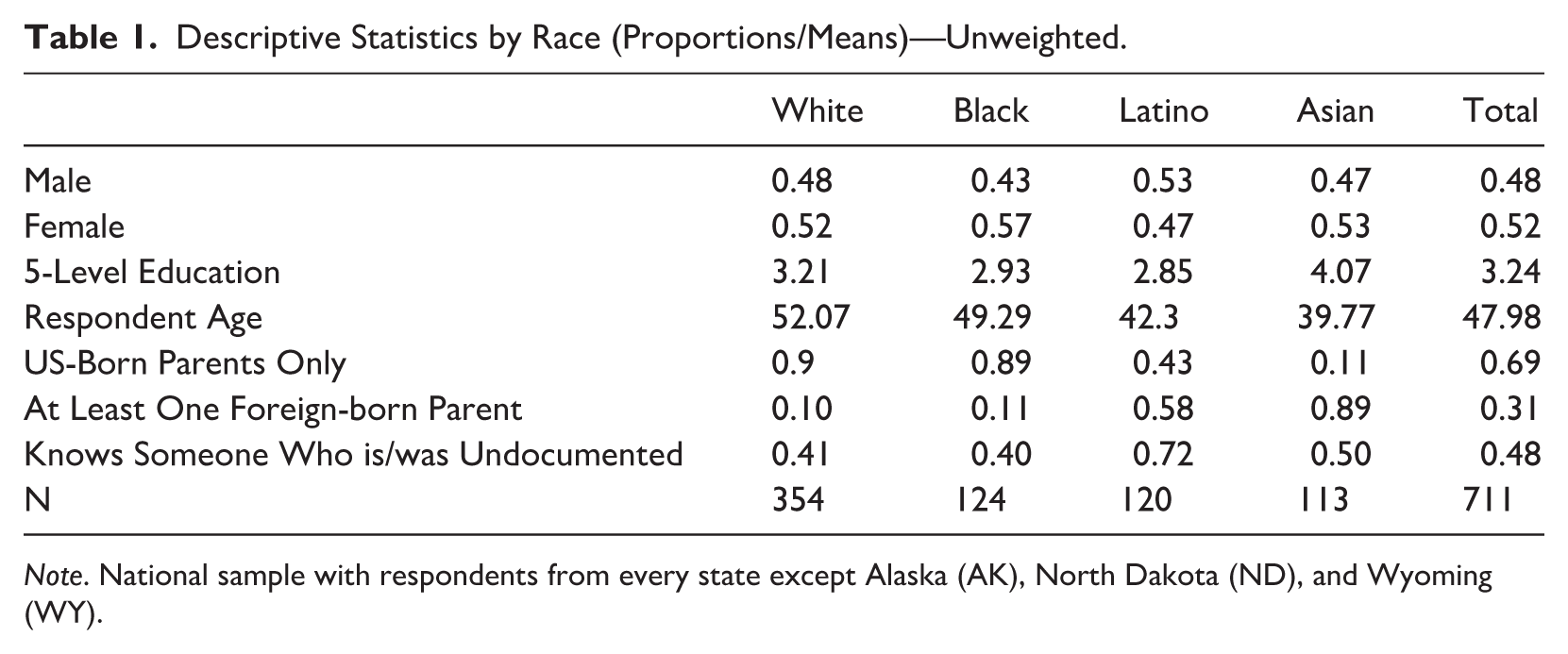
Note. National sample with respondents from every state except Alaska (AK), North Dakota (ND), and Wyoming (WY).
Measures of Americanness
The survey included five items designed to capture evaluations of Americanness through both hierarchical comparison and categorical recognition. Each item was presented individually, and respondents indicated their level of agreement using a 7-point Likert scale ranging from “strongly disagree” to “strongly agree,” with “neither agree nor disagree” as the midpoint.
The first two items assess hierarchical elevation without specifying immigrants’ legal status. Specifically, respondents rated their agreement with the statements: “Hardworking immigrants are more American than U.S.-born citizens who are on welfare” and “Law-abiding immigrants are more American than U.S.-born citizens who break the law.” These items directly operationalize the core theoretical question of whether civic conduct is treated as a legitimate basis for elevating immigrants above native-born citizens when birthright and behavior conflict.
The next two items extend this comparison by introducing unauthorized presence, specifying that the immigrants in question are undocumented. Respondents evaluated the statements: “Hardworking undocumented immigrants are more American than U.S.-born citizens who are on welfare” and “Law-abiding undocumented immigrants are more American than U.S.-born citizens who break the law.” These items assess whether civic virtue can outweigh both foreign nativity and illegality in judgments of relative national standing.
The fifth item shifts from comparative ranking to categorical recognition by asking whether civically virtuous undocumented immigrants should be regarded as American at all. Respondents evaluated the statement: “Hardworking and law-abiding undocumented immigrants who have lived in the United States for many years are Americans.” This item captures willingness to extend symbolic membership independent of relative status, allowing for a clear analytic distinction between categorical recognition and hierarchical elevation.
Though the survey items can assess whether respondents agree with the claims under investigation, they cannot determine whether rejecting these claims implies endorsement of the opposite hierarchy or reflects resistance to ranking national standing along these dimensions altogether. Disagreement may reflect either the defense of birthright primacy or the rejection of ranking logic altogether. The present data cannot fully adjudicate between these interpretations. 1
To minimize priming effects, the survey implemented a partial randomization design. The two items referring to immigrants without legal status specified were randomized but always appeared before the items referencing undocumented immigrants. The three items involving undocumented immigrants were fully randomized among themselves.
Analytic Strategy
To assess racial group differences in evaluations of Americanness, I estimate a series of bivariate logistic regression models predicting agreement with each statement as a function of respondent race, using Asian respondents as the reference category in line with Hypothesis 1’s expectation that Asian Americans will express the strongest support for behavior-based claims to Americanness. Agreement is coded as a binary variable (1 = “somewhat agree,” “agree,” or “strongly agree”; 0 = otherwise). Analyses of disagreement use a binary variable coded in the opposite direction.
These models intentionally exclude additional covariates. The goal is to estimate total group-level differences in how racial identity structures judgments of national belonging, not to isolate net effects after conditioning on variables that are themselves shaped by racialized social location. Demographic characteristics such as immigration history, education, and income are not independent of race in a society structured by racial inequality; conditioning on them would partial out variance that is theoretically constitutive of the group differences under examination (Kohler-Hausmann 2019; Saperstein, Penner, and Light 2013). Supplemental models including controls for immigrant parentage, education, gender, and age are reported to assess robustness, but the bivariate models are the primary analyses.
Partisan heterogeneity is examined in a separate set of models restricted to White respondents, testing Hypotheses 7a and 7b. Partisan identification was measured using standard items; Democrats and Republicans include both weak and strong identifiers. Independents include those who do not identify with either party and partisan leaners.
Findings
Overall Willingness to Endorse Hierarchical Claims about Americanness
I begin by examining aggregate responses to the comparative items, which explicitly ask respondents to evaluate whether immigrants exhibiting positive civic behavior are more American than U.S.-born citizens who violate civic norms. Across the sample, most respondents were reluctant to endorse such hierarchical elevation. Even when immigrants were described as hardworking or law-abiding, a majority did not agree that they were more American than native-born citizens.
At the same time, as Figure 1 shows, agreement varied by the type of civic behavior and by whether legal status was specified. Law-abiding conduct posed the strongest challenge to birthright membership. Forty-three percent of respondents agreed that law-abiding immigrants are more American than U.S.-born individuals who break the law, while 25 percent disagreed. Economic contribution carried less weight: 31 percent agreed that hardworking immigrants are more American than welfare-dependent citizens, compared to 36 percent who disagreed.
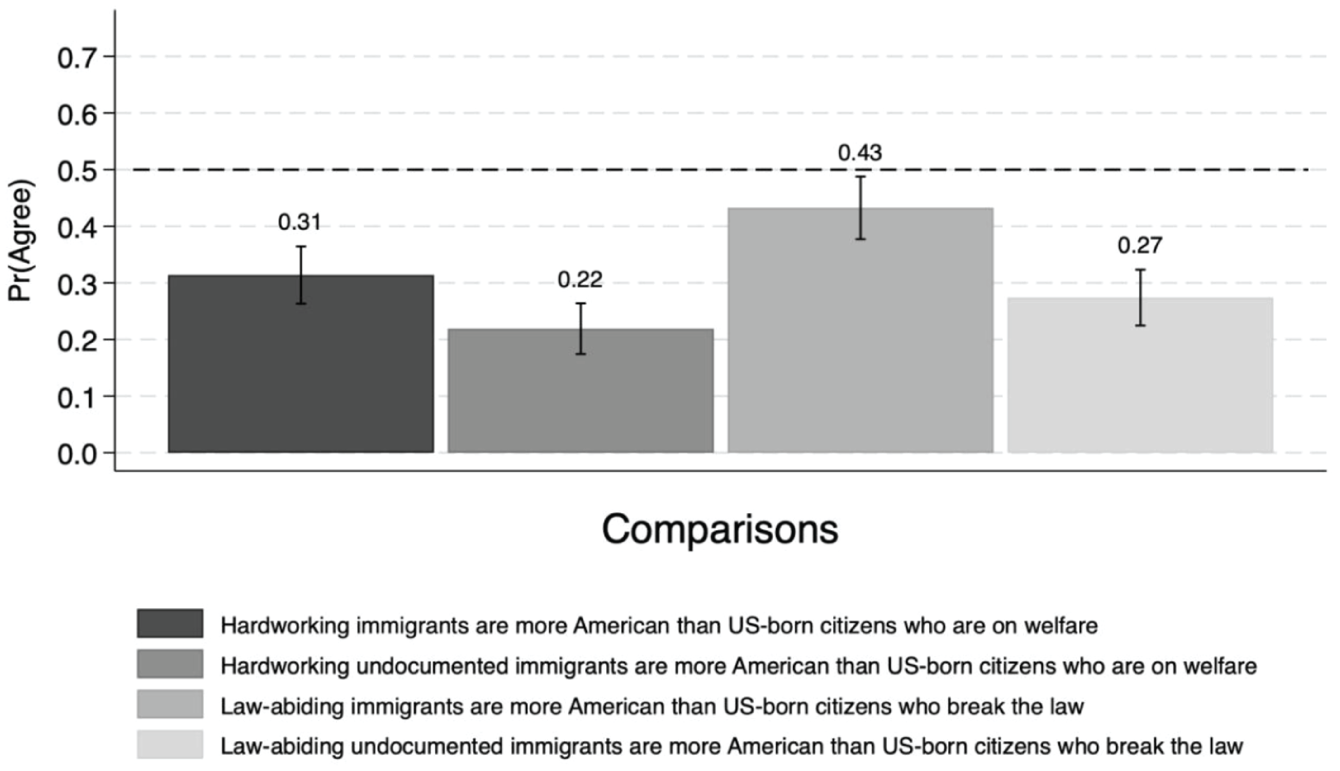
Aggregate agreement that given immigrants are “more American” than native-born citizens.
Support declined sharply once undocumented status was introduced. Only 27 percent agreed that law-abiding undocumented immigrants are more American than lawbreaking citizens, and just 22 percent agreed that hardworking undocumented immigrants outrank welfare-dependent citizens. In both cases, disagreement rose to roughly 45 percent. These patterns indicate that unlawful presence substantially constrains perceived national standing, even when immigrants are described as strongly conforming to civic norms.
Racial Differences in Endorsement of Hierarchical Elevation
Table 2 presents results from bivariate logistic regression models predicting agreement with comparative statements about Americanness. Odds ratios below 1.0 across all three non-Asian groups and all outcomes indicate that Asian respondents are consistently the most likely to agree with hierarchical claims. Figure 2 displays the distribution of responses across all four hierarchical comparison items by racial group, showing the weighted percentage of respondents who agreed, neither agreed nor disagreed, or disagreed with each statement.
Logistic Regression Models Predicting Agreement with Hierarchical Elevation and Categorical Recognition of Americanness.
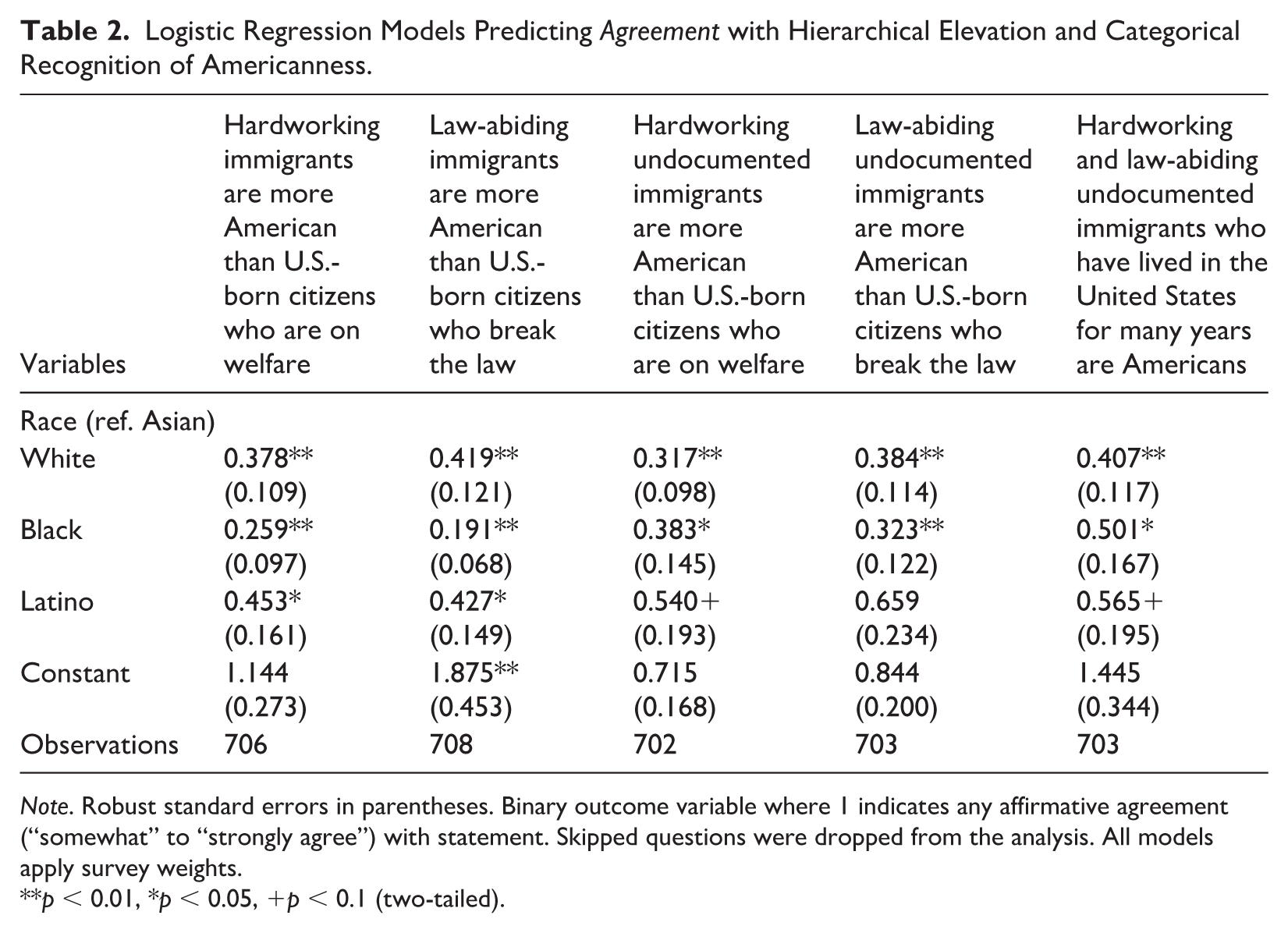
Note. Robust standard errors in parentheses. Binary outcome variable where 1 indicates any affirmative agreement (“somewhat” to “strongly agree”) with statement. Skipped questions were dropped from the analysis. All models apply survey weights.
p < 0.01, *p < 0.05, +p < 0.1 (two-tailed).
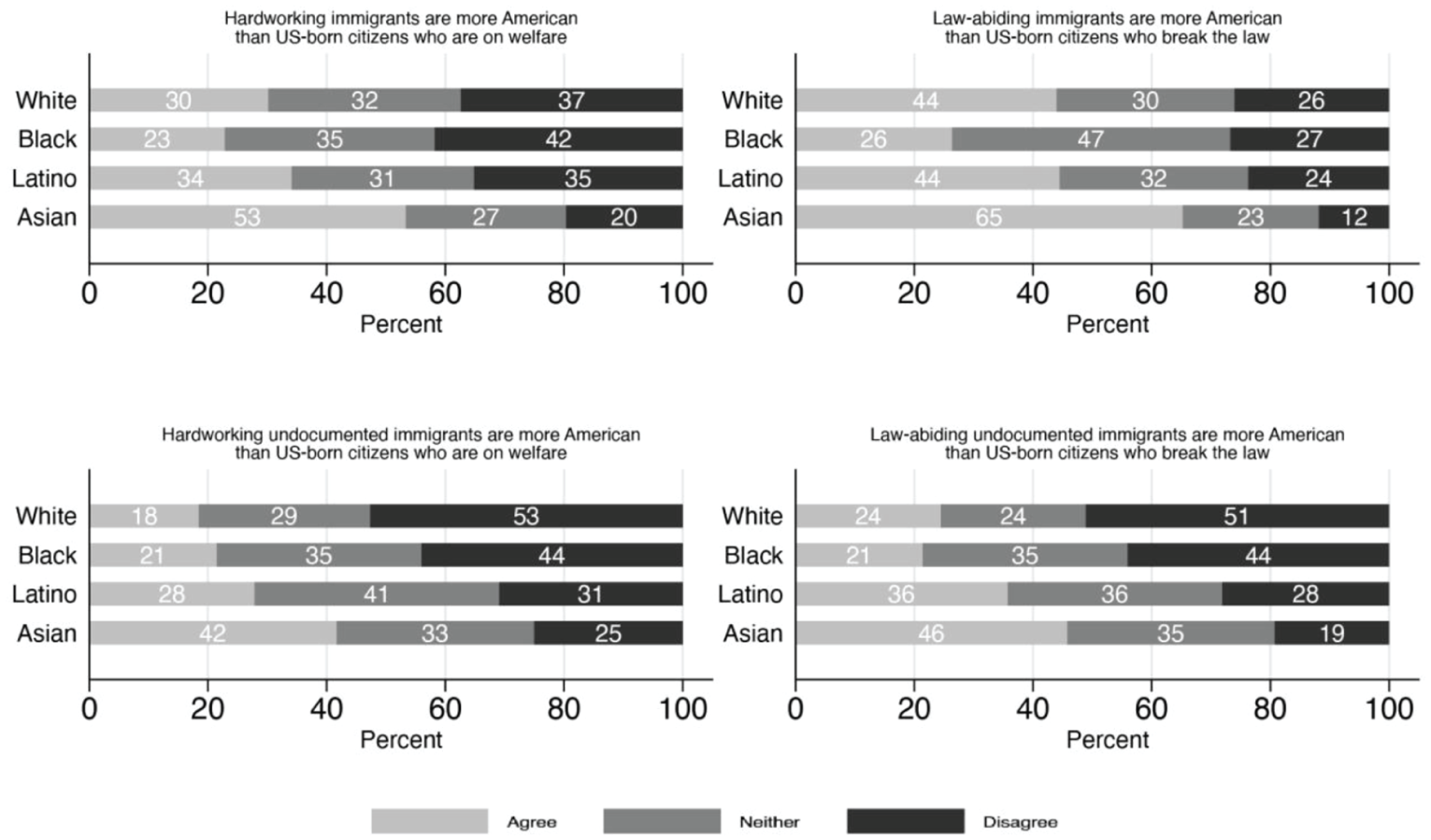
Weighted distribution of responses to comparative items by race.
Beginning with the comparison between hardworking immigrants and welfare-dependent U.S.-born citizens, Asian respondents expressed the highest level of agreement at 53 percent (Figure 2, top-left panel). Latino respondents occupied an intermediate position (34 percent), followed by White (30 percent) and Black respondents (23 percent). Relative to Asian respondents, White respondents had 62 percent lower odds of agreement (p < 0.01), Black respondents had 74 percent lower odds (p < 0.001), and Latino respondents had 55 percent lower odds (p < 0.03).
A similar pattern emerged in the comparison between law-abiding immigrants and U.S.-born citizens who break the law (Figure 2, top-right panel). Asian respondents were most likely to agree (65 percent), with Latino and White respondents at equivalent levels (44 percent) and Black respondents substantially lower (26 percent). White and Latino respondents had roughly 57 percent lower odds of agreement than Asian respondents (p < 0.01), and Black respondents had 81 percent lower odds (p < 0.001).
These findings provide support for Hypotheses 1 and 2. Asian respondents were consistently the most likely to endorse claims that civic virtue elevates immigrants above native-born citizens who violate civic norms, while Black respondents were the least likely to do so. The results also offer partial support for Hypotheses 3 and 4. Latino respondents occupied an intermediate position as expected, though differences relative to White respondents were inconsistent. White respondents were generally less supportive of behavior-based elevation than Latino respondents, except in the law-abiding comparison, where the two groups expressed equivalent levels of agreement.
The Moderating Role of Legal Status
Agreement with hierarchical claims declined across all groups when immigrants were identified as undocumented, but racial differences persisted, and the relative ordering of groups remained largely stable (Figure 2, bottom panels). For the comparison between hardworking undocumented immigrants and welfare-dependent U.S.-born citizens, agreement was 42 percent for Asian respondents, 28 percent for Latinos, 21 percent for Blacks, and 18 percent for Whites. Relative to Asian respondents, White respondents had 68 percent lower odds of agreement (p < 0.001), and Black respondents had 62 percent lower odds (p < 0.01). Latino respondents had 46 percent lower odds of agreement, a substantively meaningful difference that did not reach conventional significance (p = 0.086).
For the comparison involving law-abiding undocumented immigrants and U.S.-born citizens who break the law, agreement was 46 percent for Asians, 36 percent for Latinos, 24 percent for Whites, and 21 percent for Blacks. Both White and Black respondents had significantly lower odds of agreement than Asian respondents (p ≤ 0.003 for both).
The differences between Black and White respondents on the undocumented items were not statistically distinguishable. However, this convergence in overall agreement proportions obscures a meaningful difference in evaluative logic. Black respondents expressed nearly identical levels of agreement regardless of whether immigrants were described as undocumented. White respondents, by contrast, were markedly more responsive to legal status. Agreement on the hardworking comparison dropped by 12 percentage points (from 30 to 18 percent), and on the law-abiding comparison by 20 percentage points (from 44 to 24 percent). This pattern suggests that legal status operates as a more salient evaluative cue for White respondents than for Black respondents, even as both groups express similar levels of resistance to elevating undocumented immigrants above native-born citizens.
Across all four items, disagreement was highest among Black and White respondents, lowest among Asian respondents, and intermediate among Latino respondents (Table 3). These patterns mirror the agreement results: Black and White respondents consistently resist hierarchical claims that elevate immigrants above native-born citizens, whereas Asian respondents are most receptive, and Latino respondents occupy an intermediate position.
Logistic Regression Models Predicting Disagreement with Hierarchical Elevation and Categorical Recognition of Americanness.
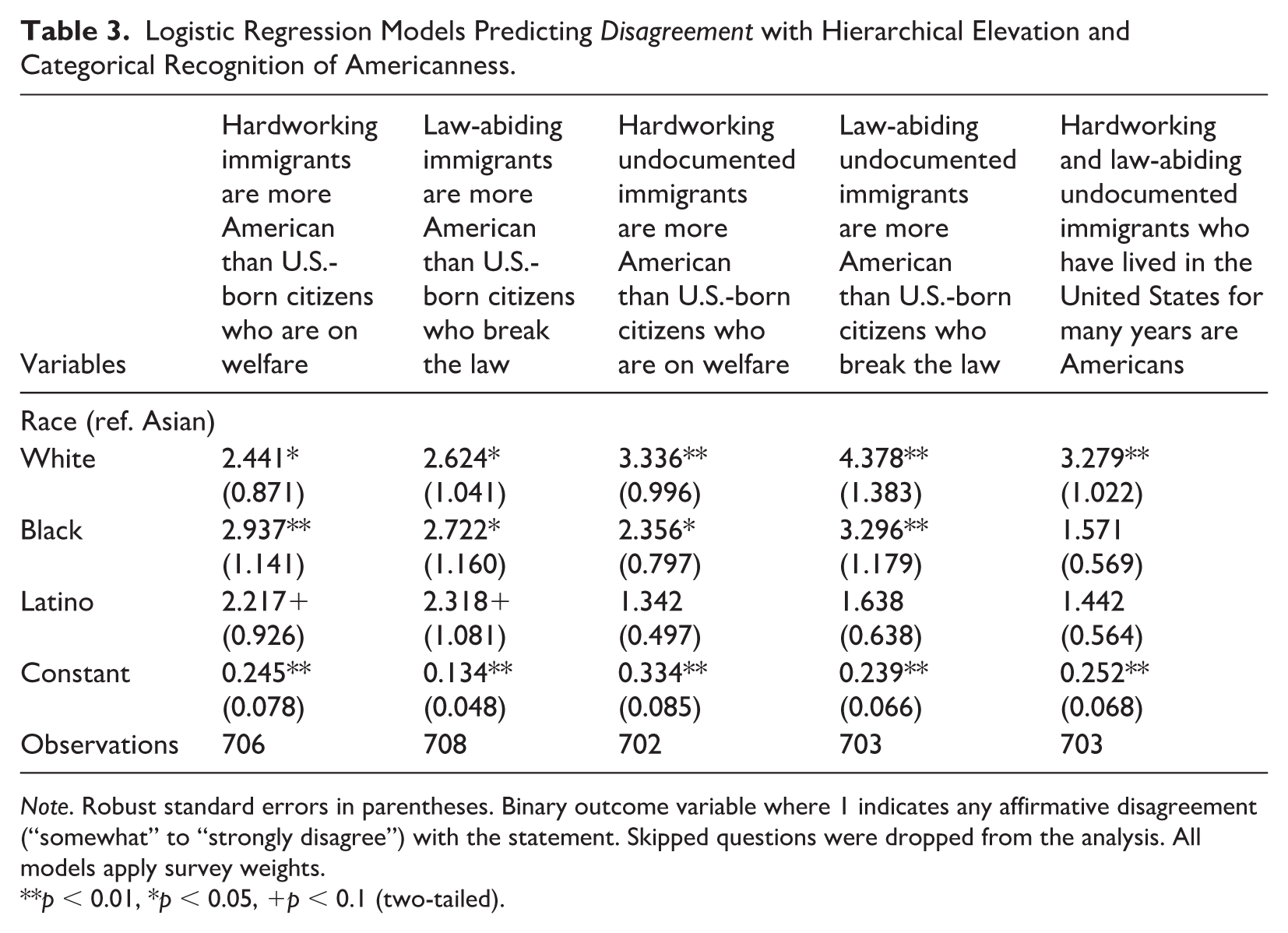
Note. Robust standard errors in parentheses. Binary outcome variable where 1 indicates any affirmative disagreement (“somewhat” to “strongly disagree”) with the statement. Skipped questions were dropped from the analysis. All models apply survey weights.
p < 0.01, *p < 0.05, +p < 0.1 (two-tailed).
Categorical Recognition of Long-Term Undocumented Immigrants
I next turn to categorical recognition, examining whether respondents agree that “Hardworking and law-abiding undocumented immigrants who have lived in the United States for many years are Americans.” This item removes the explicit comparison with U.S.-born citizens and instead asks whether undocumented immigrants are recognized as Americans at all.
Agreement was higher for categorical recognition than for any of the comparative rankings involving undocumented immigrants, with 40 percent of respondents overall agreeing with the claim. Figure 3 displays agreement with the categorical recognition item by racial group. Asian respondents were most likely to agree at 59 percent, followed by Latino (45 percent) and Black respondents (42 percent). White respondents were the least likely to agree (37 percent) and the most likely to disagree (45 percent).
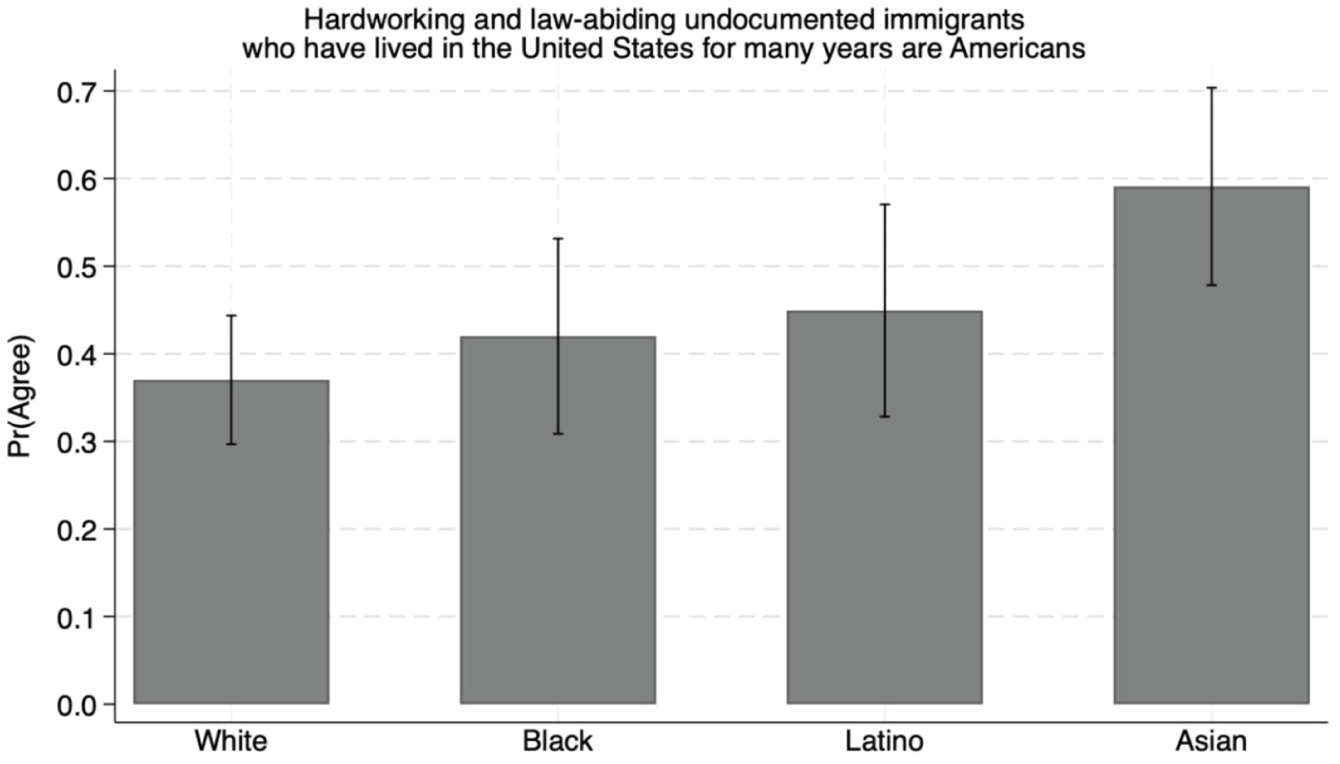
Agreement that long-term undocumented immigrants are “American,” by respondent race.
Two patterns are especially notable. First, Black and White respondents—where only one in five of the former and one in four of the latter endorsed hierarchical elevation of undocumented immigrants—were substantially more willing to endorse categorical recognition when no comparison to native-born citizens was invoked. This pattern is consistent with Hypothesis 5, which predicted that both groups would be more willing to grant categorical recognition than to endorse hierarchical elevation.
Second, contrary to expectations (Hypothesis 6), Asian respondents were most likely to endorse categorical recognition, while Latino respondents occupied an intermediate position similar to Black respondents. This finding suggests that Asian Americans’ civic positioning—where belonging is characteristically conditional on behavioral performance—generates broader receptivity to recognition claims grounded in hard work and law-abidingness, regardless of legal status. The sources of Latino respondents’ more moderate support warrant further investigation, particularly given the cross-pressures produced by simultaneous citizenship security and racialized suspicion.
Robustness to Demographic Controls
To assess whether observed racial differences reflect compositional variation, I estimated supplemental models including controls for immigrant parentage, education, gender, and age. Table 4 shows that racial group coefficients for law-abiding comparisons and categorical recognition remain statistically significant and directionally consistent after adjustment, while coefficients for hardworking comparisons attenuate, though the direction of effects remained consistent. These results suggest that racial differences are not simply artifacts of compositional variation; rather, racial group position itself shapes how individuals adjudicate claims about national standing.
Logistic Regression Models Predicting Agreement with Hierarchical Elevation and Categorical Recognition of Americanness with Controls.
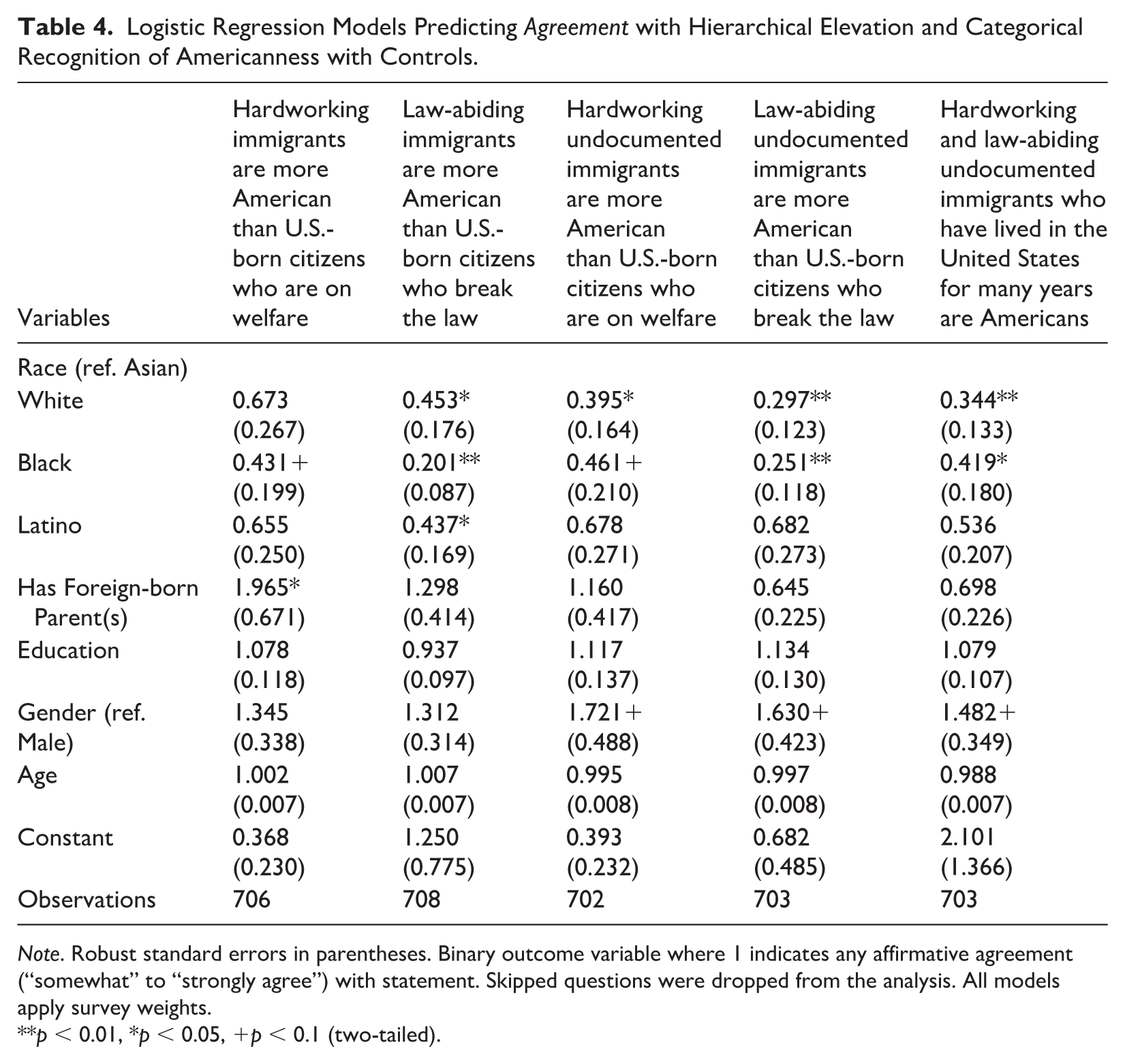
Note. Robust standard errors in parentheses. Binary outcome variable where 1 indicates any affirmative agreement (“somewhat” to “strongly agree”) with statement. Skipped questions were dropped from the analysis. All models apply survey weights.
p < 0.01, *p < 0.05, +p < 0.1 (two-tailed).
Among White and Black respondents, those with at least one immigrant parent (n = 48) expressed somewhat greater openness to civic behavior as a basis of Americanness—particularly for the hardworking comparison—though the subsample is too small to support reliable inferential claims. This pattern suggests that personal proximity to immigrants may shift evaluations of Americanness among groups otherwise resistant to behavior-based hierarchies, a question that warrants further investigation in larger samples.
Partisan Differences among White Respondents
Finally, I examine partisan heterogeneity among White respondents (Table 5). Figure 4 displays the distribution of responses by party identification across all four hierarchical comparison items.
Logistic Regression Models Predicting Agreement with Hierarchical Elevation and Categorical Recognition of Americanness, by Party Identification among White Respondents.
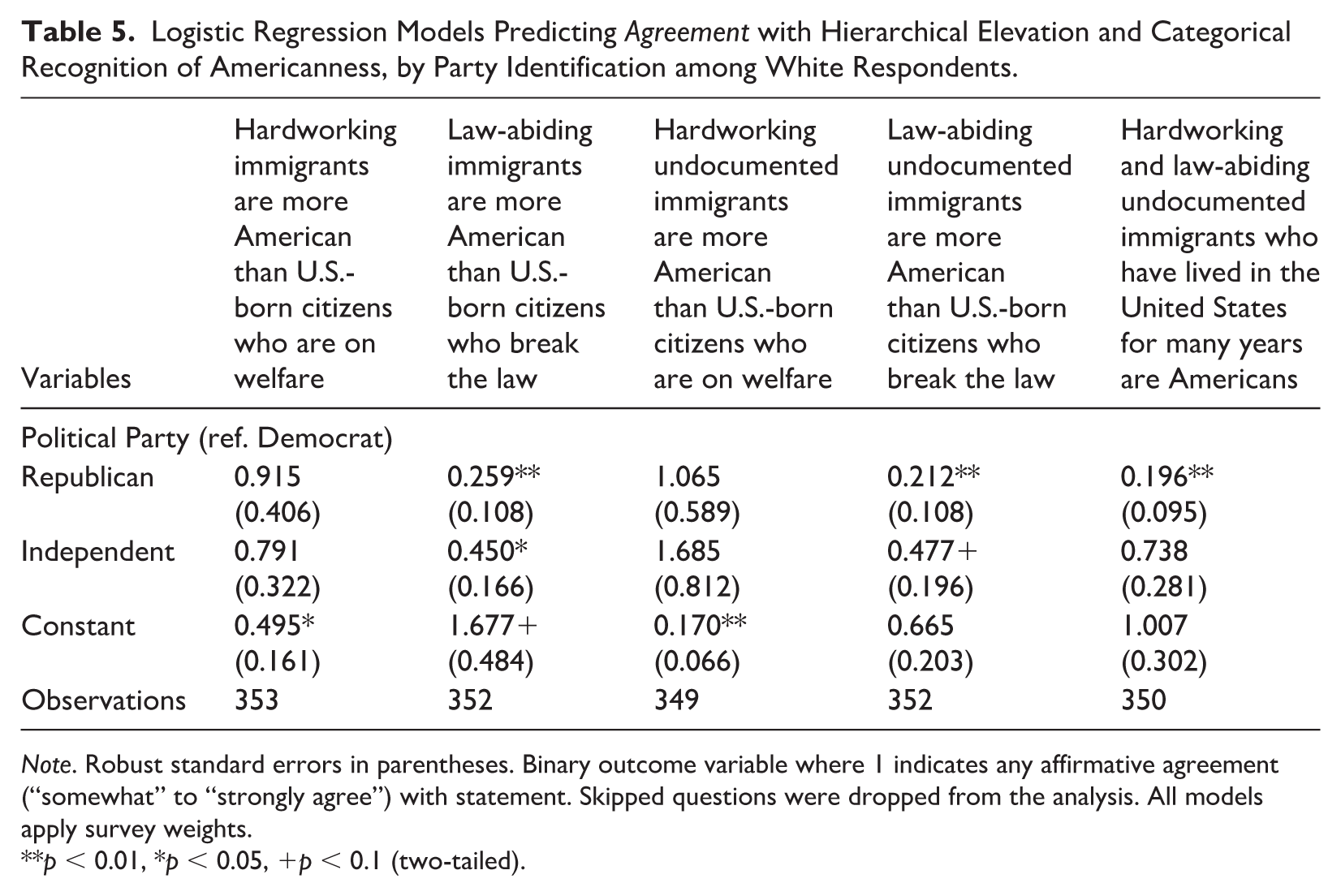
Note. Robust standard errors in parentheses. Binary outcome variable where 1 indicates any affirmative agreement (“somewhat” to “strongly agree”) with statement. Skipped questions were dropped from the analysis. All models apply survey weights.
p < 0.01, *p < 0.05, +p < 0.1 (two-tailed).
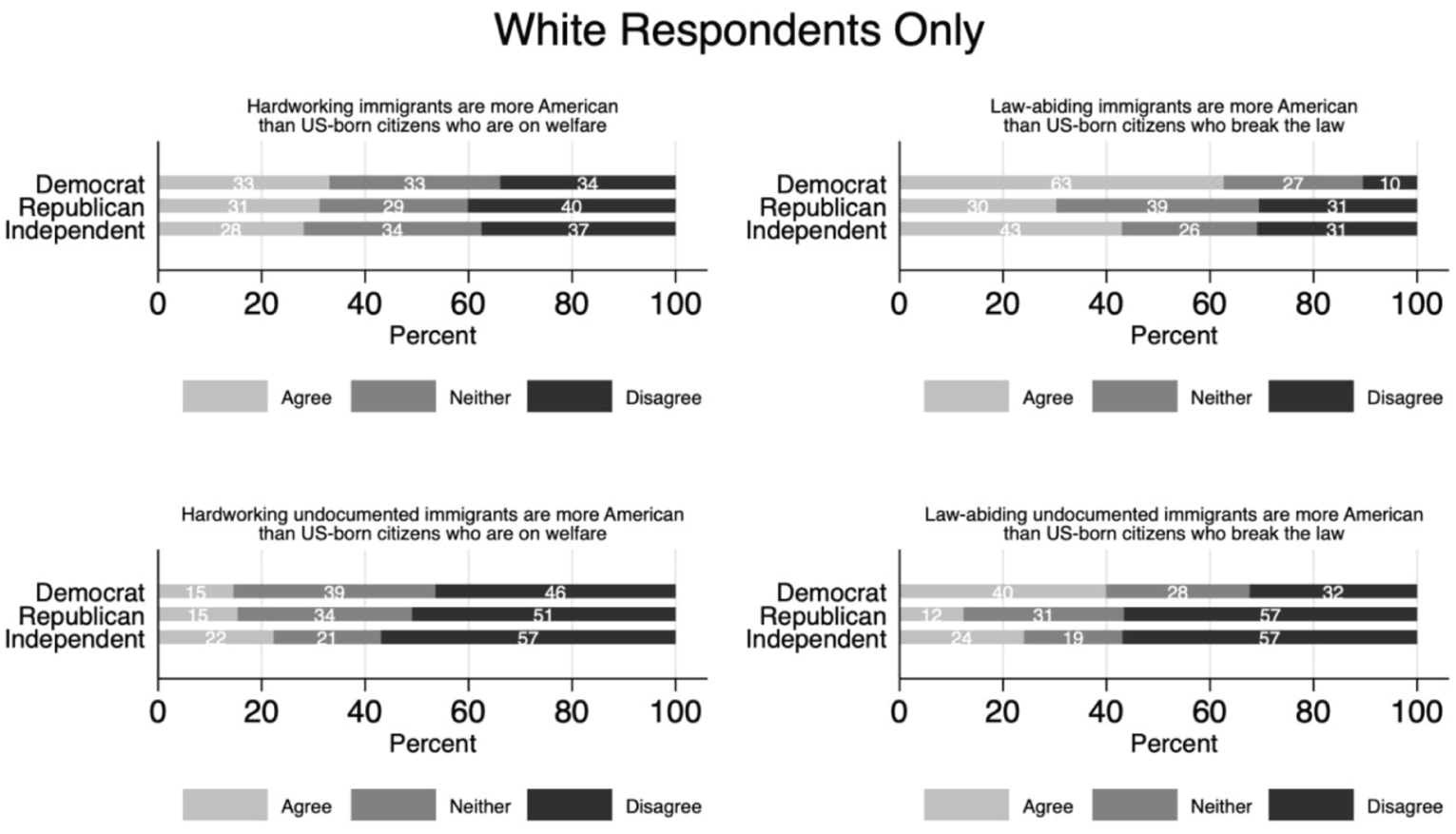
Weighted distribution of responses to comparative items among White respondents by partisanship.
Consistent with Hypothesis 7a, White Democrats were more likely than White Republicans to view law-abiding immigrants as more American than lawbreaking U.S.-born citizens (Figure 4, top right): 63 percent versus 30 percent (p < 0.001). The pattern holds when immigrants are specified as undocumented (Figure 4, bottom right): 40 percent of Democrats versus 12 percent of Republicans (p < 0.002). Although the percentage-point gap narrows slightly (33 to 28 points), the proportional difference increases: Democrats are roughly twice as likely as Republicans to agree in the generalized condition, compared to about three times as likely in the undocumented condition.
By contrast, partisan differences were not evident for the hardworking comparisons (Figure 4, left panels). For the general immigrant comparison, White Democrats and Republicans expressed nearly identical levels of agreement (33 and 31 percent, respectively). Agreement dropped similarly across both groups when immigrants were identified as undocumented (15 percent for both Democrats and Republicans). This pattern indicates that partisan polarization among White respondents is specific to law-abiding behavior rather than economic contribution.
The sharpest partisan divide emerged for categorical recognition (Figure 5). Consistent with Hypothesis 7b, 50 percent of White Democrats agreed that long-term, hardworking, law-abiding undocumented immigrants are Americans, compared to only 17 percent of White Republicans (p < 0.001). Sixty-four percent of White Republicans disagreed, compared to 32 percent of White Democrats (p < 0.004).
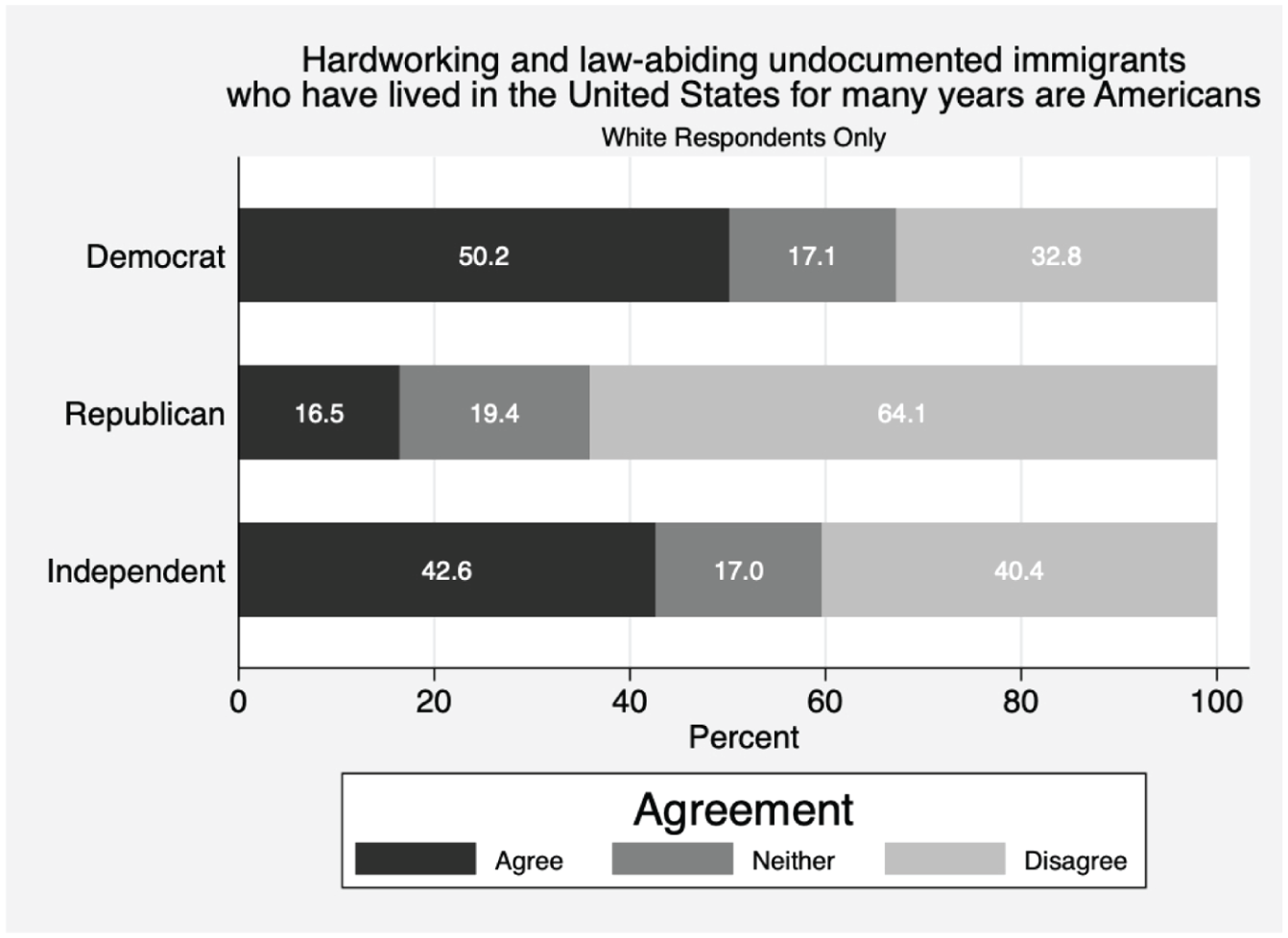
Categorical recognition of undocumented immigrants among White respondents, by partisan identification.
Discussion and Conclusion
This study examined how Americans evaluate competing claims to national standing when civic behavior and birthright citizenship are placed in direct opposition. Rather than asking respondents which traits are important for being “truly American,” the survey design required them to adjudicate explicit comparative claims about relative Americanness. This shift from classificatory definitions to evaluative judgments reveals patterned disagreement not only over inclusion but over the legitimacy of particular hierarchies of national standing.
Three core findings emerge. First, Americans are generally reluctant to endorse claims that elevate immigrants above U.S.-born citizens, even when immigrants are described as hardworking or law-abiding. Second, this reluctance is not uniform: racial groups differ systematically in their willingness to legitimate behavior-based hierarchies of Americanness. Third, opposition toward undocumented immigrants is strongest when civic virtue is used to justify relative elevation rather than categorical inclusion, highlighting the analytic importance of distinguishing recognition from ranking.
Motivated National Identity Construction and Racialized Evaluative Strategies
The racial patterning of responses supports the framework of motivated national identity construction: groups evaluate hierarchical claims about Americanness in ways that reflect their position within racialized status hierarchies.
Asian respondents’ greater openness to behavior-based hierarchies is consistent with prior work characterizing Asian Americans as occupying a position of conditional inclusion. Persistent perceptions of foreignness coexist with relative valorization through stereotypes emphasizing hard work, law-abidingness, and civic conformity (Kim 1999). Within this positional context, civic behavior functions as a plausible and affirming basis for national recognition, including relative elevation. These findings speak directly to questions raised by Tran and Warikoo (2021), who find that Asian Americans are less likely than other racial groups to support a path to citizenship for undocumented immigrants. The divergence is instructive rather than contradictory. Attitudes toward immigration policy and evaluative beliefs about immigrants are distinct: one can recognize a specific immigrant as American without endorsing a legal pathway to citizenship, and vice versa. Moreover, the stimulus matters. Tran and Warikoo’s items invoke undocumented immigrants as an abstract category, which is racially coded in U.S. public discourse as Latino (Chavez 2008; Flores and Schachter 2018). The item used here—hardworking and law-abiding undocumented immigrants who have lived in the United States for many years—loads in behavioral descriptors and temporal residence that may activate a different racial referent for Asian respondents, one closer to their own communities. Finally, agreeing that such immigrants are American, or more American than U.S.-born norm violators, need not reflect support for unauthorized immigration. It may reflect the same racialized evaluative logic the framework describes: Asian respondents affirming a hierarchy of national standing in which civic virtue and long residence confer recognition, in ways that reflect their own group’s positioning. Asian respondents’ particular receptivity to categorical recognition of undocumented immigrants is also empirically significant given the size and growth of the Asian undocumented population—estimated at 1.7 million as of 2022, up from 1.4 million in 2010, even as the overall unauthorized population remained stable (Krogstad and Im 2025)—a finding that takes on added significance given that questions of civic recognition and legal status bear directly on millions of Asian American families.
Black respondents, by contrast, were among the least willing to endorse hierarchies that elevate immigrants above U.S.-born citizens, even while expressing substantial willingness to grant categorical recognition when no comparison was invoked. This pattern suggests that resistance is not directed at immigrants’ inclusion per se, but at evaluative frameworks that predicate Americanness primarily on moralized standards of behavior (Carter 2019). Given the historical use of such standards to justify Black exclusion and devaluation, skepticism toward behavior-based social ranking reflects sensitivity to the symbolic consequences of evaluative criteria rather than opposition to immigrants themselves.
Latino respondents’ intermediate and variable responses reflect cross-pressures produced by their racialized positioning. Although most Latinos are U.S. citizens, they are likely to have foreign-born parents and are frequently racialized as foreign or undocumented. Exposure to these narratives may increase receptivity to civic criteria as a basis for recognition, while secure birthright membership may simultaneously motivate resistance to hierarchies that demote native-born citizens. The resulting heterogeneity underscores that status inconsistency does not produce a single compensatory strategy, but rather conditions the range of evaluative logics that appear legitimate.
Importantly, these racial differences are not reducible to compositional variation in demographics or family immigration history. Supplemental models, including controls for immigrant parentage, education, gender, and age, yield substantively similar results, particularly for the law-abiding comparisons and categorical recognition items. This persistence is consistent with the theoretical expectation that racial group position itself—not simply correlated individual characteristics—shapes how respondents adjudicate claims about national standing. These findings extend research on national identity by showing that groups differ not only in the criteria they endorse but also in their willingness to accept the hierarchical implications of those criteria.
Categorical Recognition versus Hierarchical Elevation
A central contribution of this study is the analytic distinction between categorical recognition and hierarchical elevation. Across racial and partisan groups, respondents were more willing to agree that undocumented immigrants are American than to agree that they are more American than U.S.-born citizens. This distinction is especially pronounced among Black and White respondents.
This pattern indicates that opposition intensifies when civic virtue is used to justify reordering national standing rather than extending membership (Hutchings and Wong 2014). Surveys that focus exclusively on categorical inclusion may therefore overstate consensus around civic definitions of Americanness. When respondents are asked to adjudicate relative status, sharper boundaries emerge, revealing discomfort with the symbolic implications of purely civic criteria.
Methodologically, these results highlight the value of comparative question designs. By having respondents resolve tradeoffs between birthright citizenship and conduct, comparative items surface evaluative commitments that remain latent in standard importance-based measures. They provide leverage on how national standing is actively allocated when symbolic and legal criteria conflict.
Evaluative Cues and Boundary Maintenance
The survey items invoke concepts—immigrant, undocumented, hardworking, law-abiding, welfare, and criminality—that are racially coded in U.S. public discourse (Bonilla-Silva 2010; Gilens 1996; Tesler 2017). Evaluations of these claims are therefore unlikely to reflect abstract tradeoffs between birthright and behavior alone. Instead, they draw on culturally embedded associations that link civic virtue and deviance to particular racial groups, and for non-White respondents in particular, comparative judgments that rank immigrants above U.S.-born citizens may plausibly be interpreted as bearing on their group’s relative standing within the nation (Bobo and Tuan 2006).
The salience of legal status further illustrates how evaluative cues operate differently across groups. White respondents were especially responsive to undocumented status, exhibiting steep declines in agreement once illegality was introduced (H. E. Brown 2013; Jones-Correa and de Graauw 2013). Black respondents’ evaluations, by contrast, were relatively insensitive to legal status. This divergence suggests that legality functions as a particularly salient boundary marker for White respondents, whereas nativity more broadly—not legal status per se—structures how Black respondents evaluate relative national standing.
Within the White population, partisan polarization structured both recognition and elevation judgments (Hajnal 2020; Westwood and Peterson 2022). White Democrats were substantially more willing than White Republicans to endorse categorical recognition of undocumented immigrants and, in some cases, behavior-based elevation. Notably, partisan divergence emerged only in law-abiding comparisons, not in hardworking comparisons. This asymmetry likely reflects the heightened political charge of law-abidingness: Republican discourse has long emphasized “law and order” and framed undocumented immigrants as rule-breakers, making legal compliance a particularly salient and contested criterion among White partisans (Asbury-Kimmel 2023). Work ethic, by contrast, is a more bipartisan value with less clear ideological valence. These differences clarify how partisan conceptions of nationhood translate into acceptance or rejection of the hierarchical implications of civic ideals.
Limitations
Several limitations warrant consideration. Although the survey items were designed to evoke widely circulating public tropes, the study cannot directly assess respondents’ racial inferences or determine whether specific racial exemplars were imagined when evaluating the claims. Future research using experimental designs that manipulate racial cues could more directly test how racial coding shapes evaluations of Americanness (Valentino, Hutchings, and White 2002).
Second, the study treats racial groups as internally coherent categories, but substantial heterogeneity exists within each group. Asian Americans encompass diverse ethnic origins, immigration histories, and socioeconomic positions; Latinos vary by national origin, generation, and legal status; Black Americans include both native-born populations with multigenerational roots and more recent immigrants from Africa and the Caribbean. These within-group differences may shape orientations toward national belonging in ways that aggregate racial categories obscure. Future research should adopt a more intersectional approach, examining how factors such as ethnic subgroup identification, nativity, generation, geography, and class position condition evaluations of Americanness.
Third, this study does not include measures of linked fate, racial group consciousness, or national attachment, which may shape the extent to which individuals draw on group-level positioning when evaluating claims about national belonging. Observed differences may also partly reflect variation in racial and immigration attitudes rather than status inconsistency per se. Future research should incorporate such measures to assess these relationships.
Implications
Despite these limitations, the findings make clear that Americans disagree not only about who belongs to the nation, but also about the principles that should govern relative standing within it. These disagreements are systematic rather than idiosyncratic, shaped by the positions groups occupy in a racialized national order.
Debates over who counts as American are often framed as disagreements over definitions. This study demonstrates that the debates are also disputes over status: who merits recognition, who should be elevated, and which principles may legitimately structure the national hierarchy. These judgments are made from unequal positions within a racialized order, and group responses reflect those asymmetries. The findings are consistent with a framework of motivated national identity construction, in which groups selectively endorse evaluative criteria that sustain their relative standing. By asking respondents to adjudicate tensions between birthright and behavior, the comparative design reveals disagreement not only over membership, but over how rank and recognition are to be assigned.
These dynamics carry direct implications for immigration politics and democratic governance. When racial and partisan groups disagree about which criteria legitimately structure national standing, the result is not merely policy gridlock but a deeper conflict over the symbolic foundations of democratic membership in a multiracial society.
Supplemental Material
sj-docx-1-sre-10.1177_23326492261459090 – Supplemental material for Who is More American? Civic Virtue, Birthright, and Hierarchies of National Standing
Supplemental material, sj-docx-1-sre-10.1177_23326492261459090 for Who is More American? Civic Virtue, Birthright, and Hierarchies of National Standing by Victoria S. Asbury-Kimmel in Sociology of Race and Ethnicity
Footnotes
Acknowledgements
I am grateful to Lawrence D. Bobo, Maria Abascal, Bart Bonikowski, Jeff Goodwin, and the anonymous reviewers for their comments on earlier drafts. All errors remain the author’s own.

Funding
The author received no financial support for the research, authorship, and/or publication of this article.
Declaration of Conflicting Interests
The author declared no potential conflicts of interest with respect to the research, authorship, and/or publication of this article.
Supplemental Material
Supplemental material for this article is available online.
Notes
Author Biography
References
Supplementary Material
Please find the following supplemental material available below.
For Open Access articles published under a Creative Commons License, all supplemental material carries the same license as the article it is associated with.
For non-Open Access articles published, all supplemental material carries a non-exclusive license, and permission requests for re-use of supplemental material or any part of supplemental material shall be sent directly to the copyright owner as specified in the copyright notice associated with the article.
