







Abstract
School choice policies purportedly empower families to select schools for their children and incentivize educational quality. However, these policies yield mixed effects on student achievement and school improvement, which we posit is at least partly due to inequities in factors shaping families’ decision-making processes. We propose an interdisciplinary theory examining the interplay between parental decision-making, choice system features, and enrollment outcomes. Drawing on theory and evidence from economics, psychology, and sociology, we explore how information, constraints, preferences, and social, economic, and cultural capital influence families’ choice system navigation. We also emphasize the importance of parental perspectives regarding schooling, including how families’ values and cultural practices shape their preferences. Lastly, we consider how centralized and decentralized system characteristics—like timing and complexity—shape participation and amplify inequities. Our model provides directions for future research and practical guidance for designing choice systems that reduce barriers and better support all families.
Keywords
Introduction
School choice policies aim to enable families to select the most appropriate schooling for their children (and themselves) and to incentivize schools to improve quality. The agency to select schools runs counter to the conventional policy of default attendance in a child’s publicly funded (i.e., “zoned”) district school. Families’ agency purportedly encourages schools to improve quality as they compete to attract families (e.g., Hoxby, 2003), a primary motivator of choice policies (Friedman, 1955). However, choice policies have had mixed impacts on student outcomes (e.g., Abdulkadiroğlu et al., 2018; Cullen et al., 2005) and school quality (e.g., Egalite & Wolf, 2016). In this paper, we posit that these mixed results could stem from variation in families’ decision-making processes, which influence who participates in choice and in which schools, and often occur within highly complex choice contexts.
We formalize this perspective in an interdisciplinary theory we title the Choice-in-Context Model, in which we conceptualize decision-making within the structural and choice policy contexts families navigate to secure a seat in a school of choice. Existing school choice models either conceptualize choice as a market mechanism (Chubb & Moe, 1990; Friedman, 1955) or draw on theories from economics, sociology, or psychology separately (e.g., Bourdieu, 1986) to conceptualize aspects of choice behavior. In this model, we draw from theory across these disciplines which, when integrated, serve as complementary perspectives in illustrating the interactions between family decision-making and the choice contexts within which it occurs. This strategy mirrors interdisciplinary theory-building in education and development, such as the interdisciplinary theory on early adversity and children’s life chances (Shonkoff et al., 2009; Shonkoff, 2012) and Critical Race Theory (Ladson-Billings & Tate IV, 1995). Together, our model demonstrates how family decision-making, application and enrollment outcomes, and choice contexts interact, informing more equitable choice system design.
The development of this model was motivated by the expansion of school choice, which is becoming increasingly available and broadly used. All states offer at least one form of choice program, providing families with options to enroll in public, charter, and/or private schools. A federal voucher program is set to begin in 2027 (The Big Beautiful Act, 2025). In tandem, district-level centralized systems in large urban centers such as New York City, New Orleans, Washington DC, and Chicago enable families to engage in (and are often required to use) choice and select a school for their children. 1 As these systems and programs have expanded, they now shape school enrollment decisions for hundreds of thousands of children nationwide, raising the significance of ensuring equity in access (e.g., Valant & Zerbino, 2025) and policymaker understanding of the ways families’ decision-making interacts with system design. Inequitable access to choice may replicate existing educational disparities, funneling resources toward already-advantaged families and shaping enrollment patterns in unintended ways.
Our theory of decision-making in choice contexts is intended to open the black box of the processes by which school choice and its systems affect families’ enrollment outcomes, and the variation in parental behavior in response to choice across families. For school choice policies to succeed, as currently implemented, several assumptions about parents’ behavior must be met: families wanting to choose their children’s schools and having the ability to make the best decisions in their choice contexts. However, information (e.g., Corcoran & Jennings, 2020), constraints (e.g., Bell, 2009b), and preferences (Abdulkadiroğlu et al., 2018; Ainsworth et al., 2023) vary across families of different socioeconomic backgrounds. Families also hold different levels of social (e.g., Bader et al., 2019; Fong, 2019), cultural (e.g., Lareau et al., 2016; Roda & Wells, 2013), and economic capital (e.g., Lenhoff et al., 2022; Valant & Walker, 2024) that influence the degree to which they can navigate choice processes effectively. Moreover, system features and idiosyncrasies likely impact parents’ ability to participate in a system and navigate it successfully (e.g., Fong & Faude, 2018; Kapor et al., 2020). Current theories do not permit a comprehensive understanding of decision-making over time that simultaneously consider parent- and system-level factors, nor articulate their interplay in ways that allow for choice system design that benefit the most marginalized. Moreover, no theory (that we are aware) explicitly considers how the interaction between contexts of choice and decision-making may systematically lead to unequal or socially undesirable enrollment outcomes.
An interdisciplinary theory can enhance our understanding of decision-making in school choice contexts and aid policymakers in designing systems effectively. Cross-disciplinary perspectives allow us to consider the foundational components of decision-making and the core linkages between them, and to contextualize these linkages to stages of the choice process. Our theory aims to shed light on how choice contexts, and the characteristics and complexities of the application systems within them, might exacerbate inequities. We consider parents’ decision-making both when completing and submitting applications in choice markets (i.e., the systems where families can choose and apply to schools) and when navigating waitlists in aftermarkets (i.e., secondary markets after seats are offered). By examining decisions at multiple stages of the process, we are able to elucidate the pathways to both application and enrollment decisions.
The Choice-in-Context Model integrates economic, sociological, and psychological perspectives on decision-making to outline how system design and family resources jointly shape application and enrollment pathways (Figure 1). Across disciplines, we draw on empirical research focused on choice, decision-making, and parenting to build a theory that integrates and extends upon evidence, incorporating findings in choice settings to inform the theory’s structure and expectations. Our final model is depicted in Figure 1. Our paper is organized as follows:
In Section I, we outline the history and purpose of school choice to illustrate the circumstances under which choice was established and developed in the country and its aims. We also briefly describe the types of choice programs and systems available today.
In Section II, we discuss how the consumer choice framework (augmented by behavioral economics) aids in our understanding of choice decision-making, considering the roles of constraints, preferences, and information.
In Section III, we highlight how the interaction between families and institutions influences these factors by considering families’ preferences for children’s socialization, and incorporating the cultural, economic, and social capital that families leverage.
In Section IV, we examine how decision-making differs in choice markets and aftermarkets considering the influence of assignment mechanisms.
In Section V, we articulate a set of theoretical propositions derived from the model.
In Section VI, we review and discuss the primary implications of the model.
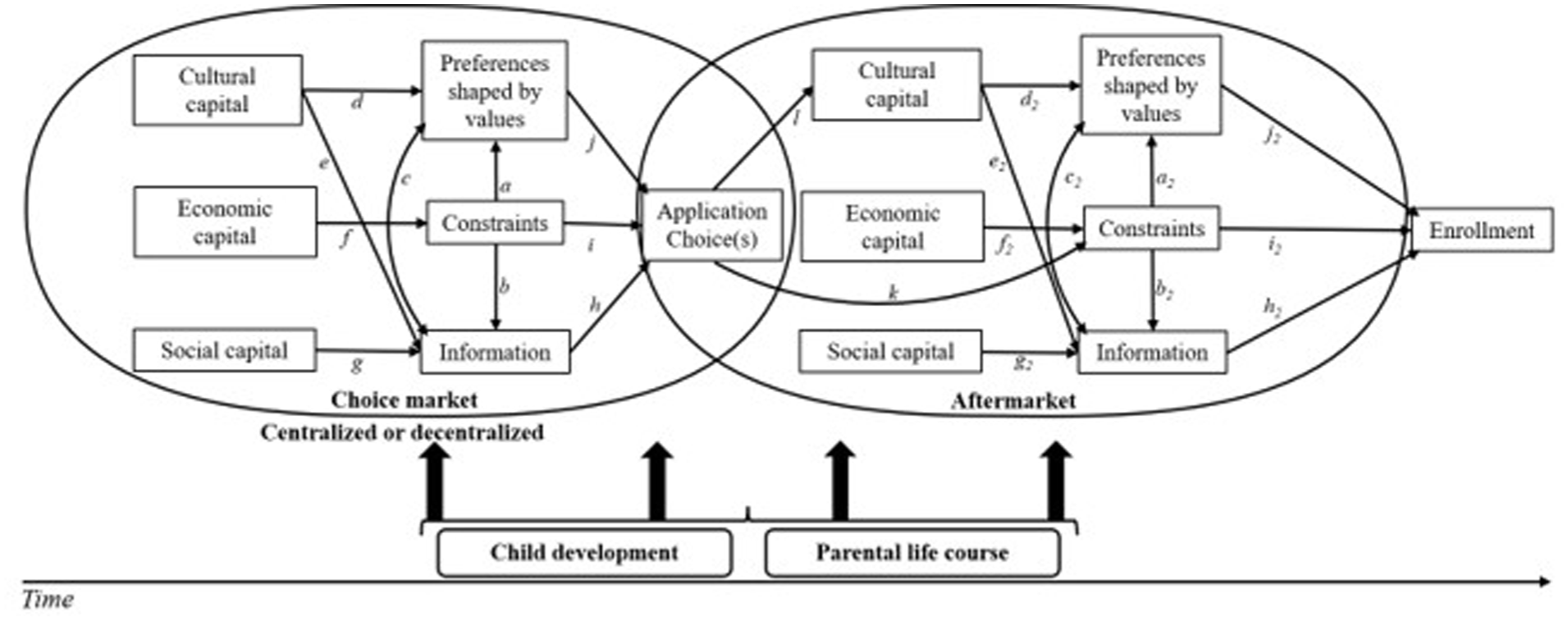
A structural representation of the Choice-in-context model.
The History and Purpose of School Choice
Fundamentally, choice policies intend to decouple children’s educational opportunities from those of their residential neighborhoods by providing equitable access to quality education regardless of where a family lives. School finance policy in the United States can be understood in its most basic form by the Tiebout (1956) model—in principle, families choose the quality of the local goods in their neighborhoods when choosing where to live. As school districts are funded by property taxes, families “choose” the quality of their children’s schools by choosing where they live. Although this model does not account for local and state policies and regulations, it shows that low-income families are systematically unable to access well-resourced schools without governmental regulation and policy intervention—with implications for their long-term academic and labor outcomes (Chetty et al., 2016, 2020). Local school funding policy detracts agency from those priced out of choosing where to live based on their preferences and needs (DeLuca et al., 2024; Rhodes & DeLuca, 2014), the very agency choice policies aim to provide.
School choice policies were initially established to address two issues, sometimes simultaneously: declines in student achievement and longstanding school racial segregation in the post-war period. During the latter half of the 20th century, education systems underwent drastic changes (Rury, 2012), largely due to demographic and sociocultural shifts such as the “White Flight” phenomenon (Boustan, 2010; Frey, 1979). Brown v. Board of Education mandated the end of racial segregation in schools in 1954, leading to shifts in education policy. In turn, many schools saw changes in enrollment as higher-income families left neighborhoods with integrated schools (e.g., Boustan, 2012)—often negatively impacting urban school funding. As such, families who could afford to leave under-resourced schools would do so, cyclically expanding inequities. By the 1980s, concerns over declines in student achievement and teaching quality (NCEE, 1983) shifted schooling’s focus to build competitive human capital to supply the economy. Thereafter, many cities established choice systems to incentivize competition by increasing accountability, motivated by economic theory (Friedman, 1955). Some cities adopted centralized systems, which used controlled student assignments to uphold desegregation mandates (e.g., Alves & Willie, 1987) while others implemented decentralized systems, which expanded options for families with voucher and charter school policies.
Today, school choice policies serve multiple—and often competing—aims.
Choice is often conceptualized as a mechanism to improve overall student achievement, individual student–school matches, and, in tandem, educational equity—for instance, by providing disadvantaged families in underperforming schools access to higher-quality educational options. Choice is expected to improve student outcomes by (1) increasing the access and supply of high-quality schooling institutions induced by competition between schools (Egalite, 2013; Neilson, 2021), and (2) better matches between students and schools (Hoxby, 2003). However, studies examining choice policies yield mixed results: on average, school competition has very small but positive impacts on student achievement in urban settings, but there is significant variation across contexts (Belfield & Levin, 2002; Betts & Tang, 2018; Jabbar et al., 2022). Furthermore, despite some school choice policies finding relative success in raising student achievement, these programs often lead to increased racial segregation in choice schools (e.g., Frankenberg et al., 2010; Ready & Reid, 2022; Roda & Wells, 2013).
In contrast, contemporary policy discourse increasingly frames choice as a means to increase families’ control of their children’s education rather than academic quality. Federal and state policymakers (Executive Order [EO] 8853, 2025; EO 8859, 2025), alongside families nationwide (e.g., Binder & Wood, 2012; Tyton Partners, 2022), argue for increasing families’ ability to determine what students learn.
As such, the expansion of choice has largely proceeded without centering the families for whom access is most constrained (Jabbar et al., 2025). A system shaped by racial segregation, disparities in school funding, and historically racialized school district boundaries jointly constrains who can access and benefit from choice (Baker & Corcoran, 2012; Chetty et al., 2020b). As policymakers move from a market-based, quality-focused motivation to one that prioritizes the desires of the families most likely to engage, policy design may increasingly cater to a select group—funneling additional resources toward already-advantaged families and exacerbating existing inequities in resource access. Because funding in many contexts follows students, these dynamics can also reduce resources in public schools serving students least able to exercise choice. While school choice holds promise in increasing access to educational opportunity, designing choice without the consideration of vulnerable families’ experiences, and the systems that bind them, risks exacerbating existing inequalities.
The Many Shapes of School Choice
School choice policies fall into two broad categories: providing families with financial resources to use in the private market, or expanding families’ options within the public market. In the former, parents are provided with school vouchers, education savings accounts (ESAs), and educational tax credits they can use for private schools. In the latter, parents can choose to enroll their children in any inter- or intra-district school, charter, and magnet schools (or provide homeschooling), which typically have individual application and enrollment processes. In most of these cases, families can enroll their child in their zoned district school or a different “choice” school (which can be a public or charter school). However, there are exceptions—for instance, New York City’s system requires families to apply at each schooling level (i.e., preschool, elementary, middle, and high schools) 2 and consolidates public and charter high school applications (Abdulkadiroğlu, Agarwal. et al., 2017).
Whether systems are centralized or decentralized determines school choice policies’ most basic architecture: the mechanisms through which families exert choice. Centralized systems often streamline the application process but limit flexibility for families. Families submit an individual application which typically includes demographic information and school rankings by a deadline. All submitted rankings are then used to assign students to schools based on matching algorithms, which may give preference or priority to some groups over others depending on policymaker objectives (Abdulkadiroğlu & Andersson, 2022; Pathak, 2011). Families accept their offers and/or add themselves to waitlists for schools they prefer, and eventually finalize their enrollment. Conversely, decentralized systems offer more autonomy to families, who may apply to receive a voucher and determine eligibility or claim a tax credit, and typically must submit applications to each individual school in which they are interested (and whose deadlines and admissions decisions might differ)—requiring the navigation of multiple applications and deadlines. Families traverse centralized or (sometimes and) decentralized systems to access choice schools, systems that may influence families’ decision-making and their ability to exert choice appropriately.
Consumer Choice Framework Augmented by Behavioral Economics
The consumer choice framework, a core foundation in traditional economic models, is foundational to our Choice-in-Context Model. This framework models consumers’ choices considering their preferences and constraints (Mankiw, 2012). Consumers weigh preferences (e.g., quality) and constraints (e.g., income and time) with market information (e.g., prices) to make a utility-maximizing choice. In education markets, families engage in decision-making to select a school, balancing preferences and constraints to maximize their utility from education.
This economic framework is useful in that it identifies factors that families consider when making school choices, despite its assumptions that they are perfectly rational, have full market information, and have static, ordinal preferences bounded by constraints. These assumptions often do not hold in practice, and economic theory has tried to address these limitations (see Akerlof, 1970; Löfgren et al., 2002; Simon, 1955) via behavioral economics (Thaler, 2016). Behavioral economists assume that decision-makers have bounded rationality, so instead of optimizing constraints and preferences they aim to “satisfice”—that is, satisfy a level of utility that is “good enough” (e.g., Kahneman, 2003). As a result, choices are shaped by cognitive biases and heuristics, particularly in complex decision environments (Tversky & Kahneman, 1974), a pattern documented in several educational contexts (e.g., Gennetian et al., 2016; Jabbar, 2011; Jabbar & Lenhoff, 2020; Mayer et al., 2020).
In our model, we incorporate bounded rationality to examine how decision-making limitations interact with the design of choice systems. Behavioral economics shows that the structure of the decision environment (“choice architecture”) influences how individuals evaluate options (Thaler et al., 2013). For example, when decision contexts contain many alternatives or complex procedures, individuals may experience choice overload, which can lead to decision deferral, regret, or switching behavior (Chernev et al., 2015; Iyengar & Lepper, 2000).
Having articulated upon how individuals make decisions, we now turn to focus on the ingredients of this process in our model: preferences, constraints, and information (Figure 2).
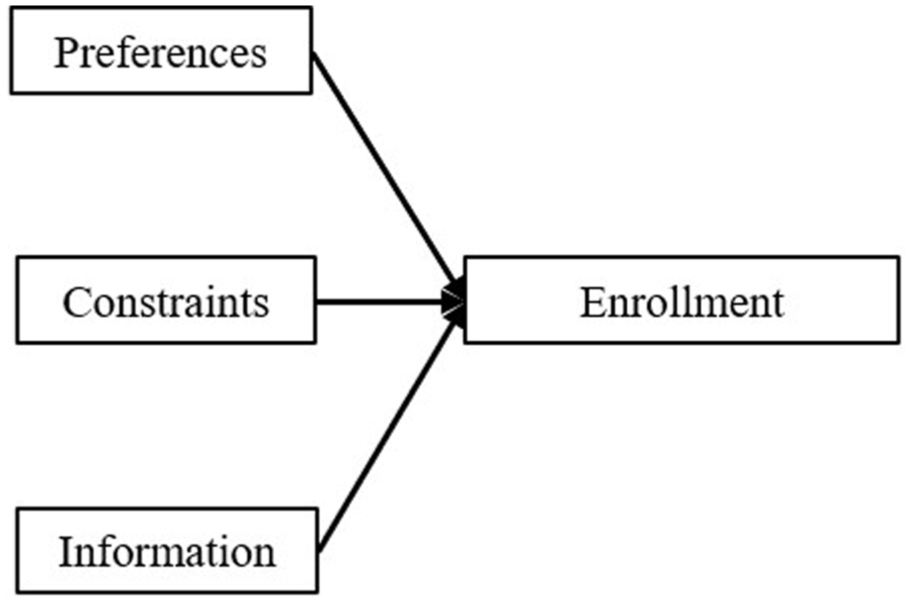
Simplified economic model of parental choice.
Preferences
Families have preferences regarding the schools they want their children to attend, which determine the schools to which they apply and how they rank them against other preferable options. In this model, we define “preferences” as the observable school characteristics that families seek that allow them to differentiate school options and identify those which they favor (as defined in economic models). In choice contexts, parents identify the schools they prefer; the way in which they apply differs depending on the centralization of the system. In centralized systems, families rank schools in order preference. In decentralized systems, families apply to schools separately, not indicating their level of preference for each.
There is little consensus regarding what families seek and prefer in schools. Parental variation in preferences for a variety of school characteristics (e.g., Ainsworth et al., 2023; Bell, 2007; Hailey, 2022) makes it difficult to determine whether, and the degree to which, families value the school–child match and academic quality of that choice. Some research suggests that families who participate in choice programs apply to schools with high academic quality (D. J. Fleming et al., 2015; Schneider et al., 2002), others for quality levels that align with the ability of their child (Chakrabarti, 2013), while others choose schools based on features like student body diversity (Schneider & Buckley, 2002) and racial-ethnic composition (Chin, 2022). Many of these preferences differ across ethnic-racial groups (Bell, 2009a; Saporito & Lareau, 1999; Schneider et al., 2002) and choice policy contexts (e.g., Bifulco & Ladd, 2007; Frankenberg et al., 2010; Singer & Lenhoff, 2022). Of course, families’ choices are also confined by constraints, which we will address in the “Constraints” section below.
Importantly, parents can also choose not to participate in a choice system when such an opportunity is offered. Despite extensive research on the determinants of choice participation, comparatively little empirical work has examined why families remain in their local schools. Some research suggests that families from low-income and ethnic-racial minority backgrounds stay as an expression of loyalty, cultural fit, or community ties (Cooper, 2005, 2007; Posey-Maddox et al., 2016). Remaining can then represent an active choice shaped by families’ values, or reflect passive decision-making driven by status quo or default biases (S. M. Fleming et al., 2010; Johnson & Goldstein, 2003; Madrian & Shea, 2001; Samuelson & Zeckhauser, 1988). Families may prefer their current school due to familiarity or loss aversion, or adhere to default options because choosing alternatives requires time and cognitive effort. When households face competing demands on their attention and resources, staying in the default school may simply be the path of least resistance (Mullainathan & Shafir, 2013).
Constraints
Many constraints can influence families’ decision-making by limiting their choice sets, with important consequences to the equity of access to desirable schooling options. We posit that families juggle both contextual- and household-level constraints that might influence their decision-making. Contextual constraints are those typically associated with geography: families’ residential and neighborhood locations determine the economic and social resources available to them, such as transportation options and school availability (Bierbaum et al., 2021; Chyn & Katz, 2021; Evans, 2004). Place thus determines the schools that families can consider (e.g., Denice & Gross, 2016). Furthermore, household constraints, such as families’ socioeconomic status, work schedules, and time to engage in choice systems, also influence decision-making. These factors may further shrink the size of families’ choice sets by determining the schools families find affordable (Cheng et al., 2016) and those that are convenient, given time and resource constraints (Chaudry et al., 2010; D. J. Fleming et al., 2015).
Importantly, context- and household-level constraints are interrelated: socioeconomic status, which largely determines the amount of financial and time-related resources families can devote toward education, also determines their residential location. A family benefits from the availability of desirable schooling options with accessible transportation services in their neighborhood (e.g., Bell, 2007, 2009b; Trajkovski et al., 2021). However, families from disadvantaged backgrounds typically live in neighborhoods with fewer accessible high-quality schooling and transportation options (Evans, 2004; Leventhal & Brooks-Gunn, 2000). Families from disadvantaged backgrounds are more likely to have inflexible and/or unpredictable work schedules (Ananat & Gassman-Pines, 2021) that could impact their ability to transport their children to schools, and thus further constrain their choice sets (Bierbaum et al., 2021).
The weight of constraints at the context and household levels in the decision-making process can vary across other factors, like child age. The importance of geographic constraints (i.e., distance between home and school) lowers as students age and gain independence. Research finds distance to schools is especially important in preschool (e.g., McCormick et al., 2023), but becomes less critical by secondary schooling (Corcoran, 2018). Time-related constraints may interact with geographic constraints, affecting families from disadvantaged backgrounds who tend to experience inflexible and unstable work schedules which limit their ability to get their children to/from school (Chaudry et al., 2011; Sandstrom & Chaudry, 2012).
Information
Information is crucial for families to know to participate in choice programs or systems, assess their options and make decisions about where to apply, navigate the choice process, and, ultimately, choose where their children will attend school (Corcoran & Jennings, 2020).
The factors that influence parents’ access to, and use of, information regarding choice contexts and options are associated with their socioeconomic advantage. In general, disadvantaged families have a more difficult time learning about and engaging with institutional systems (Keller & McDade, 2000; Moynihan et al., 2015), and less access to physical and social resources to do so. These families also have disparate access to technology or well-informed social networks (Fong, 2019), and may hesitate or struggle to seek additional information regarding school options and resources due to fear of judgement (Kim & Bianco, 2014) and language barriers (Balu et al., 2021). These factors likely influence families’ participation in choice and use of information throughout the choice process.
Little research has explicitly focused on the information to which families are privy prior to participating in choice systems. Instead, an extensive body of research investigates parental characteristics that are not strictly indicative of increased use of information, but that may represent increased access to information by virtue of experience about the system or more knowledge of options. Parents’ higher educational attainment (Bifulco & Ladd, 2006; Ladd et al., 2017) and more advantaged socioeconomic status (Lavery & Carlson, 2015), alongside higher student achievement (Cullen et al., 2005) are associated with increased participation in choice systems. These findings could be attributed to more advantaged groups’ (i.e., those with more education and higher socioeconomic status) tendency to have more and better knowledge regarding their education systems (Howell, 2006). Notably, however, information about the system or program alone is not sufficient to encourage participation—assistance through mentoring and counseling, one-on-one application support, or behavioral nudges may be needed (Herbaut & Geven, 2020; Weixler et al., 2020).
Parents may also need to be aware of school options to participate in—and exercise—choice, emphasizing the importance of the information they hold about their educational market (Corcoran & Jennings, 2020). Informational barriers regarding existing options have shown to influence whether parents participate in a choice process for early childhood schooling (e.g., Balu et al., 2021) and college (Bettinger et al., 2012; Carrell & Sacerdote, 2017). Experimental evidence, in tandem, shows that access to information about school options leads to improved application and/or educational outcomes. Interventions have led to increases in number of applicants to higher-performing schools by providing clear information regarding quality of options based on test scores (Cohodes et al., 2025; Hastings & Weinstein, 2008).
The Connections Between Preferences, Information, and Constraints
In our Choice-in-Context model, we posit that families’ preferences, constraints, and information influence one another in the decision-making process, as shown in Figure 3.
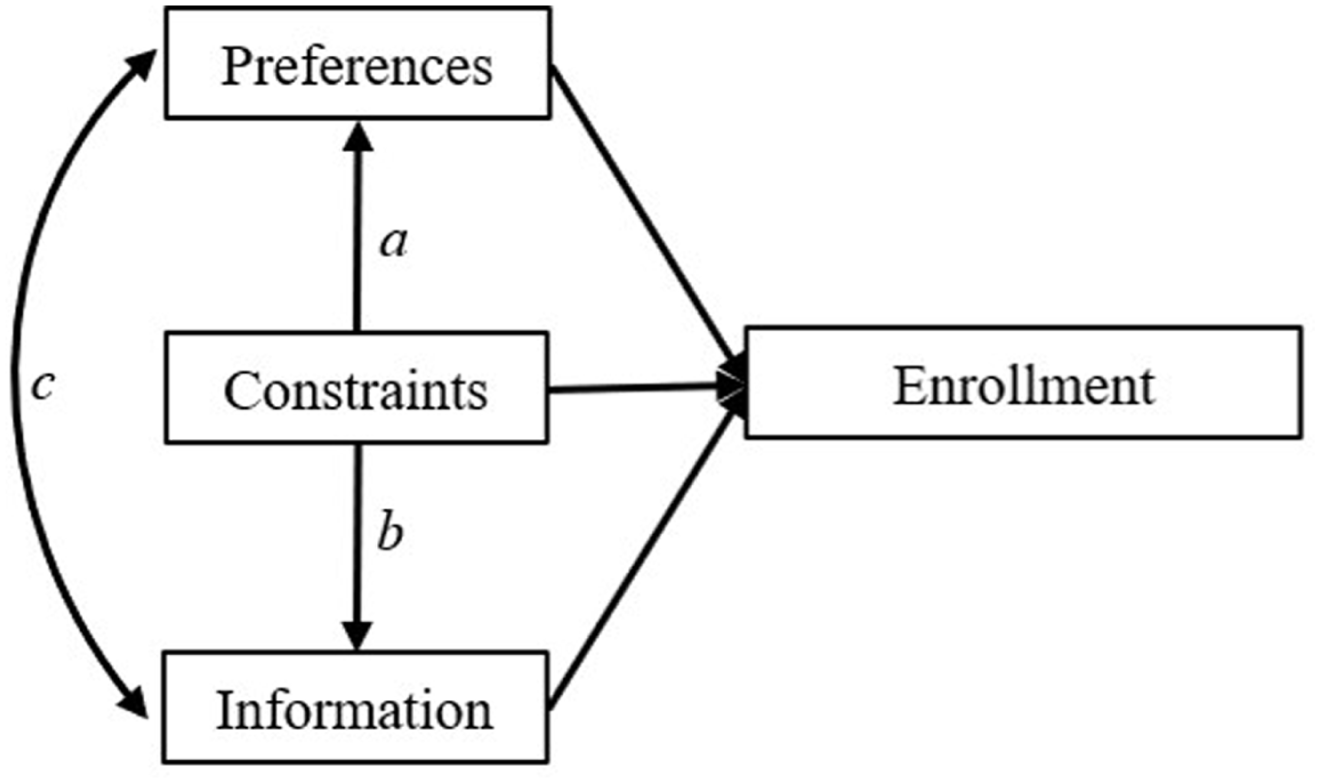
Interconnected components in the economic model of parental choice.
Constraints influence families’ preferences (Path A) and the information (Path B) they use throughout the decision-making process. Constraints can explicitly change preferences (Path A), as they are associated with consumers’ identities (Akerlof & Kranton, 2000), which are notably salient in educational choice (Akerlof & Kranton, 2002) and can impair the reasoning behind decision-making by altering preference order (Tversky & Kahneman, 1974). In addition, families’ choice sets are typically bounded by schools they can access—for example, based on location, provision of special education, or dual language programming (e.g., Bell, 2009a; Lenhoff et al., 2022; Saporito & Lareau, 1999)—and so the schools that are feasible may not directly align with their true preferences. Constraints influence the information to which families have access and their ability to gather it throughout the decision-making process (Path B). The neighborhoods where families live shape the information to which they have access, as they often rely on social networks to gather it (e.g., Bader et al., 2019; D. J. Fleming et al., 2015; Fong, 2019). Constraints in time and resources can also decrease the time and effort that families can spend in information-seeking altogether.
Families’ preferences and information are also interconnected (Path C). The information families seek is likely related to their preferences—if families prefer schools with high student achievement, they are likely to seek information regarding quality metrics for schools in their educational market (Schneider & Buckley, 2002). Relatedly, when families are provided with useful and concise information regarding schooling options, their preferences, as measured using application behaviors, can shift (Cohodes et al., 2025; Hastings & Weinstein, 2008).
Adapting the Consumer Choice Framework to Consider Parent–Institution Interactions
Although a model considering preferences, information, and constraints can explain many aspects of the decision-making process, it overlooks the interplay between parents and institutions. To address this, we incorporate how parents perceive schools not only as educational institutions, but as places in which children learn, co-exist among their school community, and are socialized within a school culture. This perspective emphasizes the need to expand the preferences parents hold to also include schools’ values and cultures and their match with those the family holds or desires (Ball, 2003). We rely on sociocultural and ecological theories (e.g., Rogoff, 2003; Vélez-Agosto et al., 2017) to incorporate this perspective into the model and consider how parents leverage accumulated capital, derived from their (or those of others’) experiences within institutions. Ultimately, sociological theory and evidence (e.g., Bourdieu, 1986; Ball, 2003; Lareau & Weininger, 2003) improve this model by allowing us to consider how parents’ relationships with schools, and the broader school system, shapes their decision-making.
Schools as Places: Extending Preferences to Include Values
Although culture is typically seen as a macro-level dimension in systems theory (Bronfenbrenner & Morris, 2006), we rely on Velez-Agosto and colleagues’ (2017) conceptualization of the ecological model which embeds culture within all environments that influence a child’s development, including schools. This lens enables us to conceptualize choice as a process through which families identify, interpret, and select among the distinct cultural environments that schools offer. We recognize the cultural practices of children’s teachers and peers within school settings as highly influential factors in families’ decision-making. We use Rogoff’s (2003) definition of cultural practices in the context of human development. Rogoff views cultural practices as the tacit and subtle ways of doing and events in everyday human activities that are collectively coherent with one another and continue to evolve due to their mutually-constituting nature—“where people contribute to the creation of cultural processes and cultural processes contribute to the creation of people” (Rogoff, 2003, p. 51). To integrate cultural practices’ role, we draw from the psychological (e.g., Hughes et al., 2006) and sociology of education literatures (e.g., Anyon, 1980; Ball, 2003) on parents’ socialization practices and school cultures.
Although we conceptualize culture at the institutional and sociological levels, we draw on psychological theories of socialization to understand how parents interpret institutional cultures and evaluate their fit with their socialization goals for their children. While sociological frameworks illustrate cultural processes within schools, psychological frameworks elucidate how parents perceive and respond to them.
We conceptualize “preferences” to be the observable attributes that families seek and identify in schools which are, in turn, shaped by the values families consider of utmost importance to their children’s education, development, and socialization, often consequential of their own experiences in schools (see Figure 4). This conceptualization allows to understand how a preference for a racially diverse school is shaped by a families’ value of ensuring their child is not discriminated against at school. This, in turn, is a value-based expression shaped by families’ cultural practices, experiences, and socialization goals. In sum, we view preferences to be shaped by values, and values to be shaped—at least in part—by families’ experiences and understanding of schools’ cultures.
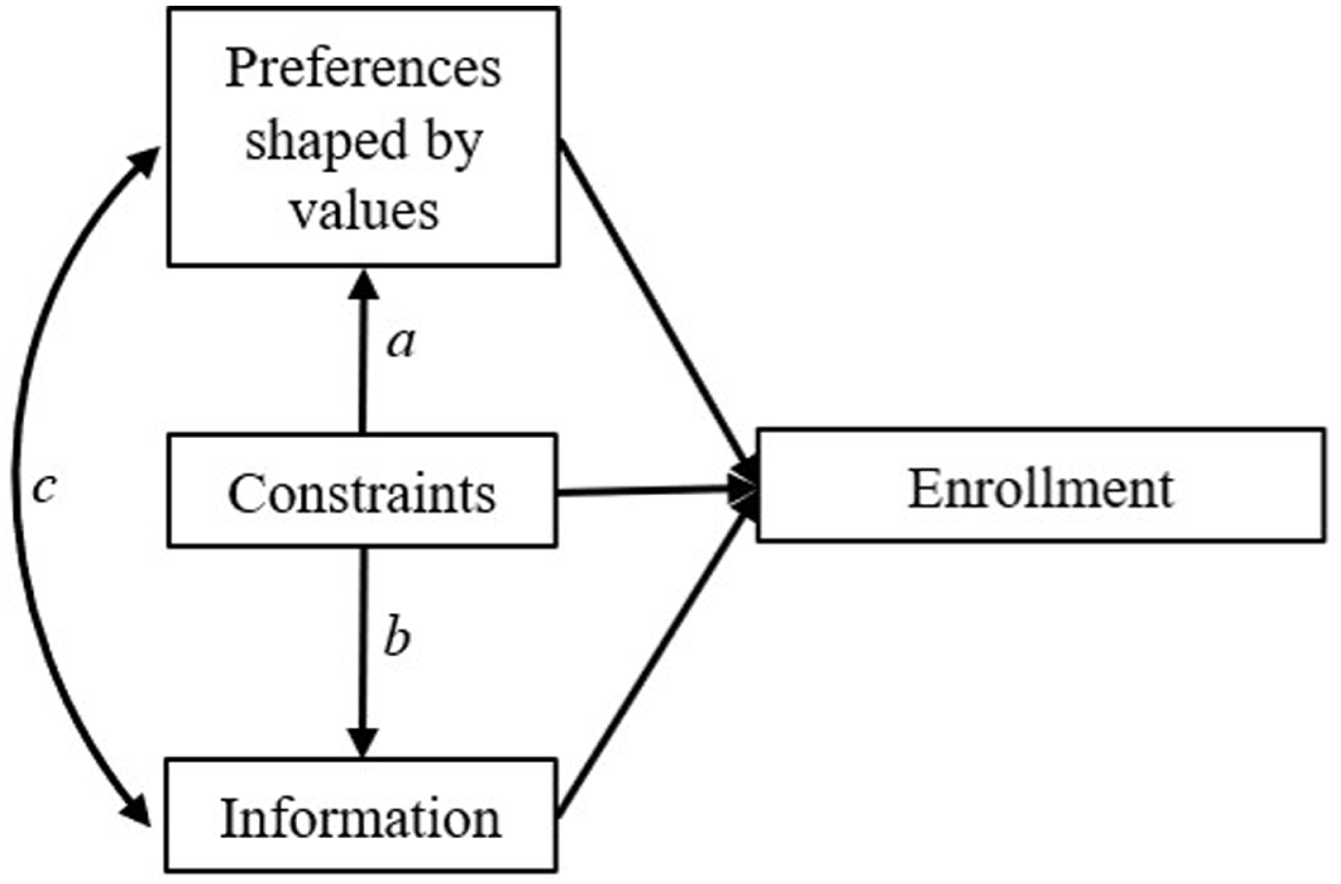
Parents consider both their preferences and values when making school choices.
Parents are typically conceptualized as having preferences for different types of schooling, but this approach fails to consider how families in choice contexts make choices both about schooling as services and about schools as places. Schooling involves several inputs, where teachers and their approaches play a role in student learning, and classrooms provide resources critical to development. However, learning does not occur in a vacuum: a student’s classroom is filled with other children whose background may (or may not) match theirs; teachers’ learning goals may (or may not) directly align with those of the student’s parents; and a school’s environment may be filled with images and text that represent (or fail to represent) the student. We see the compilation of such characteristics as the culture of the school—which parents evaluate when choosing the places in which their children will learn—that shape parental preferences for observable characteristics like racial diversity, teacher–student racial match, or the imagery and messaging along the school walls.
We conceptualize a school’s culture as the combination of behaviors, practices, and norms that shape the experiences of students, school staff, and even parents in the schooling environment. It encompasses a school’s sense of community, academic and racial climate, and disciplinary style, among other qualities—together setting the socially valued goals and outcomes children are expected to achieve (Lareau, 2003; Wentzel, 2015), as well as the collective sense of connectedness, inclusivity, and ethnic-racial climate, which can influence students’ sense of belonging (e.g., Walton & Cohen, 2011) and behavioral outcomes (e.g., Shukla et al., 2016). Within schools, teachers reinforce these expectations for students (e.g., Lewis-McCoy, 2014; Rubie-Davies et al., 2006) and peers influence and reinforce social behaviors and shape the learning environment (Hay et al., 2004; Mashburn et al., 2009; Ryan, 2000). A school’s culture ultimately determines what is considered “appropriate” behavior as a product of the interaction of a student and her setting (Sarason, 1977).
The cultural practices in a school contribute to children’s socialization (Wentzel, 2015), which we define as the process through which children learn and internalize norms, values, and skills that are necessary to function and participate in society. To understand how socialization affects decision-making, we draw from sociological and psychological theories, which offer complementary perspectives.
Sociologists view socialization as a structured and contextualized process shaped and reproduced by the social structure or hierarchy. Parents focus on socializing children to engage with institutions and their expectations, while schools socialize children into socially-constructed roles (e.g., by gender and class; Labaree, 1997; Lewis-McCoy, 2014). Schools socialize children through discipline, curriculum, and teacher expectation regarding their morality, identity, and hierarchical position within society (Bryk et al., 1993; Golann, 2021; Lareau, 2003). These mechanisms, in turn, reproduce social inequalities by socializing children into racialized and socially-constructed cultural identities (Anyon, 1980)—and helps explain why parents care deeply about schools’ cultural environments (Ball, 2003).
By contrast, psychologists view socialization as the set of messages and preparation provided to children to influence their beliefs and identity (Hughes et al., 2006; Huguley et al., 2019). Psychologists conceptualize parents as intentional agents who engage in conscious strategies to intentionally prepare their children for—and often counteract—the school cultures they encounter. When positioned within choice contexts, parents seek to examine the match between their socialization at home and that which is practiced in schools (Cooper, 2005; Posey-Maddox et al., 2021). The psychology literature, therefore, provides constructs (e.g., cultural pride, preparation for bias) that illustrate how parents interpret and evaluate school cultures.
The above helps explain why parents’ experiences inform the culture they want in their children’s schools: schools provide much of the socialization they would like their children to receive. Families prefer schools that would provide the type of educational experiences or socialization they, or their loved ones, would offer (Ball, 2003; Lareau, 2003), and dislike those that would mistreat or discriminate against them (e.g., Aggarwal, 2020). Relatedly, families also aim to teach their children the values, social skills, and behaviors they value through schools with certain cultural characteristics (Ball, 2003), like religious affiliation, a sports culture, or strict misconduct policies (e.g., no-excuses charter schools). These ultimately shape children’s identity, sense of morality, or priorities (Bryk et al., 1993; Golann, 2021; Golann et al., 2019).
Importantly, as families make decisions in complex social, political, and institutional contexts, they may deal with competing values or preferences—they can desire or steer away from certain school characteristics or cultures (Saatcioglu & Snethen, 2023). Accordingly, even when they prefer schools with strong quality-related characteristics, their children may contend with school cultures that conflict with their values (e.g., Lewis-McCoy, 2014). These tensions can be particularly salient for families from minoritized backgrounds, who often seek to protect their children from discrimination or stereotyping tied to ethnic-racial identity. These parents may engage in socialization practices that build resilience and prepare their children for racial mistrust and bias (Hughes et al., 2007). When exercising choice, parents with minoritized backgrounds report weighing characteristics of school cultures that shape children’s socialization (Hughes & Watford, 2021; Hughes et al., 2023), like racial climate (e.g., Posey-Maddox et al., 2021; Roda & Wells, 2013) and school safety (e.g., Billingham et al., 2020; Hamlin, 2017). In this way, schools can reinforce or undermine the socialization practices parents employ (Hamm, 2001), responsive to their ethnic-racial identities, cultural backgrounds, and broader social positions (Harding et al., 2017; Hughes et al., 2006).
In sum, variance in preferences, and the weight parents give them in the decision-making process, is shaped by families’ values. Families from ethnic-racial minority backgrounds may not only prioritize schools’ academic characteristics (Chin, 2022; Hastings et al., 2009); instead, they may seek schools in which their children will not experience racialized harm they, or those like them, have experienced (e.g., Cooper, 2007; Hamm, 2001; Posey-Maddox et al., 2021). As Cooper (2005) describes Black mothers’ experiences when engaging with choice systems, these families make positioned choices informed by their cultural, social, and racial standing in the education system, and thus represent a form of sociopolitical and cultural resistance.
Forms of Capital Contributing to Parents’ Values/Preferences, Constraints, and Information
Having now argued that schools do not only provide educational services but are places that reflect parental values and where parents can reinforce their socialization practices, we use sociological theory to consider how various forms of capital families hold influence their decision-making processes. Here we incorporate Bourdieu (1986), as capital explains certain social behaviors, the interactions between individuals and institutions, and, ultimately, the inequitable structure of society. 3 Below, we outline how capital influences families’ values and preferences for schools, the information families hold about schools, and the constraints that bind them when making decisions (see Figure 5).
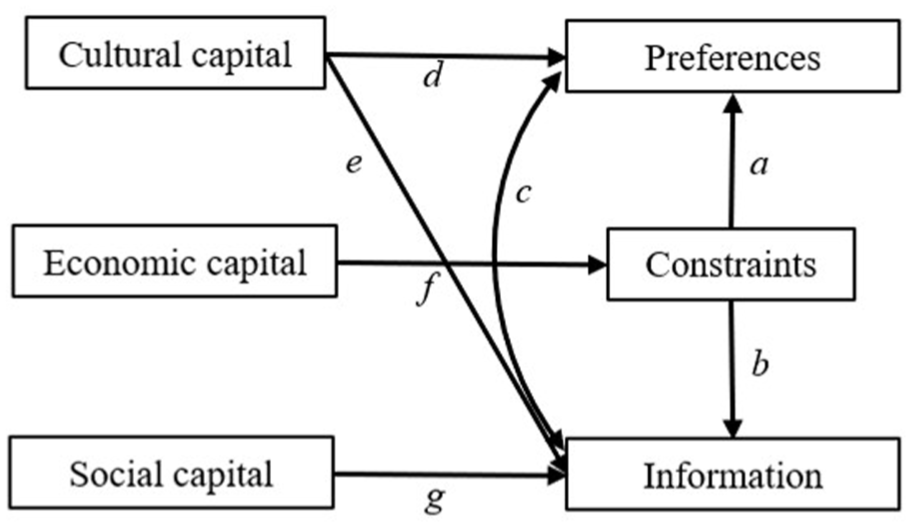
The roles of cultural, economic, and social capital.
Cultural Capital
Lareau and Weininger (2003) define cultural capital 4 as both the internalization of culture and knowledge through socialization and education, representative of the micro-interactional processes through which individuals use knowledge, skills, and competence strategically when in contact with institutions, which can ultimately promote social mobility. We posit that families’ cultural capital informs (1) their understanding of educational inputs, impacting the information (Path E) they use; (2) their preferences as shaped by their values (Paths E and C); alongside (3) their perspectives regarding the context of schooling (Path D).
When families hold more cultural capital by means of education, they are more likely to engage in choice and identify desirable available school options (Path E). Families’ higher educational achievement, and their highly correlated advantaged socioeconomic status, are associated with more participation in most choice contexts (e.g., Bifulco & Ladd, 2006; Ladd et al., 2017). These parents likely recognize the inputs that enable social mobility through schooling (e.g., Sattin-Bajaj & Roda, 2020) and leverage their knowledge to secure the “right” educational opportunities. This is not to say that parents who have accrued fewer amounts of cultural capital are unaware of the importance of certain inputs, like educational quality; rather, choice policies and reforms may be particularly appealing to them as alternatives to systematically low-resourced schools (Cooper, 2005, 2007) but their operationalization may be more challenging.
Beyond shaping access, parents’ own socialization and educational experiences also influence how they interpret and evaluate school options. Insofar as parents’ own socialization and educational experiences contribute to their cultural capital, they also set their expectations of what would constitute an appropriate or desirable schooling experience for their children (Bell, 2003). These experiences affect the information parents consider (Path E) and thereby the values/preferences they weigh (Path C). Parents’ personal, cultural, and educational experiences are often responsive to their perception of their children’s individual needs and wants, influencing the non-academic features they consider when selecting schools (Bulman, 2004; Rhodes et al., 2023). For instance, families tend to use their personal experiences to determine how they want their children’s schooling environment to feel (Cooper, 2005; Posey-Maddox et al., 2021; Potterton, 2020)—not just the form and quality of their education—and prioritize their children’s future satisfaction (e.g., Debs et al., 2023; Villavicencio, 2013).
Parents’ experiences also shape the specific school characteristics they value (Path D). Parents’ personal experiences in schools shape their views on the importance of non-academic schooling features, such as the role of play in classrooms (e.g., Metaferia et al., 2021), the appropriate (or not punitive) disciplinary practices (e.g., Golann et al., 2019; Schneider et al., 1998), and other cultural features. Parents’ experiences also inform the qualities in schooling environments they expect would make their children feel accepted and motivated to learn, prioritizing non-academic aspects foundational for their achievement in school (Bulman, 2004; Posey-Maddox et al., 2021; Rhodes et al., 2023) rather than educational quality per se. A positive learning environment often involves children’s feelings of belonging and positive, caring relationships with teachers and peers. These are associated with higher student achievement and motivation for learning, and improved (or at least unaffected) mental health outcomes (Eccles & Roeser, 2011).
Parents’ experiential knowledge and identities, especially for those who hold ethnic-racial and/or minoritized identities, can impact their perception of schools and the choice process more broadly. Parents from minoritized backgrounds may have experienced schooling in unequal, discriminatory, and segregated education systems and, thereby, make school choices considering their racially- or ethnically-charged experiences (Cooper, 2005; Posey-Maddox et al., 2021; Rhodes et al., 2023). These parents likely weigh non-academic factors highly to identify schools in which their children will thrive and develop positive ethnic-racial identities. When combined with a limited pool of high-quality schools in their neighborhoods (Chetty et al., 2020b), these parents must often weigh factors of school safety, discipline, and teacher support and care to optimize for quality rather than select for it explicitly (Pattillo, 2015; Posey-Maddox et al., 2021).
Notably, the provision of information or navigation support—intended to compensate for cultural capital—may not sufficiently enable families from disadvantaged backgrounds to circumvent the additional individual (e.g., Bettinger et al., 2012; Lenhoff et al., 2022) and system-level constraints (Bell, 2007, 2009a) they are more likely to experience.
Economic Capital
Variation in families’ economic capital influences enrollment behavior in choice contexts through a number of pathways. To expand on the constraints discussed above, families’ economic capital often determines their children’s schooling opportunities by determining residential location within a district school (Lareau, 2014; Rhodes & DeLuca, 2014) and, when choice options are available, those that surround them (Monarrez, 2023; Richards, 2014). As such, structurally, families’ own economic capital varies due to historically and systematically inequitable access to resources and educational opportunities (Baker & Corcoran, 2012; Chetty et al., 2020a; Owens, 2020). Ultimately, the link between property values and school funding plays a large role in reproducing inequity.
Foundationally, the ability to choose a neighborhood based on the quality of its school hinges on families’ economic capital. Families from disadvantaged backgrounds often do not—or cannot—consider schools or their quality when deciding where to move (DeLuca et al., 2024). Where families live may determine whether school choice is necessary, as participation often reflects dissatisfaction or mismatch with their default school.
Within this structurally unequal context, families face the context- and household-level constraints discussed above, which can intersect and amplify one another. For instance, at a context-level, families consider factors like distance when choosing schools. Considering these structural disparities, then, families can more easily access similarly-resourced schools as those within their school districts—so that high-quality schools are in higher supply in areas where high-income families live. In such cases, distance to choice schools may be less determinative of enrollment than for families from disadvantaged backgrounds (e.g., Singer & Lenhoff, 2022). At a household level, economic capital also enables families to afford conveniences that broaden their choice sets—addressing barriers like distance by paying for transportation services. Together, these interactions advantage families in resource-rich neighborhoods while compounding constraints for families with fewer resources (Evans, 2004).
Economic capital can also relieve families from constraints in ways that influence their preferences. Families with more economic resources may be more willing to “take a risk” on less academically strong schools. Economic resources provide families with the ability to supplement what is missing in schools that parents may desire—such as tutoring and extracurricular activities (Kimelberg, 2014a). Further, if dissatisfied with their public-school experience, these resources enable families to enroll their children in a private school—or even move to a different neighborhood with more eligible schooling options (Kimelberg, 2014b).
Social Capital
We posit that parents’ social capital impacts the information to which they have access (Path G) by means of social networks. We view social networks as useful to parents’ decision-making, regardless of their social standing, and thus we rely on Rios-Aguilar and colleagues’ (2011) conceptualization of social capital as also encompassing the funds of knowledge (Velez-Ibanez & Greenberg, 2006) families from disadvantaged communities accrue (e.g., Lareau, 2003; Ream & Palardy, 2008). Social networks influence whether families participate in choice (e.g., D. J. Fleming et al., 2015; Taylor Haynes et al., 2010), the schools they consider or list in applications (e.g., Bell, 2009a; Goldring & Phillips, 2008), and the role they play in informing families’ preferences and the values that shape them.
By considering the funds of knowledge framework, we acknowledge that information from social networks can be particularly useful to families from disadvantaged backgrounds. This information allows them to identify schools and navigate institutional processes in the context of complex economic, political, and social environments in which structural racism and systems of oppression are sustained (e.g., Domínguez & Watkins, 2003; Rios-Aguilar et al., 2011). Accordingly, parents’ networks allow them to learn both about schooling options’ availability and characteristics that align with their priorities (Lin, 1999) to choose where to apply and enroll their children.
Choice has been shown to incentivize families to seek information about schools. Families can access formal information sources that report on school characteristics, like academic achievement and diversity, but these sources typically omit non-academic measures (as discussed in the “Cultural Capital” section), like school climate, or student satisfaction and socioemotional outcomes. Living in a choice context has been shown to increase parental searches for “formal” school quality information online (Lovenheim & Walsh, 2018). However, information provision regarding only some school characteristics, especially those relevant to parents, may influence their preferences (Path C) when ranking schools. When achievement metrics are readily available and simplify the comparison of schools, families may rely on them in ways that accentuate perceived differences across schools, leading to biased or overly categorical decision-making (e.g., the “accentuation effect”; Spektor & Seidler, 2022).
Importantly, families may instead be skeptical of formal information sources (Sandstrom et al., 2024) and rely on word of mouth (i.e., their communities’ funds of knowledge) as a primary source of information. Evidence from public health shows that families are less likely to rely on formal informational sources regarding pediatrician quality, instead relying on social networks (Hanauer et al., 2014; Ossai et al., 2022). Those from racial-ethnic backgrounds who experienced systemic injustice, violence, and discrimination within school systems (Bryant-Davis, 2007; Smith & Freyd, 2014) might disparately distrust the information systems provide.
As mentioned above, families may seek information about schools’ cultures that is often not reported, and they must therefore rely on their networks. Reports from families across choice contexts overwhelmingly show that social networks are primary informational sources about school options and quality (e.g., D. J. Fleming et al., 2015; Goldring & Phillips, 2008). As measures for non-achievement-related constructs typically unavailable, families rely on information from experienced families they know (e.g., Bader et al., 2019; Fong, 2019). These families may be more attuned to the culture of their community’s schools, or can share information by communicating, for example, whether their own children (as students) perceived disciplinary disproportionality (Hughes & Watford, 2021) or faced racialized bias amongst teachers and peers in a given school (e.g., Hamm, 2001; Lewis-McCoy, 2014).
Notably, the quality or status of a school is also communicated through social networks and, thus, reified by them (Path C). A school’s status, which may (or may not) be related to its quality or resources, is socially constructed (Holme, 2002). The use of networks, both between and across families and school administrators, can thus shape family perspectives regarding schools (Jabbar, 2016; Jennings, 2010). This feedback loop benefits schools whose administrators activate their social networks and, for example, influence both the volume of applications they receive and the types of families who submit them.
Decision-Making in Context: Considering Parents Within Systems of Choice
Thus far, we have considered the ways in which families identify, evaluate, and select the schools in which they would like their children to enroll, while they navigate and interact with educational institutions. However, our theory has yet to fully address the systems of choice within which they make these decisions. Here we consider how decision-making is influenced by their choice systems, which typically require families to navigate two distinct and sequential markets: choice markets and aftermarkets. We illustrate the stepwise nature of these decision-making processes in Figure 1, where the core components of the model remain consistent, but specific aspects of the components and the linkages between them operate differently in each market (e.g., constraints influence values/preferences slightly differently in a choice market, Path A, than in an aftermarket, Path A2). In choice markets, parents engage in a decision-making process to select and apply to schools based on their values, preferences, constraints, and information (Paths J, I, and H). In aftermarkets, parents engage in a comparable but distinct decision-making process constrained by their admissions or assignment results and that of other applicant families (Path K). Parents may enroll in a school to which their child was assigned or admitted, wait for a seat in a more desired school via a waitlist, or exit the system.
We argue that these systems’ organization influences decision-making by setting the rules by which choice is exercised (e.g., Fong & Faude, 2018; Lenhoff, 2020) and by encouraging the use of strategies, which are unevenly adopted across families (e.g., Abdulkadiroğlu et al., 2006; Lareau et al., 2016; Mann & Rogers, 2025). These sequential markets allocate limited resources: choice markets enable interested parents to apply for limited seats across school options, and aftermarkets enable parents to access an even more limited set of seats through waitlists. Choice systems set application deadlines and requirements families must meet (e.g., Balu et al., 2021; Lenhoff, 2020), alongside assignment parameters that prioritize admission for some groups (Abdulkadiroğlu & Andersson, 2022; Pathak, 2017). Importantly, choice-determined features like deadlines can systematically disadvantage families whose residences and family structures are unstable (Fong & Faude, 2018). Seat scarcity within organized systems fosters competition, encouraging parents to be strategic when submitting applications and navigating waitlists to secure a slot (Jennings, 2010).
Below, we illustrate how choice systems influence decision-making in choice markets and aftermarkets. We highlight how parents use different forms of capital, which inform their preferences and information and shape their constraints, to make decisions, leveraging scholarship and evidence from the fields of experimental economics (e.g., Abdulkadiroğlu & Andersson, 2022), sociology (e.g., Dumont et al., 2019; Lareau et al., 2016), and education policy (e.g., Ellison & Aloe, 2019; Mann & Rogers, 2025). Our examples are not exhaustive, as choice markets differ across many contextual factors.
Making Application Choices in Choice Markets
As parents select the schools in which they are interested, they participate in an application process (or multiple ones) that can influence their decision-making. Choice systems require families to consider application processes, like submission deadlines and requirements, and introduce additional complexities, including applicant priority and school ranking rules. Thus, systems’ features and assignment and admissions mechanisms may influence how parents choose and rank schools in their applications. Throughout this section, we focus on the two most fundamental types of choice markets—centralized and decentralized.
System features that affect parents’ quality of decision-making when making application choices
Foundationally, choice markets have different features and/or requirements that may impact families’ quality of decision-making.
Centralized choice markets are controlled by a central entity that sets an application deadline and application requirements, and tailors assignment mechanisms for oversubscribed schools—that is, a single, high-level procedure. Parents in such systems identify and choose schools to which they would like to apply and order them based on preference, by a deadline. This process may lead to inequities due to the disparate amount of time families can devote to choice-related activities, challenges in keeping up with deadlines (Fong & Faude, 2018), and the cognitive load involved (Iyengar & Lepper, 2000; Mullainathan & Shafir, 2013). Further, the stakes of submitting a single application by a deadline are high, a stressor that may influence parents’ ability to make optimal decisions (Starcke & Brand, 2012).
Conversely, decentralized choice markets allow choice schools (or districts) to make decisions about when to set application deadlines, what to require from applicants (e.g., scores, interviews), and how to determine assignments. Parents complete applications for schools in which they would like to enroll their children, whose deadlines and requirements may differ. The quantity of school applications and variation in processes may require extensive time or resources for completion, serving as barriers to choice participation (e.g., Lareau et al., 2016; Lenhoff, 2020). Furthermore, decision-making in these markets likely contributes to families’ cognitive loads, which tend to be higher for families from disadvantaged backgrounds (Mullainathan & Shafir, 2013) and increase their likelihood of experiencing decision fatigue (e.g., Danziger et al., 2011).
Centralized system features that affect where and how parents submit applications
Centralized choice markets have two interrelated design features that could influence decision-making: (1) the assignment (or admissions) mechanism within their choice market, and (2) how that mechanism “prioritizes” assignment for applicant groups. Systems use assignment mechanisms (or algorithms) to assign students to schools. With the purpose of having fair, reasonable, and transparent processes, these also have features that influence children’s likelihood of school assignment. Families’ understanding of the mechanism may influence their application behaviors, depending on their ability to anticipate and respond to other applicants’ behaviors (Pathak & Sönmez, 2008).
Beyond collecting information regarding choice schools, families learn about the choice systems they must traverse (e.g., Kapor et al., 2020; Lareau et al., 2016) and the factors that influence school assignments (e.g., priority groups). For instance, parents may not only aim to learn about the quality of a school, but also the number of seats they have available in their child’s grade (e.g., Abdulkadiroğlu et al., 2006). Families may exclude a school from their application list because of their (perceived or actual) low likelihood of being assigned to highly demanded schools with limited seat availability.
The type and features of assignment mechanisms used could influence parental behavior by shaping the information parents use (Figure 1, Path H) and shifting the order of schools they rank (Path I), if any, when submitting applications. Below we discuss the influence of these factors on family decision-making in centralized and decentralized markets.
Centralized markets have a variety of assignment mechanisms that can influence applicant decision-making. Evidence shows how some mechanisms favor strategic applicant behaviors, that is, incentivizing strategies (e.g., De Haan et al., 2023; Pathak & Sönmez, 2013). Assignment mechanisms include the deferred acceptance algorithm, and the Boston and Top Trading Cycles mechanisms, 6 all of which face tradeoffs between producing efficient or fair assignments, and being strategy-proof (for a review of mechanism characteristics and tradeoffs, see Pathak, 2017). With this in mind, some school districts and policymakers have stopped using certain mechanisms in favor of more equitable options (see, for example, Abdulkadiroğlu et al., 2006; Cook, 2003) or explicitly design them to address segregation (e.g., Frankenberg, 2017).
Strategic behavior in centralized markets’ assignment mechanisms typically takes the shape of misrepresentation of family preferences. Families shift schools’ ranking order (which should represent that of their true preferences) or exclude them from their lists to secure a desired seat (Abdulkadiroğlu et al., 2006; Pathak & Sönmez, 2008). In experimental settings, where assignment mechanisms and application procedures are replicated, researchers note differences in truthful reporting 5 of ranking order when assignment mechanism features, and participants’ understanding of them, vary. System-level features, such as constraining the number of options participants can list (Calsamiglia et al., 2010) and the specific assignment mechanism used (Chen & Sönmez, 2006), and applicant-level factors, such as misunderstanding how assignment mechanisms work (Kapor et al., 2020) and the use of information about schools’ priorities for applicants (Pais & Pintér, 2008), influence applicants to change the order of their preferences. Applicants engage in strategic behaviors even when ranking true-to-preference options would lead to optimal assignment (Rees-Jones & Skowronek, 2018). Notably, and as mentioned above, some assignment mechanisms prompt more truthful reporting of preference order than others (such as the deferred acceptance algorithm) but no assignment mechanism prompts all participants to rank their preferences truthfully (Rees-Jones & Shorrer, 2023).
Assignment mechanisms can use priority groups that, theoretically, represent policy priorities and essentially “reserve” space for certain families. When schools are oversubscribed in centralized systems (i.e., more applicants than seats available), a child’s assignment is determined based on an ordered list of priority groups and a random (or quasi-random) lottery, which organizes applicants within those groups—all depending on the mechanism used. In the deferred acceptance mechanism, applicants are grouped based on sociodemographic groups to which they belong or the areas in which they live, which are ordered in an admission’s “queue,” but mechanisms differ in how or when these queues are used. Systems can choose priority groups and their order based on policy priorities and equity considerations to, for instance, ensure students across different levels of advantage can access their schools of choice 7 (Abdulkadiroğlu & Andersson, 2022; Frankenberg, 2017; Tuttle et al., 2012).
Priority group membership for a school might favor certain groups depending on the group order determined by policymakers and market designers, such as those families who are close to a given school (by living in the same school zone or district). Applicants are assigned to schools based on priority group membership and the list of schools they ranked using different methods depending on the assignment mechanism (e.g., all first choices are considered first for assignment in the first priority group). Some mechanisms incentivize families to misrepresent their preferences for schools if they consider the priority group to which they belong and whether it is highly prioritized in their ranked schools (Abdulkadiroğlu et al., 2006).
Families’ path to gaining and leveraging information about centralized systems of choice
As mentioned above, parents gain information about schools by leveraging cultural and social capital (Paths E and G), and, we argue, do the same when learning about systems of choice. Sociological evidence from applied settings suggests that parents from groups with more access to capital are more likely to learn about “successful” strategies and adopt them (Mann & Rogers, 2025; Posey-Maddox et al., 2026; Roda & Sattin-Bajaj, 2024). Evidence from experimental economics supports this notion. Applicants are referred to as “naïve” (or “sincere”) and “sophisticated” when referring to those who do not use (or misunderstand) strategies, and those who successfully use them, respectively (e.g., Pathak & Sönmez, 2008).
Cultural capital may benefit parents when it increases their awareness and consideration of factors that could increase (or decrease) their children’s likelihood of school assignment (Path E), influencing whether parents apply to them, or the rank in which they list them (Path H). Parents can obtain information regarding factors that determine their chances of admission by reading materials provided by school districts and through personal experiences (Roda & Sattin-Bajaj, 2024). Thus, applicants may fail to list schools they prefer but they learn are too competitive to gain admission (Agarwal & Somaini, 2018) and may change their application behavior based on their belonging to a high (or low) priority group (Abdulkadiroğlu et al., 2006).
Priority groups are used and weighed differently across assignment mechanisms but can impact applicant behavior—the “immediate acceptance” algorithm, now termed the “Boston mechanism,” serves as a notable example. This algorithm gives families a higher likelihood of acceptance in their top choice and is even higher if they are also a part of a high-priority group. Thus, a family is more likely to be assigned to a preferred school in which they have priority if (1) they rank it first and (2) rank a less-popular school second as a “safe” choice; or if they rank less-popular schools overall (see Abdulkadiroğlu et al., 2006). This incentivizes families to forego highly demanded schools they may prefer, focus on their top choice for which they have priority, and strategically select “safe schools” as second (and third, and so on) options. This strategy is used by “sophisticated” players in Boston mechanism games in laboratory experiments and real-world choice contexts (Chen & Sönmez, 2006; Pathak & Sönmez, 2008). Importantly, however, understanding these mechanisms does not allow families to circumvent the structural impediments to choice sets as priority groups are often geographic—which ultimately upholds district segregation and funding inequities.
Parents rely on their social capital not only to learn about school options and characteristics to consider (Path G), but to understand the system (Path H). Experimental economists have shown that social learning can impact the strategies used in matching systems (Ding & Schotter, 2017, 2019; Guillen & Hing, 2014), and thus application choices. Conversing with other participants in a market (who represent other families applying concurrently) can shift applicant ranking order and is not beneficial for those who receive advice to use counterproductive strategies by increasing strategic ranking (Ding & Schotter, 2017; Guillen & Hing, 2014). Ding and Schotter (2017) found that participants without advice-givers (i.e., those “lacking” in social capital), and in low-priority groups, are least likely to receive desired offers. Conversing with participants who have previously engaged in the market can lead to counterproductive strategy use based on (poor) advice-giver guidance (Ding & Schotter, 2019). Together, these findings suggest that families’ choices may be shaped by the decisions of other applicants within their social networks.
Notably, many systems of choice set priority groups based on geographic proximity to schools—as such, the link between economic capital, that is, neighborhood and household socioeconomic status, and constraints (Path F) influences whether and how families rank their choices (Path I). Most research investigating this link leverages data from international settings. In the Barcelona choice system, which uses a Boston mechanism where neighborhood priority is given, applicants were found to rank schools where they had neighborhood priority even after neighborhoods catchment areas (i.e., where they held priority) shrunk (Calsamiglia & Güell, 2018). In Madrid’s choice system, the removal of neighborhood priority grouping led to increased application and assignments to outside-neighborhood schools (Gortázar et al., 2023). This research is consistent with recent findings in New York City’s kindergarten system (Shmoys et al., 2026), which finds that disadvantaged racial minorities are more likely to apply to programs where they do not hold geographic priority relative to white families. Considering inequities in the quality of schools based on neighborhood socioeconomic status (Bell, 2009a; Lenhoff et al., 2022), neighborhood priority may benefit families from wealthier backgrounds.
Economic capital (Path F) can also serve as a constraint influencing parents’ choices. Parents with financial means to engage with the private school market can afford to engage in riskier application behaviors than their counterparts. Their economic capital grants them the security that their child will be able to enroll someplace they prefer, while also participating in the choice system and applying into hard-to-get schools (e.g., Roda & Wells, 2013). Combined with disparities in quality schooling across neighborhoods, this advantage grants an immense privilege—no option is a bad option. Calsamiglia and Güell (2018) found that high-income families in the Barcelona system exclusively rank highly competitive schools, and when they do not gain admission, enroll their children in private schools. 8
These forms of capital can also intersect to influence application behaviors. Families can leverage their economic, social, and cultural capital to understand the system, strategize, and aim to change the market to align with their goals. For example, parents with similar preferences and backgrounds may collectively choose a set of options, organize to bring select resources and programming, and, ultimately, change schools from within (Posey-Maddox et al., 2016).
Decentralized system features that affect where and how parents submit applications
Decentralized systems are in areas with intra- or inter-district open enrollment and charter school policies, whose admissions processes can also influence decision-making.
In areas with open enrollment policies, school districts and schools tend to have more independence to determine admissions, which may influence the constraints that families face (Paths F and I). This independence allows districts to, for instance, set geographic boundaries and cap the number of nonresident admissions, within the limits of the legislation set by their state (Mikulecky, 2013). In states with charter school policies, schools are typically required to determine admissions by lottery and can sometimes run and set their lotteries’ parameters individually, guided by legislative requirements (for a review see Tuttle et al., 2012). Schools’ use of nonresident caps and priority groups in admission lotteries may influence parents’ application choices in a comparable way as it does in centralized systems. Rather than shifting families’ rankings (or the inclusion of schools in their application list), these methods may alter the schools to which families apply.
Families may also choose to only apply to schools which they feel might feasibly admit them. Decentralized systems are typically less efficient, as a number of students may not gain admission anywhere while others may gain admission in multiple schools (Abdulkadiroğlu, Agarwal, et al., 2017; Abdulkadiroğlu, Che, et al., 2017). Thus, parents might only apply to schools where they perceive having a high likelihood of admission in response to the uncertainty of receiving an offer (Lareau et al., 2016) or be deterred from participating in choice altogether. Families may also strategically apply to highly “attainable” schools, as time-related constraints could only allow them to devote time and effort to a few applications.
The decentralization of choice systems enables districts and schools to establish barriers that disparately affect families from disadvantaged backgrounds, who experience more constraints than their counterparts (Paths F and I). Just as families cannot apply to schools due to geographic boundaries or are discouraged to do so due to enrollment caps, choice schools can use selective admissions processes (like reviewing disciplinary records) or design complex application processes and requirements that have varying application and enrollment periods (e.g., Lenhoff, 2020). Choice schools may also not offer transportation services, an important barrier to the urban poor (e.g., Singer & Lenhoff, 2022; Valant & Lincove, 2023). Importantly, applicant families in decentralized systems participate in choice to leave their default school, whereas most families in centralized systems participate in them by default, as processes are streamlined and sometimes mandatory. Families from disadvantaged backgrounds thus experience a push-and-pull effect: while they may be highly motivated to seek better school options because their default schools are lower-resourced (Rhodes & DeLuca, 2014), they also experience the most barriers to choice participation.
Families’ circumstances likely influence their ability to exercise choice, but research findings regarding who participates differs across contexts (e.g., Lavery & Carlson, 2015; Lenhoff, 2020). Evidence from Colorado, Minnesota, and Wisconsin found that more advantaged families participate in choice more often (Carlson et al., 2011; Holme & Richards, 2009; Lavery & Carlson, 2015) while evidence from Michigan shows the opposite (Cowen et al., 2015). Characteristics of the policy contexts may help explain these patterns. In some, parents may be particularly sensitive to distance to choice schools because of transportation-related constraints (Carlson et al., 2011). In others, system-level deregulation may decrease families’ access to information about options and/or likelihood of admission by providing discretion to schools to decide who to admit (Holme & Richards, 2009; Lenhoff, 2020).
System participation can also be evaluated over time, showing not only who can choose schools, but who remains in them. Notably, Cowen et al. (2015) and Lavery and Carlson (2015)—who found that more disadvantaged and more advantaged families participate most in choice in their study contexts, respectively—also investigated how likely students are to remain in choice schools. Consistent with the choice literature on student mobility, they found that students from disadvantaged groups were more likely to leave or switch between choice schools (e.g., Howell, 2004; Kotok et al., 2017). The evolution of choice policies over time can also influence participation or incentivize schools to cater to specific groups (Greaves et al., 2023; Jabbar, 2016). Evidence from North Carolina shows that charter school enrollment has become whiter since the inception of the state’s charter school policy in the 1990s (Ladd et al., 2017).
Navigating Aftermarkets
Provided the assignment mechanism has matched students to schools, or students have received (or failed to receive) admission decisions, aftermarkets serve as an allocative secondary market. 9 As families receive assignments or are admitted and are waitlisted in schools they preferred “more,” others are also assigned and waitlisted. As shown in Figure 1, decision-making is constrained by their assignment results and that of others’ who also submitted applications, all of which were determined by their application choices (Path K). Typically, two groups of families engage in aftermarkets: (1) families not given the opportunity to enroll their child in their top (or most preferred) choice may navigate the aftermarket to receive a different offer, and (2) families who did not submit applications must add themselves to waitlists in schools they are interested in or enroll in undersubscribed schools.
Decision-making in aftermarkets is similar to that within choice markets for applicant families with an important difference: families choose between accepting an offer or waiting for one through a waitlist. A few studies in sociology and education policy provide qualitative evidence that emphasizes the role that families’ capital can play in aftermarkets. Across systems, families leverage social capital and learn from their social networks how soon to add themselves to waitlists (Lareau et al., 2016) or who to talk to at schools (Brown, 2022) to secure offers. Families may have gained cultural capital from participating in the application process (Path L), which informs their understanding of the choice system, priority groups, and use of lotteries. Applicant characteristics can still be relevant in aftermarkets, as they tend to determine waitlist order in centralized systems. The accumulation of this capital likely benefits families who submitted applications and are waitlisted in the schools they prefer when compared against those who never submitted applications at all. Little understanding of the waitlist process may deter late-coming families from joining waitlists and instead might opt to enroll in undersubscribed schools, which are also likely to be of lower quality. Conversely, families hesitant about navigating the waitlist process, even after submitting applications, may instead settle for schools they do not prefer as strongly (Potterton, 2020).
Based on existing evidence, and the expectations from our model, families’ navigation of aftermarkets may lead to disparities in enrollment outcomes. More research is needed to understand who successfully navigates aftermarkets and the underlying decision-making processes in which families engage when traversing them.
Addressing the Role of Time and Timing
A full rendition of our theory would consider life course theory and developmental timing as they intersect with these processes, as we show in Figure 1. Life course theory perspective (Elder & Shanahan, 2007) adds how families’ capital, values, preferences, information, and constraints may differ between across the decision-making points in school choice processes, raising the importance of factors like household stability (DeLuca et al., 2019, 2024; Fong & Faude, 2018). By considering the child within her school and the recognizing schools as places, our model acknowledges how parents’ views and definitions of school quality and their related preferences for and values regarding schools (Paths J and J2) progressively shift in response to children’s developmental needs. Thus, our model can consider context at the level of choice markets and aftermarkets, and be positioned within and throughout families’ life course.
Theoretical Propositions
Our theoretical model generates a set of empirically testable propositions about how institutional structures, process design, and family resources interact to shape enrollment outcomes in choice systems. We present a set of exemplary propositions under three broad categories: macro-level features and pathways, institutional design of the choice process, and family-level navigation within systems.
Macro-Level Features of, and Pathways Through, Choice Systems
These include the institutional architecture of systems and the pathways through which families navigate them, which together structure access to schooling options.
Proposition 1: The effect of centralization of choice systems on the equity of enrollment outcomes is conditional on the degree to which the schooling level is compulsory. Centralization reduces inequality in access within highly compulsory systems but has stratifying effects in non-compulsory systems through a variety of mechanisms.
Proposition 2: The pathways families follow through the choice process structure their access to desired schooling options. Families who engage fully with formal application procedures are more likely to access preferred options than those who do not participate in the application process.
Design of the Choice Process
Beyond system architecture, the design of the choice process shapes how families participate in the system and their enrollment outcomes. These features influence application behavior, assignment outcomes, and enrollment decisions.
Proposition 3: Longer delays between application and enrollment periods will increase non-enrollment, because family constraints and child needs change over time. This effect will be larger for disadvantaged families facing greater instability.
Proposition 4: The information provided to families about school options by choice systems affects the extent to which their applications reflect their underlying preferences. When systems provide accessible information about attributes families value (e.g., program offerings, school climate, or academic performance), families’ application choices will more closely align with those preferences. When such information is absent or difficult to interpret, families are more likely to rely on information from social networks when choosing where to apply.
The effects of certain choice process features can depend on systems’ broader structural characteristics and the distribution of schooling options across educational markets.
Proposition 5: In centralized and non-compulsory systems, when the application period is closer to the start of school, application participation will be more inclusive and school rankings more representative of underlying preferences because deadlines are more salient and families have had more time to learn about options before applying.
Proposition 6: In systems in which desirable options are geographically unevenly distributed, geographic priority groups disproportionately benefit more advantaged families.
Family-Level Navigation Within Systems
Resource-based differences in navigation reflect the interaction between system structure, educational markets, and family characteristics. Families with different forms of capital may engage with the same system in distinct ways, leading to divergent pathways and outcomes.
Proposition 7: In non-compulsory centralized choice systems, families with less capital (e.g., informational and institutional resources) are more likely to follow non-standard pathways through the choice process and to experience non-enrollment outcomes relative to families who complete the standard application process.
Proposition 8: In systems where there are private options, families with more economic capital will be more likely to engage in riskier application behavior—such as listing fewer options or concentrating their rankings on more desirable or highly selective options—because private alternatives reduce the consequences of failing to receive a publicly funded placement. When families from disadvantaged backgrounds use similar risk-taking strategies, they will be less likely to secure preferred placements due to more limited access to institutional knowledge, information about the assignment process, or geographic advantages (e.g., within centralized systems with geographic priority groups).
To illustrate how the proposed theoretical model can inform policy, system design, and future research, Table 1 identifies research gaps, proposes potential empirical studies, and outlines considerations for administrators and policymakers related to key system features.
Choice System Features, Research Gaps, Empirical Research Guidance, and Considerations for Administrator and City Agency Officials
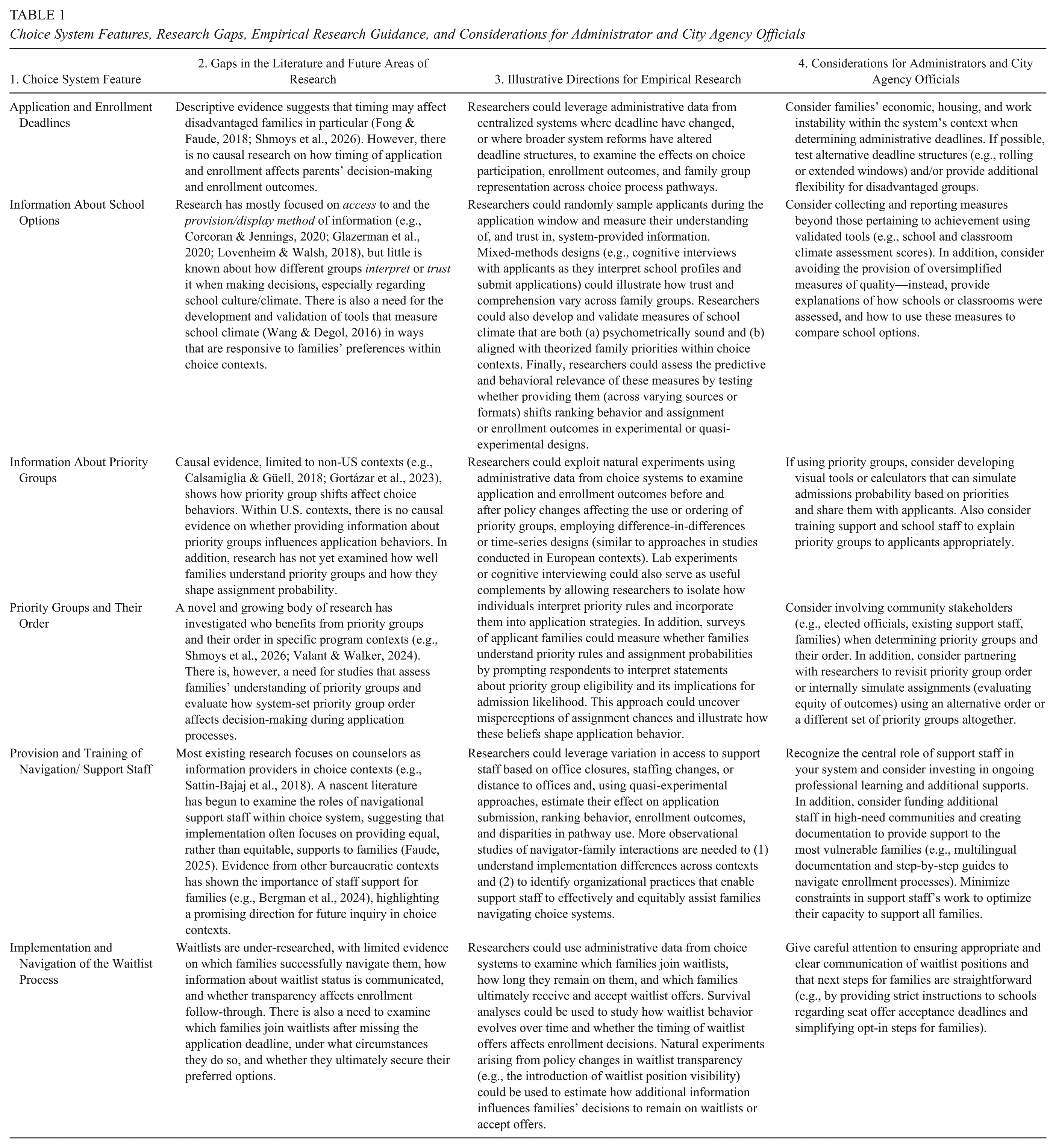
Concluding Remarks
Our Choice-in-Context Model aims to elucidate how decision-making in choice contexts unfolds and can exacerbate the inequities school choice aims to ameliorate. We use theoretical and empirical evidence from economics, sociology, psychology, and applied education policy studies to elucidate the complexity in families’ decision-making. Although we do not empirically test the full theoretical model in this paper, its development is grounded in a substantial body of empirical work that informs each of its core components. By compiling evidence across these literatures, our model raises questions as to whether school choice policies raise school quality by relying on families’ quality-seeking. Rather, our model illustrates how families’ preferences are shaped by their values, such that they see schools as places of learning and socialization, not merely as providers of schooling (e.g., Posey-Maddox et al., 2021; Saporito & Lareau, 1999). Further, the educational markets in which choice is exercised likely exacerbate access inequities when designed without explicit consideration of the structural barriers shaping decision-making and choice outcomes—such as racial and income segregation (e.g., Frankenberg, 2017). In tandem, choice systems’ administrative requirements and complexity can make choice challenging to exercise (Jabbar & Lenhoff, 2020; Jabbar et al., 2025), particularly for families from less advantaged backgrounds. More research is needed to understand how choice systems could be designed, with the awareness of the complexities of families’ decision-making process and the systems/contexts with which they interact.
Despite the strengths of this model, several limitations bound its scope. We focus on family-level decision-making and do not explicitly consider the role students may play in the process, although students—particularly those entering high school—often actively participate in school choice (Cohodes et al., 2025). The model also treats choice as a bounded process from application to enrollment, although in practice it may unfold over multiple years. This is especially relevant in systems where early admission decisions shape downstream access to selective tracks, increasing the expected returns to strategic behavior (Corcoran & Baker-Smith, 2018). Finally, the model’s complexity limits researchers’ ability to test it in its entirety using parametric methods, highlighting the potential value of more advanced predictive approaches. Nonetheless, individual components of the model can be empirically tested using conventional methods, allowing researchers to better understand how families navigate these systems.
Despite extensive research on the impacts of choice policies, few studies focus explicitly on families’ decision-making processes—a necessary ingredient for school choice. Existing literature has documented aspects of families’ decision-making in choice contexts, such as their experiences navigating specific systems (e.g., Balu et al., 2021; Mann & Rogers, 2025) and the impact of providing them with information about options (Corcoran & Jennings, 2020; Hastings & Weinstein, 2008). However, little empirical research has considered their experiences throughout the decision-making process from application, through waitlists (i.e., aftermarkets), and culminating in enrollment, or quantified parents’ understanding of the specific systems with which they engage. Education researchers have aimed to understand families’ preferences and priorities when selecting schools (e.g., Goldring & Phillips, 2008; Hailey, 2022), but little has been documented regarding the tradeoffs between educational/academic preferences and value-based characteristics that parents from disadvantaged backgrounds face (Saporito & Lareau, 1999). Our theory identifies ample gaps in the literature and points to areas of research that center families’ decision-making processes in choice contexts (as illustrated in Table 1).
Our theoretical model suggests that, insofar as economists have been the primary support for the design of choice systems (Pathak, 2017; Rees-Jones & Shorrer, 2023), social scientists could add substantial value for their design and implementation. Interdisciplinary work may uncover the root causes of inequities within choice system participation and across enrollment outcomes, and aid in the effort toward building systems of choice for all.
Footnotes
Declaration of Conflicting Interests
The authors declared no potential conflicts of interest with respect to the research, authorship, and/or publication of this article.
Funding
The authors disclosed receipt of the following financial support for the research, authorship, and/or publication of this article: This work benefited from funding from the Institute for Education Sciences-sponsored Predoctoral Interdisciplinary Research Training fellowship (Grant R305B200010).

Notes
Authors
BERTA BARTOLI is a doctoral candidate in the Psychology and Social Intervention program at New York University’s (NYU) Applied Psychology Department and an Institute for Education Sciences Predoctoral Interdisciplinary Research Training Fellow; email:
PAMELA MORRIS-PEREZ is a Professor of Applied Psychology at the NYU Steinhardt School of Culture, Education, and Human Development and an affiliated professor at the NYU School of Global Public Health; email:
DIANE HUGHES is a Professor of Applied Psychology at the NYU Steinhardt School of Culture, Development, and Education; email: