







Abstract
This study examines how racialized boundary work unfolds within a racial equity-centered research–practice partnership (RPP) and how such work shapes learning, knowledge co-construction, and justice-oriented change. Drawing on participatory design research and Cultural-Historical Activity Theory, we analyze collaborative interactions among our racially diverse partnership. Findings reveal that RPPs are not inherently transformative; their potential depends on how partners engage tensions at the boundaries of race, role, power, and knowledge systems. We identify three features—epistemic stretching, productive dissonance, and equity essentialism—that shape whether partnerships reproduce or disrupt inequities. Productive dissonance can deepen sensemaking, while epistemic stretching can expand dominant understandings. In contrast, equity essentialism risks flattening racial specificity and diluting anti-racist work. We argue that boundaries are generative spaces where power is negotiated and knowledge is co-constructed, and that intentional boundary practices, objects, and crossings are necessary to surface and address harm, redistribute interpretive power, and support justice-centered transformation in RPPs.
Keywords
Introduction
In recent years, research–practice partnerships (RPPs) have been positioned as a promising approach for bridging the longstanding divide between educational research and practice (Farrell et al., 2021; Henrick et al., 2023; Penuel et al., 2015). Yet, as calls for racial equity in education have intensified, so too have questions about whether RPPs are equipped to confront the racialized power dynamics that shape whose knowledge counts, how decisions are made, and what forms of change are possible. These challenges are exacerbated by racialized power dynamics in academia—where 72% of faculty are White compared to 58% of the U.S. population (National Center for Education Statistics [NCES], 2022; U.S. Census Bureau, 2024)—shaping whose knowledge is legitimized and whose is marginalized. Across schools and districts, efforts to advance equity often unfold within systems historically structured by Whiteness—raising critical questions about whether collaborative research can truly disrupt, rather than reproduce, these inequities.
While RPPs are often framed as collaborative and mutually beneficial (Coburn et al., 2013; Farrell et al., 2021), scholars have shown that partnerships frequently reproduce racialized and institutional hierarchies of expertise (Tanksley & Estrada, 2022; Vetter et al., 2022). These dynamics are not neutral; they are deeply racialized, shaped by broader patterns in which White-dominant institutions influence what is recognized as valid knowledge and whose perspectives are centered. Equity-oriented scholars argue that RPPs must be reimagined as iterative, reciprocal, and justice-centered collaborations that support joint work across boundaries (R. J. Smith et al., 2023; Wegemer & Renick, 2021). However, because partnerships are embedded within racialized systems of power, they do not inherently disrupt inequities; instead, they require deliberate attention to how knowledge, power, and participation are (re)structured.
Despite growing calls for more equity-centered and justice-oriented RPPs (Farrell et al., 2022; R. J. Smith et al., 2023), less is understood about how racialized power dynamics are negotiated within partnerships—within the interactions, routines, tensions, and learning that occur at the boundaries of race, role, and knowledge systems. Without this understanding, RPPs risk reproducing the very inequities they aim to dismantle.
In this study, we examine how boundary work unfolds within a racial equity-centered RPP, focusing on how partners navigate racialized identities and power, and co-create knowledge. We analyze how moments of tension, collaboration, and reflection can both challenge and reproduce inequities. Our findings reveal that equity-centered RPPs are not automatically transformative; rather, their potential lies in how partners engage with racialized tensions at the boundaries—or edges—of their work, where differences in identity, role, power, and knowledge systems meet. We introduce three features—epistemic stretching, productive dissonance, and equity essentialism—to explain how partnerships can engage racialized tensions and how these engagements shape whether joint work moves toward or away from justice-centered transformation.
Racialized Identities
Scholars emphasize that research and the use of evidence are never politically neutral (Kirkland, 2019; R. J. Smith et al., 2023). Because racialized ideologies and power structures shape research—even when framed as “objective”—racialized identities influence whose knowledge is recognized, how people participate, and what forms of expertise are legitimized (Nasir, 2012). Thus, researchers and partners must make explicit how racial consciousness, political context, and methodological choices are entangled with the disruption or maintenance of Whiteness (Diamond, 2021; Doucet, 2021; R. J. Smith et al., 2023).
These dynamics can appear in decisions about what counts as legitimate evidence. Similarly, analytic frames that privilege “neutral” or procedural explanations over historically grounded racial analyses can reproduce color-evasive logics and obscure the structural roots of inequity. Distinctions between what is labeled “objective” versus “subjective” often mirror racialized hierarchies of dominant knowledge-producing power, elevating White normative perspectives while devaluing the knowledge of communities of Color. These issues surfaced in our joint work as we navigated tensions around interpretive power, drew on counternarratives and lived experiences, and named racial harm—illustrating how racialized identities shape research processes and relational dynamics.
Racialized Organizations
Drawing on Ray’s (2019) theory of racialized organizations, we understand schools and research–practice partnerships as shaped by institutional norms that embed Whiteness into everyday routines and structures. Organizations are never race-neutral; dominant rules and practices often reproduce racial hierarchy by privileging White racialized ideologies (Ray, 2019). How racialized identities and ideologies interact shape what forms of collaboration, accountability, and learning become possible in equity-centered RPPs. Methodological choices—such as whose voices are treated as superior, how data are coded, or what gets labeled as “objective”—reflect and reproduce racialized power dynamics.
Color-Evasiveness
Confronting racism within RPPs is essential to advancing educational justice (Diamond, 2021; R. J. Smith et al., 2023; Vetter et al., 2022). This includes naming the racialized ideologies that often shape collaborative work, like color-evasiveness—a term used to describe practices that downplay or refuse to acknowledge the significance of race and racism—replacing older notions of “color-blindness” (Annamma et al., 2017). Color-evasiveness obscures the material consequences of racism and recenters White comfort by treating race as irrelevant. For RPPs to realize their potential, racial equity must be centered in the outcomes and in the process (Benjamin, 2022).
Sociopolitical Environment
These dynamics unfolded within a broader sociopolitical environment, shaped by renewed calls for racial equity following the 2020 murder of George Floyd and the subsequent national reckoning. During the study period, school districts across the country faced increased pressure to adopt and deepen racial equity initiatives, even as a reactive wave of anti-critical race theory legislation and public scrutiny of educators’ discussions of race, power, and identity intensified. These cross-pressures intersected with longstanding inequities, including segregationist histories, disproportionate disciplinary practices, shifting demographics, and tensions over whose knowledge, languages, and cultural practices are valued in schools (Ladson-Billings & Tate, 1995). This environment heightened the need and the challenges of undertaking racial equity work within an RPP.
Joint Work at Boundaries
We emphasize joint work at racialized boundaries (or edges)—spaces where differences in identity, knowledge, and power are negotiated to co-create more just practices (Penuel et al., 2015). Learning at these edges—across racial, professional, cultural, and epistemic boundaries—can catalyze shared meaning-making and knowledge co-construction (Farrell et al., 2022). We examine how boundary work, or the negotiation of differences, can surface and transform power asymmetries. Intentional boundary-crossing strategies—such as participatory co-design, reflective dialogue, and the use of boundary objects—can disrupt dominant epistemologies, center knowledge of historically under-resourced communities, and help create conditions for systemic change (Farrell et al., 2022; Penuel et al., 2015).
At the Edge: Racialized Boundaries in Research–Practice Partnerships
Boundaries in RPPs are spaces where tensions surface, power asymmetries become visible, and new practices can emerge. Depending on how they are navigated, boundaries can obstruct or enable justice-oriented work. When supported by trust, meaningful relationships, transparency, and even joy, boundaries can become sites of creative friction, where generative tension can produce new insights and possibilities (Farrell et al., 2023; Gist et al., 2024; Teeters & Jurow, 2022).
Researchers have recognized the limitations of traditional research approaches and have moved toward collaborative approaches that can disrupt entrenched power dynamics (The Collaborative Education Research Collective, 2023). These efforts have begun to cultivate collectively generated, interconnected knowledge systems (Coburn et al., 2016; Farrell et al., 2022; Gist et al., 2024; Ishimaru et al., 2022; Penuel & Watkins, 2019; R. J. Smith et al., 2023; Vetter et al., 2022; Wilson et al., 2023). Scholarship also underscores the need to embed equity into collaborative processes that drive RPPs (Gist et al., 2024; Vetter et al., 2022; Wilson et al., 2023). Building on this work, we examine the conditions under which boundaries become spaces of transformation within a racial equity–centered RPP. Drawing on our racially diverse identities, we ask: How does racialized boundary work within an RPP shape learning and knowledge co-construction, and support racial equity joint work?
While we do not position RPPs as a panacea, equity-centered partnerships can co-create knowledge that challenges hierarchical power structures and meaningfully bridges research and practice. We analyze how our RPP exchanged knowledge, built practices to support racial equity joint work, and engaged in boundary activities. These exchanges ground our exploration of how boundary work can challenge (and reproduce) inequities and catalyze transformation. Because racialized identities shape how individuals enter into and move across activity systems, a CHAT lens is necessary to understand how boundaries, roles, and learning are negotiated within an RPP.
Orienting Boundary Work: Cultural-Historical Activity Theory (CHAT)
Cultural-Historical Activity Theory (CHAT) provides a foundation for understanding RPPs as activity systems shaped by history, tools, roles, and power (Engeström et al., 1995; Sannino et al., 2018). Learning and change are collective accomplishments: partners work through contradictions, negotiate meaning, and act across differences to reshape shared activity. Within CHAT, boundaries mark the meeting points of activity systems—sites where histories, identities, and purposes collide. Boundary crossing refers to how partners move across or navigate these systems, and identities are understood as historically situated and continually shaped through participation (Akkerman & Bakker, 2011; Engeström et al., 1995). These constructs illuminate why racialized positionalities, histories, and epistemologies matter in RPPs: they influence how problems are interpreted, how roles are enacted, how power is challenged, and what knowledge is legitimized.
In the sections that follow, we outline our conceptual framework for analyzing boundary work, racialized learning, and knowledge co-construction; describe the context and methods of our partnership; and present findings illustrating the conditions and practices that support racial equity joint work at boundaries.
Expanding Boundaries: A Conceptual Framework for Racial Equity Knowledge Production
Building on Penuel and colleagues’ (2015) conceptualization of RPPs as joint work at boundaries and Farrell and colleagues’ (2022) framework for learning at boundaries, we conceptualize racial equity-centered RPPs as collaborative spaces where partners engage across racial, cultural, professional, and organizational differences to disrupt inequitable power structures and co-construct more just forms of practice. Because racialized identities shape recognition, participation, and interpretations of conflict (Nasir, 2012), attending to these dynamics is necessary for understanding how boundary work unfolds in RPPs. While race and racialized identities were the primary focus of our analysis (Ray, 2019), we understand these identities as intersectional (Boveda & Annamma, 2023; Crenshaw, 2013) and recognize the importance of how racial positioning interacts with other dimensions of identity—particularly gender and professional roles—to shape participation and interpretation.
Our framework aligns with Akkerman and Bakker’s (2011) four mechanisms of learning at boundaries: identification, coordination, reflection, and transformation. These mechanisms help explain how partners navigate racialized differences and engage in the epistemic work of co-constructing equitable practices. They illuminate how boundary tensions can create opportunities for new insights, transformative routines, and shifts in interpretive power (see Figure 1).
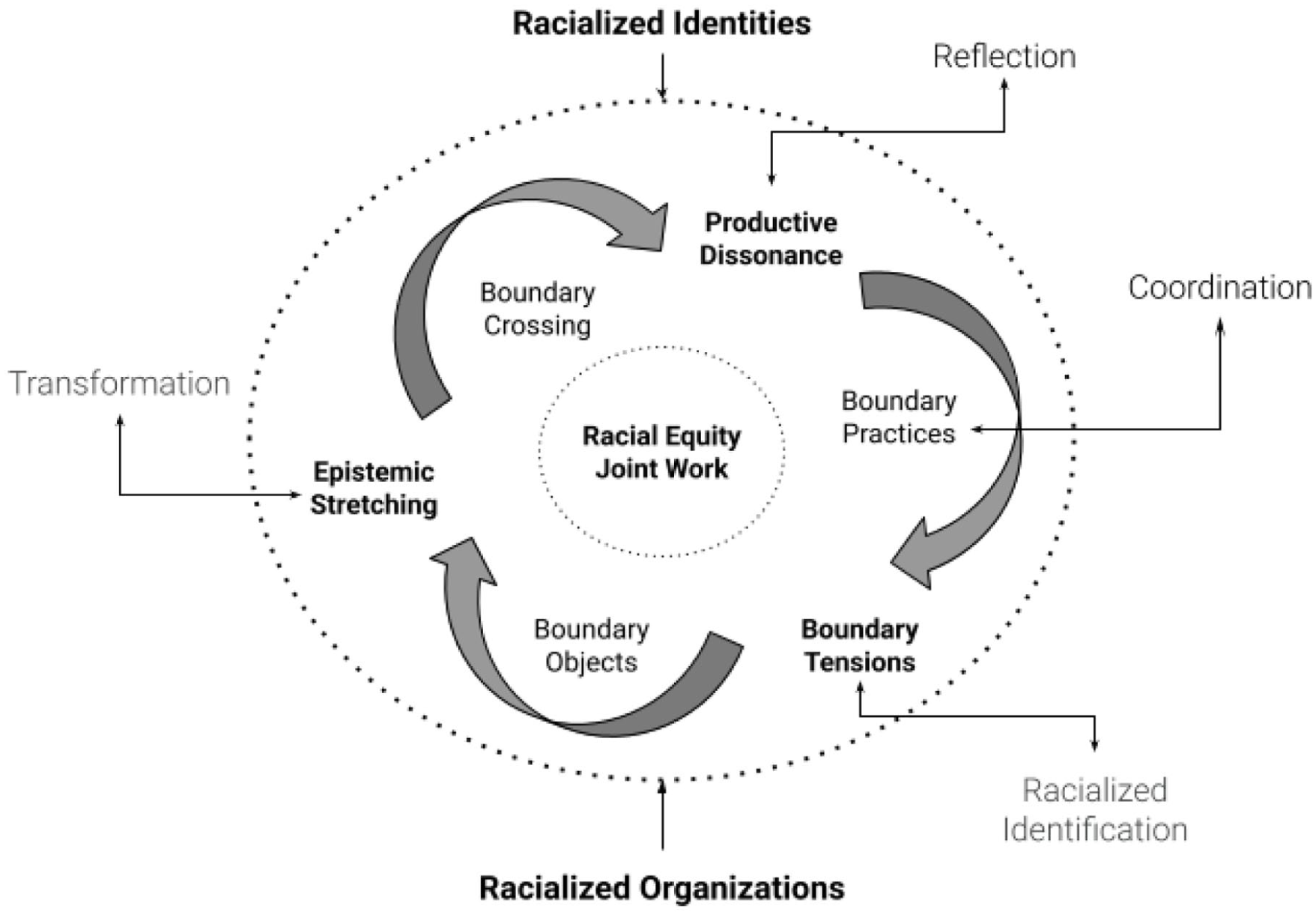
Racial equity joint work at boundaries: A framework for RPPs.
Joint Work
At the heart of effective RPPs is joint work—collaboration in which problems are co-defined, goals are mutually developed, and solutions to complex challenges, such as racial injustice, are iteratively designed and refined (Farrell et al., 2022; Penuel et al., 2015). It requires shared responsibility and responsiveness to community knowledge. We introduce the concept of “epistemic stretching” to describe how partners are pushed beyond dominant norms through vivid examples, cross-racial critique, and sustained collaboration. This process reflects the learning mechanism of transformation, as epistemic stretching pushes partners to rethink assumptions and reimagine practices. Epistemic stretching is relational and supported by boundary objects, critical dialogue, and engagement across differences.
Boundary Crossing
Boundary crossing involves navigating professional, cultural, racial, and institutional differences (Akkerman & Bakker, 2011). These crossings often entail encountering unfamiliar perspectives, challenging assumptions, and negotiating different timelines and decision-making norms (Penuel et al., 2015; Suchman, 1993). Effective boundary crossing entails deliberate moves—naming assumptions, translating concepts, reframing problems—that build shared understanding. We introduce productive dissonance as a mechanism for deep learning and knowledge building. Productive dissonance refers to the generative tension that arises when divergent perspectives can deepen racialized sensemaking. These crossings enact the learning mechanism of reflection when supported by trust and intentional boundary practices.
Boundary Practices
Boundary practices are the routines, relationships, and structures that support collaboration across systems—such as co-design meetings, data analysis sessions, and regular check-ins (Farrell et al., 2022; Penuel et al., 2015; Rigby et al., 2018). Such routines illustrate the learning mechanism of coordination, as partners negotiate tools, roles, and interpretations to sustain boundary practices that support joint work. These practices sustain joint work and create space for sensemaking, reflection, and adaptation. They can also intentionally foreground Black and Brown communities’ knowledge and lived experiences (R. J. Smith et al., 2023; Wilson et al., 2023). However, not all practices function as intended. Boundary tensions can arise when routines fail to surface or to repair harm, inadvertently reproducing hierarchies. These tensions can become sites where racialized learning is activated, as partners recognize how racialized identities and positionalities shape their meaning-making, participation, and how they navigate disagreements. Engaging with these tensions enables RPPs to refine practices to better support anti-racist learning and action.
Boundary Objects
Boundary objects—tools, frameworks, examples, data, protocols, visuals—anchor joint work across racialized and organizational differences (Penuel et al., 2015; Farrell et al., 2022). They help mediate knowledge to connect and ground partners, and encapsulate how shared meaning evolves over time (Akkerman & Bakker, 2011; Star, 2010). Objects provide shared reference points while allowing for multiple interpretations (Star & Griesemer, 1989). When used reflexively, boundary objects can surface critical questions, promote generative dialogue, and evolve alongside the partnership (Vakil et al., 2016).
Our Racial Equity-Centered Partnership
Our racialized research–practice partnership emerged from a shared commitment to confronting systemic racism in education and fostering collective knowledge-building and anti-racist leadership. Grounded in the belief that research and practice must be reimagined through racially just collaboration, our work centers trust, reflection, and co-construction of knowledge across racialized identities, roles, and forms of expertise. This study took place within the Technology Access Foundation (TAF), a Black women-led community-based organization in Washington State that partners with public schools to advance racial equity, STEM literacy, and project-based learning. TAF’s approach, rooted in liberation pedagogy, emphasizes student voice, community leadership, and the redistribution of power in educational systems.
Partnership activities analyzed here occurred within TAF’s structures, meetings, and collaborative design routines. The lead author, Lindsey, developed shared data-analysis structures to support collective analysis of secondary data. The primary participants—the authors—met regularly at TAF for joint design sessions and reflective conversations, while secondary participants (four White principals) engaged in TAF’s Ally Engagement professional learning series, also held at TAF. Lindsey collaborated closely with these principals during Ally Engagement and later followed them into their schools to observe how they attempted to take up their learning in practice.
Foundations of Our RPP
The Technology Access Foundation (TAF)—a Black women-led community-based organization co-founded in 1996 by Trish Millines Dziko—advances racial equity in education through whole-school transformation and its STEMbyTAF model. Through the Network for EdWork (NWEW), TAF supports Black and Brown educators (Education EnCounter) and engages White educators (Ally Engagement) in anti-racist leadership learning.
Our long-term partnership began through the University of Washington’s Community Partner Fellowship. Lindsey, a White community-engaged researcher, partnered with TAF for 2 years. Informal check-ins, weekly meetings, and co-planning sessions, guided by TAF’s motto, “Be your authentic self,” helped build trust and establish enduring relational routines. A couple of years later, Lindsey and David—a White Ally Engagement program manager—co-designed and co-facilitated Ally Engagement with the support of partners of Color (Amrita, Heather, and Patricia). Grounded in TAF’s Liberation Pedagogy and the wisdom of Black and Brown RPP members and scholars, this year-long, racial affinity-based learning intervention brought together more than 20 White educational leaders.
Our partnership was anchored in a shared understanding that racism is systemic—a structure that consistently advantages White people (Tatum, 1992) and is sustained through institutional policies, practices, and logics that marginalize nondominant groups (Gillborn, 1995; Paradies, 2006). From the outset, we committed to shifting racialized power dynamics by challenging systems that confer unearned privileges to White individuals and limit Black and Brown people’s access to decision-making and resources (Paradies, 2006). This shared grounding shaped our collaborative approach, rooting the work in historical and structural understandings of race and in the complexities and paradoxes inherent in anti-racist partnership.
Unpacking Positionality and Power Dynamics
Each partner entered this work with distinct racialized experiences, professional roles, and shared intersectional identities. Rather than viewing differences as obstacles, we recognized them as critical assets to our racial equity joint work. At the same time, we acknowledged the insidious nature of Whiteness and embedded power asymmetries, including White positionalities, institutional privilege, and patterns of color-evasiveness, that pose challenges, reproduce harm, and act as barriers to racial equity (Vakil et al., 2016). Staying in relationship with this tension was essential for our partnership. These dynamics shaped how we constructed and interpreted knowledge, designed Ally Engagement, and engaged in boundary work within our partnership.
Our core team comprised four TAF partners—three women of Color (Amrita, Heather, and Patricia) and one White man (David)—along with a White woman university partner (Lindsey). Each partner brought a unique combination of organizational roles, community relationships, and lived experiences informed by our intersectional identities. These differences influenced how we perceived needs, responded to challenges, and navigated systems of power (Vakil et al., 2016; Wegemer & Renick, 2021). At times, these differences generated friction or misunderstanding; at other times, they became vital sources of insight, reflection, and growth.
Lindsey is a White woman and collaborative education researcher whose racial positioning shaped how she interpreted data, the space she occupied in collaborative work, the influence she was often afforded in discussions, and how she engaged in boundary practices within the partnership. She understood that her analytic decisions and interactions could inadvertently recenter White norms and obscure the knowledge and experiences of partners of Color. Throughout the research process, Lindsey engaged in ongoing reflexivity, routinely interrogating whose interpretations were privileged, whose voices were centered, and how decisions influenced collective sensemaking. Collaborative data analysis sessions created intentional space for critique and examination, deepening the rigor and racial specificity of the team’s analysis.
David is a White man from a middle-class home with a background in social justice, documentary film, and early-childhood education. He currently serves as a Diversity, Equity, and Inclusion (DEI) facilitator and program manager at TAF. David’s commitment to racial equity stems from his awareness of both personal and societal injustices while growing up, as well as years working alongside and learning from BIPOC students, educators, and leaders. He is constantly grappling with how whiteness, patriarchy, and colonialism have shaped his own lens and role in institutions. He acknowledges that he holds significant privilege—particularly as a White man—and works to name, disrupt, and be accountable for how that privilege operates. His positionality pushes him to approach this work with humility, to listen deeply, and to center the experiences and leadership of those most impacted by systemic harm.
Amrita is a South Asian, cisgender woman of Punjabi-Sikh heritage. She comes from a working-class, immigrant family that worked the lumber mills and berry farms of British Columbia. As the daughter and granddaughter of settlers on unceded Indigenous lands in Canada, Amrita carries an awareness of the complexities of place, labor, and belonging. A former classroom teacher, she now serves as a program director working with BIPOC educators and leaders. Having been born, raised, and educated in Canada shapes how she engages with the constructs of race, ethnicity, and Indigeneity in the American context. This layered perspective drives her to critically examine the inherited and lived impacts of settler colonialism, invisibility of Asian communities, and anti-Blackness across borders. She holds a Master’s degree in social anthropology and intentionally centers the lived and living experiences of race and ethnicity through storytelling, relationship-building, and critical reflection.
Heather, an African-American woman, was raised by her white mother and educated in predominantly White institutions. She navigates complex intersections of identity, access, and belonging. Her lived experience spans from growing up in environments marked by poverty, food insecurity, and limited support to earning a doctorate from an Ivy League institution. This journey grounded her commitment to racial equity and sharpened her awareness of the privileges she holds and the structures she must interrogate. Heather understands how her upbringing and education may at times align her with dominant systems, and she strives to remain accountable in how she shows up in this work. Her perspective is shaped by both marginalization and access, and she aimed to honor the power and nuance of that duality in this partnership.
Patricia is a Black woman from Seattle, Washington—a city where navigating racism, systemic oppression, and microaggressions has been an inevitable part of her life. Her mother instilled an early awareness of her Blackness to prepare her for these realities. As a first-generation college student now pursuing her Master’s in Public Administration, Patricia is deepening her understanding of colonial legacies and socially constructed systems that perpetuate inequity. In her current role as Chief of Staff, she creates healthy, inclusive work environments through policy and operational initiatives, and she aspires to one day develop equitable public policies that uplift Black and Brown communities.
We foreground each person’s unique assets, knowledge, and experiences as we examine the racialized dynamics and boundary work that defined our partnership. In doing so, we intentionally resist the tendency to homogenize experience or reproduce essentialism. We honor the multiplicity, complexity, and relational depth that made this joint work possible.
Participatory Design Research
Our methodological approach draws on participatory design research (PDR), a strand of participatory action research, grounded in equity-centered sociocultural learning theories and collaborative design (Bang & Vossoughi, 2016). Rooted in emancipatory traditions, PDR can challenge hierarchical knowledge production by honoring the leadership, lived experiences, and epistemologies of communities historically excluded from research (Guishard, 2009; Vakil et al., 2016; Wilson et al., 2023). It foregrounds reflexivity and centers relational accountability and disrupting notions of researcher neutrality (Farrell et al., 2023; Guishard, 2009; Ishimaru et al., 2022; Kaiser et al., 2025; Tanksley & Estrada, 2022).
Participatory design research can support sustained co-design, reflection, learning, and knowledge construction across racialized boundaries, surfacing tensions, improving practices, and supporting joint work. Tensions are inherent in participatory traditions and often arise from differing assumptions, experiences, epistemologies, and expectations around roles or analysis (Wilson et al., 2023). These moments can deepen insights and generate new knowledge, especially when coupled with mutual trust and respect. As we demonstrate, boundary tensions can become catalysts for collective action and transformation.
Formative Intervention: Designing Ally Engagement
Within the PDR framework, we co-designed a formative intervention, Ally Engagement, drawing on TAF’s Liberation Pedagogy (TAF, 2021) and the principles of formative interventions (Sannino et al., 2018). Planning and refining the intervention intentionally created structured routines (e.g., reflective dialogue, co-analysis, planning structures) that allowed racialized tensions and boundary work to surface. Ally Engagement served as a key analytic site where we observed how we navigated racialized differences, engaged in joint problem-solving, and made sense of racial equity work across roles and identities.
Racial Equity Joint Work: Ally Engagement
Ally Engagement (a White affinity space), alongside Education EnCounter (a Black and Brown affinity space), functioned as a boundary space where community leadership, racial affinity work, and anti-racist design intersected. We focus on how this intervention generated real-time interactions that made boundary work visible—moments of productive dissonance, redistributions of interpretive power, and negotiations of racialized meaning. These interactions formed the empirical basis for analyzing how racialized boundary work took shape, how partners engaged across racial and organizational differences, and what forms of learning or transformation emerged. Thus, Ally Engagement operated not only as a design effort but also as a site of inquiry that illuminated the relational and epistemic dynamics central to this study.
Methods
The primary participants were the authors—one university researcher and four TAF leaders—who collaboratively engaged in ongoing RPP work focused on racial equity, organizational learning, and boundary work. As co-participants in joint design sessions, reflective conversations, and cross-boundary interactions, we generated the dataset analyzed in this paper. Secondary participants included four White principals in the Ally Engagement intervention whose interactions with TAF leaders and Lindsey informed our understanding of racialized tensions, sensemaking, and boundary crossings, even though they were not the central unit of analysis. 1
We defined the unit of analysis as the RPP core team as an activity system, rather than all individuals who participated in the RPP-designed activity. While White principals were participants in the Ally Engagement intervention and engaged in partnership-related work, they were not members of the core RPP activity system responsible for co-design and joint decision-making. Consistent with a CHAT approach, we focused analytically on partners who regularly participated in the RPP’s shared object-oriented activity (e.g., co-design sessions, routine joint data analysis, and partnership reflection routines). The principals, while deeply connected to the work, participated in an RPP-designed learning context rather than the collective activity system that generated and analyzed the data examined. We therefore conceptualize principals as participants in RPP-mediated activities, but not as members of the core RPP analytic unit. This distinction reflects our focus on how the partnership itself functioned as a site of knowledge co-construction, rather than on how RPP-designed learning traveled into practice.
Our observations and documentation emerged from participatory design research conducted with White educational leaders in Ally Engagement. More than 20 leaders participated in six, 6-hour cohort sessions (35+ hours total) designed to confront Whiteness, navigate resistance, and cultivate anti-racist leadership (Kaiser et al., 2025; Technology Access Foundation, 2021). This work enabled us to examine how racial equity-centered RPPs support White leaders’ learning while expanding possibilities for joint research–practice efforts in pursuit of educational justice.
We collected over 40 hours of partnership audio recordings and transcripts and analyzed them through iterative cycles of reflection, coding, and co-design. Data included four RPP data analysis sessions, 10 co-design planning meetings, and 11 reflection sessions and check-ins (28+ hours). Sources spanned monthly data analysis sessions, partnership reflections, documented needs and tensions, Ally Engagement and Education EnCounter planning meetings, and weekly RPP check-ins. Triangulating across these settings—TAF-based interactions, university-based interactions, and school-based enactments—we identified recurring patterns that refined and confirmed emerging interpretations. This methodological approach enabled examination of racialized dynamics, power structures, and boundary work within the partnership, supporting a nuanced understanding of how racial justice can be advanced.
Data Analysis
Our data analysis followed an iterative, multi-stage process consistent with qualitative analysis of interactional data and boundary work (Clarke & Braun, 2013; Penuel et al., 2015). We first reviewed all transcripts, memos, and fieldnotes to identify episodes of boundary work—moments involving the navigation of racialized differences, the negotiation of meaning, productive dissonance, or joint problem-solving. These episodes served as the unit of analysis.
Criteria for Boundary Practices
Drawing on CHAT and boundary learning scholarship, we coded an interaction as a boundary practice when it: (a) brought partners from different activity systems into contact around racialized differences; (b) required coordination of tools, routines, interpretations, or expertise; and (c) produced shifts in understanding, routines, or participation (Akkerman & Bakker, 2011; Penuel et al., 2015). These criteria distinguished boundary practices from routine exchanges contained within a single system.
Designed Versus Enacted Boundary Practices
We distinguished activities designed to support boundary crossing (e.g., co-design meetings, reflective dialogues, data sessions) from those that actually operated as boundary practices in enactment. We coded an interaction as a boundary practice only when the activity performed cross-boundary coordination, perspective-taking, or transformation in practice. Designed routines that did not surface harm, redistribute interpretive power, or foster collaboration were coded as boundary tensions. This distinction clarified not only when boundary practices succeeded but also when they reproduced racialized power dynamics.
Coding Procedures
Using open coding, we identified patterns related to boundary tensions, boundary crossings, identity work, and shifts in routines or interpretations (Akkerman & Bakker, 2011). Codes were compared across data sources to trace how partners made sense of racialized interactions and redistributed interpretive power. Through axial coding, we clustered these codes into categories—such as productive dissonance, equity essentialism, and transformative routines—and refined them through analytic memos and cross-episode comparisons (Miles et al., 2019). Guided by our conceptual framework (Akkerman & Bakker, 2011; Bang & Vossoughi, 2016; Farrell et al., 2022; Penuel et al., 2015), we moved from broad descriptive codes to more focused analytic categories, which ultimately shaped the three themes in the Findings.
Codes that embodied the learning mechanism of reflection, like discomfort, hesitation, and interpretive disconnect, became the analytic category of productive dissonance, informing the theme nuances of privilege and potential pitfalls.
Codes that embodied the learning mechanism of coordination and transformation related to joint design, planning routines, and data interpretation formed boundary practices, illuminating the theme of affordances and constraints of racial affinity spaces.
Codes that aligned with the learning mechanism of identification included silence, minimizing harm, and unresolved disagreement, which consolidated into boundary tensions, informing the theme (in)attention to harm as a site of learning and accountability.
Collaborative Analytic Process
Our coding process was distributed and collaborative. Initial coding was led by Lindsey, who conducted a first cycle of open coding across the dataset to identify patterns related to boundary tensions, crossings, and shifts in interpretation. These initial codes and analytic memos were then brought into collective data analysis sessions with the RPP core team, where we reviewed selected excerpts and emerging interpretations together.
We engaged in joint analysis on shared focal episodes, using discussions to refine codes, challenge interpretations, and deepen racialized sensemaking. Coding discrepancies and divergent interpretations (e.g., conversations about the rainfall showerhead or appropriate levels of principal preparation) arose through differences in interpretation during collaborative analysis sessions. These moments were treated as generative and were addressed through team discussions, memoing, and iterative refinement of analytic categories. Consistent with participatory design research, our coding was collaborative and dialogic (Bang & Vossoughi, 2016), supporting collective sensemaking across positionalities and lived experiences and deepening our racialized understandings.
Finally, we recognize that our dual roles as both participants and analysts shaped how we interpreted data and constructed meaning (Eriksson et al., 2012; Wegemer & Renick, 2021). To support the rigor of our analysis, we engaged in ongoing critical reflexivity, collaborative sensemaking, and member checking (McKim, 2023). At the same time, our perspectives are informed by our racialized identities and positions with our RPP. We take up these considerations for limitations more fully in the implications section.
Findings
To orient our analysis, we asked a central guiding question: How did racialized boundary work unfold in our partnership, and what forms of learning and transformation became possible through joint work across racialized, epistemic, and organizational differences? The three themes that follow illustrate how racialized boundary crossing, practices, and objects shaped our partnership, and what forms of learning and transformation became possible. These insights emerged through collective meaning-making rather than through the researcher’s observation of community partners, and they reflect our shared effort to honor the voices, tensions, and contributions each partner brought to the work.
The Nuances of Privilege and Potential Pitfalls That Can Dilute Anti-Racist Work
For many White people, applying a racialized lens can be a powerful tool for naming and addressing racial injustice (Kaiser et al., 2025). However, through our routine data analysis sessions and discussions of White principals’ racial learning from Ally Engagement and application of theory to practice, we surfaced a concern. When a racialized lens is extended to other forms of marginalization, its specificity can be diluted, potentially causing unintended harm. This tension became evident during a January data analysis session, when Lindsey shared themes emerging from our qualitative data. One theme involved how some White principals in the Ally Engagement intervention described using a “racialized lens” in broader equity contexts.
For example, one White principal paused a staff community-building activity and said, “Wait—before we begin, we need to make sure our deaf and hard-of-hearing staff can fully engage. How many sign language interpreters do we have?” Three people raised their hands. The principal then asked, “How might we organize this activity?” A deaf staff member suggested setting up three stations, one per interpreter, allowing those who are deaf or hard of hearing to rotate between them. Another person proposed using lights to signal when to start and stop the activity. The principal replied, “Great idea! How does that sound to everyone?” They then facilitated a collaborative redesign of the meeting to center accessibility for deaf and hard-of-hearing staff. When Lindsey later asked the principal about this decision to interrupt the team-building activity, the principal said they had “transferred applying a racialized lens” to disability.
In one of our RPP data analysis sessions, partners examined this data point and entered into a nuanced discussion about the risks and implications of that transfer. Heather offered a caution: “It could be harmful to put everything in one bucket.” Amrita added that conflating race with other forms of marginalization could “convolute” racialized experiences. Patricia drew an important distinction: “If a principal stopped a meeting to accommodate deaf and hard-of-hearing staff, that would be seen as accommodating. But if they said, ‘Let’s talk about how we support Black and Brown colleagues,’ it could be more harmful than helpful.”
Our conversation surfaced a critical truth: while accommodations may be viewed as neutral logistical fixes, racial justice required grappling with entrenched histories of systemic harm. Lindsey was reminded of the danger of flattening the work. If privilege is only viewed as a generalized concept, detached from the specificity of race, then the sharp edges of racial injustice can be smoothed into invisibility, and the nuances of different forms of privilege and disadvantage can be overlooked. Heather anchored this concern by referencing the recent murder of Tyree Nichols, a Black man fatally beaten by police officers just 3 weeks earlier, and asked, “If this staff meeting were happening today, would this principal stop everything and say, ‘I want to make sure our Black teachers are feeling supported right now’?” Many people would not question ensuring accessibility for deaf and hard-of-hearing staff, yet conversations about race can often trigger discomfort, avoidance, and defensiveness. The emotional and systemic weight of racism makes racial justice work distinct from other equity efforts.
David added, “There is no such thing as a neutral lens. Period. This non-neutrality is especially harmful when it comes to race and professed colorblindness.” His reflections highlight that even our best intentions are shaped by a racialized system. This data analysis session and our discussion emphasized that the work is not to broaden a racialized lens aimlessly or at random, but to ensure we hold space for specificity, recognizing that while oppression intersects, racial injustice is distinct from other systems of advantage and disadvantage and has different roots and impacts.
Equity Essentialism
This instance illustrated how boundary practices in RPPs can become transformative routines that resist the dilution of racial equity work and challenge what we call equity essentialism—the tendency to collapse all forms of injustice into a single category. Such flattening mirrors color-evasive beliefs and practices, obscures the specificity of racial harm, and erases the distinct histories and impacts of racism. In contrast, an intersectional lens reveals layered and interacting forms of oppression. Transformative routines emerged through epistemic stretching when partners collectively pushed back against equity essentialism, reinterpreted racial tensions, and generated new racialized understandings and practices. Our collaborative data analysis sessions served as intentional boundary practices, bringing together a researcher and community partners across boundaries to interpret data and navigate conceptual tensions. These discussions surfaced concerns about White principals applying a racialized lens so broadly that it blurred racial specificity.
Leaning Into Tensions
Drawing on scholarship on design tensions (Tatar, 2007) and organizational paradoxes (W. K. Smith & Lewis, 2011), we approached RPP tensions as necessary and generative—revealing competing commitments and interpretations within our joint work. Leaning into these tensions allowed us to hold specificity and complexity, recognizing that equity work requires sitting with competing perspectives. Naming and working through these tensions became a site for deepening racialized sensemaking.
Boundary objects—such as data themes, practitioner reflections, and theoretical constructs, such as a racialized lens—played a central role in mediating knowledge and prompting critical inquiry. Because they carry embedded assumptions about race, identity, and justice, these objects served as anchors for collective meaning-making and sites of generative tension. For example, attempts to transfer a racialized lens to other forms of marginalization sparked reflection on the risks of equity essentialism. When interrogated, boundary objects challenged dominant epistemologies and supported more racially specific interpretations of data and practice. Our willingness to engage these tensions and grapple with racial harm revealed the potential of RPPs when boundaries are navigated intentionally and critically.
When Lindsey shared this principal’s account of applying a racialized lens to redesign a meeting for deaf and hard-of-hearing staff, it initially appeared to be a promising example of how anti-racist practices can extend to other historically marginalized groups. Yet, as our RPP team engaged in deeper discussions and reflections about the data, our varied perspectives created what we call productive dissonance. This generative tension arises when individuals with different perspectives, identities, or lived experiences navigate disagreements or conflicting interpretations. Dissonance can become productive when it sparks critical reflection, challenges assumptions, and leads to deeper learning or new insights. Heather raised concerns about collapsing forms of marginalization, Amrita noted the risk of conflating race with other forms of oppression, and Patricia unpacked the different reactions to disability accommodations versus racial justice efforts. We treated this moment as an opportunity to critically reflect on how racial equity work could be diluted when generalized into broader equity discourses. Moments of dissonance are characteristics of boundary crossing—ongoing negotiations and co-construction of meaning across difference.
A Rainfall Showerhead
Ta-Nehisi Coates (2024) reminds us that we cannot act upon what we cannot see. To help White principals in Ally Engagement begin to unearth the insidious nature of White supremacy in everyday life, Lindsey introduced a rainfall showerhead to illustrate the surreptitious tendencies of Whiteness. She referenced an image shared by a Black individual who posted on social media, “Tell me how this rainfall showerhead is discriminatory.” On the surface, it appears race-neutral, but upon further examination, we can see that everyday structures can uphold White supremacy. While this might be an extreme example, Lindsey wanted to create a lasting image for White people to help reveal that racism has been institutionalized, making it difficult to notice and name. López (2003) explains that people often fail to recognize racism in their work because their perspectives are not tuned to see it in daily life. This work requires actively interrogating and dismantling color-evasive structures. During an RPP data analysis session, we recounted this moment. Patricia shared, This example has stayed with me. As a Black woman, I hadn’t thought about it. I can put on a shower cap and make it work. Maybe it’s not a big deal, but it got me thinking, what else don’t we see?
While a rainfall showerhead might seem like an extreme case of structural racism, this benign object provided a compelling illustration of color-evasiveness (Bonilla-Silva, 2021). It illustrated that Whiteness is more than an identity; it is a system that operates invisibly. As Amrita added, “I can’t look at a showerhead the same. It is the water we are all swimming in, and we don’t recognize all the things.”
Our reflections illustrated how race-neutral structures can carry racialized impacts. It is about recognizing how Whiteness operates systematically—through design, norms, expectations, and omissions. School policies, practices, ideologies, curriculum, organizational routines, and norms within school systems are often not explicitly racialized; however, the ways they are enacted and experienced are deeply racialized. As we discussed this example, we realized that making structural racism visible required vivid and memorable prompts. The showerhead example stayed with us because it revealed how easily Whiteness becomes invisible. Structural racism, as Bonilla-Silva (2021) reminds us, is institutionalized and is often perceived as invisible. It is the default, the taken-for-granted background. To disrupt it, we must learn to see it. We understood that using a seemingly neutral object to highlight deeper racial inequities could compel people to sharpen their perception and critically examine their surroundings for embedded systems of racial advantage and disadvantage within schools.
The rainfall showerhead example functioned as a boundary object that surfaced the invisibility of Whiteness, bridging perspectives and prompting us to interrogate what is often perceived as invisible, systemic manifestations of Whiteness in everyday objects and routines. The seemingly race-neutral showerhead became a shared reference point that allowed us, from varying racialized identities, to engage in deeper, critical conversations about structural racism’s subtle yet pervasive presence, and revealed the need to sharpen racial noticing. Patricia’s reflection acknowledged the lasting impact of the example, showing the power of boundary objects to surface systems of color-evasiveness. This boundary object fostered boundary crossing. As Amrita shared, the rainfall showerhead reshaped her perception of the ubiquity and invisibility of Whiteness. Through boundary-crossing conversations, we navigated differences and leveraged these moments as opportunities for mutual learning and the co-creation of knowledge.
Affordances and Constraints of Racial Affinity Spaces
Racialized identities shape experiences, perspectives, and worldviews. Moreover, they shape how individuals engage with racial equity work. Affinity spaces offer crucial opportunities for healing, growth, and building racial learning—especially for White people learning to see and name Whiteness and their roles within systems of advantage and disadvantage. These spaces helped displace the burden of educating White people and allowed White individuals to process and build capacity without causing direct harm to people of Color. At the same time, we reflected on the limitations of racial affinity spaces. Lindsey raised a concern: “It’s not uncommon to go into schools and see equity teams comprised of all White people.” David and I, both White facilitators of Ally Engagement, recognized that our leadership in White affinity spaces reified the very power structures we sought to challenge. David noted: For White people, racial equity work is about “Leading for Liberation.” But we’re still learning what that means. A big challenge is translating our identity work into [Ally Engagement] curriculum and action in real time. How do we do that in a way that doesn’t perpetuate harm? We had to ask ourselves, what did we do well, and what could we have done better? Affinity spaces are vital for self-reflection and personal growth, but we can’t have conversations about systemic change without cross-racial collaboration. We need to bring Black and Brown affinity spaces and White affinity spaces together when that’s in the best interest of people of Color.
We began to imagine this work like an accordion—sometimes affinity, sometimes in multi-racial collaboration spaces—stretching and contracting with the rhythms of the work. Stretching can be uncomfortable and a necessary catalyst for growth. It can help us reflect on our roles, our complicity, and our possibilities. Changes in racial perspectives are not simply a function of cross-racial interactions, but also of the quality of those interactions (Cabrera, 2014). These dynamics remind us that racial learning is an iterative process shaped not just by who is in the room, but also by how we engage, reflect, and grow alongside one another. David emphasized that White people should not be isolated in discussions aimed at creating institutional change. Authentic relationships and meaningful conversations with Black and Brown people are essential. This dialogic reflection became sites of epistemic stretching—the intellectual and emotional labor of negotiating power structures, knowledge, and accountability across racialized boundaries.
In a reflection session, we further unpacked the paradoxes of racial affinity spaces and discussed their importance and limitations. Amrita explained this tension: Some of the stuff that was happening in Ally Engagement, like community-based equity audits and community-asset mapping without the voice of their Black and Brown colleagues, [made me wonder] how transformative things were [for White educational leaders]? Or did it just continue to center Whiteness in those activities? What we’ve learned is that there are some activities we have to do together [Ally Engagement and Education Encounter] because when people are coming into their schools to do these assessments, budget, or school schedules—I’m assuming people are coming together with a diverse team to do that.
Amrita’s point revealed a boundary tension in our work: while racial affinity spaces for White educational leaders offered necessary conditions for critical reflection, intrapersonal work, and accountability, they are not sufficient on their own. There must also be multiracial spaces where decisions are made collaboratively, and relational accountability is practiced. She reflected, “Both racial affinity spaces and multiracial collaborative spaces are necessary to drive racial equity work forward.” David echoed this, noting that “There is merit to both racial affinity spaces and multiracial collaboration. And we need to continue to build on that work of collaboration—getting people together in the same room to make decisions.” In this way, racial affinity spaces operated as boundary practices—structures that enabled deep identity work among White participants—and as boundary objects that held shared meaning but were engaged with differently depending on racialized identities. This reflection also surfaced a larger dilemma: nationally, nearly 80% of educators are White, while only 46% of students are White (Schaeffer, 2024). David considered how facilitators might model “productive dialogues, exchanges, and practices” in multiracial spaces in ways that do not “compromise the space for people of Color.” He also pointed out that: The original conception of Liberation Pedagogy was much more about the internal work that was needed. Helping Black and Brown people to start unpacking and pushing back on their own internalized thoughts, and [what they are] holding, and coming from being harmed by White supremacy culture. And yet, we as a team have been tasked with building something that’s more actionable and systemic—creating objectives and initiatives focused on outward-facing actions, which in reality was never the point [of Liberation Pedagogy].
These reflections reveal multiple boundary tensions in our partnership: between critical reflection and action, between affinity spaces and meaningful multiracial collaboration, and between individual identity work and organizational change. This tension involved deliberate boundary crossings—moments of reckoning with our roles, relationships, and positionalities—and grappling with boundary objects like Liberation Pedagogy. It also revealed the need for meaningful boundary practices, such as routine reflection processes, carefully designed multiracial co-design spaces, and regular calibration conversations that surface harm and realign commitments. Navigating the paradoxes of racial affinity and multiracial collaborations became a site of epistemic stretching.
(In)attention to Harm as a Site of Learning and Accountability
In a culture of White supremacy, Amrita reminded us, “Harm will always happen in this work. There will never be a space where everyone’s safety is guaranteed.” This was evident during a multi-racial learning space with Ally Engagement and Education Encounter participants, and led by the Educational Leaders Consortium (ELC). The session facilitators shared an article about a White mother with a Black child who needed to decide which school their child should attend. The article illustrated components of White saviorism and framed the White mother as a savior in relation to Black schools and families. However, this framing was never explicitly brought up or critically interrogated. White participants did not name this harm nor this deficit-based perspective. Black and Brown colleagues later shared with Amrita that this interaction had caused harm. Amrita reflected, I found it strange that we [TAF, ELC, and a university partner] came together to plan, yet no one addressed the elephant in the room—the harm caused by that article. This is exactly why we need to do this work together. Where was the source pulled from? This article should have been questioned. Without collaboration and deep racial literacy, harm goes unnamed. And it wasn’t revisited. It should have been.
Address the Elephant in the Room
Amrita challenged us to think about silence, failure to act, and missed opportunities for learning. Even when harm is unintended and driven by good intentions, failing to name it maintains it. For many White people, this harm can be minimized or dismissed under the guise of “good intentions,” which can get in the way of progress. In a culture of White supremacy, doing nothing sustains systems of harm, and paradoxically, White people’s stasis can reinforce the very structures they aim to disrupt. Amrita’s comments reminded us that growth comes from reflection, accountability, and response, not perfection. The more one engages and critically reflects, the more one can learn, grow, and work to reduce harm.
This moment surfaced racial learning about the tensions of boundary work in racial equity-centered RPPs. It highlighted the critical role boundary practices play in surfacing harm, fostering accountability, and ensuring spaces are responsive to racial dynamics. Our inability to explicitly notice, name, and interrogate the harm caused by the article revealed gaps in our practices. While structures such as co-design meetings and collaborative sessions were in place, these practices may have fallen short because of a lack of boundary practices to help us interrogate another community partner’s racial harm. How might we have intentionally embedded practices such as routine “harm check-ins” or reflective pauses dedicated explicitly to racial literacy and harm acknowledgment? Would these practices have strengthened our partnership’s capacity to engage critically and responsively?
Boundary crossing emphasized the importance of actively navigating and confronting racial tensions. Although multiple racial identities were represented at the planning table, we failed to act and address harm. Lindsey and David, in particular, did not invest the necessary time and energy in addressing the harm in Ally Engagement, missing a critical opportunity to demonstrate anti-racist leadership, rebuild trust, and model the racial accountability we sought to cultivate within our RPP. Amrita’s reflection reveals the need for intentional boundary-crossing moves, such as naming implicit biases and harm, and unpacking problematic, deficit-based narratives in real time. Our learning highlights the need to cultivate boundary-crossing strategies rooted in courage, humility, and the responsibility to confront racial harm as it arises.
This boundary object—the article presented during the ELC session—shaped our understanding but required a more deliberate, reflective engagement. The article unintentionally served as a boundary object that created harm and surfaced divergent racialized interpretations, and was not leveraged to facilitate generative dialogue. Reflecting on this, we recognize the need to intentionally interrogate boundary objects and engage in conversations with principals and partners. Incorporating reflective protocols and guiding questions focused on racial equity could have created the conditions for this boundary object to catalyze growth and reduce harm.
Implications: Stretching the Boundaries of RPPs
Designing for Racial Equity Through Joint Work
The findings from our study have powerful implications for RPPs, particularly those committed to advancing racial equity, co-producing knowledge, and collective learning. Racialized RPPs can serve as sites of meaningful disruption and growth. Our study emphasizes that RPPs must be deliberately designed to support boundary crossing, cultivate shared understanding, and surface power asymmetries (Farrell et al., 2023; Tanksley & Estrada, 2022; Vakil et al., 2016). This requires embedding boundary objects, practices, and crossing into the very infrastructure of the partnership.
Boundary objects—like the rainfall showerhead—enabled us to challenge color-evasive norms and co-construct shared meaning across lines of racial, experiential, and institutional difference. Similarly, boundary practices such as reflective data analysis sessions, co-design meetings, and routine debriefs created space to interrogate routines and reveal hidden racialized structures.
Equally important were opportunities for intentional boundary crossing. When grounded in relational trust, transparency, and gratitude, these cross-racial and cross-role interactions became sites of transformation. They allowed us to engage differences as a generative resource. Our findings suggest that deliberately structured routine interactions across racial differences can deepen shared understandings of race, racism, and anti-racism. Boundary crossing required curiosity, humility, and a willingness to engage with different ways of knowing and being. As our joint work developed, these crossings often surfaced moments of productive dissonance—tensions that, when supported by trust and boundary practices, can deepen reflection, creativity, and growth.
At one of our data analysis sessions, partners reflected on what we learned together. Lindsey noted, “We are constantly learning in this partnership space. We each bring a set of knowledge and skills. We’ve collectively partnered to design learning interventions and then redesign them based on what we learn.” David offered a powerful reflection on how his understanding of research shifted: One of the lessons that I’ve learned from our partnership is the importance of frequent and regular check-ins. I think having that real-time, responsive piece helped shape and pivot our design and programming. Our weekly check-ins created cohesion and intentionality around next steps. The other piece, for me, is that research doesn’t have to be static. There are other ways to conduct it, where the researcher is involved in a way that shapes the process. That to me is a new idea. I used to think of science as objective and hands-off. Regarding transparency with participants in our study, they were very aware of the process and influenced how Ally Engagement was shaped. For me, it’s a learning curve of what research can be, counter to how it’s often used in more traditional, mainstream approaches.
David’s reflection signals epistemic stretching—from research as a distant and extractive to research as participatory, relational, and formative. This reimagining responds to longstanding critiques that educational research has been disconnected from practice, thereby siloing research and practice, stalling knowledge creation, and reinforcing systemic inequities (Penuel et al., 2015). David’s shift reflects the need to adopt research approaches grounded in justice, reflexivity, and shared governance. By engaging in iterative, humanizing, and practice-embedded research, RPPs can begin to acknowledge and repair harm and the racialized power structures that have long shaped the education research field, and foster dignity-affirming approaches of knowledge co-creation.
Differences as Strengths
Amrita emphasized how our varied racial identities, roles, and personal and professional experiences strengthened our joint work: I think that what helped our partnership was that we were all doing anti-racism work, but coming from different avenues. Lindsey came from the university; David and I came from the school system and then from TAF. These experiences shaped our design of [Education Encounter and Ally Engagement]. We each helped one another think through different approaches. Lindsey brought in knowledge and conversations from the university and translated those into programming needs.
Lindsey echoed this: “We all brought individual talents, skills, and knowledge into this space. Our racialized identities and how we positioned ourselves in the work were valuable. These differences continued to shape how we approached the work.” Our differences—in racial identity, institutional background, experiences, and expertise—were our strengths and assets (R. J. Smith et al., 2023; Vetter et al., 2022). They were sources of knowledge creation that deepened our learning, expanded our perspectives, and fueled creativity. These moments of boundary tension, when assumptions were challenged, invited critical reflection. When acknowledged and engaged, they allowed the partnership to better support anti-racist learning and action. Boundary work across identity, role, and power structures became both the means and the outcome of our partnership.
Researchers need to consider the importance of methodological approaches that explicitly engage with racialized power dynamics and their manifestations in collaborative knowledge-making spaces (Denner et al., 2019; Farrell et al., 2023; Vetter et al., 2022). Participatory design research offers ways to disrupt traditional hierarchical knowledge production and foster co-creation and meaningful relationships (Bang & Vossoughi, 2016). Researchers must adopt reflexive practices, continuously interrogating their role, racialized identity, and power dynamics within partnership boundaries to disrupt racial inequities.
Given the persistent racial disconnect between educators and students (Irby, 2021; Kaiser et al., 2025), researchers, community-based organizations, and school districts should explore how RPPs can serve as powerful vehicles for advancing racial equity through joint work—particularly through boundary-spanning practices that foster shared learning and transformative change. Cultivating spaces of boundary crossing and critical conversations across differences is necessary for growth, knowledge co-creation, and working toward anti-racist system-level change (Akkerman & Bakker, 2011; Penuel et al., 2015). Sustained routines—such as collaborative meetings, co-design, joint data analysis sessions, and intentional use of boundary objects—can facilitate deep learning and build knowledge.
Boundary work cannot be a performative act or solely focused on White people’s learning at the expense of Black and Brown partners. White partners must actively engage in independent racial identity work and in racial affinity learning spaces to continuously unlearn and unpack racialized power structures, deepen historical understandings, and reduce the potential to cause harm, ensuring that collaboration in RPPs at the edge of boundaries is genuine, reciprocal, and mutually beneficial (Kaiser et al., 2025).
Our research reveals that RPPs can create critical spaces for transformative learning. The ongoing negotiation, reflexivity, and trusting relationships required by these partnerships are necessary for meaningful anti-racist action (Denner et al., 2019; Teeters & Jurow, 2022; R. J. Smith et al., 2023). To support boundary work, partners must continuously navigate complexities, challenges entrenched in White supremacy, power asymmetries, and co-construct actionable pathways toward racial justice. Across our partnership, we saw evidence of all four mechanisms of boundary learning —identity-based racialized tensions and identity work (identification), boundary practices (coordination), productive dissonance (reflection), and transformative routines (transformation; Akkerman & Bakker, 2011)—each of which played a role in supporting racialized learning and the emergence of more racially just practices.
Across findings, we revealed that boundary crossing and racial equity joint work required co-creating not only new strategies—such as reflective routines, examples, and data analysis sessions—but also new ways of seeing. We developed a shared understanding of the need to name and address racial harm, refined practices for distinguishing intersectional oppression without flattening racism. We reconceptualized affinity and multiracial spaces that are responsive to relational needs and systemic change. Boundary practices (e.g., joint data analysis sessions, routine reflection on racial harm) and boundary objects (e.g., the rainfall showerhead example) facilitated the spanning of racialized boundaries; power structures supported our joint work in building racial learning. Through these practices, we experienced epistemic stretching—seeking to push beyond dominant knowledge systems toward more humanizing, justice-centered approaches.
Our study contributes to a growing body of scholarship that calls for context-driven engagement with racialized power dynamics within RPP (Denner et al., 2019; Diamond, 2021; Doucet, 2021; Gist et al., 2024; Ishimaru et al., 2022; Penuel & Watkins, 2019; R. J. Smith et al., 2023; Tanksley & Estrada, 2022; Vetter et al., 2022; Wilson et al., 2023). We sought to push the boundaries of what RPPs can be, do, and produce in pursuit of racial justice, finding that racial equity joint work at the edges can open new possibilities for knowledge creation, learning interventions, and more equitable partnership practices.
Limitations and Future Research
We held dual positions as both participants and analysts (Eriksson et al., 2012; Wegemer & Renick, 2021). While our insider positioning enabled deep and contextually grounded insight into boundary work, it also shaped how we interpreted the data. We addressed this through ongoing reflexivity, collaborative analysis, and engagement with multiple perspectives across racialized identities and roles. We treated moments of tension and disagreement as a part of the analysis process. However, our interpretations are inevitably shaped by our positionalities, relationships, roles, and commitments within the partnership.
A second limitation concerns our analytic focus on the RPP core team as the primary unit of analysis. Although interactions with White principals in the Ally Engagement intervention informed our understanding of boundary tensions and learning, their perspectives are partial and mediated through our interpretations. As a result, this study privileges intra-partnership sensemaking and may obscure how boundary work is experienced, taken up, or resisted in schools. At the same time, centering the RPP as the unit of analysis enabled us to examine and theorize the infrastructural conditions of racial equity-centered partnerships. Future research that more fully centers principals’ experiences in relation to an RPP would provide a fuller picture of how boundary work extends into schools.
Finally, our findings are situated within a long-term, equity-centered RPP grounded in a racially diverse community-based nonprofit organization, the Technology Access Foundation (TAF). While our findings offer analytically transferable insights (Lincoln & Guba, 1985), concepts such as productive dissonance, epistemic stretching, and equity essentialism may take shape differently across RPPs, depending on local histories, relationships, and power dynamics.
Stretching Toward Racial Justice
The insights forged through trust, relationships, accountability, and tensions reflect what we learned together, and the ongoing work of stretching ourselves toward deeper racial justice. RPPs committed to joint work must attend to racialized power asymmetries and recognize each partner’s unique knowledge, responsibilities, and positionality. This work entails intentionally creating boundary objects, implementing boundary practices, and engaging in boundary crossing, with care and humility (Teeters & Jurow, 2022). Amrita reflected, “How we negotiate our racial identities and exercise racial literacy in this work will always be a messy process, but there is powerful learning that can take place at boundaries, especially across knowledge-holding and producing boundaries.” When navigated with trust and accountability, moments of tension can be catalysts for more racially just relationships and practices that ripple outward from the partnership into school systems.
Footnotes
Acknowledgements
I extend my deepest gratitude to David, Amrita, Heather, Patricia, Trish, and the entire Technology Access Foundation (TAF) team, whose leadership, knowledge, and wisdom shaped this work. I am truly grateful for the partnership we have built. I also thank the educational leaders who participated in Ally Engagement for their openness, vulnerability, and courage. This work was made possible through your insight, leadership, and commitment to the ongoing pursuit of racial justice.

Funding
The authors received no financial support for the research, authorship, and/or publication of this article.
Declaration of Conflicting Interests
The authors declared no potential conflicts of interest with respect to the research, authorship, and/or publication of this article.