






Abstract
Motivated by recent tragedies highlighting teacher stress stemming from parental demands, this study examines the relationships among teacher–parent communication, teacher autonomy, principal leadership, and well-being in South Korea. Using data from the Programme for International Student Assessment (PISA 2022) with school fixed-effects models, we find that increased hours spent communicating with parents are negatively associated with multiple dimensions of teacher well-being. Furthermore, we uncover a critical autonomy paradox: Although perceived autonomy generally enhances well-being, high levels of autonomy significantly exacerbate the negative association between communication hours and well-being. We also reveal that strong principal instructional leadership fails to mitigate this paradox and may even intensify the perceived burden. These findings challenge the assumption that autonomy and leadership function as protective resources. Instead, within high-pressure contexts and bureaucratic systems, autonomy and leadership may operate as managerial devices and sources of personal liability, characterized by isolated responsibility rather than professional support.
Keywords
Introduction
Teacher well-being has emerged as a major global concern and a pressing issue in South Korea (hereafter Korea; Baker et al., 2021; Choi, 2024; King et al., 2023). National survey evidence points to a sharp decline in job satisfaction among Korean teachers: In 2024, only about one in five reported being satisfied with their job, and just 19.7% said that they would choose teaching again (Korean Federation of Teachers’ Associations, 2024). Media and administrative reports have likewise drawn heightened attention to teachers’ mental health and well-being, including reports of 168 teacher suicides between 2015 and August 2024 (Choi, 2024). This well-being crisis has profound implications not only for teachers’ professional and personal lives but also for the broader school community (Collie, 2023; Dreer, 2023; Harding et al., 2019). Although teacher well-being is shaped by multiple factors (Hascher & Waber, 2021), parental complaints and demands—often persistent, excessive, and emotionally charged—have been consistently reported as a growing source of strain in recent years, prompting renewed academic and public attention to how such communication shapes teachers’ work and well-being (Y. Park, 2024; Yang et al., 2025; Yeung et al., 2023).
These challenges must be understood within broader societal and cultural transformations. Historically, teacher–parent relations in Korea were grounded in strong professional authority and deference to teachers. As illustrated in the Tian dao of Zhuangzi (ca. 370–300 B.C.E.), students should not even step on the shadow of the teacher, and parents would keep a low profile in their presence—an image that underscores the profound reverence once characterizing teacher–student and teacher–parent relationships. However, extensive shifts in global education trends—including market-oriented reforms and intensified accountability—have challenged conventional professional boundaries (Hargreaves, 2000b). In Korea, these global shifts coupled with demographic shifts—including the rise of single-child households—have weakened the Confucian values that traditionally secured teacher authority in Korea, transforming parents into influential actors who increasingly engage in—and at times challenge—teachers’ professional decision making (Jang et al., 2023; Kwon & Kim, 2015; Shin, 2020). As a result, teacher–parent communication now frequently extends beyond routine updates to include instructional decisions, assessment practices, classroom management, and even after-hours interactions (Gong, 2023; Lee & Kim, 2017; Lee et al., 2023). While these challenges are deeply rooted in the changing Korean cultural landscape, they mirror a broader international trend in marketized education systems, where parental influence has expanded significantly (Addi-Raccah & Arviv-Elyashiv, 2008; Munthe & Westergård, 2023). This creates a central tension: While teachers are expected to build strong home–school relationships (Epstein, 2019; Y. Kim, 2022), they simultaneously face the challenge of maintaining professional distance and safeguarding boundaries for their own well-being.
Scholarship positions teacher autonomy as a cornerstone of professionalism that buffers external pressures and supports well-being (Hargreaves, 2000a; Ingersoll, 2006). Autonomy is theorized to protect professional boundaries from overbearing parental influence, fostering intrinsic motivation and well-being (Lasky, 2000; Ryan & Deci, 2000; Wermke & Höstfält, 2014). Empirical research corroborates this, linking greater autonomy to stronger professional identity and higher job satisfaction (Kim, 2024; Zhang et al., 2021). Policy and research in Korea likewise have emphasized autonomy as key professional capital for school improvement and teacher development, seeking to ensure that educators maintain a high level of discretion (Yang et al., 2016).
However, autonomy possesses an inherently dualistic nature—autos (“self-directed”) and nomos (“norm governed”)—that highlights the capacity to make independent decisions within bounded contexts and systems (Bertea, 2023; Nguyen & Walkinshaw, 2018). This dualism, often referred to as the autonomy paradox, indicates that the benefits of autonomy are highly contingent on the context in which it is enacted (Bertea, 2023; Wermke & Salokangas, 2021). Because teacher autonomy is fundamentally relational—negotiated through interactions within the school community—it can function as a double-edged sword for well-being when granted amid intense external pressure, professional isolation, or a culture that internalizes accountability (Chang, 2026). In such high-pressure contexts, autonomy may fail to shield teachers from parental demands; instead, expanded decision latitude can introduce greater complexity and risk. Autonomy is often deployed as a managerial device that is a “part of the repertoire of apparently liberatory techniques deployed in modern governance that have the effect of producing acquiescent teachers” (Lawson, 2004, p. 8), obscuring systemic weaknesses by shifting organizational burdens onto individual teachers. Rather than empowering educators, this form of autonomy can produce acquiescent teachers who perceive their discretion as a source of isolation and personal liability rather than a professional resource (Wermke & Salokangas, 2021).
This dynamic is particularly salient in Korea’s high-pressure bureaucratic school systems, where teachers granted substantial autonomy report feeling unprepared or reluctant to exercise discretion due to the risk of assuming full responsibility for consequences of their decisions (Gong, 2021; Hong & Youngs, 2016). This paradox is consistent with reports from Korean teachers, including our own experiences, which suggest that while autonomy may exist in policy, it rarely translates into the genuine authority or practical capacity required to safeguard teachers from parental overreach (Han, 2023), ultimately eroding their well-being.
This study seeks to bridge the gap between theory and practice by examining the relationship between teacher–parent communication, teacher autonomy, and teacher well-being in an integrated manner. Using large-scale teacher data from the Programme for International Student Assessment (PISA 2022) in Korea, we investigate how the time teachers spend communicating with parents relates to multiple dimensions of their well-being and whether this relationship is moderated by their perceived autonomy. This inquiry is guided by the following research questions:
Investigating perceived autonomy is crucial because its meaning and practical application are highly context dependent and relational (Chang, 2026; Wermke & Salokangas, 2021). This is especially true when teachers must navigate complex issues, such as interactions with parents, where their perceived level of autonomy may differ significantly. By integrating teacher–parent communication and autonomy within a single empirical framework, we move beyond the assumption that autonomy uniformly buffers external demands. Instead, we test whether, in the context of parent communication, autonomy can have unintended consequences for well-being. In doing so, we aim to provide insights relevant not only for Korea but also for other education systems where teachers face similar challenges in managing parental relationships and protecting their well-being.
Furthermore, identifying such a paradox raises a critical follow-up question: Can leadership support help teachers navigate these unintended consequences? On the one hand, effective principal leadership is theorized to provide the structural guidance and professional capital necessary for teachers to exercise autonomy effectively (Nguyen et al., 2026). On the other hand, reports from Korean educators often suggest a profound disconnect between this ideal and school-level reality (Rashid, 2023). This gap is frequently attributed to a pervasive culture of blame avoidance within a highly bureaucratic system (Kim, 2023). Rather than acting as a protective buffer at the forefront of teacher–parent conflicts, leadership is often perceived as passive, shifting the burden of parental complaints onto individual teachers, which may intensify the function of autonomy as a managerial device. This context underscores the necessity of investigating whether perceived leadership can effectively function as a mitigating resource. Thus, we conduct a supplementary analysis guided by the following question:
Teacher–Parent Relationships and the Role of Autonomy in Korean Contexts
Teacher–parent relationships in Korea have undergone profound transformations in recent decades. Historically rooted in Confucian values, these relationships were characterized by deep respect for teachers, as reflected in the maxim that one should not even step on the shadow of the teacher (the Tian dao of Zhuangzi, ca. 370–300 B.C.E). Traditionally, parents assumed a largely supportive role, whereas teachers maintained professional authority, often through formal, one-way communication (Hargreaves, 2000b; Tu et al., 1992).
This traditional order has been reshaped by broad social and educational shifts (Choi, Lee, et al., 2023). Globally, neoliberal reforms and the marketization of education have reframed parents as active consumers rather than passive supporters, granting them greater influence over school practices (Addi-Raccah & Grinshtain, 2022; Hargreaves, 2000a; Meier & Lemmer, 2019). While foundational theories of this shift often stem from Western contexts, they are highly translatable to Korea, where similar market-oriented policies have restructured school–community relations (Kwon & Kim, 2015). Simultaneously, within the specific Korean landscape, declining trust in educators, heightened accountability, and intense academic competition—exacerbated by the rise of single-child households—have amplified parental expectations and demands (Jang et al., 2023; Shin, 2020). These converging global and local trends have significantly altered power dynamics, often positioning teachers in a vulnerable and reactive role (Cho, 2023; Lee et al., 2023).
Teacher–parent communication now frequently extends beyond formal boundaries, involving personalized after-hours exchanges about both routine and sensitive issues (Lee & Kim, 2017). Parents escalate complaints across a range of student issues, at times invoking legal frameworks such as the Child Welfare Act to advance their children’s interests while challenging teacher authority and autonomy, and even lodging formal complaints against teachers over minor classroom matters (Choi et al., 2023). These patterns have contributed to heightened stress and anxiety among teachers (Choi, Lee, et al., 2023; Lee et al., 2023), leading to severe consequences, including widely publicized cases of teacher suicides linked to parental harassment (Mackenzie, 2023; Yeung et al., 2023). Reports consistently indicate a lack of effective institutional safeguards, leaving teachers to manage these conflicts in professional isolation (Mackenzie, 2023).
Although Korean educational policy formally endorses teacher autonomy as a cornerstone of professionalism (Yang et al., 2016), this autonomy is often undermined in practice by authoritarian school leadership, systemic pressures from district-level institutions, and parental interference (Koh, 2019). A significant gap thus exists between top-down policy initiatives and teachers’ perceptions of their capacity to exercise discretion, particularly in the context of parent communication (Lim & Jung, 2019; Paradis et al., 2018). Teachers may hesitate to exercise autonomy, perceiving it not as empowerment but as an absence of institutional support or clear protocols for managing parental demands (Han, 2023; Hong & Youngs, 2016). In this context, autonomy can become a source of vulnerability rather than a protective resource, creating a paradox in which teachers are left isolated and solely responsible for their discretion (Vangrieken et al., 2017; Wermke & Salokangas, 2021).
Recent legislative reforms, including the “Four Laws on Teachers’ Rights,” were enacted to reinforce professional boundaries and protect teachers from excessive parental demands (J. Park, 2024; Seo, 2024). However, reports of continued parental overreach persist. For instance, teachers report severe stress from parents misusing the Child Welfare Act to levy accusations of child abuse over routine disciplinary actions, such as addressing student smoking (Hyeon, 2025). Moreover, additional teacher suicides linked to parental harassment have been reported even after the passage of these laws (Hong, 2025; S. Kim, 2025). These realities suggest that without clear guidance from empirical evidence, future legislative acts and initiatives promoting teacher autonomy may fail to safeguard teachers from demanding parents and the resulting extreme levels of stress.
Conceptual Framework
We employ the paradox of autonomy as the guiding conceptual framework to critically examine the complex role of teacher autonomy in shaping the relationship between teacher–parent partnerships and teacher well-being. Theoretically, this paradox is rooted in the dual nature of autonomy: the capacity for self-governance (autos) and the necessity to adhere to normative rules (nomos) (Bertea, 2023). While teachers exercise autonomy based on their professional capacity (Paradis et al., 2018; Prichard & Moore, 2016), they also must act within established institutional structures and relationships (Benson, 2010; Littlewood, 1999). In practice, teachers have autonomy in instructional decisions, curriculum implementation, classroom management, and student discipline (Strong & Yoshida, 2014), yet they must comply with district-mandated curricula and policies that hold them accountable for their professional practice (Hong & Youngs, 2016). This duality reveals the central paradox of teacher autonomy: It can serve as both an empowering force and a potential source of stress and isolation.
Teachers in Korea perceive themselves as independent professionals, but their capacity for self-governance is fundamentally constrained by rigid institutional expectations and escalating external pressures (Kim & So, 2014; Koh, 2019; H. Kim, 2025). Within this tension, autonomy can devolve into mere arbitrariness when based solely on individual will or, conversely, into heteronomy when excessively restricted by external and institutional demands (Bertea, 2023). When professional judgment is not reconciled with formal authority or when it conflicts with external pressures, autonomy becomes a double-edged sword (Wermke & Salokangas, 2021). Rather than empowering educators, such unbuffered autonomy often leads to uncertainty and a heavy burden of responsibility, ultimately surfacing as a source of anxiety and dissatisfaction. Teachers recognize that although autonomy exists in principle, they rarely exercise it fully because of the inherent conflict between autos and nomos and the overwhelming personal accountability these conflicts entail (Bertea, 2023). Teachers whose autonomy is disconnected from the relational realities of their practice are unlikely to make genuinely autonomous decisions regardless of the range of choices technically available to them (Chang, 2026). This paradox leaves teachers increasingly vulnerable and isolated, especially when managing the interaction between internal capacity and the external conditions that constrain their work, such as parent engagement (Wermke & Salokangas, 2021).
High-pressure environments, such as teacher–parent communication in Korea, exemplify this paradox. Teachers are expected to exercise independent judgment while simultaneously fulfilling institutional expectations under the scrutiny of parents as critical stakeholders. In contexts where parents are empowered as influential agents, increased teacher autonomy can inadvertently invite greater parental intervention. Parents may perceive teachers’ autonomy as an opportunity to negotiate or challenge professional decisions, intensifying both demands and stress. This dynamic transforms the teacher’s professional domain into a site of negotiation and conflict, weakening their ability to exercise effective autonomy (Hargreaves, 2000a). Paradoxically, high autonomy requires teachers to manage complex and emotionally charged interactions with parents independently, placing the full weight of responsibility and uncertainty directly on the individual. This can lead to anxiety and self-blame when conflicts arise, ultimately undermining teacher well-being. A nuanced understanding of this paradox is essential to explain why simply granting more autonomy may not resolve—and may even exacerbate—the threats to teacher well-being associated with parental pressure.
Literature Review
This literature review examines two key domains of teacher professionalism—teacher–parent communication and teacher autonomy—with a particular focus on their dynamic interplay. It then explores the literature on the multiple dimensions of teacher well-being and its associated factors. Drawing on this foundation, the review culminates in the hypotheses that guide this study, which seeks to empirically test the complex relationships among teacher–parent partnerships, teacher autonomy, and teacher well-being.
Teacher–Parent Partnership and Communication
The teacher–parent partnership is a critical component of the mesosystem that connects home and school, playing a vital role in fostering student development and academic success (Bronfenbrenner, 1979; Epstein et al., 2002). Teachers are professionally responsible for building supportive relationships with parents, bridging the gap between these two core environments (Epstein, 2018). Research has consistently demonstrated that constructive teacher–parent partnerships are positively associated with a range of student outcomes, including higher academic achievement (S. Kim, 2022), fewer behavioral problems (Zulauf & Zinsser, 2019), and lower levels of learning-related anxiety (Li et al., 2019). These positive relationships also benefit educators by helping teachers feel valued and supported within the school community (Alonzo et al., 2025) and contributing to enhanced job satisfaction (Garbacz et al., 2015; Li & Hung, 2012; Li et al., 2019).
Building strong teacher–parent partnerships is often facilitated by several key factors, including parents’ respect for teachers as professionals (Santiago et al., 2016) and a foundation of shared understanding and mutual trust (Garbacz et al., 2015; Minke et al., 2014; Zulauf & Zinsser, 2019). However, these elements are not static equations; rather, they are dynamically negotiated within specific cultural and institutional landscapes. For instance, while trust and respect for professional authority remain common goals, the ways in which they are established and maintained depend on the continuous, effective management of communication and the quality of interaction (Myende & Nhlumayo, 2022).
Communication is fundamental to the teacher–parent partnership, serving as the primary channel for exchanging opinions, ideas, and concerns about students’ educational progress. This interaction occurs through both formal and informal means, including parent–teacher conferences, class notes, scheduled and unscheduled meetings, and home visits (Tett, 2004). These interactive forms of communication foster parental involvement in decision making and ensure that teachers consider parents’ concerns in their instructional practices (Leenders et al., 2019). Technological developments have further diversified communication channels, introducing email, text messaging, and social media. For example, Thompson et al. (2015) found that parents prefer email and phone communication (such as text messages and calls) over face-to-face interactions when discussing grades, classroom behavior, and peer relationships, citing convenience and accessibility.
While communication can foster a constructive partnership, it also can be a significant source of tension and conflict (Yang et al., 2025); it facilitates the exchange of information about student needs while also conveying emotions and tensions arising from differing perspectives and power dynamics (Addi-Raccah & Grinshtain, 2022; Munthe & Westergård, 2023). When parents and teachers share similar views on student growth, communication fosters a constructive and mutually reinforcing partnership (Addi-Raccah & Grinshtain, 2022). Conversely, divergent perspectives or power imbalances can undermine this partnership and negatively affect teacher well-being (Cowen Forssell et al., 2026). Many teachers perceive parental involvement in professional responsibilities as intrusive and conflictual, especially within the context of neoliberal trends and the marketization of education (Addi-Raccah & Grinshtain, 2022; Haisraeli & Fogiel-Bijaoui, 2023; Hargreaves, 2000b). Teachers frequently express concerns and negative attitudes toward parents who excessively intervene in educational matters (Addi-Raccah & Ainhoren, 2009). Lasky (2000) found that communication with overinvolved parents is emotionally taxing for teachers, leading to feelings of demoralization and discouragement. Frequent communication with parents can impose psychological and physical stress on teachers, adversely affecting their well-being and increasing their vulnerability to having professional boundaries overstepped (Addi-Raccah & Grinshtain, 2022; Blasé, 1988; Conus & Fahrni, 2019; Dahl, 2017; Yang et al., 2025).
Autonomy as a Context-Dependent Construct
According to self-determination theory, autonomy is a fundamental psychological need essential for intrinsic motivation that enhances job satisfaction and well-being (Ryan & Deci, 2000). Granting teachers a higher degree of autonomy fosters their professionalism (Bakker et al., 2023; Lawson, 2004; Parker, 2015); buffers the negative influence of job demands, including pressure and workload (Bakker et al., 2014); and enhances job satisfaction (Demerouti et al., 2017; Parker, 2015; Skaalvik & Skaalvik, 2020; Wermke et al., 2019). Autonomy allows teachers to effectively manage their workload with reduced exhaustion, thereby increasing their job satisfaction and their intention to remain in the teaching profession (Sandmeier et al., 2022; Worth & Van den Brande, 2020).
This empowerment is particularly crucial when teachers navigate relationships with external stakeholders, including parents (Frostenson, 2015; Hargreaves, 2000a). Autonomy theoretically allows teachers to make independent, professional decisions regarding instruction and classroom management and to establish professional boundaries that protect their expertise (Ingersoll, 2006; Ryan & Deci, 2000). This includes making informed decisions about how to engage with parents—whether to accommodate requests, resist pressure, or negotiate boundaries, such as limiting after-hours communication or involving administrators in conflicts (Rains & Gann, 2024). In this sense, autonomy can function as a key professional resource, mitigating the stress and burnout that often arise from challenging parental communication (Parker, 2015; Wermke et al., 2019).
However, this protective function of autonomy is not guaranteed and can be highly context dependent, particularly when enacted under substantial external pressure. This shifting landscape aligns with what Noordegraaf (2020) described as the transition from protective professionalism to connective professionalism. Traditionally, professionals were shielded by jurisdictional boundaries and granted a closed form of autonomy to treat cases independently. Yet, in today’s marketized education systems, these protective shields are eroding, transforming into a connective link between teachers and diverse external stakeholders. Neoliberal reforms and the marketization of education increasingly position parents as active consumers (Hargreaves, 2000a; Meier & Lemmer, 2019). When parents perceive teachers as having significant autonomy, they may capitalize on it to advocate for their children’s interests, intensifying demands and stress (Labaree, 1997). This can turn the teacher’s professional domain into a site of constant negotiation and conflict rather than a protected buffer.
In this environment, the primary threat to autonomy arises less from a lack of choice than from persistent misalignments between professional demands and values. As Chang (2026) has argued, especially when teachers are afforded limited space to reflect on these contradictions, they face a heightened risk of demoralization and an inability to enact their commitments in the face of demanding parental interactions, ultimately resulting in diminished well-being and a compromised sense of professional identity. Consequently, autonomy intended to strengthen professionalism can instead exacerbate teacher struggles, because managing emotionally charged parent interactions requires high levels of professional competence and emotional regulation that unbuffered autonomy alone cannot provide (Lasky, 2000; Rains & Gann, 2024).
In today’s post-professionalism era, where parental involvement increasingly shapes teacher roles, excessive or unconstrained autonomy can become counterproductive. Without clear guidance or leadership support, autonomy can lead to isolation, uncertainty, and a heavy burden of responsibility. Studies have questioned whether more autonomy necessarily improves well-being in rapidly changing policy environments (Busse et al., 2016; Zhou, 2020). In this context, autonomy can manifest as a “too-much-of-a-good-thing” effect, leaving teachers isolated and uncertain about professional boundaries (Frase & Sorenson, 1992; Pitt, 2010). Such contexts may shift responsibility away from institutional support, forcing teachers to internalize accountability for conflicts with parents (Parker, 2015; Schwartz, 2015). Teachers may feel solely responsible for managing complex and emotionally demanding interactions with parents, leading to emotional strain, self-blame, and diminished well-being (Alonzo et al., 2025; Unruh, 2024). These contradictions underscore the need for structural boundaries and clear guidance to ensure that autonomy functions as a resource rather than a liability (Jerrim et al., 2023).
A key mechanism for enabling meaningful autonomy lies in the interplay between school leadership and policy frameworks. The way leaders, such as principals, cultivate school culture and establish supportive policies can either foster meaningful autonomy or restrict teachers’ capacity for independent decision making (Benson, 2010; Nguyen et al., 2026). Teachers report greater autonomy under distributed leadership (Lin, 2022) but feel constrained when administrative control is excessive or when leadership fails to help manage parental pressures (Ingersoll & Smith, 2004). Supportive leadership is crucial for teachers’ well-being, because the benefits of autonomy are maximized when accompanied by robust institutional frameworks (Choi & Bowers, 2026; Jerrim et al., 2023; Rains & Gann, 2024). Thus, while autonomy, in general, can enhance professionalism and well-being (Jerrim et al., 2023; Unruh, 2024; Zhang et al., 2021), its benefits are contingent on the presence of supportive leadership and policy structures (Marco et al., 2025; Nguyen et al., 2026; Yang et al., 2025).
In sum, teacher autonomy is not a static trait but a dynamic process negotiated among multiple actors—particularly parents—within institutional, cultural, and policy frameworks (Frostenson, 2015; Paradis et al., 2018; Worth & Van den Brande, 2020). Its meaning and enactment vary across contexts and stakeholders, making it essential to understand the role of perceived levels of autonomy within these constraints (Frostenson, 2015; Paradis et al., 2018; Worth & Van den Brande, 2020). Exploring this paradoxical role helps explain why autonomy cannot be treated as a universal remedy for professional challenges; rather, its effectiveness depends on the interplay of policy, leadership, and relational factors.
Domains of Teacher Well-Being and Associated Factors
Teacher well-being is increasingly recognized as critical not only for educators themselves but also for student success and the overall health of the educational system (Dreer, 2023; Harding et al., 2019). Conceptualized as a multidimensional construct, teacher well-being encompasses affective, emotional, and psychosomatic dimensions (Hascher & Waber, 2021) and is reflected in both positive indicators—such as job satisfaction and positive affect—and negative indicators, including stress, burnout, and psychosomatic symptoms.
It is often understood through the lens of the job demands–resources theory, which posits that well-being is shaped by the interplay between job demands (e.g., workload) that require effort and job resources (e.g., autonomy) that help individuals achieve goals and mitigate stress (Bakker et al., 2023; Demerouti et al., 2017; Zhou et al., 2024). Research has highlighted that work-related factors influence both physical aspects (e.g., ill-health) (Frenzel et al., 2016) and psychological aspects, such as job satisfaction (Collie et al., 2015; Zhou et al., 2024), affective experiences at work (Van Horn et al., 2004), and occupational stress and burnout (Aldrup et al., 2018; Pakarinen et al., 2010; Zhou et al., 2024). Beyond the workplace, teacher well-being also extends to life satisfaction, reflecting its broader impact on teachers’ personal lives (Duckworth et al., 2009; Hascher et al., 2021).
This study examines these five domains (i.e., job satisfaction, life satisfaction, affect, occupational stress, and psychosomatic symptoms) to provide a holistic understanding of teachers’ psychological and physical health. A comprehensive account of teacher well-being also must acknowledge other factors operating at both the individual and school levels (Mendoza et al., 2023; Sandilos et al., 2023). At the individual level, factors such as gender, years of teaching experience, employment status, educational attainment, workload, and salary have been linked to well-being, although findings are mixed (Hascher & Waber, 2021; Yang et al., 2025). At the school level, characteristics such as location, size, institutional type, and teachers’ perceptions of school leadership are also associated with well-being outcomes (Choi & Bowers, 2026; Hascher & Waber, 2021). The influence of these factors also has been confirmed in the Korean context, making them essential to control for in our analysis (Guk & Lee, 2022; Kim, 2024).
The Current Study
This study seeks to bridge the critical gap between the theoretical promise of teacher autonomy and principal leadership and the practical realities faced by educators. Using large-scale data from PISA 2022 in Korea, we examine how the time spent communicating with parents relates to multiple dimensions of teacher well-being and whether perceived teacher autonomy moderates these associations. Our inquiry is significant because it challenges the assumption that autonomy uniformly buffers external demands. Instead, we empirically test the autonomy paradox, examining whether, in the specific context of demanding parent communication, autonomy can have unintended negative consequences for well-being. Understanding teachers’ perceptions of autonomy is crucial because this construct is highly context dependent and relational.
Building on the theoretical framework and prior empirical evidence, we test three primary hypotheses:
Furthermore, we conduct a supplementary analysis to explore a potential mitigating factor. Because effective school leadership is theorized to provide the guidance and structural support necessary for teachers to exercise autonomy effectively, we also investigate a fourth hypothesis in the analysis:
Methods
Data and Analytic Sample
This study used teacher-level data from the Korean sample of the Programme for International Student Assessment (PISA 2022), administered by the Organisation for Economic Co-operation and Development (OECD, 2024). PISA 2022 gathers information from 15-year-old students and their parents, teachers, and principals. In 2022, while 81 countries and economies participated in the main student assessment, only 18—including Korea—administered the optional teacher questionnaire, which provides the data used for this study. Given the shifts in teacher well-being and teacher–parent communication methods since the COVID-19 pandemic, the use of the latest PISA data provides timely empirical evidence for the current educational landscape.
In Korea, a total of 3,614 teachers from 185 schools participated in the survey, representing those at the grade level attended by most 15-year-old students (i.e., secondary schools). To ensure representativeness of the target population, we applied the final teacher sampling weight recommended in the PISA 2022 technical report. To mitigate the influence of extreme outliers, we excluded teachers reporting more than 10 hours of parent communication or over 80 total working hours per week, resulting in a 2.6% reduction in the sample. The final analytic sample consisted of 3,521 teachers across 185 schools. The proportion of missing data was less than 1% for all variables except for the hours of communication with parents (~11%), with complete cases comprising about 88% of the analytic sample. Following the guidelines from Graham et al. (2007), we generated 15 imputed datasets using multilevel multiple imputation with the Blimp software to account for the nested data structure during the imputation process (Enders et al., 2018). Parameter estimates were combined using Rubin’s (1987) rules.
Measurement
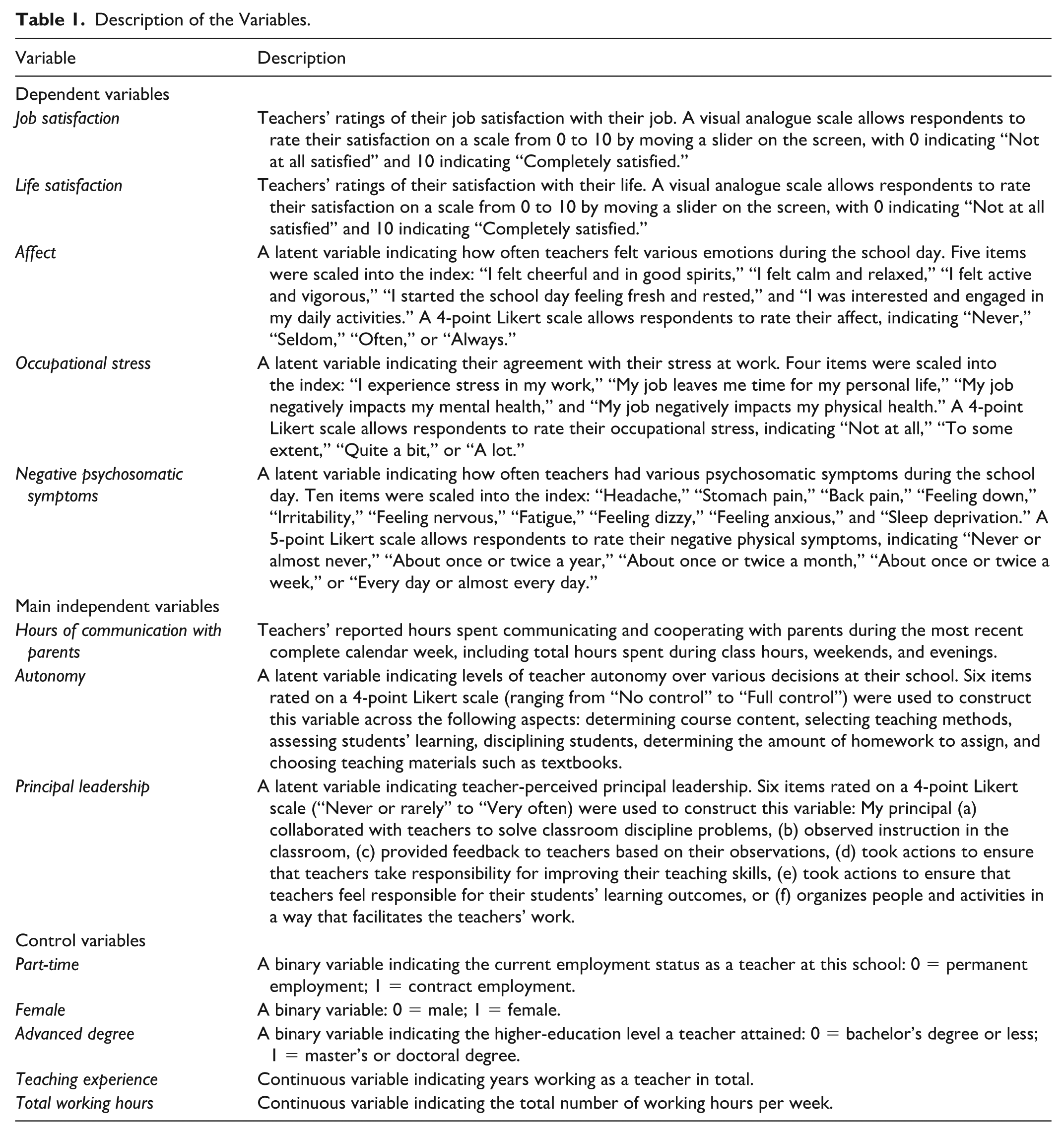
Using item response theory scaling, PISA 2022 constructed various indices of teacher well-being, including affect, occupational stress, and negative psychosomatic symptoms, as well as teacher autonomy. These indices were created after confirming that the internal reliability of the items met established psychometric standards (OECD, 2024). Detailed descriptions of all variables used in this analysis are presented in Table 1.
Description of the Variables.
Dependent Variables
Well-being is a multidimensional concept (Deci & Ryan, 2012; Hascher et al., 2021). Because the ramifications of communication with parents extend beyond the workplace, this study included various forms of well-being to provide a holistic understanding of their association with teacher–parent communication. We examined five dependent variables representing teacher well-being. The first and second dependent variables were teachers’ job satisfaction and life satisfaction. We used two continuous variables measured by a visual analogue scale (VAS). Teachers rated their satisfaction on a VAS ranging from 0 to 10 by moving a slider on the screen, where 0 indicated “Not at all satisfied” and 10 indicated “Completely satisfied.” The VAS, particularly when implemented digitally, offers high variability and reliability while remaining easy to understand and interpret (Sung & Wu, 2018). Although we used latent variables of teacher well-being for other dependent variables in the analysis, the VAS also allows for straightforward comparisons with other studies because this scale has been widely used in psychological, clinical, and medical research and practice (Weigl & Forstner, 2021).
The third dependent variable was affect. This latent construct represents the extent of teachers’ positive emotional experiences during the school day. Five items rated on a 4-point Likert scale were used to construct this index, such as “I felt calm and relaxed” and “I started the school day feeling fresh and rested.” The fourth dependent variable was occupational stress, a latent construct indicating the level of stress experienced at work. Four items rated on a 4-point Likert scale were used to construct this index. For instance, teachers responded to items such as “I experience stress in my work“ and “My job negatively impacts my mental health.” The fifth dependent variable was negative psychosomatic symptoms. This index indicates the frequency of various psychosomatic symptoms during the school day. Items included symptoms such as headaches, stomach pain, feeling down, irritability, and feeling nervous, with five response options ranging from “Never or almost never” to “Every day or almost every day.” These latent variables were standardized in the analyses to have a mean of 0 and a standard deviation of 1, enabling effect size comparisons.
Independent Variables
The primary independent variable was the number of hours spent communicating with parents. Teachers reported the total hours spent communicating and cooperating with parents during the most recent complete calendar week. This measure included all time spent on this activity, whether during class hours, weekends, or evenings.
The other key independent variable was teacher autonomy. This was a latent variable constructed to represent the extent of teachers’ perceived control over key decision-making areas within their school. It was derived from six items rated on a 4-point Likert scale assessing aspects such as “Determining course content” and “Disciplining students.” For the main analysis, this latent variable was treated as a continuous measure to provide a more direct and straightforward interpretation.
Control Variables
To address potential confounding variables identified in prior research, our models include several controls. We controlled for teacher-level characteristics plausibly related to both communication hours and well-being outcomes: part-time status, gender, educational degree, years of teaching experience, perceptions of principal leadership, and total working hours. Controlling for total working hours is particularly important because it allows us to isolate the association of communication time from that of the overall workload (Yang et al., 2025). While salary and grade level are also known correlates of well-being, they are effectively controlled for by the study’s design. The PISA 2022 sampling frame restricts the sample to teachers of 15-year-old students (limiting grade variation), and Korea’s centralized salary system primarily ties pay to teaching experience, which is already included in the model. Finally, because school-level characteristics (e.g., size and funding type) can influence outcomes, we include school fixed effects. This approach absorbs all stable unobserved heterogeneity across schools, yielding less biased estimates.
Analytic Approach
PISA 2022 exhibits a clustered structure in which teachers are nested within schools. We employed multilevel modeling combined with school fixed effects to account for the clustered data structure and control for unobserved school-level heterogeneity (Huang, 2016). The use of school fixed effects allows for the examination of within-group effects, leading to more robust estimates compared with controlling for only a subset of group-level variables. Consequently, our analysis relied exclusively on within-school variation, thereby enhancing accuracy and reducing potential bias from omitted school-level variables.
Model 1 included all predictors except for an interaction term between teacher–parent communication and teacher autonomy. Subsequently, model 2 introduced the interaction term between them while keeping all other specifications consistent with the previous model. The final model was expressed as

where
Results
First, descriptive statistics of the variables used in this study are summarized in Table 2. The regression results without interaction terms are presented in Table 3. Unstandardized coefficients are reported for VAS outcomes and standardized coefficients are reported for latent variables. The findings indicate a consistent negative association between hours of communication and various dimensions of teacher well-being: job satisfaction (
Descriptive Statistics of the Variables (Non-imputed Dataset).

These variables were standardized to have a mean of 0 and a standard deviation of 1 (1 SD) in the analysis to facilitate effect size comparisons across models.
Results of Regression Models.
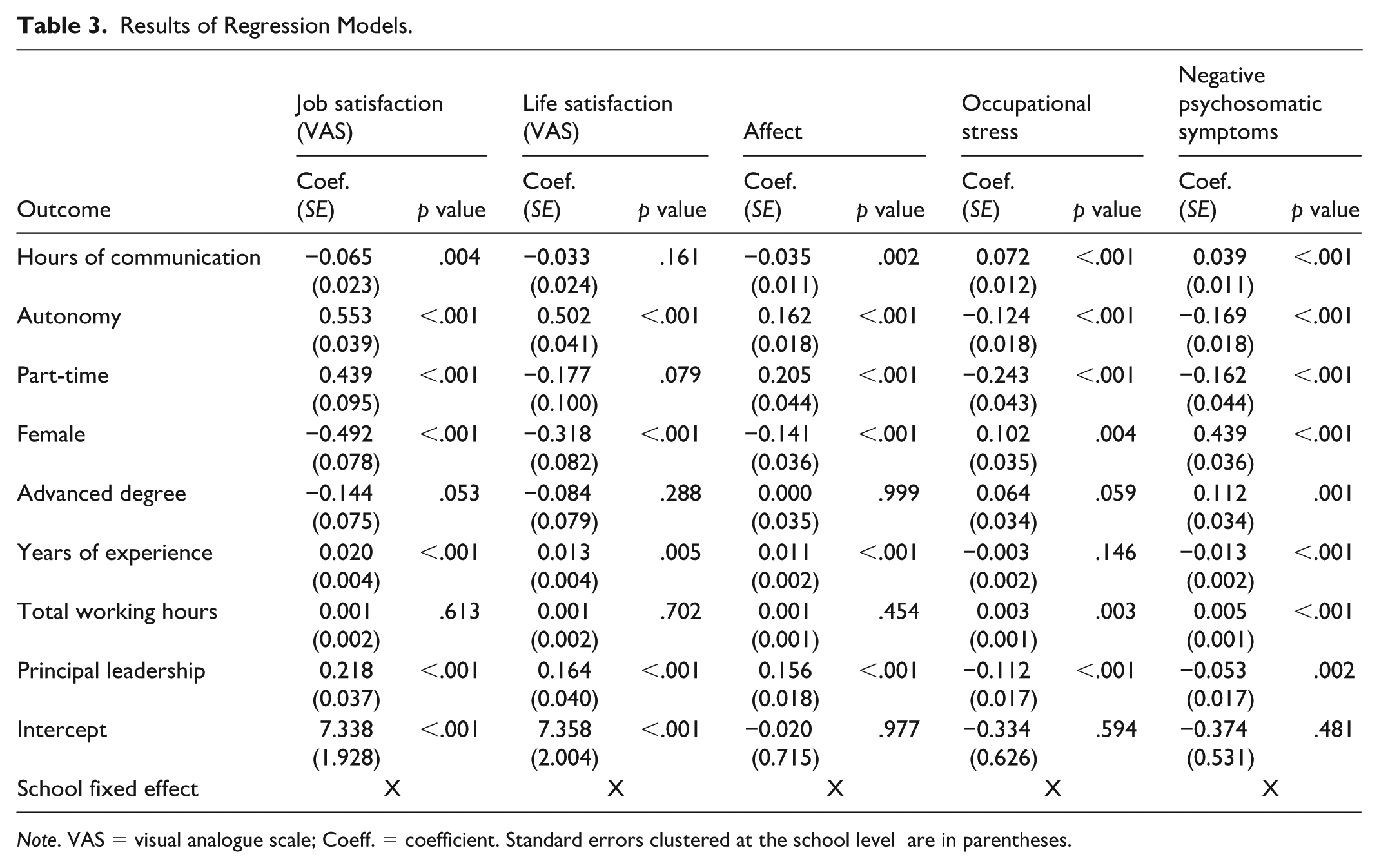
Note. VAS = visual analogue scale; Coeff. = coefficient. Standard errors clustered at the school level are in parentheses.
Regarding the main effect of teacher autonomy on outcomes, we found a positive relationship between teacher autonomy and job satisfaction (
To address the core research question, we tested the two-way interactions between hours of communication and autonomy. As shown in panel A of Table 4, autonomy significantly moderated the relationship between hours of communication and multiple well-being dimensions. Specifically, higher levels of autonomy strengthened the negative association between hours of communication and well-being, supporting Hypothesis 3. With an increase in autonomy, the negative association between hours of communication and well-being became stronger for job satisfaction (
Results of Regression Models with the Interaction Terms.
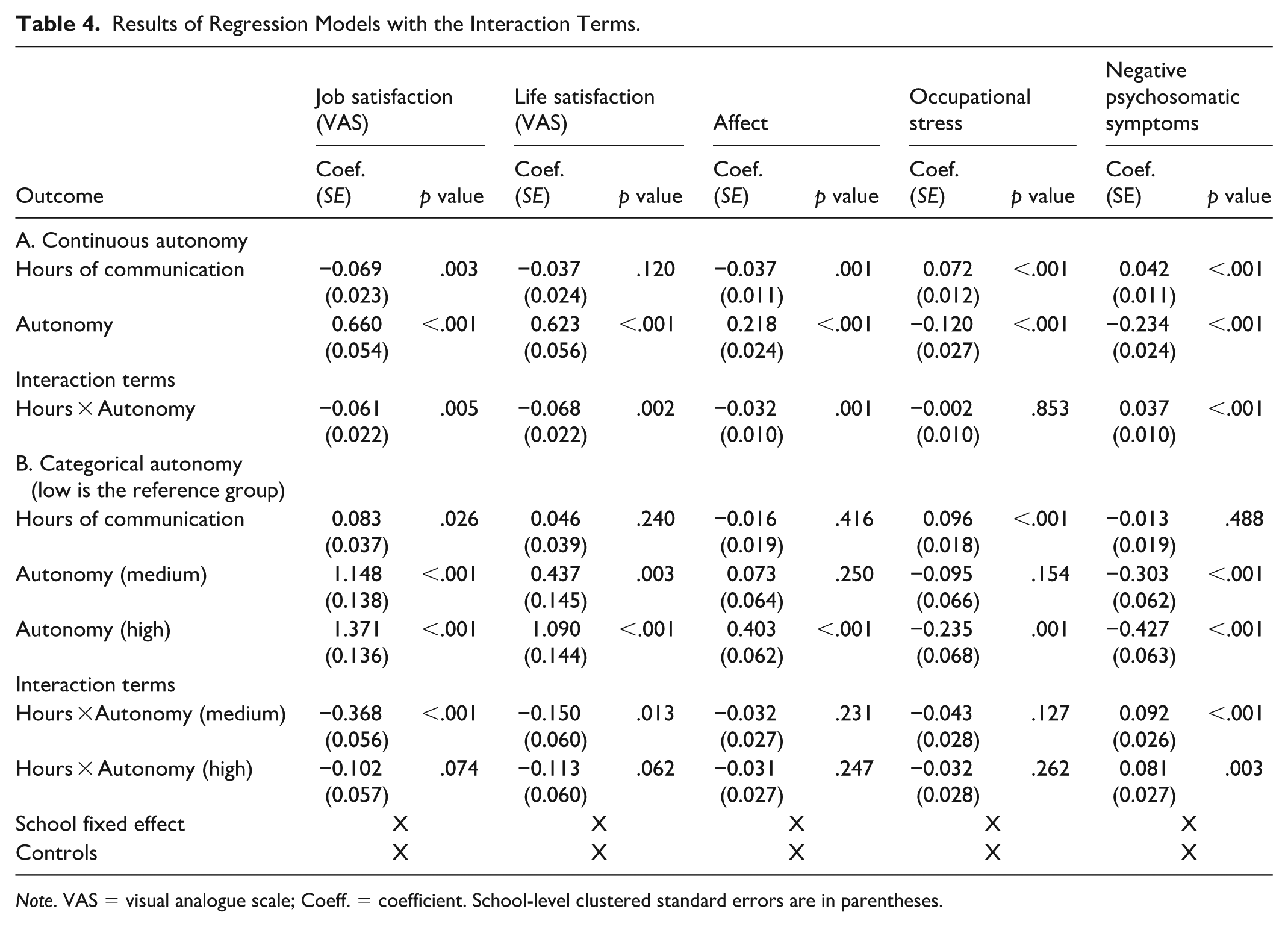
Note. VAS = visual analogue scale; Coeff. = coefficient. School-level clustered standard errors are in parentheses.
Figure 1 illustrates these moderating effects. Across all outcomes, autonomy itself was positively associated with well-being. However, autonomy was not sufficient to buffer the negative effects of communication—and, in most cases, it exacerbated them, except for occupational stress. For job satisfaction (panel a), all slopes were negative, but the slope for high autonomy (+1 SD; blue dotted line) was significantly steeper than for low autonomy (−1 SD; red dashed line). For life satisfaction, affect, and psychosomatic symptoms, strong crossover interactions were evident. Specifically, under high autonomy, slopes became substantially steeper, whereas under low autonomy, the slopes remained flat for affect (panel c) and negative psychosomatic symptoms (panel e), and they even turned positive for life satisfaction (panel b). By contrast, the slopes were largely parallel for occupational stress (panel d), indicating no significant interaction. Taken together, these results suggest that greater autonomy intensifies the negative association of greater teacher–parent communication hours with well-being, rendering it more harmful for teachers with higher autonomy than for those with lower autonomy.
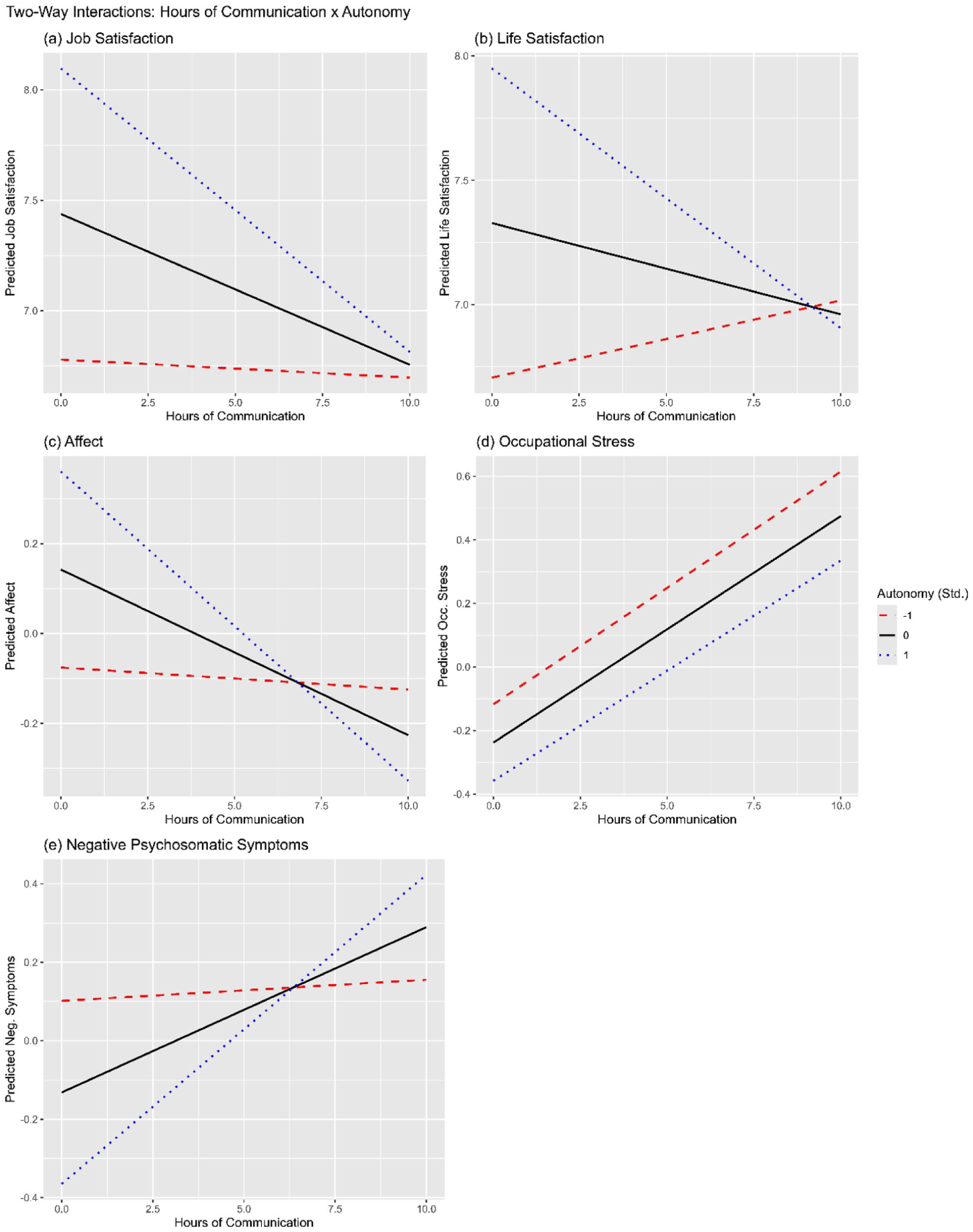
Two-way interaction plots between hours of communication with parents and teacher autonomy on teacher well-being.
Supplementary Analysis
Our main findings present a critical paradox: While teacher autonomy, on its own, is positively associated with well-being, it does not appear to safeguard teachers from the challenges inherent in teacher–parent communication. This raises a follow-up question: Does principal leadership help teachers navigate the paradox of autonomy in the context of teacher–parent communication? The literature suggests that effective leadership is crucial for the successful enactment of teacher autonomy, creating a synergistic effect between the two (Nguyen et al., 2026). Although the measures in our dataset focus more on principal instructional support rather than leadership specifically related to teacher–parent relationships, this supplementary analysis explores whether principals help teachers leverage their autonomy more effectively in managing teacher–parent communication, ultimately supporting their well-being.
The supplementary analysis, which incorporates three-way interactions, revealed that the moderating role of autonomy varied depending on teachers’ perceptions of principal leadership, with mixed directions and magnitudes. As shown in Table 5, the three-way interaction was statistically significant for negative psychosomatic symptoms (
Supplementary Analysis Including Three-Way Interaction Terms.
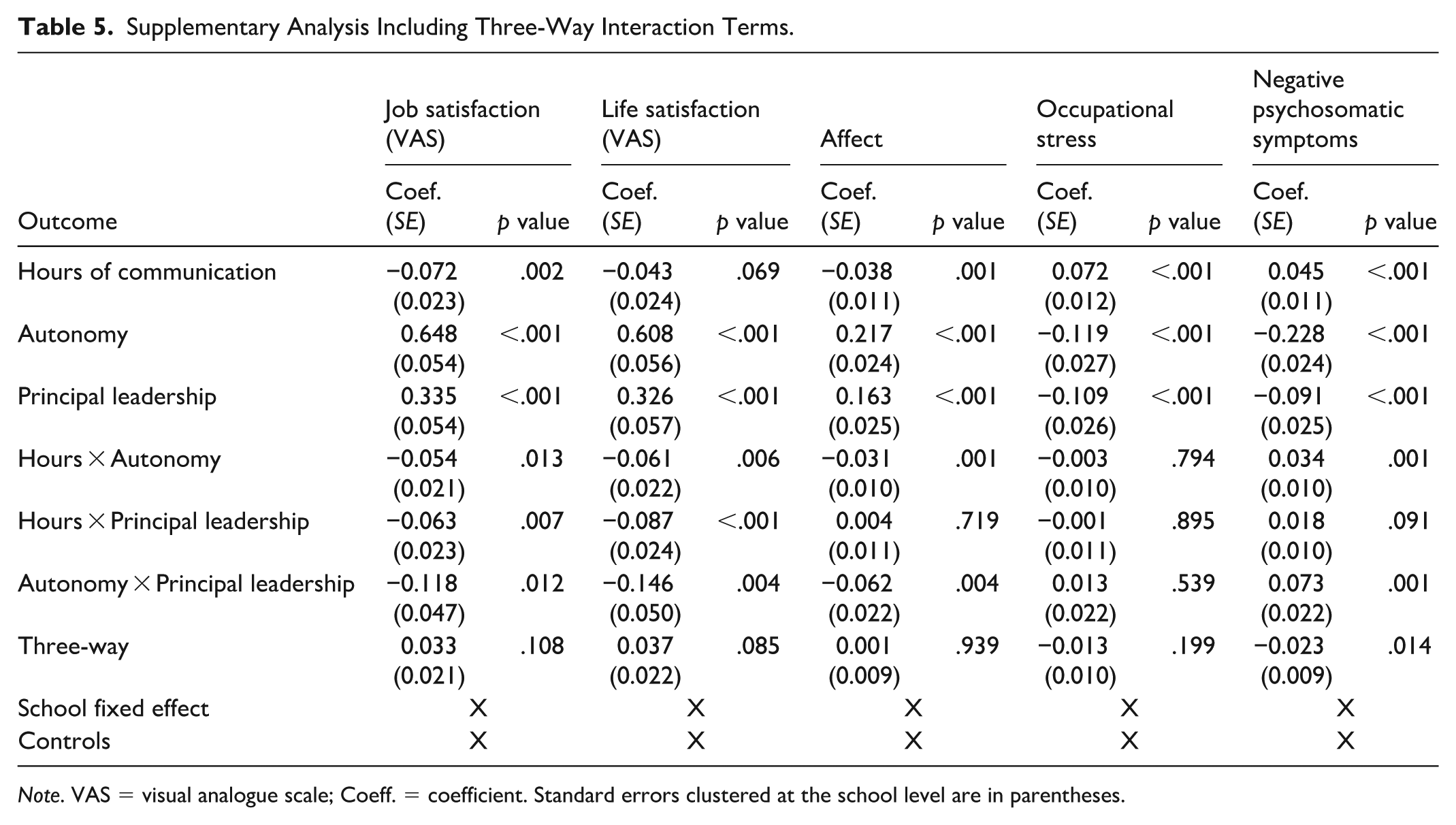
Note. VAS = visual analogue scale; Coeff. = coefficient. Standard errors clustered at the school level are in parentheses.
Figure 2 further illustrates these patterns. Under conditions of low principal leadership (−1 SD), teachers with high autonomy showed declines in job satisfaction (panel a) and life satisfaction (panel b) and increases in negative symptoms (panel e) as communication hours rose. In contrast, teachers with low autonomy under low leadership exhibited a counterintuitive trend: an increase in job and life satisfaction and a decrease in symptoms. In high leadership contexts (+1 SD), however, all slopes turned negative for job and life satisfaction, including those for low-autonomy teachers, indicating that the positive pattern observed under low leadership disappeared due to the negative two-way interactions related to leadership. For high-autonomy teachers, the negative slopes were marginally steeper under conditions of high leadership than low leadership. In addition, psychosomatic symptoms exhibited positive slopes under conditions of high leadership, suggesting a pattern analogous to that observed for job and life satisfaction. Taken together, the supplementary analysis suggests that while the three-way interaction per se slightly reduces the negative moderating effect of autonomy on the relationship between communication with parents and well-being, it is insufficient to mitigate or eliminate the paradox of autonomy, thus failing to support Hypothesis 4.
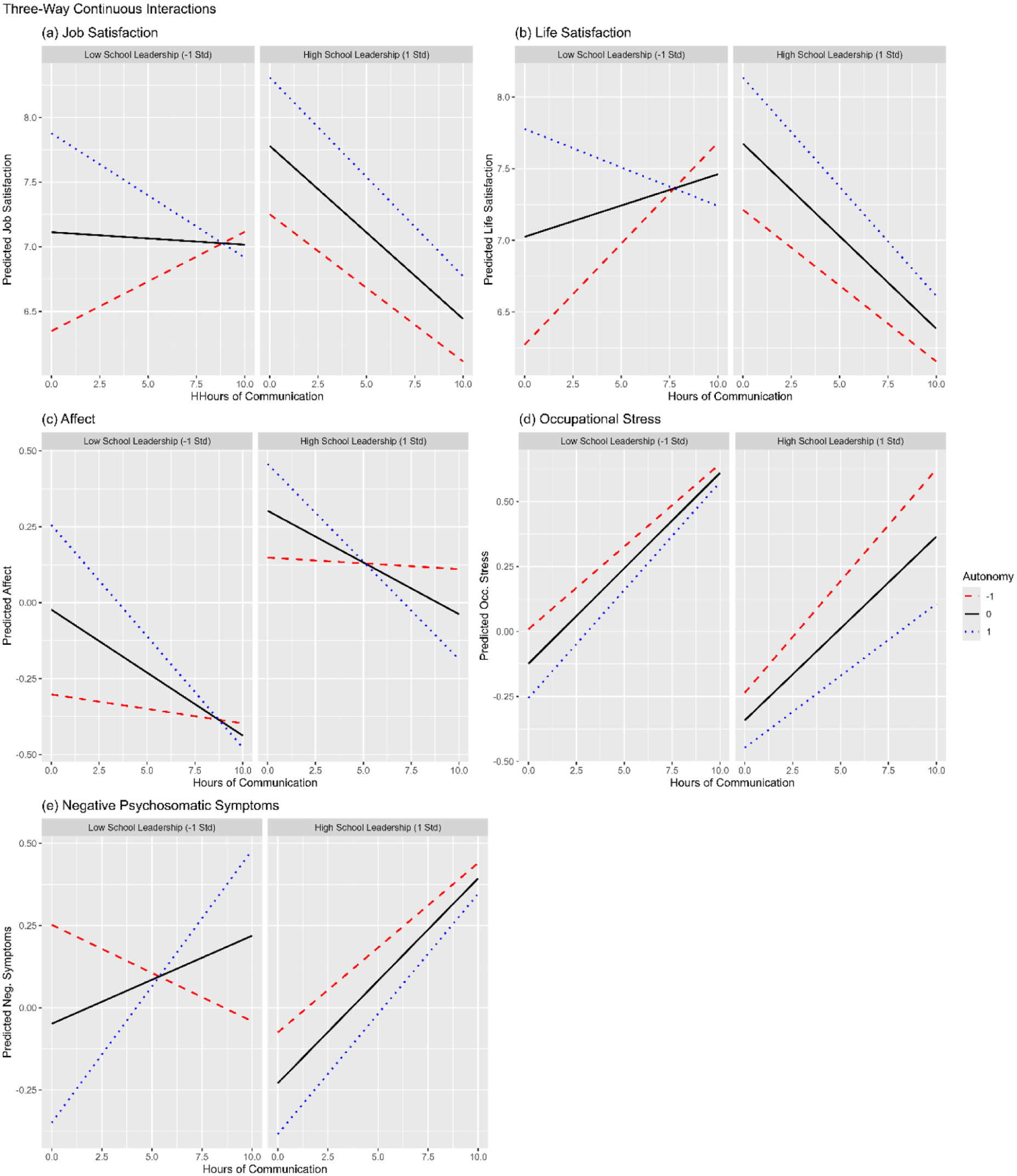
Supplementary analysis: three-way interaction plots.
Sensitivity Checks
To assess the robustness of our findings, we conducted two additional sets of sensitivity checks by applying alternative specifications for autonomy and communication. First, we treated teacher autonomy as a categorical variable, dividing it into terciles (low, medium, and high), and reran our main models with the corresponding interaction terms. This approach allowed us to compare differences across distinct groups rather than assuming a uniform linear pattern. Overall, the results corroborated the main findings while offering more nuanced insights (see panel B of Table 4). The main effects of autonomy remained statistically significant, although the medium-autonomy group did not show significant differences in affect or stress compared with the low-autonomy group. The interaction terms—with the exception of affect—remained statistically significant and followed the same direction as those in the main models. Notably, while the paradox of autonomy was evident at both medium and high levels, it was most pronounced for the medium-autonomy group with respect to job satisfaction (interaction plots are presented in Supplementary Appendix Figure S1 in the online version of the journal).
Second, we included quadratic terms for both autonomy and communication hours in the models to test for potential curvilinear relationships, such as diminishing returns or threshold effects. Model comparisons were conducted using χ2 difference tests and the Akaike information criterion. The quadratic models did not show an improved fit relative to the baseline linear models, and most quadratic terms were not statistically significant (see Supplementary Appendix Table S1 in the online version of the journal). The few exceptions—specifically, communication hours predicting life satisfaction and autonomy predicting affect and stress—were consistent with the categorical autonomy estimates. Given these results, and to preserve parsimony and interpretability, we did not extend the quadratic specifications to include interaction terms.
Discussion and Implications
First, the findings indicate that increased time devoted to teacher–parent communication is negatively associated with multiple dimensions of teacher well-being (Hypothesis 1). This result corroborates prior research (Yang et al., 2025) and extends it by demonstrating that the adverse effects are not confined to job-specific outcomes such as job satisfaction and occupational stress. Rather, the strain of this communication also correlates with diminished personal well-being, including lower life satisfaction and positive affect, and an increase in negative psychosomatic symptoms. This finding is particularly concerning given the recent well-being crisis and tragic teacher deaths in Korea, underscoring that stressors arising from communication with parents compromise both professional and personal health. These results have significant implications for the entire school community because teacher well-being is a critical determinant of student well-being and overall school climate (Collie, 2023; Dreer, 2023; Harding et al., 2019). It is unlikely that schools can cultivate positive learning environments when teachers themselves are struggling. While heightened accountability has intensified the demand for strong teacher–parent relationships, our findings suggest that this emphasis may inadvertently impose a level of stress that jeopardizes the foundational health of the school community.
Second, our results reveal a critical paradox of autonomy (Bertea, 2023; Wermke & Salokangas, 2021). Consistent with our framework (Hypothesis 2), we found that autonomy, as a main effect, is positively associated with all dimensions of teacher well-being, supporting foundational theories of teacher professionalism and self-determination (e.g., Hargreaves, 2000a; Ryan & Deci, 2000). However, it fails to serve as a protective buffer against the stress of parent communication. In support of Hypothesis 3, our findings show that for most outcomes, higher levels of autonomy exacerbate the negative relationship between communication hours and well-being. This finding challenges the common assumption that autonomy is a universally beneficial resource against external pressures and suggests that its function is highly context dependent.
Although the underlying mechanisms cannot be conclusively established in this quantitative study, our findings suggest that autonomy may function differently across levels of perceived control. For teachers with low autonomy, their limited discretion may function as an inadvertent protective buffer. They may have greater latitude to defer decisions or redirect parental concerns to administrators or colleagues, thereby reducing direct confrontation and mitigating personal stress. Such deferral mechanisms are often employed as coping strategies in high-pressure bureaucratic environments such as those prevalent in Korea (Gong, 2021).
In contrast, high autonomy can become a source of vulnerability and professional isolation. These teachers may find themselves solely responsible for managing demanding parental interactions, often in the absence of clear protocols or institutional support (Boote, 2006; Pitt, 2010). This dynamic aligns with critiques suggesting that autonomy, rather than being purely empowering, may operate as a managerial device (Lawson, 2004). Rather than experiencing empowerment, teachers may perceive such discretion as isolating, accompanied by a heightened responsibility for outcomes beyond their control—a reality particularly salient in Korea’s high-pressure bureaucratic school systems (Gong, 2021; Hong & Youngs, 2016). Additionally, in the Korean context, where parents hold high expectations and may leverage policies and systems to advance their interests, autonomy functions as a double-edged sword: It confers the freedom to act while simultaneously placing the full weight of responsibility for navigating conflicts and ramifications—including legal actions—on the individual teacher (Bertea, 2023). This paradoxically intensifies the stress and uncertainty inherent in parent communication, transforming a supposed professional resource into a personal liability (Wermke & Salokangas, 2021). The freedom to choose thus transforms into pressure to make the “right,” self-legislated decision, discouraging teachers from exercising their autonomy and leading to heightened stress, self-doubt, and self-blame (Schwartz, 2015). These findings highlight the need for robust legal and policy support, alongside clear communication protocols, to ensure that autonomy functions as a professional resource rather than an individual burden (Marco et al., 2025; Nguyen et al., 2026; Yang et al., 2025).
Third, this autonomy paradox prompted a supplementary analysis (Hypothesis 4) to determine whether principal leadership could mitigate its negative effects. The results indicate that principal leadership—measured here primarily as instructional leadership—does not fundamentally resolve the paradox. While the three-way interaction showed a minor buffering effect for some outcomes (i.e., job/life satisfaction and negative psychosomatic symptoms), it was largely overshadowed by strong negative two-way interaction effects. Specifically, we found that both the interaction between leadership and communication and the interaction between leadership and autonomy were adversely related to well-being.
This counterintuitive finding suggests that contrary to the theorized role of leadership as a supportive resource enabling teachers to effectively use their autonomy (Lin, 2022; Nguyen et al., 2026), strong principal leadership instead may intensify the burdens associated with parent communication in the Korean context. In centralized and high-stakes educational systems such as Korea’s, instructional leadership often reflects a top-down, compliance-driven approach centered on standardized outcomes and administrative accountability (Choi et al., 2025; Gümüş et al., 2021; Hallinger et al., 2025). Strong leadership therefore may translate into heightened monitoring and performance surveillance, requiring teachers to align closely with external expectations and benchmarks, potentially rendering their granted autonomy ineffective. Rather than feeling protected, teachers may find themselves caught between strict institutional demands imposed by leadership and escalating parental pressures for individualized attention. Furthermore, within bureaucratic systems characterized by a pervasive culture of blame avoidance, principal leadership may prioritize institutional stability and risk management over teacher protection, effectively shifting the burden of managing parental conflict onto individual teachers. Together these dynamics suggest that leadership, rather than buffering the autonomy paradox, may reinforce it by amplifying accountability pressures without providing corresponding structural and emotional support. At the same time, we acknowledge that alternative forms or practices of leadership may better support teachers in navigating this paradox. Future research therefore should examine alternative leadership approaches—such as distributed or community leadership—that may more effectively help teachers manage teacher–parent interactions and enact autonomy as a shared professional resource (Choi, 2023; Khalifa, 2012).
Limitations and Future Studies
Despite this study’s contributions, several limitations warrant consideration and call for future research. First, the reliance on cross-sectional data precludes the establishment of causal relationships. While we employed rigorous analytic methods, causal inferences cannot be drawn. It remains possible, for example, that teachers’ baseline well-being influences their perceptions of autonomy and their interactions with parents rather than the reverse. Future research should employ longitudinal or experimental designs to better establish these causal pathways and generate more robust policy recommendations.
Second, this study relies on self-reported data, which may be subject to inherent social desirability bias. Teachers experiencing negative emotional states might overstate their job-related burdens or underreport their sense of autonomy, potentially biasing the estimates. Furthermore, the PISA 2022 indicators for autonomy primarily capture perceived freedom (e.g., over course content and discipline). This measure may not fully reflect a teacher’s actual capacity to exercise that freedom effectively within the contextual constraints of their professional practice, particularly when facing difficult parental demands (Nguyen & Walkinshaw, 2018). Future studies could incorporate alternative data sources—such as policy documents, teacher logs, or observational measures—to provide a more multidimensional assessment of autonomy.
Third, the study’s quantitative design, while effective for identifying broad patterns, limits our ability to explore the underlying mechanisms or capture the lived experiences of teachers behind the observed patterns. The proposed explanations for the autonomy paradox, as well as for the failure of strong principal leadership to mitigate it, remain inferential despite being grounded in the existing literature. To address this gap, future research should adopt qualitative or mixed-methods approaches. In-depth interviews or focus groups could provide richer insights into how teachers experience teacher–parent communication and perceive their autonomy within those interactions. Such approaches are particularly needed to illuminate why strong principal leadership failed to mitigate these challenges, offering a more nuanced and context-sensitive understanding of the dynamics at play.
Conclusion
Our study offers critical insights by demonstrating that teacher autonomy and principal leadership, commonly assumed to help teachers navigate the challenges of parent communication, may not function as intended. Instead, they may inadvertently place greater burdens on teachers in managing teacher–parent interactions. These insights have important implications not only for Korea but also for global education systems confronting similar tensions between teacher well-being, professionalism, and parental expectations. The findings underscore an urgent need for policymakers and school leaders to move beyond the simplistic granting of autonomy. Instead, they must develop robust support structures that transform autonomy and leadership from potential burdens into genuine professional resources, enabling teachers to navigate teacher–parent communication with confidence and resilience.
Finally, we extend our sincere condolences to the teachers who have lost their lives, their families, and the entire education community affected by these tragedies. It is our hope that this research contributes to a deeper understanding of these challenges, helping to build a foundation in which teachers can approach their emotionally demanding work with safety, dignity, and renewed well-being.
Supplemental Material
sj-docx-1-ero-10.1177_23328584261458830 – Supplemental material for Unintended Consequences of Teacher Autonomy and Principal Leadership: Evidence from Teacher–Parent Communication and Teacher Well-Being
Supplemental material, sj-docx-1-ero-10.1177_23328584261458830 for Unintended Consequences of Teacher Autonomy and Principal Leadership: Evidence from Teacher–Parent Communication and Teacher Well-Being by Soobin Choi and Sangmin Park in AERA Open
Footnotes

Funding
The authors received no financial support for the research, authorship, and/or publication of this article.
Declaration of Conflicting Interests
The authors declared no potential conflicts of interest with respect to the research, authorship, and/or publication of this article.
Supplemental Material
Supplemental material for this article is available online.
Author Biographies
References
Supplementary Material
Please find the following supplemental material available below.
For Open Access articles published under a Creative Commons License, all supplemental material carries the same license as the article it is associated with.
For non-Open Access articles published, all supplemental material carries a non-exclusive license, and permission requests for re-use of supplemental material or any part of supplemental material shall be sent directly to the copyright owner as specified in the copyright notice associated with the article.
