






Abstract
Universities are embracing their roles as anchor institutions within their cities and regions for purposes of economic and community development. Several place-based initiatives, however, have been subject to critiques related to gentrification. Rather than building equitable community wealth, these initiatives may be fundamentally changing neighborhoods for purposes of recruiting students and faculty based upon conceptualizations of gentrification and abandonment. If universities are launching place-based initiatives for the sake of creating districts more attractive to students and faculty, they are likely targeting districts perceived as undergoing abandonment, or vulnerable to gentrification, based on racialized and classed perceptions of development and blight. This paper applies a gentrification vulnerability scale to census data to study whether tracts targeted by university-led urban development initiatives are more vulnerable to gentrification prior to the initiative than those that are not targeted. Gentrification vulnerability is a statistically significant predictor of being targeted by an initiative.
Keywords
Introduction
Universities are competing in a global marketplace for students and faculty, and part of their recruitment strategies includes creating neighborhoods near campus where prospective scholars can see themselves living, working, and playing. The place-based, local development initiatives universities use to shape neighborhoods in this way are called anchor institution initiatives (AIIs). AIIs have been subject to critique for contributing to gentrification, with concerns that universities are displacing current residents as part of their efforts to redevelop neighborhoods near campuses (Baldwin, 2021). To date, little is known about the neighborhood characteristics that predict being selected by a university for redevelopment through an AII. Perceptions of the types of neighborhoods in need of redevelopment could be shaping university decision-making, making them more likely to select neighborhoods that are vulnerable to gentrification.
Using United States decennial census data, a gentrification vulnerability index, and logistic regression, this study identifies neighborhood characteristics that predict being targeted by a university AII. This exploratory study serves to frame the conditions and decisions that lead to university-led urban development projects, particularly how racialized and classed understandings of urban blight and abandonment shape decision-making around AIIs. Understanding the conditions that predict university decision-making is essential to grasping the evolving role of universities in the spatial organization of cities. If universities are participating in larger gentrification processes as part of their objectives to recruit students and faculty, then they are likely selecting neighborhoods for AIIs based on preconceived notions of what constitutes a desirable neighborhood. With housing costs in cities reaching record highs as a proportion of income (Chen & Le, 2023) and more universities incorporating AIIs as key strategic initiatives (Coalition of Urban and Metropolitan Universities, 2025), fully understanding AIIs and their relationships to gentrification is essential.
The significance of this study is twofold. First, universities are increasingly positioning themselves not only as the main vehicles of knowledge production, but also as drivers of urban governance. From strategic plans calling for a commitment to stewardship of place to partnerships with private real estate developers, modern universities consider themselves as both education providers and economic engines. This dual role, however, can be potentially contradictory. Universities do possess resources, infrastructure, and expertise pertinent to urban development, but these projects cannot be separated from larger urban processes of racism, income inequality, and the overarching spatial organization of cities.
Second, this study is situated within higher education literature and the literature on gentrification and urban change. Classical economic theories argue that neighborhood transformations are the result of changes in consumer preferences and demand. Conversely, critical scholarship emphasizes the role of policy and direct interventions by the state in creating neighborhood transformations. Universities, in this sense, are active agents in shaping the trajectories of neighborhood change. This study aims to bridge higher education studies and urban studies by exploring how institutional logics of prestige and growth relate to urban processes of racialized abandonment and gentrification.
The main research question this study tackles is what variables predict being targeted by an AII. The data are decennial census data and the U.S. American Community Survey 5-year estimates at the tract level from 1970 to 2010, standardized to 2010 census tracts. We developed a gentrification vulnerability index, slightly revised from an index developed by Bates (2013), and regressed a binary indicator of whether a census tract was targeted by a university AII or not on the index. We found that census tracts with high vulnerability scores were more likely to be targeted by an AII. Within the index, the proportion of residents who identified as a Person of Color, the proportion of residents below the poverty threshold, and the proportion of residents without a bachelor’s degree were all significant predictors of being targeted by an AII. Race and class are very likely playing a role in how universities select neighborhoods for AIIs. In their pursuit of desirable neighborhoods to recruit faculty and staff, universities are potentially risking the displacement of communities.
Literature Review
The concept of anchor institutions emerged from Michael Porter’s (1997, 2016) work on inner-city competitiveness in the 1990s. Porter reframed urban development discourse by shifting attention from deficits such as a lack of financial capital to the underutilized assets of inner cities. Among these, he identified anchor institutions, typically universities, hospitals, and other place-based organizations, as critical actors in economic revitalization. Because these institutions represent stable sources of capital, employment, and investment, Porter argued they could form the cornerstone of development strategies in urban neighborhoods. AIIs are the intentional strategies led by anchor institutions to leverage their place-based capital for purposes of local economic and community development (Garton, 2021).
Porter’s (2016) arguments around anchor institutions align with broader discourses in geography that emphasize the productivity and economic activity growth unique to cities (Florida et al., 2012; Rosenthal & Strange, 2004). Universities, hospitals, and large cultural organizations like museums all have incredibly high moving costs, literally and metaphorically, as most of these types of organizations are spatially tied by founding charter or recurring funds from state governments. The idea is that cities can rely upon these types of organizations for some degree of economic stability during stormy weather and potentially catalyze growth when times are calm. However, anchor-led development initiatives frequently reinforce uneven development patterns rather than stabilizing them (Baldwin, 2021). For example, while universities offer a large number of jobs, the high-wage jobs are filled through national or even global searches, and local hiring is limited to relatively low-wage positions (Hyatt, 2010).
Garton (2021) identified different types of AIIs, including intentional campus expansion and real estate development (Dalton et al., 2018); direct financial investments in local businesses and community development corporations (Etienne, 2012; Hodges & Dubb, 2012); entrepreneurial work by faculty, graduate students, and alumni (Etzkowitz, 2014); and partnerships and outreach to local community groups (Doberneck et al., 2010). AIIs range from coordinated outreach partnerships to wholesale reconstructions that integrate housing, retail, office space, and cultural amenities (Spirou, 2021). Universities often frame these initiatives using the language of mutual benefit and shared value (Wittman & Crews, 2012), even though material benefits are disproportionately captured by universities and affiliated developers (Baldwin, 2021).
To give a few examples of AIIs that are included in the sample of this study, we describe particularly representative cases here. The first case, and perhaps the most widely referenced in the literature, is the West Philadelphia Initiatives by the University of Pennsylvania. The university invested financial capital by offering mortgage incentives to faculty and staff who lived in West Philadelphia and purchasing and renovating apartment buildings and vacant homes (Etienne, 2012). The homes were then resold, though the university maintained ownership of the apartment buildings. The University of Pennsylvania also expanded the physical campus by building new retail developments on the outskirts of campus. The Netter Center for Community Partnerships further leveraged the university’s intellectual capital by coordinating service-learning courses and engaged research within West Philadelphia (Hodges & Dubb, 2012). Finally, the university invested in local human capital through a new charter school and expanded the scope of the university’s police force beyond the campus (Etienne, 2012).
Other examples highlight both the diversity of strategies and the tensions inherent in many AIIs. Youngstown State University committed financial resources to revitalization in the Smoky Hollow neighborhood by purchasing land and then gifting it to developers (Bromley & Kent, 2006). Youngstown State also intentionally expanded the physical campus into Smoky Hollow by building new student housing. Syracuse University similarly invested financially in neighborhoods, complemented by intellectual capital. Through the Near Westside Initiative and Connective Corridor, Syracuse University purchased property for renovation and resale, offered mortgage incentives for faculty and staff to live in the Near Westside neighborhood, and prioritized local businesses in making purchasing decisions. A host of service-learning courses and coordinated engaged research projects supported the financial investments (Hodges & Dubb, 2012). Finally, Trinity College made large physical changes in Hartford along with investments in local human capital. The college purchased and redeveloped an industrial district into a complex largely devoted to community partnerships. The new complex included charter schools, workforce development centers, a police station, theaters, and new housing (Reardon, 2006).
Yet, critical scholarship complicates what can otherwise be an optimistic narrative. Although many institutions frame their AIIs in terms of democratizing regional economies and expanding community wealth (Dubb et al., 2013; Etzkowitz, 2014; Sladek, 2017), there are also deep concerns that universities are participating in larger gentrification projects. In some cases, particularly when universities invest heavily in real estate development, AIIs contribute to gentrification by attracting higher-income residents, thereby raising housing costs and displacing long-term, lower-income communities (Garton, 2023). Critical scholars emphasize that these effects are not unintended consequences but rather reflect the racialized and classed assumptions embedded in urban development logics (Baldwin, 2021; Etienne, 2012).
Universities have long been participants in urban development and gentrification. The shift from an industrial economy to a knowledge economy in the latter half of the 20th century positioned universities as pivotal actors in cities inextricably tied to capital accumulation by the White middle class (Gregory, 2013; H. L. Taylor et al., 2018; Walker & East, 2018). As colleges and universities became globally competitive, they took direct action to shape their surrounding neighborhoods for purposes of recruiting students and faculty (Etienne, 2012; H. L. Taylor et al., 2018). The drive to become globally competitive extends beyond changes to the university itself to encompass changes in surrounding neighborhoods to become more attractive to the global elite class (Ilano, 2020). Universities thus became domineering forces with potentially self-serving motivations (Baldwin, 2021).
The effects of development are disparate across social groups, with some residents increasing wealth or gaining access to desired amenities and other residents facing prohibitive costs or displacement (Rucks-Ahidiana, 2021). Bates (2013) developed a measure of gentrification vulnerability to predict whether residents in a census tract would be susceptible to displacement amid development. Gentrification vulnerability emerged from the concept of social vulnerability, which aimed to measure how natural disasters like floods or epidemics might be more or less disruptive for different social groups (Hilhorst & Bankoff, 2006). Vulnerability measures typically incorporate dimensions of education levels, socioeconomic indicators, and at-risk populations (Mah et al., 2023). Bates’s (2013) gentrification vulnerability index includes education levels and socioeconomic indicators. There is no indicator for at-risk populations, as this speaks directly to the health risk of natural disasters or disease outbreaks (Mah et al., 2023). Bates (2013) also includes an indicator of race/ethnicity given the centrality of race in U.S. urban development and gentrification (Gregory, 1993; Williams, 1988).
Theoretical Framework
The focus of this study is on the conditions, processes, and decisions that lead to gentrification, not necessarily the process of gentrification itself. Many theories of gentrification assume it is a process in response to individuals’ changing housing preferences (Baum-Snow & Hartley, 2017). As preferences change for urban amenities, demand for housing in cities increases, thus prices increase. These theories tend to conceptualize gentrification as a process fed by new city residents, or people who are moving into the city and thus increasing demand across the entire city broadly, though targeted in specific neighborhoods. Marcuse (1985, 1986) argued for a theory of gentrification and abandonment that challenged this conceptualization, instead viewing gentrification as a result of state projects and policy decisions. Marcuse made three theoretical claims related to gentrification and abandonment pertinent to gentrification vulnerability and anchor initiatives.
First, Marcuse showed gentrification is not the result of new city residents, but instead reflects shuffling within cities. This trend continued into the 20th century after Marcuse’s writings (Slater, 2009). This directly challenged the notion that gentrification is simply a reflection of changes in overall demand for urban amenities. Overall demand within a city remains fairly steady. Rather, demand for specific neighborhoods changes. In terms of university districts and other neighborhoods targeted by AIIs, enrollments do not necessarily need to increase for a university to have a discernible effect on local neighborhoods. Students, faculty, and staff just need to change where they want to live within the city.
Second, Marcuse incorporated abandonment within the theory of gentrification as an intentional choice, not a natural process. Abandonment is the process of vacating or neglecting physical properties by owners or the state. Marcuse argued abandonment was largely seen as inevitable, with cities needing to make decisions on which neighborhoods to abandon. The only cure for abandonment was gentrification. Thus, gentrification and abandonment were both a result of choices by the state, or two sides of the same coin. Neighborhoods would undergo abandonment following a century of neglect by the municipal government, predatory landlords, and discriminatory policies like redlining. The very perceptions of city planners were structured to consider race and poverty as indicators of safety and community health (Herscher, 2020; D. E. Taylor, 2014). Gentrification and displacement would then be introduced as the only possible solution to problems the state created and curated. Anchor initiatives are potentially part of those state projects to fundamentally change neighborhoods.
Third, the changing nature of the city economy through deindustrialization into the knowledge economy and creative city (Florida, 2014) has exerted dual pressure on neighborhoods by simultaneously pushing lower-income residents to abandon their neighborhoods while pulling higher-income residents to gentrify those same neighborhoods. This is occurring due to the changes in the labor market. Universities are core organizations within the knowledge economy and creative cities. Students and faculty come to the city and often to specific neighborhoods because of the presence of the university. Recent graduates start businesses or seek work near their alma mater, and companies that require skilled labor locate their headquarters near universities to draw from the talent pool being produced by the university (Andersson et al., 2009; Etzkowitz, 2014). Cities then make land-use decisions based on the new needs and preferences of the creative class. As universities seek to attract and retain students and faculty, they work to change neighborhoods based on the needs and preferences of those types of residents. The order of events is important here. Other theorists claim the amenities existed first, thus when preferences changed to value those amenities, demand increased and gentrification followed based on the increased demand. Marcuse argued that the overall economic conditions and labor markets of cities changed first, then cities began to design themselves around being competitive locations for top talent.
Overall, gentrification and abandonment are two sides of the same coin. They are not the result of aggregated individual housing preferences but are instead state projects to change neighborhoods to attract individuals deemed desirable. Universities are conceptualized as cornerstones of the knowledge economy and creative cities, key components of changing cities from working-class industrial centers to upper-class innovation zones. Within these broader projects, universities are also attempting to recruit students and faculty by creating neighborhoods where they want to live and work.
In the context of AIIs, universities may be targeting neighborhoods they consider to be areas students and faculty would see as undesirable, or neighborhoods undergoing abandonment. Under Marcuse’s theory, the next step would then be for the state, or the university, to target the abandoned neighborhood for gentrification. If this theory holds, neighborhoods that are more vulnerable to gentrification would then be predicted to be more likely to be targeted by an anchor initiative than neighborhoods that are less vulnerable to gentrification, as they are not undergoing abandonment.
Methods
This study uses a logistic regression model to identify the neighborhood characteristics that predict being targeted by an AII, focusing specifically on the concept of gentrification vulnerability and covariates that are likely related to both the selection of neighborhoods for AIIs and gentrification vulnerability. By operationalizing vulnerability as a composite index, this design allows for an examination of the underlying latent construct, as well as the manifest variables that make up the index, thus providing more full information about the conditions that lead to AIIs.
Data
This study relies on census data from the Longitudinal Tract Database (LTDB), which harmonizes U.S. census tract boundaries across decades—for our purposes, 1970–2010—to account for redistricting (Logan et al., 2012). The LTDB has been used in prior studies to make causal inferences regarding gentrification (Baker & Lee, 2019; Couture & Handbury, 2017). The LTDB is the best available database for longitudinal analysis of census tracts that are experiencing major growth.
The primary question examined in this study is whether gentrification vulnerability predicts a university’s coordinated and deliberately targeted efforts toward specific neighborhoods. AIIs are defined by having 1) an explicit, time-bound decision to engage in neighborhood transformation, 2) a focus on specific geographic areas, and 3) an integrated plan guiding university effort. Once implemented, these initiatives are treated as persistent—that is, once a neighborhood is in the treatment category, it remains there in perpetuity. This assumption reflects how AIIs are typically structured. Once a university has committed to a neighborhood, withdrawal is rare, particularly in cases where the university has invested in physical capital. The unit of analysis for this study is the census tract.
Sample
AIIs were identified using a three-step process, as in Garton (2023), repeated here in brief. First, institutions affiliated with the Coalition of Urban and Metropolitan Universities (CUMU) or the Coalition of Urban Serving Universities (USU), and those recognized by the Carnegie Community Engagement Classification or listed on the President’s Honor Roll for Community Service, were identified. Second, university websites and official documents were examined for AIIs using keywords—for example, “revitalization” and “anchor institution.” To supplement the AIIs identified through the first two steps, AIIs identified through a literature review or highlighted by the Democracy Collaborative were also included, even if not identified in steps 1–2. Through this process, we identified 49 AIIs in 38 cities. Two of the identified AIIs were launched in the 1970s, six in the 80s, 15 in the 90s, and 26 in the 2000s. This is consistent with the chronology in which AIIs as a strategy for development became widespread following Porter’s (1997) work.
Geographic boundaries of the targeted neighborhoods were delineated through reviews of public documents, and the corresponding census tracts were identified using PolicyMap (PolicyMap, 2025). Once the tracts that were targeted by an AII were identified, all other tracts within that same core-based statistical area (CBSA) were included in the sample and coded as not being targeted by an AII. Restricting the comparison to tracts within the same CBSA helps maintain consistency across broader urban conditions, such as labor markets, housing demand, and municipal governance. While we do not claim to have identified all AIIs through this process, this is the most comprehensive list in existence to our knowledge. It is worth noting that due to our exclusion criteria, we are not measuring any campus construction, only campus construction that was explicitly meant for economic and urban development. Similarly, almost all universities have work related to social and economic development. However, our AIIs are limited to initiatives with clearly delineated spatial boundaries, which is a unique approach.
Variables
The dependent variable is a binary indicator of whether an AII targeted the census tract at any point in time. The key independent variable is a composite measure of gentrification vulnerability. The four variables that make up gentrification vulnerability are the proportion of households occupied by renters, the proportion of the population that identifies as a Person of Color, the proportion of the population older than 25 without a bachelor’s degree, and the proportion of the population at or below the poverty level. These four variables were combined by running a principal component analysis (PCA), extracting a single component, then weighting each of the variables by their loading and combining them linearly (see Table 1). The PCA was only run once across pooled years.
Principal Component Analysis Results.
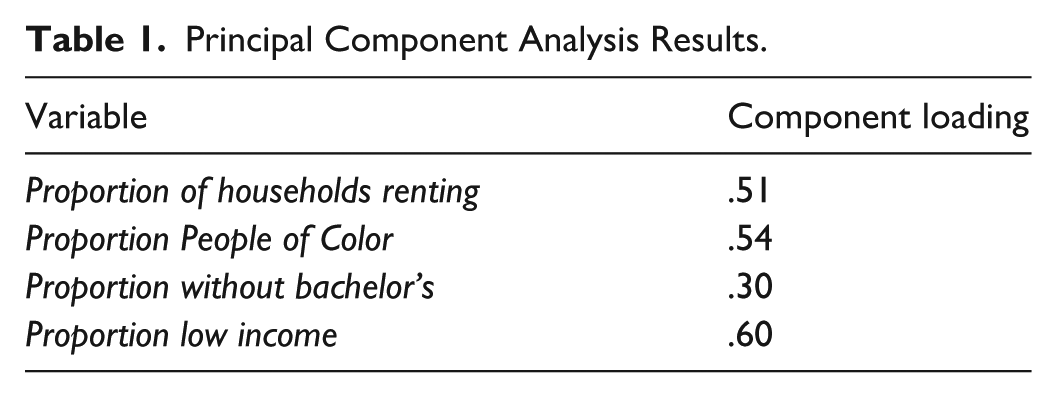
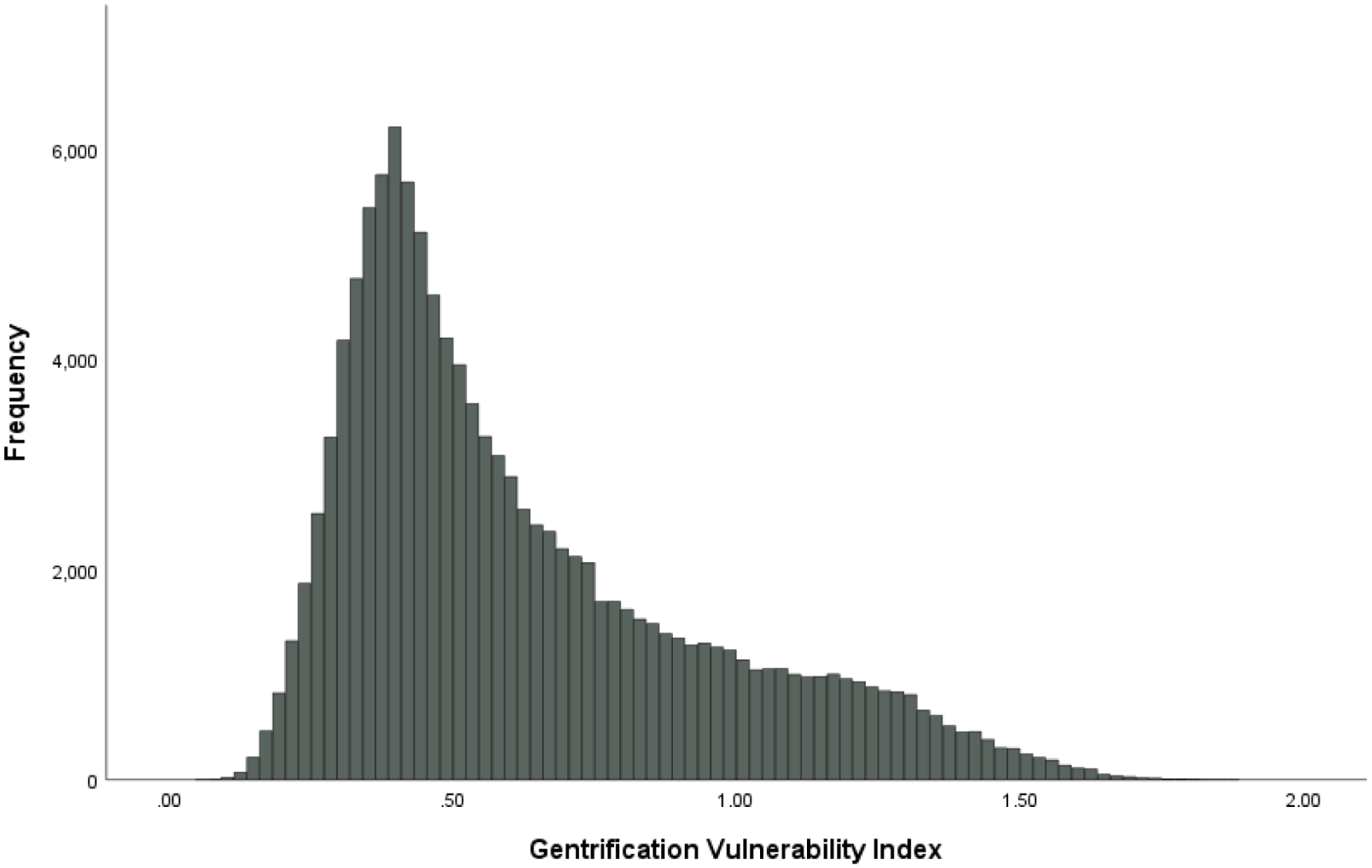
PCA is particularly valuable here as it reduces the risk of multicollinearity between the four indicators of vulnerability and provides a singular measure of the latent construct. We extracted a single component for two reasons, one a priori and the other a posteriori. The a priori reason is that because we conceptualized gentrification vulnerability as a discrete construct, we wanted one measure. This reasoning was supported by our PCA and the a posteriori rationale to extract a single component. The eigenvalues for all four possible components were 2.27 for the first component, .9 for the second, .54 for the third, and .29 for the fourth. All but the first component were below the commonly used 1.0 threshold for retention (Kaiser, 1970). Additionally, the first component explained 57% of the variance, while the remaining components only explained 23%, 14%, and 7%, respectively. The resulting index has a mean of
Histogram of gentrification vulnerability index.
As the data are longitudinal in structure, we also included tract-level random effects, allowing intercepts to vary across tracts, to account for the nature of observations as being dependent across time. In practical terms, each tract appears in the dataset up to five times, once for each time period. Regression models that are not built to recognize re-occurring tracts would treat each observation as completely unique, an incredibly strong assumption, as a tract in one year is going to be tightly correlated to itself in another year. A basic way to conceptualize random effects is similar to including a huge number of indicator variables, one for each tract, thus modeling how each set of observations is related, as they are all observations of the same tract, just at different points in time. Each tract is then permitted to have its own baseline probability of being targeted by an AII.
Covariates were included to improve estimation precision and reduce bias from omitted variables. These controls were included to account for demographic shifts and housing stock changes that may independently influence gentrification. The control variables were the natural log of population density, the distance to the nearest university with an identified AII in miles, the proportion of homes inhabited by the owner, the proportion of homes that were vacant, the proportion of multi-unit homes, the proportion of structures more than 30 years old, the proportion of structures less than 10 years old, the proportion of the population that is under the age of 18, and the proportion of the population that is over the age of 60. We did not include year fixed effects in the main specifications due to concerns about sparse data in combination with the random effects.
Analysis
We ran logistic regressions for two samples: 1) tracts were either targeted by an AII or not at any point in time, resulting in a binary outcome in a time-invariant structure and 2) a restricted sample in which tracts that were targeted by an AII were dropped once the anchor initiative actually began. The second sample functions as a robustness check to ensure the odds ratios were not being inflated by tract characteristics after the AII decision had already been made. We performed two logistic regressions for each sample, one with the composite gentrification vulnerability measure and a second with separate variables of the index, ungrouped and unweighted. Odds ratios greater than one indicate tracts with higher gentrification vulnerability scores relative to other tracts in the same cities were more likely to be targeted by an AII, which supports Marcuse’s (1985, 1986) argument that state-supported development targets vulnerable neighborhoods.
Limitations
We made the assumption that AIIs were implemented independently of expected neighborhood changes. In other words, universities were not attempting to buy into expanding markets. That assumption may not hold true for all census tracts, though AIIs are not usually marketed as revenue generators for universities (Hodges & Dubb, 2012). We believe that due to our myriad controls and the criterion that all initiatives appeared to be externally motivated, we have greatly reduced the bias in our results. However, there are always unmeasured factors that could lead to spurious conclusions. One notable omission is student residency patterns, which likely influence AII implementation and neighborhood demographics. In dense, urban environments, it is difficult to fully isolate treatment to specific tracts. Large AIIs or nearby institutions may have outsized or spillover effects, making our estimates distorted or diluted. However, if there are spillover effects beyond the areas being targeted by AIIs, this would bias our estimates toward zero, so our results are potentially underestimates rather than overestimates.
Results
The final sample size was n = 113,410, with 22,993 total tracts across five points in time; 297 tracts were targeted by an AII, with a total of 1,482 observations being targeted by an AII across time. The restricted sample, in which targeted tracts were removed once the initiative began, was n = 112,897. The sample sizes are not perfectly divisible by five due to missing data. Cases were removed listwise, with the original sample containing n = 117,223 observations. See Table 2 for descriptive statistics.
Descriptive statistics.

To check for potential issues with multicollinearity, we checked the variance inflation factor (VIF) and conducted correlations for all combinations of explanatory variables. All VIF values were below the generally accepted ceiling of 10. Most correlations were r < .5. The gentrification vulnerability index was correlated with the proportion of homes occupied by owners (r = −.78) and the proportion of multi-unit homes (r = .65), but as these are important covariates to control for through Marcuse’s (1985, 1986) theory of gentrification and abandonment, we did not remove those covariates. Other covariate pairs with r > .5 included the natural logarithm of the population density and the proportion of homes occupied by owners (r = −.52), the natural logarithm of population density and the proportion of multi-unit homes (r = .607), the proportion of homes occupied by owners and the proportion of multi-unit homes (r = −.89), and the proportion of residents under the age of 18 and the proportion of residents over the age of 60 (r = −.56). These are all intuitive relationships, and as they do not directly involve gentrification vulnerability, the effects of the collinearity on our standard errors should not influence our core research question, which is whether the vulnerability index predicts being targeted by an AII.
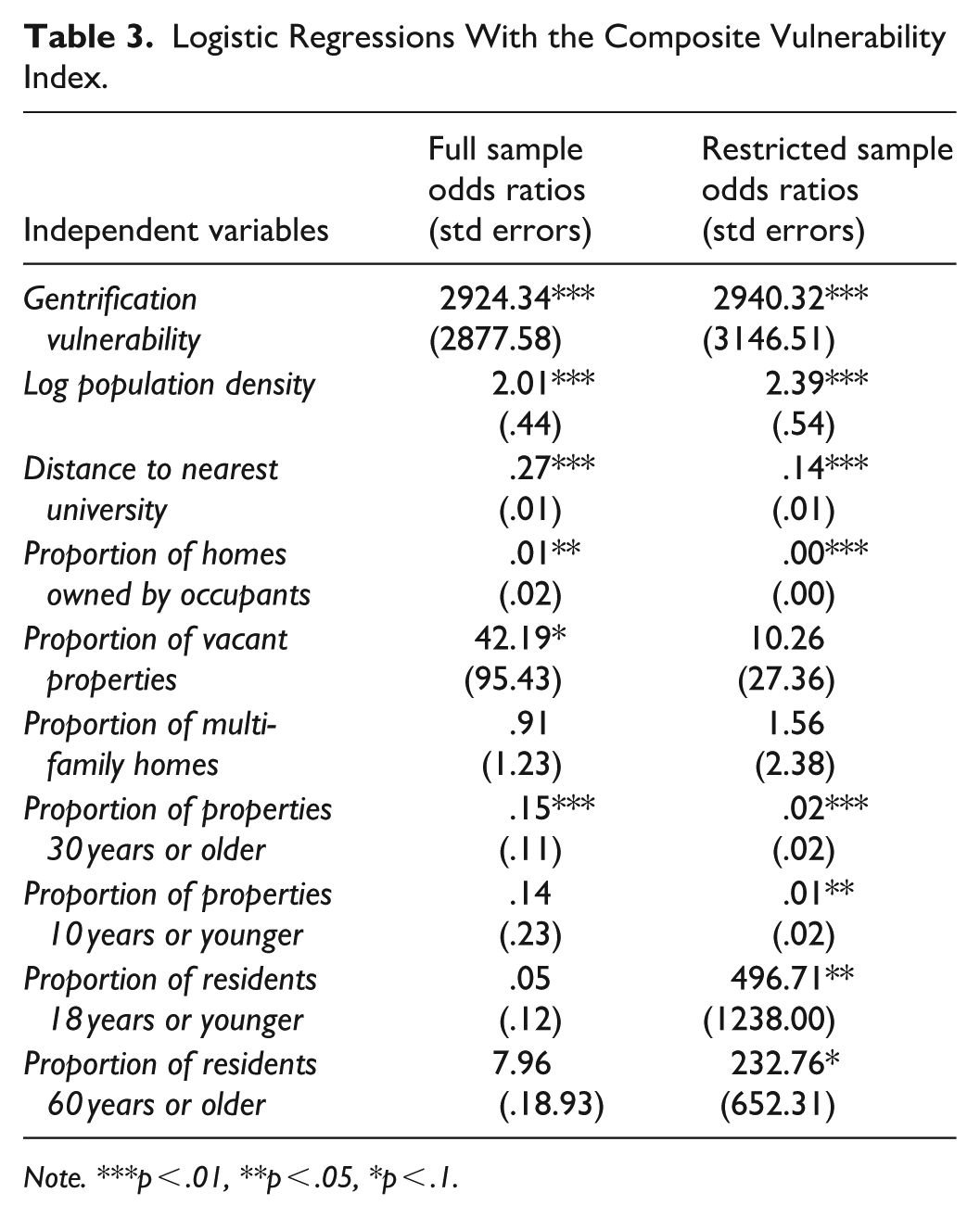
Across our series of regressions, gentrification vulnerability and almost all of the individual variables comprising the index were significant predictors of being targeted by an AII. More specifically, there is compelling evidence that the proportion of residents who identify as a Person of Color, the proportion of residents without a bachelor’s degree, and the proportion of residents below the poverty threshold are all strongly associated with being targeted by an AII. We ran our first random effects model on the entire sample, using the combined vulnerability index as the explanatory variable of interest (see Table 3). The model as a whole was statistically significant, Wald χ2(10) = 2094.53, p < .00. The odds ratio for the gentrification vulnerability index was δ = 2924.34, p < .00. The interpretation of this ratio is staggering, but before stating the interpretation, a word of caution is advised. The index’s values ranged from .07 to 1.88. A one-unit increase in the index, therefore, moves through more than half of the distribution’s range. Put simply, it is a relatively large jump in values, thus we would expect relatively large jumps in odds ratios. That said, a one-unit increase in the index is associated with a more than 290,000% increase in the likelihood that a census tract is targeted by an AII after controlling for neighborhood characteristics. To give more context, the mean vulnerability index value for census tracts targeted by an AII is 1.07, while the mean value for tracts not targeted is .62. This is a difference of almost 1.5 standard deviations. In other words, universities are disproportionately targeting neighborhoods at the higher end of the vulnerability index.
Logistic Regressions With the Composite Vulnerability Index.
Note. ***p < .01, **p < .05, *p < .1.
As a robustness check, we ran the same model with the restricted sample that removed tracts targeted by an AII once the AII actually began (see Table 3). The model remained fairly stable. A global hypothesis test was again statistically significant, Wald χ2(10) = 1599.49, p < .00, and the odds ratio for the gentrification vulnerability index barely budged, with δ = 2940.32, p < .00. This consistency across models lends credence to the interpretation that vulnerability strongly predicts targeting. There were changes in the odds ratios for several control variables, specifically the proportion of vacant properties, the proportion of properties newer than 10 years old, the proportion of residents under 18, and the proportion of residents older than 60, but these did not appear to change the results on the explanatory variable of interest.
We also fitted a second random effects model that deconstructed the vulnerability index into its composite, unweighted variables. We did this for two reasons. First, this second model provides more concrete information about what is driving the overall relationship between gentrification vulnerability and being targeted by an AII. Second, the enormous odds ratios in the first model are likely due to each of the composite variables having its own positive relationship with the outcome variable. Combining them thus creates a much stronger monotonic predictor. Disaggregating the index allows each variable to maintain its magnitude, though we lose some degree of generalizability.
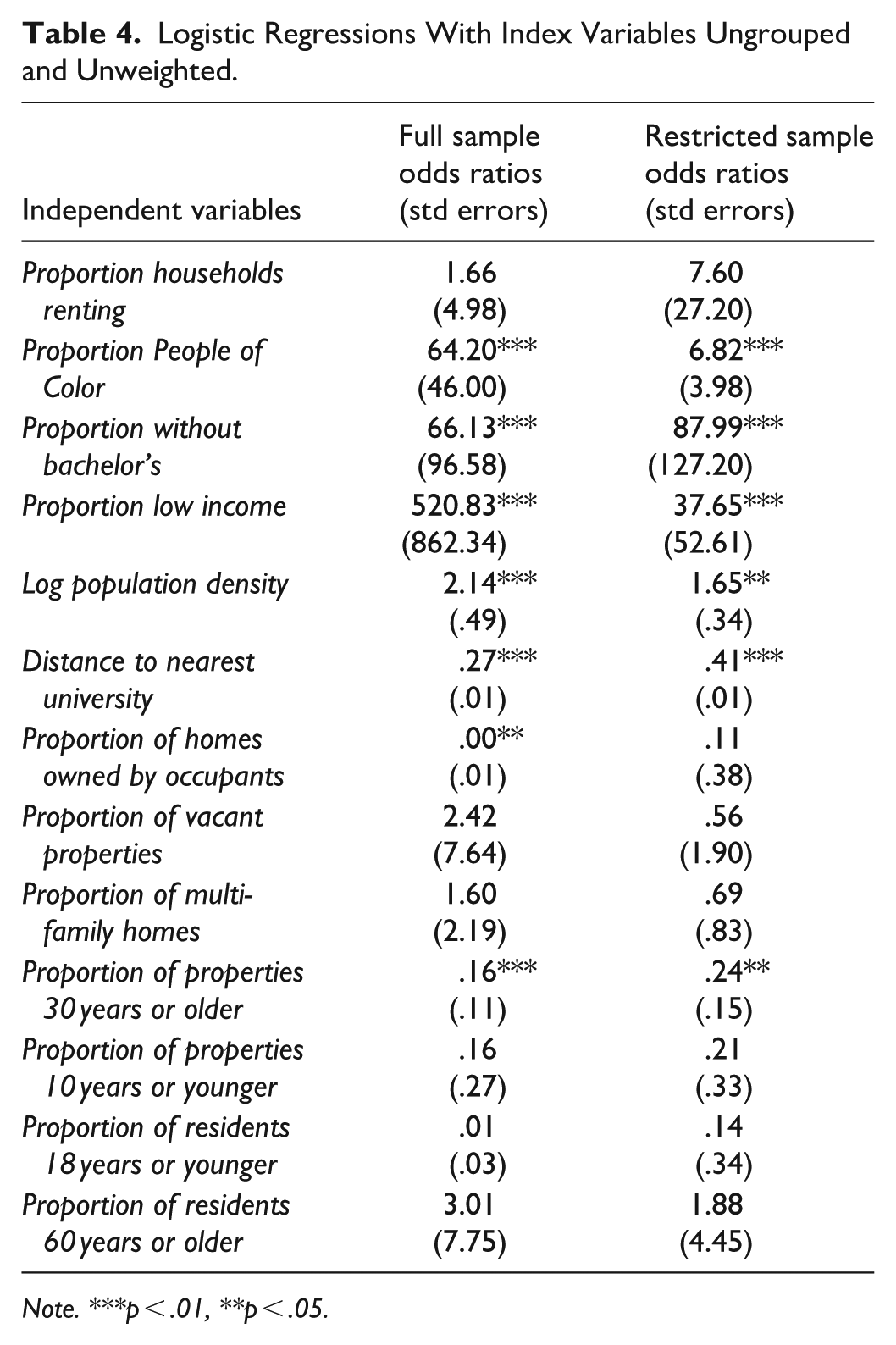
We ran this model again across both samples (see Table 4). In the full sample, the model as a whole was statistically significant, Wald χ2(10) = 1764.49, p < .00. Of the four variables in the vulnerability index, three were statistically significant: the proportion of residents who identified as a Person of Color (δ = 64.20, p < .00), the proportion of residents without a bachelor’s degree (δ = 66.13, p < .00), and the proportion of residents below the poverty threshold (δ = 520.83, p < .00). The proportion of residents who were renting was not a statistically significant predictor (p = .87). This is somewhat surprising, as renter-heavy neighborhoods are often considered to be more susceptible to gentrification due to weaker property security (Smith, 1982, 1998). One possible interpretation is that tracts with large proportions of renters are already catering to students, so universities are less interested in developing these areas to create spaces for students.
Logistic Regressions With Index Variables Ungrouped and Unweighted.
Note. ***p < .01, **p < .05.
The large odds ratios again need to be interpreted with caution, as a one-unit increase in a proportion is moving from a value of 0 to 1. For example, a census tract that is comprised entirely of residents who identify as People of Color is 6,320% more likely to be targeted by an AII than a census tract that is comprised entirely of White residents. When scaled down linearly to more realistic changes (e.g., a .1 increase in the proportion that identifies as a Person of Color), the odds ratios become more comprehensible, though still enormous (e.g., a 632% increase in the likelihood of being targeted).
In the restricted sample, the magnitudes of the relationships changed, though the directions and significance did not. The overall model was again statistically significant, Wald χ2(10) = 1657.37, p < .00. The proportion of renters was not significant (p = .57), the same result as the full sample. The other three vulnerability indicators were again statistically significant, though with different odds ratios: the proportion of residents identifying as a Person of Color (δ = 6.82, p < .00), the proportion of residents with no college credential (δ = 87.99, p < .00), and the proportion of residents below the poverty threshold (δ = 37.65, p < .00). Though the overall statistical significance and direction were the same between models, the magnitude is more volatile here. The relative stability of the models that used the index instead is likely due to the weighting and the monotonic combination. The consistent results across all the models, however, serve as strong evidence that gentrification vulnerability is a strong predictor of being targeted by a university as part of an AII. Specifically, relatively large populations of People of Color, low postsecondary attainment, and high poverty rates predict being targeted for development.
Robustness Checks
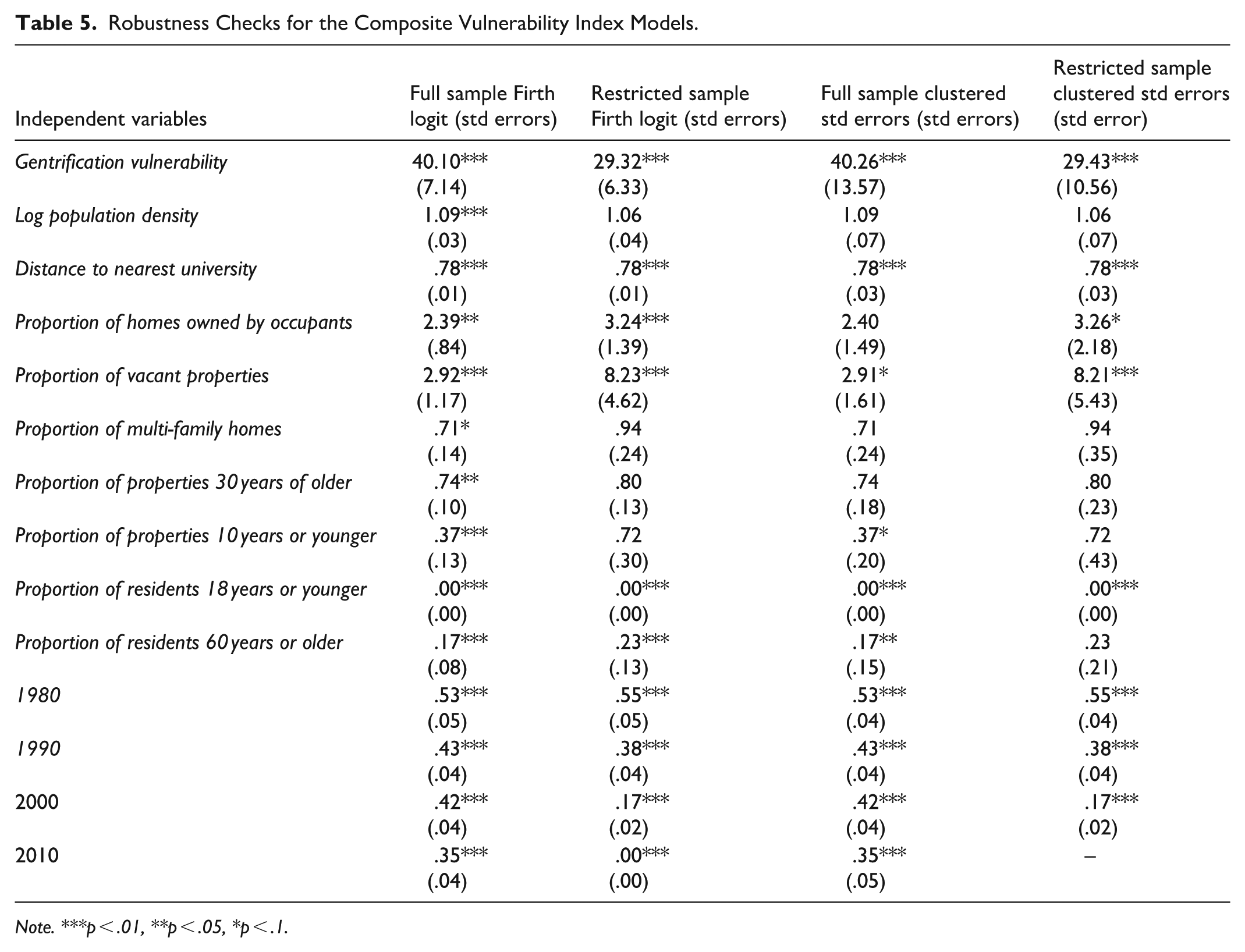
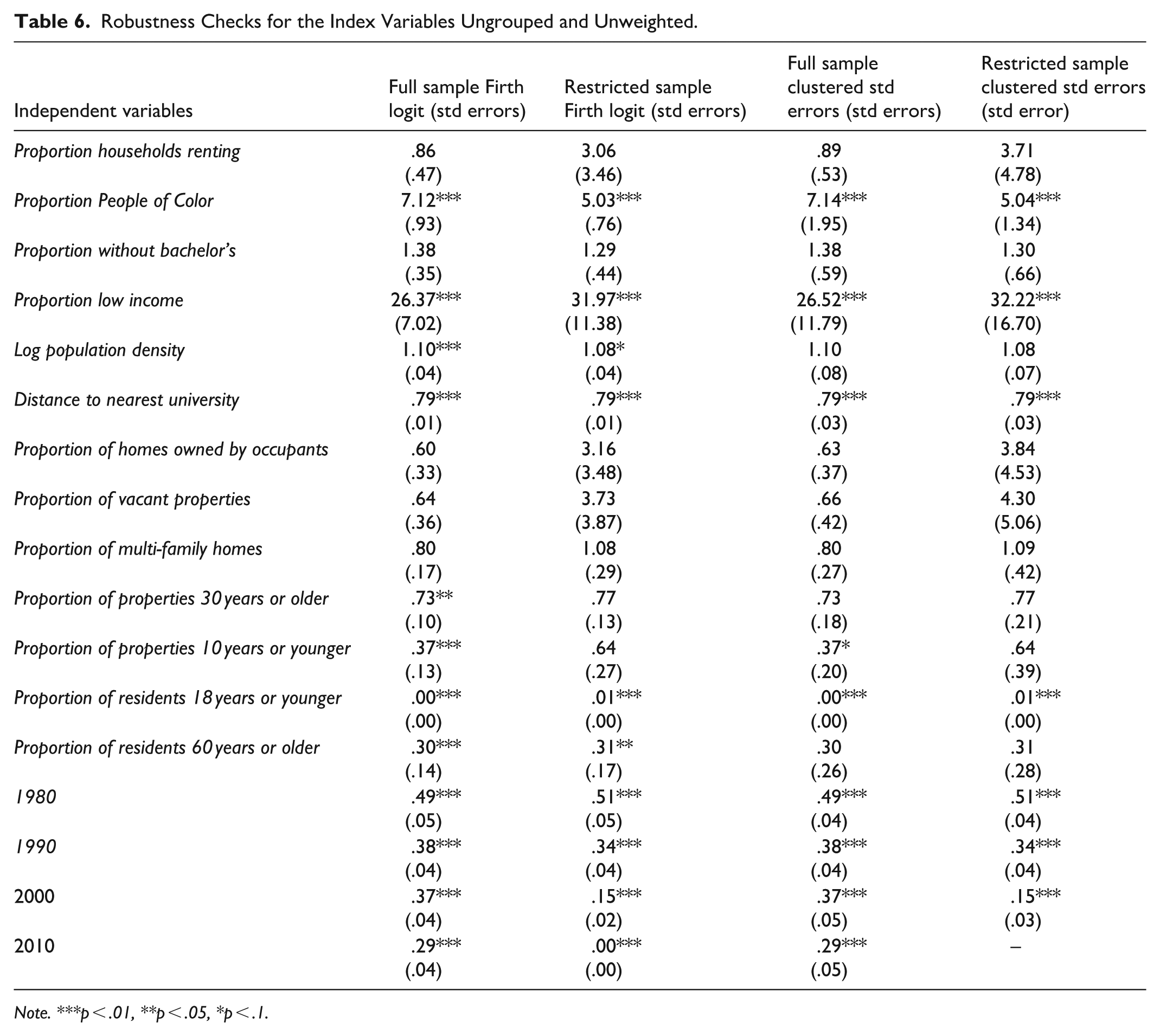
Given the large odds ratios and standard errors, a possible concern is sparse data problems, or situations in which there are low cell sizes for the outcome variable and specific combinations of predictors. As a robustness check, we reestimated key specifications using Firth’s penalized likelihood to address potential bias due to small cell sizes and potential quasi-separation in the data. Because standard implementations of penalized logit do not accommodate random effects, these models include the year of data collection as a series of fixed effects. We also ran models with alternative corrections for within-unit dependence and small cell size bias by clustering the standard errors by unit. We ran each of these models in both the full sample and the restricted sample with the vulnerability index as the predictor of interest (see Table 5), as well as both samples with the index disaggregated into its individual unweighted variables (see Table 6).
Robustness Checks for the Composite Vulnerability Index Models.
Note. ***p < .01, **p < .05, *p < .1.
Robustness Checks for the Index Variables Ungrouped and Unweighted.
Note. ***p < .01, **p < .05, *p < .1.
While the magnitudes shrink considerably, as expected, they remain relatively large, and the substantive conclusions remain the same. Gentrification vulnerability is a significant predictor of being targeted by an AII across all models. The proportion of the population that identifies as a Person of Color and the proportion below the poverty threshold were also significant predictors across all models. The only variable that is not stable across models is the proportion of the population without a bachelor’s degree. This variable was not significant across any of the robustness-check models.
Discussion
The overarching main result is that gentrification vulnerability is a positive predictor of being targeted by an AII. Census tracts that are more likely to have residents who face displacement during development are also more likely to be targeted by universities for development. The same indicators that make up gentrification vulnerability are factors in universities’ decision-making in designing AIIs. This result provides support for Marcuse’s (1985, 1986) theory of gentrification and abandonment, as universities seek to invest in census tracts that previously were abandoned. It also supports and extends previous work finding that university-led urban development is typically motivated by goals of recruiting students and faculty in a global marketplace (Etienne, 2012; Ilano, 2020; H. L. Taylor et al., 2018). When universities consider neighborhood characteristics that will appeal, or more accurately, for this study, fail to appeal, to potential candidates, demographics of the neighborhoods appear to be a major consideration. Racialized and class-based perceptions of blight (Herscher, 2020; H. L. Taylor et al., 2018) continue to shape decision-making. From the perspective of prevailing institutional logics reflected in university-led development decisions, universities treat achieving the idea of a desirable neighborhood for knowledge economy participants as requiring the reshaping of neighborhoods that are vulnerable to displacement. AIIs are driven by complex motivations and social conditions, espousing equitable development while remaining deeply entangled in historically racialized and classed constructions of urban desirability and neglect.
Within the index, two of the four variables were consistently statistically significant predictors of being targeted by an AII. The first significant predictor was a census tract’s proportion of residents who identify as a Person of Color. In other words, neighborhoods with fewer White residents are more likely to be targeted for development. This result is consistent with prior research that race is a key component of neighborhood change in the United States (Rucks-Ahidiana, 2021) and that university-led development is concentrated in majority-Black census tracts (Ilano, 2020). There are two potential interpretations of the mechanisms at work here. First, neighborhoods with large communities of Color were often constructed intentionally through policy choices like redlining and then neglected intentionally by those same policy bodies (Marcuse, 1985, 1986). The abandonment that necessitates gentrification, under Marcuse’s theory, is correlated with race because race was the deciding factor behind the initial abandonment decision by cities. Second, the racial composition of a neighborhood itself is often conceptualized as an indicator of neighborhood quality and blight, as these perceptions are based on long histories and structures of racism in urban planning and community development (Herscher, 2020). In this interpretation, the actual financial wealth and built environment of a neighborhood are secondary. Universities objectify non-White bodies to be indicative of neighborhoods that require change in order to be desirable places to live, work, and play for students and faculty. Universities’ selection of neighborhoods for development is inseparable from larger histories of redlining, disinvestment, and perceptions of what constitutes blight.
The next predictor within the index of being targeted by an AII was the proportion of the population below the poverty threshold. High poverty rates serve as a relatively visible marker of disinvestment, reinforcing narratives that these neighborhoods require interventions and development. This again supports Marcuse (1985, 1986) by highlighting the material consequences of abandonment that lead to gentrification plans. The detrimental effects of deindustrialization are to be remedied by the creative class, yet the proposed new residents that will result from an AII, students and faculty, are likely not the same residents who were affected by deindustrialization. More importantly, high poverty rates are perceived to be the result of abandonment, and thus gentrification, enacted through an AII, is posited as the necessary solution. Through this line of reasoning, poverty becomes not only evidence of past abandonment but also a justification for displacement.
The final predictor of being targeted by an AII was the proportion of residents without a bachelor’s degree, though this result is not stable across models. The very instability of the relationship is itself of interest in the context of this study, as if universities were consistently targeting neighborhoods with strong student presence, we would expect there to be a clear relationship between tracts with a large number of residents without bachelor’s degrees and the presence of AIIs. Our mixed evidence on this relationship emphasizes that university-led urban development appears to be structured primarily through racialized and classed logics of abandonment and redevelopment (Baldwin, 2021; Etienne, 2012) rather than through market responses to student housing demand. This interpretation is also consistent with work distinguishing studentification from gentrification, which finds that student populations alone are not necessarily associated with gentrification and displacement (Revington et al., 2021). Race and income are the most consistent and salient predictors of where universities choose to intervene, and to the extent educational attainment is considered, it is likely secondary or entrenched within broader patterns of disinvestment and redevelopment.
There are several implications for future research. As is the case in most research related to the spatial distribution of students in the United States, more granular data on where students actually reside would increase our understanding of how universities are embedded within the geographies of their cities. Primary data on off-campus student residences could allow for inferences regarding student housing and university-led urban development. This article also does not directly analyze data on the decision-making process around AIIs. Qualitative studies with the decision-makers could give more insights into the motivations, the factors that were explicitly considered, and assumptions or perceptions of neighborhoods that influenced the AIIs. Ethnographies, interviews with planning staff, or content analyses of strategic plans could illuminate how perceptions of race, poverty, and education inform choices around university-led urban development. Finally, comparative international work could shed light on whether these dynamics are unique to the history of racism and development in the United States or whether universities globally adopt similar logics when reshaping local neighborhoods.
From a critical urban studies perspective that recognizes development and neighborhood change as a question of power and control (DeFillipis, 2004), there are also several implications for practice. First and foremost, neighborhoods that are more vulnerable to displacement are also more likely to be targeted by an AII. This should be a major consideration in all decision-making for any university considering engaging in an AII. Assuming universities are acting in good faith, they should intentionally seek out development strategies that reduce the risks of displacement. Universities in the planning stages of an AII should also directly confront racialized and classed perceptions of what neighborhoods require development. Universities should consult with urban geography experts and community members while strategizing AIIs to ensure development decisions are made in concert with communities of Color and low-income families.
Finally, these results offer strong evidence that AIIs cannot be understood in isolation from broader urban policy logics. Universities often operate in partnership with city governments, foundations, and private developers through AIIs. Assuming cities continue to embrace development strategies that center the knowledge economy and attract the creative class, universities will continue to find their own goals aligned with broader gentrification projects. Thus, efforts to build equitable wealth through AIIs will require intentional and thoughtful engagement with motivations, potential adverse effects on neighborhoods, and community stakeholders beyond the powerful few.
Conclusion
Understanding the conditions that lead to university-led urban development is an essential component of developing theoretical and empirical frameworks of universities and cities. This study provides evidence that communities that are more vulnerable to displacement when faced with gentrification are also more likely to be targeted by university-led AIIs, specifically, communities of Color, communities below the poverty threshold, and communities with low educational attainment. While this study does not directly measure the actual motivations for launching AIIs, there is strong evidence that universities are much more likely to select neighborhoods that are vulnerable to displacement than those that are not vulnerable. The most plausible reason is that perceptions of urban blight and abandonment are racialized and classed, the same factors that make up gentrification vulnerability.
These results extend Marcuse’s (1985, 1986) theoretical claims that abandonment and gentrification are complementary processes, produced not through natural housing market dynamics but through intentional state decision-making. Marcuse was speaking mostly to municipal policy. This study shows that postsecondary institutions are also actors in the shift from abandonment to gentrification within neighborhoods by demonstrating that universities disproportionately target neighborhoods vulnerable to displacement. Universities are not passive participants in urban economies but are major actors with agency in shaping neighborhood trajectories, selecting sites for development that align with institutional priorities and global competition for talent.
Universities that present themselves as anchor institutions committed to equity must seriously reflect on their roles in racialized disinvestment and redevelopment. As they engage with local communities and navigate their role in cities and society, universities should critically reflect on their own perceptions of what constitutes a good neighborhood and what it means to be a good neighbor. Future work should strive to observe the decision-making process directly, gathering data on the perceptions and discourse of planners. Ultimately, this research calls for a reframing of how universities conceptualize themselves—and how others conceptualize them—as anchor institutions. Rather than considering AIIs as the solution to abandonment, universities must shift toward recognizing communities as stable entities deserving of self-determination and worthy partners in recruitment strategies.
Footnotes

Funding
The authors received no financial support for the research, authorship, and/or publication of this article.
Declaration of Conflicting Interests
The authors declared no potential conflicts of interest with respect to the research, authorship, and/or publication of this article.