







Abstract
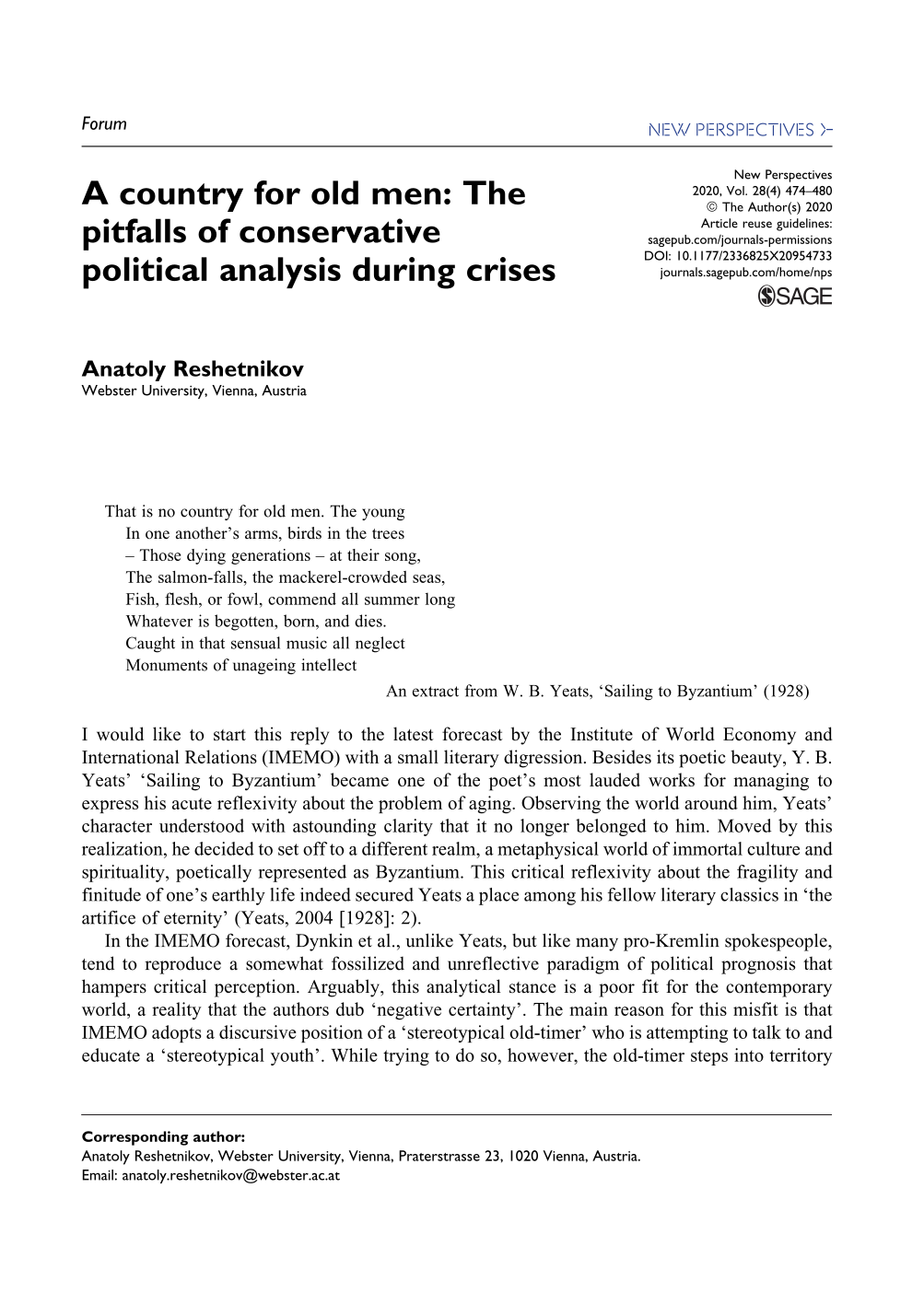
That is no country for old men. The young
In one another’s arms, birds in the trees
– Those dying generations – at their song,
The salmon-falls, the mackerel-crowded seas,
Fish, flesh, or fowl, commend all summer long
Whatever is begotten, born, and dies.
Caught in that sensual music all neglect
Monuments of unageing intellect
I would like to start this reply to the latest forecast by the Institute of World Economy and International Relations (IMEMO) with a small literary digression. Besides its poetic beauty, Y. B. Yeats’ ‘Sailing to Byzantium’ became one of the poet’s most lauded works for managing to express his acute reflexivity about the problem of aging. Observing the world around him, Yeats’ character understood with astounding clarity that it no longer belonged to him. Moved by this realization, he decided to set off to a different realm, a metaphysical world of immortal culture and spirituality, poetically represented as Byzantium. This critical reflexivity about the fragility and finitude of one’s earthly life indeed secured Yeats a place among his fellow literary classics in ‘the artifice of eternity’ (Yeats, 2004 [1928]: 2).
In the IMEMO forecast, Dynkin et al., unlike Yeats, but like many pro-Kremlin spokespeople, tend to reproduce a somewhat fossilized and unreflective paradigm of political prognosis that hampers critical perception. Arguably, this analytical stance is a poor fit for the contemporary world, a reality that the authors dub ‘negative certainty’. The main reason for this misfit is that IMEMO adopts a discursive position of a ‘stereotypical old-timer’ who is attempting to talk to and educate a ‘stereotypical youth’. While trying to do so, however, the old-timer steps into territory which is governed by principles that are much more appealing to the youth and that feel alien and uncomfortable for the old-timer. Below, I elaborate this idea in three steps. First, I provide an example of similar rhetoric coming from a Kremlin-affiliated actor. I then expose the similarities between that pro-Kremlin rhetoric, on the one hand, and the style and semantics of the forecast, on the other hand. Finally, I ponder on the tasks of political prognosis during the time of crises relating them to the literary illustration above.
The ignorant youth
On 22 July 2020, the press secretary of the Russian state-owned oil corporation ‘Rosneft’ Mikhail Leontiev proposed to disfranchise Russian youth. In a radio interview, he lamented that ‘these people are completely ignorant’ and that ‘we [i.e. the Russian elites allegedly representing the Russian people] might need to revoke their voting rights, or else we will lose the country’ (Novye Izvestiya, 2020). While, as a mouthpiece of the Russian regime, Leontiev has reasons for trying to distance the youth from voting, 1 his proposition was politically unthinkable within Russian discourse, which is still pervaded by ‘the-youth-is-our-future’ type of talk. Yet, Leontiev is not a random figure, but an editor, a laureate of several writing awards and a conservative intellectual (with a relatively long-standing anti-socialist stance), so his statement was not a simple-minded and/or ageist faux pas. To be sure, ‘youth’ in his representation has little to do with biological age, for if it was the age Leontiev was attacking, he would not only have to disqualify the tremendous efforts of the regime to create ideologically friendly youth organizations, such as Yunarmia, but also recognize the agency of numerous and vocal elderly opposition figures, such as Lev Rubinshtein. 2 In other words, Leontiev politicizes the concept of youth in such a way that it becomes equivalent to a political identity.
No doubt, ‘the youth’ as a political identity does not need to be interpreted as hierarchically inferior or superior to its conservative counterpart. What seems to be at stake here are the inconclusive and unending debates about (1) frugal materialism versus radical idealism, (2) transformative activism versus critical conformism, (3) the evaluation of long-term trends with their cautious projection into the near future versus creative and risky improvisation here and now backed by a stern commitment to as yet distant ideals. Thus, Leontiev and many other pro-Kremlin intellectuals 3 are, in fact, promoting their own version of conservatism exemplifying the trend that Elizaveta Gaufman captures in her contribution to this forum. In my understanding, Dynkin et al. take a cognate path, which does a disservice to their otherwise sound analysis.
While Leontiev’s flamboyant and scandalous style discredited him in the eyes of most pro- and anti-Kremlin political actors (Regions.ru, 2020), IMEMO’s sober conservative voice, trained by years of institutionalized academic practice, possesses more social capital and carries expert credibility sought by the Russian authorities. Substantively, however, Leontiev’s and IMEMO’s framing of the current political reality are not that different, as I will demonstrate in the following section. This point is important, since as the experts themselves admit, ‘[p]erception of reality by national elites’ is a determinant factor in international relations. This means that, if IMEMO (and other Russian political think tanks) aspire to report anything different from ‘negative certainty’, when it comes to Russia’s current and future interactions with the outside world, a more flexible and less paternalistic approach to political analysis may help reveal the true power of IMEMO’s agency as Russia’s leading research institute. Below, I point out a few problematic assumptions that trap IMEMO’s forecast within an old-timer’s discursive position, which is becoming unfit for the world they are describing.
An old-timer’s wisdom
Just like Leontiev, Dynkin et al. show their deep mistrust towards the youth. In their understanding, ‘the rise of an easily affected, sometimes naïve, younger generation has become a global trend’. The authors probably refer to the likes of Greta Thunberg and movements such as ‘Extinction Rebellion’ who ‘feed on wider populist protest sentiments which often lack constructive programs’. Downplaying the equalizing rhetorical simplicity and radical charm of environmentalist youth movements, the authors perceive them as nothing more than a destabilizing factor. In IMEMO’s account, populism and young age function as natural attractors and mutual catalysers. In reality, the relationship between these two is certainly much more nuanced. Some scholars demonstrate that both age and gender are ‘largely irrelevant’ when it comes to supporting populist movements (Spruyt et al., 2016: 342). Other scholars argue that it is the emerging alternative modes of political engagement and relative deprivation (where it exists) that attracts/pushes the youth into politics and not populist ideologies per se (Lello, 2020). IMEMO’s quip about the reckless youth, paradoxically rebellious and sequacious at the same time, would probably find its audience in a traditionalist, inertia-driven society. It may also represent quite well how Russian elites interpret political reality (cf. Leontiev). Yet, it does not seem to match IMEMO’s own depiction of the current global context, in which it is the ‘elites and governments [who are] losing touch with society’ and not the youth movements.
IMEMO’s take on new technologies and the global challenges they create is also noteworthy. The authors call for a ‘special socio-political support and training to help societies overcome the emerging ‘desynchronization’ – the gap created by accelerating technological change between those who are ready for it and those who are not, those who are afraid to lag behind and those who feel threatened by it’. This quote contains several assumptions that neatly fit into an old-timer’s discursive assortment. First, there is, of course, the ontological fear and anxiety supposedly evoked by new technologies, which the youth usually lacks, ‘appropriating’ innovation in their daily practice untroubled by incomplete understanding of what stands behind (Laguna and Babcock, 1997; Wagner et al., 2010). Second, there is paternalism manifesting in the call for sociopolitical support and training offered by the technologically advanced to the technologically lagging. Importantly, this call is framed in the language of linear progress and maturity versus immaturity: ‘those who are ready [should help] those who are not’. 4 Finally, the authors claim that the first two are natural phenomena allegedly caused by desynchronization or a technological gap between different countries. However, Russia’s own Leon Trotsky, among others, was making a valid point that such desynchronization was not only a permanent feature of international society but could also trigger different strategies and responses, producing heterogenous and seemingly anachronistic combinations within individual polities (Trotsky, 1932). This, for instance, happened with Russia’s backward, largely rural society in the beginning of the 20th century, when Russian proletariat took upon itself the function that was usually performed by a well-developed bourgeoisie in other countries and managed to achieve an industrial breakthrough (at a horrendous human cost), despite lacking technological and economic preconditions. Trotsky’s thesis about uneven and combined development has recently gained traction in International Relations (IR) and even had a shot at becoming the discipline’s ontological core (Rosenberg, 2016; Tallis et al., 2018). In other disciplines, cognate ideas have been around for decades (Reshetnikov, 2019), while the idea of the ‘linear progress’ has long ago turned into a deeply contested ideologeme attacked and exposed by the brightest minds of modern continental philosophy (Foucault, 1977; Koselleck, 2004).
Another problem of an old-timer’s wisdom is its excessive focus on the past when predicting the future and the shifting of political agency away from the actual political actors. One clear example of this is IMEMO’s take on memory politics. For the authors, the flabbergasting 2020 still remains a year of four anniversaries: the end of World War II (75), the founding of the UN (75), the tragedy of Hiroshima and Nagasaki (75) and the signing of the Treaty on the Non-Proliferation of Nuclear Weapons(NPT) (50). Naturally, the corona crisis that cancelled all mass commemorations and events led the editors to downplay the significance of those anniversaries that had previously been considered important. Allegedly, this happened because the pandemic ‘force[d] politicians to focus on today’. My immediate reaction to this is that politicians, unlike historians, always focus on today, even when they exploit commemorations and historical narratives to their immediate advantage. Thus, the sole fact that a certain historical event happened some rounded number of years ago does not tell us anything about the present (let alone the future) in the absence of a contextual exposition of the discursive environment, where those events are being represented and used by political actors, and often not in a black and white manner. Hence, there is little meaning in saying that those jubilees would ‘revitalize and reinforce existing contestation over historical narratives’ without also providing an explanation of who is likely to be exploiting these narratives, towards which ends, and under which limitations.
And the band played on
Interpreted through the prism of an old-timer’s discursive rationality, it is not that puzzling why IMEMO experts, on the one hand, believe that ‘Russia’s foreign policy course, focused on strengthening its independent role in international affairs is quite adequate to the nature and scope of challenges for the country at the global, regional and national levels’ and, on the other hand, portray the world around as ‘negative certainty [that] does not provide any grounds for optimistic forecasts’ (emphasis original). It also becomes clear why change is often delegated to other actors, such as President ‘V. Zelensky [who ought to] find a format acceptable for the elites and society in order to comply with the Minsk agreements’ to somewhat normalize Ukraine’s relations with Moscow.
However, this self-confident yet negative disposition and the resulting political inflexibility of IMEMO’s political prognosis are not performed in a discursive and political vacuum. They are performed in a world that is undergoing a ‘“Trumpisation” of world politics and economics, a continuing decadence in global governance and the accelerating destruction of its instruments in all spheres’, a world that is experiencing a major crisis, whose scale and consequences ‘no one had anticipated’, a world that is also about to pass through ‘several bifurcation points’ (emphasis original), which, by definition, always undermine a system’s stability and bring about a qualitative change, impervious to prediction (Prigogine, 1989). All these challenges require significant creativity and plasticity in both political action and prognosis. The safe ‘Russia-is-still-doing-everything-right’ kind of rhetoric that pervades the IMEMO report may not suffice, when the world is on fire.
The Russian ark
It is indicative that amidst this global crisis, Dynkin et al. use the metaphor of ‘Noah’s Ark’, which is supposed to unite and rescue, under Russian leadership, the responsible environmentalist actors (including France, Germany and China). This metaphor is, of course, totally inappropriate, as (1) the looming climate catastrophe is very unlikely to be eventually reversed by an almighty God, and (2) global environmentalist action is not supposed to be about building a refuge for two of every kind and letting the rest perish. Yet, this metaphor illustrates well one further deficiency of Russia’s political imagination during this transformative moment, as represented by IMEMO: Where is this 21st-century ark sailing? Just like Noah’s Ark, it is sailing nowhere – it is simply floating to-and-fro trying to preserve its integrity and waiting for the flood to recede.
Despite its esotericism, Yeats’ ‘Sailing to Byzantium’ exhibits a clear-headed gaze on the world. Its protagonist possesses a sufficient interpretive ability (1) to adequately evaluate the main qualities and dynamics of that world (‘the young / In one another arms…commend all summer long / Whatever is begotten, born, and dies’), (2) to grasp what these mean for the character’s own status (‘An aged man is but a paltry thing, / A tattered coat upon a stick…’) and (3) to come up with an appropriate action program, given the first two conditions (‘…there [is no] singing school but studying / Monuments of its own magnificence; / And therefore I have sailed the seas and come / To the holy city of Byzantium’). In the language of interpretive analysis (Schwartz-Shea and Yanow, 2012: 91–113), Yeats’ character is both hermeneutically sensible (i.e. susceptible towards local knowledges and knowers that inhabit the character’s immediate contexts) and reflexive (i.e. understands its own limitations, biases and options available in that context). That is why the character decides to leave the country of the youth, which no longer welcomes aged persons, attempting to find not a pensioners’ home, but a place where age does not matter, as everything in that place is supposed to be as much idealistic as it is material.
In the Russian context, a similar move was brilliantly performed by Alexander Sokurov in his ‘Russian Ark’. 5 To reflect about the cultural and political legacies of (mostly) the Russian empire, the director focused his attention on one of the most comprehensive material incarnations of Russian imperial culture – the Hermitage – and staged a pronouncedly fantastic political performance within its walls. He preferred this to making a more mainstream historical film that would have unavoidably misrepresented the bygone political realities, given the director’s positionality. Thereby, Sokurov made a powerful statement about the culture and politics of the period but did so not as a contemporary or a historian (neither of which he was), but as an artist from another time. In other words, he understood who he was, which expressive tools he could use to deliver his message and what was the appropriate way to talk about a political entity he never witnessed in person but inherited a discursive connection to. IMEMO’s mistake is that they are trying to utilize the noble language of political prognosis permeated by false certainty about the world, as well as about Russia’s place and future within it, in the times of a fundamental political transformation. In a time like that, however, the main task of political prognosis is to reflect upon the surrounding context, as well as a given political actor’s place within it, and, if the context requires (which it certainly does today), to detach oneself from the tried and true analytical scenarios no longer suitable for the situation and imagine a new, even if yet unfamiliar, world, refusing to be an old man in a young country.
Footnotes
Declaration of conflicting interests
The author(s) declared no potential conflicts of interest with respect to the research, authorship, and/or publication of this article.
Funding
The author(s) received no financial support for the research, authorship, and/or publication of this article.