







Abstract
Methodological uniformity and the relatively small number of studies concerning election turnout in Serbia strikingly detract from the social importance of the topic. The goal was to reduce this disparity by studying turnout in the 21st century under a statistically atypical approach that uses objective, publicly available data at the municipalities/cities level. Beginning in 2012, the trend of a worrying, almost linear decrease in turnout was found. Canonical correlation analysis showed that socio-demographic-economic variables are highly predictive of voter turnout. Six pairs of statistically significant canonical factors were isolated from the space of socio-demographic-economic characteristics and corresponding variables of electoral participation. It was indirectly established that the analytically extracted types of environments whose inhabitants exhibit specific electoral-participative behavior also show specific constellations of electoral preferences. The findings were then discussed in light of the regression to Vučić’s hybrid regime.
Keywords
Introduction
Electoral turnout is the most essential form of political participation (Cancela and Geys, 2016). Accordingly, a considerable number of relevant variables have been identified. The most general classification divides them into socio-economic, institutional, and political (Geys, 2006; Blais and Dobrzyinska, 1998). A more detailed categorization postulates different approaches to this problem: sociopsychological, sociological, 1 historical-institutional, rational choice, and communicative (Harder and Krosnick, 2008; Knight and Marsh, 2002). This paper falls under the sociological approach and deals mainly with socio-demographic and economic variables that are important in numerous studies. Age (e.g., Turner et al., 2001), gender (e.g., Inglehart and Norris, 2000), nationality (e.g., Fraga, 2018), religious affiliation (e.g., Hougland and Christenson, 1983), marital status (e.g., Wolfinger and Wolfinger, 2008), educational status (e.g., Sondheimer and Green, 2010), economic status (Nadeau et al., 2019), and degree of urbanization (e.g., Mo et al., 1991) are some of them.
Despite extensive empirical support, the findings are far from being entirely consistent even at the level of meta-analytic studies (Frank and Martínez i Coma, 2021; Smets and Van Ham, 2013). Additionally, collected scientific material is not equally consistent in different types of political regimes.
The studies of developed democracies did not lead to overly noticeable contradictions. Elections are conducted to elect and authorize political representatives in a fair and free competition. 2 Modern representative democracy depends on electoral participation since the political system derives its legitimacy from it (Todosijević and Pavlović, 2020). The level of turnout serves as an indirect indicator of the “health of democracy” (Franklin, 2004: 4), and the voters who go to the polls most regularly belong to the category of older individuals with a higher educational and economic status (Wolfinger and Rosenstone, 1980).
In purely autocratic regimes, elections are either not held at all or are conducted formally. 3 Turnout percentages are high 4 (Martínez i Coma and Morgenbesser, 2020) since the ruler/ruling party applies mechanisms of unequal competition, clientelism, 5 intimidation, coercion, and electoral theft to formalize electoral victory. The goal of such elections is not to get elected political representatives, but to provide apparent legitimacy, 6 merge clientelistic networks, manage elites, co-opt potential rivals, deter opposition, and, ultimately, perpetuate power (Gandhi, 2008; Gandhi and Lust-Okar, 2009; Brownlee, 2007; Schedler, 2002; Magaloni, 2006; Little, 2012; Morgenbesser, 2014). Poor and illiterate voters are more likely to turn out for such elections than the rest of the population (Blaydes, 2006; Calvo and Murillo, 2004).
Hybrid regimes, 7 especially recently, have been conceived as an independent, so-called residual category of regimes (Bogaards, 2009) since it has been shown that they do not necessarily transform into either democracy or pure (closed) autocracy. If they sustain themselves for over 10 years, they can consolidate and maintain their form in the long run 8 (Morlino, 2009; Mufti, 2018). Although elections are held pluralistically, regularly, and mostly without massive fraud, the authorities routinely abuse state resources, deny the opposition adequate media coverage, harass opposition candidates and their supporters, and sometimes manipulate election results. Journalists, opposition, and other government critics may be spied on, threatened, harassed, or arrested. Dissidents may be imprisoned, persecuted, or even attacked or killed (Levitsky and Way, 2002). Therefore, the differences between democratic and hybrid regimes are qualitative.
Frank and Martínez i Coma (2021) argue that the main determinants of turnout in democratic and non-democratic regimes are quite similar. However, it has been shown that the findings obtained from studies of hybrid regimes often contain inconsistencies and contradictions (Norris, 2002; Dukenbaev, 2017). For example, poor voters from rural areas are more susceptible to manipulation and mobilization to vote (Bunbongkarn, 1996), with the urban middle class also going to polls in large numbers (Dukenbaev, 2017). On the contrary, Hil and Huskey (2015) claim that in the post-communist part of the world, better-informed and politically sophisticated voters from urban areas exercise significantly lower turnout. Radcliff (1992) showed that in industrialized democracies, economic problems led to a decrease in turnout, in contrast to developing countries where he registered the opposite effect.
As this paper seeks to assess the degree and nature of voter turnout in the Serbian parliamentary elections during the 21st century, it is necessary to emphasize the lack of democratic tradition and the absence of democratic experience within the studied population.
From 1945 to 1990, Serbia was part of the Socialist Federal Republic of Yugoslavia, a communist state in which the elections held were neither fair nor free. Starting in 1945, the activities of opposition political parties were vastly limited and banned soon afterward. Parliament was completely deprived of power in favor of the ruling communist party, that is, its leadership core, which was not subject to any democratic control (Goati, 1999).
In the first multi-party Serbian elections held in December 1990, the Socialist Party of Serbia (SPS) under the leadership of Slobodan Milošević won a landslide victory. The SPS is the de facto successor of the communist party, which has made a pronounced nationalist program conversion while maintaining personnel, organizational, and, to some extent, ideological continuity. Milošević and his SPS remained in power until 2000. In literature, this ruling is almost consensually qualified as an example of a hybrid regime (Levitsky and Way, 2002; Howard and Roessler, 2006; Castaldo, 2020; Vladisavljević, 2016; Pavlović, 2004; Atlagić and Vučićević, 2019). According to the typology of emergence postulated by Levitsky and Way (2002), Milošević's regime belongs to the post-communist hybrid regimes.
In the presidential elections held on 24 September 2000, Milošević suffered a defeat by the Democratic Opposition of Serbia (DOS) candidate Vojislav Koštunica 9 but refused to step down, until the mass civil protests on October 5. Soon after, a transitional government was formed, early parliamentary elections were held, and a new executive power was constituted, headed by Zoran Đinđić. Between 2000 and 2012, elections brought some, but not radical, changes. One could rather talk about the redistribution of relative power among the parties that overthrew Milošević (Todosijević and Pavlović, 2020). From the point of view of regime typology, this period is qualified as democratic by some theorists (Ostojić, 2011; Vejvoda, 2004), while the majority still speak of semi-consolidated (Fiket and Đorđević, 2022), sub-consolidated (Jovanović, 2012), non-consolidated (Pavlović, 2004), or low-quality (Bursać and Vučićević, 2021) democracy.
In the parliamentary elections held on 6 May 2012, the Serbian Progressive Party (SNS) won a tight majority 10 but in the second round of presidential elections, Boris Tadić suffered a defeat to Tomislav Nikolić. The SNS, together with the SPS, constituted a government whose prime minister-designate was Ivica Dačić, and the first vice-president was Aleksandar Vučić. This event marked the entry into the second phase of political life after Milošević in which the SNS only strengthened its position as the most massive party on the Serbian political scene (Todosijević and Pavlović, 2020). From the aspect of regime typology, most theorists (Bieber, 2018; Keil, 2018; Pavlović, 2020; Castaldo, 2020; Maerz et al., 2020; Vladisavljević, 2020; Bursać and Vučićević, 2021) and relevant institutions (Freedom House, 2020; V-Dem Institute, 2019) qualify the latter part of this time interval as a hybrid regime dominance, while some even consider the period after 2020 to be autocratic (Fiket and Đorđević, 2022; Alizada et al., 2021). According to Levitsky and Way’s (2002) systematization, Vučić's regime could be categorized as a post-democratic hybrid regime.
Electoral turnout surveys in Serbia are surprisingly rare. Tucker (2002) shows that Serbia is one of the post-communist countries with the lowest rate of conducted electoral surveys. In addition, almost as a rule, this country has been excluded from comparative studies (Todosijević and Pavlović, 2020). Exploring the factors that affect turnout is of particular importance not only because of the small number of surveys but also because of the relatively low turnout 11 (Todosijević, 2020).
However, several empirical studies are addressing this topic. According to Logar’s (2007) findings, electoral abstainers are younger on average and absenteeism is more pronounced in urban areas, which agrees with common findings from foreign literature. It is stated, nevertheless, that gender differences are not significant. Moreover, educational status is associated with the turnout as opposed to what is usual in democratic countries—voters recorded slightly lower average levels of education than abstainers.
Quite the opposite, Branković (2007) records that higher socio-economic status operationalized by education and income is positively associated with the electoral turnout. Milošević-Đorđević (2007) presents similar results. Educated, wealthy, and elderly vote more regularly. In addition, both Branković (2007) and Milošević-Đorđević (2007) find that women are more prone to absenteeism.
Todosijević and Pavlović (2020), similar to Logar (2007), report that the gender turnout gap has disappeared. Older, better-educated, and respondents from rural areas, according to these authors, vote more often, but the effect of education, again similar to Logar’s (2007) findings, is quite weak. 12 Additionally, they found that individuals living in a marital union exhibit a higher average level of elective participation. 13 Economic factors such as employment, income, and wealth proved irrelevant, as did belonging to a religious denomination or a degree of personal religiosity. On the other hand, the regularity of attending religious ceremonies has proven to be facilitative in terms of electoral turnout.
Todosijević (2020) retroactively analyses unstandardized survey data collected by the Institute of Social Sciences throughout the whole period of multi-partying in Serbia. He systematizes the obtained findings in a meta-analytical format showing that socio-demographic factors are solid and more or less consistent predictors of electoral turnout. In eight studies education was positively, and in three negatively associated with electoral participation, while in the remaining two, it did not reach the level of statistical significance. The author attributes this inconsistency to a variable political context, that is, “politically colored voluntary abstinence” (Todosijević, 2020: 237). His results show that there are no intersex differences. Only one of 13 studies found this effect statistically significant pointing to higher turnout among women. Regarding urbanization, turnout is lower in urban areas in three studies, one registers lower turnout in rural areas, while in the remaining seven, there is no statistically significant effect of this type. In contrast to the subjective assessment of one’s religiosity, institutionalized religiosity 14 proved to be a relatively robust predictor of turnout. Household income was not among the relevant factors.
Todosijević and Pavlović (2020) explain the relative coherence of the above findings in terms of age and urbanization: The fact that abstainers are somewhat younger indicates the importance of socialization for the formation of the habit of participation (Plutzer, 2002; Franklin et al., 2004). When it comes to the effect of urbanization, rural areas are more conducive to the manifestation of social factors that lead to electoral participation, such as cross-pressure or social integration (Tarrow, 1971; Morlan, 1984). The impact of rural social networks, which is often more important than voluntary organizations, was determined by research in Kyrgyzstan (Darr and Hesli, 2010; Dukenbaev, 2017). Tatyana Kostadinova (2003) analyzed data from 15 Eastern European countries and found a negative correlation between urbanization and turnout.
Todosijević and Pavlović (2020) explain incoherent findings on gender by pointing out two causal possibilities. Factors such as resources, motivation, social integration, and interest in politics, lead to more pronounced participation in men (Milbrath and Goel, 1977; Inglehart et al., 2003; Pavlović, 2017). The fact that in recent studies gender differences disappear is sometimes interpreted as a consequence of emancipation, and sometimes as a reflection of personality traits, that is, a higher conscientiousness 15 in women. 16
From the aspect of the methodological approach applied in the above-presented studies, it is possible to classify them into two groups: One category includes research based on bivariate statistics in which the dependent variable is the turnout on one of the election cycles; independent variables are altered from analysis to analysis in a relatively wide spectrum. The second category involves logistic regression analyses where the dependent variable is also one election turnout, but with more predictors simultaneously included in the model. 17 Both types of studies deal with individual differences between respondents, implying that the dependent variable is necessarily binary. The approach applied in this paper differs substantially. A set of independent variables is associated with a set of dependents intending to examine latent aspects of the connection between them. Both the intercorrelations within and the cross-correlation between sets are considered. Therefore, the limitation related to multicollinearity is not as rigorous as with logistic regression analysis, and the possibility of a simultaneous study of a considerable number of elections opens up. In addition, differences at the level of municipalities/cities 18 are analyzed. Consequently, dependent variables belong to a higher level of measurement. Such a methodological orientation might lead to the discovery of some regularities that could not be detected in previous studies, due to the listed limitations.
There are three aims of the research. First, to determine whether the level of the electoral turnout has changed in the function of time, 19 and if so, in what way. Second, to establish whether there is a correlation between the municipalities/cities’ socio-demographic-economic structure with specific patterns of their inhabitants’ turnout, and if so, to clarify whether there are one or more types of such association. Third, to achieve a better understanding of the possible relations between municipalities/cities’ socio-demographic-economic characteristics and the patterns of turnout, indirectly investigate the electoral preferences of these communities’ residents towards political entities that have won parliamentary status.
The following hypotheses were put forward to concretize and operationalize these goals: First, a significantly higher electoral turnout sets apart the regime dominated by the DS from the SNS regime, especially its later phase. Second, there is a significant correlation between municipalities/cities’ socio-demographic-economic structure and their inhabitants’ specific patterns of turnout. Third, the relationship between the socio-demographic-economic structure of municipalities/cities with their residents’ turnout represents a complex phenomenon with independent connections. Fourth, environments with specific socio-demographic-economic features, whose inhabitants also manifest specific patterns of turnout, express their inherent configurations of electoral preferences.
Method
The research design falls under the canonical correlation studies conducted to gather information on the presence, direction, and degree of association between multiple independent and multiple dependent variables (Ristić, 1995). The analyzed variables were collected, arranged, and systematized from publicly available, therefore verifiable, sources. Electronic publications 20 from the website of the Statistical Office of the Republic of Serbia (Republički zavod za statistiku n.d) were used as data sources. Unlike pre-election polls in which respondents express their intention to vote and post-election polls stating if they allegedly voted, this is an indisputable facticity.
Of the techniques for statistical data analysis, relative percentages, analysis of variance (ANOVA) for dependent samples, product-moment correlation coefficients, and canonical correlation analysis were used.
The sample of the entities comprised 160 municipalities/cities. To avoid the problem of sample leakage, 21 municipalities formed after 2000 were, depending on the possibility, either removed from the sample or merged with the previously existing ones. Given the specific situation, municipalities/cities from the territory of Kosovo are not included in the analysis.
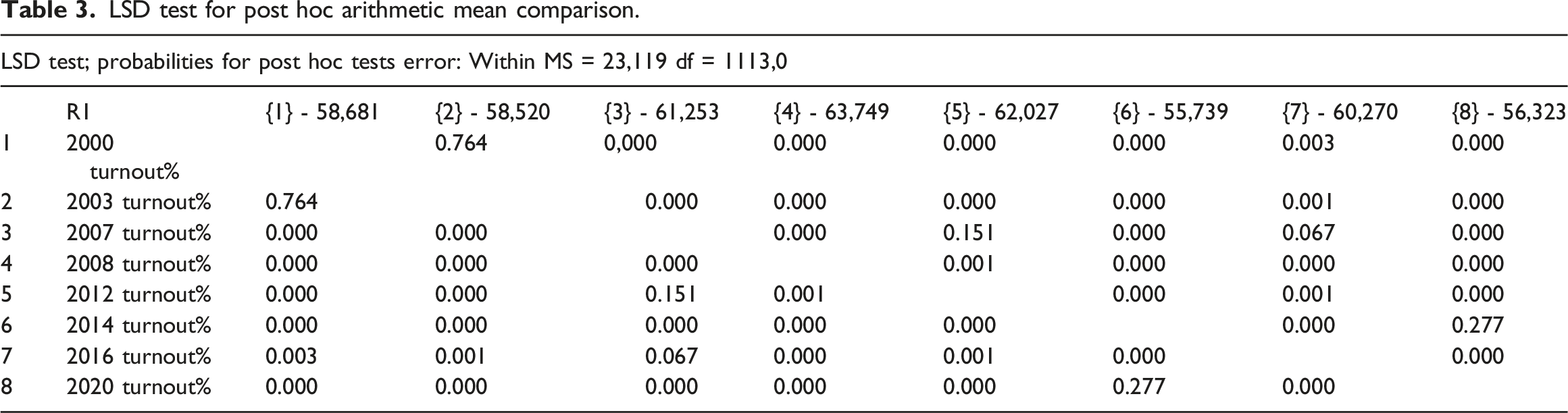
To check whether the percentage of turnout changed at the municipalities/cities’ level after the DS’ regime fall, ANOVA for dependent samples was applied and post hoc comparisons were calculated by the LSD method.
To study the connection of the municipalities/cities’ socio-demographic-economic structure with specific patterns of turnout, a canonical correlation analysis was conducted. The set of independent canonical variables consists of four dummy variables of national affiliation, 22 four dummy variables of religious orientation, 23 four dummy variables of age structure, 24 one dummy variable of gender structure, 25 six dummy variables of marital status, 26 four dummy variables of educational status, 27 two dummy variables of computer literacy, 28 percentage of illiterate, percentage of employed, percentage of unemployed who once worked, percentage of unemployed looking for their first job, percentage of persons with disabilities, degree of urbanization, 29 population density, 30 and average net wage for April 2012. The set of dependent canonical variables comprises turnout 31 for parliamentary elections held in 2000, 2003, 2007, 2008, 2012, 2014, 2016, and 2020. Virtually all variables are expressed as a percentage except for population density and average net earnings, with none below the ratio level of measurement.
Altogether, 41 variables were included in the canonical model – 33 were independent, and eight were dependent. The left set contains independent, right-dependent variables. There are almost four times more entities than variables in the model. Therefore, the prerequisite for applying factor analysis, 32 which is considered paradigmatic for this group of multivariate techniques, is satisfied. This, however, should be accepted with a certain amount of reserve. The number of variables analyzed is still somewhat too large, especially if the methodological instructions are extremely rigorously interpreted. Thus, some findings may fall under statistical artifacts. On the other hand, the somewhat increased number of variables does not have to be problematic, especially from the aspect of research practice. The conventional criterion was used throughout the interpretation—only coefficients 33 larger than 0.2 were considered.
Since the data undoubtedly contain multicollinearity, 34 a distinct advantage in interpretation is given to factor weights, 35 which are based on a logical-mathematical rationale close to partial correlations in regression analysis. 36
To shed more light on isolated canonical factors, as an auxiliary means, voter preferences 37 were used. In particular, the electoral lists that won the parliamentary status in the analyzed election cycles. The product-moment correlation between canonical scores for canonical factors isolated from the left set of variables and the just-mentioned voting preferences were calculated. Then, for the sake of visibility and cost-effectiveness of the display, the highest product-moment coefficients 38 were systematized and frequency was displayed by the contingency table. Parliamentary political options were presented in the ranks, and canonical factors from the left set were listed in the columns. Each column was divided into two subcolumns designed to record the frequency of positive and negative sign coefficients. This simple frequency analysis further demystified the content of the extracted factors. In addition to predictiveness in terms of electoral participation, part of their role regarding electoral preferences has been determined.
Results
Total turnout in post-October 5 parliamentary elections in Serbia.
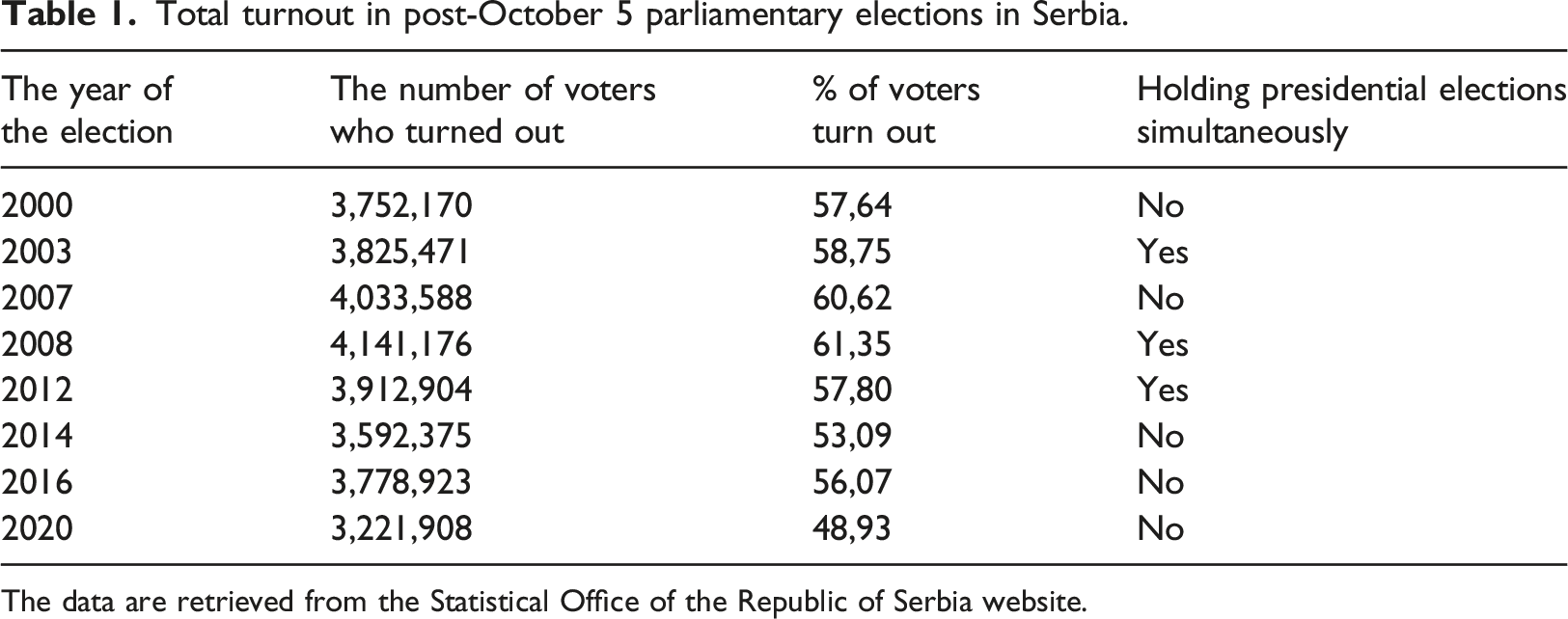
The data are retrieved from the Statistical Office of the Republic of Serbia website.
ANOVA for dependent samples—turnout from 2000 to 2020 at the municipalities/cities’ level: statistical significance of the model.

LSD test for post hoc arithmetic mean comparison.
Canonical correlations, squares of canonical correlations, χ2 tests, and statistical significance of successively isolated canonical roots.
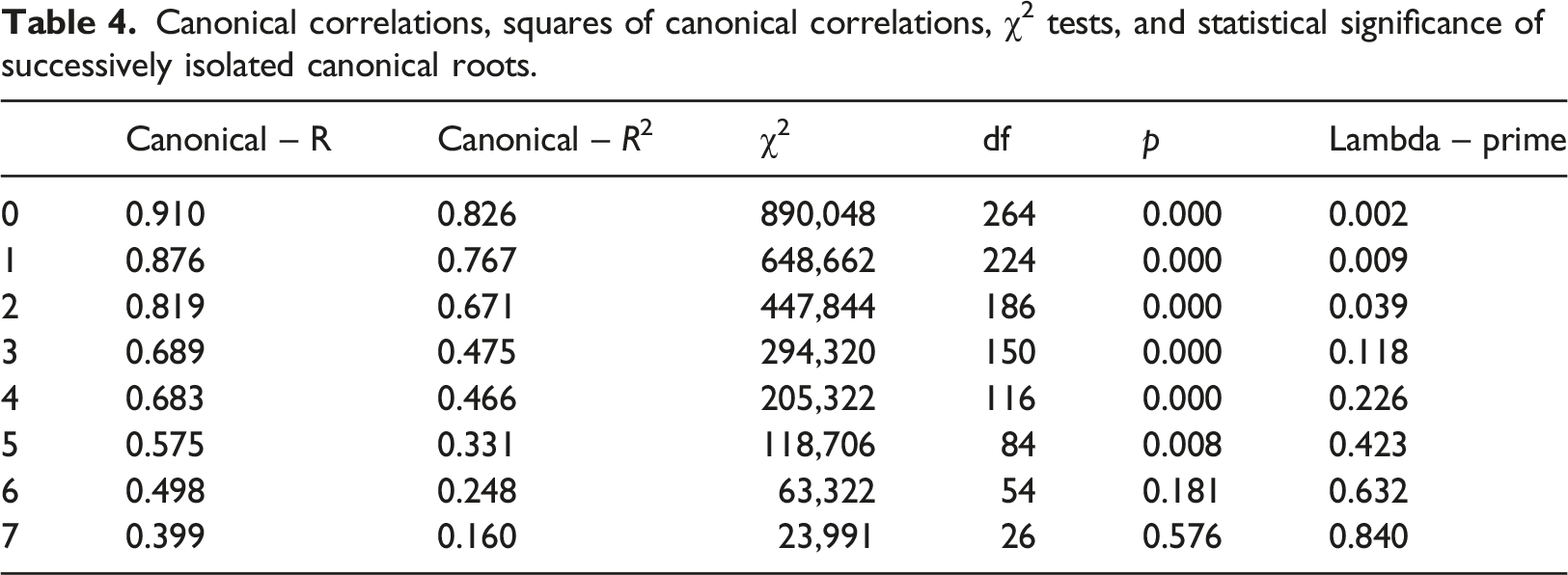
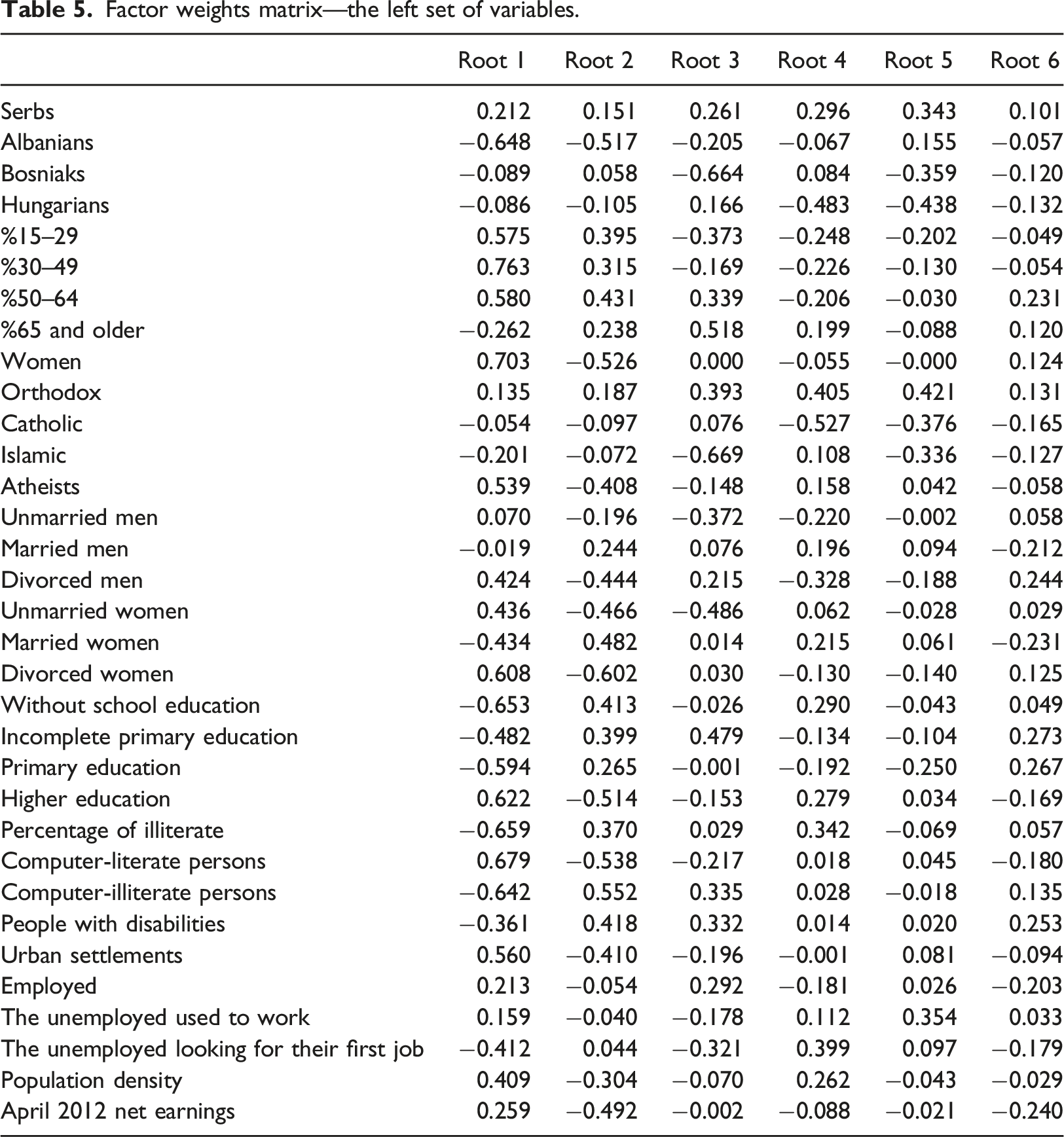
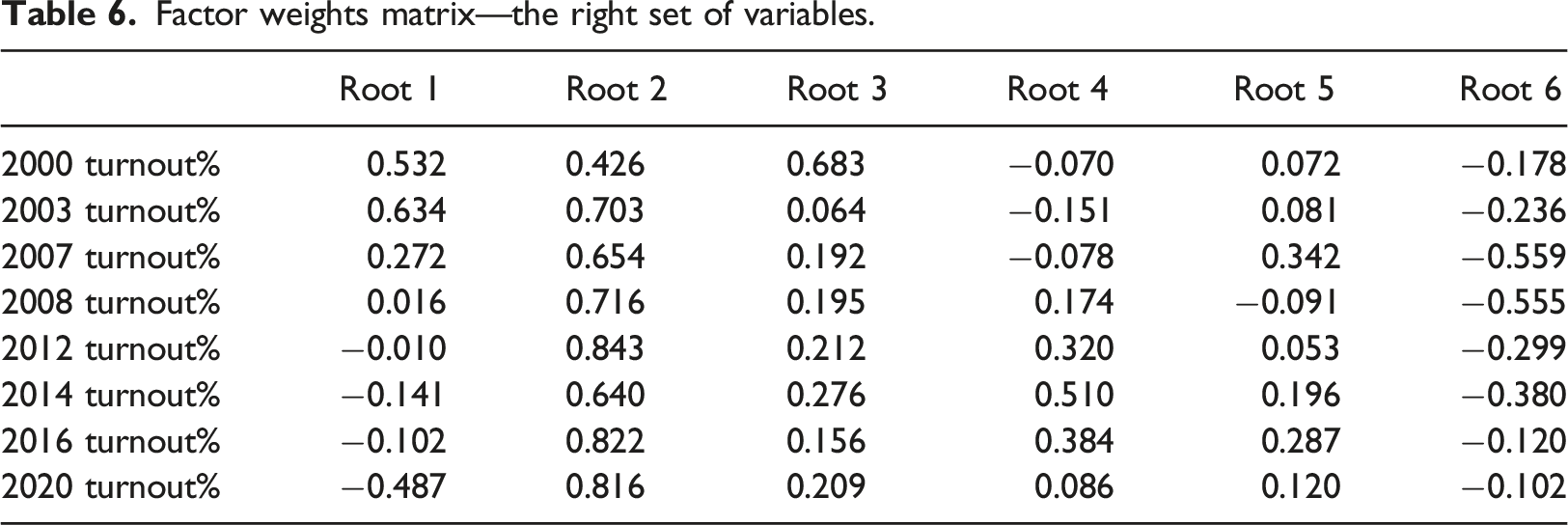
All six canonical factors isolated from the left set of variables are bipolar, while all canonical factors extracted from the right set of variables are unipolar, except for the firstly isolated one (Tables 5 and 6).
The canonical correlation between the canonical functions of the first pair is 0.91. The positive side of the canonical factor isolated from the left set of variables is determined by municipalities/cities with a more prevalent Serbian population, higher urbanization, population density, employment rate and incomes, a dominant share of the population from 15 to 64 years of age, women, 42 divorced men, non-religious, computer-literate and highly educated inhabitants; the negative side is defined by the environments with a higher percentage of the Albanian national minority, the Islamic religion, individuals with primary and unfinished primary education, illiterate and computer-illiterate people, married women, persons with disabilities and unemployed residents who have never worked. The positive side of the canonical factor isolated from the right set of variables is determined by the high turnout in the first three post-October 5 parliamentary election cycles, especially in 2003 and 2000; the negative side is defined by the high turnout in the 2020 parliamentary elections.
The canonical correlation between the canonical functions of the second pair is 0.88. The positive side of the canonical factor isolated from the left set of variables is determined by municipalities/cities of all types of age, a higher percentage of individuals with primary, incomplete primary and no education, married men and married women, illiterate and computer-illiterate residents, and persons with disabilities; the negative side is defined by environments with a higher degree of urbanization and population density, an increased proportion of females, 43 divorced men, Albanian national minority, non-religious, computer-literate, highly educated people, and higher average net earnings. The unipolar, positively oriented canonical factor isolated from the right set of variables is determined by the consistently high turnout for parliamentary elections, with turnout in 2020, 2016, and 2012 elections saturating it to the greatest extent.
The canonical correlation between the canonical functions of the third pair is 0.82. The positive side of the canonical factor isolated from the left set of variables is determined by municipalities/cities with a majority Orthodox, Serb population, aged 56 and over, employed, computer-illiterate residents with incomplete primary education and high disability rates. Communities with a highly represented Islamic religion, Bosniak and Albanian national minorities, young, computer-illiterate population, men and women who did not marry, and persons who never got a job define the negative side of this factor. The unipolar, positively oriented canonical factor isolated from the right set of variables is determined by the increased turnout in 2000, 2012, 2014, and 2020 parliamentary elections.
The canonical correlation between the canonical functions of the fourth pair is 0.69. The positive side of the canonical factor isolated from the left set of variables is defined by densely populated, Orthodox, Serbian communities, an increased percentage of those who once worked and are now unemployed, a high proportion of illiterate persons without a school education, but also people with higher education; the negative side is determined by municipalities/cities with a highly represented Hungarian national minority, Catholic religion, the dominance of the age range of 15–64 years, and unmarried and divorced men. The unipolar, positively oriented canonical factor isolated from the right set of variables is determined by the increased turnout in the 2012, 2014, and 2016 parliamentary elections.
The canonical correlation between the canonical functions of the fifth pair is 0.68. The positive side of the canonical factor isolated from the left set of variables is determined by municipalities/cities with a majority Serb, Orthodox population, and a pronounced category of those who used to work and are now unemployed. The highly represented Hungarian and Bosniak national minorities, Catholic and Islamic religions, younger population, and a more pronounced presence of individuals with completed primary education define the negative side of this factor. The unipolar, positively oriented canonical factor isolated from the right set of variables is determined by the increased turnout in the 2007 and 2016 parliamentary elections.
Factor weights matrix—the left set of variables.
Factor weights matrix—the right set of variables.
Frequency of statistically significant correlation coefficients between political preferences and canonical factors isolated from the left set of variables.
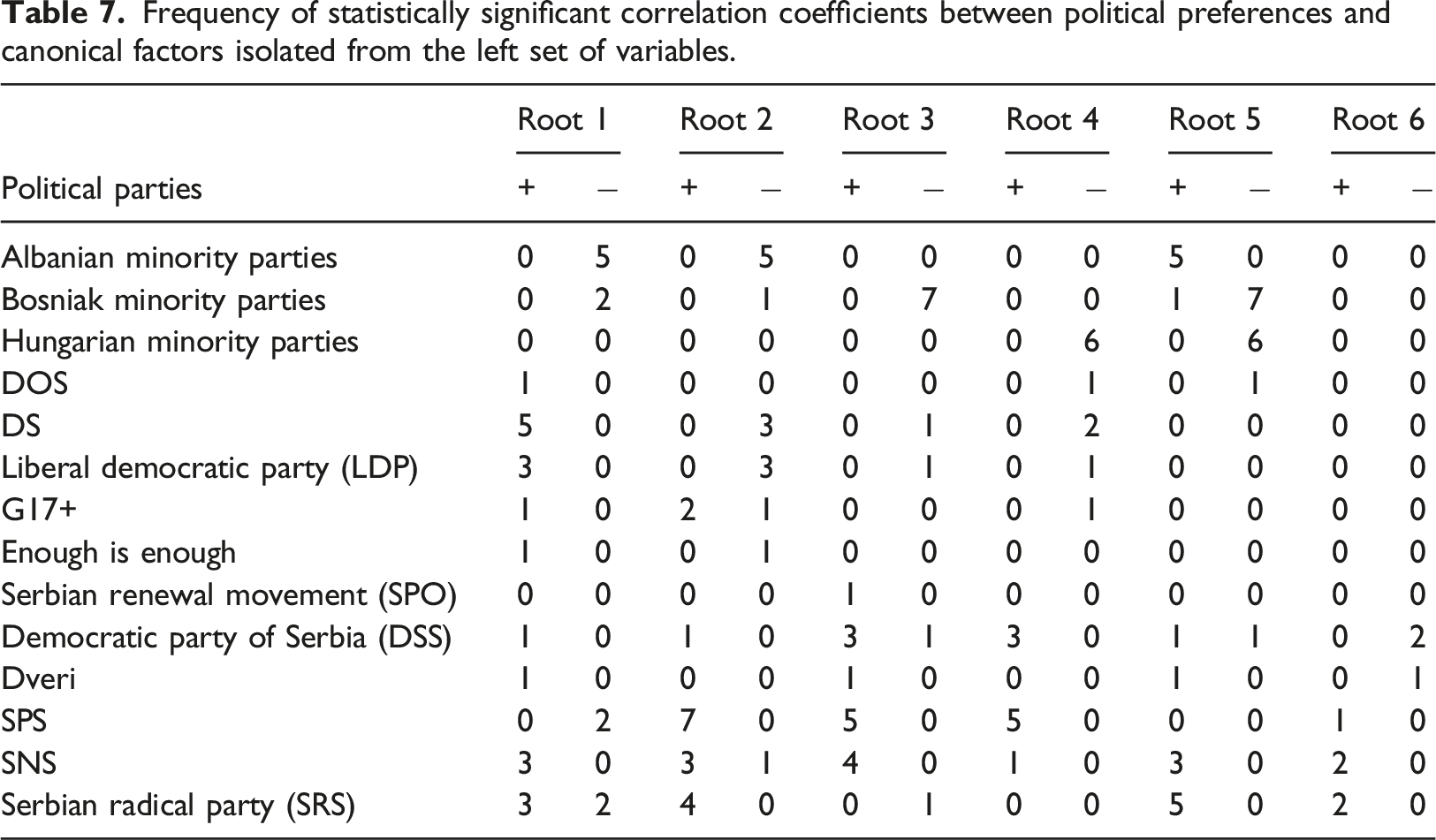
Voters from environments that define the positive side of the second left canonical function almost exclusively opt for SPS, SRS, SNS, and G17. Conversely, voters from environments that define the negative side of this canonical factor predominantly opt for DS and LDP. As environments with an Albanian population highly determine the negative side of this canonical function, consistent voting for parties of the Albanian national minority is also present here (Table 7; Appendix 2).
The positive side of the third left canonical root is associated with the tendency to vote for SPS, SNS, DSS, Dveri, and SPO. Since the negative side of this canonical factor is highly defined by belonging to the Islamic religious community and the Bosniak national minority, members of these communities primarily show a tendency to vote for the parties of the Bosniak national minority (Table 7; Appendix 2).
The positive side of the fourth left canonical root is characterized by a tendency to give electoral trust almost exclusively to SPS and DSS. The negative side of this factor is highly saturated with environments of the younger Hungarian population. Besides dominantly supporting the parties of its national minority, they sometimes trust options such as DS, DOS, LDP, and G17+ (Table 7; Appendix 2).
The positive side of the fifth left canonical function is connected with giving electoral trust to SRS, SNS, and parties of Albanian national minorities. The negative pole of this canonical factor quite reliably predicts a monolithic commitment to Bosniak and Hungarian national minority parties (Table 7; Appendix 2).
The positive side of the sixth left canonical function is associated with certain sympathies towards the SNS, SRS, and SPS, while environments from the negative side express exclusive electoral trust towards the DSS (Table 7; Appendix 2).
Discussion
According to the Serbian electoral system, the entire country represents a single electoral unit. 45 When turnout is analyzed at the level of that comprehensive “mega” electoral unit, the first hypothesis should be considered confirmed. Namely, the turnout is higher in the parliamentary elections held during the regime whose backbone was the DS 46 compared to the turnout in the SNS era, especially in its later phase. Examined in more detail, in the period from 2000 to 2008, a gradual but continuous increase in electoral participation can be observed. Starting in 2012, 47 a slight decline in electoral participation was noticed, followed by a simultaneous increase in the share of invalid ballots. After that, the SNS regime was enthroned and the drastic, continuous erosion of voter turnout began, not counting the accidental case of the 2016 election.
Klačar’s (2015) research facts could, to a certain extent, explain this worrying phenomenon. Namely, 77% of citizens do not trust political parties, almost 50% believe that democratic regimes have an alternative, and only 30% believe that democracy is a better arrangement than others. If we accept the warning expressed by Franklin (2004: 4), according to which the level of electoral turnout serves as an indirect indicator of the “health of democracy,” then this alarming finding additionally vindicates many authors (Bieber, 2018; Keil, 2018; Pavlović, 2020; Castaldo, 2020; Maerz et al., 2020; Vladisavljević, 2020; Bursać and Vučićević, 2021) who classify the SNS regime in the hybrid category.
However, the question arises: Why did the upward trend of electoral participation change during the mandate of the Government under the prevalent control of the DS? The answers are numerous and speculative. Some of them could be cumulative corruption scandals without a judicial epilogue, inadequate response to the global economic crisis, 48 a clumsy and ineffective response to the declaration of Kosovo’s independence, the establishing of a “historical reconciliation” with Slobodan Milošević's semi-reformed SPS, the delay in accession to European integration, insufficiently successful privatization, partrocratic judicial reform that has met with condemnation from the EU, et cetera. All this could have acted passivatively on the voters who “put forward” October 5 changes, which was indirectly confirmed by the structure of the first pair of canonical factors. In addition, the analysis of the trend of de-Europeanization based on data on the freedom of the Serbian media (Castaldo and Pinna, 2018) fully corresponds with the presented results on the beginning of the decline in electoral turnout, as well as its further precipitous collapse.
The analysis of turnout at the municipalities/cities’ level reveals two interesting facts. First, from the statistical inference point of view, the increase in turnout was not recorded between the elections of 2000 and 2003. It followed in the upcoming period ending in 2008. The reasons could be Đinđić’s murder and the low level of achieved democratic consolidation. Second, it is necessary to be noted that the boycott produced a drop in turnout between two electoral cycles, with more than half a million votes missing. However, even though taken on aggregate 2020 turnout decreased by more than 350 thousand votes compared to 2014, at the municipal level there is no statistically significant difference between the turnout recorded in 2014 and 2020, although 2020 was boycotted. Bursać and Vučićević (2021) speak about the failure of the boycott organized by a part of the opposition. As reasons, they emphasize a lack of support from foreign factors, unequal access to law, resources, and media, abuse of state institutions, and manipulation of electoral rules. 49 However, it is also necessary to highlight the facts concerning the opposition factor. First of all, most of the opposition is delegitimized by its corruption scandals from the past. Then, the opposition did not approach the boycott uniquely. Finally, the opposition could not organize any serious protests and demonstrations against unfair and unfree elections. On top of everything, the elections were held during the first (deadliest) wave of the COVID-19 pandemic. 50 Notwithstanding, the authoritarian leader and his demagogic-populist catch-all party 51 repeated the turnout from the 2014 elections. In this light, the result of the boycott cannot be judged as a failure, but as a debacle.
The hypothesis that assumes a link between the municipalities/cities’ socio-demographic-economic structure and the specific pattern of electoral participation is fully confirmed. 52 Not only has this correlation been test-detected, but the measured degree of association is high. Moreover, six independent socio-demographic-economic factors and corresponding types of electoral participation were found. This is an immediate confirmation of another hypothesis indicating that the relationship between the municipalities/cities’ socio-demographic-economic structure and specific patterns of turnout represents a well-founded, complex, multidimensional phenomenon with plenty of independent forms of connection. In other words, socio-demographic and economic variables proved to be very predictive in terms of turnout, not only from the aspect of presence, direction, and intensity but also from the richly differentiated structure of that connection. Finally, established types of environments whose residents exhibit specific electoral-participatory behavior show specific constellations of electoral preferences, which confirms the latest research hypothesis, the truth to be told indirectly. To investigate these relations more precisely, a different methodological framework is necessary, which exceeds the scope of this paper. All these regularities provide empirical material that allows delving deeper into the extracted environmental types of specific socio-demographic-economic structures regarding electoral-participatory and electoral-preferential features of their inhabitants.
The first isolated type of environments is two-sided. One side of this dimension is determined by a greater national monolith, a higher urbanization and population density, better incomes, a more dominant share of the younger and middle-aged population, women, 53 divorced men, non-religious, computer-literate, employed, and highly educated residents. High turnout in the first three post-October 5 parliamentary election cycles, especially in 2003 and 2000, is characteristic. Ending with 2008, electoral preferences were mostly consistent and focused primarily on democratic, liberal, pro-European parties. Later, however, a portion of these voters turned to SNS and even SRS. The opposite side of the dimension is defined by a pronounced representation of the Albanian national minority, the population of the Islamic religion, individuals with low and lowest educational status, illiterate and computer-illiterate, married women, persons with disabilities, and the unemployed who have never worked. It is distinguished by a high turnout in parliamentary elections held in 2020. This type of environments could be interpreted as “High socio-economic status with high electoral participation at the beginning of democratic changes versus low socio-economic status with refusal to take part in the boycott of the elections held in 2020.”
Classic research has shown that the younger, female, urbanized population who live outside of marriage exhibit a lower level of electoral participation (Turner et al., 2001; Inglehart and Norris, 2000; Mo et al., 1991; Wolfinger and Wolfinger, 2008). Bearing this in mind, it is possible to assume: The processes of the overthrow of Milošević and the beginning of democratic changes mobilized a considerable part of the electoral abstainers who supported pro-European parties until 2008. At the end of Milošević's reign, the country was economically devastated, internationally isolated, and destroyed by NATO bombing. After that, there was a sharp bloc division within the political spectrum accompanied by the danger of reactionary tendencies. In these circumstances, it is to be expected that conscientiousness, civic duty, and social responsibility, which are more pronounced in females, led to the greater mobilization of more emancipated, informed, and politically sophisticated women. Todosijević's (2016) findings, according to which younger, female, more educated voters express higher electoral preferences towards liberal, pro-European parties, serve as indirect evidence of this claim. After 2008, declarative reformation of the SNS arose, ideological differences faded, and the danger of reactionary action disappeared. Therefore, the main motivator for increased electoral participation of this social stratum was extinguished. When it became clear that the process of European integration is stagnating, the democratization of society not only stopped progressing, but takes place in the opposite direction (Castaldo and Pinna, 2018), and the danger of a recurrence of international isolation no longer exists, these voters changed their electoral preferences or returned to passive/protest abstinence. After the SNS came to power, there was a drastic drop in turnout and a continuous increase in emigration (Stevanović, 2017). A recorded change in electoral preferences could signal that some of these voters, likely for existential reasons, were drawn into SNS’ clientelistic network. Since 2007, the Albanian national minority has taken part in the parliamentary elections providing its representatives, so the refusal to join the boycott of the 2020 elections should not be surprising. The finding that women participated more in the first four post-October 5 election cycles seems to contradict the findings of Branković (2007) and Milošević-Đorđević (2007), while the result that the turnout among the younger and middle-aged urban population was higher in these elections seems to contradict Logar’s (2007) findings. However, unlike the research by the authors just cited, this is not about associations that refer to the entire population. It is only one aspect of the relationship that, when considering oppositely directed second-isolated and third-isolated pairs of canonical factors, is most likely “masked” 54 at the level of integral connectivity.
The second type of analytically extracted environments is bilaterally determined. One end of this dimension is defined by the universal age structure, a higher share of people with low and lowest educational status, illiterate and computer-illiterate, married, and persons with disabilities. The repeatedly high turnout in all parliamentary elections held during the two studied decades is characteristic. At the same time, voters from these municipalities/cities consistently opt for SPS, SRS, SNS, and G17+, parties that inherit populist-demagogic elements in their programs. The opposite end of this dimension is determined by higher urbanization and population density, an increased share of women, 55 divorced men, Albanian national minority, non-religious, computer-literate, highly educated, as well as a higher average net income. However, no noticeable raise or drop in participation was registered in the analyzed election cycles. Electoral preferences of voters from these environments are directed towards DS and LDP, parties with a democratic-liberal orientation. As the areas with an increased share of the Albanian population also define this dimensional end, it should not be surprising that a disciplined vote for the parties of the Albanian national minority is present. Based on the above, this environmental type can be interpreted as a “Low educational-emancipatory status distinguished by permanently high electoral participation versus high educational and emancipatory status without characteristic oscillations regarding the level of electoral participation.”
Studies of developed democracies have established a robust finding that voters who go to the polls most regularly fall under the category of older individuals with a higher educational and economic status (Wolfinger and Rosenstone, 1980). The Serbian “super voter” who does not miss voting also belongs to the category of older, married, 56 but poorly educated, often illiterate, and computer illiterate. Logar (2007) also reports that educational status in Serbia is related to the turnout opposite to what is usual in democratic countries—Serbian voters are slightly lower educated than abstainers. Branković (2007), on the contrary, finds that higher socio-economic status operationalized by education and income is positively associated with the turnout. There are also studies (Pavlović and Todosijević, 2018; Todosijević and Pavlović, 2020) that have established a higher turnout among older, economically better-off voters from rural areas, but the link between education and electoral participation was not registered. The main reason for this discrepancy could likely be the fact that the prototype of a zealous voter described here comes from a specific segment of the population only. If, for example, the association explained by the first pair of canonical factors was taken into account, this correlation could be modified, or even nullified. 57
The third-isolated type of environments is defined bilaterally. One side of this dimension is determined by the predominantly Orthodox, Serbian, elderly, poorly educated, computer-illiterate population with an above-average employment rate and a high incidence of disability. Increased turnout was registered in the 2000, 2012, 2014, and 2020 parliamentary elections. Electoral preferences were dominantly directed towards SPS, SNS, DSS, Dveri, and SPO. If one were to look for a common content of these political options, it would probably be the conservative-traditionalist narrative they propagate. Since the state was and remains the “biggest employer” in the Serbian context, the fear of uncertainty and job loss 58 might be the main motivator of such electoral behavior. Of course, this “stretched” hypothesis must be verified by specially designed research. The opposite end of this dimension is defined by the highly represented Islamic religion, the Bosniak and Albanian national minorities, the young computer-illiterate population, men and women who have never married, and persons who have never found employment. Given the specific ethnic and religious structure, it is not surprising that members of these communities primarily vote for the parties of the Bosniak national minority. At the same time, no drastic variations in turnout from election to the election were detected. In summary, this type of environment could be denoted as “Aged orthodox environments proposed to go for elections which are propagated as especially important versus young Islamic environments without distinctive oscillations regarding the level of election participation”.
The fourth type of analytically extracted environments is bilaterally determined. One side of this dimension is defined by densely populated, predominantly Orthodox, Serbian communities, with a high proportion of those who used to work and now are unemployed, illiterate persons without an elementary education, but also persons with higher education. The increased turnout in the 2012, 2014, and 2016 elections is characteristic. As far as electoral preferences are concerned, there was a tendency to give trust to the SPS and DSS, parties with pronounced social and national demagoguery features. The other end of this dimension is determined by the high representation of the Hungarian national minority, the Catholic religion, the younger and middle-aged population, as well as unmarried and divorced men. Apart from opting for the parties of the Hungarian national minority, there was a sporadic showing of electoral trust in democratic, pro-European options such as DS, DOS, LDP, and G17+, but without significant variations in turnout between election cycles. It is possible that these findings indirectly indicate lower isolation, closure, and homogenization of the Hungarian national minority compared to the Albanian and Bosniak ones, especially when it comes to the younger population. This environment type can be interpreted as “Monolithic Serbian environments of transition losers manifesting high turnouts in elections that resulted in the establishment and consolidation of the SNS government versus the younger Hungarian environments without characteristic oscillations regarding the level of election participation.”
The fifth type of environments identified by analytical means is bilaterally defined. One side of this dimension is determined by the predominantly Serbian, Orthodox population, and a pronounced category of those who used to work, but are now unemployed. These environments are distinct by the increased turnout in the 2007 and 2016 elections. SRS, SNS, and parties of the Albanian national minority record better results here. One gets the impression that in this type of environments, economic problems combined with the minority presence of the Albanian national community open up space for nationalist options for easier acquisition of “political profit.” The representation of the Hungarian and Bosniak national minorities, the Catholic and Islamic religions, the younger population, and the more pronounced presence of individuals with completed primary education define the opposite side of this dimension. The consistent electoral preference for the parties of the Bosniak and Hungarian national minorities is characteristic, with no observed oscillations in the height of electoral turnout. This type of environments could be interpreted as “Transition losers’ environments distinguished by a sporadic increase in electoral participation versus Hungarian and Bosniak environments without distinctive oscillations regarding electoral participation level.”
Like the previous five, the sixth type of analytically detected environments is also bilaterally determined. One side of this dimension is defined by a higher representation of the middle-aged population, incomplete primary and completed primary education, divorced men, and persons with disabilities. It is characterized by preferences towards SNS, SRS, and SPS, with a constant level of electoral participation. The opposite side of this dimension is determined by the enlarged percentage of married, the high unemployment rate, and low wages. It is distinguished by the increased turnout in the parliamentary elections held in 2003, 2007, 2008, 2012, and 2014, with almost exclusive trust expressed in the DSS. This environment type can be interpreted as “Environments with a balanced national structure and relatively low educational status without characteristic oscillations regarding the level of electoral participation versus economically devastated patriarchal environment distinguished by increased election turnout during the electoral period of DSS under the leadership of Vojislav Koštunica.”
Before a conclusion, there is a need for additional underlining of some empirical facts. First of all, this analysis showed that the electorate responsible for the overthrow of Milošević and the early development of democracy in Serbia no longer exists. Disappointment, passivation, emigration, and changing electoral preferences are some of the reasons. Then, the obtained findings indirectly indicate that SNS is politically extremely well-founded in more or less all types of environments detected by this research, enjoying the electoral support of citizens regardless of the socio-demographic and economic 59 specificities of the environment they come from. Therefore, it is a respectable catch-all party, regardless of its populist-demagogic nature. In addition, Vučić’s regime has already stayed in power for over 10 years, which theoretically allows it to further consolidate and maintain its hybrid form in the long term (Morlino, 2009; Mufti, 2018). Furthermore, the current opposition is delegitimized, and on top of that, continuously demonized through numerous regime media. Because of particular interests, it is unable to unite, which the failed boycott of 2020 vividly demonstrates. In this connection, it is necessary to point out that even electoral alienation is less disincentive to turnout than a negative attitude towards all political entities. It is not enough that the attitude towards a political unit is less negative. Electoral turnout is primarily motivated by a positive attitude towards at least some political entities (Todosijević and Pavlović, 2020). In the end, international pressure on Vučić’s regime will most likely be absent in the foreseeable future due to the interest of the foreign factor in preserving the so-called stabilocracy “in the heart” of Southeast Europe.
All in all, the birth of a new intellectual and political elite that would be capable of launching mass demonstrations against media control, legal insecurity, abuse of state resources, the collapse of institutions, the supremacy of the executive over the legislative branch of government, unequal electoral conditions, widespread corruption, the trampling of civil rights, limiting political freedoms and other major problems of Serbian social reality seems to be the only way out of the hostage position within Vučić's hybrid regime. Nevertheless, there is a justified fearfulness that the lack of democratic experience and the subject-parochial political culture (Almond and Verba, 1989) in interaction with the peculiarity of this case—the double transition to and from democracy in less than two decades—support pessimistic prospects for the future of democratization in Serbia. (Castaldo, 2020). Downs’ (1957) idea, according to which the driving force behind electoral participation is the effort to prevent the collapse of democracy, seems extremely unrealistic in Serbia. Citizens are not convinced that democracy will collapse if they do not vote (Todosijević and Pavlović, 2020). In addition, a negative assessment of the democracy of the political system has a disincentive effect on turnout, because those who would like to make it more democratic are distrustful and destimulated, abstain from elections, reducing the possibility of political change (Todosijević and Pavlović, 2020). During that time, SNS’ clientelistic network in association with media ubiquity serves its purpose and the circulus vitiosus closes.
Conclusion
Canonical correlation analysis showed that socio-demographic-economic variables are highly predictive of voter turnout, not only regarding the presence, direction, and degree but the richly differentiated structure of connections. Six pairs of statistically significant canonical factors were isolated from the space of socio-demographic-economic characteristics and corresponding variables of electoral participation, which implies a complex phenomenon with many independent, qualitatively different types of connection. It was indirectly established that the analytically extracted types of environments whose inhabitants exhibit specific electoral-participative behavior also show specific constellations of electoral preferences.
The specificity of the methodology, the data source, and the semi-aggregated level of analysis require the obtained findings to be verified on an individual, national, and cross-border level. At the same time, it is necessary to keep in mind that the voters’ lists in Serbia are not up to date, which can lead to an overestimation of the electoral abstinence problem in the research context.
Even if this is taken into account, as a consequence of an insufficiently built democratic culture and sense of civic responsibility among citizens, the continuity of relatively low turnout (Todosijević, 2020) acts particularly harmful in the context of the crystallized hybrid regime in Serbia. According to Dahrendorf (1990), fundamental sociocultural changes in post-communist societies take about 60 years. Serbia doesn’t have time to wait that long. The solution capable of achieving results in the shorter term might be to reform the electoral system, which, following the example of Belgium, Greece, Australia, and the like, would provide for mandatory voting. Of course, such a reform of electoral legislation needs to be the result of simultaneous pressure from oppositional and international factors.
To solve the possible problem of an increased number of invalid ballots, Troumpounis’ (2010) model is available. This theorist advocates that the number of invalid votes recorded within the election results should be turned into a corresponding number of seats in the parliament that would remain vacant during that convocation. Theoretically, this could lead to the objectification of electoral legitimacy, maximization of electoral participation of citizens, an increase in the quality of candidates/programs that parties offer, and forcing political subjects to cooperate on a smaller number of undisputed priorities. Truth be told, this model has not been tested so far. However, Serbia has been inheriting a socio-political system, the so-called self-governing socialism, which was not in use before or after. Therefore, the following question seems justified: Why not apply an idiosyncratic but promising legal provision?
Footnotes
Acknowledgments
I express my gratitude to Prof. Dušan Pavlović and Prof. Pero Šipka for critically reviewing the study proposal.
Declaration of conflicting interests
The author(s) declared no potential conflicts of interest with respect to the research, authorship, and/or publication of this article.
Funding
The author(s) received no financial support for the research, authorship, and/or publication of this article.
Notes
Appendix
Turnout on studied election cycles—arithmetic means with 0.95 confidence intervals.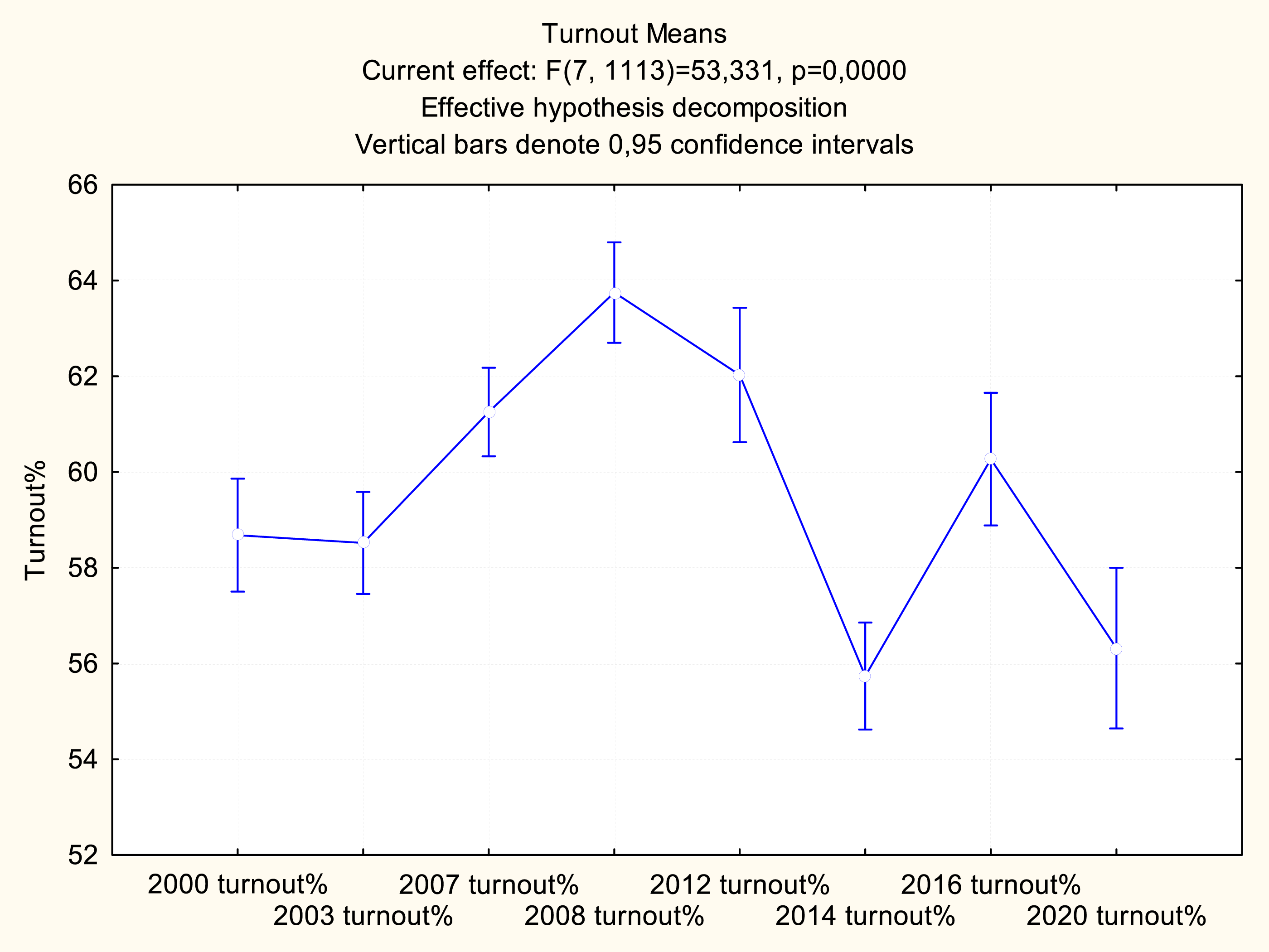
The correlation is statistically significant at the level of significance p < 0.01. The correlation is statistically significant at the level of significance p < 0.05.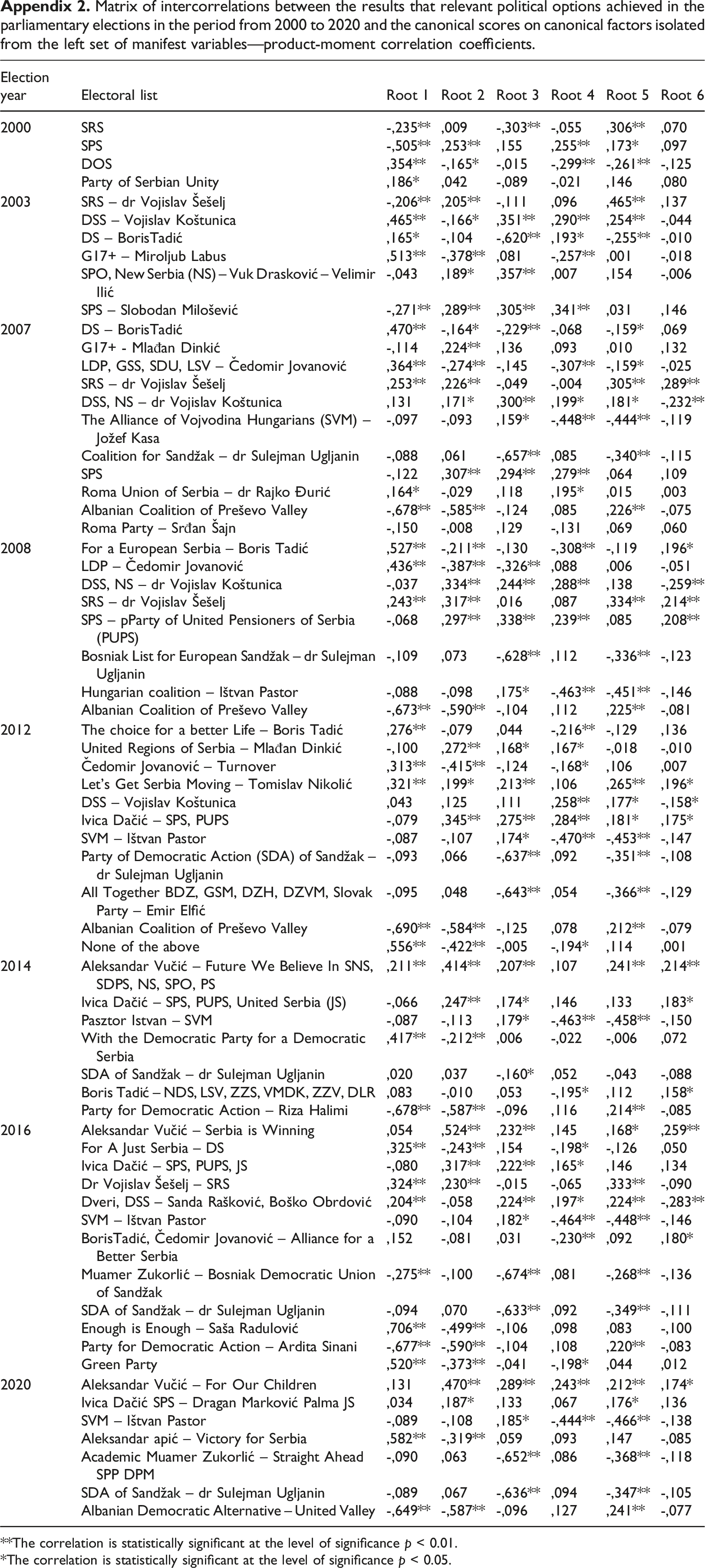
Election year
Electoral list
Root 1
Root 2
Root 3
Root 4
Root 5
Root 6
2000
SRS
-,235
**
,009
-,303
**
-,055
,306
**
,070
SPS
-,505
**
,253
**
,155
,255
**
,173
*
,097
DOS
,354
**
-,165
*
-,015
-,299
**
-,261
**
-,125
Party of Serbian Unity
,186
*
,042
-,089
-,021
,146
,080
2003
SRS – dr Vojislav Šešelj
-,206
**
,205
**
-,111
,096
,465
**
,137
DSS – Vojislav Koštunica
,465
**
-,166
*
,351
**
,290
**
,254
**
-,044
DS – BorisTadić
,165
*
-,104
-,620
**
,193
*
-,255
**
-,010
G17+ – Miroljub Labus
,513
**
-,378
**
,081
-,257
**
,001
-,018
SPO, New Serbia (NS) – Vuk Drasković – Velimir Ilić
-,043
,189
*
,357
**
,007
,154
-,006
SPS – Slobodan Milošević
-,271
**
,289
**
,305
**
,341
**
,031
,146
2007
DS – BorisTadić
,470
**
-,164
*
-,229
**
-,068
-,159
*
,069
G17+ - Mlađan Dinkić
-,114
,224
**
,136
,093
,010
,132
LDP, GSS, SDU, LSV – Čedomir Jovanović
,364
**
-,274
**
-,145
-,307
**
-,159
*
-,025
SRS – dr Vojislav Šešelj
,253
**
,226
**
-,049
-,004
,305
**
,289
**
DSS, NS – dr Vojislav Koštunica
,131
,171
*
,300
**
,199
*
,181
*
-,232
**
The Alliance of Vojvodina Hungarians (SVM) – Jožef Kasa
-,097
-,093
,159
*
-,448
**
-,444
**
-,119
Coalition for Sandžak – dr Sulejman Ugljanin
-,088
,061
-,657
**
,085
-,340
**
-,115
SPS
-,122
,307
**
,294
**
,279
**
,064
,109
Roma Union of Serbia – dr Rajko Đurić
,164
*
-,029
,118
,195
*
,015
,003
Albanian Coalition of Preševo Valley
-,678
**
-,585
**
-,124
,085
,226
**
-,075
Roma Party – Srđan Šajn
-,150
-,008
,129
-,131
,069
,060
2008
For a European Serbia – Boris Tadić
,527
**
-,211
**
-,130
-,308
**
-,119
,196
*
LDP – Čedomir Jovanović
,436
**
-,387
**
-,326
**
,088
,006
-,051
DSS, NS – dr Vojislav Koštunica
-,037
,334
**
,244
**
,288
**
,138
-,259
**
SRS – dr Vojislav Šešelj
,243
**
,317
**
,016
,087
,334
**
,214
**
SPS – pParty of United Pensioners of Serbia (PUPS)
-,068
,297
**
,338
**
,239
**
,085
,208
**
Bosniak List for European Sandžak – dr Sulejman Ugljanin
-,109
,073
-,628
**
,112
-,336
**
-,123
Hungarian coalition – Ištvan Pastor
-,088
-,098
,175
*
-,463
**
-,451
**
-,146
Albanian Coalition of Preševo Valley
-,673
**
-,590
**
-,104
,112
,225
**
-,081
2012
The choice for a better Life – Boris Tadić
,276
**
-,079
,044
-,216
**
-,129
,136
United Regions of Serbia – Mlađan Dinkić
-,100
,272
**
,168
*
,167
*
-,018
-,010
Čedomir Jovanović – Turnover
,313
**
-,415
**
-,124
-,168
*
,106
,007
Let’s Get Serbia Moving – Tomislav Nikolić
,321
**
,199
*
,213
**
,106
,265
**
,196
*
DSS – Vojislav Koštunica
,043
,125
,111
,258
**
,177
*
-,158
*
Ivica Dačić – SPS, PUPS
-,079
,345
**
,275
**
,284
**
,181
*
,175
*
SVM – Ištvan Pastor
-,087
-,107
,174
*
-,470
**
-,453
**
-,147
Party of Democratic Action (SDA) of Sandžak – dr Sulejman Ugljanin
-,093
,066
-,637
**
,092
-,351
**
-,108
All Together BDZ, GSM, DZH, DZVM, Slovak Party – Emir Elfić
-,095
,048
-,643
**
,054
-,366
**
-,129
Albanian Coalition of Preševo Valley
-,690
**
-,584
**
-,125
,078
,212
**
-,079
None of the above
,556
**
-,422
**
-,005
-,194
*
,114
,001
2014
Aleksandar Vučić – Future We Believe In SNS, SDPS, NS, SPO, PS
,211
**
,414
**
,207
**
,107
,241
**
,214
**
Ivica Dačić – SPS, PUPS, United Serbia (JS)
-,066
,247
**
,174
*
,146
,133
,183
*
Pasztor Istvan – SVM
-,087
-,113
,179
*
-,463
**
-,458
**
-,150
With the Democratic Party for a Democratic Serbia
,417
**
-,212
**
,006
-,022
-,006
,072
SDA of Sandžak – dr Sulejman Ugljanin
,020
,037
-,160
*
,052
-,043
-,088
Boris Tadić – NDS, LSV, ZZS, VMDK, ZZV, DLR
,083
-,010
,053
-,195
*
,112
,158
*
Party for Democratic Action – Riza Halimi
-,678
**
-,587
**
-,096
,116
,214
**
-,085
2016
Aleksandar Vučić – Serbia is Winning
,054
,524
**
,232
**
,145
,168
*
,259
**
For A Just Serbia – DS
,325
**
-,243
**
,154
-,198
*
-,126
,050
Ivica Dačić – SPS, PUPS, JS
-,080
,317
**
,222
**
,165
*
,146
,134
Dr Vojislav Šešelj – SRS
,324
**
,230
**
-,015
-,065
,333
**
-,090
Dveri, DSS – Sanda Rašković, Boško Obrdović
,204
**
-,058
,224
**
,197
*
,224
**
-,283
**
SVM – Ištvan Pastor
-,090
-,104
,182
*
-,464
**
-,448
**
-,146
BorisTadić, Čedomir Jovanović – Alliance for a Better Serbia
,152
-,081
,031
-,230
**
,092
,180
*
Muamer Zukorlić – Bosniak Democratic Union of Sandžak
-,275
**
-,100
-,674
**
,081
-,268
**
-,136
SDA of Sandžak – dr Sulejman Ugljanin
-,094
,070
-,633
**
,092
-,349
**
-,111
Enough is Enough – Saša Radulović
,706
**
-,499
**
-,106
,098
,083
-,100
Party for Democratic Action – Ardita Sinani
-,677
**
-,590
**
-,104
,108
,220
**
-,083
Green Party
,520
**
-,373
**
-,041
-,198
*
,044
,012
2020
Aleksandar Vučić – For Our Children
,131
,470
**
,289
**
,243
**
,212
**
,174
*
Ivica Dačić SPS – Dragan Marković Palma JS
,034
,187
*
,133
,067
,176
*
,136
SVM – Ištvan Pastor
-,089
-,108
,185
*
-,444
**
-,466
**
-,138
Aleksandar apić – Victory for Serbia
,582
**
-,319
**
,059
,093
,147
-,085
Academic Muamer Zukorlić – Straight Ahead SPP DPM
-,090
,063
-,652
**
,086
-,368
**
-,118
SDA of Sandžak – dr Sulejman Ugljanin
-,089
,067
-,636
**
,094
-,347
**
-,105
Albanian Democratic Alternative – United Valley
-,649
**
-,587
**
-,096
,127
,241
**
-,077