







Abstract
The wide acceptance of remote work as a result of the ongoing shifts in the world of work has fundamentally reshaped the boundaries between work and home. Drawing on the Work-Home Resources model (W-HR) and conducting two daily diary studies, we explored the mechanisms and boundary conditions of stress related to extreme events. Findings from the first diary study reveal the role of (a) leader support for work-family and telecommuting as an antecedent of reduced stress, (b) workflow as a mechanism explaining the impact of stress on employee outcomes and (c) the moderating roles of mental home demands and gender. Findings from the second diary study reveal that (a) work-supportive spouse behaviours (i.e., WSSBs) reduce stress related to extreme events and (b) resource accumulation and interruptions (family-to-work and work-to-family interruptions) can serve as mechanisms to explain the impact of resource loss on vitality of employees.
Keywords
Introduction
Large-scale disruption in the world, and more specifically in the world of work, has the potential to result in changes, which can be conceptualized as a ‘predictable surprise’ (Watkins & Bazerman, 2003). Such drastic change can impact everyone working in an organization, in blue-collar and white-collar industries alike, who has to devise creative and equally challenging ways to keep business ‘normal’ and ‘flourishing’. In light of these exceptional changes, the core aim of this research is to explore how and why employees experienced stress related to remote work as a result of change on a daily basis. Thus, in this article, our first goal is to delineate the role of support mechanisms at home, with a focus on leader and spouse support, which can offer key instrumental and relational resources to facilitate the completion of work and tackling of work-family issues. In our first study, we explore how a leader’s general level of support for telecommuting is likely to reduce employees’ stress because of remote work as a result of a drastic change. Our second study integrates a novel concept (i.e., work-supportive spousal behaviours, that is, WSSBs), as an antecedent to stress as a result of change. Structural shifts have intensified scholarly interest in the daily processes that enable employees to function effectively while working from home, including how support, demands and resources accumulate and spill over across domains. Although the global COVID-19 period accelerated the large-scale adoption of remote work, it serves here only as the contextual backdrop for our data collection rather than the central phenomenon of interest. Instead, we leverage this period of mandatory remote work as a natural experiment that allows us to observe remote work dynamics under conditions where work and home roles were fully coexistent. Against this backdrop, our two daily diary studies examine how leader and spousal support shape daily stress, workflow, interruptions and well-being in remote work settings.
Our first contribution relates to offering a nuanced understanding of how leader and spouse support shape daily experiences in remote work settings. Rather than positioning support as a buffer against change-specific uncertainty, we examine how leader support for telecommuting and work-supportive spouse behaviours function as key contextual and relational resources in remote work, influencing outcomes such as work intensification, sleep quality and vitality (Hammer et al., 2019; Kelly et al., 2020). This reframing emphasizes that effective support practices remain essential beyond change conditions and are central to managing distributed work arrangements. Interventions and training efforts should therefore focus on developing family-supportive leader behaviours and strengthening partner support systems to facilitate effective telecommuting (Hammer et al., 2009).
A second contribution of this research is the exploration of stress consequences of rapid change, using the historical context of the COVID-19 pandemic as the data collection backbone. Our findings from Study 1 indicate that stress, exemplified in the intense pandemic period, can heighten work intensification perceptions and negatively affect sleep quality in contexts where uncertainty is increased. A key mechanism in this relationship is the daily workflow experience, serving as a pivotal resource for employees. In Study 2, we highlighted the significance of resource accumulation and disruptions (from work to home and vice versa) as mediators in the stress-workflow-employee vitality relationship. Building upon Rivkin et al. (2018), who demonstrated through a daily diary study how affective commitment influences employee well-being positively via daily flow experiences, our research adds a new dimension. By contextualizing our study during a historically stressful change event, we showcase how resource depletion at a daily level can disturb workflow, leading to negative consequences on various work and home domain outcomes. This aspect brings a fresh perspective to the existing literature, which primarily focuses on well-being indicators (such as vitality, ego depletion, work engagement) as outcomes of workflow, often neglecting its broader impact (Debus et al., 2014 being an exception). Moreover, our emphasis on variations in workflow responds to recent calls for a dynamic approach in understanding both the antecedents and consequences of workflow (Soriano et al., 2021). This approach allows us to transcend the specific context of the pandemic, offering insights into stress and workflow management under various challenging scenarios, with rapid change being the main theoretical backbone.
Our third contribution relates to showing that the triggers and consequences of stress related to change events are not the same for everyone. Our findings contribute to recent debates on the importance of managing mental home demands, considering the prototypical role of gender in work-family research (e.g., ten Brummelhuis & Greenhaus, 2018; Thompson et al., 2020), and how a personal resource, such as love for spouse, can impact the dynamics between work and home domains (e.g., Carlson et al., 2019). Gender plays a pivotal role in shaping work-family conflict experiences. Historical and societal norms have traditionally assigned caregiving roles to women, influencing their vulnerability to stress and their reliance on supportive behaviours. Cerrato and Cifre (2018) emphasize that gender norms are not static but shaped by historical and cultural forces, which are constantly evolving. Mills et al. (2015) highlight how these shifts impact work-family balance strategies, creating new opportunities and challenges for both men and women in dual-earner households. Addressing gender as a dynamic construct allows our study to explore not only traditional patterns of WFC but also the changing expectations that redefine workplace and family dynamics during extreme events.
Our final contribution relates to exploring the boundary conditions of the antecedents and consequences of stress related to change events. We introduce (a) mental home demands, (b) gender and (c) love for spouse as possible moderators in shaping the strength of our proposed associations. In the context of our data collection, due to the constraints imposed by the mandated lockdowns, the boundaries between work and home had disappeared, making it challenging to work while simultaneously dealing with home responsibilities. In a context where being ‘available 24/7’ is valued, the toll of a drastic change event has introduced a new layer of difficulty with respect to carrying out work and family roles. We thus introduce mental home demands as a first moderator. Second, we integrate the role of gender as a second moderator. The expected gender roles and societal norms position women in a vulnerable situation in trying to balance work tasks and non-work responsibilities (Eagly, 2009, 2013; Liebler & Sandefur, 2002). Third, we introduce love for spouse as a key personal resource that may act as a mechanism to eliminate the negative consequences of stress related to rapid change events. This refers to a sense of positive evaluation and care for significant others that is reflected in helpful and caring behaviours (Berscheid, 2010; Tasselli, 2019).
In our aim to comprehensively understand the dynamics of work-family processes during change events, this manuscript presents two distinct yet complementary studies. While each study employs its own methodology, samples and measurement instruments, they are united under the overarching theme of exploring the role of social support in mitigating change-induced stress (Allen et al., 2014; Greenhaus & Beutell, 1985).
The Work-Home Resources Model, integral to both studies, argues that resources in one domain can buffer stress in another (ten Brummelhuis & Bakker, 2012). This model provides a lens through which we examine the impact of rapid change (methodologically conceptualized as the Covid-19 pandemic) on work-family dynamics. By applying this framework, we aim to understand the interplay of resources and demands that individuals face during disruptive change events, and how these dynamics were influenced by various forms of social support (Kossek et al., 2011).
The first study delves into the psychological and emotional support offered by supervisors to employees during compulsory telecommuting. Here, we consider the supervisor’s support as a contextual resource, examining its capacity to reduce stress generated by the demands of rapid change. This study pays particular attention to the interactions between supervisor support, gender and family obligations, offering insights into how workplace dynamics shifted during this period (Kreiner et al., 2009; Michel et al., 2011).
The second study shifts the focus to the home domain, analysing how work-supportive spousal behaviours provide psychological resources. Study 2 explores the defence mechanisms against stress generated by rapid change, particularly examining the contribution of spousal support in mitigating work-family conflict (Hammer et al., 2005; Matthews et al., 2014).
Despite their distinct focuses, the two studies are interconnected in their examination of how different sources of social support function as critical resources during a change event. Study 1 highlights the importance of organizational support in managing work-induced stress and its relationship with family responsibilities. In contrast, Study 2 underscores the role of family support in buffering work-related stress. Together, these studies paint a comprehensive picture of the influences between work and family realms under rapid change and remote work conditions (Bakker & Demerouti, 2007; Carlson et al., 2006).
Our findings suggest that both organizational and family support systems play important roles in managing work-family conflict, especially under change conditions. Future research could benefit from a longitudinal approach, capturing these dynamics over different phases of change, providing deeper insights into the evolving nature of work–family interactions (Allen et al., 2015).
Our conceptual models are informed by the W-HR model (ten Brummelhuis & Bakker, 2012) and research on gender role expectations and norms (Eagly, 2013). In line with calls for research to explore the dynamic and volatile nature of resources between work-home domains and in the context of change, we carried out two diary studies in Spanish-speaking regions of the world. See Figure 1 for the conceptual model of Study 1 and Figure 2 for the conceptual model of Study 2. We develop our hypotheses in the following sections.
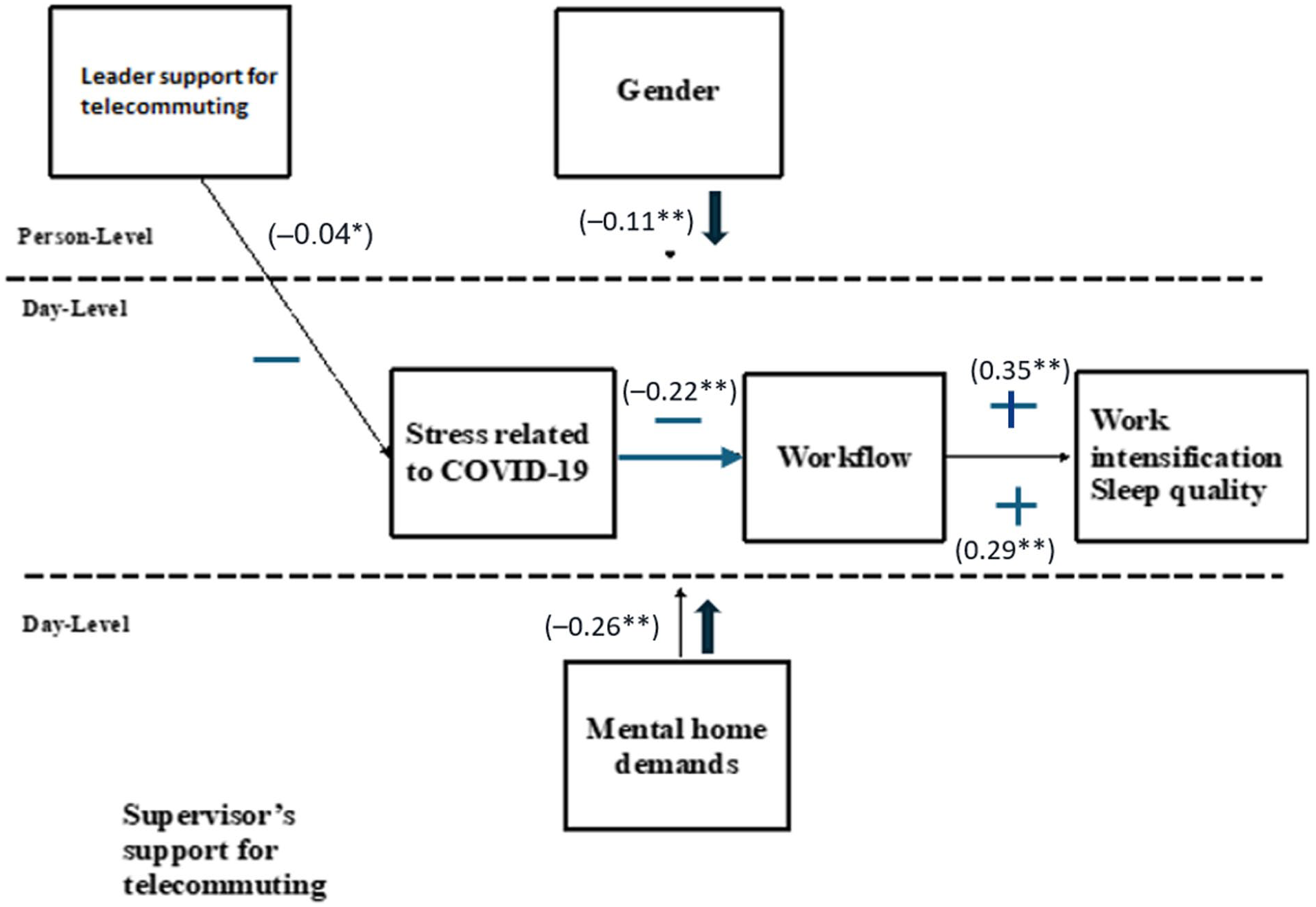
Results of Study 1.

Results of Study 2.
Theory and Hypotheses Development
In building our conceptual model, we draw on the W-HR model (ten Brummelhuis & Bakker, 2012). The core tenet of this model is that stress occurs when individuals face the threat of losing resources in either the work or home domain (Hobfoll, 2002). According to the model, individuals experience both demands and resources in their work and family domains. The demands compete for resources, and resources help in overcoming the burden of demands (Hobfoll, 2002). The model distinguishes resources into two types according to their origin: contextual resources originate from ‘outside’ the individual, while personal resources reside ‘inside’ the individual. Contextual resources emanating from the work domain led to the development of personal resources, thereby reducing stress, whereas contextual demands emanating from the home domain are likely to compete for resources and hamper the resource accumulation process (e.g., Ilies et al., 2017).
Drawing on a key tenet of the W-HR model that resource provision reduces stress and acts as a starting point for resource accumulation, we argue that when employees perceive higher leader support for alternative work arrangements and their well-being (including telecommuting in these stressful and uncertain times), these employees are likely to report lower stress levels. However, working from home (‘telecommuting’ 1 from now forward) necessitates a great deal of information and technology infrastructure support. Furthermore, since the shift to telecommuting has been abrupt, most employees have experienced fear of losing control in their jobs, of lagging productivity and of falling behind on performance targets set by leaders. But most importantly, employees face increasing challenges of balancing their work and home demands, leading to possible conflicts concerning family responsibilities and achieving performance targets in parallel. These aspects make leader support for telecommuting an important contextual resource.
To provide a more robust theoretical foundation, we use the classic WFC model (Greenhaus & Beutell, 1985; Kopelman et al., 1983) and the W-HR model (ten Brummelhuis & Bakker, 2012). We acknowledge that work–home dynamics can also be explained by other perspectives such as Boundaries Theory (Ashforth et al., 2000), Spillover Theory (Edwards & Rothbard, 2000) and Cross-Effects Theory (Westman, 2001). These frameworks similarly emphasize the flow of demands, emotions and behaviours across domains. However, because our interest lies in resource dynamics during remote work, our primary theoretical anchors remain the Work–Home Resources (W-HR) model and Work–Family Conflict (WFC) theory. We therefore draw on these complementary perspectives only to support specific mechanisms where relevant, rather than developing them in depth.
In our study, each dependent variable reflects a distinct dimension of how daily stress, which is exacerbated by the change and the shift to remote work impacts individual functioning across work and home domains. Workflow was selected as it represents a critical indicator of optimal functioning at work (Csikszentmihalyi, 1999) and is sensitive to resource depletion caused by stress (Debus et al., 2014; Rivkin et al., 2018). Sleep quality was included to capture well-being spillover into the home domain, as poor sleep is a key consequence of stress and disrupted resource recovery (Harvey et al., 2008; Ogbonnaya et al., 2017). Work intensification was chosen to reflect the experience of pressure and increased demand, which aligns with core tenets of the W-HR model regarding resource strain (Ogbonnaya & Valizade, 2015; White et al., 2003). Vitality, included in Study 2, serves as a core outcome of effective resource accumulation and management (Castillo et al., 2017; Rofcanin et al., 2019). Similarly, our moderator and mediator variables, including leader support, spousal support, mental home demands and gender, were selected based on their established roles in influencing how resources are distributed across domains (Eagly, 2009; Hammer et al., 2009; Peeters et al., 2005; ten Brummelhuis & Greenhaus, 2018). These variables help explain when and for whom stress has the most detrimental effects, and when support mechanisms are most effective.
The uncertainty in the environment as a result of change and extreme events results in a pressure to perform well and to maintain high motivation levels during these uncertain times (e.g., Hammer et al., 2019). As a potential antidote for these circumstances, we propose that when leaders offer psychological and emotional support to their employees working from home, their subordinates are less likely to report change-induced stress at the daily level (e.g., Kelly et al., 2020). Leader support, as a contextual resource, signals that leaders care for the safety, well-being and security of employees, as well as their work-family balance (Hammer et al., 2009; Thomas & Ganster, 1995). Working with leaders who demonstrate empathy for work-family problems offers instrumental support regarding the logistics of telecommuting, which in many cases, in the context of COVID-19, is done with dependents at home. For all these reasons, employees with leaders who are there for them when there is an urgent need (Hammer et al., 2019) are likely to report less stress emanating from COVID-19 on a daily basis (Crain & Stevens, 2018). Our first hypothesis is:
H1. Perceived leader support for telecommuting (on the between-person level) is negatively associated with (daily level) stress.
The W-HR model builds on the tenet that resources accumulate in both domains to combat stress. While avoiding stress occupies a central position in the W-HR model, the answer to the question ‘what happens when we face conditions as extreme and stressful as those related to change’ remains unanswered. Yet in this article, we explore it. We propose that on days when employees experienced a higher extent of change-related stress (which is conceptualized as the Covid-19 as a contextual backbone), their daily workflow diminishes. Rapid change-related stress occurs mainly because of two reasons: the uncertainty concerning an effective treatment and the unpredictability of job security. The combination of these two factors, which are out of the employees’ control, is likely to intensify the feeling of stress. On days when these feelings are intense, employees are less likely to feel ‘in the flow’ about their work (Csikszentmihalyi, 1999). Prior research that explored within-person level antecedents of workflow emphasized the importance of feeling resourceful. For example, the findings in Debus et al. (2014) reveal that recovery, the perception that one has recovered overnight, positively relates to daily level flow experiences. Drawing from this body of research, we argue that stress related to change, and COVID-19 as our methodological backbone, depletes from one’s personal energy and enthusiasm to invest their energetic resources in their work, reducing workflow experiences.
H2. On days employees feel less stress, they report higher levels of workflow.
In line with the W-HR model, we argue that experiencing fluctuations in daily workflow influences two employee outcomes: work intensification and sleep quality. The former refers to the amount of work effort expended in relation to one’s experience of high work demands and dealing with work pressure (White et al., 2003). The latter refers to one’s evaluation of the satisfactoriness of sleep quality, mainly an ease for falling asleep and sleeping well without waking up in the middle of the night (Harvey et al., 2008). A reduced sense of flow in one’s work implies that an employee is not enjoying the intrinsically motivating side of his or her job and has lost a sense of control of his or her daily tasks (Rivkin et al., 2018). On days when employees lose the sense of fluidity and absorption in their work tasks, they are likely to feel a ‘work-to-rule’ attitude, implying that they consider their work to be demanding and stressful and in need of completion without any intrinsic attraction value to it (e.g., Debus et al., 2014). On these days, employees are likely to see work demands as exploitative and as management tools designed to drive their work performance rather than facilitating an intrinsically motivating element (Ogbonnaya & Valizade, 2015), leading to perceptions of work intensification.
Furthermore, having lost a sense of flow in one’s work, employees are also likely to lack quality sleep. The stress induced by the rapid change, contextualized as the COVID-19 in our study, combined with a lack of flow means employees are likely to ruminate about work and health, two main known disruptors of sleep efficiency and quality (Ogbonnaya et al., 2017). Combining our arguments and drawing on the W-HR model, experiencing high states of flow is likely to trigger the accumulation of other resources in the work and home domains.
In relation to these arguments, we believe the unprecedented nature of the rapid change that is the COVID-19 pandemic has heightened the relevance of understanding how stress influences daily work experiences and well-being. Under these conditions, a diminished sense of flow is not only a result of regular job demands but is increased by the stress associated with health risks, remote work challenges and uncertainty about the future (Hammer et al., 2019; Kelly et al., 2020). Change-induced stress amplifies the negative effects of low workflow, amplifying the perception that work is burdensome and inescapable, which in turn fosters work intensification and impairs sleep quality. By linking daily workflow directly to change related stress, we underscore that the loss of flow during such a global crisis does more than only disrupting work (ten Brummelhuis & Bakker, 2012).
H3. On days when employees report higher levels of workflow, they are likely to report lower levels of work intensification and better sleep quality.
The W-HR model suggests that resources change in a dynamic fashion over time; the gain cycles of resources are core to the premise of the model (Hobfoll, 2002). The idea is that resource gains or losses are cumulative. That is, initial gains or losses may lead to a chain of declining resources (i.e., a loss cycle) or a cyclical trend of resource growth (i.e., a gain cycle). Applied to the current model, high perceptions of leader support for telecommuting ensure employees feel valued and safe. Feeling less worried and uncertain about personal health and the future of jobs on the days when they feel this support, employees are likely to generate reservoirs of positive personal resources of affect and resilience, triggering an upward spiral of flow in their work. Experiencing a heightened state of workflow, employees are likely to be reenergized to invest their physical and psychological resources the following day, which in turn leads to high sleep quality. Moreover, due to feeling intrinsically drawn to their work, these employees are likely to experience work as less intimidating and stressful (i.e., lower perceptions of work intensification). Our hypothesis that indicates the gain cycle of resources is:
H4. Leader support for telecommuting (on the between-person level) is positively associated with better sleep quality and a lower extent of work intensification through reducing stress and increasing workflow (on the daily level).
Moderating Associations: The Role of Mental Home Demands and Gender
According to the Work-Home Resources (W-HR) model (ten Brummelhuis & Bakker, 2012), demands arising from either the work or home domain compete for personal resources, affecting resource gain cycles. These demands require sustained physical and mental effort, often resulting in resource depletion (Halbesleben et al., 2014). The rapid change in work conditions as a result of the COVID-19 pandemic forced employees to work from home, blurring the lines between work and family responsibilities. In this context, home-related mental demands such as planning childcare and organizing chores have grown significantly and required focused attention, often diminishing from the resources needed to meet work demands (Peeters et al., 2005; ten Brummelhuis & Greenhaus, 2018).
First, we argue that high mental home demands impair employees’ ability to benefit from supportive leadership. While leader support for telecommuting is typically a contextual resource that helps buffer stress (Hammer et al., 2009; Kelly et al., 2020), its effectiveness diminishes when employees are cognitively drained by increased home demands. On days when employees are preoccupied with household responsibilities, they may lack the cognitive and emotional capacity to seek out or fully engage with leadership support, thereby weakening its stress-reducing potential. Furthermore, the burden of home demands can lead to emotional exhaustion and withdrawal (Ilies et al., 2011; J. V. Wood et al., 1990), which may further diminish the benefits of perceived leader support for telecommuting.
Second, we propose that when employees face high mental home demands, the negative impact of change-related stress on workflow becomes more pronounced. Workflow reflects a state of deep absorption and enjoyment in work tasks (Csikszentmihalyi, 1999), and achieving this state requires considerable cognitive resources. In line with the W-HR model, when both home and work domains are demanding, employees experience increased resource loss, making it more difficult to enter or sustain a state of flow. This is especially true in the change context, where employees may face stressors such as health concerns, job insecurity as well as the need to manage family dynamics (Bakker & Demerouti, 2014; Powell & Greenhaus, 2006).
Third, we argue that high mental home demands also disrupt the positive effects of workflow on work outcomes. Under typical circumstances, experiencing flow at work leads to greater productivity and reduced feelings of pressure (Debus et al., 2014). However, when employees are cognitively preoccupied with family-related issues, the psychological energy gained from workflow may be insufficient to balance the demands they continue to face outside their work role. As such, even when employees are momentarily absorbed in their work, the increased burden of home responsibilities can still produce a sense of pressure and intensification (Ogbonnaya & Valizade, 2015).
Finally, we suggest that mental home demands weaken the beneficial spillover effects of workflow into the home domain, especially in the context of sleep quality. Quality sleep is crucial for recovery and well-being and is often disrupted by stress and rumination (Harvey et al., 2008). Although positive work experiences like flow typically support better sleep, these gains may be undermined when employees are continually mentally preoccupied by unresolved home responsibilities (Ilies et al., 2007). Thus, high mental home demands interfere with the transfer of work-related resource gains into home recovery outcomes.
Hypothesis 5a. On days when employees report higher perceived mental home demands, the negative association between leader support for telecommuting and daily stress will be weakened.
Hypothesis 5b. On days when employees report higher perceived mental home demands, the negative association between daily stress and daily workflow will be strengthened.
Hypothesis 5c. On days when employees report higher perceived mental home demands, the positive association between daily workflow and work intensification will be weakened.
Hypothesis 5d. On days when employees report higher perceived mental home demands, the positive association between daily workflow and sleep quality will be weakened.
Cerrato and Cifre (2018) provide an examination of the historical evolution of societal norms and their influence on gender roles, particularly within the context of work-family balance. Their work highlights gendered caregiving responsibilities, which amplify women’s stress levels when managing work-family boundaries. Pitt-Casouphes et al. (2006), on the other hand, highlight that gender-specific stress responses and support dynamics within the workplace are shaped by these norms. Mills et al. (2015) argue that although gender roles are evolving, traditional expectations persist, influencing how men and women navigate work-family dynamics.
Our understanding of why rapid periods of change such as the pandemic impact genders differently is still evolving. While early research noted men’s greater mortality risk, gendered role expectations offer further insight into how men and women respond to stress and support in the pandemic. We build on this by integrating research on social norms and role expectations to explore how gender moderates the relationships within our model.
First, we expect the perceived leader support for telecommuting to be more salient for women, reducing their daily stress related to COVID-19 more significantly. This is rooted in the relationship-oriented nature of women’s social roles (Eagly, 2009). Women are more likely to value and utilize leader support for work–family balance because such support aligns with their caregiving responsibilities and need to maintain relationships, especially under conditions where work and family boundaries are blurred. Supporting this, Las Heras et al. (2017) found that leader support for flexible work practices was more apparent and significant for women, particularly for those with caregiving demands.
Second, we argue that for women, the negative association between stress related to rapid change in the context of COVID-19 and workflow is more significant. Drawing on research on prosocial behaviour and gender norms, women are often expected to support others and sustain emotional relationships at home and work (ten Brummelhuis & Greenhaus, 2018). These demands, intensified by the pandemic, reduce their capacity to become deeply absorbed in work, thereby undermining their experience of workflow (Rivkin et al., 2018).
Third, we propose that when women experience low workflow, they are more likely to report intensified experiences of work. Due to the intensity of their caregiving and relationship-oriented roles, the loss of intrinsic motivation and energy derived from flow may leave women more vulnerable to perceiving work as a burden (Debus et al., 2014). As a result, they may experience greater pressure and stress in completing work tasks, increasing perceptions of work intensification (Ogbonnaya & Valizade, 2015).
Finally, we argue that for women, diminished workflow is more likely to impair sleep quality. High cognitive and emotional engagement in caregiving, exacerbated with difficulty psychologically detaching from work or family demands leads to poorer sleep (Harvey et al., 2008; Ilies et al., 2007). As such, we argue that women may experience greater difficulty in translating moments of workflow into restful recovery.
Accordingly, we propose:
H6a. For women, the negative association between leader support for telecommuting (on the general level) and stress (on the daily level) will be stronger.
H6b. For women, the negative association between stress and workflow (on the daily level) will be stronger.
H6c. For women, the positive association between workflow and reduced work intensification (on the daily level) will be weaker.
H6d. For women, the positive association between workflow and sleep quality (on the daily level) will be weaker.
We expand the debates and contributions of Study 1 by exploring two untested assumptions. First, stress related to change in the context of Covid-19 leads to interference of work to family (and vice versa). Second, experiencing such a stress on the daily level depletes an employee’s resources. We enrich these propositions furthermore by exploring the impact of support received by one’s spouse at home, which we refer to as work-supportive spouse behaviours (WSSB).
An important source of support for employees is the one received by their partners, who constitute the most proximal resources for them. In a context characterized by uncertainty concerning COVID-19-related stress and being physically confined to working from home, employees are in constant interaction and communication with their spouses, who offer various extents of emotional, instrumental and physical support for employees (Hammer et al., 2013). Living with a partner who offers help in managing work-family conflicts and organize work to jointly benefit the work and home issues of their significant other is likely to reduce stress related to rapid change in the work context. This is because spousal support provides a platform of security, care and concern for the future. This resource, if not used, is likely to lead to stress and ambiguity on part of the focal employee regarding how the future will unfold (Hammer et al., 2009; Kossek et al., 2016).
H7. Work-supportive spouse behaviours (WSSBs, on between-person level) are likely to reduce stress (on day-level).
The W-HR model is grounded on the argument that stress depletes employee resources, leaving them unable to cope with work demands and unable to concentrate on their work tasks effectively (Halbesleben, 2021). On days characterized by a degree of insecurity and stress associated with rapid change in the context of Covid-19, employees are less likely to feel vigorous and enthusiastic about their tasks, diminishing their availability of limited personal resources.
H8. On days employees feel less stress, they report higher levels of resource accumulation.
In a context where employees juggle the work and home demands simultaneously, it is plausible to expect that one’s home responsibilities will sweep into their work. Similarly, work-related tasks and responsibilities are likely to take a toll on how one completes their family duties. This is because individuals create and maintain psychological behavioural boundaries around their work and home roles and interruptions are likely to occur when employees are physically located in their home domains (Ashforth et al., 2000). Accordingly, on days when employees feel depleted and lacking the necessary energy to cope with various demands arising in both domains, the boundaries of the work and home roles are likely to be more transparent while working from home (Voydanoff, 2008). Supporting our arguments, the findings in Versey (2015) highlight that loss of control and stress associated with work tasks increase negative spill-over effects from work to home. On the day level, Delanoeije et al. (2019) demonstrate that on days when employees work from home, they report higher work-to-family as well as family-to-work conflict because they could not transition between their work and home roles. We thus propose,
H9. On days employees report higher levels of resource accumulation, they are less likely to experience family-to-work and work-to-family interruptions.
The W-HR model argues that interruptions deplete our limited resources and leave us vulnerable to invest in related domains (ten Brummelhuis & Bakker, 2012). On days employees feel that their family roles are preventing them from completing their work tasks, they are less likely to feel focused, energized and proactive about completing their work tasks. These employees are likely to have limited physical and mental resources that can be devoted to the effective completion of work tasks (e.g., Carlson et al., 2015). Similarly, on days when they experience interruptions from work in relation to their family responsibilities, they are likely to feel worn out and have less energy left to devote to work. Such home-to-work interruptions may make employees mentally detach from work, which is one of the main causes of reduced engagement with work (e.g., Derks et al., 2016; Schieman & Young, 2010). Combining these arguments, we thus argue:
H10. On days employees report lower levels of interruptions (both from family-to-work and work-to-family), they are more likely to experience higher levels of vitality.
The W-HR model (ten Brummelhuis & Bakker, 2012) proposes the role of key resources that explain why some individuals are better at generating new resources and optimizing their contextual resources. Relevant to this research, relational factors such as social power and status constitute important personal resources. Drawing on this, we argue that love for spouse acts as a catalyst in shaping the consequences of stress related to change for family and work domains. We argue that the negative impact of stress related to change on resource accumulation will weaken for employees who display high levels of love for their spouses. These employees are likely to engage in selfless behaviours, show genuine care and concern for their spouses as well as engaging with their home duties in a responsible manner (Berscheid, 2010), all of which are likely to act as mechanisms for accumulating further resources.
Furthermore, we propose that for employees who feel high levels of love for their spouses, the impact of resource accumulation on interruptions in both domains will be stronger and more positive. Prior research has shown that compassionate love is positively associated with empathy, helpfulness and support to significant others (Sprecher & Fehr, 2005). In a context where the majority of employees are working from home, signs of love for significant others are likely to eliminate interruptions in the home domain. These employees are also more likely to show family support (Carlson et al., 2019). Furthermore, for these employees, we expect a lower extent of interruptions in their work domain. Supporting our argument, the findings in a weekly diary study by Rofcanin et al. (2019) show that on weeks when employees engaged in relational job crafting, they experienced higher levels of work engagement, and this effect was stronger for employees with a high motivation for prosocial behaviours.
Finally, for employees with higher levels of love for their spouses, we expect the impact of interruptions on vitality to be less significant. Feeling love for one’s significant other is a significant personal resource that creates an inner sense of happiness and energy (Berscheid, 2010). We argue:
H11. For employees who have high levels of love for their spouses (at the general level), the negative impact of stress on their resource accumulation will be weaker, the positive impact of resource accumulation on interruptions (both work and home) will be stronger, and the negative impact of interruptions (both work and home) on vitality will be weaker (both on the daily level).
Method
Study 1
The study was conducted during a period of mandated remote work, during which employees performed their full workday from home due to government-imposed teleworking requirements. Although this period was triggered by COVID-19, the pandemic itself is not the theoretical focus of this research. Rather, the context offered a unique opportunity to examine daily resource, stress and support processes under change conditions where work and home roles were fully co-located.
Procedure
Through the involvement of one of the leading business schools in Europe, we recruited full-time, working employees from Spain, Chile and Guatemala who participated in a daily diary study under the title ‘Understanding COVID-19’s implications on well-being’. Ethical approval was received by the University Research and Grants Committee of the corresponding university before the data collection began. Given the dynamic and uncertain situation of the pandemic and the new challenges and threats which emerged with each passing day, we conducted a daily diary study. In Spain, confinement began on 16 March 2020. Initially, the government indicated it would last for 2 weeks, yet it ultimately lasted for over 2 months. The week prior to this mandated confinement, some regions (e.g., Comunidad Autonoma de Madrid) had already recommended that companies allow employees to work from home and had closed primary and secondary schools. For this reason and being aware of the state of alarm in Italy at the time, we realized the damage COVID-19 will have and started the data collection process on 16 March. Within 1 week, participants from all three countries were recruited.
From 23 March to 3 April (i.e., 10 working days), participants received a link at 7 p.m. (local time) every day to take a survey related to their experience and perceptions for that given workday. We conducted surveys in Spanish on a system called Cvent, and we used back-to-back translation procedures to ensure consistency in meaning (Brislin, 1980). Our final sample was made up of 763 participants with 3,429 data points (i.e., 4.49 days per person). The distribution of respondents per country is as follows: 131 respondents from Chile, 212 from Guatemala and 420 from Spain. Among the 763 participants, 60% were female; 75% of them identified as ‘married’ or ‘in a relationship’ and the remaining 25% identified as either ‘single’, ‘divorced’ or ‘widowed’; on average, they were 42 years old (s.d. 10 years); 63% of the participants had children (2.29 on average). On average, participants had been working in their respective organizations for 9 years (s.d. 2.3 years).
Measures
We used established measures.
General Measure
Leader support for work-life and telecommuting. We used five items from the scale developed by Thomas and Ganster (1995) to measure the extent to which leaders offered emotional and instrumental support for work-life balance, and we adjusted three of the questions to capture the support for telecommuting to their subordinates during the pandemic (1 = rarely, 7 = very often). An example item is: ‘My leader is supportive of my efforts to work from an alternative location (telecommuting) in this exceptional (COVID-19) situation’.
Daily Measures (Common Across Studies)
Stress Related to COVID-19
To assess stress related to COVID-19, we adapted three items from the general stress scale in the second version of the Copenhagen Psychosocial Questionnaire (COPSOQ II; Pejtersen et al., 2010). Although the original scale contains four items designed to measure general stress, we selected and modified three items to specifically capture daily fluctuations in stress attributed to the COVID-19 context. One item included: ‘COVID-19 has made me feel tense today’ (α = .94; 1 = strongly disagree, 7 = strongly agree).
Daily Measures
Workflow
We used an established three-item version of the workflow scale (Moneta, 2017). An example item included: ‘Today, when I was working, I became so absorbed in my work that I was less aware of myself and my problems’ (α = .95; 1 = never true, 7 = always true).
Work Intensification
We used the two highest loading items in the work intensification scale (Ogbonnaya et al., 2017). An example item included: ‘Today it seemed I did not have enough time to do all the work which had to get done’ (1 = not true at all, 7 = completely true).
Sleep Quality
We used three items to test the sleep quality of employees (Yi et al., 2006). An example item included: ‘Today I feel refreshed from last night’s sleep’ (α = .97; 1 = not true at all, 7 = completely true).
Mental Home Demands
We used a four-item scale (Peeters et al., 2005) to measure mental home demands of employees. An example item included: ‘Do you have to coordinate everything at home?’ (α = .93; 1 = rarely, 7 = very often).
Controls
In testing our hypotheses, we controlled for employee age, gender, marital status, level of education and number of children. The direction and strength of the results remained the same, and therefore, we excluded these control variables from our analyses (Becker et al., 2016).
Results of Study 1
Table 1 reports the mean, standard deviation, reliability and correlation values of the study variables.
Mean, Standard Deviation, Reliability and Correlation Values of Study 1.

Note: 763 participants with 3.429 data points (4.5 days per person).
p < .05; **p < .01.
Due to the nested structure of the data, in which days are nested in persons, we conducted multilevel analyses using MLWIN software (Rasbash et al., 2000). To determine whether multilevel analysis was appropriate, we calculated the intra-class correlation statistics ICC (1)s for our day-level variables. Results indicated that the variance for all of them was above 20%, indicating multilevel analysis was indeed appropriate. To test our mediation hypotheses, we used a Monte Carlo method which uses 20,000 iterations and relies on a product of coefficient approach (MacKinnon & Fairchild, 2009). We tested our moderation hypothesis using the recommendations by Aiken and West (1991). We centred the control variables and trait-level work motives on the grand mean, and the weekly measure on their respective person means (Ohly et al., 2010).
Hypothesis 1 was supported: employees who perceived higher leader support for telecommuting reported lower daily change-related stress (Table 1). Hypothesis 2 was also supported, as daily stress was negatively associated with workflow (Table 1). Consistent with Hypothesis 3, stress was positively related to work intensification and negatively related to sleep quality (Table 1). Hypothesis 4 received partial support: leader support indirectly related to better sleep quality through lower stress and higher workflow, although the indirect path to work intensification was not significant (Table 1).
Hypothesis 5, concerning the moderating role of mental home demands, received partial support. Mental home demands strengthened or weakened several relationships in the model in the expected directions, with the exception of the workflow–sleep quality link (Supplemental Table 3). Corresponding moderation plots are available in the Supplementary materials.
Hypothesis 6 was supported. Gender moderated all focal associations in Study 1, indicating that the relationships between leader support, stress, workflow and employee outcomes differed for men and women (Supplemental Table 4). Supplementary figures illustrate these interaction patterns.
Method
Study 2
Procedure
Study 2 followed the same daily diary procedure as Study 1, with data collected at the end of each workday using the same platform, translation process and ethical safeguards. The only procedural differences were that (a) recruitment included participants from Mexico in addition to Spain, Chile and Guatemala and (b) data collection occurred during the easing phase of government lockdowns rather than the initial strict confinement. Participants completed daily surveys over 10 working days, following the same timing and instructions used in Study 1.
Participant Inclusion Criteria
Given the central focus of this research on the dynamics of work-family interface and the role of spousal support, we applied specific inclusion criteria related to participants’ marital or partnership status. In both Study 1 and Study 2, we excluded participants who reported being single, divorced, or widowed (25% of participants in Study 1% and 26% in Study 2). This decision was based on the rationale that the constructs of interest such as work-supportive spouse behaviours (WSSBs) and the influence of spousal relationships on work-family dynamics are most relevant to individuals in marital or similar partnership arrangements. This exclusion is consistent with prior research on work-family dynamics, which typically centres on populations with active familial roles (e.g., Carlson et al., 2019; ten Brummelhuis & Greenhaus, 2018).
Measures
Love for Spouse
We measured love for spouse (1 = strongly disagree, 7 = strongly agree; α = .87) using the compassionate love subscale of the Love Attitudes Scale Short Form (Hendrick et al., 1998). One example item included: ‘I cannot be happy unless I place my partner’s happiness before my own’.
Work-Supportive Spouse Behaviours
We modified the family-supportive leader behaviour scale (FSSB; short version developed by Hammer et al., 2013) to measure work-supportive spouse behaviours (WSSB) that are aimed at solving issues that fall in the work-family domains. An example item was: ‘Your partner organizes the work at home to jointly benefit the family and your work’ (1 = strongly disagree, 7 = strongly agree; α = .87).
Daily Measures
Resource Accumulation
We used a four-item scale that was developed by Petrou et al. (2019). An example item included: ‘Today at work, it did not take a lot of effort for me to concentrate on something’ (α = .94; 1 = not true at all, 7 = completely true).
Family-to-Work and Work-to-Family Interruptions
Using the scale developed by Kossek et al. (2015) – we measured interruption with three items that allowed us to capture the daily phenomenon. One example is ‘Today I allowed my family to interrupt my work time’ α = .95; 1 = not even once, 4 = a few times; 7 = all the time). For work-to-family interruptions, a sample item is ‘Today, I took care of personal or family needs during work’; α = .92; 1 = not even once, 4 = a few times; 7 = all the time).
Vitality
We used a seven-item scale developed by Castillo et al. (2017). An example item included: ‘Today I was feeling alive and alert concerning work’ (α = .95; 1 = not true at all, 7 = completely true).
Controls
We controlled for employee age, gender, marital status, level of education and number of children. The direction and strength of the results remained the same and therefore we excluded these control variables from our analyses (Becker et al., 2016).
Findings of Study 2
Results of Study 2
Table 2 reports the mean, standard deviation, reliability and correlation values of the study variables.
Mean, Standard Deviation, Reliability and Correlation Values of Study 2.
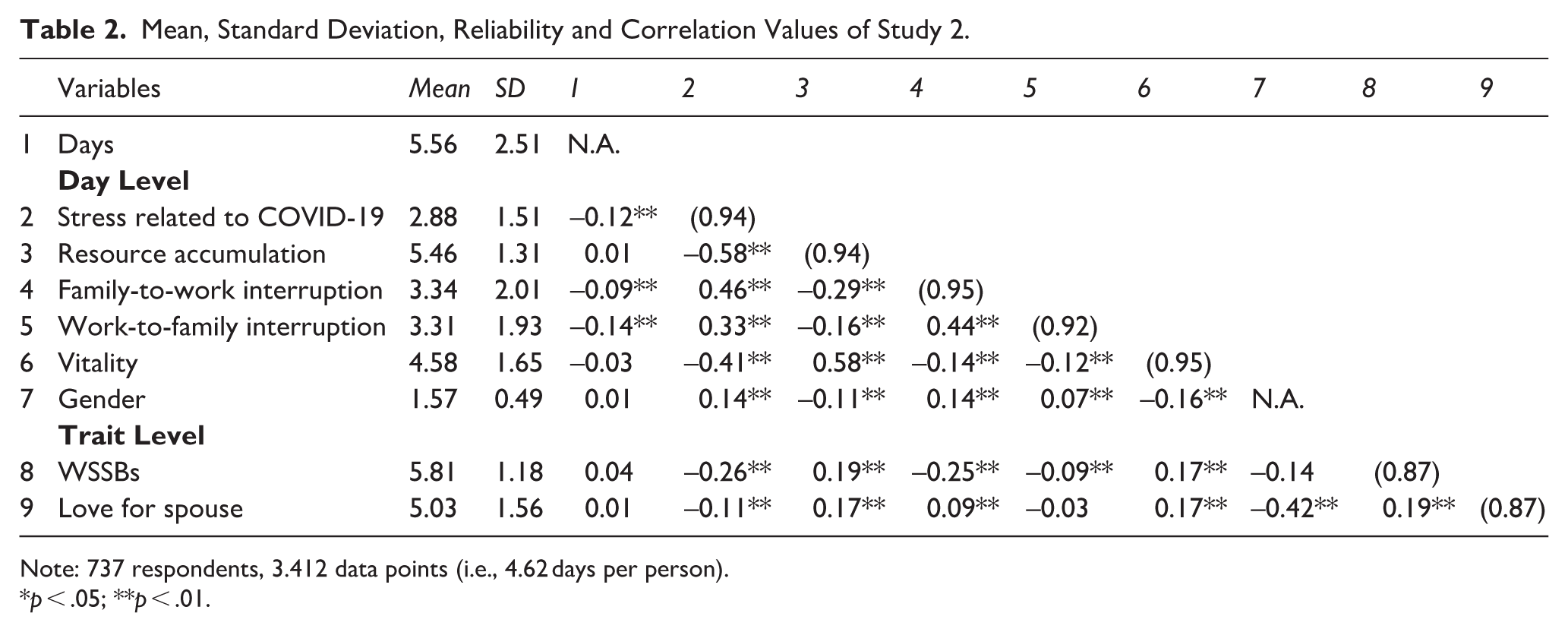
Note: 737 respondents, 3.412 data points (i.e., 4.62 days per person).
p < .05; **p < .01.
Due to the nested structure of the data, the same procedures were followed in testing the hypotheses of study 2 (Ohly et al., 2010; Rasbash et al., 2000). For all of our day level constructs, variance was above 20%, which justified the use of multilevel analyses.
Hypothesis 7 was supported: higher work-supportive spouse behaviours were associated with lower daily stress (Table 2). Hypothesis 8 was also supported, as COVID-19 stress was negatively related to daily resource accumulation (Table 2). Consistent with Hypothesis 9, resource accumulation was negatively associated with both family-to-work and work-to-family interruptions. Hypothesis 10 was supported as well: daily interruptions were negatively related to vitality (Table 2).
Hypothesis 11 received partial support. Love for spouse moderated several of the focal associations in the expected direction, strengthening the beneficial effects of resource accumulation and buffering the detrimental effects of stress. Moderation plots are available in the Supplementary materials (Supplemental Table 5).
Finally, gender moderated a subset of relationships in Study 2, although fewer interactions reached significance than in Study 1. Where significant, these patterns suggest that the effects of resource accumulation and interruptions varied between men and women (Supplemental Table 6). Supplementary figures depict the interaction patterns.
Supplemental Figures 10–13 present the interaction findings from Study 2. Supplemental Figure 10 shows that love for spouse buffers the negative effect of COVID-19–related stress on resource accumulation. Supplemental Figures 11 and 12 reveal that high spousal love decreases the negative impact of resource accumulation on both family-to-work and work-to-family interruptions. Supplemental Figure 13 shows that spousal love strengthens the positive relationship between resource accumulation and vitality.
General Discussion and Theoretical Contributions
Across two diary studies with over 6,841 responses, conducted in the early and late stages of the imposed government lockdowns in Spanish-speaking countries, we aimed to unpack the mechanisms and boundary conditions of what reduces daily remote-work stress (measured during the COVID-19 period). Our results supported most of our hypotheses and revealed key insights that will inform researchers and practitioners alike. Our findings lend important theoretical contributions to research on the interface of work-family, which are discussed below.
The supportive role of leadership and spouses for telecommuting and the overall well-being of employees.
A first contribution of our study relates to the finding of study 1 that working with leaders who are supportive of alternative work arrangements, namely telecommuting, reduces employee’s daily remote-work stress. Our finding is not only replicated but also strengthened in study 2. In our second study, we control for the impact of leadership and our findings demonstrate the importance of work-family oriented behaviours of spouses in reducing employee’s remote-work stress, highlighting the need for a caring and other-oriented supportive relationship in these unprecedented circumstances. Prior research has demonstrated the positive influence of family-supportive and flexibility-oriented leadership on employee’s work performance (Rofcanin et al., 2017) and well-being outcomes (Las Heras et al., 2017). Contributing to these discussions, our findings show, on a daily level, leaders who are perceived to be supportive of alternative work arrangements are key ingredients to reducing daily stress levels of employees to counter the negative implications of this mandated remote-work period. This could be due to the signalling functions of leaders who are key agents in an organization and who hold important resources to allocate to employees (Hammer et al., 2009). Perry et al. (2023) extend the discussion on teleworking interruptions by proposing a resource-based framework that examines how interruptions from family and work domains influence stress and performance. Their research complements our findings on the moderating roles of resource accumulation and interruptions in managing employee vitality. Together, these studies provide a theoretical foundation for further exploring the interplay of supervisor support, resource dynamics and employee outcomes during remote-work contexts. Indeed, the delivery of efficient communication and instrumental support from leaders to their subordinates are likely to be the main reasons and resources explaining why employees report less remote work stress every day (e.g., Chesley, 2010). Feeling secure and confident in working with such leaders, employees are likely to build on this important relational resource and manoeuvre their feelings of stress and uncertainty about what the future will bring for them (Gajendran et al., 2015).
In addition to the role of supportive leadership, WSSBs provide a secure base for employees, reducing uncertainty and remote-work stress. Few studies have shown that resources within the home domain can increase emotional energy and induce positive affect in an employee. For example, family support for work has been linked to reduced strain (Ilies et al., 2007, 2017) and increased helping behaviours at work (e.g., ten Brummelhuis et al., 2013). In a more recent study that adopts a daily diary approach, ten Brummelhuis and Greenhaus (2018) highlighted that emotional work support at home (provided by one’s spouse) relates to family relationship quality. Our findings contribute to these debates by highlighting the role of WSSBs which are novel support resources, and which are found to reduce daily remote-work stress.
Our findings also align with recent research highlighting the broader mental health implications of the COVID-19 period as a contextual backdrop rather than a focal phenomenon. For example, Gerogiannis et al. (2025) show that the crisis had marked effects on the mental health of self-employed workers across Europe, illustrating how prolonged uncertainty, reduced autonomy and blurred boundaries contributed to heightened strain. Their results reinforce our argument that the mandated remote work period created conditions under which daily stress processes became more highlighted, even though our theoretical focus lies in remote-work dynamics rather than the pandemic itself. Integrating insights from this work strengthens our contextualization by demonstrating that the period of data collection represented a change environment of elevated stress, which in turn offered a natural way for observing how leader support, spousal support and resource processes operate when work and home roles are fully co-located.
Mechanisms explaining the impact of remote-work stress on employee outcomes. A second contribution of this research relates to the consequences of stress experienced during mandated remote work. Findings from study 1 reveal that stress emanating from this period increases work intensification perceptions while leading to poor sleep quality. Our findings also highlight the critical role of family-supportive supervisor behaviours (FSSBs) in mitigating the negative effects of remote-work stress on employees’ well-being and performance. Similarly, recent studies reinforce the importance of these behaviours during widespread telework conditions. For example, Chambel et al. (2023) highlight how FSSBs facilitate employees’ management of work-family boundaries and increase engagement in teleworking contexts. These results align with our observations, demonstrating that supportive leadership serves as a critical resource for employees navigating the challenges of remote work under unprecedented circumstances. A mechanism explaining this association is the daily experiences of workflow, which acts as a resource caravan for employees. Results of study 2 highlight the role of resource accumulation and interruptions (from work to home and from home to work) as serial mechanisms accounting for the impact of remote-work stress on employee vitality. Regarding the former, we contribute to debates in recent studies: Using a daily diary study, Rivkin et al. (2018) show that daily flow experiences explain how and why affective commitment shapes employee’s well-being positively. We expand on this study by focusing on the remote-work context of our data collection and show that through resource loss at the daily level, a reduced sense of workflow leads to undesirable implications for employee work outcomes. From this angle, prior research tended to focus mainly on indicators of well-being (e.g., vitality, ego depletion, work engagement) as consequences of workflow, overlooking the impact on other work and family-related outcomes (e.g., Debus et al., 2014, as an exception). Furthermore, our focus on the within-person changes in workflow is a response to most recent research which underlines the need to adopt a dynamic approach for the antecedents and consequences of workflow (Soriano et al., 2021).
Regarding the latter, our findings highlight the role of resource accumulation as an enriching pathway to explain how interruptions between work-home domains can be eliminated (Carlson et al., 2015). In particular, daily resource accumulation is revealed to be a key catalyst for eliminating interruptions and can be considered an element for work-family enrichment (Powell & Greenhaus, 2006) and can extend a resource-based view in work-family research (Hirschi et al., 2019). Our focus on work intensification at the daily level is also novel, as this construct has mainly been explored within the strategic HRM literature (e.g., S. Wood et al., 2012) revealing how pay structures and compensation packages increase employees’ sense of work demands and their inability to work efficiently. By relating it to leader support and stress (intangible and micro-level phenomena), this finding opens future opportunities for researchers in HRM. Furthermore, sleep quality is a key well-being indicator that occupies a central role in occupational health and has been rarely associated with workflow (e.g., Park & Sprung, 2015).
The impact of remote-work stress is not the same for everyone. A third contribution relates to our findings concerning the role of the boundary conditions of mental home demands, gender and love for spouse. Regarding the role of mental home demands, our findings consistently support that employees who perceive taxing home demands benefit more from leader support. When home demands are high, employees report lower levels of workflow and work outcomes. Prior research has revealed that high home demands consume both physical (e.g., sleep, vigour; Demerouti et al., 2009; Weer et al., 2010) and psychological resources (e.g., they lead to rumination and stress; Haar & Roche, 2010). We contribute to these studies by exploring the dynamic nature of mental home demands as a boundary condition preventing the resource transfer from work to home domain outcomes. Regarding the impact of gender, consistency in the patterns of our findings in both studies demonstrates that women are the main victims of remote-work stress (measured during the COVID-19 period). Research on gender norms and expectations shows that women are likely to experience additional barriers in their careers compared to men (Eagly, 2013; Kossek et al., 2017; Lyness & Thompson, 2000). In addition, family structures and societal norms impose greater burdens on women’s shoulders, having them assume responsibility for family chores while also pursuing career goals. In this respect, our findings contribute to recent debates in work-family research. Across two studies, ten Brummelhuis and Greenhaus (2018) demonstrate gender patterns of work-home processes: female employees are better at preventing demands that consume their resources, both within the work or home domains. This is mainly due to the supportive nature of female employees, offering their emotional resources to colleagues and partners in both domains, and thereby facilitating enrichment. In addition to the support-provision role of women, our findings show that in these circumstances, women need more support from their leaders to tackle remote-work stress. Therefore, unlike what is assumed in research on gender norms and expectations, women may not be more likely to experience positive work-home processes (Pleck, 1977). Support mechanisms need to be in place for women in both domains to facilitate a positive process of enrichment and to prevent resource losses.
Findings across our two studies expand recent anecdotal evidence on the impact of remote-work conditions on women. Various cross-sectional studies reveal similar patterns, demonstrating that women feel more stressed, have greater sleep problems and worry that they will not be able to take care of their families. Feeling disproportionally overwhelmed, women worry that they will have to work double shifts to keep their households afloat (Rofcanin et al., 2020). In the wake of this remote-work shift, it is time for organizations to openly discuss the emotional support they offer their employees and for couples to discuss their priorities and responsibilities on a daily basis. A possible solution may be that couples talk openly about their fears, priorities and goals so that they find fulfilling solutions and do not need to engage in career and care-taking related compromises (Petriglieri, 2019). Furthermore, Lawson et al. (2024) emphasize the role of FSSBs in reducing work-to-life conflict, particularly for STEM women faculty members during the mandatory work-from-home period. Their findings resonate with our study’s gender-focused analysis, where women reported higher vulnerability to work-family conflict and stress. Incorporating such insights suggests that fostering FSSBs not only mitigates conflict but also supports the retention of talent in gender-sensitive contexts. The findings reveal significant gendered patterns in the experiences of stress and work-family conflict, supporting prior research by Cerrato and Cifre (2018) and Pitt-Casouphes et al. (2006). Especially women have experienced higher levels of stress due to societal expectations of caregiving and the blurring of work and family boundaries during the mandated remote-work period. Mills et al. (2015) provide a valuable framework for understanding how these roles are evolving, which may explain the non-significant gender interactions observed in certain areas of Study 2. Interestingly, the lack of significant moderation effects in Study 2 may reflect a broader societal shift. As noted by Mills et al. (2015), gender roles are becoming less rigid, reducing the differential impacts of stress and WFC on men and women in certain contexts. However, the persistence of traditional caregiving expectations highlights the need for continued exploration of how gender norms influence work-family outcomes.
Our focus on love for spouse is an important addition to research on the work-family area. Research to date has shown status and power to be key relational resources (ten Brummelhuis & Bakker, 2012). However, such proxies of relational resources are more likely to apply within the work domain and in the interpersonal management of employment relations when explaining how spill-over occurs between domains. Our findings in study 2 thus extend the W-HR model by showing that a personal resource relating to home can act as a catalyst to shape and facilitate resource transitions between work-home (e.g., Carlson et al., 2019). Our focus can be considered a response to a call for studies to integrate relationship studies and organization studies (Tasselli, 2019).
Limitations and Future Research Suggestions
First, the data from both studies come from Spain and Latin American countries, where gendered norms and values are more pronounced and significant. Future research is suggested to replicate and extend our findings in contexts with gender neutral norms (e.g., the Netherlands). The data collected was solely single-source data, raising a possibility of common method bias. Although additional tests revealed it was not a major issue (which can be provided upon request), future studies can integrate leader and spouse reports to provide a broader picture of findings. Third, we measured leader support for telecommuting once, exploring its impact on employee stress and outcomes at the daily level. It is possible that perceived leader support may be subject to change from day to day; we recommend future studies tease out these between-level and within-level patterns in relation to stress (i.e., COVID-19).
Several future suggestions can be derived from our study. First, contextual conditions can be extended to include work (e.g., support received and given from colleagues) and life- related constructs (e.g., leisure activities and recovery). Support could enlarge our understanding of how resources are maintained and accumulated between domains. Second, our proposed model can be expanded to include crossover between spouses (Westman et al., 2009). The transition of experience between spouses (e.g., affect, support, stress, communication) may exacerbate or reduce the undesirable negative consequences of COVID-19. Third, performance and career- related outcomes can be explored to understand the work implications of COVID-19; are women more prone to miss promotions and feel overworked.
Practical Implications
Our findings bear important practical implications for organizations. In contemporary remote and hybrid work settings, it is obvious that managers and HR units need to care about the family lives of employees and proactively engage with their issues and problems. To facilitate leader support for work-life and telecommuting and to reduce the toll of mental home demands for employees, the topic of work-family processes should be made transparent and open for conversation between employees and their managers, as well as HR units. Similar to training interventions carried out for family-supportive leader behaviours (Hammer et al., 2019), a similar approach could be adopted to facilitate leader support for remote work and well-being (Hammer et al., 2019).
In addition to offering instrumental and structural resources for an effective remote-working experience (e.g., laptops, internet connection), open and transparent conversations about work-family problems can facilitate and ensure employees can rely on spouse support when and if needed. Furthermore, these conversations are likely to serve a purpose of revealing the gendered patterns and expectations of women. These processes are likely to be intensified if employees are encouraged to share events that happened on that day (Ilies et al., 2011; interpersonal work-family capitalization). Another possible step is to introduce and carry out gender-supportive coaching, in which problems and issues women face in juggling work and home roles can be openly discussed and dealt with (Behson, 2005). Also, organizations can offer instrumental or emotional support to subordinates and can be an institutional part of HR policies. Embedding such conversations within remote/hybrid work routines can be another means of solving gender imbalance when it comes to juggling work and home responsibilities.
Furthermore, organizations must recognize the dynamic nature of gender roles and provide targeted support to address the unique challenges faced by men and women. As Cerrato and Cifre (2018) suggest, policies that promote gender equity, such as flexible work arrangements and family-supportive leadership, are essential for mitigating work-family conflict. In addition, Pitt-Casouphes et al. (2006) emphasize the need for gender-sensitive stress management interventions, while Mills et al. (2015) highlight the importance of fostering shared caregiving responsibilities. Training programmes for supervisors should address gender disparities and equip leaders with the tools to provide equitable support, particularly within ongoing remote and hybrid work arrangements.
Supplemental Material
sj-docx-1-brq-10.1177_23409444261416543 – Supplemental material for What Happens at Home Stays at Home: Dynamics of Work–Family Processes in Remote Work Settings
Supplemental material, sj-docx-1-brq-10.1177_23409444261416543 for What Happens at Home Stays at Home: Dynamics of Work–Family Processes in Remote Work Settings by Yasin Rofcanin, Mireia Las Heras, Maria Jose Bosch and Can Ererdi in BRQ Business Research Quarterly
Footnotes

Funding
The authors received no financial support for the research, authorship and/or publication of this article.
Declaration of conflicting interests
The authors declared no potential conflicts of interest with respect to the research, authorship and/or publication of this article.
Supplemental material
Supplemental material for this article is available online.
Notes
References
Supplementary Material
Please find the following supplemental material available below.
For Open Access articles published under a Creative Commons License, all supplemental material carries the same license as the article it is associated with.
For non-Open Access articles published, all supplemental material carries a non-exclusive license, and permission requests for re-use of supplemental material or any part of supplemental material shall be sent directly to the copyright owner as specified in the copyright notice associated with the article.
