







Abstract
This review of the key concepts of classical and quantum physics explores the contribution that quantum mechanics and its insights into the nature of reality can make to our understanding of good teaching and learning. In addition to an explanation of the classical scientific concepts of matter, gravity, space, time, light, cause and effect, and motion, this article will also investigate quantum features such as randomness, uncertainty and entanglement with a view to exploring the extent to which these concepts can be used to inform education. The implications of quantum physics for teaching and learning are threefold. First, the creation of an optimum learning environment depends upon the pivotal role and nature of an observer, in this case, a teacher; second, the quantum leap from possibility to actuality is determined by certain properties of that observer, principally metacognition. Third, such thinking about thinking can be analyzed according to the Buddhist practice of mindfulness. By nurturing the development of these three dimensions, an educator can create a wholesome teaching and learning environment that manifests the ideal learning outcomes in their students. This article will end with a call for an education in mindfulness for both teachers and students.
If quantum mechanics hasn’t profoundly shocked you, you haven’t understood it yet.
—Niels Bohr (Heisenberg, 1971, p. 206)
Introduction
The aim of this article is to review and examine the findings and insights of quantum physics, especially those pertaining to the building blocks of our world—matter, gravity, space and time, motion, light, and cause and effect—and to use such insights to illumine and understand the conditions of effective teaching. Advances in science should inform universal knowledge practices, so the significance of such a review is to bring teaching and learning up-to-date with the benefit and implications of the astonishing advances in our understanding of the reality of the physical world and the nature of the quantum world at the subatomic level.
The plan for this research is as follows. First, the article will contextualize the review of classical and quantum physics in the frame of tertiary education. The review will then continue in a philosophical tone by introducing the historical question of the nature of reality. A short recent history of physics and two views of reality will then be explored, namely classical physics and quantum physics, especially as they relate to the key topics of matter, gravity, space and time, motion, light, and cause and effect. These two views of reality will be reconciled via the observer and the act of observation, and will be followed by an explanation of the significance of consciousness and metacognition. A discussion section will then analyze metacognition into four dimensions according to the Buddhist practice of mindfulness, which involves becoming aware of and managing four processes of one’s existence, namely the body, feelings, thought patterns and the mind–body relationship (de Silva, 2014). Recommendations and a conclusion will then follow.
The Context of the Research
Quality teaching in tertiary settings is guided by the goals and graduate outcomes of higher education. The former includes the higher-order thinking skills of analysis, evaluation and synthesis, while the latter includes creativity, critical thinking and problem-solving skills (Biggs & Tang, 2011). In the context of practical classroom teaching, Biggs and Tang (2011) explain that quality teaching is characterized by three features—the ability to nurture a warm classroom climate via spontaneous conversations, which is conducive to feelings of safety and a consequent willingness to learn; using quality teaching practices that ensure active student engagement, starting at the most basic level of lectures, followed by reading, group work, collaborative learning and finally metacognition; and utilizing metacognition, which is the awareness, understanding and monitoring of one’s own thought processes for problem-solving purposes, the benefit being that it confers upon students more control over their own learning (Metcalfe & Shimamura, 1994). For instance, students can be encouraged to ask themselves self-reflective questions about the material they are studying, helping thereby to evaluate and manage their learning progress (Biggs & Tang, 2011).
With this pedagogical context in mind, this article will now turn to an examination of reality according to the physical building blocks of the universe.
The Nature of Reality
One of the central perennial themes of philosophy has been the theory of knowledge (epistemology) and the nature of reality and truth, and whether an enquiry into such a theme can ever prove fruitful (Baggini, 2002). Implicit to this questioning is the role and status of an observer who is situated within whatever reality exists around them. As will be seen later in this article, such a status is highly relevant when quantum reality is introduced.
The Nature of Reality According to Classical Physics and Quantum Physics
The long-accepted theoretical framework for understanding reality and the physical world has been classical physics as founded upon the work of scientists like Sir Isaac Newton. Under this conceptual umbrella, major advances in our understanding of the fundamental building blocks of the physical world have been made, such as gravity, space and time.
More recently, developments in the field of physics over the last two centuries have led to two views of reality. The two main theoretical pillars of twentieth-century physics were and still are the general theory of relativity and the theory of quantum mechanics (Rovelli, 2016). The former sits within the purview of classical physics; the latter is of an entirely new order. This article will now review the classical conceptual building blocks and workings of the universe.
Matter
The concept of matter is a prime example of how physics has changed its understanding of this fundamental phenomenon. The classical world position of Newtonian mechanics is based on dogmatic realism, which Heisenberg (1958) defined as the claim that there are no statements concerning the material world that cannot be objectively defined. Thus, Davies (1989) states that material objects exist ‘out there’ and can be defined and measured both in terms of position and velocity, with observations uncovering reality rather than creating it. Furthermore, at a classical physics level of description of the world, mass, length and time are fixed absolutes that are identical for all observers (Kumar, 2008). According to such a classical perspective, both an object’s position and momentum 1 can be known at the same time, with Einstein assuming that a real world existed independently from any act of perception, a position also known as philosophical realism (Blackburn, 2005).
But cracks in the classical worldview of matter eventually began to occur, with Heisenberg (1958) claiming that dogmatic realism is not a necessary condition for the use and efficacy of natural science. As Bohm (1980) later explained, Einstein’s theory of relativity implies that no coherent concept of an independently existing particle as featured in classical physics is possible. Indeed, particles came to be seen as interactions between fields of energy (Zukav, 1979/2001). Max Born then argued that these waves are probability waves (Zukav, 1979/2001) because at the atomic level we cannot determine the post-collision effects of the atomic particles except as a probability according to the wave function (as described by Schrödinger’s wave equation), which implies that physical reality is all the positional possibilities that the particles could be in at any one time (Kumar, 2008).
Such possible states of atomic particles seemed to be completely undetermined and accidental, a situation that led Einstein and Schrödinger to disagree, with Einstein famously saying that God ‘is not playing at dice’ (Kumar, 2008, p. 224). Nevertheless, the unknowable state—the position and momentum—of atomic particles led Heisenberg (1958) to famously postulate the uncertainty principle or, as Heisenberg himself preferred to say, the indeterminacy principle (Kumar, 2008). This states that it is not possible to measure simultaneously certain pairs of observables—such as position and momentum, energy and time—with any degree of accuracy that exceeds a limit expressed in terms of Planck’s constant h (Kumar, 2008). This is because the very act of measuring something introduces a disturbance, resulting in a limit on how well we can know an electron, hence the need for probabilities when describing any natural state (Cox & Forshaw, 2011). One of the important implications of such uncertainty is the questioning of a causal universe (Heisenberg, 1958; Zukav, 1979/2001) and that any speculation about the nature of reality beyond the act of observation and measurement is pointless (Kumar, 2008).
In the world view of quantum mechanics, physical reality is now seen as the result of a probability function and therefore as fundamentally indeterminate. So, the question arises—how does matter become real, in appearance at least? In other words, what makes a state of probability into an actuality?
The next step in unravelling this mystery was taken by Bohr, who hypothesized that electrons can ‘jump’ between one atomic orbit and another, during which they emit a photon—the famous ‘quantum leaps’ (Rovelli, 2016). This is important because ‘quantum leaps’ from one orbit to another are the only way an electron has of being, again, ‘real’; when nothing disturbs it, it is in no precise ‘place’ at all (Rovelli, 2016). But again, how does such a leap occur?
The answer, and an illustration of the remarkable probabilistic feature of matter according to quantum physics, is found in Schrödinger’s famous thought experiment involving a cat. A cat, a flask of poison and a radioactive source are placed in a sealed box. If an internal monitor detects radioactivity (that is, a single atom decaying), the flask is shattered, releasing the poison that kills the cat (Kumar, 2008). Common sense says that when one looks in the box, one sees the cat is either alive or dead, not both alive and dead. But the Copenhagen interpretation of quantum mechanics—the view that there is no quantum reality beyond what is revealed by an act of measurement or observation—indicates that the cat is simultaneously alive and dead and that only the act of observation can determine the true state of the cat (Kumar, 2008). In effect, it is the presence of an observer which causes a leap from a state of probability into a state of actuality (more on this later in relation to the collapse of the wave function and the measurement problem).
Such a result is supported by Bohr’s Copenhagen interpretation of quantum mechanics, which asserts that a particle exists in all states at once until observed, when the collapse of the wave function—also known as the observer effect—occurs, which is the sudden change in the wave function due to an act of measurement when all the abstract possibilities represented by the wave function manifest as one actuality (Kumar, 2008). In particular, the collapse of the wave function occurs when all probabilities of the electron collapse into a physical event (Dispenza, 2012). Even further, according to the Copenhagen interpretation, a microphysical object has no intrinsic properties, so only in the act of observation does an electron become ‘real’, that is, an unobserved electron does not exist (Kumar, 2008). In other words, the act of measurement causes the set of probabilities to immediately and randomly assume only one of the possible values of the space–time dimension via a wave function collapse, that is, a quantum jump or leap takes place from a multifaceted potentiality to a single actuality (Zukav, 1979/2001). This leap transits from a theoretically infinite number of dimensions into a reality composed of three dimensions: length and width, depth, and time (Zukav, 1979/2001).
Understandably, this randomness of the microworld and its particles was a shock to the scientific world, which viewed everything deterministically (Cox & Forshaw, 2011). Randomness is in stark contrast to the Newtonian framework, which assumes that objects are located in fixed places and times; the quantum view is that at the microscopic level, electrons can be both ‘here’ and ‘there’ and indeed many places at once (Davisson & Germer, 1927, cited in Cox & Forshaw, 2011). Even further, quantum experiments demonstrated that electrons exist simultaneously in an infinite array of possibilities or probabilities in an invisible field of energy (Zukav, 1979/2001). Only when an observer focuses attention on any location does an electron appear.
Subsequently, another of the astonishing implications of the quantum view of reality is that quantum particles can be ‘anywhere and everywhere else in an instant’ (Cox & Forshaw, 2011, p. 46; authors’ italics), that is, a wave of electrons spreads out throughout the universe immediately. In effect, electrons disappear and reappear in different places without being anywhere in between (Kumar, 2008). In terms of our understanding of motion, the perception that objects move smoothly from a point A to another point B is an illusion; rather, particles move from A to B via all possible paths until at some point only one motion is perceived by an observer (Cox & Forshaw, 2011).
The same probabilistic, indeterminate quantum leap and collapse of the wave function due to the presence of an observer also applies to gravity, space, time, motion, light, and cause and effect.
Light
Another example of the contrasting worldviews between classical physics and quantum mechanics is seen in the phenomenon of light. Newton showed that light consists of a spectrum of colours formed by particles (what he termed ‘corpuscles’), although by the latter half of the nineteenth
century, light was accepted as a wave phenomenon and a form of electromagnetic radiation (Kumar, 2008). This wave-like nature came to be overturned by Einstein, who theorized that light is actually composed of particle-like quanta or little packets (Kumar, 2008). This followed from Max Planck’s solution to the ‘black body problem’ of radiated energy, in which he showed that the energy of the light emitted from a hot object can only be described in terms of quanta (Cox & Forshaw, 2011).
Even so, according to quantum physics, light—that is, electrons, photons and radiation—can behave either like waves or particles depending upon the experiment performed, but not both at the same time (Kumar, 2008). This led to Bohr’s (1913) Complementarity Principle, which asserts that the wave and particle aspects of light and matter are complementary and not contradictory realities, depending upon which one we wish to focus on in an experimental situation (Davies, 1989). 2
Like with the existence of matter, this again introduces the critical role of the observer in determining reality (more on this critical insight below).
Cause, Effect and Directionality
A further basic tenet of classical physics is that of the directionality of cause and effect. ‘Going Newtonian’ is to take the position that the external environment controls one’s internal environment (thinking/feeling), which equals cause and effect (Dispenza, 2012). Such a Newtonian universe is totally deterministic with no room for chance (Kumar, 2008). The quantum world reverses this directional effect—that it is one’s internal environment that influences one’s external environment.
According to quantum mechanics, cause and effect is bidirectional and characterized by what is known as entanglement. Entanglement is a quantum phenomenon in which two or more particles remain inexorably linked no matter how far apart they are (Kumar, 2008). Such a puzzling feature occurs when matter is characterized by waves. Such a phenomenon arose from the Einstein–Podolsky–Rosen (EPR) paradox, which describes entangled or interconnected particles that are emitted in a single event (Kumar, 2008). What is disconcerting about this phenomenon is that any change in one particle causes an instantaneous change in the other, that is, non-locally—and yet no information-bearing signal or entity is supposed to travel faster than light, which led Einstein to describe this phenomenon as ‘spooky action at a distance’ (Cox & Forshaw, 2011). Such an instantaneous transmission of cause and effect suggests that information can be communicated at superliminal speeds (faster than light) (Zukav, 1979/2001; authors’ italics). However, since light is a constant, EPR concluded that the quantum mechanical description of reality must be incomplete, being explained by the positing of hidden variables, such as particles, forces or something completely new (Kumar, 2008). Bohm (1980), for instance, argued for a deeper causal structure that he termed the implicate order. However, Niels Bohr (and most of the scientific community) believed that quantum physics was a complete description of nature, even though its language was ill-suited to human experience and discourse (Heisenberg, 1958).
It was a physicist by the name of John Stewart Bell who later discovered a mathematical theorem that could decide between the opposing philosophical world views of Einstein and Bohr (Kumar, 2008). Bell’s theorem has been described as ‘the most profound discovery of science’ by Stapp (1975, p. 271), a historian of science (cited in Kumar, 2008, p. 331). Recall that one of the suggested solutions to the EPR paradox was that of yet unaccounted-for hidden variables. Bell’s theorem states that any hidden variables whose predictions agree with those of quantum mechanics must be non-local (Gröblacher et al., 2007; Kumar, 2008). In effect, Bell’s theorem demolished Einstein’s principle of localism once and for all and illuminated the non-local aspect of nature, so that what happens in a far-away place depends on what an observer chooses to observe here (Zukav, 1979/2001). Maintaining realism does indeed necessitate the introduction of ‘spooky’ actions that defy locality.
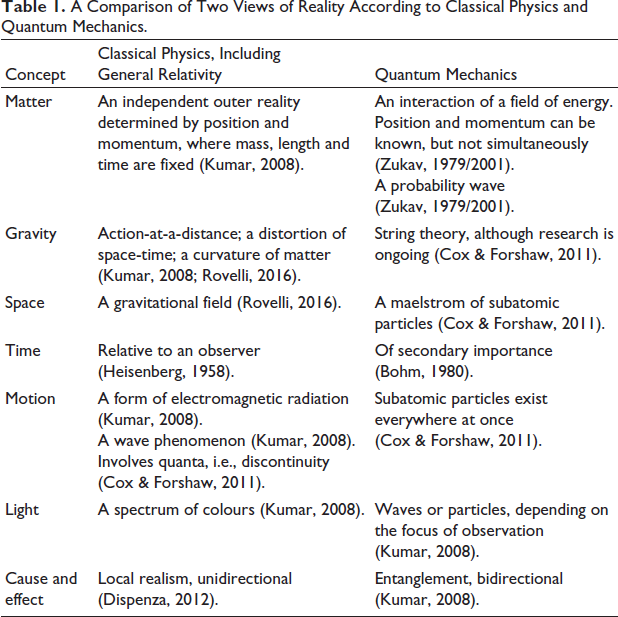
The above differences between the worldviews of classical physics and quantum mechanics are summarized in Table 1.
A Comparison of Two Views of Reality According to Classical Physics and Quantum Mechanics.
Reconciling Classical Physics and Quantum Mechanics via an Observer 3
Heisenberg recognized that, unlike everyday objects, atomic particles are only potentialities or possibilities rather than things or facts, and these possibilities are not independent of an observer (Kumar, 2008). For example, Heisenberg had theorized that electrons do not always exist—they only exist when an observer is present, that is, when interacting with something else (Rovelli, 2016). Another example of the all-important determining factor of the observer is the wave-particle duality of light, with light becoming a wave or particle depending on the experiment performed, which suggests that light has no properties independent of us. For instance, in studying light, a ‘photon’ becomes isolated from the fundamental unbroken unity because we are studying it (Zukav, 1979/2001). In other words, light itself only exists as a result of we who interact with it (Zukav, 1979/2001). 4
Returning then to Schrödinger’s thought experiment of a cat, we can now answer how an infinite number of quantum possibilities—the wave function—becomes a singular reality or particle function. The answer lies in the act of observation, that is, the cat is not there until we observe it (Zukav, 1979/2001). This bizarre possibility requires the concept of superposition, that is, the nature of a quantum condition to be in multiple states at the same time until it is measured, which poses the question of when exactly quantum superposition ends and reality collapses into one possibility or the other (Kumar, 2008). 5 This interactive feature was taken to its logical conclusion by the German physicist Pascual Jordan (1902–1980), who stated that ‘We ourselves produce the results of measurement’ (Kumar, 2008, p. 313). 6 Again, reality is created when an observer makes observations (Davies, 1989).
The Takeaways
Based upon the above insights arising from quantum physics, the following concepts are key to an understanding of a new view of reality:
Nature is dualistic. This feature was explored by Niels Bohr, who named it the complementarity principle, as evidenced by the phenomena of light, which is both a particle and a wave. Such complementarity also means that atomic and sub-atomic constituents cannot be measured exactly, which leads back to the probabilistic nature of the universe and its indeterminacy and uncertainty. Nature is probabilistic. There is no certainty in nature. As Heisenberg discovered, both the position and velocity of an object cannot be measured exactly at the same time, even theoretically. This insight led to Heisenberg’s uncertainty principle. In effect, the workings of the universe are probabilistic, not deterministic. Nature is relational. Everything is related to something else; all is relative, with no absolutes. This is proven by the principle of quantum entanglement—what Einstein believed was ‘spooky action at a distance’ (Bell, 2004, p. 143).
7
Matter is an illusion. In effect, quantum physics tells us an astonishing fact—matter is an illusion, that is, matter does not actually exist and is thus not created (Cox & Forshaw, 2011) except when being observed.
8
As for the observing system, Rovelli (2016) highlights the conclusion—reality only arises as an interaction. Physicists had discovered that the person observing (or measuring) the tiny particles that make up atoms affects the behaviour of energy and matter (Dispenza, 2012). In other words, a particle cannot manifest in reality—that is, ordinary space–time as we know it—‘until we observe it’ (Dispenza, 2012, p. 14). This brings us to the final takeaway. The observer creates reality. The subatomic realm and its particles are ‘tendencies to exist’ (Dispenza, 2012, p. 35), which are then manifested according to the observer’s presence.
9
Schrödinger’s equation depicts a universe of endless possibilities that are collapsed into an actuality when perception takes place—and the astonishing truth is revealed—‘We are actualizing the universe’ (Dispenza, 2012, p. 87; Zukav, 1979/2000). Physics and science have accumulated enough evidence for the conclusion that the key to understanding the universe is you, the observer, which is to say that what is ‘out there’ depends on what is ‘in here’ (Zukav, 1979/2001).
10
Discussion
How can the above review of classical and quantum physics and its insights into the nature of reality contribute to our understanding of effective psychotherapy? First, let us return to and highlight one of the major findings in this review. The most astonishing insight of this tour of quantum physics concerns our understanding of the status of the observer. Classical physics assumed tacitly that an experimenter was a passive observer of nature (Kumar, 2008). Quantum physics has turned that view on its head, showing that the observer actively creates reality. The new physics and the Copenhagen interpretation tell us that an observer cannot observe without altering what they observe at the subatomic level, that is, there can be no independent observer watching from the sidelines (Zukav, 1979/2001). For instance, the Copenhagen interpretation states that in the absence of a measurement, an electron has no position; indeed, no elementary phenomenon can be said to exist until it is observed. The key act of perception or observation by a perceiver/observer converts or transforms a probability into an actuality with coordinates in the space–time matrix, which is known as the collapse of the wave function.
The Wave Function Collapse and the Measurement Problem
The observer collapses the wave function, but why and how that happens is one of the foundational problems of quantum physics and is called the problem of observation or the measurement problem that Einstein and Schrödinger took as evidence for the incompleteness of quantum mechanics (Kumar, 2008). But incomplete or not, the Copenhagen interpretation requires a demarcation line, a boundary, above which an object would cease to be quantum and start to be classical. 11
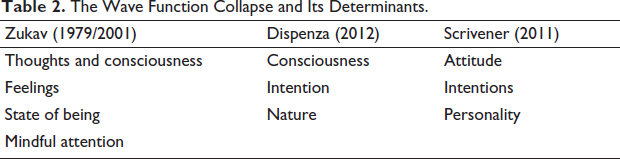
While there is no consensus on where the actual demarcation line is situated, we do know that any interaction between an observer and any phenomenon takes place according to a set of properties that ‘depends on our specific way of interacting’ with our surroundings (Rovelli, 2016, p. 57; author’s italics). What are those properties? Zukav (1979/2001) hypothesized that the apparently pure chance element in the wavefunction collapse is determined by the nature, intention and consciousness of the observer, while Dispenza (2012) believes that the factors influencing the quantum jump into actuality include one’s thoughts and their associated consciousness, one’s feelings and one’s state of being. Dispenza (2012, p. 15) also reasons that at the subatomic level, energy responds to a person’s mindful attention and becomes matter, like a piece of clay that is put in the hands of a potter, and that ‘the energy of infinite possibilities is shaped by consciousness: your mind’. 12 In relation to teaching, Scrivener (2011) argues that the most important task of a teacher is to create the conditions in which learning can occur, which involves developing a relationship that is determined by the teacher’s attitude, intentions and personality. 13
These three sets of properties are presented in Table 2.
The Wave Function Collapse and Its Determinants.
Teaching and Metacognition
Without downplaying the other properties listed in Table 2, this article will focus on consciousness and mindful attention, especially given the importance of metacognition as the most effective teaching and learning activity (Biggs & Tang, 2011).
So, what exactly should a teacher be mindful and aware of in order to successfully enhance the learning process? To help answer this question, the researchers now wish to bring to the fore the tried-and-tested practice of Buddhist mindfulness. Mindfulness can be defined in several ways. Essentially, it is ‘paying attention to whatever is happening’ (Kabat-Zinn, 2013, p. 26). Such attention refers to the awareness that arises by paying attention on purpose, in the present moment, and non-judgmentally (p. xxxv, author’s italics). As for such awareness, this involves non-conceptual knowing (p. 587, author’s italics). 14
The actual practice of paying attention begins with breathing, the ‘easiest and most effective way to begin cultivating mindfulness’ (Kabat-Zinn, 2013, p. 44). By bringing awareness to one’s breathing, the parasympathetic branch of the autonomic nervous system is activated and acts like a ‘brake’ on the experience of stress, which is indicated by the slowing down of one’s breathing (Kabat-Zinn, 2013, p. 313). In doing so, mindfulness creates a pause and ‘extra time to assess things more completely’ (Kabat-Zinn, 2013, p. 340, author’s italics); as you continue, you will also notice that less things ‘push your buttons’ (p. 341). This is especially important and useful when the most common difficulties that students face nowadays are stress-related issues leading to aggression, anger and anxiety (Landreth, 2001).
In addition to mindfulness of one’s body, including breathing and postures, paying attention also includes awareness of one’s bodily feelings, one’s thoughts and the underlying content of one’s mind, including what are known as ‘the five hindrances’ of sensual desire, anger, sloth, doubt and worry (Bodhi, 2005, p. 263). 15 But note that such ‘awareness’ is ‘different from the sensations, the thoughts and the emotions themselves’ (Kabat-Zinn, 2013, p. 382).
It is important to note that the first two foundations of mindfulness practice lead to a kind of intelligence—including emotional intelligence—that generates ‘tools for intelligent and constructive living’ (de Silva, 2014, p. 85). 16 But these first two foundations are not an end in themselves; rather, they serve as stepping stones to the third and fourth foundations involving the highly important dimensions of meaningful human existence, namely ethics and spirituality. In this regard, mindfulness makes a practitioner aware of actions that lead to wholesome, positive and conducive consequences as opposed to damaging outcomes because it allows ‘conscious, beneficial choices’ to be made (Lee & Ong, 2018, p. 328). 17
What does all this signify for effective teaching and learning in tertiary settings? We now have a working agenda for becoming a metacognitive and mindful educator: being a reflective practitioner about the goals and outcomes of higher education, one’s teaching and learning activities, including how to nurture positive relationships with one’s peers and one’s students; being mindful of one’s feelings towards one’s profession, institution, colleagues (and other staff members), as well as one’s students; being conscious of one’s intentions regarding one’s vocation as a teacher; and paying attention to professional ethics, including being aware of one’s own inner hindrances of sensual desires, anger, sloth, doubt and worry, while also nurturing and developing one’s virtues of loving-kindness, compassion and altruism towards the people you work with and teach. All of these factors will determine how you as a teacher-observer can transform a probability into a wholesome actuality in a classroom setting.
Conclusions
As the renowned physicist Niels Bohr indicated in the opening epigraph of this article, the present researchers have hopefully taken you, the reader, on a shocking tour of quantum reality. Philosophical realism—that a real world exists independently from any act of perception—is at variance with quantum predictions, which state that at any point in time only one dimension of an object’s position or momentum can be known, not both (Rovelli, 2016). Since we cannot determine both the position and momentum of subatomic particles at the same time, we cannot predict much about them except as a probability function (Rovelli, 2016). In other words, quantum mechanics does not yield a description of an objective reality but deals only with statistical possibilities of energy quanta (Davies, 1989). At the quantum level, randomness and probability hold reign. 18 Even further, matter is an illusion and only exists when an act of observation occurs. As one of the classical and fundamental building blocks of the physical world, matter as an independent existent evaporates at the subatomic level (Zukav, 1979/2001).
Quantum mechanics has thus provided us with evidence showing that it is not possible to observe reality without changing it; that an objective world out there is impossible; that we as observers and actors are part of nature (Zukav, 1979/2001). What we can conclude is that an observer’s experience is not of external reality but their interaction with it (Zukav, 1979/2001). This is a fundamental assumption of complementarity (Dispenza, 2012, p. 103). This law of complementarity leads to the startling conclusion that the entire world around us consists not of things but of interactions, a feature that is characteristic of everything (Zukav, 1979/2001; author’s italics). This interpretation of quantum theory is very significant because it is incompatible with the objective reality postulated by Einstein (Kumar, 2008). Reality thus occurs at the interface of observer and observed.
The significance of the observer brings us to an eyebrow-raising implication. The quantum model, based on Einstein’s E = mc², states that all physical reality is primarily energy existing in a vast web that is interconnected across space and time (Zukav, 1979/2001). That web, the quantum field, holds all probabilities, which we can collapse into reality through our observation, thoughts (consciousness), feelings and states of being (Dispenza, 2012). For this reason, Dispenza (2012) challenges the reader to become a ‘quantum creator’ and to ‘direct the observer effect and … collapse infinite waves of probability in to the reality you choose’ (p. 14, author’s italics). Becoming a ‘quantum creator’ is reversing the process of cause and effect from environment to observer, that is, changing one’s thoughts and feelings to alter one’s physical environment (p. 25).
Ultimately, Buddhist mindfulness has a ‘universal and transcendent purpose: human flourishing, virtuous behavior, and an altruistic concern for the welfare of all sentient beings’ (Purser & Milillo, 2014, p. 7). In doing so, Buddhist mindfulness is intended to help in the removal of mental afflictions and self-centredness, that is, enhancing ethical sensitivity, moral development and altruism for all sentient beings (de Silva, 2014, p. 19).
Finally, mindfulness offers such a wide-ranging, fertile and significant practice that the researchers of this article wish to recommend that all educators and their students learn and acquire a ‘rigorous and systematic training in mindfulness’, such as Kabat-Zinn’s (2013) mindfulness-based stress reduction programme (MBSR) (p. xlix).
Regarding limitations in this exploration of a quantum world, non-localism highlights a paradox, for while we can describe our experiments in terms of the concepts of classical physics, we also know that these concepts do not fit nature accurately (Heisenberg, 1958). And yet, claiming that no underlying physical reality exists independently of the observer and measuring equipment requires, awkwardly, the use of classical concepts of description (Kumar, 2008). Even so, every subatomic particle and field can be described by a wave function giving only probabilities of outcomes, with the results of observations being described by classical physics (Davies, 1989). Indeed, the correspondence principle of Bohr and Heisenberg states that the quantum mechanical description of large systems will closely approximate the classical description (Davies, 1989), which is why Cox and Forshaw (2011) also tell us not to be fooled into thinking that the coherence of everything is lost every time we measure something. Nevertheless, the laws of quantum theory are a major improvement over Newton’s laws because they provide a more accurate description of the world and universe (Cox & Forshaw, 2011).
Footnotes
Authors’ Contributions
The first author, Adrian John Davis, was responsible for the initiation of this article and its research concept, writing and submission. The author’s research partner Connie Sou Sok Weng helped with the literature review and critical reflection on its intellectual content, including a review of the discussion section. Both of them met regularly to discuss the theory and practical implications of the findings for the teaching and learning process, approved the final content, and are both accountable for its veracity and intellectual value.
Declaration of Conflicting Interests
The authors declared no potential conflicts of interest with respect to the research, authorship and/or publication of this article.
Funding
The authors received no financial support for the research, authorship and/or publication of this article.
