







Abstract
This research examines the challenges faced by Islamist women Members of Parliament (MPs) in the Moroccan House of Representatives as they balance advancing women’s interests with supporting their party’s agenda. This study analyzes the legislative activities of female MPs from Morocco’s Islamist Justice and Development Party (PJD), including their submission of questions and drafting of bills. The research underscores the observed rise in female political participation, attributed in part to institutional reforms, notably gender quotas, within PJD. However, an examination of initiatives and propositions advanced by female Islamist MPs reveals a conspicuous absence of advocacy for women’s political interests. Consequently, the study concludes that despite constituting a numerical majority, Islamist women MPs exhibit limited engagement in advancing women’s interests, often prioritizing their respective parties’ agendas over broader gender-related concerns.
Keywords
Introduction
The presence of women in the political arena is often viewed as a sign of political progress. Consequently, some conservative countries, which have traditionally not supported women’s participation in politics, emphasize appointing women to cabinet positions or as legislators to signal political openness. Although women do not constitute a numerical minority in society, they remain politically underrepresented in legislative institutions and political leadership worldwide (Elder, 2004; Lawless & Pearson, 2008). For this reason, women are often treated as a marginalized political group, and their representation has become a central issue in debates about democratic inclusion and equality. To address women’s underrepresentation in politics, institutional measures such as gender quotas have been introduced to facilitate women’s engagement in political processes by mandating reserved electoral seats. Consequently, the adoption of gender quotas has increased women’s participation in formal political arenas, given the higher probability of female candidates winning elections. This has resulted in a notable upsurge in women’s representation within formal political domains.
However, because women remain underrepresented in many political systems, reforms such as gender quotas have often been used to increase women’s representation and signal political openness and reform. Simply increasing the number of seats for women has not significantly influenced the political decisions of dominant political factions. However, adopting political reforms that enhance women’s political engagement has proven to be an effective tool, especially for authoritarian regimes seeking to address political demands for reform while concealing repression of opposition groups. Similarly, in Islamic countries where Islamic values and principles heavily influence politics, women are often used as a political tool to either moderate or strengthen the role of Islam in the political sphere. Since women’s interests, such as the freedom to wear the hijab or not, have been employed by regimes as symbols to demonstrate religious identity in politics, women’s political representation in formal politics can also be an effective tool for signaling the political moderation of Islam or the reinforcement of Islamization in politics, and vice versa.
Following the Arab Spring, countries in the MENA region witnessed the rise of political Islam, as many Islamist political parties gained popularity by winning elections and became significant actors in formal politics, filling the power vacuum left by the collapse of dictatorships. In Morocco, the Islamist political party, the Justice and Development Party (PJD), won consecutive elections in 2011 and 2016, becoming the governing party in parliament. However, as an Islamist political party, the PJD has faced the challenge of balancing two political identities: operating as a pragmatic governing party capable of appealing to a broad electorate while maintaining its ideological roots as an Islamist party. In the political struggle of Islamist parties, women have always been a key factor in determining the party’s political orientation, whether it is perceived as a catch-all or a religious party. In Morocco, the adoption of gender quotas as part of political reforms to enhance women’s political rights has increased the number of women MPs in parliament. Consequently, the Islamist PJD also witnessed an increase in the number of seats obtained by women candidates.
However, an increase in women MPs from the Islamist party does not necessarily translate into advocacy for women’s interests in the legislative process. The Islamist party often struggles to balance its agenda between upholding religious values and pursuing moderation. When it comes to women’s interests, the party faces challenges in either moderating its stance or staying true to its original principles. Nonetheless, if the presence of women in parliament strengthens the focus on women’s issues, female MPs from the Islamist party can play a crucial role in advancing women’s voices. From this perspective, this study aims to examine whether and how women MPs in the Moroccan Islamist party, PJD, have sought to advance women’s political interests. To this end, the study analyzes legal proposals, questions to the government, and statements by women MPs in the Moroccan Islamist party, and assesses whether these legislative activities are relevant to the practical advancement of women’s political interests. It analyzed statements, questions to the government, and draft laws proposed by women MPs from the PJD party who won seats in the 2021 Moroccan legislative election, using the PJD and Nouabka websites, both of which provide public access to Morocco’s legislative activities. In doing so, this study deepens our understanding of the political challenges faced by Islamist women MPs as they balance the dual roles of advocating for women’s interests as female representatives while remaining committed to their party’s primary agenda.
The Women at the Center of the Controversy Between Islamism and Secularism
In the Middle East and North Africa (MENA) region, the conflict between Islamist and secular groups has been a primary issue. In this context, political reforms that cast women as symbols within the Middle East and North Africa have been strategically employed by the state to bolster national identity or nationalism (Müftüler-Bac, 1999). Notably, Kemal’s reforms in Türkiye serve as a prime example of effectively leveraging women as symbols of modernization, aligning with the overarching goals of the Kemalist government (Müftüler-Bac, 1999). In Tunisia, the issue of wearing or not wearing the hijab has long been a political matter, as women’s freedom to make this choice is viewed as a symbolic expression of a state’s stance toward modernization or secularization (Yacoubi, 2016). Wearing the headscarf in Tunisia signifies a refusal to submit to both men and the state, which imposes restrictions on women who choose to wear scarves, highlighting the precedence of religious beliefs over national values (Yacoubi, 2016).
In a similar vein, there has been a longstanding political debate over whether Islamic tradition impedes the development of democracy. Some scholars argue that many authoritarian regimes are concentrated in Muslim-majority countries (Fish, 2002; Karatnycky, 2002; Kedourie, 2013). Moreover, in conservative Islamic countries, where preserving Islamic values is a top priority, women have historically been prohibited from participating in politics (Donno & Russett, 2004; Fish, 2002). As a result, women’s issues in Islamic authoritarian regimes are often treated as a variable when examining the advancement of political freedom. Conventional wisdom often portrays women’s political participation in these contexts—where Islamism is the dominant ideology—as passive and constrained (Donno & Russett, 2004).
However, the impact of Islam on women’s political engagement in these nations is not consistently restrictive. Rather, processes of modernization or shifts toward secular politics offer opportunities to transform women’s roles in politics. Similar to democratic regimes, many authoritarian Islamic countries in the MENA region have adopted parliamentary systems to allow political parties to operate and encourage citizen participation, thereby reinforcing the regime’s legitimacy (Levitsky & Way, 2002). In a similar vein, many Islamic countries have adopted gender quota systems to bolster women’s political participation in parliament (Lu, 2013). The inclusion of women in official political arenas, such as parliaments or governments, can signal political reform, potentially masking the authoritarian nature of male-dominated politics in Islamic countries.
Furthermore, the political struggle for women’s inclusion and representation in Islamic countries is closely tied to the internal dynamics of political parties. In the MENA region, Islamic movements are among the most active political actors within authoritarian political systems, often serving as significant opposition groups. Most Islamist movements in the MENA region are ideologically rooted in the principles of the Muslim Brotherhood, which was founded in Egypt by Hasan Al-Banna. Al-Banna emphasized the necessity of sex segregation, believing that men and women should occupy distinct social spheres, and warned of the moral dangers of public interaction between the sexes (Shitrit, 2016). He advocated that women primarily fulfill roles as mothers and wives and therefore did not support the active presence of women in state institutions (Shitrit, 2016).
Although Islamist movements maintain conservative positions on issues such as gender roles, their ideologies have begun to moderate as they have entered the electoral arena to gain broader popularity and support from civil society (Schwedler, 2011). Recent scholarship also highlights that Islamist parties have often been effective in mobilizing women and facilitating their political participation. Contrary to the common assumption that Islamist electoral success necessarily undermines women’s political representation, studies suggest the relationship may be more complex. Abdel-Samad and Benstead argue that Islamist parties may mobilize female supporters through religious networks and gender-segregated social spaces, such as households, mosques, and women’s social organizations (Abdel-Samad & Benstead, 2016, 2022). In these contexts, female activists and parliamentarians play an important role in connecting women citizens to political institutions, thereby enhancing women’s symbolic and service representation. Similarly, research on Islamist women’s activism shows that they have actively engaged in political debates, articulating women’s rights and social roles within an Islamic framework and challenging both secular state ideologies and patriarchal traditions (Arat, 1998, 2012). These findings suggest that Islamist movements may, under certain conditions, create new opportunities for women’s political participation and representation.
Following the Arab Spring, many Islamist parties gained prominence by winning elections after the collapse of authoritarian regimes in Tunisia, Egypt, Morocco, and elsewhere. However, in doing so, they faced a dilemma over their political identity—whether to remain religious parties or evolve into more moderate, catch-all parties. For these parties, the role of women in politics and their political representation have long been critical issues shaping party ideology and policies. Even in established democracies, the question of whether elected conservative women can adequately represent women’s interests has been a subject of scholarly debate (Schreiber, 2008; Webb & Childs, 2012). Given that conservatism typically does not prioritize social welfare or equality policies, women’s issues may be marginalized within conservative political frameworks (Celis & Childs, 2018). Since party identity often exerts a significant influence on a representative’s attitudes and behavior, there is reason to question whether conservative women representatives can effectively advocate for women. This concern is particularly salient in religious parties, such as Islamist parties, which are perceived to adhere closely to religious values in policymaking. For example, in Tunisia, the Islamist Ennahda party, which won the first parliamentary election after the collapse of the Ben Ali dictatorship, experienced a significant decline in popularity due to its rejection of proposed inheritance law reforms aimed at enhancing gender equality, as the party viewed the new law as contrary to the Quran (Middle East Monitor, 2018). By contrast, in countries where Islamic parties have not prioritized Islamic social values, constituents with gender-egalitarian attitudes toward women’s political inclusion are more likely to support Islamist parties, as in Indonesia and Malaysia (Mhajne & Saxton, 2022; Pepinsky et al., 2012). In this context, the following sections examine the political attitudes of Moroccan women politicians within an authoritarian constitutional monarchy. Morocco, where secularism and Islamism coexist, provides a valuable case for exploring how these women, particularly MPs from Islamist parties, navigate their positions amid the tensions between these two ideologies.
Morocco: Advancing Political Reform by Enhancing Women’s Political Representation
Women in Morocco have actively participated in politics since the country’s founding. Since the inaugural elections in 1963, Moroccan women have enjoyed both the right to vote and to run for office (Zaanoun, 2022). Despite this significant engagement, women’s representation in parliament remains limited. The Convention on the Elimination of All Forms of Discrimination against Women, published in the Gazette on January 18, 2001, marked a pivotal moment in advancing women’s status in Morocco. In 2002, a quota system was implemented, reserving thirty seats for women in the House of Representatives, thereby promoting gender representation (Manal, 2020). As a result, 35 women secured seats in the 2002 legislative elections, with 30 attributed to the quota system and five as members of local lists following the adoption of the electoral list-voting system (Zaanoun, 2023). Despite advocacy by women’s groups during the 2007 elections for an expanded national list to surpass the 10.7% threshold for women MPs, the electoral system remained unchanged (Zaanoun, 2022).
During the Arab Spring in 2010, Morocco experienced protests demanding reform under the banner of “freedom, dignity, and social justice,” prompting the government to revise the constitution. The revised 2011 Constitution advanced gender equality through Article 30, which enhanced women’s equal access to elected positions (Morocco 2011 Constitution). Figure 1 illustrates the increasing proportion of women in parliament over time. Law No. 27-11, pertaining to the House of Representatives, raised the number of quota seats to 90, earmarking 60 seats for women and allocating the remaining 30 to youth. As a result, the number of women MPs in parliament rose to 67 (Darhour & Dahlerup, 2013). In the 2021 elections, female candidates secured a total of 96 seats, with 90 attributed to quotas and the remainder won organically. This number is an increase from the 81 seats held by women MPs in parliament in the 2016 elections (WFD, 2023). The gender quota in the 2021 elections stems from the electoral reform enacted by Law 04-21, which mandates that two-thirds of the electoral lists for regional districts be reserved for women and young candidates, resulting in the allocation of 90 seats (Szmolka, 2023). Consequently, the establishment of regional districts aimed to enhance women’s representation in parliament. In the 2021 election, all Moroccan political parties exclusively included women candidates on their regional lists.
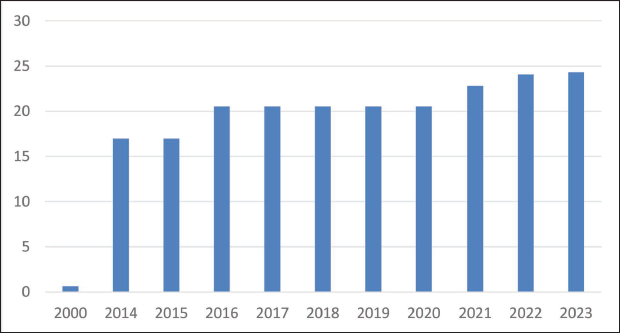
Then, the growing number of women MPs in parliament raises a question. Is the rise in the number of female MPs in parliament significant for advancing the political interests of women constituents? While the 2021 Moroccan parliamentary election is widely regarded as a pivotal moment for women’s political representation, due to a substantial increase in the number of women MPs, some argue that one-fifth of these female MPs have personal relationships with their party leaders (Zaanoun, 2022). In fact, analyses suggest that national-level quotas enhance the descriptive representation of women, but women’s ability to secure non-quota seats is constrained by the patronage-oriented nature of politics in Morocco (Darhour & Dahlerup, 2013; Sater, 2007). Additionally, an analysis indicates that the increased representation of women at the national level has contributed to the legitimization of the “de-democratization” of Moroccan politics (Darhour, 2020). Improving the descriptive representation of women in parliaments does not always lead to positive political change. Instead, the presence of a large number of women MPs can be leveraged to address shortcomings in state and party politics. Even within political parties, female MPs do not consistently advocate for women’s political interests; rather, they are often used to advance their parties’ agendas. The next section explores whether Islamist women MPs have prioritized advancing women’s political interests or have primarily focused on securing loyalty to their respective parties. The analysis centers on Islamist women MPs because of the distinctive dilemmas they face. As members of Islamist parties, these MPs frequently navigate the tension between advocating for women’s interests in their capacity as female politicians and aligning with the broader priorities of their affiliated parties.
The Justice and Development Party and the Representation of Women’s Interests in Morocco
In the 2021 Moroccan legislative elections, the PJD, which had emerged as the leading party in the 2011 and 2016 elections, suffered a dramatic electoral decline. The party won only 13 seats, down from 125 in 2016, while the National Rally of Independents (RNI) secured a decisive victory across parliamentary, municipal, and regional elections (Monjib, 2021). This sharp decline provides important political context for examining how the PJD has positioned itself on women’s representation and gender politics. The PJD’s electoral setback may be understood in light of the broader challenges Islamist parties face when moving from opposition to government. Before the Arab Spring, the PJD largely operated as an opposition force. After 2011, however, it was required to act as a governing party, respond to social and economic demands, and position itself in relation to the monarchy. This transition made questions of political identity more salient, including how the party would articulate its stance on women’s issues, family policy, and social reform.
As shown in Table 1, the electoral balance between the PJD and secular-oriented parties shifted significantly in 2021. Rather than interpreting this outcome solely as the failure of an Islamist party, this study is better served by examining how debates over gender, family, and social values have shaped the party’s public image and political discourse. In Morocco, these debates have often become a key arena for expressing broader tensions among religious legitimacy, social change, and political modernization.
Changes to the Distribution of Seats Within the Moroccan Parliament in the Years 2016 and 2021.
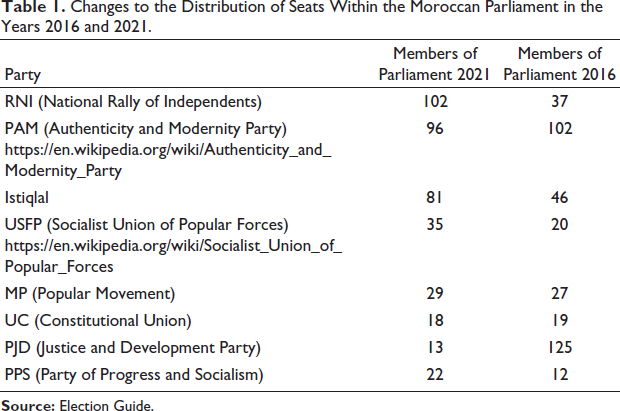
However, as shown in Table 1 and demonstrated by the 2021 elections, the disparity in the share of seats held by the Islamist party versus secular parties in Morocco has been significant. This gap is primarily due to the PJD’s failure to effectively transform its party identity. In redefining its political identity, the PJD has made women’s rights central to solidifying its ideological stance. Rather than uniformly opposing women’s rights, Islamist actors have often supported certain forms of women’s participation while resisting reforms they consider inconsistent with Islamic values. Moreover, by emphasizing the King’s role as the Commander of the Faithful, the PJD underscored the importance of Islamist values, arguing that revisions to family law that contradict these values pose a threat to the regime’s legitimacy and stability (El Karmaoui, 2024).
Meanwhile, because women often experience politics differently than men, particularly when they are treated as an underrepresented group in some societies, their interests frequently diverge from those of men, underscoring the need for differentiated advocacy (Wängnerud, 2009). However, the definition of women’s interests can vary by context. According to Phillips, women have diverse interests that may include issues related to childbearing, societal concerns such as sexual harassment and violence, unequal treatment in employment, or their exclusion from economic and political power (Phillips, 1998, pp. 67–68). Furthermore, because women’s situations vary by circumstances, backgrounds, and cultures, their political interests are diverse. In countries where Islamic values or traditions are deeply respected by the state or the public, religious factors are sometimes seen as obstacles to advancing women’s interests (Hassan, 1995; Orakzai, 2014). For instance, in some cases, the wearing of the veil is mandated by law, turning it into a significant political issue in more conservative Islamic societies (Shirazi, 2001).
In Morocco, debates on women’s rights have often centered on reform of the family code (Moudawana), inheritance rules, and related legal questions. However, women’s interests cannot be reduced to these issues alone. They may also include concerns about social welfare, education, health, economic participation, administrative access, and the everyday challenges faced by women in marginalized communities. Recognizing the multidimensional nature of women’s interests is important for evaluating the parliamentary role of female MPs, including those affiliated with Islamist parties.
The resurgence of Islamist groups in Morocco since the 1990s poses a major challenge for the women’s movement. The 2004 reform of the Moudawana marked a major turning point in Moroccan debates on gender and family. It expanded women’s legal rights in areas such as self-guardianship, divorce, and child custody (Zvan Elliott, 2009) and was driven by sustained pressure from civil society organizations, including women’s movements and political actors (Outaleb & Sadiqi, 2020). At the same time, the reform generated considerable resistance from conservative actors, including Islamist groups that viewed parts of the reform agenda as excessively Westernizing or insufficiently grounded in Moroccan religious and social values (Zvan Elliott, 2009). Over time, however, the debate became more complex than a simple binary between reform and rejection, as even conservative actors increasingly framed their positions in terms of culturally and religiously appropriate reform rather than outright opposition.
Following these debates, King Mohammed VI established a Royal Commission in 2001 to review and propose reforms to the Moudawana. In the initial period, the PJD and the Islamist movement Al-Adl wa’l-Ihsan (Justice and Spirituality) organized a protest march in Casablanca opposing the Moudawana, which they perceived as an attempt to Westernize the Personal Status Code (Zvan Elliott, 2009). In the end, conservative Islamist groups no longer opposed reform of the Personal Status Code. Instead, they advocated a more culturally and religiously sensitive approach to reform (Zvan Elliott, 2009). Again, in 2022, Moroccan King Mohammed VI called for comprehensive reform of family law, including the abolition of legal child marriage, the expansion of inheritance rights, and a standardized judicial process for divorce, among other measures (El Yaaqoubi, 2024). However, the new reform deepened divisions in Moroccan society, especially between conservatives, such as the PJD party, who argued that the amendment is against religious rulings and Quranic texts, and reformists who argued for countering discrimination against women (Al-Ashraf, 2024).
The PJD’s conservative stance on expanding women’s rights has intensified following the political opening after the 2011 Arab Spring. The PJD has advanced conservative narratives about women’s roles more broadly. The Islamist discourse opposing women’s participation in the public sphere appeals to young, unemployed men, who are easily led to believe that women’s paid employment robs them of opportunities (Sadiqi, 2010). Furthermore, in a 2014 speech to parliament, the PJD leader, Benkirane, compared women to “lanterns” and lamented the declining respect for the “sacred status God gave” to mothers who stay at home (Abdel Ghafar & Hess, 2018). He stated, “Don’t you realize that when women went to work outside, the light went out of their homes?” These comments sparked a public backlash, leading to a protest outside parliament and the trending hashtag #anamachitria (I am not a chandelier) on Twitter (Abdel Ghafar & Hess, 2018). Ironically, the opening of the political system has given greater political voice and representation not only to women but also to Islamist groups that seek to limit women’s political space and rights.
Despite its conservative rhetoric, the party’s practical engagement in female political representation tells a different story; the number of PJD women in reserved seats surged from just 4 in 2002 to 20 in 2016, reflecting a significant growth in their legislative presence approach (Škrabáková, 2017, p. 350). In 2004, the PJD adopted a new charter that limited the authority of its general secretariat and introduced more transparent competencies across all party institutions. Furthermore, to counter criticisms that Moroccan parties select female candidates based on their connections to the leadership, the PJD and the Istiqlal party have established formal selection criteria for candidates on their national lists (Škrabáková, 2017, p. 335). For instance, the PJD’s male-to-female ratio among its MPs increased from 14.3% of total seats in 2002 to 19.2% in 2016 (Škrabáková, 2017). Despite controversy over the PJD’s stance on women’s political activity and representation, the proportion of female MPs affiliated with the PJD has remained notably high in the parliament. During the Arab Spring in Morocco, the Islamist party, the PJD, won the legislative election, and the voices of female Islamist representatives also became visible. Furthermore, veiled women appeared within the government during this political change in Morocco (El Haitami, 2016, p. 79).
Although the proportion of women representatives in the PJD is relatively high compared with other Islamist parties in the region, their roles within the party remain constrained. The internal structures of most political parties in Morocco are shaped more by charismatic or clan loyalties than by legal procedures or democratic principles (Drif, 2022). Furthermore, when competing for significant positions, women often face pressure to defer to male candidates (Drif, 2022). This struggle is particularly evident among women in the PJD, who find it difficult to attain key leadership roles, such as positions in the general secretariat or the Shura Council (Škrabáková, 2017). This can be attributed to factors such as their personal distance from high-level politics, entrenched patriarchal norms, or resistance from male leadership (Škrabáková, 2017, p. 342). Even in developed democracies, political parties can be a significant barrier to women’s political representation, often before the adoption of electoral or parliamentary systems designed to improve it (Norris, 1996). Parties may restrict women’s participation through practices akin to ‘gender gerrymandering,’ in which women are less likely than men to be preselected for winnable seats (Sawer, 2000, p. 371).
The PJD party allows women to hold leadership roles, but these positions are often limited to areas where their influence is minimal (Abartal, 2023). For instance, former Prime Minister Abdelilah Benkirane’s cabinet (2012–2017) included only one female minister, Bassima Hakkaoui, in contrast to the previous government, which had seven women ministers from 2007 to 2011 (El Haitami, 2013). Moreover, during her tenure, she was criticized by numerous women activists who accused her of neglecting critical issues affecting women, including rape, pedophilia, the challenges faced by single mothers, forced marriages, deep gender inequalities, and the plight of homeless children (Owen-Jones, 2019). Additionally, the new law on violence against women, spearheaded by Hakkaoui, faced criticism from women’s rights organizations for failing to address all forms of violence against women and for not aligning with international standards (Fana, 2018). This legislation, commonly referred to as the Hakkaoui law, has been a point of contention. Organizations have expressed concerns about the potential deterioration of women’s rights.
Furthermore, the Moroccan Islamist party has faced internal divisions over women’s issues. For instance, the revelation of a photograph of PJD’s MP Amina Maeleainine in front of the Moulin Rouge in Paris sparked increased criticism of her within the party (Guerraoui, 2019). This scandal suggests internal conflicts within the PJD over the role of women MPs (Guerraoui, 2019). In addition, as demand for the legalization of abortion in Morocco has risen, there has been disagreement within the PJD over abortion rights. The former PJD Prime Minister opposed the legalization of abortion, arguing that pregnant women bear responsibility (Regragui, 2013, p. 8). However, his successor, Saad Eddine el-Othmani, blamed the government for failing to expand abortion rights in cases of rape or incest (Regragui, 2013, p. 8).
Also, the Moroccan government’s efforts to reform inheritance laws to enhance women’s financial rights and equality have consistently faced opposition from the Islamist PJD party. In 2022, Nabila Bouayach, the head of the National Human Rights Council (CNDH) in Morocco, criticized the inequality in inheritance laws, linking it to rising poverty among women (El Atti, 2022). However, in response to CNDH’s concerns, the PJD warned against what it perceived as the exploitation of Morocco’s religious values (El Atti, 2022). In this context, the PJD has grappled with women’s issues both internally and externally. It could be argued that the substantial number of Moroccan Islamist women MPs has been strategically employed by the party to reinforce and legitimize its moderate stance. Therefore, a deeper analysis is necessary to understand the attitudes and perspectives of individual Islamist women representatives as they advocate for women’s political interests. If the presence of women in parliament is crucial for advancing women’s interests, then Islamist women representatives should prioritize women’s interests in the legislative process, even if their party is traditionally not seen as supportive of such advocacy. The following section will analyze how female Islamist representatives in Morocco’s House of Representatives have navigated the dual identities of being both female MPs and Islamist MPs since the 2021 legislative elections.
Legislative Activities of Islamist Women Members of Parliament: A Case Study of Female Members of Parliament from the Justice and Development Party
Against this background, it is important to examine how female MPs within the PJD articulate women’s interests in parliamentary practice. Rather than assuming that women MPs automatically prioritize a single, unified set of women’s interests, this section explores how their interventions reflect the interplay among gendered representation, party ideology, committee specialization, and the broader institutional context of Moroccan politics.
To analyze the political behavior of female PJD MPs in the Moroccan parliament, this study employs qualitative content analysis of their legislative activities, including parliamentary statements, written and oral questions addressed to the government, and draft laws proposed during the 2021–2026 legislative term. The analysis examines how these MPs engage with issues related to women, family policy, social welfare, and gender-related public concerns. By examining these parliamentary interventions, the study explores how women-related issues are framed and addressed by female Islamist MPs, and how these interventions reflect the interplay between gender representation and their parties’ ideological orientations.
The data used in this study were collected from 2021 through March 2024 from two primary sources: the official PJD website and the Nouabka website. The Nouabka platform, developed by the Sesame Association, aims to improve parliamentary transparency and facilitate citizen access to legislative information by allowing users to track the activities of members of the Moroccan House of Representatives. These sources provide detailed information on MPs’ parliamentary interventions, including draft laws, parliamentary questions, and legislative initiatives. By systematically examining these records, this study seeks to identify patterns in how female Islamist MPs engage with women’s issues in Morocco’s parliamentary politics.
During the 2021–2026 legislative term, nine women candidates from the PJD won seats in the parliament of Morocco. Among them, one female MP was assigned to the Productive Sectors Committee, two to the Justice, Legislation and Human Rights Committee, one to the Foreign Affairs, National Defense, Islamic Affairs, and Moroccan Expatriates Committee, two to the Infrastructure, Energy, Mining and Environment Committee, two to the Education, Culture and Communication Committee, and one to the Finance and Economic Development Committee. The sectors of the committees on which female MPs of the PJD were seated are diverse. Furthermore, although the total number of PJD representatives elected in the 2021 legislative elections was low, at only 13 members, the number of female MPs was significantly high, constituting almost three-quarters of the total membership, which was 9, due to the gender quota system. Therefore, the parliamentary term from 2021 to 2026 is suitable for examining the role of Islamist MPs in advocating for women’s interests, as the proportion of Islamist women MPs within the total seats won by the PJD during this term is relatively high, benefiting from institutional measures aimed at enhancing women’s political representation, as seen in Figure 2.
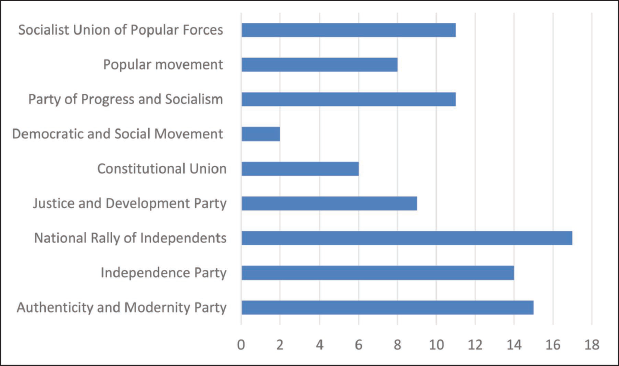
This section analyzes the role of women MPs in the PJD and whether they focus on advancing women’s interests. First, it analyzes questions or comments that PJD female MPs have posed to the government. The information is gathered by searching for each female MP on the PJD website, which provides comprehensive details on the legislative activities of its members. The analysis primarily focused on statements and questions related to women’s issues or interests that were raised by all-female MPs from the PJD. It analyzed the legislative activities of female MPs from other parties, focusing on the number of questions they posed and bills they drafted. Compared to their counterparts from other parties, the female MPs from the PJD are particularly active, as they posed numerous questions to the government and drafted a significant number of laws.
Table 2 highlights the relatively active participation of women MPs in the PJD, despite the party’s low share of parliamentary seats during the 2021–2026 term. In the Education, Culture, and Communication Committee, which is typically dominated by women MPs, there are three representatives from the PJD: Al Nuzha Abakrim, Al Batoul Abladi, and Thuraya Afif. Al Batoul Abladi, who ran for the regional constituency of Guelmim-Oued Noun in the legislative election, has been highly active in parliament and manages her own Facebook page (Abladi’s Facebook; TelQuel, 2016; Nouabka website). She has posed 17 oral questions and 388 written questions to the government. Her primary focus has been on education-related issues. However, she has also expressed concern about challenges faced by women. For instance, in a video statement released by the PJD, she emphasized the need to combat violence against women through the collective efforts of civil society organizations, unions, and political parties to empower women in different sectors (PJD, 2023, July 18). In a written question directed to the Minister of Health and Social Protection, she highlighted the increasing need for ambulance services due to the risks posed by scorpion stings and the importance of ensuring safe childbirth conditions (PJD, 2023, September 27). She also criticized the suspension of financial support allocated to widows and raised concerns about the administrative difficulties faced by Moroccan divorced women living abroad when attempting to obtain identification documents for their children because their former husbands refused to provide the necessary documentation (SNRT, 2022). Taken together, these interventions indicate that her engagement with women-related issues has largely focused on social protection and the everyday challenges faced by vulnerable women.
The List of Active Women Members of Parliament (MPs) in Morocco.
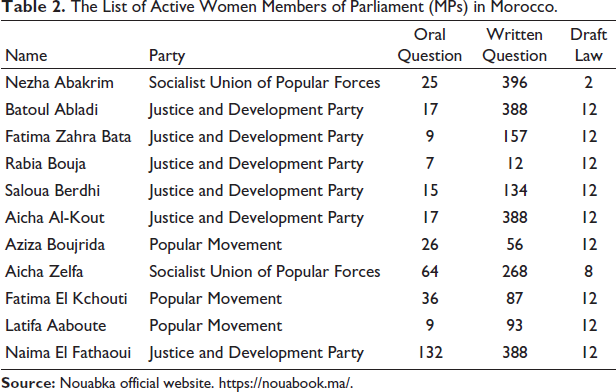
Naima El Fathaoui, who ran for the regional constituency of Souss-Massa in the legislative election and serves on the Committee on Infrastructure, Energy, Minerals, and Environment, has been among the PJD’s most active female MPs in terms of parliamentary questions, posing 132 oral and 388 written questions to the government (Nouabka website). In several public statements, she has expressed concern about the challenges faced by Moroccan women. For instance, in a message released by the PJD on International Women’s Day, she referred to the difficulties women encounter in achieving greater empowerment (PJD, 2024, March 7). She also called for the cancellation of a concert by a French rap singer who referred to Moroccan women as prostitutes, framing her criticism as a defense of the dignity and honor of Moroccan women (PJD, 2023, April 4). These interventions suggest that her engagement with women-related issues often emphasizes moral protection and social dignity. At the same time, much of her parliamentary activity remains concentrated on policy areas related to her committee’s responsibilities, particularly infrastructure, energy, and environmental issues.
Another active representative, Fatima Zahra Bata, who ran for the Oriental region’s regional constituency in the legislative election and serves on the Committee on Basic Infrastructure, Energy, Minerals, and Environment, posed 9 oral and 157 written questions to the government (TelQuel, 2016; Nouabka website). Much of her parliamentary activity has focused on criticizing government policies and addressing issues in the energy and environmental sectors. For example, she raised concerns about rising fuel prices, the closure of unsafe wells, and disruptions in water supply in several regions (PJD, 2023, June 14; PJD, 2023, November 13). Regarding women-related issues, she referred in a PJD television statement to the limited outcomes of policies aimed at women’s economic empowerment (PJD, 2023, July 18). In general, her parliamentary interventions indicate that her legislative priorities have been primarily concentrated on sectoral policy issues linked to her committee responsibilities, while references to women-related concerns have appeared less frequently in her public statements.
Rabia Bouja, who ran for the Rabat-Kenitra regional constituency in the legislative election and serves on the Committee on Justice, Legislation, and Human Rights, posed 7 oral and 12 written questions to the government (TelQuel, 2016; Nouabka website). Her parliamentary interventions have addressed a range of policy issues, including concerns about low salaries for teachers and professors and criticism of the government for failing to fulfill its promise to increase educators’ wages (PJD, 2024, February 7). Regarding women-related issues, Bouja highlighted the government’s limited progress in promoting women’s economic empowerment during a television program broadcast in January 2024 (PJD, 2024, January 15). She noted that many qualified women face barriers to promotion in public administration and that women often encounter discrimination in political parties and other sectors, where opportunities for advancement remain uneven. At the same time, in discussions concerning the reform of the Family Code, Bouja emphasized the importance of maintaining a balance between legal reform and Morocco’s constitutional framework, official religion, and social values. Her remarks suggest that gender-related reforms are often framed within broader debates about the relationship between religious principles, constitutional norms, and social change in Morocco.
In addition, Bouja, together with another PJD female MP, Hind Ratell Bennani, submitted a written question to the Minister of Endowments and Islamic Affairs, requesting equal opportunities for women to access mosques for Quran recitation during the month of Ramadan (PJD, 2023, March 9). This intervention illustrates that, for some female Islamist MPs, women’s representation in parliament may also entail advocating for women’s participation in religious spaces and practices. Bouja’s parliamentary activities indicate that her engagement with women-related issues encompasses concerns about discrimination and economic empowerment, while situating these issues within a broader framework that emphasizes religious values and social norms.
Meanwhile, some female PJD MPs may be less active in parliamentary questioning but still raise concerns about women and family issues in their public interventions. Aicha Al-Kout, who ran for the regional constituency of Marrakesh–Safi in the legislative election and serves on the Committee on Finance and Economic Development, posed nine oral and 46 written questions to the government (TelQuel, 2016; Nouabka website), which is lower than the activity levels observed among some other female MPs. In her public statements, she addressed several socio-economic issues, including the need to review social benefits for financially disadvantaged Moroccan families, the rising cost of living, and challenges related to the Compensation Fund (PJD, 2024, January 16). Regarding women-related concerns, she emphasized the importance of empowering women in rural and mountainous areas, highlighting the structural difficulties these women face in accessing education, training, and financial resources compared with women in urban areas (PJD, 2023, March 8).
She also submitted two written questions to the Ministers of the Interior and of Endowments and Islamic Affairs regarding an incident in the Chichaoua region, requesting an investigation and protection for girls who had been assaulted while reading the Quran during Ramadan (PJD, 2024, March 19). In addition, she called for spaces for Quran memorization and study for girls in villages affected by the September 8 earthquake. On International Women’s Day, Al-Kout also highlighted gender inequality in the labor market, particularly the persistent wage gap between men and women in the private and industrial sectors (PJD, 2023, March 8). At the same time, she expressed reservations about certain aspects of the ongoing debate over reform of the Family Code, arguing that some proposals do not reflect the social priorities of Moroccan society. Overall, her parliamentary and public interventions suggest that her engagement with women-related issues combines concerns about socio-economic inequality, especially among rural women, with an emphasis on protecting religious practices and social values.
Nadia Al-Qanssouri, who ran for the Fez-Meknes regional constituency in the legislative election and is a member of the Committee of Foreign Affairs, National Defense, Islamic Affairs, and Moroccans Residing Abroad, has posed four oral and 43 written questions to the government (TelQuel, 2016; Nouabka website). She has repeatedly commented on crimes committed by the occupation against Palestine and Gaza. As a member of the committee addressing Islamic affairs, she has strongly criticized colonial powers for labeling resistance as terrorism. She has also emphasized the importance of Islamic values. On women’s issues, Nadia Al-Qanssouri has criticized certain statements and initiatives that diverge from Islamic principles and societal identity regarding women and family matters. During the public session dedicated to the monthly oral questions directed at the Prime Minister on Monday, she expressed concern about the Justice Minister’s statements on women’s and family issues (PJD, 2023, July 17). She emphasized that while it is important to respond positively, wisely, and consciously to the achievements made for women in the context of their historical struggle, it is equally important to be cautious and to counter certain claims that clearly contradict religious texts, natural human inclinations, or the centrality and uniqueness of the family in Moroccan society and its role in raising individuals (PJD, 2023, July 17). Her statements suggest that Islamic values and ideologies remain crucial in shaping the perspectives of Islamist female MPs on women’s interests.
Furthermore, during the period under analysis, female MPs from the PJD party have proposed several laws. According to proposals available on the Nouabka website, all nine Islamist women MPs have put forward twelve legislative drafts focused on social issues. These include proposals to prohibit smoking in public places and to establish the Hassan II Foundation for Social Work for Military Veterans and War Veterans. Additionally, PJD women MPs have proposed laws to enhance the welfare of government-sector employees. These include establishing a collaborative institution to promote social activities benefiting employees and staff of public administration.
The legislative drafts proposed by female PJD MPs during the period under review were largely oriented toward broader social issues, including public health, social welfare, and support for public-sector employees. By comparison, fewer legislative initiatives directly address women’s political representation or major legal reforms related to gender equality. This pattern suggests that, while female PJD MPs were active in legislative work, their initiatives were more frequently concentrated on general social policy concerns than on legislative proposals specifically focused on gender equality reforms.
These patterns can be better understood within the broader ideological and political context in which Islamist parties operate. The analysis of the parliamentary activities of female MPs from the PJD in the Moroccan parliament suggests that their engagement with women-related issues is shaped by the party’s ideological framework and the broader political context. Islamist parties in Morocco continue to navigate the challenge of balancing their religious identity with their role as broad-based political actors.
Although the PJD includes a relatively high proportion of female MPs, their parliamentary interventions indicate that women-related concerns are often articulated within a framework that emphasizes religious values, social norms, and family-related issues. While these MPs do raise concerns about challenges faced by women—such as economic empowerment, employment discrimination, and the difficulties experienced by marginalized women—their discourse frequently situates these issues within broader debates about religion, morality, and social order.
This pattern suggests that the representation of women’s interests within Islamist parties does not necessarily align with the agenda commonly associated with secular feminist politics. Instead, women’s concerns may be framed to integrate religious values and social norms. In this sense, the presence of female MPs within an Islamist party does not automatically translate into a rights-based agenda focused exclusively on gender equality reforms. Rather, the party’s ideological orientation and political priorities shape how women’s interests are articulated and pursued within the legislative process. These findings highlight the importance of examining not only the presence of women in political institutions but also the ideological and institutional contexts that shape how women’s interests are defined and represented.
Conclusion
This study examined the role of Islamist women MPs in Morocco, focusing on members of the PJD and their engagement with women-related issues in parliamentary work. The analysis was situated within the broader political context in which Islamist parties often navigate tensions between preserving their religious identity and adapting to the expectations of broad-based electoral politics. In Morocco, political reforms, including the introduction of gender quotas, have significantly increased the number of women elected to parliament. As a result, the PJD has included a relatively high proportion of female MPs in the House of Representatives, even during periods of electoral decline. Examining the legislative activities of these female MPs, therefore offers an important opportunity to assess how women’s representation operates within an Islamist political framework.
The findings suggest that female Islamist MPs in the PJD raise concerns about women’s issues, including economic empowerment, social welfare, and the challenges faced by marginalized women. However, their parliamentary discourse often frames these concerns within broader debates about religious values, family norms, and social stability. Discussions of family law reform illustrate how gender-related issues are frequently interpreted through the interplay of constitutional principles, religious references, and social values in Moroccan political discourse. These findings indicate that the presence of women in Islamist parties does not automatically translate into a legislative agenda focused on gender-equality reforms commonly associated with secular feminist politics. Rather, women’s representation in Islamist parties may reflect alternative interpretations of women’s interests that integrate religious values and social norms. In this sense, the study highlights the distinction between descriptive representation and the diverse ways substantive representation may be articulated across ideological and political contexts.
More broadly, the analysis illustrates how Islamist parties continue to grapple with questions of identity as they operate within formal political institutions. Women’s issues often become a key arena for these identity debates, particularly as parties attempt to balance religious legitimacy with the demands of electoral politics and social change. By examining the legislative activities of female Islamist MPs, this study contributes to ongoing debates about women’s political representation in the MENA region. It suggests that understanding women’s representation requires not only assessing the presence of women in political institutions but also analyzing the ideological and institutional contexts that shape how women’s interests are defined and pursued within party politics.
Footnotes
Declaration of Conflicting Interests
The author declares no potential conflicts of interest with respect to the research, authorship, and/or publication of this article.
Funding
The author received no financial support for the research, authorship, and/or publication of this article.

References

 .
. 












