







Abstract
The Israel–Hamas war, which began following the Hamas terrorist attack on Israel on October 7, 2023, has unsettled many of the geopolitical notions about the Middle East. One critical consequence of the war has been the disruption of the global maritime trade route after the Houthis in Yemen entered the war in solidarity with Hamas. Houthis targeting the ships and the vessels passing through the Bab al-Mandab turned the Red Sea into a theatre of war. It created a crisis for global maritime trade, particularly the Suez Canal route, which, along with tourism and remittances, constitutes the principal source of revenue for Egypt. As tensions in the Red Sea escalated, many shipping companies have opted to sail around the Cape of Good Hope, depriving the Egyptian government of billions of dollars in revenue. This article examines the evolution of the Red Sea crisis, its impact on global shipping routes, and the high costs it imposes on shipping companies. It then analyzes the impact of disruptions to traditional sea routes on the Suez Canal’s revenue and how these disruptions have compounded the woes of Egypt’s already staggering economy.
Introduction
The Israel–Hamas war, following the October 7, 2023, attack by Hamas on Israel, continues to reshape and redirect the political and strategic trajectories of the broader Middle East region. Amongst several visible and invisible outcomes of the conflict, the entry of the Houthis in solidarity with Hamas, primarily targeting international shipping in the Red Sea, has added a new gambit to the quagmire. Soon after the launch of the Al-Aqsa Flood operation by Hamas, which subsequently turned into a full-blown Israel–Gaza war, Houthis began targeting the commercial vessels and merchant ships in the Red Sea. This provocation by the Houthis forced many shipments to avoid the Red Sea and head toward the Cape of Good Hope. As a result of the route change, the global maritime industry is suffering significant losses totaling billions of dollars (Statista, 2024).
The Houthis first began targeting Israel-linked ships in the Red Sea and soon widened their operation by targeting all ships destined for Israeli ports. Subsequently, their target included ships from the USA and the UK for their military support to Israel (Raydan & Nadimi, 2024), and the Houthis termed these attacks an act of self-defense (Amin, 2024). In October and November 2023, hundreds of merchant ships sailing through the Bab al-Mandab in the Red Sea were targeted. In one of the attacks, Houthis used a helicopter to seize a merchant vessel, Galaxy Leader, and took its 25 members hostage (Terdiman, 2024). Between 12 and 18 December 2023, at least seven major vessels were attacked or threatened in the Bab al-Mandab (Rayedan, 2023). By mid-2024, the Houthis began targeting any ship having any association with Israel, and soon their missiles started targeting the Israeli cities as well (Raydan & Nadimi, 2024). The Houthis are using UAVs (drones), mobile munitions, limpet mines, explosive boats, and other low-cost conventional weapons to target the ships in the Red Sea (Maritime Mutual, 2023).
The Houthi attacks not only raised security concerns but also disrupted the global supply chain, which had only recently begun to revive after a years-long lull due to COVID-19. Avoiding the Red Sea route and pursuing the Cape of Good Hope have caused delays, longer travel times, higher shipping costs, increased fuel consumption, additional premiums and insurance charges, and inflation. The additional war risk premium to be paid by ships harboring at regional ports has increased tenfold, subsequently causing a rise in freight rates (Ozdemir & Ece, 2025). Amid rising tensions in the Red Sea, France’s CMA and CGM announced they would double shipping rates between Asia and Europe (Berman, 2024). Major global shipping companies, such as the Danish carrier Maersk, the Mediterranean Shipping Company (MSC), British Petroleum (BP), Equinor, Euronav, and other frontline oil companies, decided to skip the conflict-prone Bab al-Mandab route (Nightingale, 2024). Many shipping companies reportedly hired private security firms to protect high-risk shipments, which violates international maritime law and ethics (Ahmed, 2024). Lieutenant General Mohab Mamish, former Chairman of the Suez Canal Authority (SCA), also asked the Egyptian government to form a special naval task force to escort the ship coming to the Suez Canal from the Bab al-Mandab (Matasaddaq-al-Sh, 2023).
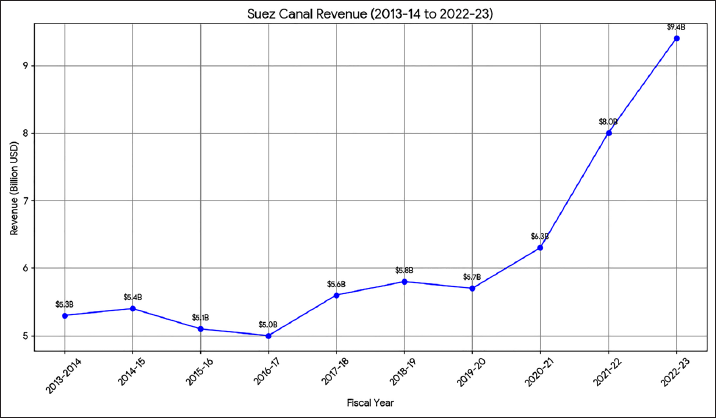
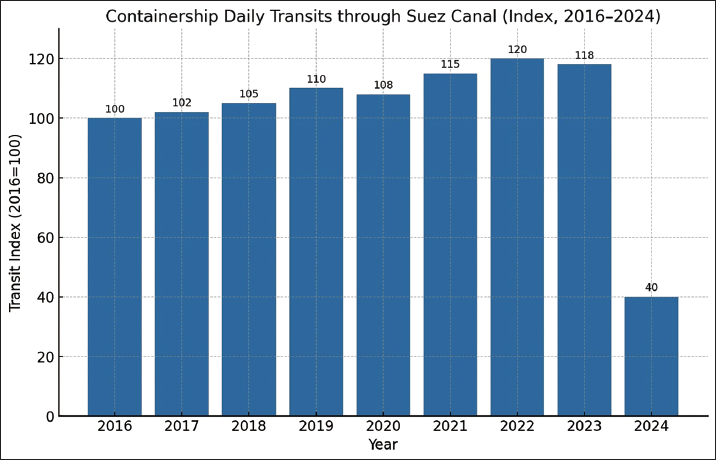
Amidst growing fear of a protracted conflict and continued evasion of the Suez Canal route by thousands of ships, the one country that bore the real brunt is Egypt, for which the Suez Canal revenues are a major source not for its state treasure but a source of hard currency as well to maintain its balance of payment. Only between the last two weeks of December 2023 and the first week of January 2024, the average crossing of the ships through the Suez Canal declined by 60%, while the Cape of Good Hope witnessed a surge of 70% (Nightingale, 2024). In the first few months of the Houthis’ attacks, there was a 55% weekly decline in shipments through the Suez Canal, and nearly 22,000 ships evaded the Red Sea route (Ozdemir & Ece, 2025). In the fiscal year 2022–2023, Egypt received $9.4 billion in revenue from the Suez Canal, but the SCA reported a 40% decline in Suez Canal revenues in the first two weeks of 2024 (Reuters, 2024). The article has four subsequent sections that briefly focus on the significance of the Suez Canal for global trade, explain how the current crisis has exacerbated Egypt’s economic woes, and, finally, discuss the Suez Canal’s expansion and Egypt’s refusal to join the anti-Houthi naval operation.
International Maritime Trade and Significance of the Suez Canal
Throughout history, seas have served as an indispensable means for global trade and transportation. History is replete with accounts, anecdotes, and folktales that narrate humanity’s efforts to connect rivers, seas, and canals to reduce distances for the benefit of traders, marchers, invaders, and explorers. Today, around 90% of global trade occurs by sea, and the shipping industry employs around 1.8 million workers worldwide (United Nations Trade & Development, 2025). During the peak of Western colonization of the Arab world in the nineteenth century, the Suez Canal was one of the largest projects, built to reduce the shipping distance between the East and the West by connecting the Red Sea to the Mediterranean.
The first reference to the idea of digging a canal between the two seas dates to 1504, when it was discussed between the Mamluk Sultan of Egypt and the Venetian Council of Ten (Marlowe, 1964). Napoleon Bonaparte, too, had attempted in 1799 to create a shorter route between the two major seas, but he failed due to the erstwhile geopolitical rivalry (Elvazaghan, 2021). The last successful attempt was made during the reign of Khedive Ismail in Egypt by a career French diplomat and an architect of great repute, Ferdinand de Lesseps, who established a Suez Universal Company in 1858 (Marlowe, 1964). It took almost a decade to complete the project, and it was inaugurated on November 17, 1869. The Suez Canal is an artificial canal that remains the fastest and most direct maritime trade link between Asia and Europe (New Zealand Foreign Affairs and Trade, 2021). The Suez Canal provides a valuable shortcut for ships traveling between ports in the Red Sea, the Persian Gulf, the Arabian Sea, the Bay of Bengal, Southeast Asia, and the Far East (United Nations, 1973).
The Suez Canal was, of course, an economic project, but over time it morphed into an epicenter of geopolitical contestation and external intervention. The story of the nationalization of the Suez Canal in 1956 during the reign of Gamal Abdel Nasser (Watt, 1956) is well documented in history. In the words of Hugh J. Schonfield, “It is one of the great tragedies of history that a work [Suez Canal] designed in the interest of peaceful commerce between East and West should have become so involved in the intentional rivalry” (Maity, 1956, p. 1). Since its nationalization, the Suez Canal has been closed five times, and the last time it happened was during the 1967 Israel–Egypt war. The Canal was finally opened for international navigation on June 5, 1975 (DW Arabic, 2014).
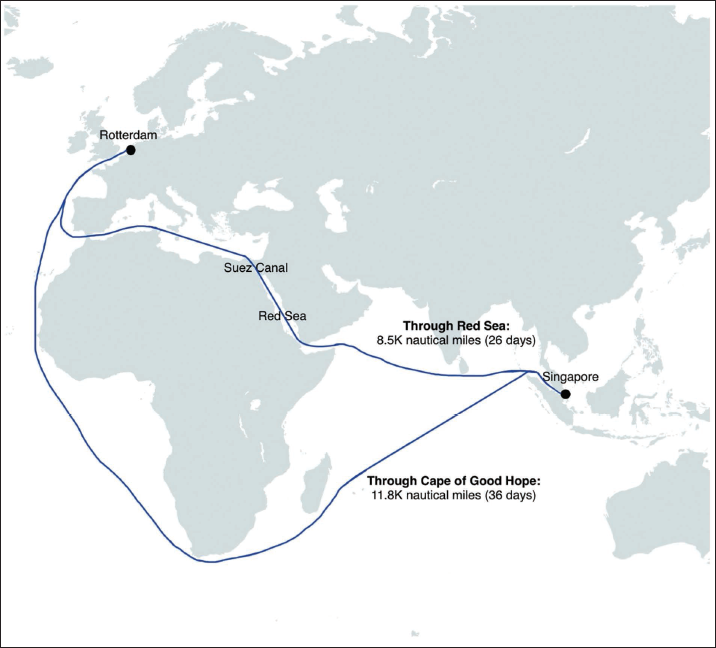
The construction of the Suez Canal helped escape the hazardous route of the Cape of Good Hope, which, before the Suez Canal, was the only viable route for Asian goods to travel across the continent (Elvazaghan, 2021). The Suez Canal provides the shortest and fastest route between Europe and Asia, saving about 5,500 nautical miles in shipping distance between the North Atlantic and the Northern Indian Ocean. It has reduced the sea trade route between Asia and Europe by 7,000 km, thereby strengthening global economic interdependence (Ahram Online, 2025). To cite an example here, if a container originating at a port in Singapore to reach the Rotterdam port in Holland, the voyage would need to cover around 8,500 nautical miles while using the passage of the Suez Canal; the voyage using the Cape of Good Hope would cover around 11,800 nautical miles and the difference can mean a ship passing through the Cape of Good Hope will have to sail for additional ten days (Brigham, 2021).
Around 12% of global sea trade passes through the Suez Canal (International Trade Administration [ITA], 2024), and approximately 20,000 ships enter the Canal each year (Seker, 2024). The Suez Canal is a critical route for shipping, as 30% of global container traffic traverses it (Al-Riffai, 2024), and 12% of seaborne oil and 8% of LNG transit through it (Berman, 2024). Two-thirds of the crude oil coming from the Gulf region transits the same route (Murray & Longley, 2023). Since the nationalization of the Canal in 1956, around 1.07 million ships have passed through it, with a total tonnage of 31.6 billion tons, generating $143 billion in revenue for Egypt’s public treasury (Zayed, 2025). In the last quarter century, container ship capacity has quadrupled, reaching 220,000 TEU, and ship sizes have grown so rapidly that existing infrastructure has struggled to keep up with the increasing traffic (New Zealand Foreign Affairs and Trade, 2021). This is not the first time the Red Sea and Suez Canal routes have been threatened and made so vulnerable. Amid growing fears of an imminent US–Iran war in mid-2019, many freight companies opted for an alternative route as a preventive measure (Raydan, 2023). Similarly, in 2018, the Houthis attacked several ships in the Red Sea belonging to those countries allied with Saudi Arabia in its anti-Houthi war.
The Suez Canal Disruption and Egypt’s Growing Economic Woes
Though the economies of many countries, along with the insurance ventures and the shipping houses, have incurred huge losses because of the ongoing Houthis attacks in the Red Sea. The story of Egypt is quite different because the Suez Canal revenue, along with foreign remittances and tourism, constitutes the principal source of the national GDP. Egypt was the first country to suffer economically because of the onset of the Houthi military operation in the Red Sea and the subsequent diversion of hundreds of ships. This unforeseeable crisis hit Egypt at a time when its economy was on the path to recovery after severe setbacks from COVID-19 and the Russia–Ukraine war. In the fiscal year 2022–2023, tourism revenue increased to a record 26.8%, while the net inflow of foreign direct investment (FDI) reached $10 billion, up from $8.9 billion the previous year (Ahram Online, 2023). During the same period, the Suez Canal transit fee reached a record of $9.4 billion. Before tensions escalated in the Red Sea, around 50 ships used to traverse the Suez Canal every day, carrying around $39 billion in cargo (Yacoubian, 2023), but that figure has been declining.
However, the diversion of most of the shipment has reversed Egypt’s economic resurgence. Due to increasing restrictions on ship passage through the Suez Canal, transit fees declined by 40% in the first two weeks of 2024, compared with the corresponding period in 2023 (Reuters, 2024). In December, the total number of ships traversing the Suez Canal fell to 210, down from 330 in November 2023 (Ahram Online, 2023b). This declining graph itself was an early warning for the country, which was trying hard to narrow its fiscal deficit to $17 billion by 2026 (Ahram Online, 2023b). In January 2024, Egypt lost around 40% of its Suez Canal revenue compared to the corresponding month in 2023 (Amin, 2024). In February 2024, President Abdel Fattah el-Sisi said in an official statement that Suez Canal revenue declined by 40%–50%, while in the last fiscal year, the Suez Canal yielded $9.3 billion in revenue (The Times of Israel, 2024). In April 2024, revenue from the Suez Canal fell by 36.5% compared to April 2023, when it earned $904.5 million (Iqtesad-al-Yuom, 2024).
It is worth recalling that Egypt faced a similar crisis when its earnings from the Suez Canal were severely affected by piracy on the Somali coast at its peak. Egypt reportedly suffered an 8.4% loss in fiscal year 2008–2009, declining to $4.7 billion from $5.2 billion in 2007–2008, and a further 4.3% decline in fiscal year 2009–2010 (Matasaddaq-al-Sh, 2023). In 2024, Suez Canal revenue declined by 61% from 2023, with the SCA earning only $3.991 million, compared with $10.25 billion in 2023. In 2023, the number of ships crossing the Suez Canal was 26,434, while in 2024, this number came down to 13,213 (Bawabatii, 2025). There was a 42% decline in monthly traffic through the Suez Canal in the first half of February 2024, and container tonnage transiting the Canal fell by 82% compared to the corresponding period of 2023 (The Economic Times, 2024). Amid rising tensions in the Red Sea, the passage of container ships through the Suez Canal was more affected than that of bulk cargo or tankers, and there was a 42% decrease in the number of capsize ships passing through the Suez Canal in 2024 compared to 2023 (Ozdemir & Ece, 2025).
Because of route diversions, the Suez Canal lost $7.2 billion in fiscal year 2023–2024, ending in June, 23.5% less than the previous fiscal year, as reported by the managing director and the SCA chairman, Osama Mounier Mohamed Rabie. Between January 1, 2024, and January 11, 2024, the Suez Canal experienced a 30% decline in its tariff compared to 2023, and the number of vessels traversing it fell from 777 to 544 (Asharq Al-Awsat, 2024). In the first two months of 2024, shipments through the Suez Canal fell by 50%, while shipments through the Cape of Good Hope doubled during the same period (Kamali et al., 2024). Only between December 15, 2023, and January 9, 2024, Egypt suffered a loss of $175 to 350 million in transit fees, as documented by the SCA (Notteboom et al., 2024). Before the escalation in the Red Sea, around 50 ships were passing through the Suez Canal every day, but the figure declined to 32, resulting in a 60% drop in revenue soon after the opening of a new war front there (Ozdemir & Ece, 2025). The trend of declining passage through the Suez Canal continued, and in the first two months of 2025, it decreased by 50% compared with the same period last year (Ozdemir & Ece, 2025).
The Suez Canal is one of the country’s major sources of hard currency, and in fiscal year 2022–2023, it accounted for 10% of total state revenue (United Nations Development Programme [UNDP], 2024). However, the escalation in the Red Sea continues to pose a major economic challenge for Egypt, as the crisis has deprived it of its main source of revenue. Earlier, revenue from the Suez Canal used to bring in $30–$35 million per day to the state treasury (Ozdemir & Ece, 2025). President Sisi, on March 17, 2025, stated that Egypt is losing $800 million in monthly revenue since the Red Sea became a battleground. Earlier in September 2024, President Sisi, in a meeting with SCA chairman and managing director, Osama Mounier Mohamed Rabie, announced that Egypt had already lost $7 billion in 2024, representing a 60% decline in Suez Canal revenues (Ahram Online, 2024). The conflict in the Red Sea continues to drive ships toward the Cape of Good Hope, costing Egypt heavily, as the year 2024 witnessed a 76.1% decline in the number of ships passing through the Suez Canal compared to 2023 (Ozdemir & Ece, 2025). Writing in a British Maritime Publication, Lloyd’s List, Egyptians Minister of Foreign Affairs, Emigration and Foreign Expatriate, Badr Abdellaty, noted that Egypt was the most severely impacted country in the region since the Red Sea crisis triggered, losing approximately worth $800 million of revenue every month with a total aggregate amount of $8 billion since the beginning of Israel–Gaza war (Abdellaty, 2025). Given the extent and scale of the economic losses incurred by Egypt, one is reminded of the Ever Given ship accident in the Suez Canal in March 2021, when global trade suffered losses of around $10 billion (Das, 2021). It is worth mentioning here that the Houthi attack in the Red Sea is not only forcing the commercial fleets, tankers, vessels, and merchant ships to divert their routes, but it is also imposing a harsh condition on cruise ships, which are also forced to take the longer route to shield themselves against the Houthi attacks (Haha, 2024).
The Hamas–Israel ceasefire signed in January 2025 was followed by a brief period of peace, during which shipping activity surged. Between January and March 2025, shipping through the Suez Canal increased by 2.4%, and 7.1% more cargoes passed through the Canal. Total revenue increased by 8.8%, and in February 2025, 264 ships were rerouted from the Cape of Good Hope to the Suez Canal amid hopes of stability in the Red Sea (Bawabatii, 2025). Still, it dropped again after following the collapse of the ceasefire agreement in March 2025 and the resumption of war by the Houthis.
To encourage the shipping industries to return to the Suez Canal, the Egyptian government opened direct channels with the major shipping companies, and in mid-May 2025, the SCA chairman spoke directly with the heads of many shipping companies and informed them about additional logistical and navigational services being provided to the global shipping companies (News Plus, 2025). Meanwhile, the SCA announced it would offer a 15% discount on transit fees for container ships with a net tonnage of 130,000 tons or more for 90 days. This announcement came only after the Houthis and the US agreed on a ceasefire (Ahram Online, 2025). It is worth recalling that, given the declining number of ships in the Suez Canal, the Egyptian government, in October 2023, had decided to hike the transit fee by 15% for selected vessels, but later withdrew its proposal (Egypt Today, 2023).
The SCA has no option but to offer these incentives because there was a free fall in the national economic graph after the Houthis began attacking the ships in the Red Sea (Butter, 2024). In an interview, the former Chairman of SCA, Mohab Mamish, said that any vessel that encroaches on the Suez Canal brings dollars into the state treasury, and we need them. He further stated that Egypt needs to increase revenue from the Suez Canal to meet the country’s growing hard-currency needs (Matasaddaq-al-Sh, 2023). The International Monetary Fund (IMF) revealed in November 2024 that Egypt had lost 70% of its Suez Canal revenue since the Red Sea emerged as a new theatre of war. An IMF statement noted that, because of the ongoing multi-layered geopolitical tensions in the region, the economic outlook for the region in general and Egypt in particular remains challenging (Al-Mauqa Post, 2024). It is not only the IMF that expressed its concern over growing incidents of attacks in the Red Sea, but the Secretary General of the International Maritime Organization, Arsenio Dominguez, too condemned the Houthis for targeting the ships and putting the lives of seafarers in danger, and called it a threat to international stability (Al-Mauqa Post, 2024).
Egypt is caught in the vortex of the economic crisis, as its economy faces mounting difficulties in the wake of the COVID-19 pandemic and the Ukraine–Russia war, and is trying to revive itself. In fiscal year 2022–2023 and before the outbreak of the Israel–Gaza war, Egypt was able to turn its $10.5 billion deficit of fiscal year 2021–2022 into a surplus of $882 million in fiscal year 2022–2023, because of the hefty rise in the Suez Canal revenues and tourism earnings (Ahram Online, 2023). The Russia–Ukraine war affected Egypt particularly because of rising global grain prices, as Egypt is one of the most populous countries and the world’s largest wheat importer. It receives around 80% of its wheat from Russia and Ukraine (Financial Times, 2022). Egypt’s own supply chain (fuel, food, and other intermediate goods) is also affected because of the current crisis. The months preceding the Houthi attacks, Egypt also witnessed a drastic decline in remittances; the first quarter of FY 2022–2023 saw a 30% decline in foreign remittances, and inflation was 33.7% in December 2023 (Choukeir & Awadallah, 2024). The Egyptian economy is not hit only by the diversion of the global trade route but also by the suspension of its gas exports to European countries. It happened following the closure of Israel’s Tamar offshore gas field, which supplies LNG to Egypt, which it later exported to European countries (El Wardany et al., 2023). In the wake of the Russia–Ukraine war, Egypt’s gas exports to Europe have experienced a new boom, with 80% of its LNG exports going to Europe alone (Kamal & Mostafa, 2025).
Egypt has been trapped in a severe economic crisis due to declining revenue from the Suez Canal, while its people are suffering on many fronts. For the first time since 1989, Egypt was forced to raise bread prices in 2024, from 5 piastres per loaf to 20 piastres per loaf, an almost fourfold increase (Jovanovic & Glauber, 2024). Bread prices have always been a sensitive issue in Egyptian politics, and the people are still haunted by the bitter memory of the Bread Riot of 1977 under President Sadat. The main slogan of the 2011 Arab Uprising in Egypt was “Bread, Freedom and Justice” (Jovanovic & Glauber, 2024). Apart from the rise in bread prices, the country has been experiencing high inflation (30%–40%) over the years, which is also adding to the economic woes of the common Egyptian. Oil production has dropped to the lowest level in four decades. The decline has forced the regime to strike deals with giants like Shell and TotalEnergies to import LNG, which would place an additional burden on foreign reserves (Watan, 2025). Only amidst the Houthi attack on the Red Sea and its impact on Suez Canal revenue, the government decided to increase the electricity bill by 50%, and this was done under the IMF-led scheme to stabilize the national economy (Akram, 2026).
Suez Canal’s Expansion Plan and Current Crisis
Since the Suez Canal is a major source of revenue for Egypt, every government has sought to expand its viability to enhance revenue, but has failed to do so in the past. However, of late, the Suez Canal’s infrastructure has been failing to accommodate the growing volume of maritime traffic and trade. Hence, the government decided to pursue a canal-widening project in 2014, spending around $8.2 billion. The expansion work was completed in record time, and the expanded Suez Canal was inaugurated on August 6, 2015 (Al-Tasdeer-al-Youm, 2025). In December 2024, a 10-km expansion test was also completed at the southern tip of the Canal, increasing the length of the two-way section to 82 km and creating room for an additional 8–9 ships to pass through the Canal.
Under the expansion project, Canal’s total length increased from 164 to 193 km, its depth from 7.5 to 24 m, and its daily throughput capacity from 77 to 97 (Zayed, 2025). The expansion project also included digging a 35-km parallel waterway, along with widening and deepening the existing Canal to convert one-way traffic to two-way traffic (Marawen, 2025). The parallel water lane reduced the shipment’s waiting period from 8 to 11 to 3 h and reduced the transit time from 18 to 11 h. It was speculated that the expansion would eventually increase revenue by 259% (Al-Tasdeer-al-Youm, 2025). The expansion of the Suez Canal significantly increased revenue, with total revenue rising to $9.4 billion in 2023 from $5.3 billion since the inauguration of the expanded Canal in 2015 (Marawen, 2025).
During the same period, the number of tons passing through the Canal increased by 66.7%. In 2013–2014, the total tonnage passing through the Canal did not exceed 0.9 billion tons, whereas in 2022–2023, it increased to 1.5 billion tons (Zayed, 2025). Between 2014 and 2023, the number of ships transiting the Suez Canal also increased by 55.1%, reaching 25,900 in 2022–2023 from 16,700 in 2013–2014, the highest so far in the Canal’s history. In January 2023, the world’s largest floating library, with 800,000 books, “Logo Hope,” passed through the expanded Suez Canal (Zayed, 2025).
However, all the gains achieved through the expansion of the Suez Canal suffered a major setback in the wake of the Israel–Gaza war, making the Red Sea and the Suez Canal a vulnerable passage. The conflict in the Red Sea would, no doubt, reverse the success story of the expanded Suez Canal. The traffic of vessels in the Suez Canal fell by 50% between 2023 and 2024, and revenues also declined from over $10.25 billion in 2023 to $3.9991 in 2024 (Akhbar-al-Youm, 2025a)
Operation Prosperity Guardian and Egypt’s Skepticism
Yemen is in a critical geographical region that includes major sea lanes and chokepoints, connecting the Indian Ocean and the Persian Gulf to the Suez Canal and the Mediterranean Sea (Kuehn, 2024). The Houthis have exploited the strategic location of Yemen to destabilize the region’s security and stability. Not long ago, they had targeted the Gulf countries with missiles and drones and created a new war zone in the Red Sea. It is worth mentioning here that the Biden Administration had removed the Houthis from the US list of officially designated terrorists in 2021, which could have bolstered the Houthis’ morale (Al-Sayed, 2023)
The US took no time in accusing Iran of abetting the Houthis’ military operation in the Red Sea. To secure the passage for shipment through the Bab al-Mandab Strait and deter the Houthis from attacking the sailing ships, erstwhile US Defense Secretary Lloyd Austin, on November 19, 2023, announced the formation of a military coalition, “Operation Prosperity Guardian.” It was also announced that the coalition would operate under the existing mechanism, “Combined Maritime Forces,” a counter-piracy and counter-terrorism naval operation. The US moved its aircraft carrier, USS Dwight D. Eisenhower (CVN-69), CSG, from the Persian Gulf to the Gulf of Aden to assist the operation (Manohar Parrikar Institute for Defence Studies and Analyses [MP-IDSA], 2024). The coalition, under US stewardship, launched its first major strike against the Houthis on December 18, 2023 (MP-IDSA, 2024).
The response of the Red Sea countries to the conflict involving the Houthis has been marked by extra caution, and they have tread very carefully. Contrary to the US’s policy of direct military action, the countries around the Red Sea preferred a more restrained approach through diplomacy and expressed their disapproval of a full-blown war. Many European nations joined the coalition, while some preferred to participate either partially or make a token participation (Donegan, 2024). Amid the dilemma of diplomacy versus coercion among many regional countries, what proved inexplicable was Egypt’s absence from the coalition. One finds it difficult to explain Egypt’s unwillingness, given its loss of billions of dollars in revenue and the unprecedented challenges it faces in the Red Sea (Maher & Farid, 2024). During the Yom Kippur War (1973), Egypt had no hesitation in blocking the southern end of the Red Sea near the Bab al-Mandab, and today its stance is marked by a conspicuous silence. Egypt has the longest coastline on the Red Sea, which runs for 1,941 km, and in March 2025, dozens of doctors and health workers were injured when a massive missile fired by Houthis fell in the southern Sinai (The Jerusalem Post, 2025)
The most obvious reason for Egypt’s reluctance to join the coalition seems to evade the allegation of siding with Israel or its allies in the Gaza war. Egypt seems so conscious of this fact that, in a March 2025 statement from the president’s office, the term “Houthis” was avoided when discussing the Red Sea crisis (Taminwamasaref, 2025). In a rare remark about Houthis, Egypt only asked the Houthis to attack the Israeli ships and let other ships pass through (Al-Ayyam, 2024)
Further, Egypt seems more eager to end the war in Gaza instead of opening a new front against the Houthis. Despite being a close ally of Saudi Arabia, it had not joined the latter’s anti-Houthi coalition and had deployed only its ships to secure the free passage of vessels in the Red Sea (Maher & Farid, 2024). Any participation in the current US-led war could antagonize the Kingdom of Saudi Arabia, which Egypt would never want, given its significant economic stakes in the kingdom. Further, Egypt views the US and its European allies as militarily able to subdue the Houthis. However, its poor economy prevents it from joining the coalition, while it is already involved in a semi-war-like situation with Libya and Sudan (Ozdemir & Ece, 2025).
The bitter memory of involvement in the Yemeni civil war against King Faisal’s Saudi Arabia in the 1960s could have had its own diplomatic and strategic restraints on Egypt and prevented it from taking a disastrous move. It is worth recalling here that in its war with the kingdom to remove a theocratic regime in northern Yemen against the wishes of the former, Egypt suffered a heavy loss, which significantly contributed to its 1967 defeat against Israel. Further, Egypt is aware that any involvement by regional countries could drag the region into another war, while the whole region is already on the brink of a new abyss.
No countries from the southern Red Sea region joined the coalition, except Bahrain, which is home to the US Fifth Fleet (Ozdemir & Ece, 2025). Any form of involvement in the anti-Houthis war could also erode the credibility of Egypt as an honest broker, which Egypt, along with the US and Qatar, has been acting as since the Israel–Gaza war broke out. Egypt knows that tensions will persist soon, and any association with the coalition would yield no political, strategic, or diplomatic dividends for the country and would instead engender more enemies (Figures 1–3).
However, Egypt’s skepticism should not be defined through the prism of its naval weakness. Egypt recently deployed its Southern Fleet to protect its interests in the southern Red Sea, and in 2022, Egypt commanded Combined Task Force 153, formed to enable the free passage of ships in the Red Sea. Today, the Egyptian Navy has 150 fleets at its disposal, and according to the latest report of Global Firepower, Egypt holds the 22nd rank when it comes to global naval strength (Global Firepower, 2025)
Conclusion
Several factors determine the extent of the harm to Suez Canal’s revenues, but the most important is how long the Israel–Hamas war lasts. Houthi operations in the Red Sea have continued, and the ability of various naval forces to ensure the safe passage of ships in the Red Sea remains unclear. As noted, there is no indication of an early end to the war, and instead, the war’s scope has only expanded with the US–Israel attack on Iran in February 2026 and the Iranian retaliation on the Gulf states. Meanwhile, Israel and the Houthis have entered a war-like situation with regular air raids and missile attacks. Israeli forces have bombarded the hideouts of the Houthis and civilian areas in the capital city of Sana’a. The Houthis have vowed to avenge every Israeli action by targeting Israeli cities and ships in the Red Sea. In the given situation, the chance of peace and stability seems unfathomable. The Red Sea is likely to remain a theatre of war, and the existing volatility and vulnerability would pose a major challenge to navigation through the Bab al-Mandab and the Suez Canal.
The tension in the Red Sea has adversely affected the Egyptian economy, as Suez Canal revenue is linked to stability and peace in the Red Sea, which remain elusive. Though European naval forces have launched a series of operations and other countries have deployed their navies to secure safe passage, these efforts have failed to alter the situation, and evasion of the Red Sea routes has continued. Though the Houthis have agreed to a ceasefire with the US, their attacks in the Red Sea are likely to expand soon because of their committed support for Hamas and their linkages with Iran. The Egyptian economy has suffered from the disruption, and any improvement in Suez Canal revenue is contingent on the return of peace in the Red Sea. If the war in the Middle East continues for long, it might reignite conflicts that could further deepen Egypt’s economic crisis, as its canal ports are a significant source of national revenue. It is not only Egypt, but the global community too has suffered due to the disruptions caused in the Red Sea, especially as it comes on the heels of the COVID-19 pandemic and the Russia–Ukraine war.
Footnotes
Declaration of Conflicting Interests
The author declared no potential conflicts of interest with respect to the research, authorship, and/or publication of this article.
Funding
The author received no financial support for the research, authorship, and/or publication of this article.
