






Abstract
Nowadays, food security constitutes one of the greatest challenges for the Abraham Accords Countries (AACs) (Israel, the United Arab Emirates, Bahrain, Morocco, and Kazakhstan), which face multiple dimensions of a food security crisis. This article analyzes the agricultural and food-related assets of these countries and highlights the major policies and strategies they are pursuing to address food security issues. It also examines the main challenges these countries experience in ensuring food security and explores the forms and aspects of food security cooperation between Israel and the other four signatory countries following the Abraham Accords. The article concludes by suggesting that a common food security policy, like the European Agricultural Policy, should be established to strengthen food security partnerships among the AACs and, consequently, promote regional integration in the Middle East and North Africa.
Introduction
In 2020, three Arab countries established diplomatic relations with Israel under the auspices of the USA: The United Arab Emirates (UAE), Bahrain, and Morocco. These agreements have opened a new chapter of promising cooperation across multiple sectors for the signatory countries. Food security 1 is undoubtedly one of the most important issues addressed in the Abraham Accords, given that the Middle East and North Africa (MENA) region, to which all these countries belong, faces a critical situation in terms of food and agriculture. In November 2025, the Abraham Accords were extended to include Kazakhstan, a Central Asian country and a former member of the Soviet Union. Like the MENA region, Central Asia constitutes another geographical space characterized by specific complexities and vulnerabilities regarding food security issues. It is therefore expected that the Abraham Accords Countries (AACs) coordinate their policies and strategies to address food security challenges and become a real model of leadership, innovation, and regional cooperation in this area. This article begins with a general outline of the food security situation in the AACs and then proceeds to highlight measures and policies that could bolster their food security resilience.
State of Food Security in the Abraham Accords Countries
United Arab Emirates
The UAE ranked 23rd in terms of food security according to the Global Food Security Index (GFSI) 2 in 2022. It is thus ranked higher than all MENA countries and, more specifically, the AACs. This ranking is the result of food security policies established by the UAE authorities, inspired by the saying “Give me agriculture, and I will give you civilization in return.” 3 The most recent policy adopted in this regard is the National Food Security Strategy 2051, which aims to position the UAE as the top-ranked country in the GFSI by the year 2051.
These policies are grounded in technological innovation as a key pillar for ensuring food security. Consequently, substantial investments have been mobilized to develop aquaponics and hydroponics, as these systems are well adapted to the UAE’s harsh natural conditions. Vertical farming constitutes another agricultural policy instrument that the Emirati authorities are developing to address food security and environmental issues. Through the efficient use of land and water, these innovative agricultural practices contribute to increasing growth in food production and processing.
In addition to the technological dimension of its food security policies, the UAE also resorts to external food security investments. It acquires agricultural land in several foreign countries to outsource food production and secure its food supply. Numerous African, Asian, and American countries have become major destinations for Emirati investment in agriculture and food security.
The Emirati food security strategy also includes a strong logistical dimension. The UAE has invested heavily in the construction and expansion of maritime ports to position itself as a regional trade hub. Since food security and transport infrastructure are closely interconnected, the UAE’s strategy is based on securing control over the logistics sector to ensure access to food commodities. With a network of 12 commercial trading ports, including Jebel Ali Port and Khalifa Port, the country possesses a highly efficient logistical instrument for enhancing food security. Accordingly, it can be argued that the UAE’s food security strategy is, at its core, a logistical strategy.
Food security policies in the UAE are centered on promoting cooperation and partnerships with countries that are leaders in agriculture and food security. In this context, the Abraham Accords have ushered in a new era, as the UAE has signed three agreements with Israel. In July 2021, Mariam Hareb Almheiri, the Emirati Minister of State for Food Security, signed the first memorandum of understanding on food security and agricultural research and innovation with Israel’s Minister of Agriculture, Oded Forer, in Tel Aviv. The Ministry of Climate Change and Environment subsequently signed a second memorandum of understanding on agriculture with Israel’s Ministry of Agriculture and Rural Development in Dubai in March 2022. Furthermore, the UAE–Israel Comprehensive Economic Partnership Agreement (CEPA), signed on May 31, 2022, in Dubai, marks a new stage in food security cooperation between the two countries. By aiming to remove or reduce tariffs on 96% of traded goods, the CEPA is expected to strengthen food security in the UAE considerably. These developments indicate greatly that the UAE and Israel are pursuing a long-term partnership that goes beyond short-tactical considerations (Vakil & Quilliam, 2023, p. 49).
Despite extensive public policy efforts, the UAE continues to face enormous obstacles and struggles with managing its food supply. The country imports more than 90% of its food and is thereby highly vulnerable to global crises, such as the COVID-19 pandemic and the war in Ukraine. It primarily imports wheat, rice, corn, and barley, with various suppliers including the European Union, Canada, India, Australia, Argentina, Ukraine, Pakistan, Thailand, and the USA. This indicates that the UAE’s food security is highly dependent on international trade flows, particularly on a limited group of exporting countries.
Besides its heavy reliance on imports, food security in the UAE is challenged by water scarcity, limited arable land, and, more broadly, the effects of climate change. Consequently, temperatures reach between 48°C and 50°C in many parts of the country, while average humidity rises to up to 60% in coastal cities. Additionally, three cyclones affected the Arabian Peninsula, to which the UAE belongs, between 1977 and 2018 (Ministry of Climate Change and Environment [MCCE], 2019, p. 10). Climate change is therefore a pressing risk to food security in the country.
Bahrain
Bahrain launched its Economic Vision 2030 in 2008 as a comprehensive framework for economic development, based on the principles of sustainability, competitiveness, and fairness. Two years later, in the wake of this vision, the National Initiative for Agricultural Development was established with the aim of strengthening the role of the agricultural sector at the economic, social, and environmental levels. The initiative thus seeks to increase employment, preserve water, land, and natural resources, and enhance national food security. Driven by the constant desire to strengthen its food production capacity and build greater self-reliance, Bahrain has launched its National Strategy of Food Security (2020–2030), which is built around two fundamental objectives: (a) enhancing local production and (b) reducing dependence on food imports. To achieve these goals, the strategy includes allocating public financial resources to food security projects and promoting bank initiatives and partnerships with international organizations and neighboring countries. Encouraging foreign acquisitions is another key pillar of the strategy, given the country’s small size. In doing so, Bahrain aims to protect itself against the volatility of the international food market and feed its population primarily through local resources.
To become an AAC, Bahrain signed a Joint Communiqué with Israel on October 18, 2020, establishing diplomatic, peaceful, and friendly relations. Meanwhile, they also signed seven Memorandums of Understanding covering various sectors. One of these agreements concerns agriculture and was signed by the Ministry of Works, Municipalities Affairs, and Urban Planning of the Kingdom of Bahrain and the Ministry of Agriculture and Rural Development of the State of Israel. In January 2021, the Bahraini authorities granted Israel approval to export fresh agricultural produce and propagation materials to Bahraini territory. This represented an important step in the process of consolidating agricultural cooperation between the two countries. At the International Summit on Food Technologies from the Dead Sea and Desert, held in October 2022 in Eilat, a Joint Declaration on Cooperation in the Field of Agriculture was signed by Oded Forer, the Israeli Minister of Agriculture, and Wael Bin Nasser Al Mubarak, his Bahraini counterpart. This agreement focuses on the sharing of knowledge and modern technology, as well as food security. It thus appears that partnership with Israel is a key component in Bahrain’s strategy to ensure its food security.
As a result of the strategies implemented, food security levels in Bahrain have improved in a meaningful way, with the country moving from the 49th position in 2020 to the 38th position in 2022, according to the GFSI. But despite Bahrain’s progress in the international food security rankings, it is important to note that the country faces many constraints in the field of food security. Although its agricultural production consumes 29% of the available water, it constitutes less than 1% of gross domestic product (GDP) (Government of Bahrain and United Nations, 2021, p. 8). It also does not meet the country’s food needs, relying heavily on global imports to ensure food security. Approximately 90% of food is imported, including rice, wheat, meat, dairy products, vegetables, and fruits. Domestically, climate change poses a substantial threat to both available water resources and domestic food production efforts.
Morocco
In the years following the country’s independence, public policy in the agricultural sector—known as the dam policy—was characterized by extensive but selective state intervention. Public authorities concentrated resources primarily on irrigated areas. In the 1980s, Morocco embarked on a structural adjustment phase, with the main objective of gradually disengaging the state from the public sector. As a result, public spending on agriculture was greatly reduced. During the 1990s, agricultural policy entered a new period characterized by Morocco’s commitment to liberalizing agricultural trade, as evidenced by the numerous free trade agreements (FTAs) concluded with various countries.
During the period 2008–2020, Morocco adopted a new agricultural strategy, the Green Morocco Plan, aimed at modernizing and upgrading the agricultural sector. Agricultural and food-related issues are currently addressed through a new policy adopted in 2020, Generation Green (2020–2030). This strategy seeks to create a new agricultural middle class and further modernize the sector, particularly considering international crises—such as the COVID-19 pandemic and the war in Ukraine—which exposed the country’s food vulnerability.
Regarding the Abraham Accords, the Joint Declaration signed on December 22, 2020, through which Morocco and Israel established full diplomatic relations, identifies water, food security, and agriculture as key fields of bilateral cooperation. This commitment was further cemented by the signing of a memorandum of understanding between the two countries in Marrakech in September 2023. The Moroccan Minister of Agriculture, Mohamed Sadiki, and his Israeli counterpart, Avraham Moshe Dichter, agreed to establish an agricultural project in aquaponics and to strengthen cooperation through the exchange of knowledge and expertise, particularly in wheat cultivation and the water sector.
Scientific cooperation between Israeli and Moroccan agricultural institutes and universities is also a key component of the implementation of the agri-food dimension of the Abraham Accords. For example, Mohammed VI Polytechnic University has signed several research and academic cooperation agreements in agriculture and sustainable development with Israeli academic institutions. Additionally, Israeli companies such as Supplant and Mehadrin have launched agricultural and water-related projects in Morocco. Morocco–Israel trade further reinforces this partnership, with food products playing a central role.
While the UAE and Bahrain rank 23rd and 38th, respectively, in GFSI, Morocco was placed 57th in 2022. However, food security in Morocco remains a matter of concern, despite more than 50 years of public policy efforts in this field, as the country continues to face multiple structural constraints. One of the most pronounced of these constraints is the gap between the two segments of Moroccan agriculture: The traditional sector and the modern sector. While the former is characterized by fragile rain-fed agriculture and faces poverty, underemployment, and numerous social difficulties that limit development, the latter is distinguished by modern equipment, infrastructure, and advanced mechanization.
It should also be noted that Morocco has experienced successive waves of severe drought, which have affected (and continue to affect) the country. Climate change, primarily manifested through declining rainfall and rising temperatures, is clearly constraining agricultural production, preventing it from fully meeting domestic food needs. The continued dominance of cereal crops also deserves attention, as they occupy more than 50% of the country’s arable land. However, cereal production remains highly dependent on climatic conditions and is subject to considerable interannual variability due to rainfall fluctuations. This helps explain why, despite the expansion of cereal-cultivated areas since the late 1980s, productivity gains have remained limited.
Consequently, despite the substantial prominence of cereals within the agricultural sector, domestic production does not satisfy internal consumption requirements, even though cereals constitute the staple of the population’s diet. More broadly, Morocco imports approximately 60% of its cereal and sugar needs and more than 80% of its vegetable oil requirements. Some researchers attribute this food dependency to the agricultural and food policies pursued since the country’s independence, which favored an increasing reliance on the international market (Akesbi, 2013, p. 14).
In contrast to staple food crops, Morocco has achieved strong performance in commercial agriculture, producing and exporting large quantities of watermelons, avocados, and tomatoes. The country has become the world’s 15th largest producer of watermelons and the 22nd largest producer of avocados, while also ranking 18th among global tomato producers. However, this production remains the subject of ongoing debate in Morocco, particularly due to the high-water requirements of these crops in a context of increasing water scarcity.
Kazakhstan
Kazakhstan’s accession to the Abraham Accords in November 2025 is diplomatically the least significant. Kazakhstan has maintained normal relations with Israel since 1992, following its independence from the Soviet Union, and does not belong to the Arab world or the Middle East. Nevertheless, its accession is the most significant when assessed through a food security geopolitical lens, as Kazakhstan possesses specific assets that distinguish it from the other AACs.
Cooperation in agriculture and food security between Kazakhstan and Israel began before the signing of the Abraham Accords. The two countries signed an agreement in this regard in Astana on December 14, 2016. The deal focused on crop and livestock production, agricultural science, water-saving technologies, aquaculture, and other related areas. Following the signing of this agreement, several high-level meetings were organized between Kazakh and Israeli senior officials. For instance, in September 2023, Kazakhstan’s Prime Minister Alikhan Smailov met with Michael Roe, Chairman of the Chamber of Commerce and Industry “Israel–Kazakhstan,” in Kazakhstan to discuss water technologies and food production. On June 12, 2025, Kazakh Ambassador Daulet Yemberdiyev met with Avi Dichter, Israel’s Minister of Agriculture and Food Security, to discuss bilateral cooperation in agriculture, particularly Kazakhstan’s use of Israeli agricultural expertise. It should also be remembered that Kazakhstan is part of the 2022 “Treat the Wheat” project, which is designed to secure Israel’s wheat supply by diversifying its import sources. Alongside other partners such as Uzbekistan, Azerbaijan, Morocco, and Romania, Kazakhstan contributes to Israel’s wheat food security. In return, Israel provides agricultural technologies and expertise to support this cooperation.
To strengthen its food security, Kazakhstan adopted the Concept for the Development of the Agro-Industrial Complex for 2021–2030. This government strategy aims to achieve self-sufficiency in key food products through domestic production, targeting 100% self-sufficiency in producing apples, sausages, cheese and cottage cheese, and poultry meat, and 83% self-sufficiency in producing sugar. Moreover, the Concept seeks to triple labor productivity in agriculture compared to 2020 levels and to increase wheat yields to 20 centners per hectare by 2030.
Notwithstanding its considerable potential, there are important limitations to food security in Kazakhstan. Obviously, the changing climatic situation is the most influential one as it can hinder the achievement of overall agricultural and food system stability. According to the World Bank (World Bank & Asian Development Bank, 2021), climate change is responsible for many severe impacts on agriculture and the natural resources needed for food security. The northern part of the country, where wheat production is concentrated, is experiencing drought with increasing frequency, leading to significant social consequences for farmers in the region. On the other side, reduced precipitation and rising temperatures have led to the depletion of soil moisture, a critical factor for agricultural productivity. Crop yields and pastures were also severely affected by persistent droughts in the country (Ministry of Ecology and Natural Resources of the Republic of Kazakhstan, 2025, p. 13).
In addition, Kazakhstan suffers from a deficit in qualified human resources essential to agricultural development, particularly in fields such as agronomy, engineering, and veterinary sciences. Furthermore, the agricultural sector remains underfinanced, as its share of GDP has declined over the past two decades. (Zhanaltay, 2023, p. 50).
Israel
The establishment of agricultural research and innovation centers forms a solid basis for Israeli food security policies. The Volcani Institute and the Weizmann Institute are among the organizations that have enabled Israel to build its agricultural strength. The former undertook the task of developing agriculture in arid regions, allowing Israel to improve its agricultural production in a context of water scarcity. It was consequently able to develop techniques and processes that are more resilient to extreme climatic conditions. The Weizmann Institute, which focuses on the exact and natural sciences, is today one of the most prestigious research centers in the world. By promoting scientific research in the agricultural sector, the Weizmann Institute has made an outstanding contribution to modernizing Israeli agriculture.
Hence, Israel has established itself as a true technological powerhouse in three areas: Agritech, Foodtech, and Watertech. Thanks to innovative agricultural technologies, techniques, and processes that are more resilient to unfavorable climatic conditions—as well as recognized expertise in irrigation and water desalination—Israel has become an inspiring model for agricultural and food development. In a context of food crises and water shortage, the country is affirming itself as a worldwide agricultural pioneer, capable of using less water despite extreme heat (Fernandez, 2021, p. 208). It is now the second-highest ranked AAC in terms of GFSI, placing 24th in 2022. It is also nearly self-sufficient in vegetables, fruits, poultry, eggs, milk, and dairy products.
As in the other AACs, food security in Israel has its weaknesses. Even though agriculture is a highly developed sector, as reflected in the ongoing expansion of new export commodities (Troen & Fish, 2017, p. 35), the country relies almost entirely on imports for grain, sugar, vegetable oils, oilseeds, and fish. Budget cuts are impacting scientific research, weakening the agricultural sector, and, consequently, food security. Increasingly frequent geopolitical tensions in the MENA region are disrupting supply chains and can limit access to the global food market. It is important to highlight that climate change is an essential factor to consider in Israel, particularly in the coming years, given its location in the Eastern Mediterranean, a region expected to experience severe impacts from climate variability (Kimhi, 2024, p. 14). For instance, the year 2025 can be recalled as a particularly challenging period for Israeli agriculture (The Jerusalem Post, 2025). Annual rainfall fell by 40% compared to the multi-year average, leading to a 60% decline in wheat and barley production in some regions, as well as a 12% increase in fresh fruit and vegetable prices. The Israeli Ministry also stated that the climate crisis, manifested through powerful winds and heatwaves, caused significant damage to crops and plants (Ministry of Agriculture and Food Security, 2024). In response to the growing pressures and threats to its food security, Israel launched its National Food Security Plan 2050 in May 2025. The plan aims to address worsening climate conditions, workforce shortages, and increasing reliance on imported food.
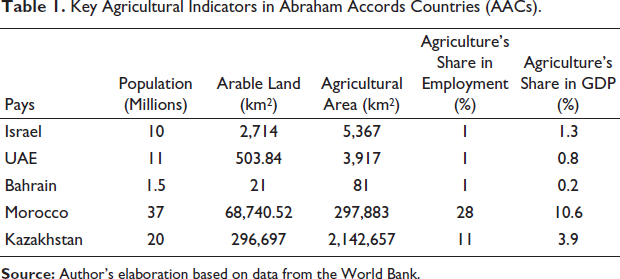
It therefore appears that the AACs face similar deep structural problems in terms of food security. These include climate variability, land and water scarcity, structural dependence on food imports, and regional instability. When confronted with such shared challenges, unilateral or bilateral actions can only produce limited results. By contrast, a coordinated and collaborative approach to food security could strengthen the food system resilience of the AACs and deepen their economic and political ties (Table 1).
Key Agricultural Indicators in Abraham Accords Countries (AACs).
Toward a Common Food Security Policy Among the Abraham Accords Countries
It is true that “signing the agreements is ceremonial, uplifting, and full of joy and optimism” (Ben-Shabbat & Aaronson, 2022, p. 6). In analyzing the Abraham Accords, it is important to consider their evolution and how they can be maintained over time. These accords risk losing their significance if they do not translate into robust regional cooperation to tackle the food security crisis. In the current global context, food security goes far beyond the scope of individual countries and requires appropriate responses formulated within a regional cooperation approach. Indeed, the Abraham Accords do not constitute a comprehensive regional framework (Mațoi & Caba-Maria, 2025, p. 93); however, the urgent need to address the food crisis could serve as their core foundation and foster stronger regional integration. The creation of regional agricultural markets is thus essential as a tool for developing agriculture and ensuring food sovereignty (Alahyane, 2017, p. 175). In this regard, the model of the European Union’s Common Agricultural Policy (CAP) is worth highlighting. Established by the Treaty of Rome in 1957, the CAP introduced a regional approach to agriculture and food security among six European countries: Germany, Belgium, France, Italy, Luxembourg, and the Netherlands. Its objectives were to increase agricultural productivity, ensure a fair standard of living for the agricultural population, stabilize markets, guarantee the security of supply, and ensure reasonable prices for consumers (Ackrill, 2000, p. 30). Thanks to the CAP, the European Union has become a dominant global agri-food power. Its production and export capacities have made it a leading player in worldwide food security.
The AACs could take inspiration from the foundational principles of the CAP to develop coordinated food security strategies. Notably, the five countries possess comparative advantages that can be mobilized to jointly address the challenge of food security. Morocco is an agricultural country par excellence, with the agricultural sector contributing more than 10% to its GDP and providing nearly one-third of employment. The country also has approximately 68,000 km2 of arable land. Moreover, Morocco is the world’s second-largest producer of phosphate, after China. Phosphate, it should be noted, is essential for fertilizer production. The country holds about 70% of the world’s phosphate reserves and produced around 40 million tons in 2022. As for the UAE, it is among the world’s 10 largest oil producers and possesses the sixth-largest proven oil reserves. It also holds considerable proven natural gas reserves, ranking seventh globally. With respect to Bahrain, although it produces much less than its neighbors, its oil and gas resources should not be underestimated, nor should its strategic geographical position. The UAE and Bahrain produce and export fertilizers whose production is based on gas resources, providing a strong boost to agriculture and food production, and can therefore contribute to improving food security in the AACs. Kazakhstan’s contribution would constitute a genuine added value, particularly in wheat production. It is the only AAC that belongs to a “select club of privileged states” (Abis, 2015, p. 135), those capable not only of producing wheat but also of exporting it. In contrast, Israel, Morocco, Bahrain, and the UAE face heavy deficits in this area. Globally, more than 80% of wheat exports are accounted for by only 10 countries, and Kazakhstan is indeed one of them. Israel is the most technologically advanced country in agriculture within the MENA region and among the AACs. Despite its small size and limited natural resources, it has developed an innovative agricultural model that successfully adapts to hard climatic conditions and contributes to global food security. Accordingly, a common food security policy could be considered, based on the following pillars:
Forming a Cartel of Food Essential Commodities
Since the AACs rely on foreign suppliers for staple foods and often require similar products, it would be wise to establish a cartel for the collective purchase of these basic foodstuffs. Unlike cartels that aim to set production quotas—such as the Organization of the Petroleum Exporting Countries for oil—this proposed cartel would focus on coordinating joint purchases of staple foods. The four member countries could negotiate collectively with multiple suppliers by placing combined orders, thereby benefiting from lower prices. Additionally, risks and costs associated with the purchasing process would be shared among the members.
Establishing a Common Strategic Stock of Basic Foodstuffs4
One effective way to promote food security among the AACs is through the creation of a joint strategic food reserve. These countries face diverse yet overlapping climatic, security, and geopolitical tensions that frequently disrupt food supply chains and increase their vulnerability, given their heavy reliance on imports to meet domestic demand. History shows that, during global shocks, agro-exporting powers rarely prioritize the food security of importing nations and may even restrict or ban exports. To counter this threat, the AAC should adopt solidarity-based strategies by developing a shared food stock that can be mobilized whenever one of them faces a severe food emergency.
In this regard, Kazakhstan could play a major role and make a significant contribution. The country is the 13th largest wheat producer in the world, accounting for approximately 2% of global production, and ranks as the 10th largest wheat exporter. It also has 296,697 km2 of arable land. Kazakhstan is a key supplier of food products, particularly cereals, to its neighboring Central Asian countries such as Uzbekistan, Tajikistan, and Kyrgyzstan, as well as to China, Afghanistan, and the European Union. In recent years, it has also explored new markets for its grain exports, including in the UAE and Morocco. Another remarkable point is that Kazakhstan satisfies 80%–100% of its domestic demand for meat, milk, eggs, vegetables, and flour through local production.
Creating a Food Security Council for the Abraham Accords Countries
One of the characteristics of the Abraham Accords is their limited institutionalization, as the member countries have so far not considered any form of supranational authority (Skordas, 2022, p. 6). Nevertheless, it is essential to establish an institutional structure to coordinate the formulation and implementation of the AACs’ food security strategies. This could take the form of a Food Security Council of the AACs, tasked with proposing measures and policies and coordinating their implementation in each member country. Such a coordinating institution could become a key instrument in advancing the idea that food security must move beyond bilateral arrangements and evolve into multilateral cooperation among the five countries. Although many agricultural and food agreements have already been signed bilaterally between Israel and the other four AACs, secure food security requires a multilateral approach that jointly involves all five countries. In this context, the European trajectory in building food security is particularly instructive, as it began with a multilateral framework that progressively brought together all member states.
In addition to the AACs, other MENA countries could join the Food Security Council for the sake of efficiency. In this respect, Egypt and Jordan are particularly well-positioned, as they have already signed peace treaties with Israel and maintained stable political and diplomatic relations with it. Moreover, both countries are highly exposed to food security challenges. With a population of 116,538,258, Egypt is the most populous country in the MENA region and requires around 20 million tons of wheat annually. Since domestic production covers only 50%–55% of local demand, the country must import more than 10 million tons of wheat each year. As a result, Egypt is the largest wheat importer in the MENA region and one of the world’s leading wheat importers. Jordan, by contrast, has a much smaller population (11,552,876), but food imports remain essential to meeting its food requirements. The country relies on international markets for more than 95% of its grain and rice consumption needs. This means that both Egypt and Jordan are net food-importing countries, which would benefit significantly from integration into any regional initiative aimed at enhancing food security. They would also strengthen the Food Security Council, as such an institution requires additional members from the MENA region to expand its scope, relevance, and effectiveness.
The Nexus of Food and Logistics: Designing a Middle East and North Africa Food Connectivity Corridor
Food security integration clearly requires integrated connectivity to ensure the smooth exchange of food through imports and exports. It should be remembered that logistics and transport are key instruments of food security, as they guarantee the movement of goods between producers and consumers (United Nations Economic and Social Commission for Western Asia, 2024, p. 7). The AACs are therefore expected to place their logistical infrastructure at the service of one another to guarantee access to food in both normal and crises situations. With its 12 commercial ports, the UAE is already well equipped and strategically located to serve as a gateway between Asia, Africa, and Europe. Bahrain, for its part, hosts Khalifa Bin Salman Port, a major commercial hub linking the country to Saudi Arabia and the wider region. As for Morocco, it is home to Tanger Med Port, the largest port in Africa, as well as the Port of Casablanca, another principal port hub located in the country’s economic capital. Two additional ports are under construction: Nador West Med in the north and Dakhla Port in the south. These infrastructure projects are expected to enhance Morocco’s internal maritime connectivity and strengthen its role as a strategic corridor between the Middle East, Africa, and Europe. Regarding Israel, the country is equipped with two ports providing access to the Mediterranean—Haifa Port and Ashdod Port—as well as Eilat Port, which offers access to the Red Sea. Accordingly, the four countries already have a strong logistics of food and a favorable geographical position, placing them at the heart of regional connectivity initiatives.
It is of the utmost importance to include additional countries to ensure the success of such a logistical partnership policy. The roles of Saudi Arabia, Jordan, and Egypt should be fully considered, given their strategic geographical positions. The USA should also not be excluded from any common logistics policy under the Abraham Accords. Similarly, India, Greece, and other countries from Central Asia should be integrated to ensure connectivity with Kazakhstan, a landlocked country. Obviously, this regional connectivity should not be limited to maritime shipping networks. It should also ecompass road and rail infrastructure, which provide a reliable alternative for food transport when geopolitical tensions threaten maritime security.
Linking Markets: Toward a Multilateral Free Trade Agreement
Any food-logistics connectivity among the AACs may encounter significant obstacles if it is not supported by strong trade integration. In this context, the establishment of the FTA appears as the logical next step in any regional integration project centered on food and agriculture. Strengthening trade relations—particularly in food and agricultural products—requires a solid institutional system, and an FTA constitutes an essential instrument for reducing or eliminating tariff and non-tariff barriers among the participating countries. Importantly, the foundations for such an agreement are already partially in place. Morocco and the UAE have been linked by a bilateral FTA since 2001. The latter, together with Bahrain, is part of the Gulf Cooperation Council Common Market, launched in 2008, which promotes trade integration among its members. In parallel, Israel signed its first FTA with an Abraham Accords partner in 2022 (with the UAE) and has initiated negotiations with Bahrain to reach a similar agreement.
Taken together, these developments illustrate an emerging pattern of bilateral trade liberalization among the AACs. However, this dynamic remains fragmented and should be consolidated into a comprehensive regional deal. Transforming these bilateral arrangements into a unified FTA encompassing the five countries would create a whole regional market and significantly enhance economic integration. Beyond its potential impact on food security, such an Abrahamic FTA could generate substantial economic benefits, including job creation, increased foreign direct investment, and a strengthened external trade position for the member countries. On a broader scale, the development of commercial relations will contribute to stronger connectivity among the AACs and their peoples (Greenway, 2023, p. 3)
The USA as a Catalyst: A “Marshall Plan” for Food Security Synergy Among the Abraham Accords Countries
The construction of the European order would not have been possible without American involvement, nor without the existence of a common threat facing both the USA and European countries. The US launched the Marshall Plan to encourage its allies to pursue regional integration and to protect them from Soviet influence (Magid, 2012, p. 2). Today, history appears to be repeating itself. The USA has initiated the Abraham Accords Process (AAP)to promote collaboration and partnership among its partners in the MENA region, which are confronted with the Iranian threat. It goes without saying that the success of the AAP requires strong and sustained American support.
As with the European countries, the AACs should build their integration through food and agriculture. Food security has become an alarming global challenge in the twenty-first century, closely interconnected with other pressing issues such as climate, water, energy, and health, and exerting profound impacts on the AAC and the broader MENA region. As a catalyst for cooperation among the Abraham Accords members, the USA could implement projects or initiatives like the Marshall Plan that supported postwar Europe. In this regard, a “Marshall Plan” for food security in the AAC could be established. The USA, as a leading agricultural and food power, possesses significant assets that it can share with the AACs, thereby fostering greater integration and complementarity in the food security sector.
Iran: A Strategic Disruptor to Food Security Integration Among the Abraham Accords Countries
In any food security integration project among the AACs, it should not be overlooked that Iran represents a real disruptive factor. This challenge is further compounded by the country’s regional expansionist strategy within the MENA region. Through its support for non-state actors such as Hamas, Hezbollah, and the Houthis, Iran has developed a network of influence. On many instances, the Iranian regime has demonstrated its willingness and preparedness to undermine food security resilience in the AACs through the weaponization of food supply chains.
The October 7 terrorist attacks and the subsequent war are a relevant example in this regard. The prolonged duration of the conflict has created significant uncertainty and posed troubling challenges to Israel’s agricultural sector and food security. 5 The southern region of Israel, a key agricultural area, was the most affected by the October 7 attacks. This region, which accounts for approximately 13% of Israel’s total wheat production, experienced the destruction of nearly 50% of the land dedicated to wheat cultivation. It is also a big producer of vegetables since it accounts for between 50% and 70% of the national production in Israel. One-fifth of the greenhouse tomato area, along with two-thirds of the areas allocated to potatoes and carrots, was damaged. The southern region also contributes approximately 7% to Israel’s milk production; its dairy farms were significantly impacted, with around 5,000 cows killed or injured during the October 7 attacks.
The involvement of Hezbollah in the aftermath of the October 7 terror attacks has created a serious threat for northern Israel, another cornerstone of the country’s agricultural sector, particularly in fruit production, as well as eggs and poultry. In this context, a large share of fruit harvests remained uncollected, while around 10 chicken cooperatives were damaged, with severe consequences for laying hens and chicks. Beyond the direct impacts on agricultural and food production, the attacks by Hamas and Hezbollah also led to population displacement and the evacuation of several cities. As a result, many farmers were forced to abandon their land. In addition, the Israeli agricultural sector is estimated to have lost nearly 50% of its workforce. By undermining Israel’s food supply, Hamas—and, beyond it, Iran— also aimed to hinder regional integration by plunging the region into persistent conflicts and tensions.
After Hamas and Hezbollah, it was the Houthis’ turn to intervene in the war, benefiting from Yemen’s strategic geographical location, which has allowed them to exert significant influence over the Bab El-Mandeb Strait. As a maritime corridor connecting Asia, Africa, and Europe, the Bab El-Mandeb is situated between Yemen on one side and Djibouti and Eritrea on the other. It is therefore a key waterway through which approximately 9% of global oil demand and 12% of global trade pass. Since November 2023, the Houthis have been attacking all Israel-linked ships, including those heading to its ports, those that had previously visited Israeli ports, and those whose owners or operators had vessels calling at Israeli ports (Raydan & Nadimi, 2025). The attacks have also targeted US- and UK-linked ships, as well as vessels belonging to other countries not involved in the conflict. Tensions in the Bab El-Mandeb have led to a crisis in global maritime transport. Trade flows have declined significantly, and ships have been forced to seek safer routes, leading to logistical disruptions in the shipment of goods and increased costs.
The war between Iran, on the one hand, and the USA and Israel, on the other, is highly significant, as it confirms the aforementioned developments. It has become evident that the Iranian belligerence is not limited to the USA and Israel but extends to the Gulf countries as well. Iran has not hesitated to attack several countries, even those that have adopted a strict position of neutrality, and has blocked maritime traffic in the Strait of Hormuz in its standoff with the USA and Israel. Moreover, this war has revealed that the food security of the UAE and Bahrain can be put at risk by Iranian regional strategies, as both countries depend on the Strait of Hormuz to conduct their food imports, which cover around 90% of their national food needs. The same applies to Emirati and Bahraini oil exports, which are highly vulnerable since they also transit through this strait. The Strait of Hormuz is a vital component of the regional and global logistics network, as nearly one-third of the world’s maritime trade in fertilizers—including urea, sulfur, ammonia, and phosphates—and one-fifth of global oil and gas trade pass through it. When considering the importance of food imports, as well as energy products and fertilizer exports for regional and global food security, one can fully grasp the scale of the crisis that would result from its closure. Iran’s geopolitical use of the Strait of Hormuz is now a reality, and the AACs must carefully draw lessons from its implications.
However, what is perceived as a critical crisis can also become a significant opportunity, given that Morocco is a leading producer and exporter of phosphates. Morocco has already severed its diplomatic relations with Iran since 2018, due to the financial and military support provided by Tehran and Hezbollah to the Polisario Front, and it is therefore unsurprising that Rabat has firmly condemned the Iranian attacks against the Gulf countries. The Strait of Hormuz crisis could likely be leveraged to strengthen partnerships between the UAE and Bahrain on one side, and Israel and Morocco on the other, in both political and food-related domains. This represents a favorable historical moment to advance food security integration among the AACs and to encourage other actors to join the process of sustainable peacebuilding, as Iran has clearly demonstrated its hostile intentions and has anchored itself as an adversary to all the countries of the region.
Conclusion
By combining their multiple comparative advantages in food security within a regional system, the AACs can gradually move from food dependence to food interdependence. This will enable them to become self-sufficient in providing their populations with food, regardless of internal or external crises. In a region increasingly characterized by food, climate, and water crises, such an achievement would constitute a precious political resource, helping the AACs shield themselves from the whims of history and geopolitics. This success is also likely to encourage other states in the MENA region (where the causes of food insecurity are also widespread) to join the initiative and benefit from the noticeable results of food security partnerships.
Footnotes
Declaration of Conflict of Interests
The author declared no potential conflicts of interest with respect to the research, authorship, and/or publication of this article.
Funding
The author received no financial support for the research, authorship, and/or publication of this article.