







Abstract
This article examines Tanvir Mokammel’s documentary Seemantorekha as a historical text that opens a representational space to engage with the memories of the 1947 Bengal Partition. Seemantorekha documents the journey of four individuals to their erstwhile homes in Bangladesh and West Bengal. In the moment of seeing their ancestral homes, they share the ‘Third Space’ of being, the premise of which transcends the ideological normative of nations and borders.
Documenting the 1947 Bengal Partition
Located at the Indian side of the India–Bangladesh borders, the Petrapole Railway Station wears an abandoned look. In striking contrast to the present situation, it was through Petrapole that countless batches of refugees had entered West Bengal during the 1947 Partition 1 and the following decades. The deserted station underscores the festering wound that Partition still occupies in the collective memory of South Asia. It is essential to distance oneself from the event to recognise the trauma of it. However, in Seemantorekha 2 (The Border Line), Bangladeshi filmmaker Tanvir Mokammel engages with the event and examines its layered significance in the context of the two neighbours—Bangladesh and West Bengal. It is at the Petrapole Railway Station that he interviews three writers and artists—Amar Mitra, Ratanbasu Mazumder and Pratul Mukhopadhyay. Unequivocally, they rue that the meteoric rise of religious fundamentalism, coupled with jingoistic patriotism, has so much damaged diplomatic relations, thereby making it difficult for people to freely visit one’s neighbour. The following frame records Pratul Mukhopadhyay, who sings: ‘Both of us are Bengalis. Look what has happened to us—you are a Bangladeshi, and you call me an Indian’. 3
The Partition divided the province of Bengal into the Muslim-majority East Pakistan 4 and the region of West Bengal, remaining within India, with a Hindu majority. The persistent fear of religious persecution forced minority communities to migrate from one to the other Bengal. What complicated the matter was that migration across the borders did not remain restricted to years immediately following the Partition. On account of palpable threat to life and limb, individuals continued to take to migration. 5 For instance, in December 1949 and early 1950, there were widespread attacks on Hindus in East Pakistan, 6 followed by violence against Muslims in West Bengal, 7 which impelled individuals to migrate. With the introduction of the passport system between India and Pakistan in 1952, large-scale migration took place in the eastern zone. 8 After the sacred relic of Prophet Mohammad disappeared at Hazratbal in Kashmir in December 1963, the fresh spate of communal riots stimulated a further spate of migration. 9 The prelude to the Bangladesh Liberation War witnessed unprecedented forced migration, as expropriated or fearful Hindu families sought refuge in makeshift refugee camps in West Bengal. 10 Even after de-escalation, following the war, many families refused to go back to the newly formed Bangladesh. 11 In the process, the Government of West Bengal constructed camps to shelter refugees who were later rehabilitated in various parts of West Bengal or in other states of India. 12
Seemantorekha employs voice-over narration with descriptive commentary to acquaint the viewers with the history of the period, starting from the Partition to the Bangladesh Liberation War (1971). The narration is reinforced with flashes of images of trains crammed with refugees, malnourished children standing with their mothers in queues waiting for doles, a family of three eating from one single plate and a field full of tents where refugees are sheltered. In the scenes preceding the sequence, the camera’s gaze follows the barbed wire fences on the India–Bangladesh border. Tanvir Mokammel holds the view that Seemantorekha is a ‘journey film’, for the film is structured around journeys that are ‘pivotal in the film’. 13 Soon the journey begins as the voice-over introduces us to the Cooper’s Camp in Ranaghat, West Bengal. The angular view of the camera follows a mother and a child who walk past the isolated barracks that form the camp. Here, the interviews are conducted on the side of the road. The five interviewees narrate a detailed account of the camp, while the camera, time and again, directs us to the road running parallel to it. The mode of filming remains the same as the viewers are directed to the Dhubulia Camp in Krishnanagar, West Bengal. The scene is punctuated with repeated references to the pathetic condition of the settlement, and the voice-over tells of the death at the camp of some 500 children in 1950. 14 The West Bengal government had sponsored a few resettlement centres in its endeavour to make the refugees self-reliant. Those settled in these centres mostly came from the aforementioned camps. The camera showcases a wide road flanked by trees on both sides as the viewers are taken to Ashoknagar where a ‘production centre’ had been built to employ refugees. Though the refugees here have designated rooms, the small structures lack proper ventilation. It forces them to keep their front door open, making it amply clear that their rooms have no privacy. When asked how difficult it is to live in this condition, one of the interviewees laughs and replies, ‘It is very hot during the summers, but at night the weather is as cool as Darjeeling’. 15 The situation in Ashoknagar is quite different from those who had settled in Jabardakal—forcefully occupied—colonies in Kolkata. In fact, the Commissioner of Rehabilitation and Secretary of Relief for West Bengal (1949–55), Hiranmoy Bandyopadhyay, writes that the refugees who forcefully occupied the lands were ‘energetic’ souls who did not require much institutional support. 16 Notably, in one of the Jabardakal colonies at Bijoygarh in Jadavpur, Kolkata, the location of the interview is on a house’s terrace. The clustered, closed spaces of Ashoknagar give way to an open, breezy background at Bijoygarh. In the initial segments of Seemantorekha, space appears as a crucial discursive trope. It is one of the vital principles of sociopolitical organisation: ‘Our epoch is one in which space takes [for us] the form of relations among sites’. 17 The refugees in the Jabardakal colonies, nonetheless, had also to struggle. 18 While they were kept under strict surveillance, 19 they had to fight with goons sent by the landlords to evict them from their humble abodes. Hence, the area is named Bijoygarh—the bastion of victory. 20 As the camera navigates its way through the concrete edifices of Kolkata, the viewers are taken to the suburban town of Uttarpara. The focus is now on the individuals who reside in the Permanent Liability Camp at Bhadrakali, Uttarpara. Forced migration, death of male members in communal riots and dearth of economic independence mean that the elderly women in the camps are considered a ‘liability’ for the Indian State. On being questioned about what the future holds for her, the interviewee, Indumati Dasi, despondently looks away and says, ‘Will go to the Ganges, (pauses), what else’. 21
The refugee crisis posed a unique problem because the individuals dispossessed, owing to the Partition, were not rendered stateless; 22 instead, they were entitled to citizenship in the nation that they had migrated to. 23 The political obligation to absorb and rehabilitate the refugees imposed a heavy financial burden on the West Bengal government. 24 The union government intervened in the scheme of things and designed plans to ‘unburden’ West Bengal of its expanding refugee population. 25 In the first phase, the refugees from East Pakistan were sent to the sparsely populated Andaman Islands. 26 Later, the Union Rehabilitation Minister Mehr Chand Khanna met his West Bengal counterpart Prafulla Chandra Sen in Kolkata, deciding to appoint a committee comprising Union and State Rehabilitation officials, to look into the problem of rehabilitating refugees over various phases. 27 The proposed idea was to rehabilitate refugees in other states of India, 28 especially Uttar Pradesh, Madhya Pradesh, Bihar and Rajasthan. 29
From the riverine areas of West Bengal, the viewers are now transported to the hills in Nainital, Uttarakhand. ‘In 1952, seven settlements were created here with each family receiving a house and eight acres of land’, an interviewee tells us. 30 The camera records the verdant green countryside with the narration showing the agricultural fecundity of the region. What it fails to record is the cultural miscegenation that the refugees experienced due to the different sociocultural ambience in Nainital. It seems, on the other hand, that the refugees in Andaman Islands nurture little grievance regarding the facilities they were provided with. 31 Ravinder Kaur suggests that the post-partition rehabilitation of refugees depended on the refugees’ ability to perform the designated work and engage in productive labour. 32 The refugees in Andaman echo Kaur’s proposition. ‘We built it through our physical labour,’ the interviewee says, ‘as we took to agriculture and fishing’. 33 The refugees, who are settled in Dandakaranya, Central India, face problems adapting to the surroundings. In the interviews, they complain about the aridity of the region. The recurrence of endemic diseases proves fatal to many. 34 Tucked between these narrations is the history of migration of refugees who had come back to West Bengal in an island called Marichjhapi in the Sundarbans. The refugees who came back to settle in Marichjhapi had to suffer state-sponsored oppression; they were eventually evicted in May 1979. 35
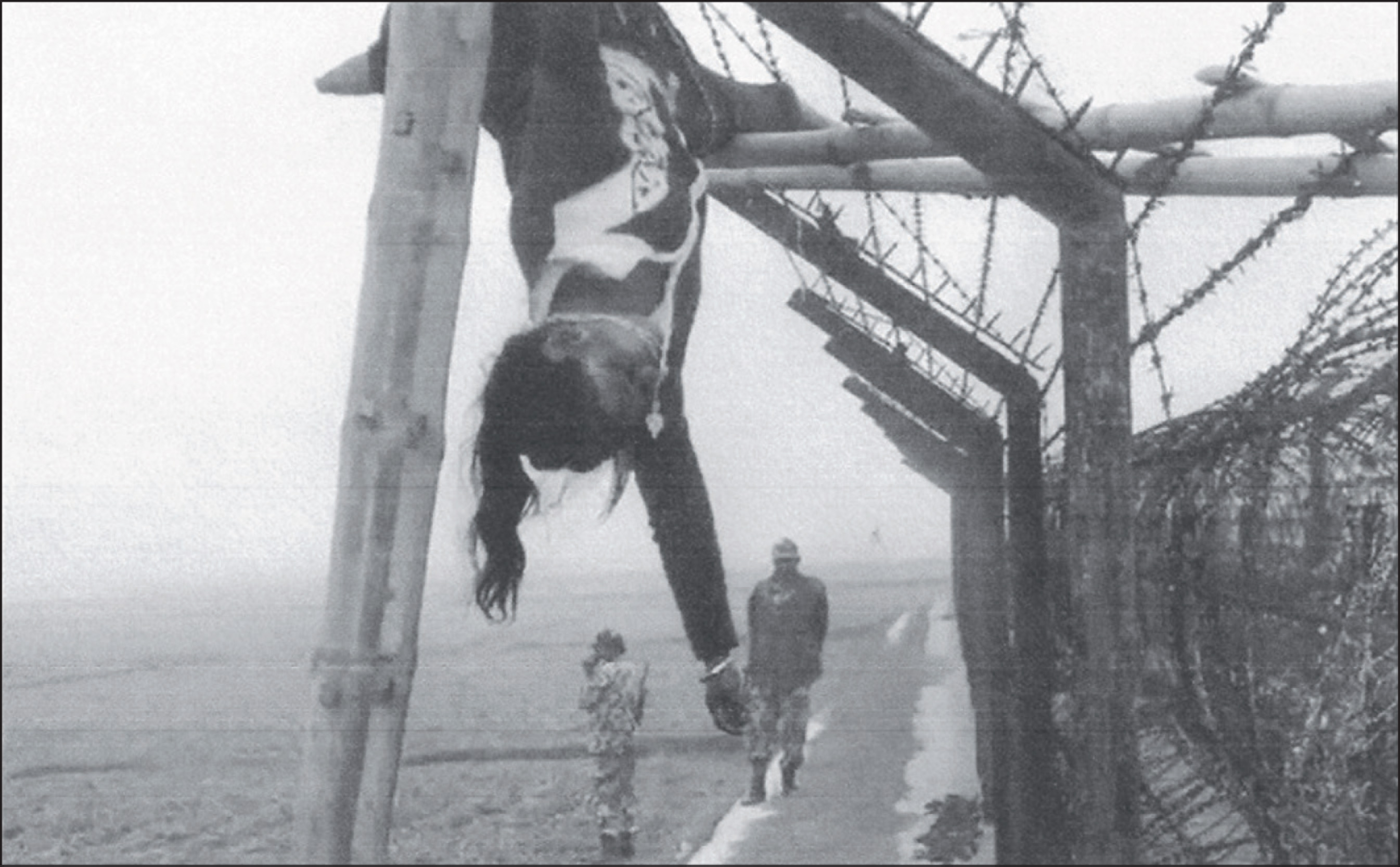
In its treatment of the theme of the Partition, Seemantorekha fashions a temporality of its own. In the beginning, Seemantorekha skims over the rise of communal politics in the 1940s to show documentary footage of families migrating during 1947. The concern stems from Mokammel’s personal engagement with the event. He is from Khulna, Bangladesh, and his mother was born in Basirhat, West Bengal. In the course of the documentary, the voice-over reiterates the frequently held argument that middle-class Muslims, who migrated to East Pakistan, benefitted in the long run. 36 On the other hand, as early as in September 1948, Filmindia magazine called the Muslims in India the ‘living dead’ who were ‘orphans in their own land’, paying ‘for the sins’ of other Muslims who had migrated to Pakistan. 37 Recent scholarship discusses how difficult it is for the Muslims in India to develop and cultivate a sense of belonging. 38 One is reminded of the predicaments faced by Salim Mirza and his family in M.S. Sathyu’s Garam Hawa (1974). 39 By talking to the Muslims who reside, at present, in Murshidabad, West Bengal, Seemantorekha puts forward their viewpoint. One of them says that his family never thought of migrating to East Pakistan. He has seen people of different faiths intermingle with each other. 40 Joya Chatterji warns about the narratives of ‘cultural assimilation’ that led to ‘the creation of secular independent India’, because these narratives gloss over the rather ‘harsher dynamics’ of Muslims being marginalised in society. 41 Compared to the rest of the population, the Muslims in India tend to be undereducated and underemployed. 42 At the same time, Seemantorekha sheds light upon the fact that some Bangladeshi nationals cross over to the Indian side for economic reasons, allegedly without any formal paperwork. It narrates the story of Felani, shot dead by the Indian security forces. In the documentary, a frame focuses on her body as it is seen hanging on the barbed wire fences (Figure 1). The significance of the image has to be understood in its relation to temporality because it ‘points to the presence of an actual referent in the past’. 43 The image is offered the screen space for some 10 seconds as the camera zooms in on Felani. The Indian security personnel remain silhouetted against the image. 44 André Bazin observes, ‘I cannot repeat a single moment of my life, but cinema can repeat any one of these moments indefinitely before my eyes’. 45 This intriguing aspect of documentaries and films (and by that fact, of any art form) to record and repeat images on the screen brings out, by contrast, the ephemeral nature of our experience. It makes the image timeless as it gets cemented in our sensory perception.
Mokammel avers that ‘most of the political, economic and cultural problems of our Sub-Continent are somehow rooted in the Partition’. 46 He derives his own inspiration to document the lives of refugees from the political and material understanding of present-day society. In India, the present political dispensation appropriates the communal discourses prevalent in 1947, and the ensuing experiences of individuals being dispossessed, to make amendments to the criteria of citizenship. It desires to correct the ‘historical wrong’ done in 1947 by granting citizenship to minorities who chose to migrate to India from its three neighbouring countries. 47 The historical wrong, if any, done during the Partition, pertains to the arbitrary decisions, lopsided policies and piecemeal schemes that were drafted to rehabilitate refugees who migrated across the Radcliffe Line. Rather than defining the Partition in communally charged rhetoric, it is crucial that we study it as a process through which displaced individuals and minorities in partitioned nations sought to rebuild their lives and communities after 1947. It is this long shadow 48 of the Partition that Mokammel retraces in Seemantorekha and takes it further by narrating the journey of four individuals—two Muslims and two Hindus—to their erstwhile homes in West Bengal and Bangladesh.
The Third Space of Being
Navine Murshid opines that with the influx of Rohingyas in Bangladesh and India, the ‘silence’ regarding the refugee crisis in South Asia was, finally, broken. 49 The silence that Murshid refers to has seeped in the body politic because of two reasons. The first refugee crisis that South Asia experienced went hand in hand with Independence from the Raj. The task of nation-building necessitated that the violence and displacements of 1947 be read as an aberration in the nationalist historiographies of the two nations. 50 On the other hand, the trauma of being uprooted required the refugees to distance themselves from the painful memory of displacement. Since they could not express themselves, they preferred to bury the past in the deep recesses of their mind. Such an action cannot be termed as forgetting in Freudian parlance, it is not due to erosion of memory. Rather, it is a ‘purposeful conduct’ performed by the individual. 51 On the other hand, for the past two decades or so, there is a ‘memory boom’ in studies related to the Partition. 52 ‘Partition survivors whose stories have been largely consigned to oblivion or silenced for seventy years’ are now being actually called upon to share their narratives. 53
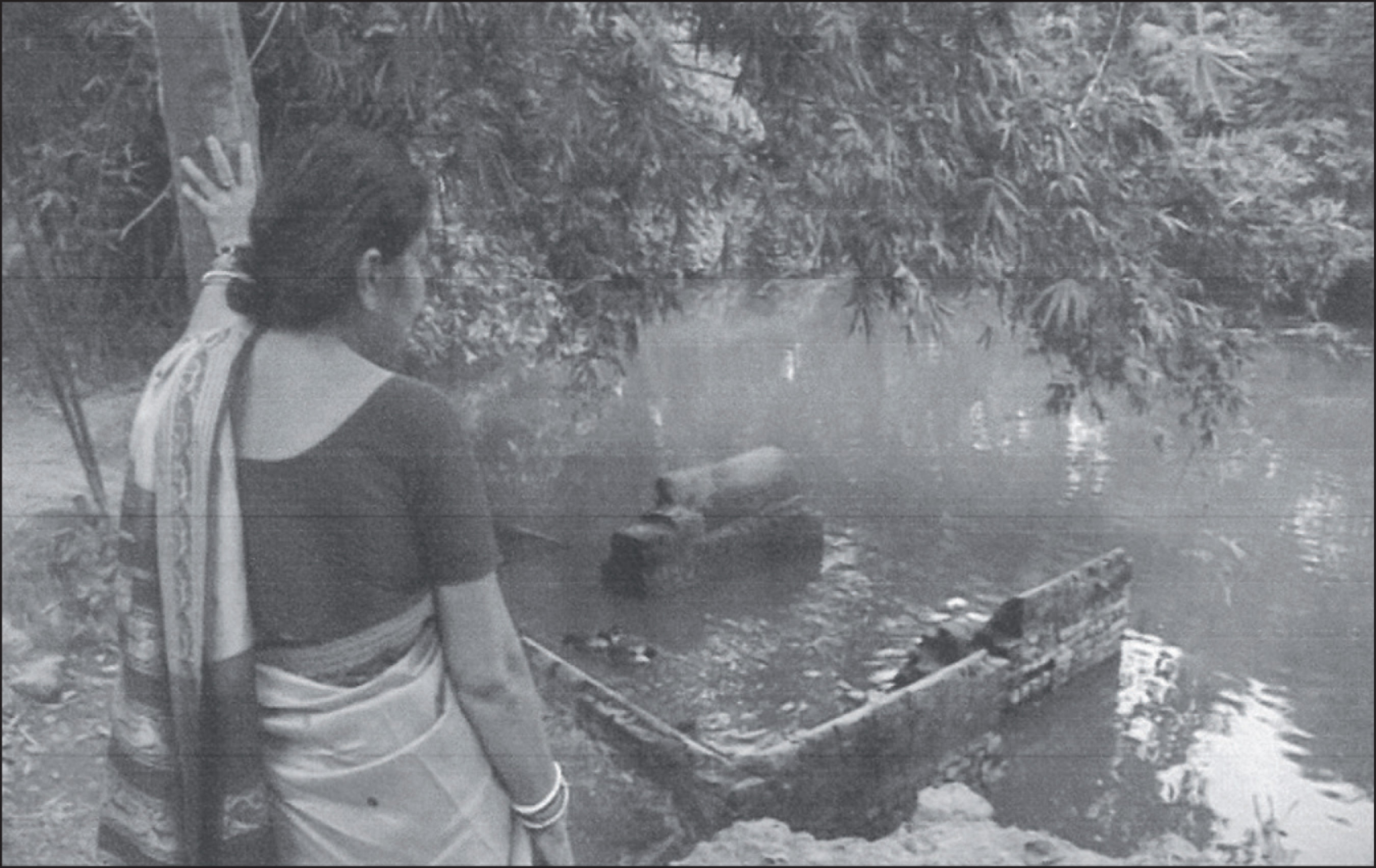
Seemantorekha begins with the life story 54 of Aparajita Ghosal, who recollects how her father, a doctor, dressed in a burqa 55 , escaped the riots and migrated to West Bengal, with the help of one of his Muslim friends. Soon, she is shown visiting her ancestral home at Santhahar, Bangladesh. She makes her way to her home, and the present owners show her the well that is kept and maintained as it was when she left. She stands in front of a pond, adjacent to her home, and says she is ‘seeing it for one last time in this life’. (Figure 2) 56 Though Bangladesh and India are divided by borders, the two nations remain connected by the rivers. In Rajshahi, as she sits by the side of the Padma, her voice is heard in the background: ‘Ganga is my mother, Padma is my mother…’. 57
Unlike her sisters, Achiya Khanum migrated from Howrah, West Bengal, to East Pakistan. She recollects the sight of her brothers leaving for East Pakistan, and 9-year-old Khanum wanted to leave with them. She believed that Pakistan would be a better country, very different from Howrah. When she was crossing the borders, she asked her brothers, ‘The trees are all the same just like we had in Howrah’. One of her brothers replied, ‘Bengal is still the same; it has merely been partitioned’. 58 Now, the fragile figure of Khanum is seen clad in a spotless white sari, trudging through the Khulna Railway Station, Benapole border check-post, and reaching her erstwhile home. ‘I will stay for a month’, Achiya Khanum remarks.
We are, then, introduced to Gayatri Chakravarty who travels to Barishal, Bangladesh, to see the original home of her family. She was born in West Bengal, but the stories of pre-partitioned Bengal, which she heard in her formative years, have inspired her to come to Bangladesh. This is a case of what Marianne Hirsch terms ‘transgenerational inheritance’. 59 Chakravarty says, ‘It is surprising that the country I have never seen has remained as a memory’. 60 She refuses to call it nostalgia; it is an experience that is intrinsic to her being. Chakravarty’s words substantiate Hirsch’s argument that postmemory is not a ‘movement, method or idea’; rather, it is a ‘structure of inter- and transgenerational return’ of embodied experience. 61 Chakravarty, thus, remembers her grandmother’s story of commuting from Dhaka to Barishal by the Kirtankhola River. The camera works its way through Chakravarty’s dilapidated, ancestral house, capturing the outer wall and the staircase. In the end, Chakravarty says, ‘When I return to [West] Bengal, I will have the feeling that I came here, stood on this ancestral piece of soil’. 62
Ernest Gellner states that ‘having a nation is not an inherent attribute of humanity, but it has now come to appear as such’. 63 If the appearance of the nation is thought of as an imagined community, 64 it presupposes the membership of subjects in the community on the basis of an uncontested, monolithic identity. 65 It is a structure that sustains itself through the practice of certain rituals 66 that legitimise the power of the ruling elites. 67 The epistemological understanding of the nation does not encourage different and alternative affiliations; the ideological form 68 of it rests on the expression and realisation of the popular will and the self-determination of its common identity. 69 The migration of refugees after the Partition complicates the idea of the nation as new spatial imaginations characterise the concept of belonging. 70 Bhaskar Sarkar succinctly sums up this argument when he writes that for the refugees, the ‘geographical displacement amounted to no more than a few hundred miles, and often much less. This strange proximity of the abandoned homeland, and the simultaneous sense of cultural–linguistic contiguity and difference, produced precarious subjectivities, suspended between the lost home and the new nation. 71 While the borders map out the nation within a territory, the refugees are, through affective attachment, drawn towards their ancestral home, which falls in a different country. It opens a liminal space of belonging that disrupts the ‘logics of synchronicity’ of the structure. 72 The structure in question is the nation. When they visit their ancestral home, the refugees embrace liminality in which ‘meanings and symbols’ of the structure have ‘no primordial unity or fixity’. 73 The life story of Manowar Ali is a case in point. Ali comes to Basirhat to visit his former home. On his way, he harks back to the days after the migration when his erstwhile well-established family faced years of penury. In Basirhat, a few of the neighbours remember Ali’s father and uncle, but they cannot help him identify his home. He frantically tries to locate it. Soon, he finds the house only to realise that another building has been erected on that particular piece of land. Seeing the crew of the film, people have gathered around Ali. He tells them about his childhood days. The people do not know Ali, but they listen to his stories wrapped in empathetic silence. The camera follows Ali who walks on the path leading to the pond. Like Aparajita Ghosal, he tries to imbibe the fleeting moments of his return to Basirhat. In the cathartic moment of reconciling with their ancestral home, Ali and Aparajita, Khanum and Chakravarty share a symbiotic, corporeal space that rests on emotional commonality and shared experiences of mourning. It is the ‘Third Space’ 74 of being that is contingent on the politics of the moment, based on imagination, attachment and longing.
The presence of the Third Space is intensely felt in the last phase of Seemantorekha. On either bank of the Ichamati River, people gather to witness the immersion of Durga idols. The boats fluttering the national flags of Bangladesh and India row side by side. People wave at each other and collectively take part in the celebration. A woman says, ‘Whenever I come to the river, I look at the other side and pay obeisance to my birthplace…one can never forget one’s birthplace’. 75 An individual remarks, ‘Since my childhood I see it happening. Now it is not only a festival of Hindus; it has become a combined affair’. 76 With their regime of power, the nations, in general, dictate the process of mobility and movement of people. 77 In the scenes that Seemantorekha portrays, the movement of people transforms the regime of border control as nations and their agencies (in this case, the border security forces) acknowledge the emotive and relative intimacies of the crowd. The voice-over narrates that to mark the occasion of the International Mother Language Day, each year on 21 February, the Benapole border check-post becomes a meeting ground for people from either side of the borders. Seemantorekha covers the event as cultural groups from both Bangladesh and India perform before the audience. 78 The borders do not dissolve, but they symbolically merge through the unification of people.
The first film that depicts the Partition—Nemai Ghosh’s Chinnamul (1950)—presents an old widow, who, after migrating from East Pakistan, is seen stuck amidst the squalor of the Sealdah railway station. She tells one of her associates, ‘Let us go back home’. 79 Seemantorekha pays a fitting tribute to Ghosh’s film by pursuing the journey of four individuals to their erstwhile homes. Most importantly, it opens a representational space that eludes the politics of polarity between home and homelessness by transcending the ideological normative of nations and borders.
Footnotes
Acknowledgements
The author is grateful to Tanvir Mokammel for his observations and would like to thank the Partition Museum, Amritsar, for supporting a part of the archival work cited in this article.