






Abstract
This study describes evidence for multiple attachments by orphaned and separated children (OSC) to caregivers and explores predictive relationships between attachment and family social relationships. A sample of forty-three longitudinal children residing in residential care between 15 and 144 months at the time of assessment and forty-two newer-to-care children (entering one to thirteen months before testing) was interviewed in summer 2019. Caregiver attachment was measured using the IPPA Guardian scale, and family social relations were measured using the PROMIS Pediatric Family Relationships scale. Longitudinal children displayed similar attachment scores across a one-year time span regardless of whether they nominated the same or different favourite caretaker. Results are discussed in the context of evidence for multiple attachments and the way attachment can predict social relations for new but not longitudinal children. This paper supports that OSCs form multiple attachments to caregivers over time, with attachment starting and remaining relatively strong in the long-term.
Introduction
Attachment research has shown that favourable child–caregiver attachment patterns established early in life can contribute to a number of positive outcomes, including higher self-esteem, resilience, and positive perceptions of romantic relationships in adulthood (Cassidy et al., 2013; Laible et al., 2000). Bowlby and Ainsworth’s foundational attachment theory focuses on construction of these child–caregiver relationships over time, defining secure attachment as an emotional bond that stems from an innate drive and is nurtured by dependability and responsiveness (Flaherty & Sadler, 2011). Longitudinal studies find various stages in the development of attachment to single or multiple caregivers over time (Ainsworth, 1973; Schaffer & Emerson, 1964). Schaffer and Emerson (1964) outlined four distinct phases, with the last two being discriminate attachment and multiple attachment; results indicated that from seven to eleven months of age, infants showed a strong attachment to one specific individual, but they began to form strong emotional bonds with other caregivers other than the primary figure after nine months of age.
Research with children who have experienced severe breaks in attachment relationships, such as orphaned and separated children (hereafter known as OSCs), finds, however, that traditional ideas of attachment may not adequately reflect the attachment of OSCs to present caregivers in residential care due to past experience and effects of traumatic events (Browne & Winkelman, 2007). Multiple attachments are important to consider for OSCs due to the many types of adult and peer social relationships they encounter in residential care, which may be temporary or inconsistent.
An understanding of attachment and its association with family social relationships also has implementational value in informing programmes tasked with the process of deinstitutionalising children. The term ‘deinstitutionalisation’ refers to ‘a movement that advocates the transfer of people from public or private institutions…back to their families or into community-based homes’ (Stiker, 2020). In the context of OSCs, this requires children in institutional care to be moved back to their original family settings, to other extended family caregivers or foster families.
It should be noted that careful thought around deinstitutionalisation is a process in which the needs of the child are foremost (UNICEF, 2019), and parents and caregivers are empowered through a variety of means, including behavioural, educational and mental health support to construct a safe and stimulating environment for the child and whole family. Since this study describes evidence of OSC attachments to multiple caregivers and explores the predictive relationship between attachment scores to a particular caregiver and the child’s perceptions of overall family social relationships, it forms a platform for assessing the needs of the OSCs while structuring a course of action for deinstitutionalisation.
Methods
Definitions
Child: denotes an individual still living in the residential group home.
OSC: defined as children who have lost one or both parents, or have been separated from their parents with no intention of returning to them.
Residential Care Homes: group homes where children from different families live together under the care of an unrelated caregiver(s).
Ethical Considerations
Ethical approval was obtained from Duke University’s Institutional Review Board and locally from Udayan Care’s Managing Trustee Dr Kiran Modi. Each participant provided written consent prior to the interview. All identifiable information was kept on an encrypted server, and all data were de-identified before analysis.
Instruments
IPPA Guardian (Inventory of Parental and Peer Attachment, Guardian subsection): Part one of the IPPA (Armsden and Greenberg, 1987) assesses three subscales: degree of mutual trust, quality of communication and extent of alienation. Total scores range from 25 to 125 and are a summation of three subcategories. Sub score categories are as follows: trust—low (10–23.33), medium (23.34–36.67) and high (36.68–50); communication—low (8–18.67), medium (18.68–29.35) and high (29.36–40); alienation—low (7–16.33), medium (16.34–25.67) and high (25.68–35). During interviews, children were asked to nominate a ‘favourite’ caregiver to keep in mind when answering questions.
PROMIS Family (Patient-Reported Outcomes Measurement Information System, Pediatric Family Relationships): The PROMIS Pediatric Family Relationships Questionnaire (Bevans et al, 2017) assesses feeling important and cared for and that family members can be trusted. Scores range from 19.2 to 61.9, with higher scores indicating more positive feelings of family social relations.
Participants and Procedures
Note that depression was measured using the Center for Epidemiological Studies Depression Scale–Children (CESD-C), a screening test that measures depression symptoms. Anxiety was measured using the Screen for Child Anxiety Related Disorders (SCARED), a screening inventory for specific and generalised anxiety in children. Trauma was measured using the Trauma Symptoms Checklist for Young Children (TSCYC), designed to indicate posttraumatic symptomology.
A study using a variety of mental health measures involving children in seventeen residential homes was conducted by Duke University undergraduate researchers during May–July of 2019. Each participant partook in a one-on-one interview, using questionnaires to assess anxiety, depression, trauma, peer and guardian attachment, perceptions of caregiver parenting, peer and family social relations, resilience and self-concept. Sixty- to ninety-minute interviews were conducted in English or Hindi in private areas of the residential homes by Udayan Care research assistants, a translator or the student researcher. Interviews conducted by a research assistant or translator had a student researcher present at all times. For all interviews, a social worker or counsellor was either in the home or on-call.
A sample of forty-three longitudinal children who had resided in residential care between fifteen months and twelve years at the time of assessment and a sample of forty-two children newer to residential care (residing between one to thirteen months at the time of assessment) were interviewed. The sample of longitudinal children chosen were those with anxiety, depression or trauma risk levels of two or above (in any construct) in 2018.
Table 1 shows the categories used to delineate OSC risk designation (one through four), with higher risk levels in anxiety, trauma and depression indicated by higher scores in the SCARED, TSCYC and CESD-C questionnaires. Scores lower than 23, 63 and 14 for anxiety, trauma and depression, respectively, indicated a child as ‘no risk’ (NR) in that construct.
Risk Designation by Score in Anxiety, Trauma and Depression for Longitudinal Children

Demographic Data and Trends
Number of Longitudinal and New Children’s Date of Joining and Current Age

2019 Anxiety, Trauma and Depression Scores
The majority of OSCs in this sample are between the ages of fourteen to eighteen, with a slightly wider age range of new children (nine to eighteen) versus longitudinal (eleven to eighteen). About 77 per cent are female children, ranging from age nine to eighteen, with about 23 per cent being male children, ranging from age thirteen to eighteen.
Results
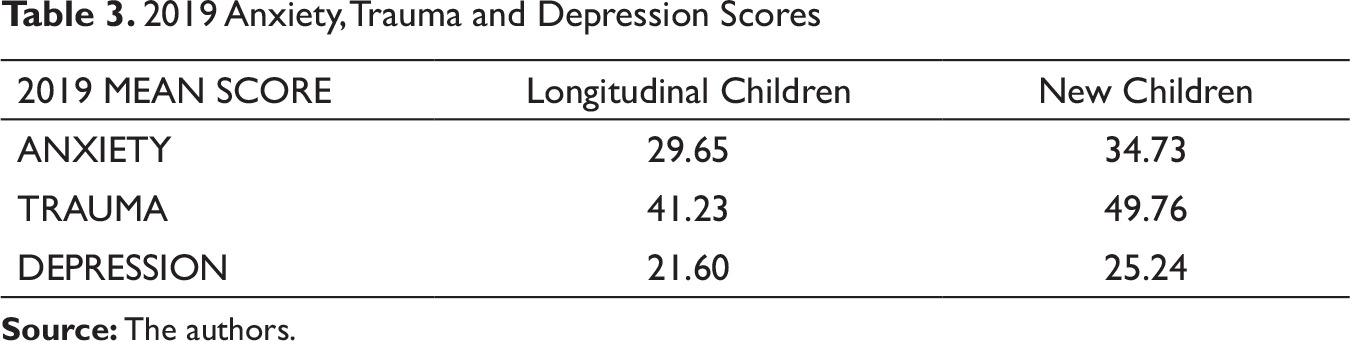
Mean score differences of anxiety, trauma and depression across longitudinal and new groups were analysed to understand if any existing differences may confound subsequent analyses of attachment and social relations. Overall, mean scores differed by between 3.64 and 8.53 points across constructs, as shown in Table 3.
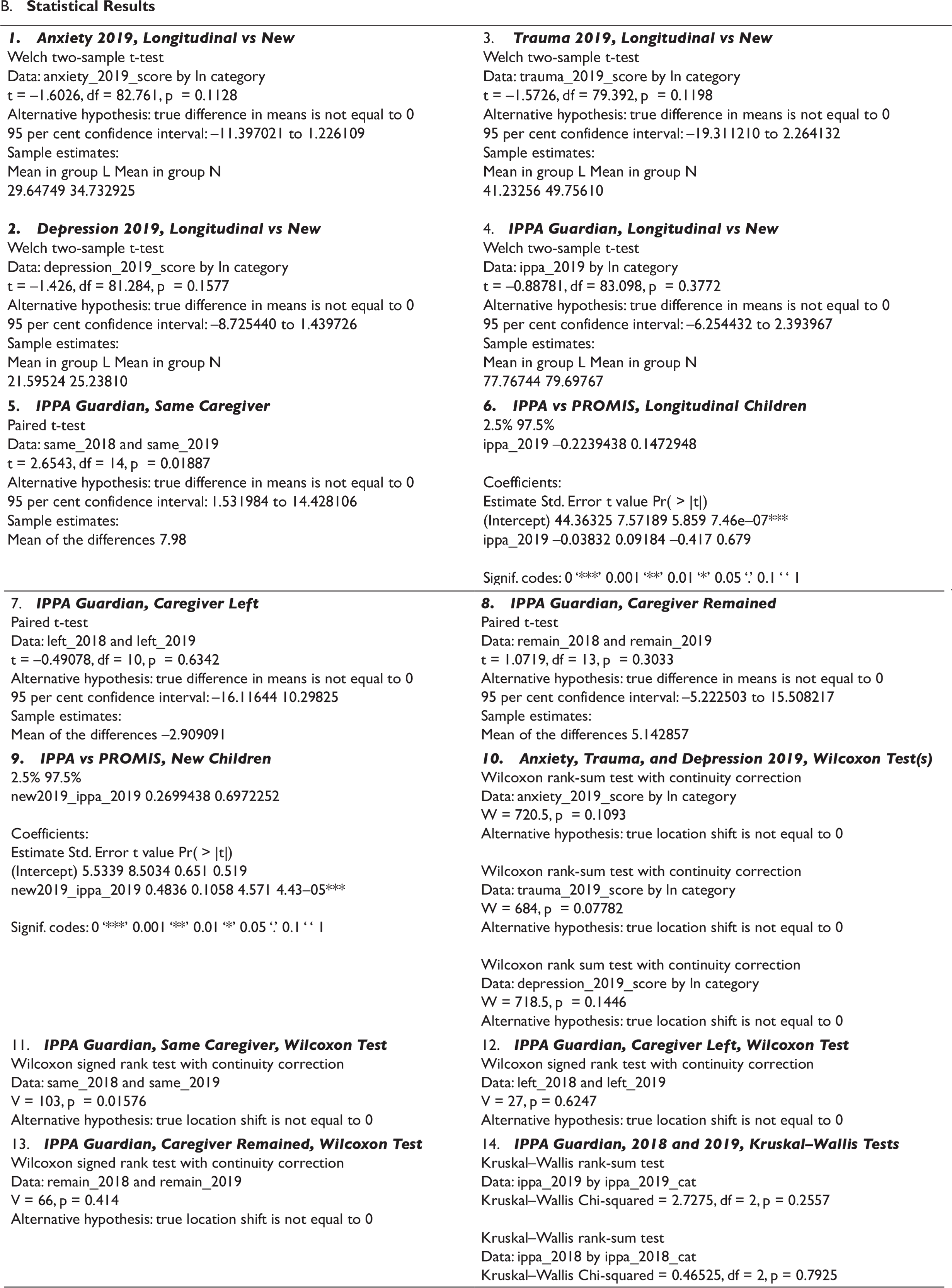
Independent two-group t-tests comparing anxiety, depression and trauma scores showed no significant difference in means between the longitudinal and new children (anxiety: t(82.76) = –1.0, p = 0.11; depression: t(81.28) = –1.41, p = 0.16; trauma: t(79.392) = –0.84, p = 0.12), mitigating mental health risk level as a primary confounding variable in assessing sample differences in attachment and family social relations. Results from these t-tests are shown in Appendix B, sections 1–3.
As distributions for 2019 scores cannot be assumed to be normal, the Wilcoxon rank-sum test was used to compare longitudinal and new distributions across the three mental health measures to check for each measure whether longitudinal and new samples were likely to be selected from populations with similar distributions. Results from these tests are shown in Appendix B, section 10. This analysis confirmed a lack of significant difference between means of score distributions in all three constructs of new and longitudinal children (anxiety: W = 720.5, p = 0.11; depression: W = 684, p = 0.078; trauma: W = 718.5, p = 0.144).
Multiple Attachments in Residential Care Setting
The 2018 and 2019 IPPA Guardian Scores for Longitudinal and New Children
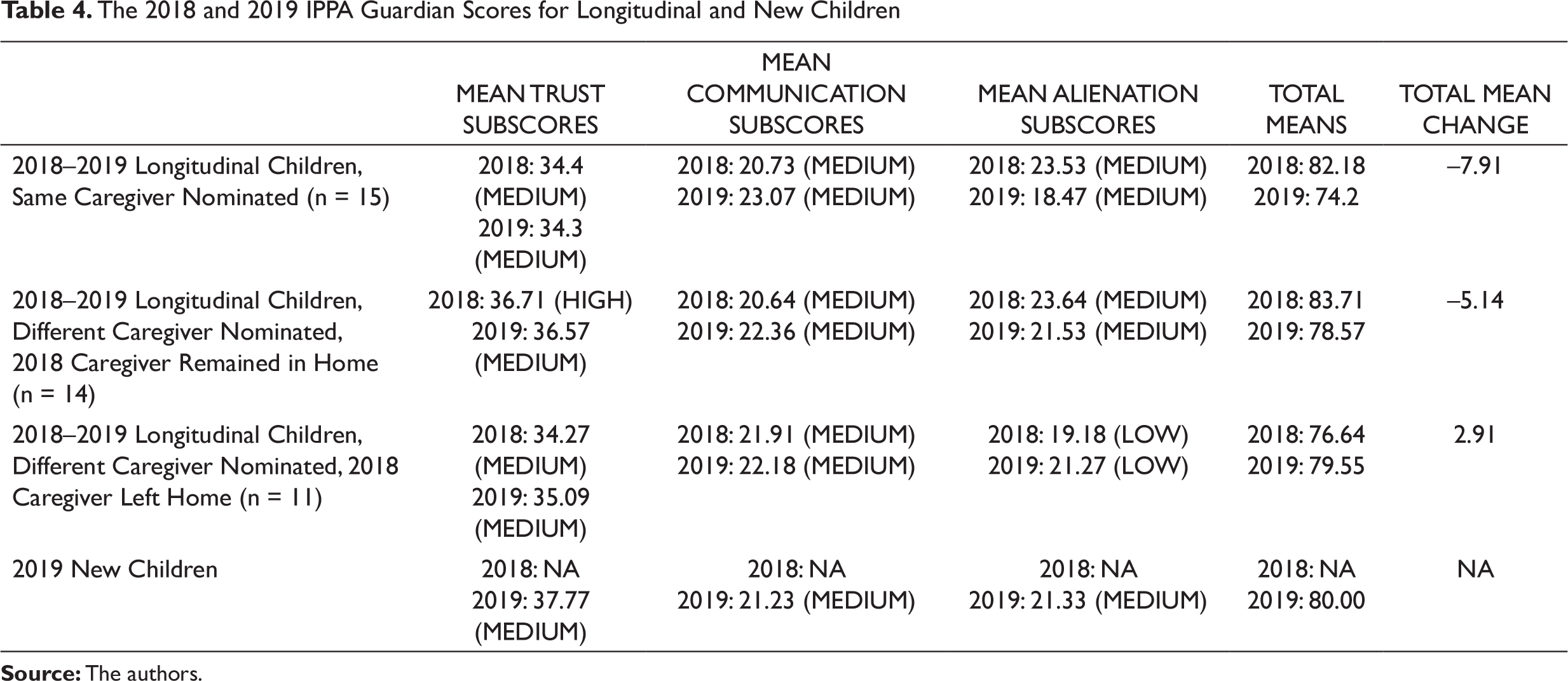

As seen in Table 4, 2019 total IPPA Guardian mean scores for new and longitudinal are 80 and 77.20, respectively. We see no significant difference in 2019 mean scores between the longitudinal and new children groups, t(83.1) = –0.89, p = 0.38. For both samples, 2019 IPPA Guardian scores are similar: longitudinal (range of 45–92, mean = 77.20, median = 77), newly entered children (range of 54–98, mean = 80, median = 82). While the range and averages are slightly higher for the new children, the few point differences are also not psychologically meaningful on this scale. Results from this independent two-group t-test are provided in Appendix B, section 4.
In addition, though the longitudinal sample joined residential care over a wide range of dates, regardless of the time they have spent in residential care, mean 2019 total IPPA Guardian scores all fall into a fifteen-point range from seventy to eighty-five, as can be seen in Figure 1.
Likewise, 2018 scores for longitudinal children across all three caregiver choice categories (same caregiver, new caregiver with 2018 caregiver having left and new caregiver with 2018 caregiver having remained) showed no significant difference in 2018 (Chi-square = 0.465, p = 0.7925) or 2019 (Chi-square = 2.7275, p = 0.2557). See Appendix B, section 14, Kruskal–Wallis rank-sum test. In both 2018 and 2019, subscores of trust and communication remain in “medium” and “high” categories while alienation remains ‘medium’, providing support that OSCs form attachments at reasonable levels.
Thus, children entering care for the first time show similar attachment scores to the same set of caregivers as children who have been residing in the environment for many years. This general congruence provides support for the idea that OSCs who have experienced significant adverse life events are open and able to develop attachments in familiar and novel settings with old and new caretakers, despite experiencing and knowing that caregivers can and do leave.
Despite slight 2018–2019 total score differences in the longitudinal sample, guardian attachment scores did not significantly differ across the one-year time span for children nominating a different favourite caregiver regardless of whether their previous favourite caregiver remained or stayed in the home (2018 caregiver left: t(10) = –0.50, p = 0.63; 2018 caregiver remained: t(13) = 1.07, p = 0.30) and corresponding subscores changed only one to two points. However, there was a statistically significant decrease in total IPPA Guardian scores from 2018 to 2019 for the seventy-three per cent of children (n = 15) who chose the same favourite caregiver in both years, t(14) = 2.65, p = 0.02. Though there is a significant one-year drop in total attachment score for children nominating the same caregiver over time, scores in communication slightly increase while those in alienation decrease. These changes indicate that attachment for this group became more positive over the year.
Overall, the finding that children display similar attachment scores to newly nominated caregivers as they had to previously nominated ones, and that IPPA Guardian total scores and subscores remain similar from year to year despite same or different caregiver nomination supports the idea that OSCs are creating multiple adult attachments at similar, reasonably high levels in a residential care setting.
Attachment and Family Social Relations
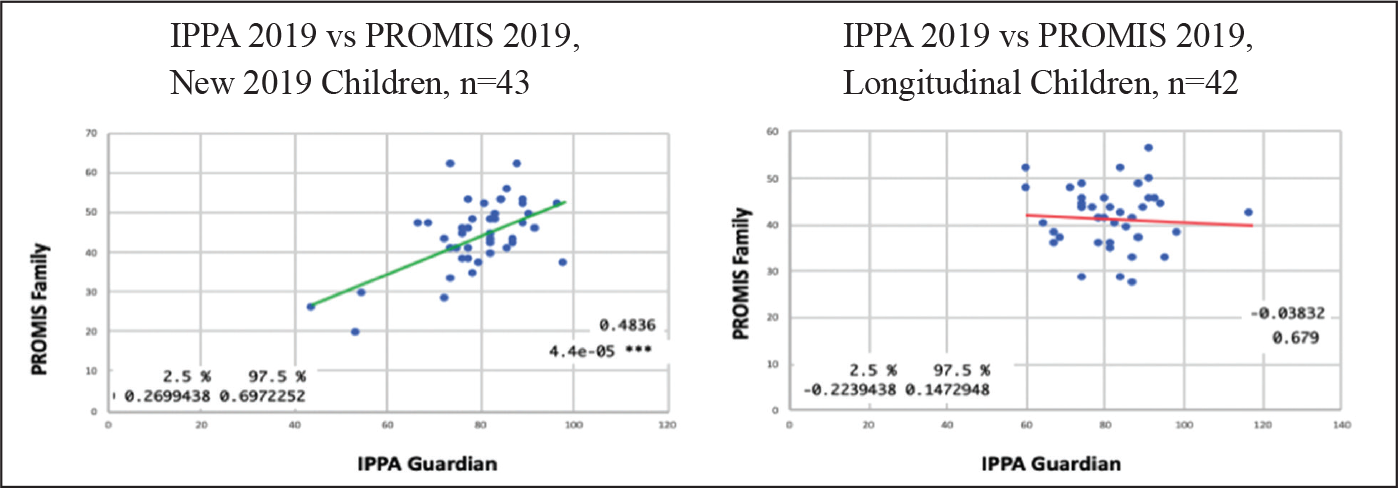
Positive adult family social relations seem to be predicated on having positive attachments to primary adult caregivers. We next explored how adult attachment relates to perceptions of trusting caregivers and feeling cared for by them as measured by the PROMIS Family Questionnaire. We expected attachment to predict family relations. Simple linear regressions were used to look at the effect of children’s guardian attachment on their perception of family relationships.
For both new and longitudinal children, PROMIS Family scores are moderate to high, ranging from 27.3 to 55.8, with possible scores ranging from 19.2 to 61.9. As seen in Figure 1, results suggest that total IPPA Guardian scores predict PROMIS Family scores for new children, but not for children in the longitudinal sample (see Appendix B, sections 8–9). The predictive effect of IPPA Guardian on PROMIS Family for new children is significant (b = 0.48, p < <0.05, 25%–97.5% CI: 0.27–0.70) while for longitudinal children there is no evidence for a clear relationship (b = –0.04, p = 0.68, 25%–97.5% CI: –0.22–0.15). For children new to residential care, every ten-unit increase in IPPA Guardian score shows approximately a five-unit (thirteen per cent) increase in the PROMIS Family score.
This result may suggest that for children newly entering a care setting, a new favourite guardian attachment is related to a child’s feelings and perceptions of overall family relations, while for longitudinal children a singular adult attachment may not play the same function in a child’s sense of family. This finding is intriguing and could imply that attachment may contribute to perceived social relations differently for new-to-care children than for children who have formed multiple adult attachments.
Discussion
This study aimed to better understand guardian attachment trends for OSCs in the context of a residential care setting, as well as examine the role that guardian attachment may play in children’s perceptions of overall family relations. The finding that guardian attachment scores start positively for new OSCs and remain so for longitudinal OSCs over a one-year period, regardless of favourite caregiver choice, suggests that OSCs are able to adapt to settings in which there are multiple adult caretakers to form meaningful attachments.
Similar 2019 IPPA Guardian scores regardless of year of joining care provides additional evidence that over longer periods of time, despite turnover in caregivers standard for OSCs in any environment, whether it is care by extended family, in foster care, or residential care, OSCs in this sample are open and able to retain attachment over time, as well as form new attachments. This seems to be an encouraging finding. Instead of demonstrating a lack of trust and inability to form new attachments in the face of experiencing multiple and changing caregivers, OSCs in this study showed what seems to be positive adaptability. These findings support the idea that in child-centred, high-quality residential care settings, at least in this Indian context, OSCs are able to take what is needed from the extended family environment and gain the bonds that allow trusting relations with adults to develop and be maintained.
Family relations scores as measured by PROMIS are also moderate to high in both longitudinal and new children, implying perceived positive family perceptions. The predictive effect of IPPA Guardian on PROMIS Family seen only for children new to care is interesting. It is possible that as a child spends more time in residential care and forms multiple attachments in that setting, specific, single guardian attachments alone may not be what the child uses to judge overall family social relations. Children who have lived in a stable group residential home with multiple primary or favourite adult caregivers may use an overall attachment to the home versus single attachments that contribute less weight to an OSC’s overall perceptions of family relations. However, children first entering a new residential care environment may use their first primary adult attachment as a way to encompass and understand their sense of overall family relations in that new environment. It is important to remember that children entering residential care are coming from various past care environments (the street, social services, other extended family or community care). The fact that new OSCs coming from past traumatic backgrounds are also showing positive attachments and perceived family relations is encouraging and likely a testimony to both OSC resilience and the quality of residential care they enter into.
While our sample size is, by necessity small, these findings provide impetus to continue investigating OSC attachment in different care setting environments and to develop new ways of hypothesising and understanding attachment in vulnerable populations. Understanding how OSCs navigate a highly variable and often unstable landscape of multiple attachments and social relations will help residential care providers better understand how OSCs form trusting bonds with adults and eventually their own families. Counsellors and social workers can structure counselling sessions to build on OSCs resilience and ability to form healthy attachment relationships, creating prospective course of action for enabling healthy family rehabilitation. Findings should be checked in other settings and larger samples and used as an important starting point to understand the best ways to support child and young adult attachment.
Footnotes
Appendix
| Almost never | Not very | Sometimes | Often | Almost always |
| Or | Often true | True | True | or |
| Never true | Always true | |||
| 1 | 2 | 3 | 4 | 5 |
Welch two-sample t-test Data: anxiety_2019_score by ln category t = –1.6026, df = 82.761, p = 0.1128 Alternative hypothesis: true difference in means is not equal to 0 95 per cent confidence interval: –11.397021 to 1.226109 Sample estimates: Mean in group L Mean in group N 29.64749 34.732925 Welch two-sample t-test Data: depression_2019_score by ln category t = –1.426, df = 81.284, p = 0.1577 Alternative hypothesis: true difference in means is not equal to 0 95 per cent confidence interval: –8.725440 to 1.439726 Sample estimates: Mean in group L Mean in group N 21.59524 25.23810 |
Welch two-sample t-test Data: trauma_2019_score by ln category t = –1.5726, df = 79.392, p = 0.1198 Alternative hypothesis: true difference in means is not equal to 0 95 per cent confidence interval: –19.311210 to 2.264132 Sample estimates: Mean in group L Mean in group N 41.23256 49.75610 Welch two-sample t-test Data: ippa_2019 by ln category t = –0.88781, df = 83.098, p = 0.3772 Alternative hypothesis: true difference in means is not equal to 0 95 per cent confidence interval: –6.254432 to 2.393967 Sample estimates: Mean in group L Mean in group N 77.76744 79.69767 |
Paired t-test Data: same_2018 and same_2019 t = 2.6543, df = 14, p = 0.01887 Alternative hypothesis: true difference in means is not equal to 0 95 per cent confidence interval: 1.531984 to 14.428106 Sample estimates: Mean of the differences 7.98 |
2.5% 97.5% ippa_2019 –0.2239438 0.1472948 Coefficients: Estimate Std. Error t value Pr( > |t|) (Intercept) 44.36325 7.57189 5.859 7.46e–07*** ippa_2019 –0.03832 0.09184 –0.417 0.679 Signif. codes: 0 ‘***’ 0.001 ‘**’ 0.01 ‘*’ 0.05 ‘.’ 0.1 ‘ ‘ 1 |
Paired t-test Data: left_2018 and left_2019 t = –0.49078, df = 10, p = 0.6342 Alternative hypothesis: true difference in means is not equal to 0 95 per cent confidence interval: –16.11644 10.29825 Sample estimates: Mean of the differences –2.909091 |
Paired t-test Data: remain_2018 and remain_2019 t = 1.0719, df = 13, p = 0.3033 Alternative hypothesis: true difference in means is not equal to 0 95 per cent confidence interval: –5.222503 to 15.508217 Sample estimates: Mean of the differences 5.142857 |
2.5% 97.5% new2019_ippa_2019 0.2699438 0.6972252 Coefficients: Estimate Std. Error t value Pr( > |t|) (Intercept) 5.5339 8.5034 0.651 0.519 new2019_ippa_2019 0.4836 0.1058 4.571 4.43–05*** Signif. codes: 0 ‘***’ 0.001 ‘**’ 0.01 ‘*’ 0.05 ‘.’ 0.1 ‘ ‘ 1 |
Wilcoxon rank-sum test with continuity correction Data: anxiety_2019_score by ln category W = 720.5, p = 0.1093 Alternative hypothesis: true location shift is not equal to 0 Wilcoxon rank-sum test with continuity correction Data: trauma_2019_score by ln category W = 684, p = 0.07782 Alternative hypothesis: true location shift is not equal to 0 Wilcoxon rank sum test with continuity correction Data: depression_2019_score by ln category W = 718.5, p = 0.1446 Alternative hypothesis: true location shift is not equal to 0 |
Wilcoxon signed rank test with continuity correction Data: same_2018 and same_2019 V = 103, p = 0.01576 Alternative hypothesis: true location shift is not equal to 0 |
Wilcoxon signed rank test with continuity correction Data: left_2018 and left_2019 V = 27, p = 0.6247 Alternative hypothesis: true location shift is not equal to 0 |
Wilcoxon signed rank test with continuity correction Data: remain_2018 and remain_2019 V = 66, p = 0.414 Alternative hypothesis: true location shift is not equal to 0 |
Kruskal–Wallis rank-sum test Data: ippa_2019 by ippa_2019_cat Kruskal–Wallis Chi-squared = 2.7275, df = 2, p = 0.2557 Kruskal–Wallis rank-sum test Data: ippa_2018 by ippa_2018_cat Kruskal–Wallis Chi-squared = 0.46525, df = 2, p = 0.7925 |
Declaration of Conflicting Interests
The authors declared no potential conflicts of interest with respect to the research, authorship and/or publication of this article.
Funding
The authors received funding from the Duke Global Health Institute through the Student Research Training Program for research on-ground.