







Abstract
The streets of Bangladesh are increasingly being claimed by juvenile gangs, where lost dreams and broken families fuel a dangerous rebellion against society. The purpose of the study is to provide a comprehensive understanding of juvenile gang dynamics in Bangladesh by examining gang member profiles, activities, and the underlying causes of involvement. Using criminological theories as a framework, this research offers evidence-based strategies to prevent and reduce juvenile gang participation, with a particular emphasis on family strengthening. Following this approach, the study uses secondary sources to evaluate how the data align with relevant theoretical frameworks through thematic analysis. The findings indicate that most juveniles involved in gangs come from economically disadvantaged backgrounds or families with criminal associations and that these gangs often emerge under the protection of political influence. Juvenile gangs are primarily engaged in property-related and sexual offences. Among various criminological perspectives, subculture and interaction theories most effectively explain the underlying factors contributing to gang involvement. By integrating existing literature, the study explores the factors shaping juvenile gang activity in Bangladesh through a theoretical lens. Moreover, this study offers valuable insights often overlooked in previous research, particularly by examining the media’s influence on juvenile involvement in gang violence. Future research may explore more preventive strategies of juvenile gang involvement.
Introduction
Introduction and Background of the Study
Juveniles are often considered the prospective leaders of a nation, possessing the potential to illuminate the world (Khuda, 2019). But when they become entangled in gang culture, their involvement leads to a descent into darkness, thereby facilitating the emergence of the underworld (Shore, 1999). Juvenile gang-related crimes in Bangladesh, from petty theft to severe violence, have been rising in recent years, with their organised, syndicate-like operations sparking public concern over alleged political protection (Uttom & Rozario, 2019). This trend underscores the prevalence of ‘juvenile gang culture’, popularly labelled as Kishore-gang in Bengali socio-legal discourse (Amin, 2024).
The Children’s Act (2013) was enacted in Bangladesh, repealing the Children’s Act (1974) to align with the provisions of the United Nations Convention on the Rights of the Child, aiming to better protect and support children’s development. The law considers anyone under 18 years old as a child and defines a child offender as someone under 18 who breaks the law (section 4). Any act committed by a child aged between 9 and 12 is not considered an offense if they lack the maturity to understand its nature and consequences (The Penal Code, 1860, sec. 83).
Despite the absence of a universally accepted definition, juvenile gangs are generally characterised by self-formed group of peers with a name, symbols, leaders, regular meetings, and involvement in crime (Howell, 2010). Delinquent behaviour among juveniles during the transition from childhood to adulthood contributes to criminal activity (Rahman, 2022).
Urmi and Chowdhury (2023) stated that juvenile gang violence in Bangladesh has spread beyond the capital, affecting major cities like Dhaka, Chattogram, and Khulna, as well as smaller towns and rural areas nationwide. In 2023, these gangs were responsible for 25 murders in the capital, and legal action has been taken in 780 cases against their members (Amin, 2023). In 2024, around 237 teen gangs were active nationwide, with Dhaka having the highest concentration at 127 (Amin, 2024). The total number of gang members is 1,382, with Chattogram having the second-highest number of gangs at 57, involving 316 individuals.
Prior researchers (Connolly & Jackson, 2019; Hesselink & Bougard, 2020) analysed risk factors at multiple ecological levels, including individual, familial, peer, and community dimensions, as well as different harmful effects of juvenile gang involvement. Bangladesh, like many other countries, grapples with the complexity of juvenile gang dynamics. Rapid urbanisation, economic disparities, and cultural shifts have created an environment where juveniles find themselves vulnerable to the allure of gang affiliations. Against this backdrop, the study seeks to explore the factors influencing juvenile gang formation in Bangladesh. This research presents a synthesised overview by integrating existing literature to develop a comprehensive understanding of juvenile gang dynamics in Bangladesh. This study aims to examine the socio-demographic profiles of juveniles in gangs, analyse their criminal activities, identify underlying causes of involvement, and assess effective prevention strategies. Moreover, this study addresses a gap in existing research by examining the media’s role in influencing juvenile involvement in gang violence. From a policy perspective, the findings of this study can serve as a valuable resource for policymakers and government agencies of Bangladesh. Furthermore, this study may have implications beyond the borders of Bangladesh, as its insights into understanding and addressing juvenile gang issues could be relevant in the broader international context.
Theoretical Exploration into Juvenile Gang
Rather than focusing on a single theory, the research analysed multiple criminological theories to determine which had a stronger influence on juvenile gang offending.
Subculture Theory
Cohen (1955) suggested that boys from working-class backgrounds often join gangs to earn respect and confidence, which they find difficult to attain in a society that prioritises middle-class norms. Theoretical debate persists regarding Cohen’s subculture theory, as Kitsuse and Dietrick (1959) criticised it, arguing that lower-class boys do not strongly care about middle-class opinions. According to them, gang members join for different reasons at first, but over time, they develop a shared purpose that helps maintain the subculture.
Theory of Economic Structure and Crime
Using Marxist ideas, William Aldrian Bonger (1876–1940) explained how the economic system can lead to crime (Rahman, 2022). He argued that child labour, a characteristic feature of capitalism, is closely associated with juvenile delinquency (Howard, 1916).
Interaction Theory
Interactional theory by Thornberry (1987) takes a comprehensive approach by bridging theoretical gaps in gang research (Alleyne & Wood, 2010). The theory explores the complex interactions among personal attributes, social ties, peer dynamics, and broader community factors, emphasising their collective impact on behaviour. Based on the ideas of social interaction and social control (Lenzi et al., 2014), it suggests that juvenile gang involvement is the result of a mix of personal traits, social influences, and situational factors (Lee, 2003).
Differential Association Theory
Sutherland (1972) proposed that people learn criminal behaviour by interacting with those who break social rules. According to this theory, criminal behaviour is a socially acquired phenomenon shaped through learning processes. Barnes et al. (2006) showed that during adolescence, peer groups exert a significant influence on adolescent behaviours, particularly in cases where parental supervision is limited. When someone spends time with individuals or groups involved in criminal activities, they are likely to adopt their attitudes and behaviours (Maloku, 2020).
Routine Activity Theory
According to this theory, crime occurs when three elements intersect: a motivated offender, a suitable target, and the absence of capable guardianship. Cohen and Felson (1979) argued that the possibility of criminal activity rises when these three factors overlap in both space and time.
This theory is helpful for studying juveniles to understand how their actions are influenced by factors such as the absence of capable guardianship, the presence of motivated offenders, and the availability of suitable targets (Lynch, 2020).
Social Disorganization Theory
Social disorganization theory developed by Shaw and McKay (1942) shows that crime can rise or fall based on changes in family structure and community strength, influenced by factors like single-parent households, city growth, and family support systems. When social cohesion is low and social controls are weak, juveniles have a greater risk to involve in crime due to the increased opportunities created by these conditions (Errol et al., 2021).
Cultivation Theory
Cultivation theory posits that television content systematically influences the formation and reinforcement of viewers’ cognitive and normative frameworks, including their perceptions, beliefs, attitudes, and values (Gerbner & Gross, 1976). This theory suggests that the more time juveniles spend watching TV, the more they start to believe that what they see, like gangs, violence, and crime, is normal and happens often in real life (Shrum, 2017).
Methodology
This study relies on secondary sources such as peer-reviewed journal articles, books, and reports from national and international publications, government bodies, and online newspaper articles. All these materials have been retrieved from Google Scholar and Google Search. Peer-reviewed articles, books, and reports were retrieved from Google Scholar, whereas online newspaper articles were sourced from the results of Google search.
Based on the objectives of this study, queries have been made in Google Scholar and Google Search. A total of 54 literature and newspaper articles were found to be relevant to this study. Following the retrieval of these studies, a total of 35 studies were selected, which are fully aligned with this study for the thematic and theoretical analysis. Among these, 18 literature were empirical studies and newspaper articles. The remaining 17 literature were used for theoretical understanding to gain a comprehensive understanding of this study. These 35 literature have been analysed and presented thematically throughout the article (Ashton & Bussu, 2020) to assess alignment with theoretical frameworks. Following the literature review, open coding and subsequent categorisation facilitated the emergence of several sub-themes and themes. This coding and theme development process was conducted manually by the author.
Findings
Socio-demographic Characteristics of Juvenile Gang Members
Ahmed and Islam (2010) stated that in Bangladesh, most gang members share common traits: 98% are male, aged between 12 and 25 years. They are mostly found in big cities, often as school dropouts or frequent absentees, and tend to engage in various crimes, especially in areas with high poverty, unemployment, and single-parent families. Sarker (2023) highlighted that socio-economic factors significantly influence juvenile gang involvement, emphasising that low family income and less education for parents can cause more juvenile delinquency.
These findings mirror patterns in other developing countries. Studies in South Africa reveal similar male dominance, early school disengagement, and concentration of gangs in historically marginalised neighbourhoods (Commission for Gender Equality, 2024).
Nature of Their Activities
Ferdousi (2012) reported that the most common crimes among juveniles were theft, drug-related activities, and physical conflicts. However, in recent times, juveniles are increasingly involved in more severe offences, including murder and crimes against women, such as forcible rape (Sharmin, 2021). Hossain et al. (2024) found that juvenile gangs are more involved in property crimes, such as robbery, extortion, and snatching. Looking beyond Bangladesh, a similar pattern emerges in India, where juvenile gangs were reported to invest in illegal businesses, including land-grabbing operations, betting and gambling rackets, and illicit liquor trade (Korde & Raghavan, 2023).
Root Causes of Juvenile Gang
Toxic and Unstable Family Environment
Mortuza (2021) explained that many juveniles from poor or troubled families, especially those without proper guidance or education, often fall into the wrong crowd and end up involved in crimes like drug dealing, mugging, and harassment. Family member involvement in crime greatly increases the risk of a juvenile joining a gang, as illustrated by the experience of a gang member who admitted that his father was scarier than him (Hossain et al., 2024).
In contrast, research in China shows that juvenile gang involvement is driven more by social dislocation from large-scale rural to urban migration, with Palasinski et al. (2016) noting that migrant children are especially vulnerable to crime and gang activity due to alienation and limited community support.
Peer Influence
Patoari (2020) explained that peers often influence juveniles more than parents, where negative peer influence can hinder moral and educational growth, often leading to delinquency. Friendships with delinquent boys led the juveniles to engage in gang culture (Sharmin, 2021).
Poverty
It is undeniable that poverty significantly influences the occurrence of delinquent and criminal behaviour, both directly and indirectly, including juvenile gang involvement (Rahman, 2022). Shindaini and Mahtab (2021) found that poverty, which hinders juveniles from fulfilling their basic needs, significantly increases their possibility of engaging in delinquent behaviour.
Political Patronisation
Islam (2023) reported that teen gangs are politically motivated and operate in many areas in Dhaka (capital of Bangladesh), putting pressure on the police to maintain control. Some juvenile gang leaders were involved in the ruling party, while others got shelter from politicians. The police report also stated that 21 Dhaka city councillors supported these gangs (Amin, 2024).
Media Influence and Objectification of Women
Sharmin (2021) noted that fictional heroes portrayed in media often mix love with aggressive behaviour, which juveniles may imitate, leading to criminal actions; in Bangladesh, this is seen when secondary school boys form gangs, gather near girls’ schools, disturb students, and clash over territorial dominance.
The uncontrolled digital world fuels this social crisis, trapping teenagers in unrealistic fantasies, false heroism, and misleading illusions. Instead of guiding them, smart devices leave them directionless and without purpose. Instead of making them smarter, smart devices are leading them astray. They lack real goals or purpose in life, wandering aimlessly without any clear direction or hope (Abedin, 2024).
Discussion
This study organises and synthesises the types of crime, their underlying causal factors, and their alignment with various theoretical frameworks through the construction of Table 1.
Overall Discussion.
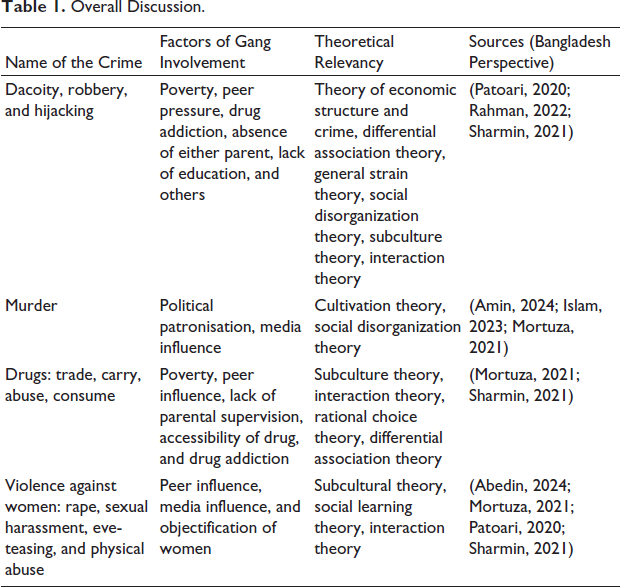
Table 1 highlights key factors contributing to juvenile gang involvement in Bangladesh across different crimes. Socio-economic conditions (poverty, lack of education), peer pressure, drug addiction, and family dynamics are prominent factors in offences like robbery, hijacking, and drug-related crimes, aligning with economic structure theory, differential association theory, and subcultural theory. Murder is linked to political patronisation, media influence, and moral degradation, aligning with cultivation theory. Broadly, subculture theory and interaction theory best explain the widespread factors driving juvenile gang involvement.
Conclusion and Recommendations
Recommendations
Role of Family
Numerous research show that parenting practices like monitoring, supervision, involvement, and strong attachment help reduce the risk of juveniles engaging in delinquency and gang culture (Hoeve et al., 2009; Keijsers et al., 2010). Ara and Mahjabeen (2012) emphasised the importance of a home where children feel safe, heard, and free to express themselves through open and respectful communication. They also encouraged parents to seek professional guidance on choosing age-appropriate video games and TV programmes for their children. Studying a sample of 8,811 Chinese adolescents, Wan et al. (2022) found that those with better family functioning exhibited lower levels of delinquent behaviour, accompanied by higher positive behaviour recognition.
Role of Educational Institutions
Rahman (2022) highlighted several impactful initiatives led by educational institutions, including reforming zero-tolerance policies to reduce school suspensions and expulsions, supporting struggling students, providing juveniles with soft skills and awareness training, and equipping teachers and guardians to handle behavioural challenges and mediate conflicts effectively. Anderson et al. (2003) emphasised that integrating life skills education, such as stress management, emotional regulation, self-awareness, and empathy into the academic curriculum, can play a crucial role in guiding juveniles away from gang involvement.
Role of Police
Islam (2023) stated that the SARA model can provide a structured approach to prevent juvenile gang involvement by addressing the root causes of crime rather than merely responding to its symptoms. This model consists of four key phases:
Scanning: Police can detect juveniles at risk of gang association. Analysis: Underlying factors contributing to gang membership can be examined. Response: Targeted interventions and strategies can be implemented. Assessment: The effectiveness of these measures should be evaluated.
Conclusion
The Bengali phrase Polapan Manush, na buijhya korse (literally ‘innocent child, did not understand his actions’) reflects a prevalent cultural belief that juvenile offenders deserve automatic forgiveness due to their presumed lack of culpability. However, contemporary Bangladesh is witnessing a troubling erosion of this traditional presumption of childhood innocence, as harsh socio-economic realities increasingly expose juveniles to criminal behaviour. The findings of this study illuminate the harsh realities faced by juveniles involved in gangs in Bangladesh, emphasising the root causes of juvenile gangs and urgency for a comprehensive strategy that combines preventative measures. Moreover, this study reveals the need for a collaborative and holistic approach to mitigate the impact of juvenile gangs on the social fabric of Bangladesh. Only through comprehensive reforms can the nation pave the way for a safer and more promising future for juveniles.
Footnotes
Author’s Contribution
The author was solely responsible for the whole research.
Data Availability Statement
This study is based on secondary data obtained from publicly available sources, including journal articles, newspapers, and reports. All data used in this research are properly cited in the reference section. No new data were generated or collected by the author.
Declaration of Conflicting Interests
The author declared no potential conflicts of interest with respect to the research, authorship, and/or publication of this article.
Ethical Considerations
This research is based entirely on secondary data obtained from publicly available sources, including journal articles, newspapers, and reports. No human participants were involved in the study, and therefore, ethical approval was not required. Proper citation and acknowledgement of all sources are ensured.
Funding
The author received no financial support for the research, authorship, and/or publication of this article.
