






Abstract
Sex work is arguably considered one of the most marginalised occupations. Sex workers are discriminated against as the cheapest people, and mostly they are degraded and isolated by society. The main objective of this study is to explore the socio-psychological condition of sex workers, how they manage the dual identities as working women and mothers, and the impacts of their work on their children. The study is qualitative and explorative in nature and used a thematic approach to explore the objectives based on 10 respondents who were mothers. Research findings were placed from the analysis, with 3 main themes and 12 sub-themes; most of the findings were related to the socio-psychological condition of sex workers and the challenges faced when they played dual identities. Given the difficulties that they encounter as mothers and sex workers, widespread services include those for unfavourable living conditions, community conflict, abuse from the madams, past experiences of facing sexual violence and exploitation of children, health, education of children, social collaboration, obstacles, and pressure of family maintenance. This research suggested that the governmental and non-governmental authority should pay more attention to ensure the fundamental rights of sex workers.
Introduction
The most vulnerable category in society is generally agreed to be women, despite not being statistically significant (Nasar et al., 2022). They are approximately equal in number to men, but they are still discriminated against as a minor group (Daniel et al., 2023). If a woman engages in any criminal activity or other bad deed in this circumstance, she will be severely marginalised by society (Putnis & Burr, 2019). ‘Sex work’ is the term for an occupation considered ignominious, also called by different names, such as prostitute, slut, whore, harlot, courtesan, and others (Orchard, 2019). This local term is socially stigmatised, so the prostitutes prefer to introduce themselves as sex workers. Prostitution, on the other hand, has connotations of criminality and immorality (Green, 2016). Many people who sell sexual services prefer the term ‘sex worker’ and find ‘prostitute’ demeaning and stigmatising (Benoit et al., 2017). The dangers of sex work, both physical and psychological, as well as the stigma associated with a ‘spoiled identity’ for sex workers and their families, compound these problems (Goffman, 1963). While trying to avoid stigma, criminalisation, and marginalisation, mothers who work in the sex industry must make an effort to live in a profession that poses risks of violence, substance abuse, and other types of abuse to them and their children (Sultana, 2015). These issues are made more challenging by the potential risks for children associated with living with mothers who are engaged in sex work, which in turn presents care and control, risk, and protection challenges for social workers and other agencies involved in working with them. Many sex workers in this situation lead double lives because they believe they must work to support and maintain their children in a job that could lead to their employment being terminated (Sultana & Scott, 2022).
Female sex workers (FSWs) are estimated to make up 1.1% of women of childbearing age across sub-Saharan Africa, with national figures ranging from 0.3% in Malawi to 2.8% in Burundi. A dedicated regional study in Malawi reported a national average for this demographic at 0.58%. When looking at the broader adult or general population in other nations, sex workers are estimated to make up approximately 0.15% in the UK, 0.11% in Germany, 0.08% in Australia, 0.05% in the Netherlands, 0.04% in New Zealand, and 0.03% in Belgium (Jensen et al., 2025; Laga et al., 2023; Niu et al., 2020). Sex workers’ children experienced identity crises and social stigma as they developed, which frequently resulted in them being denied access to fundamental human rights (Romans et al., 2001). Evidence indicates that every year, more than 20,000 children are born and reside in the 18 red-light districts registered in Bangladesh, where nearly 13,000 become victims of the commercial sex industry. Additionally, those children lead unhealthy lives while daily witnessing their mothers’ exploitation and treating themselves as an extension of that exploitation (Benoit et al., 2020; Daniel et al., 2023). Bangladeshi children who live in brothels have disproportionately little access to schooling (UNAIDS, 2020). A few of the children whose mothers are in the profession of sex work are currently enrolled in government institutions, and they continue to be denied the right to an education (Shohel, 2013). This study has been undertaken to examine the socio-demographic and psychological conditions of the children of sex workers. This research will be instrumental for assisting the government, civil society, researchers, and policymakers to gain a better understanding of the issues of conflicting identities between the roles of sex worker and motherhood in Bangladesh.
Theoretical Framework
Stigmatisation Theory
Goffman (1963) described the concept of stigmatisation. According to this theory, stigma is a phenomenon in which a person who possesses an indicator is stigmatised and rejected by their community. He realised that stigma is a narrow channel through which the response of others obliterates the typical identity. It is considered a label that associates a person with a set of undesirable characteristics that form a stereotype and diminish a person in the mind of others (Lucas & Phelan, 2012). Stigma may have a long-term impact on the FSWs; they face social consequences such as negative views of self, illness, anxiety, depression, and low self-esteem (Dobransky, 2009; Faruk & Rosenbaum, 2023). For the structural stigmatisation of women working in brothels, they do not get access to healthcare, gas supply, or social services. Due to the children not having the exact identities of their fathers, they face challenges; sometimes they are bullied or harassed during admission to educational institutions or accessing other social and cultural facilities (Ma et al., 2018). The stigmatisation theory above the concept is appropriate for this independent study research.
Victimisation Theories
Victimisation is the process of being victimised or becoming a victim. Victimisation studies the process, rates, incidence, effects, and prevalence of victimisation (Janssen et al., 2020). Victimisation includes psychological effects on victims, relationships between victims and offenders, the interactions between victims and the criminal justice system, and the connections between victims and the social groups (Fattah, 1989). Victim precipitation theory, where it is said that the sex-working women’s occupation or activities are involved as a factor of sexual orientation or gender identity (Lasky, 2019). The deviant place theory of victimisation also states that the sex workers are likely to become the victims of violence when they are exposed to violent and dangerous areas (Zhang et al., 2001). The more frequently the sex workers venture into a bad neighbourhood where violent activities are common, the greater the risk of victimisation, although prostitution historically has been a dangerous and risky profession, victimisation of sex workers increased sharply after it was criminalised (O’Doherty, 2011). Sex workers are primarily victims of violence and assaults because of their limited status and credibility in society, and they are less likely to report victimisation for fear of their own arrest (Bowen et al., 2021). Overall, women working in the sex industry face a number of challenges and risks.
Methods
In this study, an exploratory study design has been applied to examine the experiences and challenges faced by sex workers with their dual identities. The qualitative method and in-depth interviews have been conducted through a semi-structured interview guide to gather data. This study is conducted with the aim of exploring the socio-psychological condition of sex workers and how their identity affects their children. Tangail Brothel was selected as the study area, as it is the second-largest brothel in Bangladesh, and there had never been prior research on the identity conflict of FSWs and their motherhood. The data used in this study were derived from primary sources. The population here is unknown, so non-probability sampling was used, and the method was purposive sampling. This research has been ethically approved to collect data from a vulnerable population by the Department of Criminology and Police Science, Mawlana Bhashani Science and Technology University. The Society for Social Service (SSS) deals with the research issues in the brothel; they have helped the authors to collect data for this research, and for this reason, no written consent was taken as per their rules to maintain confidentiality. Interviews were conducted in safe, private spaces facilitated by the SSS. Participants were informed prior to the interview that they could refuse to answer any question or terminate the interview at any time without consequence. All the respondents have verbally consented before the interview. Data were collected from 10 sex workers who were also mothers of their children. Following data collection from respondents, the raw data were sorted, and all recordings were transcribed and translated in order to generate meaning from the data. Based on the commonalities in the speeches of the respondents, several themes and additional sub-themes arose during the coding process, and the narratives were later used as findings.
Findings
In this research, the main objective is to explore the socio-psychological condition of sex workers and how it affects their identity as mothers of their children. In this section, the findings have been analysed from the collected data and provide demographic information, socio-psychological conditions, and challenges faced by the sex workers and their children. This article is classified into 3 main themes and 12 sub-themes.
Socio-demographic Information
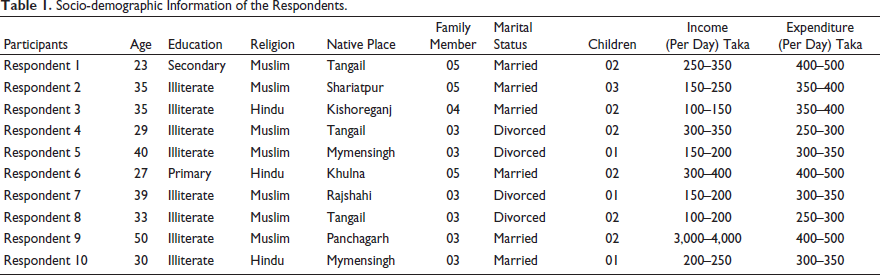
In total, 10 respondents were interviewed in depth. The participants ranged in age from 23 to 50 years old, with the majority falling between 30 and 40 years of age. Demographically, majority of the respondents were married, experienced financial insecurity, and lacked formal education (see Table 1). Notably, most of the participants reported having been subjected to human trafficking by various perpetrators of diverse origins.
Socio-demographic Information of the Respondents.
Socio-psychological Condition
Social Exclusion and Stigmatisation
Sex workers are routinely denied social opportunities; they are socially deprived on a regular basis. Exclusion means excluding any individual from the primary activities of the society. This stigma and exclusion can have a significant impact on the lives of sex workers. Most of the respondents expressed that they encounter difficulties every day and are unable to complete their regular work.
Since I experienced social discrimination almost everywhere, I try to keep my name secret whenever I go to places like the market, the doctor, or a shopping mall instead of hearing a lot of negative words and also abusive behavior. (Respondent 1)
People in the brothel community exclude them from social gatherings, particularly weddings, church services, and cultural events; even their funerals are not attended.
I feel isolated from society and encounter barriers at funeral services. When my mother died, I faced discrimination from the society, and only local residents attended our memorial services. (Respondent 2)
From the beginning of the brothel society, they had no rights, and they still do not have access to their basic rights in the twenty-first century.
Community Conflict
Brothel is a complex and controversial issue, and members of the brothel community encounter a variety of difficulties, including personal conflicts with family members, neighbours, and other people. Conflicts can arise within the community of sex workers.
The brothel community experiences internal conflict from time to time, sometimes because of the customers and other times for other social causes. I once had a similar situation where a repeat client of another sex worker came to me and got into a fight with me. (Respondent 1)
Sometimes conflicts can also arise within the community of sex workers over issues related to safety and health. Some sex workers may engage in risky behaviours, such as using drugs or not practicing safe sex, which can put other sex workers in threatened situations.
Lack of Familial Support
For any woman, being a mother is the source of pride, self-worth, and fulfilment. However, in the brothel, a mother may wear an evil face occasionally to protect her daughter’s life and be forced to participate in this profession.
One day my mother called me in my aunty’s home and offered me to get involved in this work because she felt insecurity about my future, and she thought this profession would secure my life, where I would be permanently working for a lifetime, but when I refused and wanted to continue my studies, my mother physically attacked me and later took me from there and forced me to work in sex labor after I had finished up to the eighth grade. (Respondent 5)
In some cases, family members may be involved in or complicit in prostitution, either through coercion or financial necessity.
My kid is 12 years old, my mother is 69, and my father is 72; none of them are able to work. My spouse also enjoyed gambling. He was worthless because he frequented prostitutes and gambled constantly. So I divorced him. I must survive. I am unable to escape. This is the only kind of income I can make. I can’t take care of my child if I don’t make this money, right? (Respondent 4)
While family support for sex workers may exist in some cases, it is important to remember that sex work is a perplexing issue that requires a multifaceted approach to address effectively.
Lack of Access to Government Facilities
Sex workers often face stigma and discrimination from healthcare providers, which can make it difficult for them to seek the medical care they need. Many sex workers face legal and social barriers to accessing healthcare, such as criminalisation or marginalisation, which can further limit their options.
At Central Hospital, the majority of the time I receive less assistance than other patients if I disclose my identity. This makes me feel inferior and prevents me from receiving excellent care, so I go to the hospital while concealing my identity but spend maximum time going to the community-based health care. (Respondent 3)
As a result of these barriers, sex workers are often at greater risk of health issues such as sexually transmitted infections (STIs), unintended pregnancies, and substance abuse. Efforts to address the lack of healthcare facilities for sex workers must address the root causes of these barriers, including stigma and discrimination, criminalisation, and marginalisation.
Media Representation
Media representation of brothels and sex work can vary depending on the type of media and the specific context in which the representation is being presented. One common trope is the idea of the ‘happy hooker’ or the ‘sex worker with a heart of gold’. This is a portrayal of sex workers as empowered, independent women who are making a choice to engage in sex work and who are able to use their sexuality to their advantage.
Media always represent us negatively with TV shows, movies, and other forms of media. Media portrayals of the sex industry have influenced public opinion in ways that foster sex workers’ dehumanization as well as encourage negative self-perceptions and internalized stigma among sex workers, which also determine structural stigma. (Respondent 9)
Another common portrayal of prostitution and sex work in the media is the idea of the ‘fallen woman’. This is a stereotype that portrays sex workers as victims of circumstance, who are being forced into sex work due to poverty, addiction, or other factors. This portrayal tends to emphasise the negative aspects of sex work, like exploitation, abuse, and coercion.
Sex Worker and Motherhood: Incongruent Identities
Physical and Sexual Abuse
Children who grow up in families involved in sex work are at heightened risk of abuse, neglect, and exploitation due to their caregivers’ occupation.
When my children were 5 years old, a client came to see me, but when my son interfered with the client’s job, the client slapped him; after that, she felt afraid when any clients came to me. (Respondent 7)
Inside the brothel, children are not secure from physical or sexual abuse. Children who are physically or sexually abused are also at risk of developing behavioural problems, substance abuse issues, and engaging in criminal activity later in life.
As we work in this line of work, clients, neighbors, and outsiders are constantly attempting to take a risk on how they mistreat our kids. The clients tried to sexually abuse, teasing, unwanted touching, kissing my 9-year-old daughter, so I had to send her outside of this neighborhood. (Respondent 4)
The effects of physical abuse can be long-lasting and severe, both physically and emotionally. Children who experience physical abuse may suffer from injuries, including bruises, broken bones, and internal damage. They may also experience sentimental and psychological trauma, including anxiety, depression, and post-traumatic stress disorder (PTSD).
Unwanted Pregnancy and Abortion
Abortion is a controversial issue, and different people have different opinions about its morality and legality. Some people may debate that sex workers face unique challenges and may be more likely to experience unwanted pregnancies or may not have access to adequate prenatal care. In some cases, sex workers may also face stigma or discrimination related to their profession, which can complicate their decision-making around pregnancy and abortion.
Although my customers prefer not to use condoms, I am unable to refuse them because I need their money. I’m 35 and have already had three. (Respondent 8)
Induced abortion is prohibited unless the woman is in danger. FSWs frequently experience unwanted births, and the majority of these women opt to terminate their pregnancies due to the effects on their jobs. If they have an unwanted child, they often sell or abandon them under duress from the boss or voluntarily in order to make money and feel better. As they are bonded sex workers (trapped by the brothel owner, forced into commercial sex with no freedom to leave or refuse clients until they pay the debt of the brothel owner), they cannot do anything as they wish (Sandy, 2009).
I committed to my so-called spouse (client), and we both desired to start a family. My intention was to deliver a healthy child into the world and raise them as any other mother would. But since I was a bonded sex worker, I had to comply with my employer’s instructions and transfer the child to a broker because later the child would interfere with my work. (Respondent 5)
Although sex workers sell children under the pressure of a madam or their own decision, both abandonment and sale of children are illegal in most countries and are considered criminal offenses. Children who are abandoned or sold are often vulnerable to a range of abuses, including physical and sexual abuse, neglect, and exploitation.
Exposure to Inappropriate Scenes and Places
A suitable environment is essential for a child’s socialisation, psychological health, and physical well-being. However, as sex workers grow up in an unhygienic, unsafe, and unhealthy environment, brothel kids are more likely to participate in a variety of criminal activities.
We live in a congested, poorly ventilated, dimly lit space split into small compartments by partitions, which are the main obstacles to children’s psychological well-being, even as they grow up in an environment where lifestyle, grooming, language, behavior, and traditions are wholly foreign to the rest of society and are the main barriers for my children. (Respondent 3)
Sex workers may be forced to bring their children with them to work, which can expose them to unsafe environments and potentially harmful situations. Children may be at risk of exploitation or abuse if they are left alone while their parents are working. Growing up in an environment where they regularly see drug abuse, hostility, other sex workers, mothers accompanying the clients, and abusive language has an impact on their psychological well-being and even proper socialisation. The role of sex work can make it difficult for parents to provide adequate care for their children, including safe and stable housing.
Don’t want my kids to find out, so they don’t. I won’t know what to do if they know one day. However, some kids were aware of their mothers’ jobs, and those that were exhibited signs of anxiety and hostility. (Respondent 9)
It can be very challenging for kids to acknowledge that their mother works. When children understand the nature of the work of their mother, they can have long-term negative consequences. After knowing about their mothers’ work, boys began robbing and dealing drugs.
My son grew up with me at the brothel, but when he could understand everything and the nature of my work, he was getting angrier day by day. A boy finds it intolerable when their mothers engage in these kinds of activities with other men. (Respondent 2)
These children may struggle to integrate their identity as the child of a sex worker with other aspects of their identity. Sex workers’ children may experience disruptions in attachment due to parental absence, inconsistent parenting, and exposure to trauma related to their parents’ work. These disruptions can impact their ability to form healthy relationships and regulate their emotions.
My son, who is now 16 years old, became more hostile when his peers found out who I was and made fun of him. (Respondent 10)
The children who experience trauma or stress in childhood may be at risk for cognitive, emotional, and behavioural problems later in life. Sex workers’ children may also face unique challenges related to their parents’ occupation, such as financial instability and mobility, that can make them involved in several types of illegal activities.
Taking Care of Children
Some respondents brought up the fact that they had no one to watch their kids when they had to leave for work. Some sex workers give their kids to a madam to take care of them in return for a portion of their pay.
My mother forsook me at a time when I was a young child with our neighbors, and I grew up to be such a lady. I don’t want my kids to experience it. (Respondent 10)
Some of the respondents shared experiences like that children face bullying and harassment when going to school. Some respondents stated that when we go to admit our children because we do not know their precise father, we experience harassment.
He (the child) will be able to work in any field and remove his mother from prostitution if he receives a degree. We occasionally encounter difficulties because our children’s precise identities and fathers are unknown, and they experience bullying and harassment in regular schools. (Respondent 2)
Another respondent described how her son’s schoolmates and other students made fun of him and accused him of quitting school because his mother works in the profession of sex work. Sex workers’ children are not free from bullying and discrimination. Two major factors, the expense of educating the child and the stigma associated with having a prostitute mother, had an impact on children’s regular attendance at school.
Lack of Proper Nutrition
The nutritional needs of children of sex workers are the same as those of any other child. Some respondents stated that they had struggled to afford alternative nutrition in the form of milk powder because they had been unable to breastfeed.
I was extremely frail and had no milk when my baby was delivered, and I added sugar to water to make a sugar solution for the infant because milk powder was too costly to buy. (Respondent 4)
Breastfeeding provides essential nutrients and helps protect against infections and illnesses. The importance of proper nutrition during infancy persisted. But some mothers noted that, because of the working period, they did not get the time to breastfeed their babies.
Because the expenses are too high, I fill their stomachs with rice, bread, and potatoes. I am unable to provide for my children’s needs in terms of both nutrition and education because of family expenditures. (Respondent 3)
Children had a diet high in carbohydrates and fat with little protein, fruits, or vegetables because their households were low-income. As they age, they exhibit an increased vulnerability to disease driven by childhood nutritional deficits and a cumulative deprivation of developmental support.
The Generational Transmission of Sex Work
Most of the respondents want to ensure the lives and futures of their children. Many daughters had become sex workers themselves, according to the interviewees, either as an outcome of pressure from their mothers or because of unique social circumstances like the stigma associated with being a sex worker’s daughter.
I lived in this brothel for 20 years, so I consider putting my daughter in this line of work to ensure her future. When she was 17, my daughter was currently a sex worker. If a guy marries her without knowing and knows later, he will either divorce her, leave her, or make her become a prostitute. Therefore, it is much preferable that she collaborate with me. (Respondent 9)
The children of sex workers face stigma and discrimination, which can impact their access to education and other opportunities. They may also be at increased danger of abuse and violence. Ultimately, the future of sex workers’ children depends on a complex interplay of social, economic, and political factors.
Discussion
This study found that sex workers face various challenges due to their dual identities as both sex workers and mothers. The aim of the study was to explore the socio-psychological condition of sex workers and their children and how it affects their identities. This study found the respondents faced social stigmatisation such as bullying; sometimes they were not allowed to access social services, they were isolated from the community, and they faced social discrimination as well as deprivation of the basic rights that normal people get, which is similar to the previous study where the institutionalisation of discriminatory norms through law and public policy, socio-economic marginalisation, and negative health outcomes are all very real negative effects that stigmatisation entails at both the individual and structural levels (Benoit et al., 2017). Laws and regulations are typically used to impose structural stigma, making it a potent social driver of inequality alongside other social determinants (Bolster-Foucault et al., 2021).
Second, sex workers experienced internal conflict and family violence, which significantly hampered their ability to lead normal lives. They encountered severe challenges such as exposing their children to an inappropriate environment, life endangerment, physical and sexual abuse, abortion, and child abandonment. Previous research has shown that FSWs were more prone to have a wholly unfavourable experience of motherhood (Billah & Baroi, 2012). As social isolation brings children into a vulnerable position, the vulnerability of the children of sex workers stems from their exposure to various forms of exploitation, including human trafficking, child labour, sexual exploitation, and being forced into criminal activity (Shohel et al., 2012). Finally, findings showed that most sex workers did not properly take care of their children. These kids require specialised care and all-encompassing assistance, and those who set healthcare policy need to pay much more attention to this underserved population. A previous study showed that introducing kids to a dangerous setting where the parenting styles and capacities of some sex workers were negatively impacted by occupational risks and marginalised lifestyles. There are numerous dangers, including STIs, addiction, violence, malnutrition, and their children’s vulnerability and exposure to violence, sex abuse, sexual activity, drug addiction, and involvement in the sex labour (McClelland & Newell, 2008).
In addition to AIDS, youngsters who are the victims of commercial sexual exploitation experience other health and psychological risks. Worldwide, minors who are prostituted have a high prevalence of sexually transmitted diseases like herpes, chlamydia, crabs, gonorrhoea, and syphilis (Flowers, 1998; World Health Organization, 2022). The psychological effects of sexually exploited children, including child prostitutes, can include extreme depression, poor self-esteem, PTSD, and attempted suicide.
Conclusion and Recommendations
Sex workers are positioned in society as a marginalised community. They are deprived of the fundamental rights, government facilities, and social services. Children are exploited in every place and used as child labour and weapons of social politics. Sex workers faced several challenges when playing dual identities, such as a lack of time management. The stigma and rejection of these kids and their mothers pose risks and harms and make it difficult for them to meet their fundamental requirements (Hora, 2026; Platt et al., 2018). Children of the brothel community growing up under this environment were likely to create violence and multifaceted social crimes. Minors are being abused in every place and used as child labour and weapons of social politics. All of the women acknowledged that their kids had gone with them at least once. Sometimes they cannot tolerate clients accompanying their mother and increase their aggression and hostility. Most of the respondents are aware of their children and do not want to participate in this profession; a low number of respondents want to engage their girls to secure their lives. The results of this research showed that there are two categories into which sex workers can be classified: the first category consists of women who engage in sexual activity to meet their basic needs. They keep their job a secret from their kids out of concern for how they will respond if they do so. The second group is open with their offspring about their line of work (Alexander & Fannin, 2014; Canosa et al., 2025).
The government and non-governmental authorities should be concerned about this problem. Necessary steps should be taken to emerge the rights of sex workers and their children at the global and national levels. The government should make efforts to respect, protect, fulfil, and promote the human rights of sex workers. The state needs to be more accountable to give them access to social, economic, and legal entitlements, as most often times they lack access to resources. The promotion of workplace security should be made by the negotiation of owners and managers of sex establishments in order to protect sex workers from violence. Health services should be made obtainable, accessible, and satisfactory to sex workers based on the principles of avoidance of stigma, non-discrimination, and the proper right to health.
Footnotes
Acknowledgements
The authors would like to express their gratitude to Abdul Hamid Bhuiyan, Executive Director of Society for Social Service (SSS), who helped us by giving us his necessary information regarding this study and helped get the permit to conduct this study in Tangail Brothel.
Author’s Contribution
Jannatun Tasmim Joya: Conceptualisation, methodology, literature review, data collection and analysis, writing original draft, and revising draft; Mostak Bari Fahim: Methodology, literature review, data collection and analysis, writing original draft, and revising draft; Nelufer Yesmen: Methodology, supervision, and revising draft.
Data Availability
Available from the corresponding author upon request.
Declaration of Conflicting Interests
The authors declared no potential conflicts of interest with respect to the research, authorship, and/or publication of this article.
Ethical Approval and Informed Consent
This research has been ethically approved by the Department of Criminology and Police Science at Mawlana Bhashani Science and Technology University. All respondents provided informed consent to participate in this research. Individuals who did not provide consent were not approached for data collection.
Funding
The authors received no financial support for the research, authorship and/or publication of this article.
