






Abstract
Citizenship education historically has been the major goal of social studies instruction. What do students understand ‘citizenship’ to mean?
Forty-six students in grades 6, 7, and 8 were interviewed about their emerging concepts of citizenship. Content analysis revealed middle grades students’ understandings of citizenship were expressed through one or more of the following five constructs: helping others, following / obeying laws or rules, being nice / polite, being loyal, or respecting self and others. No correlation was found between students’ ability levels and support for citizenship constructs. Interestingly, gender appeared to play a factor in students’ understanding of citizenship: females were more likely than males to support loyalty as a citizenship construct, and less likely to support helping others or following/obeying rules or laws.
Results of this small study demonstrate middle grades students’ emerging concepts of citizenship are experientially rather than academically based. None of the students interviewed mentioned citizenship constructs supported by the professional literature.
Introduction
The major goal of social studies education traditionally has been expressed as "citizenship education." Citizenship is an abstract term, yet it has been and continues to be included on students’ grade cards in the elementary grades. At the middle school and secondary levels, educators may even offer recognition to students who are honored as "good citizens."
Students must understand the concept of citizenship in order to comprehend democracy, but conceptual understanding of citizenship is not enough. John Patrick, a national authority on citizenship education, states students need to
move beyond conceptual understanding [of citizenship] to learning experiences that develop participatory skills and civic dispositions for exercising the rights and carrying out the responsibilities and duties of citizenship in a democracy (Patrick 1999, p. 2).
Citizenship education has been linked with schooling since the advent of public education in the early American republic (Chapin and Messick 1999, p. 191). Schools as social institutions share the general goal of training young students toward responsive and responsible citizenship; this goal historically has been connected with social studies education (Welton and Mallen 1999, p. 22). If the "core knowledge base" for citizenship education is to be developed it must be through social studies instruction, since "social studies is the only place in the school curriculum where focused inquiry on [citizenship understandings] might be located" (Parker 1990, p. 17).
In 1990, the US president met with state governors to establish Goals 2000 a set of national educational goals and expectations. Goal 3 of Goals 2000 anticipated that, by the beginning of the 21st century, US students would leave grades 4, 8, and 12 having demonstrated competency in core content areas "so that they may be prepared for responsible citizenship... and productive employment in our modem economy" (U.S. Office of Educational Research and Improvement 1990). Summaries of student achievement by the National Assessment of Educational Progress (NAEP), however, revealed high school students’ scores in civics decreased by the end of the twentieth century (Patrick 1993, 1998). In fact, the National Commission on Civic Renewal issued a recent report depicting the declining quality and quantity of citizen involvement. The report warned that "In a time that cries out for civic action, we are in danger of becoming a nation of spectators" (1996). Patrick revealed surveys of students’ "knowledge, attitudes, and actions [about citizenship] reveal serious deficiencies in the citizenship education of young Americans," and advised schools to infuse all areas of the curriculum with lessons about "the responsibilities of citizenship" (Patrick 1991, pp. 1-2).
National standards for social studies education identify citizenship as a basic standard for social studies instruction at all grade levels (National Council for the Social Studies 1994). Methods text authors and others who emphasize social studies instruction define citizenship as:
knowledge, skills, values, and dispositions related to democratic participation, including informed decision making (Parker 1999; Remy 1980);
democratic values, such as freedom of speech, religious freedom, and equal protection under the law (Dayton 1994); concern about the welfare of others and the common good (Gross and Dynneson 1991; Engle and Ochoa 1988);
knowledge and ability to understand experiences and events from multiple perspectives, and willingness to suspend judgment (Welton and Malian 1999; Banks 1997).
With proper instruction, students in the middle grades should be able to know, understand and use ten separate citizenship education constructs (see Table 1). No single textbook or course of study can elicit student behaviors that guarantee their development of productive citizenship understandings and behaviors. Teachers must select from a variety of curricular approaches and resources to plan effective citizenship based instruction (Welton and Malian, 2001). Some experts even assert that, unless young students acquire the essential understandings of social studies during their elementary and middle school years, they will not develop the informed decision making demanded of good citizens (Stockard 2001, pp. 22-23; Farris 2001, p. 18; Linn 1990, pp. 49-50).
Performance Expectations for Civic Ideals and Practices (Middle Grades)
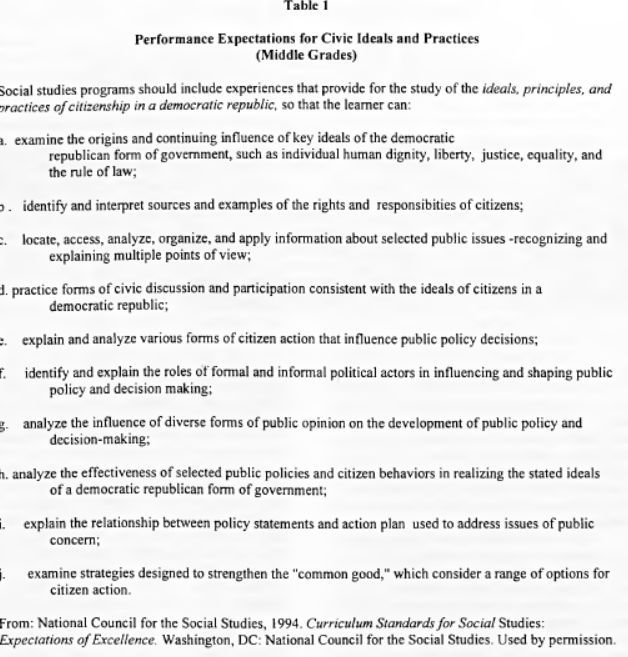
From: National Council for the Social Studies, 1994. Curriculum Standards for Social Studies: Expectations of Excellence. Washington, DC: National Council for the Social Studies. Used by permission.
The social studies literature suggests young students can and must be taught essential understandings of good citizenship. But what do students themselves know about citizenship?
Background of the Study
A number of studies conducted in the past twenty-five years provide educators with vital information about how children conceptualize information (see Driver and Easley, 1978; Driver and Erickson, 1983; and Osborne and Freyburg, 1983). Although most of the research conducted dealt with children’s understanding of science concepts, these studies spawned research agendas which explored the development of conceptual understanding in other content areas (Novak, 1988; Hickey and Bein, 1996). This study adds to the knowledge base of children’s understanding of key social studies concepts by exploring emerging concepts of citizenship at the middle grades level.
The term emerging concepts is defined as children’s processing or making sense of the natural world (Muthukrishna, et al, 1993). The following questions served as the basis of the study:
What are young adolescents’ emerging concepts of citizenship in grades 6-8?
What patterns, if any, are represented in young adolescents’ thinking about citizenship?
What role, if any, do young adolescents’ academic ability levels play in their emerging concepts of citizenship?
Methodology
Forty-six students in grades 6-8 in a suburban middle school in a midwestem state comprised the participants in this study. Potential participants were identified by homeroom teachers, who also supplied information about participants’ ability levels. High ability students were identified as those who were either enrolled in the school’s academic enrichment program, or who had been nominated for the enrichment program. Low ability students were those who had been identified as being academically at-risk for failure, either through a school-wide screening program or by a special education teacher. Average ability students were those who fell between these two extremes. Fairly equal numbers of high, average, and low ability students were represented in the final sample. Twenty-three participants were male, and twenty-three female. Twelve sixth graders, eighteen seventh graders, and sixteen eighth graders participated in the study.
The "interview-about-instances" technique (Osbome and Gilbert, 1980) was used to collect information about participants’ emerging concepts of citizenship. This technique places emphasis on eliciting children’s ideas of phenomena, however uninformed those ideas may be. The interview-about-instances technique focuses primarily on exploring concepts a child associates with a particular word or phrase, and so was ideally suited to the intent of this study.
A series of prompting questions was designed to facilitate the interviews; these questions were clarified by researchers following a pilot study. The students, all of whom were voluntary participants, were interviewed over a ten-week period. All interviews were conducted one-on-one in a private setting during the "free" period of students’ gym class. The interviews were recorded on audiotape and later transcribed. On the average, each interview lasted 20-30 minutes.
Findings
Interview transcripts were subjected to content analysis by the author and two research assistants, resulting in an interrater reliability index of .93 (see figure 1). A pattern of five constructs emerged from participants interviews. Two constructs received major support from participants, and three received minor support. Fifty-four percent of the students interviewed believe good citizenship entails helping others. Forty-one percent believe good citizenship involves following / obeying laws or rules. Minor support was given to being nice/polite (17%), being loyal (15%), and respecting self and others (13%).
Examples of Students’ Responses to the Question: "What Do You Think It Means to Be a Good Citizen?" "What Do You Think It Means to Be a Good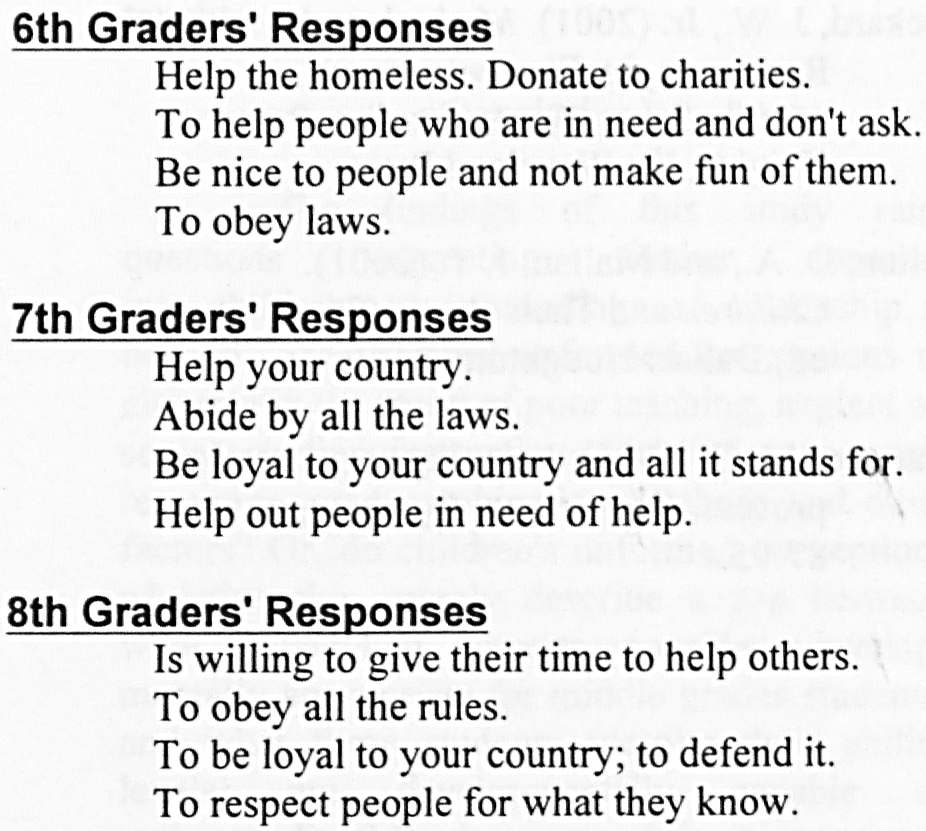
An analysis of response patterns by ability level was not conclusive. Gender, however, seemed to be a determining factor for some of the constructs. This was an unexpected finding, as gender was not originally a part of the guiding questions for the study. Helping others was supported by 54% of the group as a whole, for example. Sixty-one percent of the male participants supported helping others, while somewhat less (48%) of the female participants supported helping others as a vital construct to good citizenship. Fifty-two percent of the males believed following/obeying laws or rules is vital to good citizenship, while only 30% of the females agreed. The one pattern of response females supported more strongly than males was that of loyalty. Interestingly, loyalty was mentioned or referred to only by students from grades seven and eight (see figure 2).
Response to Citizenship Constructs by Grade Level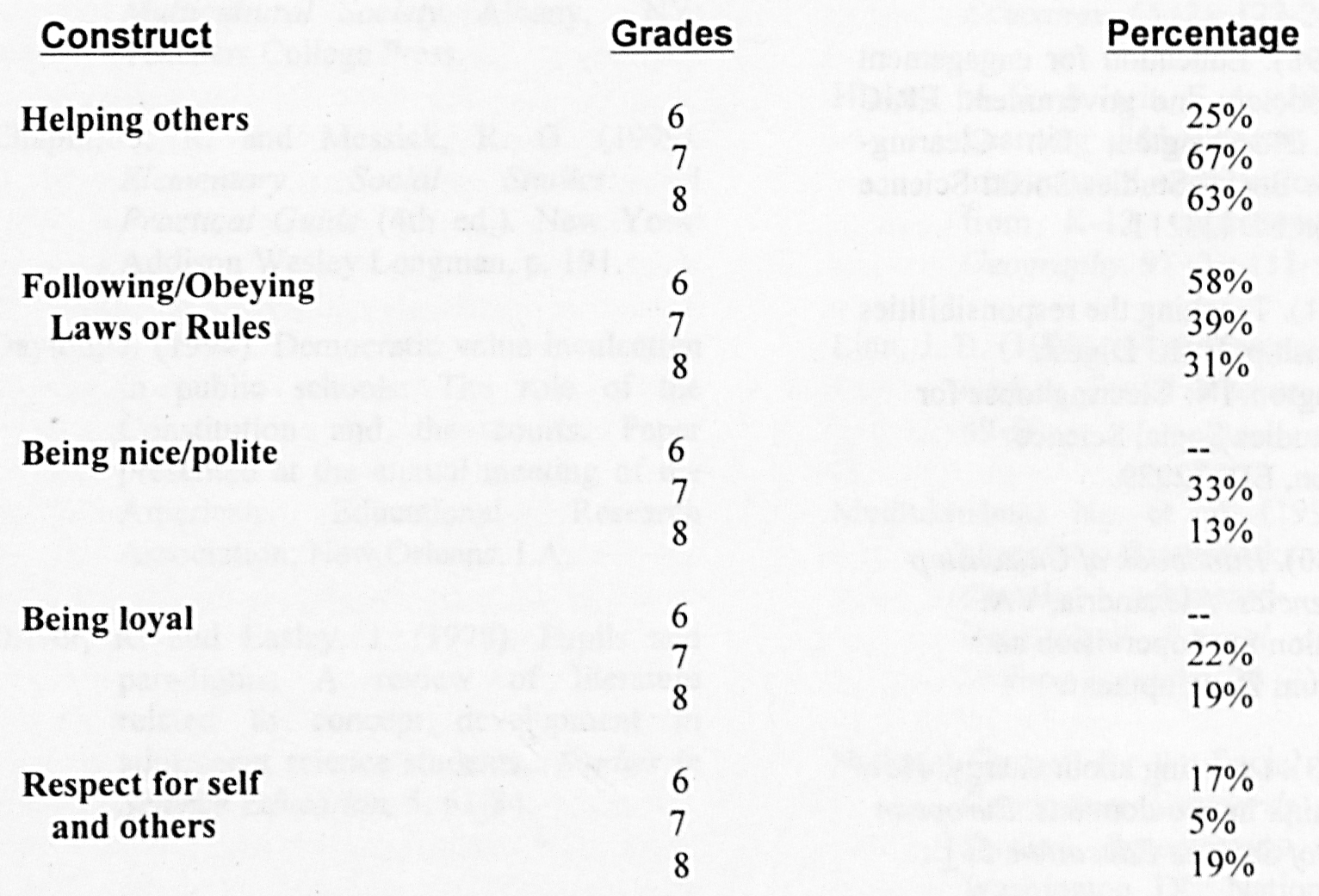
Discussion
The National Council for the Social Studies defines the standard of citizenship in the K-12 curriculum as being related to the themes of culture and power, authority and governance (1994). General themes or constructs of citizenship identified by the young adolescents in this study tend to be more reflective of commonly accepted democratic values. For example, those values dealing with acceptable behavior in human interactions, such as caring for the homeless and elderly, being obedient to authority, and behaving politely toward others, were more widely supported by study participants than values associated with the themes of power, authority and governance. When participants’ constructs are compared with curricular standards (National Council for the Social Studies 1994) or basic competencies of citizenship education (Parker, 1999; Remy, 1980), the emerging concepts of citizenship espoused by young adolescents in this study seem shallow and unformed. More than half of the participating sixth graders, for example, supported constructs of citizenship having to do with following or obeying laws or rules. Two-thirds of the seventh graders in the study supported citizenship constructs dealing with helping others. None of the participants at any grade level discussed citizenship constructs supported in the literature.
Participants in this small study represent learners at the middle grades level who were enrolled in departmentalized social studies classes where instruction focused on traditional social studies content. No attempt was made by researchers to gather information about participants’ social studies instruction in the elementary grades. Social studies curriculum experts agree that children at the middle grades level are developmentally capable of dealing with academic constructs of citizenship, such as governance and power. Although small in sample, the results of this study seem to indicate that students who have acquired seven to nine years of formal schooling in the United States have not yet formed a cogent understanding of citizenship -- in spite of the fact citizenship theoretically has been the guiding concept behind social studies learning during these years. Participants in this study have not yet made a successful transition between the life-world thought domain and the academic thought domain identified by Wittrock (1974): these middle grades students’ understandings of citizenship have continued to be experientially, rather than academically focused. This finding supports Haas and Laughlin’s recent research (2001), in which teachers surveyed neglected to identify citizenship -- or civics-centered instructional units among social studies topics taught.
Conclusion
The findings of this study raise questions suggesting further research into children’s understandings of citizenship is needed. Are students’ unformed conceptions of citizenship the result of poor teaching, neglect of social studies instruction, lack of appropriate resources, or a combination of these and other factors? Or, do children’s unformed conceptions of citizenship merely describe a gap between what curriculum experts consider develop-mentally appropriate for middle grades students, and what these students (despite their ability levels) are developmentally capable of understanding? Further research in this area will be required to answer these important questions regarding children’s understanding of a key social studies concept.