






Abstract
This study seeks to understand the ways nine states represent African Americans within their standards for U.S. History. Previous research on the effects of high-stakes assessment on social studies educators suggests teachers align their instruction with information found in state standards. Therefore, an understanding of the way African Americans are represented in state standards may lead to a better understanding of how teachers portray African American history in their classrooms. The states included in the study, California, Georgia, Indiana, New York, North Carolina, Oklahoma, South Carolina, and Virginia, all annually assess students and teachers though end-of-course assessments. For each set of standards, all references to African Americans were coded and then categorized. Additionally, all references to individual African Americans were noted and analyzed for patterns. The results suggest that the states tend to focus on instances and individuals associated with African American oppression or liberation and largely avoid societal and cultural contributions. Therefore, it is suggested that states reframe their standards to include more explicit references to cultural accomplishments of African Americans.
Introduction
While No Child Left Behind may only measure student performance in reading, and mathematics, most states have restructured their social studies curricula in the spirit of standards-based instruction. Several states include social studies in their assessments of school performance, which are based on end-of-course student examinations that measure content knowledge. Therefore, despite the lack of national attention, social studies educators have experienced the same narrowing of curriculum as their more heralded counterparts (Ross, 2006).
Such restrictive practices are problematic for a discipline often engaged in political debates about the inclusion of particular voices. As Fore's (1998) account of the adoption of the Virginia Standards of Learning for social studies depicts, the politics of education are often heated, yet the process of developing standards is often selective. Too often, the voices of a few speak for everyone. The resulting curriculum serves as an authoritative view of history as seen from the lens of the middle-class, male, European-American majority. Such a revelation is by no means new. However, standards-based education has intensified these issues by forcing teachers to align their instruction to the master narrative in order to ensure student success on standardized assessments.
Although no curriculum can be entirely inclusive, the political decisions that perpetuate the traditional canon in public education too often exclude the voices of marginalized Americans in society. LaSpina (2003), in a study of textbooks, argues that this distortion in representation translates to a grand narrative that continuously places minority groups in positions of victimization and oppression. Others echo similar arguments regarding the way educators often portray minorities and indigenous groups in the classroom (Alridge, 2006; Ladson-Billings, 2003; Loewen, 1996). Although the issue of representation is a global phenomenon (Ahonen, 2001; Al-Haj, 2005), within the United States, the most intense debate regards the teaching of American history.
Proponents of the traditional version of American history point to repeated references of the plight of Native Americans and African-Americans as examples of diversity within the curriculum. To that end, Epstein (1998) asks a fundamental question regarding the nature of minority inclusion in U.S. History curricula; should marginalized groups be included for their contributions to the economic, cultural, and political fabric of our nation, or should they serve as both reminders and exemplars of historical oppression in the United States? To focus exclusively on the latter leaves gaping holes in the minority narrative, forcing students to view members of traditionally oppressed groups as significant only during times of oppression or liberation. While struggles for freedom and equality should not be dismissed, standards should also focus on explicit ways minorities have helped shape our modem nation.
That question serves as the focal point for this research. This study analyzes nine state social studies standards based on their representation of African-Americans in their U.S. History curricula. These nine states, California, Georgia, Indiana, New York, North Carolina, Oklahoma, South Carolina, Texas, and Virginia, represent diverse geographic and cultural influences. Additionally, these nine states all incorporate end-of-course assessments that hold teachers and students accountable for content knowledge. Using these state standards, I seek to answer the following questions: a) how do the respective standards represent the history of African-Americans in the United States? b) to what extent do the standards place African-Americans in positions of victimization or oppression, as opposed to celebrating their contributions to American society? and c) how do the standards attempt to individualize African-Americans in American history? The answers to these questions will aid in determining differences among states in their depictions of African-Americans in American history and will provide insight into the inclusion of African-Americans in the master narrative often utilized in public education.
Review of Related Literature
The Nature of Standards-Based Assessment in Social Studies
Testing has become an effective way for all levels of government to control curriculum (Mathison & Fragnoli, 2006). In the decades following A Nation at Risk, the public increasingly placed blame on teachers for student deficiencies, prompting legislators to propose standards as a way of maintaining quality within public education (Fore, 1998). One argument for standards is that they provide a starting point for teachers and students in the hope that basic standards will help close the achievement gap, leading to higher achievement among American students as a whole (Mathison, Ross, & Vinson, 2006). Yet, over a decade after states first began drafting curriculum standards, many have questioned the ability of standards to promote educational equality (Darling-Hammond 2004; 2006; Ladson-Billings, 2006; Ryan, 2004). Moreover, Ravitch (1996) argues that standards allow for curriculum equality by providing a coordinating function for states. In theory, standards should ensure that students are learning comparable information in all disciplines regardless of where they reside.
Within social studies, the impact of standardization remains debatable. Ross (2006) dismisses the perceived impact of standards in social studies by making a distinction between the formal and enacted curriculum. While he acknowledges that standards have narrowed the formal curriculum, Ross postulates that most teachers simply use standards as a frame of reference and enrich the formal curriculum with their own ideals and methods. In most cases, according to Ross, this enacted curriculum differs considerably from basic state standards.
Others disagree, claiming that increased pressure to ensure students demonstrate content knowledge on state assessments has blended the formal and enacted curriculum (Vogler & Virtue, 2007). The literature is filled with examples of social studies teachers abandoning preferred teaching methods in favor of rote memorization of required content (Grant, 2001; Kahne, Rodriguez, Smith, & Thiede, 2000; van Hover & Pierce, 2006; Segall, 2003; Vogler, 2005; Yeager & van Hover, 2006). In perhaps the most telling example, van Hover and Pierce (2006) monitored first-year history teachers and found that as the year progressed, the teachers lost their idealistic approaches to instruction and began obsessing about the ramifications of state assessments. The teachers soon changed their instruction from a student-centered, discussion-oriented style to one characterized by rote memorization and biweekly quizzes of content knowledge.
Sleeter and Stillman (2005) suggest that the amount of information required by states affects teacher autonomy. The authors distinguish between what they call strong and weak framing. The former limits teacher influence by narrowly defining topics and listing copious amounts of information in an effort to control variances in content from teacher to teacher. Weak framing presents topics broadly, includes only key facts, and allows for more curriculum decisions at the classroom level. Extreme framing in either direction is not desirable; standards that are framed strongly limit teachers' creativity and influence, while weakly framed standards create gaps that may be too wide for teachers to fill on their own. Given the apparent influence standards have on social studies teachers' actions, the way individual states frame their standards may act as the most salient determinant of the way certain topics are handled in the classroom.
Benefits of Diversity within the Curriculum
Multiculturalism is part of a liberal philosophy of education that seeks to challenge the civic republicanism of traditional American curricula by promoting diversity and tolerance (Abowitz & Harnish, 2006). Liberals view education as a forum for expanding horizons, deliberating over issues, and understanding values different from one's own (Gutmann, 1987; Gutmann, 2004). This is not to say that conservatives oppose ideas of diversity; however, conservatives feel that patriotism and knowledge of the traditional canon best promote the national interest and should supersede issues of culture (Holmes, 2001; Ravitch, 2006).
Ogbu (1992) argues that the type of curriculum taught in schools is particularly important to minority students. Ogbu (1987, 1992) supports this claim by making a distinction between voluntary and involuntary minorities. He defines the former as those immigrants who willingly entered the United States in a search for the American dream of a better life. The latter are groups, such as African Americans and Native Americans, who were forcefully oppressed or brought to this nation against their will. Ogbu (1992) contends that involuntary minorities often face problems in school based on the clash between their home culture and the mainstream culture taught in public education. He advocates a curriculum of inclusion, although one that does not simply call attention to cultural deficiencies or oppression, such as slavery or forced relocation. Instead, a multicultural curriculum that promotes cultural accomplishments may make involuntary minorities more comfortable with educational institutions by giving those students a feeling of representation and agency within the classroom.
Multicultural education does not exclusively benefit students of color. Wills (1996) argues that White students also benefit from understanding minority voices and culture. Such an understanding allows White students to better understand current racial issues. Too often White students cannot empathize with minority concerns, either because they live and attend school in predominately segregated areas or they have never experienced the multitude of issues that marginalize people of color on a daily basis (Marri, 2005).
Studies on African Americans in high school U.S. History courses support these notions. In separate studies, Epstein (1998; 2000) observed that African American and White students differed in their opinions of salient issues in American history. While both groups viewed Martin Luther King Jr. as an important figure, White students tended to name George Washington and John F. Kennedy in contrast to Harriet Tubman and Malcolm X, who were listed by the African American students. Similarly, African American students cited the Civil Rights Movement, Civil War, and slavery as significant events in American history, while White students chose the Civil War, Declaration of Independence, and Revolutionary War. Additionally, in a study of African American youth and their perceptions of citizenship, Cooks and Epstein (2000) report that few African American students believe equality exists in the United States based on what they see, both in society and in the classroom.
Various methods of teaching American history have framed the history of African Americans differently. The most widely used model suggests that African Americans struggled to overcome governmental and societal oppression. This model acknowledges the horrific conditions placed on African Americans, but argues that democratic notions of individual rights and equity led the fight for freedom. A second perspective views the fight for equality as an ongoing process, indicative of a flawed democratic system that nonetheless strives for perfection. This model often looks beyond specific instances of oppression in an effort to avoid framing injustice as time-specific. A third, seldom used, method is teaching American history from an African American perspective. This method presupposes that curricula is Euro-centered and advocates White supremacy, which must be counterbalanced by avoiding the traditional canon completely (Epstein, 1998). Finally, others advocate a critical race theory approach that attempts to challenge majority viewpoints based on a study of the legal oppression of minority groups. Critical race theory urges teachers to treat oppression as a socially constructed ideology that panders to the will of the majority (Lintner, 2004). In practice, however, most standards do not fall neatly into one of these prescribed theories. Therefore, depictions of African Americans in American history tend to vary from state to state.
Method
Data Collection
I analyze nine states identified by a report for the Department of Education as having established end-of-course student assessments in U.S. History. These states annually measure student and teacher performance using formal examinations, and many of the assessments have graduation implications for students (Education Commission of the States, 2002). Since these states hold teachers accountable for student knowledge, they offer the best representation of how formal curriculum can effectively influence instruction that students receive in the classroom (Vogler & Virtue, 2007).
The nine states listed by the report and used in the present study are: California, Georgia, Indiana, New York, North Carolina, Oklahoma, South Carolina, Texas, and Virginia. I accessed each state's standards for U.S. History from their respective state department of education website, focusing only on secondary curriculum. Five of the states (GA, IN, NC, SC, and VA) teach U.S. History as a one year course, usually during the junior year of high school. Three states (CA, OK, and TX) split U.S. History into two courses, using Reconstruction as the dividing point. The first half is taught in eighth grade with the concluding portion taught in eleventh; I used both sections of the course for analysis. Finally, New York divides their U.S. History curriculum into two sections labeled “intermediate” and “commencement” with no historical dividing point. Instead, New York encourages teachers to focus on various themes as students progress through high school. One limitation of this study is that I rely solely on the standards as they are portrayed on the respective state's department of education website. This does not take into account any supplemental information states or districts give their American history teachers.
Analysis
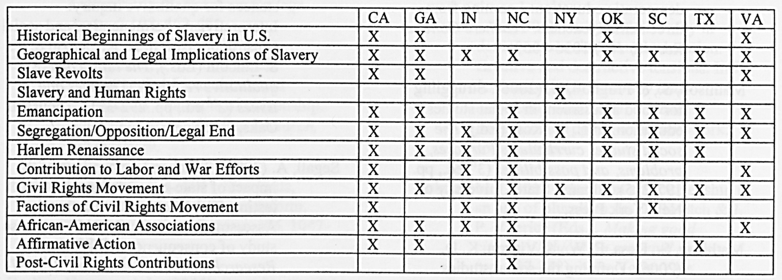
The analysis of each set of standards focused on two main aspects. Using an interpretive framework (Schwandt, 1994; 2003), I looked for patterns within the data regarding the representation of African Americans. I developed 13 categories, which can be seen in Table 1, and then coded all references to African Americans in each state's standards as corresponding to a specific category. Eight of the categories dealt with instances of oppression or emancipation. The remaining categories celebrated African American achievements and contributions or, in the cases of affirmative action and African American associations, dealt with modem issues affecting African Americans.
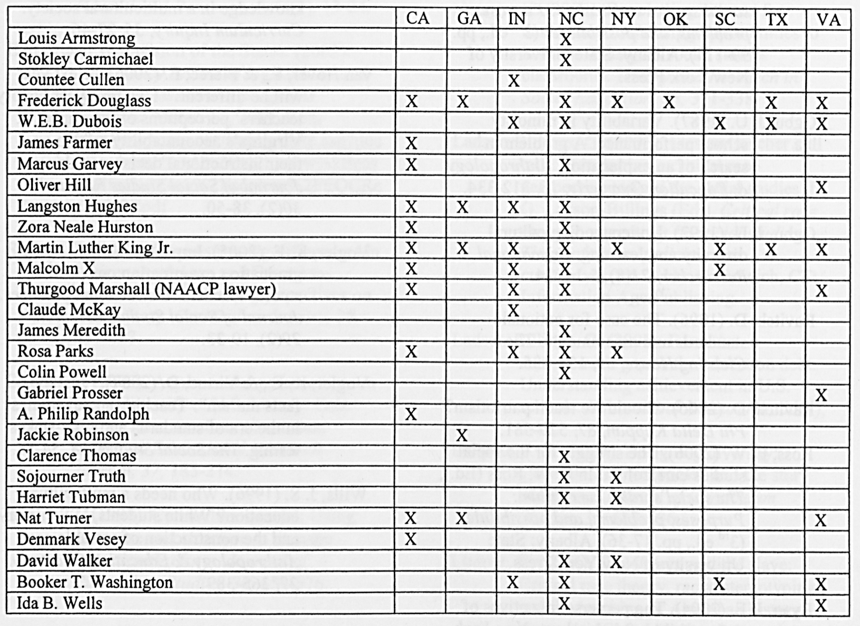
I then noted all references to African American individuals within each of the standards. A total of 28 African Americans were mentioned within the combined nine state standards. I then noted instances where the same person was mentioned in more than one set of standards in order to better compare the personalization of African Americans among the various states. Table 2 lists each individual and the corresponding state(s) in which they were mentioned.
Results
Oppression and Emancipation versus Culture and Contribution
Among the nine state standards, I uncovered numerous references to African Americans. Much of the content overlapped from state to state; however, each state represented African Americans in their own way, as shown in Table 1. Therefore, instead of simply listing ways in which the states differ, I wish to synthesize the overall depictions of African Americans in the standards of these particular nine states, with the understanding that the subsequent accounts do not attempt to list or describe every instance pertaining to African Americans. Instead, I seek to portray common themes of representation using the categories listed in Table 1. (See Table 1 at the end of this text)
The only topics explicitly mentioned in each of the state standards are slavery, segregation, and the Civil Rights Movement, all of which focus on the struggles of African Americans to gain equality. While all of the states address slavery, they appear to do so through different means. The majority of states focus on the geographical and legal implications of slavery, such as the Missouri Compromise of 1820, the Compromise of 1850, and the Dred Scott v Sanford decision. Only three states place slavery in a historical context. Georgia and Virginia both highlight 1619 as the first time African slaves were brought to the colonies. Both states also include descriptions of the terrible journey through the Middle Passage from Africa to the New World. Those two states are joined by California in describing how slaves factored into the decisions of the founding fathers when framing the Constitution as evidenced by the 3/5 Compromise. Oklahoma addresses the plight of slaves during the American Revolution. New York takes a stance unique to the rest of the states in that they call for teachers to describe chattel slavery as a human rights violation.
Treatment of segregation and the Civil Rights Movement occurs in a similar fashion as states focus on the implementation of Jim Crow laws following the end of Reconstruction. The states then highlight the legal decisions in both Plessy v Ferguson and Brown v Board of Education before progressing into the nonviolent protests of Martin Luther King Jr. and the eventual signing of the Civil Rights and Voting Rights Acts in the mid 1960s. However, only four states, California, Indiana, North Carolina, and South Carolina, address competing factions of the Civil Rights Movement. All four states include Malcolm X and his contradictory stances to the leadership of King. None of the states include more militant approaches to the Civil Rights Movement such as the Black Panthers.
Inclusion of cultural contributions from African Americans appears less uniform among the states. The Harlem Renaissance is mentioned by seven states, but beyond the 1920s, African American contributions receive noticeably less attention. Only four states highlight the selflessness of African Americans aiding a nation that deemed them second class citizens. North Carolina and California include the Buffalo Soldiers that helped police the West after the Civil War. California and Virginia highlight the bravery of the Tuskegee Airmen during World War II, while both Indiana and Virginia also acknowledge the willingness of African Americans to enter the workforce during World War II to aid the wartime economy.
While five states include references to African American organizations, their inclusion is largely limited to the National Association for the Advancement of Colored People (NAACP). Only Indiana, in addition to the NAACP, mentions the Congress of Racial Equality and the National Urban League as powerful groups lobbying for the interests of African Americans. Modem African American issues and contributions receive arguably the least amount of attention among the standards. Despite ongoing debate over the merits of affirmative action in the United States, only four states deem the issue salient enough for inclusion in their standards. Moreover, only North Carolina includes accomplishments of African Americans beyond the Civil Rights Movement. They include the entry of Clarence Thomas to the Supreme Court and Colin Powell as the first African American Secretary of State.
Inclusion of Individuals
The inclusion of African Americans within the standards varies considerably among the states. Table 2 includes all African Americans found within the nine state standards and the respective states in which they are found. (See Table 2 at the end of this text)
Martin Luther King Jr. and Frederick Douglass are the most cited African Americans in the nine standards, with eight and seven mentions each, respectively. Beyond those two individuals, the individual with the highest number of citations is W.E.B. Dubois with five. Even among civil rights activists, individual recognition appears far from uniform. Rosa Parks only receives mention in four states, placing her alongside Booker T. Washington, Malcolm X, and Thurgood Marshall. Yet, other recognizable activists such as James Farmer, Ida B. Wells, James Meredith, and Stokley Carmichael are only included in one or two states' standards.
A similar phenomenon occurs with abolitionists. Douglass is mentioned seven times but the number of African American abolitionists mentioned beyond Douglass sharply declines. Harriet Tubman, David Walker, and Sojourner Truth all are mentioned in two states. In contrast, there are more references to Nat Turner, who led a bloody insurrection in 1831, than any of the abolitionists except Douglass. Other leaders of failed slave revolts, Gabriel Prosser and Denmark Vesey, are mentioned in Virginia and California, respectively.
Focusing on the individual states, Georgia, New York, and Texas, only associate King with the Civil Rights Movement of the 1960s, failing to include other individuals that contributed to the effort. Oklahoma does not even mention King; instead the state makes a sweeping reference to de jure and de facto policies affecting African Americans after World War II. Similarly, Georgia, Oklahoma, and Virginia only reference Douglass as the sole African American influence on the abolitionist movement. Indiana and South Carolina do not include Douglass or any other African American abolitionists.
References to individuals who influenced American culture and society receive considerably less attention from the states. Langston Hughes sets the standard with references in four states. While the Harlem Renaissance is mentioned by seven of the states, few references to individual efforts during that period are mentioned by those states. Only Hughes and Zora Neale Hurston are mentioned in more than one state, with Hurston only referenced in California and North Carolina. Other Harlem Renaissance artists and writers, Louis Armstrong, Claude McKay, and Countee Cullen, are only included in one set of standards each. It is also noteworthy that four states include Thurgood Marshall, although for his work as lead council for the NAACP in the Brown case, not for his appointment as the first African American Supreme Court justice. Finally, only Georgia includes Jackie Robinson breaking the color barrier of the national pastime, arguably one of the strongest statements against segregation prior to the Brown decision.
Discussion
These results are not meant to draw comparisons among the states included in the study. Trying to create perfect standards is a futile endeavor as no set of standards can ever be entirely inclusive. Moreover, standards do not serve as the only narrative present in a classroom. For example, Oklahoma never mentions Martin Luther King Jr. by name in their standards, yet it seems unreasonable for even the poorest of teachers to explain the Civil Rights Movement without mentioning King's influence.
However, teachers can, and routinely do, teach the Civil Rights Movement without mentioning important contributions of other individuals, such as Stokley Carmichael, Malcolm X, and even Rosa Parks. Therefore, instead of scrutinizing individual states over their specific lack of inclusion, the more useful way to discuss these results is by looking at overall patterns relating to the representation of African Americans in state standards. If, as studies (Grant, 2001; van Hover & Pierce, 2006; Volger, 2005; Yeager & van Hover, 2006) suggest, teachers adapt their instructional methods to align with content found in state standards, then an understanding of how states depict African Americans provides a better understanding of how African Americans are represented in classrooms.
To answer the question posed by Epstein (1998) presented at the beginning of this paper, African Americans in state standards are often represented as either oppressed or fighting to free themselves from oppression. All of the states cover slavery, segregation, and the fight for civil rights, as they all should. However, states mention these hardships without equal recognition of cultural, political, or economic achievement by African Americans. It does not seem coincidental that the two individuals displayed most prominently within these states are a civil rights leader and an abolitionist. While King and Douglass deserve their place alongside Hamilton, Lincoln, and Roosevelt, where are the African American equivalents to Thoreau, Edison, and Ruth? African American authors, entertainers, and inventors often are not household names, and this study suggests that such ignorance may be partly influenced by the version of American history students learn in school.
This representation of African Americans also creates several pedagogical concerns. As Ogbu (1992) contends, minority students have a vested interest in how they can identify with the curriculum. If all students see in their history classes are instances of African American oppression or liberation, they may feel that the plight of African Americans in the United States is nothing more than a constant struggle for freedom. As the study by Cooks and Epstein (2000) shows, African American students observe at an early age that society does not always treat everyone equally; they do not need their history courses to constantly reinforce that notion. Instead, students need their history curriculum to also highlight examples where African Americans contributed both to society and the overall American experience. Such instances allow students to realize that they have a voice and can succeed despite the actions of those in power. Hearing how individuals like Hurston or Jackie Robinson flourished even within the confines of segregation can inspire future generations of African Americans to aspire to greatness.
From a historical perspective, the way states represent African Americans may create issues in historical understanding for all students. First, only three states provided a historical context for chattel slavery. Students need to understand why slaves were brought to the colonies and how their initial interactions in the New World influenced the way African Americans would be treated for the next two centuries. Waiting until the invention of the cotton gin to talk about slavery sends the message to students that slavery occurred out of immediate necessity. While the cotton gin elevated the demand for slaves, plantations in the South had become economically dependent on slavery over a century earlier.
Similarly, the fact that only one state, New York, specifically decrees chattel slavery as a violation of human rights sends a mixed message to students, particularly when studying examples of modem human rights violations. When students hear modem events, such as the Holocaust or genocides in African nations, described as human rights violations and not slavery, it suggests that the institution of slavery was less significant or not as terrible as these more recent events. In other words, most states portray slavery as an undesirable occurrence in American history that was eventually rectified, albeit following a bloody conflict. This version of history does not question the morals of those who both owned slaves and permitted slavery to legally exist.
Additionally, the lack of inclusion of prominent African Americans often sends a simplistic message to students regarding the nature of African American history. When states only focus on Frederick Douglass and Martin Luther King Jr., they portray monumental events such as the abolition of slavery and the Civil Rights Movement as being the sole work of dynamic individuals. Students need to know that such movements were the result of actions of ordinary Americans, White and Black, and that they sought leadership from multiple sources. Failing to mention factions of the Civil Rights Movement suggests that all African Americans eagerly followed King's lead when, in fact, many believed King's nonviolent tactics did not progress the movement quickly enough. Perhaps the greatest example of the diverse nature of leadership during the Civil Rights Movement came during the celebration of Rosa Parks following her death in 2005. Parks became the first woman and second African American to lie in state at the Capitol, yet only four states felt her worthy of inclusion in their standards.
Finally, the lack of emphasis on modem African American issues sends the message to students that racial inequality ended with the Voting Rights Act of 1965. Recent events, such as criticism of the government in the wake of Hurricane Katrina, suggest otherwise. As Wills (1996) and Marri (2005) both note, the greatest beneficiaries of increased attention to modem African American issues may be White students who may have never considered effects of racism and prejudice on society. While their parents and grandparents may have memories of a segregated society, our current generation of students has lived in an “equal” society their entire lives. By understanding how far African Americans have come in the relatively short history of the United States, White students may develop a better understanding of current issues such as affirmative action.
Even with this knowledge, trying to make standards more inclusive remains a lofty goal. States wish to maintain flexibility over what their students learn, which will always create variances in information from state to state. Occasionally, as in the case of Oliver Hill in the Virginia standards, these differences seek to illustrate important issues or individuals pertaining to that state's history. Yet, with respect to fundamental elements of American history, a common narrative is desirable. Students in Oklahoma should have the same knowledge of the Civil Rights Movement as students in California. However, such a goal cannot exist without instituting a national curriculum, a position that I do not advocate, nor do I think is politically feasible. Instead, states should lean to the side of caution when developing history standards and avoid standards that are weakly framed (Sleeter & Stillman, 2005). While standards should not be framed so strongly that they stifle teacher creativity, they should be extensive enough that teachers are forced to promote a minimum level of diversity within their classroom. Based on the current study, states should specifically include more references to cultural contributions of African Americans to counter the instances of oppression and liberation that already exist. African Americans have long constituted an influential portion of American culture, a fact that should be celebrated and evidenced to our students within their history curriculum.
Conclusion
An analysis of nine states that incorporate end-of-course standardized assessments revealed discrepancies in the representation of African Americans within their American history curricula. States tend to focus on instances of oppression and subsequent struggles for freedom, with slavery, segregation, and the Civil Rights Movement receiving the most attention among all of the states. References to cultural contributions and influential African Americans receive considerably less attention. While this study does not attempt to understand how African Americans are depicted in individual classrooms, research on the effect of state standards on social studies teachers suggest that facts included within standards receive more attention than information not included on standards. Consequently, the way African Americans are represented in state standards may influence the way teachers portray African American history to their students. Therefore, states are recommended to include more references to African American culture and societal contributions in order to provide students with an understanding of African American history that goes beyond oppression and liberation.