






Abstract
The purpose of this study is to provide descriptive portraits of how two elementary teacher candidates incorporated historical photographs when teaching history. In an effort to construct new knowledge in the field of elementary social studies teacher education, an examination into their planning, implementation, and reflection was investigated. The sources of data for this study include the copies of lesson plans and materials, formal observations and field notes of the teacher candidates teaching their lesson, and their reflections. Two descriptive snapshots of practice are presented in the discussion section to provide insight into possible connections between what instructors teach in social studies methods courses and what is actually going on in the teacher candidates field placements.
Recent research indicates that children can and ought to do the work of formulating historical problems, locating relevant information, grappling with evidence, weighing alternative explanations, and reaching justified conclusions on their own (Brophy, 1992; Brophy & Van Slcdright, 1997, Foster & Padgett, 1999; Levstik & Barton, 2005; VanSledright, 2002). VanSledright suggests that children need opportunities to work with various forms of evidence, deal with issues of interpretation, ask and adjudicate questions about the relative significance of events and the nature of historical agency, and cultivate a thoughtful, context-sensitive imagination to fill gaps in evidence trails when they arise (2002, p. 1092). It is, after all, just these kinds of activities that social studies educators have traditionally cited as essential to the education of an informed and humane citizenry (Nicole, 1998, p 11).
Despite this evidence, because elementary teacher education majors’ social studies content knowledge is comprehensive, and social studies is one just one of several content subjects they teach in the course of a day or week, teacher candidates often have limited opportunities to implement innovative methods for historical inquiry with children during their field placements. Fewer opportunities for teacher candidates to teach historical inquiry to elementary students subsequently produce fewer opportunities for research in this area. Thus, scholarly investigations arc limited that offer evidence to support the assumption that elementary teacher candidates possess the pedagogical knowledge necessary to select and implement relevant strategies to teach historical inquiry to elementary students. Slekar suggests that social studies teacher education research “lacks… multiple portraits of practice” (p. 235). What we need to know is, docs what we do in the methods course make a difference? Kreber (2002) suggests that, “The greatest integration of research and teaching will occur if faculty arc given the opportunity to not only advance their knowledge of their field, but to integrate this with existing knowledge, apply it, and explore the best ways of teaching it” (p. 18).
This research reflects our efforts to improve our practice by investigating elementary teacher candidates’ instructional practices incorporating historical photographs to teach history. We were curious about the instructional strategies they selected, their rationales for those selections, and how effectively they implemented the strategics when teaching their lessons. The focus of this study, which is part of a larger investigation, was to provide a descriptive portrait of how two elementary teacher candidates incorporated historical photographs. In an effort to construct new knowledge in the field of elementary social studies teacher education, their planning, construction, implementation, and reflection was investigated. The guiding questions of this study were:
What rationale do elementary teacher candidates have for selecting historical photographs when teaching concepts? What instructional strategics do elementary teacher candidates incorporate when guiding elementary students’ analysis of historical photographs?
The presentation of this research includes a theoretical framework Preceding descriptive snapshots illustrating how two teacher candidates incorporated historical photographs in lessons with first and fourth grade children.
Review of the Literature
Despite recommendations found in the literature, often teachers’ instructional strategics do not reflect research-supported practices for increasing student engagement in history (Mayer 2006; Ragland, 2007; Russell, 2008). The strategies teachers select and implement have been found to influence students’ attitudes about the content, their desire to learn about it, what they learn, their retention level, and the impact on their lives (Alleman, Knighton & Brophy, 2007), but often teachers lecture students about the importance of the past rather than allowing students to discover for themselves the significance of past events (Fuchs, 2006). Teacher educators find many elementary teacher candidates in social studies methods courses learned history using didactic approaches (Cuban, 1991; Lowenthal, 1985; 1996; Owens, 1997; Ukpokodu, 2003; Wilson, 2001). Therefore, it falls on the shoulders of methods instructors to guide teacher candidates in the process of learning how to teach children how to think historically in ways they have never experienced (Slekar, 2005).
Teacher Candidates Learning to Teach History
The literature on learning to teach history focuses on many different influences that either limit teachers’ motivation or encourage them to develop sophisticated practices. Mayer suggests, “One thread is the perspective or beliefs about the discipline that a new teacher brings to the program and the dynamic relationship between those beliefs and the evolution of practice” (2006, p. 2). Elementary teacher candidates often have a single opportunity to learn methods for teaching history, and that would be in a social studies methods class. Students begin with preconceived beliefs and perceptions about social studies and how to teach it, though; their ideas may not be congruent with the program (Chiodo & Brown, 2007; Fragnoli, 2005; Collins & Pratt, 2007). At the beginning of social studies methods courses instructors often ask students what they remember about their elementary social studies experiences. Schell and Fisher (2007) recount some of the most common answers, and these usually fall into three categories; (1) reading a textbook chapter, answering the questions at the end of the chapter, and taking at test at the end of a unit; (2) participating in learning experiences such as plays, songs, assemblies, projects, costumes, roleplay and generally ‘doing’ social studies; and (3) amnesia—cannot remember anything. When they begin to teach, “…many teachers return to what they remember, or replicate what they experienced” (p. 7). This may account, in part, for the less than enthusiastic attitude that many elementary teachers have toward social studies (Chapin, 2006; Fragnoli, 2005; Slekar, 2006). Social studies methods students may have difficulty defining history and identifying what students should learn, and they may feel under qualified to teach the subject in a meaningful way (Chapin; Fragnoli; Mayer, 2006; Savage & Armstrong, 2008). “As a result, the history curriculum is often filled with trivia that [their] students fail to see as relevant or having any personal meaning” (Savage & Armstrong, 2008, p. 31).
It is reasonable to assume, however, that social studies methods students can develop knowledge and ideas about the discipline, a repertoire of engaging, meaningful, and unbiased approaches for delivering history to children, and confidence to implement the strategies. To further the dialogue on this issue, Slekar (2006) suggests that we must get to the power of social studies methods courses by constructing more portraits of practice. There are portraits, in current literature, that illustrate how teacher candidates can gain an understanding of instructional strategies, reflecting research-supported practices for increasing student engagement in history, but they sometimes lack cither the content knowledge or confidence needed to select and implement them. Doppen (2007) sought to determine whether social studies methods courses, field experiences and student teaching led to changes in their beliefs about teaching and learning social studies. They encouraged the pre-service teachers to engage their students in child-centered teaching strategics, historical-inquiry, and the use of primary documents. Results indicated that, because of the teacher education program, students were more inclined to try many of the student-centered approaches that they learned in the program.
Wcsthoff and Polman (2007/2008) explored how pre-service teachers’ experiences with actual learners helped them learn the pedagogical content knowledge necessary to advance historical thinking. The teachers served as guides, helping students use primary sources and used knowledge of the subject to motivate and build the thinking skills of students. The researchers concluded that students who were comfortable with both content knowledge and the skills of using primary sources in sophisticated ways were most successful in recognizing and facilitating historical thinking. Slekar (2006) described a design for a social studies methods course to help pre-service teachers understand and overcome their negative experiences using alternate elementary historical content topics and opportunities to witness historical teaching from three different epistemological positions, including the use of primary sources. Students realized that teaching history requires a depth of content knowledge as well as knowledge about what, how, and when to deliver information. In Mayer’s case study a teacher candidate concluded, “To teach historical thinking to young people, new teachers must come into the experience with a rich understanding of history and to be ready to continue examination of that understanding as they develop in their teaching” (2006, p. 75). Fragnoli (2005) studied elementary social studies methods students and noted that they enjoyed using primary documents, object-based instruction, and simulations, but lacked confidence in their abilities and their content knowledge to be able to create an historical inquiry activity using these sources (p. 250). As Slekar (2006) noted, “…preservice teachers tend to think differently and usually only learn to ‘talk the talk’. The ‘walking’ part-teaching history as inquiry proccss-is often clumsy, and the prescrvice students often appear paralyzed” (p. 237).
Selecting Visual Images to Teach History to Elementary Students
There are some obstacles to teaching children to use primary sources. Russell points out that “providing students opportunities to see connections among historical content is part of the complexity which makes historical thinking challenging” (2008). Mayer (2006) reported that one teacher found students’ limited experience with primary sources, difficulty reading and analyzing primary documents, resistance to analysis versus receiving the information directly, and restricted time were reoccurring challenges.
At any grade level, one should take care to select age appropriate primary sources and the strategies for implementing their use. For children, analyzing suitable visuals, such as historical photographs, using focused methods could provide a means for learning historical content as well as skills. Alleman and Brophy state, “…important time and history learning is possible, even in first and second grade, if it is developed through appropriate tasks about the past that interest the children” (2003, p. 107). Fallace, Biscoe, and Perry (2007) describe how two teachers developed foundational levels of historical thinking in their second grade students. Using visual images to teach history allowed students to conceptualize history and engage in historical thinking in a non-verbal/non- linguistic manner. In a study concentrated on the use of visuals to teach history to older students, Coohill (2006) reported that eighty-seven percent of his students said that his use of visual images was an effective way to help them retain the material. Students commented that they were visual learners and needed the visuals to hold their interest and help them learn. Salinas, Franquiz, and Guberman (2006) used historical photographs with English Language Learners (ELL) to activate prior knowledge and to provide a springboard for historical inquiry examining multiple perspectives of the participants of an historical event, The Alamo. The authors concluded that historical photographs were appropriate primary sources for ELL learners, and such activities enriched the potential for historical inquiries. When teachers use images well, students can come to realize that history is not a fixed story; they have the potential to guide students in gaining a greater understanding of the atmospheres and mentalities of past cultures.
Methodology
Participants and Setting
Two elementary teacher candidates enrolled in elementary social studies methods courses in a large, public research university in the southeast agreed to participate in this study. The teacher candidates previously completed two semesters in the program that included reading, science and math methods courses with field placements of no less than 90 clock hours per semester. This semester they were enrolled in their final methods block (social studies and language arts) that included 105 clock hours in a field placement the semester before student teaching. The social studies methods course’s conceptual framework is rooted in constructivist pedagogy and reflective practices in an effort to facilitate teacher candidates’ construction of their own knowledge.
Each week of the 15-week semester, the teacher candidates spent 30 minutes of a two-hour class participating in mini lessons using primary sources modeled by the methods instructor followed by a reflective debriefing session. Throughout the semester, they were introduced to and used a variety of resources for teaching social studies including primary sources. At the time of this assignment, they were about halfway through the semester. In addition to the teacher candidates’ university coursework, they completed a minimum of twelve clock hours per week in a field-based placement with an elementary teacher. Within their field-based placement, they were required to teach no less than four social studies lessons. For the lessons examined in this study, teacher candidates were required to develop and implement a history lesson centered on a historical person, event, or issue incorporating primary sources.
Data Collection and Analysis
The overall goal in the design of this study was to provide a source of data that attempted to answer the guiding questions. Bogdan and Biklcn’s (1998) fieldwork approach was used to form the methodological framework of this study, which incorporated a set of data collected to provide a deeper understanding of teacher candidates’ experiences. The sources of data for this study included the copies of each of the teacher candidates’ lesson plans, copies of the historical photographs, a brief description of how they would use the primary sources in a lesson plan, their reflections after implementing the lesson and researcher field notes from formal observations of the teacher candidates implementing the lesson.
Field notes were taken during the observation of the teacher candidate implementing the lesson during their field-based placement. This was to confirm the instructional procedures indicated by their lesson plan and to also provide insight into the interaction between the teacher candidate and the elementary students in the classroom. Analysis of written lesson plans were used to understand the instructional procedures and strategics, of the teacher candidates, incorporated into the lesson. Each lesson plan followed a template based on the guided inquiry learning cycle model (Sunal & Haas, 2005). For the purpose of this study, the nature and characteristics of instruction using historical photographs were examined. Lee Shulman’s (1986) model of pedagogical reasoning and action guided the teacher candidates’ reflection questions that were a requirement of the course. The teacher candidates were assigned written reflections coupled with their teaching experiences in their field placement. Data were examined and analyzed according to Bogdan and Biklen’s units of analysis that reflected “perspectives held by subjects” (p. 173). An important goal in this study was to maximize the number of replicable research procedures. Thus, one advantage of using a content analytic procedure was to increase the likelihood of replicability. The overall study was a balance between emic an etic perspectives. Although the coding and content analytic procedures are replicable, the initial category development is unique to the teacher candidates and their particular setting. Hence, it is likely that another setting with other teacher candidates may well produce different results. Because the emerging themes are evidenced within the framework of both research questions, the results and conclusion sections of this paper are presented in a narrative context in an effort to present two individual portraits of practice of the teacher candidates in this study.
Results
Portrait of Practice: Victoria teaching first graders
Victoria was placed in a first grade classroom during the spring semester. Her cooperating teacher asked that she develop a lesson for Black History month that introduce students to the concept of discrimination with a focus on segregation. Initially, Victoria felt overwhelmed about how to approach this concept with first graders. She confessed that using primary sources might be developmentally too challenging for first graders. However, Victoria expressed a strong desire to create a lesson that would provide students with a meaningful experience through the lens of the past. Recognizing that first graders are concrete learners and should be able to easily recognize what is fair and what is not fair, Victoria selected historical photographs illustrating the concept of discrimination.
Victoria grouped a set of four historical photographs depicting segregated elementary classrooms from the late 1950’s and early sixties. She explained that her goal of the lesson was for students to discern between the similarities and differences between segregated schools prior to the Civil Rights Movement. She wrote in her rationale statement:
I chose these pictures [photographs of segregated classrooms] because I wanted these first graders to compare and contrast all White and all Black schools to help them construct their own sense of what is fair and equal. I can only imagine that discrimination is a difficult concept for first graders if they have never experienced it. It is my goal for them to critically examine the photographs and develop their sense of what separate versus equal means to them.
For example, Victoria selected one photograph of African-American children in a one-room schoolhouse. You can see holes in the floor and students sitting on benches rather than desks. The only books that are evident arc the ones on the teacher’s desk. In contrast, another photograph illustrated an attractive classroom of all White children with desks, maps on the wall, a small classroom library and a blackboard. Since the teacher was planning of reading a children’s literature book about Ruby Bridges, Victoria indicated she felt the introduction of the historical photographs would provide concrete, real world connections prior to hearing the story.
When reflecting on the implementation of the lesson, Victoria stated:
I enlarged historical photographs depicting elementary classrooms before segregation for the students to examine. I chose photographs that represented both black and white schools from the south. Without telling the students anything, I asked them to examine the pictures and identify what is similar and what is different. I wanted them to compare and contrast multiple perspectives to develop empathy. To help in this process, I had them to complete a Venn diagram, which they use in reading class quite often to guide them in identifying how the photographs were similar and how they were different. Not surprising, they quickly recognized that while all the photographs represented children in their classrooms, the white school children had better desks, prettier classrooms, books on their desks, pictures and maps on the wall whereas the classroom of the black children did not. 1 believe the use of the Venn diagram, which is a strategy they use when comparing, and contrasting events in the story, prompted the students to focus on the details of the pictures. 1 thought about using the photo analysis guide from the Library of Congress but thought the Venn diagram would be easier for these first graders to do. I believe using a graphic organizer that was familiar to them allowed me to direct their attention to the content. Discrimination is an abstract concept for first graders to comprehend. Using historical photographs allowed them to sec examples in a concrete fashion and prompted them to think critically about the past.
Observing this lesson was truly enlightening. As a methods instructor, we grade countless lesson plans, but rarely have the opportunity to observe most of the lessons our students implement. Victoria began her lesson waving a “magic wand” and told the students they had been changed into “history detectives who would be looking for clues in a set of pictures to figure out what going to school before the Civil Rights Movement might have been like.” She guided the students as they carefully analyzed every detail of the pictures through questioning, “How are these pictures alike and different? What do you notice about the classroom, the teacher, or the students? How would you feel if you were a student in these classrooms? Which classroom(s) would you want to be in? Why or why not?” These first graders listed similarities of students, teacher, classroom and noted differences in the resources such as; books, desks, blackboard, maps and pictures on the wall. They also recognized that the African-American children’s clothing appeared old and worn out indicating they were poor. These insightful first graders quickly determined they wanted to be in the classroom with the books, desks, and pictures on the wall, which were illustrated as the all White classrooms. Then Victoria posed the question, “How would you feel if you were told you could not go to that classroom because of the color of your skin?” Victoria had successfully set the stage and ignited a curiosity in these first graders to know more.
Portraits of Practice: Erin Teaching Fourth Graders
Erin was placed in a fourth grade classroom during her social studies methods block. For her lesson, she focused on the essential question, what was life like for people in our state during the Great Depression? She selected primary sources that included historical photographs from the digital library at our state archives museum and children’s letters written by children from Alabama to Mrs. Roosevelt. She opened the lesson by providing groups of students a packet of historical photographs. Students were directed to construct a KWL chart (What I Know, What I Wonder, and What I have learned) based on their initial observations of the historical photographs. The students possessed some background knowledge of the Great Depression based on their textbook readings, but lacked a demonstration of empathy for the struggles and sacrifices of individuals living during this time period. In her reflection, Erin explained her goals and rationale for her lesson:
I wanted to develop historical empathy in my students by having them make meaningful connections to the children living during this [Great Depression] time period. I wanted my students to experience the Great Depression through the eyes of a child. To do so, I selected historical pictures that illustrated children’s faces, their clothes and their make shift homes. By reading the letters they could then hear from the children first hand.
After the students completed the K and W of their chart, each group shared their observations and their “wonders.” Next Erin placed an index card upside down with quotes from children’s letters to Mrs. Roosevelt written on each card. Erin explained to the students the background information of the collections of letters that are now in a book entitled Dear Mrs. Roosevelt edited by Robert Cohen. She further explained that by reading the actual words that children from Alabama had written to the First Lady, they could develop a better sense of what it would have been like to be a child during the Great Depression. The students each read their quote aloud. It was a powerful experience listening to each child carefully read the words on their card. Upon reading each of the cards, Erin guided the students in completing a version of a cause and effect chart on the board. As the students completed the chart, Erin related students’ ideas to solve the problem with Roosevelt’s New Deal. In her reflection, Erin explained her rationale for using instructional strategies that were familiar to the students when introducing primary sources:
I knew my students lacked experiences with critical analysis of primary sources. Since I was only given 40 minutes to teach my lesson, I thought I would try using reading comprehension strategies that I had seen my cooperating teacher use. I adapted a graphic organizer that the students use often with their reading book for identifying cause and effect. I added a third column and entitled it “Solution.” I wanted my students to come up with possible solutions that might have helped the children who wrote to Mrs. Roosevelt.
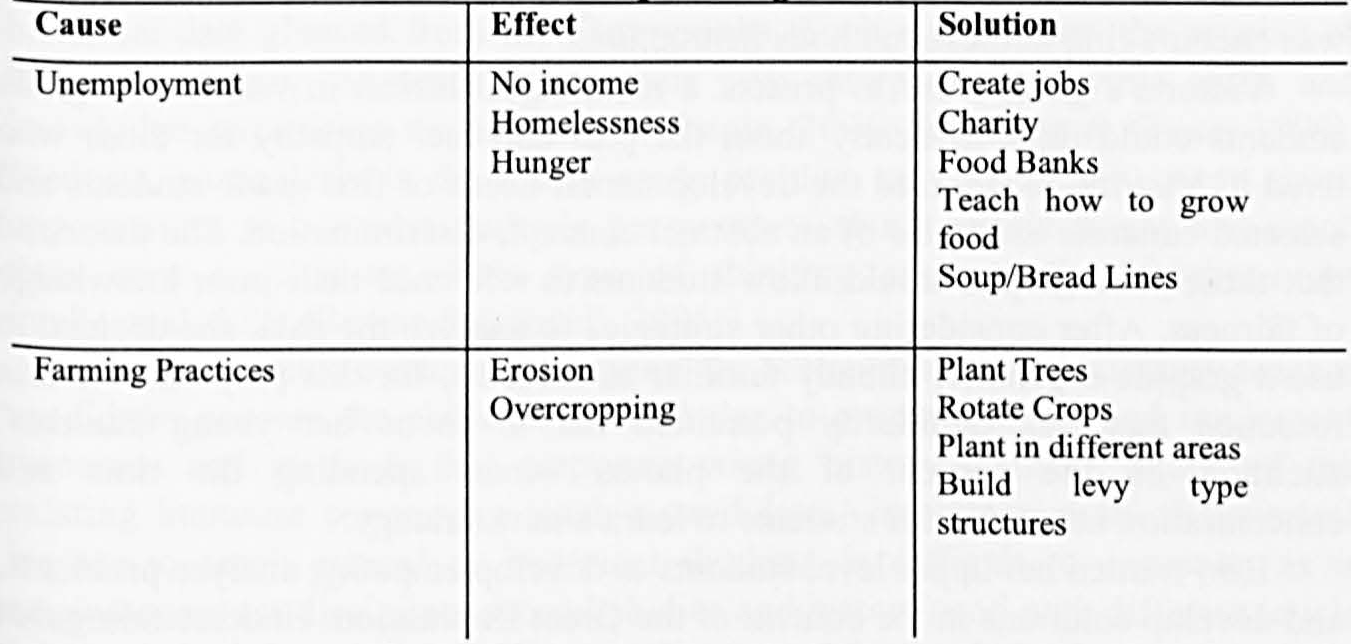
To expand the lesson, each student was given a complete copy of the letter and asked to read the letter, re-examine the historical photographs and complete the chart column of “W” – what they had learned. Based on the students’ comments, it was evident that they had, in fact, developed empathy for the children of the Great Depression. Many commented that they wanted to know more about what was done to help the children. This teacher candidate was challenged by her limited time to teach the lesson and the students’ lack of experiences, therefore she chose to use familiar instructional strategies such as the KWL chart to guide the students’ analysis of historical photographs and quotes from children’s letters.
Discussion and Conclusions
This research provides descriptive snapshots of practice of two teacher candidates’ first attempts at using primary sources to teach history with first and fourth grade children. By analyzing their efforts to interconnect the theories and strategies learned in their social studies methods class, we were able to examine their historical inquiry processes, with elementary students, from beginning to end. Of most interest were the instructional strategies the teacher candidates selected, their rationales for those selections, and how effectively they implemented them when teaching the lessons. It was encouraging to note that the strategies that had been modeled in class were the ones they implemented in their classrooms. The content was different, but the notion of sparking curiosity and developing empathy through the eyes of children was one that was noted in many of the lessons observed by other teacher candidates and had been modeled by the instructor using the Japanese Internment Camp experiences as the context for discrimination. This notion of transferring similar strategies to other content was encouraging to these methods instructors.
Victoria’s goals were to present a meaningful lesson in which first grade students could think critically about the past and feel empathy for those who lived it. Victoria recognized the developmental needs of first grade students and selected concrete examples of an abstract concept, discrimination. She theorized that these photographs would allow students to reference their prior knowledge of fairness. After considering other strategics to analyze the data, she decided to use a graphic organizer, already familiar to students, for this purpose. Victoria reasoned that this familiarity permitted her to focus her young students’ attention on the content of the photos versus spending the time and concentration necessary for students to learn a new strategy.
Erin wanted her upper level students to develop empathy, analyze problems, and develop solutions in the context of the Great Depression. Understanding that fourth graders are required to learn state history, she purposely selected historical photographs and letters that exposed the effects of the Great Depression on children in this state. Erin reasoned that her students would be able to view the Great Depression through the eyes of a child; a technique used to cultivate empathy. The strategy selected for analyzing the photos was a K.WL chart. The rationale for this was to engage students in observation skills, access prior knowledge, encourage curiosity, and discuss newly developed questions (wonderings). Quotes taken from children’s letters, written to Eleanor Roosevelt, were intentionally included to inspire empathy and lay the groundwork for analyzing problems and solutions related to the Great Depression. Students segregated information on a cause-effect-solution organizer, and again, in this case, the student candidate used a familiar strategy to save time and focus on the content.
Both candidates’ goals indicated an awareness that, as LaFaye ( 2001) noted, primary sources are selected and used to help students connect with history on a personal level while learning and practicing essential skills in critical thinking, analysis, synthesis, research, and empathy. Historical thinking elements that students can learn at early ages arc historical empathy and the construction of historical accounts (Fallace, Biscoe, & Perry, 2007). The photographs that each teacher candidate used were intentionally selected for their very specific content and relevancy, created by those who participated in or witnessed events of the past. These help students view the world through the eyes of the one who lived through it, breathed it, and felt it (Percoco, 1995, p. 3). Evidence suggests that candidates recognized the prior knowledge, curricular requirements, and developmental abilities of the students for which they were planning. They were also able to discern which parts of the lesson to prioritize, keeping unnecessary expenditure of time to a minimum. Graphic organizers were used to assist the young students in analyzing and communicating the historical data gleaned from the photographs. Such aids support the process of historical inquiry. Students create their own interpretations while skills and knowledge acquisition arc enhanced (Chapin, 2006; Singleton & Giese, 1999). Students, particularly in the fourth grade problem solving activity, were given opportunities to consider multiple perspectives about certain issues and reach their own conclusions. This type of thinking engages their higher-order intellectual skills (Bower & Lobdcll, 2005).
There is limited evidence to support the assumption that elementary teacher candidates possess the skills and knowledge to properly select and implement resources and methods that empower young history learners. Much of the existing literature concerning teacher candidates’ implementation of historical inquiry to teach critical or historical thinking is difficult to compare, as it originates across disciplines (social studies and history) and with different levels (elementary and secondary). The significance of this study is that it serves as a portrait of practice reflecting teacher candidates’ first attempts to link the strategics and theories, learned in their social studies methods class, to implement historical inquiry in elementary classrooms. As suggested here, historical photographs can be an appropriate tool for novice teachers to begin helping elementary students, at different grade levels, engage in historical inquiry. Thus, this investigation provides insight into elementary teachers’ instructional practices when using historical photographs. Evidence gathered from this research also helps discern possible connections between what instructors teach in social studies methods courses and what is actually going on in teacher candidates’ field placements. What appears to be insightful for methods instructors is these results indicate that modeling and having teacher candidates actually participate in the process of historical inquiry has to potential to transform them from the telling of history to the doing of history.
Elementary teacher candidates need multiple opportunities throughout the social studies methods coursework to experience historical inquires. They need to pose and investigate questions through the analysis of primary sources. These two teacher candidates replicated strategies they had seen modeled in their class into their field-based placement. Both Erin and Victoria concurred that doing the activity in their methods class helped them in the planning of their lessons and enhanced their confidence to try such endeavors in their field placement. It can illuminate the process of preparing elementary teacher candidates to teach abstract historical concepts within the context of the social studies methods courses and help to document and describe candidates’ attempts to apply their newly learned knowledge and skills.