






Abstract
The increased popularity of desktop documentary making among both teachers and students in history classrooms warrants an examination of its integration into classroom instruction. This multiple case study focused on two secondary students in an AP European History course during a unit that featured desktop documentary making. Employing Cultural Historical Activity Theory (CHAT) as a theoretical framework, this study revealed that the students constructed historical narratives with multiple web-based encounters that affected their composition over a span of time. Whenever students experienced tensions in their narrative process, the students made historical judgments that furthered the narrative process. These judgments were, at times, based on evidence, and at other times devoid of evidence. These findings suggest that students may form baseless historical conclusions when given creative freedom in a desktop documentary making assignment. The challenge for history teachers and teacher educators who seek to integrate desktop documentary making into their instructional repertoire is to balance the need to provide students with creative freedom while creating an instructional setting that effectively and efficiently addresses students' historical understanding.
Introduction and Background
The advent of free and easily accessible documentary making software has led elementary and secondary school teachers to become increasingly interested in desktop documentary making (DDM) as a means to enliven their classroom instruction. (Ferster, Hammond, & Bull, 2006; Fehn, Johnson, & Smith, 2010; Schul & Montgomery, 2011). History teachers, in particular, have found DDM as a useful strategy to engage students in historical production. The inclusion of this new and innovative approach to history teaching and learning raises some important questions for researchers to examine. Past studies on DDM (e.g., Hofer & Swan, 2006, 2008; Fehn, 2011; Kearney & Schuck, 2005; Hammond, 2008; Schul, 2010) have provided helpful insight on teachers' practices while integrating DDM. These studies, while giving heavy attention to the role of the teacher in the integration of DDM, have provided little coverage of students' activity during their composition of desktop documentaries. However, recent research on DDM and student activity (e.g., Swan, Hofer, & Swan, 2011) is emerging with attention toward the constructivist nature of students' compositional processes. Since DDM is primarily a constructivist activity, research into students' actions as they compose their documentaries promises to greatly enhance how DDM is integrated in history classrooms. The aim of this study, therefore, is to add much needed insight on students' compositional practices during DDM by empirically examining the activity of two secondary history students as they each composed desktop documentaries as part of a class project.
An understanding of student activity during DDM in a secondary history classroom, therefore, prerequisites an understanding of the nature of history teaching and learning as well as the significance of history in the school curriculum. History, for many reasons, is integral to civic education in both the elementary and secondary school experience. Knowledge of history, according to the National History Standards (Nash & Crabtree, 1994), is the precondition for political knowledge. Drake and Nelson (2009), for instance, asserted that “historical study is a necessary component of both the liberal intelligence and the civic intelligence necessary to understand that political positions on issues are subject of deliberation and debate” (p. 23). In other words, history is the fertile ground where citizens can test ideas that may have policy-making consequences. History educators have, in recent times, jettisoned the disciplinary practices of historians to the forefront of the discourse about history teaching and learning as a means to develop students' liberal and civic intelligence. With that said, it has become necessary for history educators to teach history as a personal construct (Jenkins, 1991) than as an assemblage of fixed facts. “Rather than teaching them to be consumers of stories,” history educator Tom Holt (1995) advised history teachers on how they should teach their students, “we might better develop their critical faculties by letting them create stories of their own” (p. 12). Moreover, history teachers' positioning of students to construct their own history as a means to teach critical inquiry necessitates researchers to investigate the practices involved in students' historical inquiry.
Nearly two decades ago Sam Wineburg (1991) studied the unique disciplinary practices of history by comparing professional historians' practices (i.e., critical inquiry of primary sources) with those of advanced secondary students. Wineburg's study led to the simple, yet significant, conclusion that those professionally involved in history possess knowledge different from the high school student of history:
What seemed to distinguish historians from students was not whether they could identify Fort Ticonderoga or the Townsend Acts but broader, more sweeping ways of knowing and thinking about historical evidence … knowledge of how to establish warrant and determine the validity of competing truth claims in a discipline (Wineburg, 1991, p. 84).
These unique practices, used by historians, of assessing and comparing documents represent historical thinking. Wineburg's significant study was followed by studies led by other researchers (e.g.. Barton & Levstik, 2004; Van Sledright. 2002; Yeager & Davis, 1996) that investigated historical thinking as a way for teachers to nurture inquiry-based practices for students. Such inquiry-based practices as collecting sources and analyzing them, synthesizing them into some sort of narrative structure, and providing source-based evidence to support claims and assertions, provide the premise for researchers' attempts to explore students' problem solving within the landscape of history-making.
The primary practice of historical inquiry, developed by professional historians, is the fitting together of primary and secondary sources into a coherent synthesis, which can be assessed by the discipline - the community of historians. This conception of historical thinking reflects historian David Hackett Fischer's (1970) claim of historical thought as “a process of adductive reasoning in the simple sense of adducing answers to specific questions, so that a satisfactory explanatory ‘fit’ is obtained” (p. xv). Fitting sources together is at the core of historical narration. According to Gaddis (2002), all historians use narrative as a way to organize, and thus represent, a reconstruction of the past. White (1987) asserted that a narrative involved a plot with a strong narrative voice directing that plot. This plot entails a causal sequencing of people, places, and events that builds upon each other and converges toward a particular consequence (Gaddis, 2002). Narration, therefore, is a historical practice of recounting the past through a cause-effect relationship between various people, places, trends, or things from the past (Barton & Levstik, 2004; Holt, 1990). Narrative construction also requires the historian to engage in the process of “recursive iteration” or the repeated revisiting of archival sources and evidence (Fehn & Schul, 2011; O'Leary, 2006). Consequently, narrative construction requires the historian to use his or her imagination to make meaning out of the relics of the past (Booth, 1993; Gaddis, 2002; Jenkins, 1991). Historical imagination entails speculation, since historians rely on traces of the past rather than actually reliving what had happened and how it affected certain individuals or groups of individuals (Gaddis, 2002; Holt, 1995). Historical imagination also entails moral judgment (Gaddis, 2002) since historical speculation usually involves an analysis of human motive and social consequences of events and human activity in the past. These practices of the historian are underscored by a necessity to produce a narrative that can be understood by a contemporary audience of other historians and/or the general public.
While the body of research on historical thinking continues to grow, the landscape of history-making has changed. The past quarter of the twentieth century marked the beginning of the digital age (Murray, 1998). In this digital age, students' lives are saturated with digital media such that they may already be using digital technologies at home for creative purposes (Buckingham, 2003). With the emergence of the digital age, a digital “turn” has provoked students and teachers alike to express their historical understanding in new and unique ways (Coventry, Felton, Jaffee, O'Leary, Weis, & McGowan, 2006). This digital “turn” in history, according to an increasing body of research (e.g., Koehl & Lee, 2009), is long-lasting and significant. As a case in point, computer software such as iMovie, Photostory 3, and Moviemaker allows any individual to easily produce high quality documentaries (i.e., desktop documentaries) that was at one time only possible for the professional filmmaker. Desktop documentaries, like other innovations of the digital age, possess powerful consequences for classroom instruction, especially in history courses where narration plays such a central role (Hofer & Swan, 2006, 2008; Fehn, Johnson, & Smith, 2010, Schul & Montgomery, 2011).
In response to the need for empirical research that answers what students do, or practice, as they compose desktop documentaries, this study qualitatively examined the activity of two Advanced European History students as they composed desktop documentaries as a part of a classroom assignment. This investigation was therefore guided by the following primary research question: What historical practices did students employ in order to compose their desktop documentaries?
Theoretical Framework
In order to examine students' activity during DDM in a history classroom, it was necessary to be able to describe the interactions that students had with various primary and secondary sources. I concluded that these interactions were best understood through the lens of mediated action. Vygotsky (1978) offered the basic premise for mediation when he claimed that development occurs first between people and then within the individual, therefore a mediating effect exists where a person internalizes what was once exclusively external to him or her. Wertsch and Tulviste (1992) built upon Vygotsky's conception of mediation by emphasizing that an individual's thought process can only be discovered in tandem with the surrounding social and cultural environment. The relationships between human action and the environment where that action takes place is the basic premise behind the theory of mediated action (Wertsch, 1998). Moreover, the analysis of mediated action involved in DDM required a fluid model, or heuristic, that enabled description of the practices that students engaged in as they composed desktop documentaries. With that said, I used a Cultural Historical Activity Theory (CHAT)-based lens to understand the complex interactions involved in DDM. CHAT provides a theoretical model, or heuristic, which theorists (e.g., Engeström, 1987. 1999; Leont'ev, 1974, 1978) and researchers (e.g., Kaptelinin & Nardi, 2006; Roth, 2004; Roth & Lee, 2007; Yamagata-Lynch, 2007) have developed and refined over several decades, that enables description of complicated processes humans employ to make “objects” such as a historical narratives across a span of time. In the example of DDM in a classroom, an individual may use a multitude of mediators to compose a historical documentary. Kozulin and Presseisen (1995) suggested three classifications of mediators: material, psychological (cultural), and other human beings. Material tools are used in all forms of history construction. For example, one possible definition of history is a narrative claim warranted through a primary and secondary source-based investigation with the primary and secondary sources serving as two obvious material tools. Cultural tools also play a prominent role in historical inquiry. Barton and Levstik (2004) claimed, for instance, that several cultural tools are used in history practice, including narrative structure, as well as two different types of empathy: perspective recognition as empathy, and care and commitment as empathy. In addition to material and cultural tools, students may use human tools such as their classmates or teacher, either for assistance or as a prospective viewing audience as they compose their desktop documentaries.
Using the CHAT framework to specify historical practices enacted during desktop documentary composition, as shown in Figure 1, the subjects represent the student-composers of the object, namely the desktop documentaries. Tools, which shift as subjects construct documentaries, play a central mediating role in the creation of a desktop documentary.
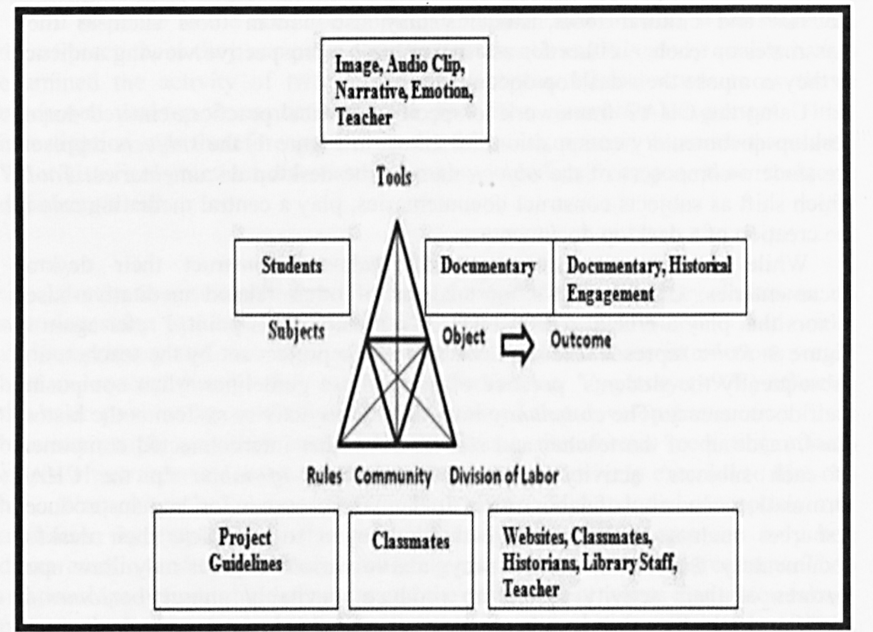
General Activity System Heuristic for Desktop Documentary Making in a History Classroom.
While students use a myriad of tools to construct their desktop documentaries, CHAT allows for analysis of other related meditative-based factors that play a crucial role in DDM. To illustrate this point, I refer again to Figure 1. Rules represent the requirements of the project set by the teacher, and subsequently the students' practice of using those guidelines when composing their documentary. The community involved in this activity system is the history class, made up of the teacher and students. Another interconnected component of each subjects' activity system, was division of labor. In the CHAT formulation, division of labor refers to human resources, or human-produced resources such as websites subjects drew upon to complete their desktop documentary. Subjects in various ways and to various degrees may draw upon features of their activity system to produce inevitably unique outcomes in addition to a historical documentary.
While the documentary may be an intended outcome for the classroom teacher assigning the project, he or she may also intend for students to be engaged in the practices of history, in other words, many teachers likely intend for the compositional process of students to be an equal or possibly more important learning outcome than the documentary itself. CHAT is also a useful analytical lens for this study because it recognizes that activity is ever-changing with mediation ever-shifting. Until the final version, for example, the outcome for students may shift during the compositional process depending upon the compositional intent and actions at particular moments. These shifting outcomes comprise the evolvement of a desktop documentary with nearly every outcome changing into a tool at one time or another. Additionally, students likely experience tensions within their particular activity systems in the process of DDM. For example, a newly found image may appear to the students as important to the existing narrative but does not seem to fit comfortably within the “current” outcome “Should I adjust my present outcome,” students might ask themselves in the face of anomalous evidence, or “Should I just forget about the new evidence in favor of my present narrative construction?” These tensions, along with other behaviors observed through the CHAT model, shed light on the nature of practices students engage in as they compose their historical documentaries.
Research Methods and Data Collection
This research was a multiple case study of two secondary history students as they engaged in an instructional unit that employed DDM. The setting of the study was a suburban public high school in the Midwest. For the purposes of this study, the high school will be called Southview to protect anonymity. Southview high school shares a community with a Research I university. The university attracts academically oriented professionals whose children attend the local public school resulting in a demand for accelerated coursework at the secondary level. This study focused upon one such accelerated course, Advanced Placement European History, which served as the bounded setting for this case study (Stake, 1995).
A purposeful sampling method was used to select the teacher in this study. Purposeful sampling is a typical method employed in case study research to garner maximum information about a phenomenon (Patton, 1990). The teacher in this study was a male who, at the time of this study, had five years of experience with implementing DDM in his classroom. The teacher, Harlan Jones (a pseudonym), was in his fifth year of teaching high school social studies at Southview at the time of this study and was selected because of his robust experiences with integrating DDM into his instruction. The teacher incorporated DDM as a final project near the end of the school year, just prior to the students taking their AP exam. It was the last of three projects that he required of his students, all of which asked students to construct history in a unique fashion. The first was a timeline where students had to physically construct a visual timeline that explored and explained a specific period of time, connecting student-written underlying course themes with student-selected key events. The second was a research paper where students practiced the skills of professional historians. The final project, the focus of this study, required students to make a desktop documentary (See Appendix A for the project assignment sheet distributed to students). Jones named his documentary project assignment “The Museum Exhibit Project” because he perceived a desktop documentary as a museum exhibit where a curator informs an audience in a visually artistic manner. The teacher made no prerequisite for the credibility of web-based sources students used, as he was less concerned with historical accuracy than he was with positioning students to engage in the overarching process of historical construction. The project lasted for nearly three calendar weeks, including Southview's week-long spring break.
Seven students, all high school sophomores, were investigated in the initial inception of this study. Each student was randomly selected amongst a group of students who volunteered to participate in this study with selection based primarily upon the students' schedules and their availability to participate in this research. A secondary criterion for participant selection involved a concern for gender balance. However, this report of research features only two students as a way to make the qualitative data more manageable and to avoid saturation or redundancy (Lincoln & Guba, 1985) as Jones' classes were highly homogeneous. It should also be noted that this is one component of a larger study that also included an in-depth study of the teacher. For the sake of clarity and focus, this study primarily focuses on student data since student activity is emphasized in this particular research report. The two student cases (both names are pseudonyms) and their documentary topics in parenthesis were as follows: Charlie Hudson (Vichy France) and Maria Stevens (Stalin and the Purges).
Data Collection
Acquiring multiple data sources is critical to garner in-depth understanding of the phenomenon under study. Collecting a variety of records infused depth to the study as it allowed this researcher to check self-conceptions of the reality of the phenomenon from one data source to another (Creswell, 1998; Stake, 1995). Subsequently, three types of data collection methods were employed: interviews, think-aloud protocols, and document retrieval. Each student was interviewed twice, once prior to their compositional activity and once afterward (See Appendix B for interview protocols). Each interview was audio-recorded to insure accurate retrieval of interview data. As a technique to specifically explore the research participants' history-making practices, a think-aloud protocol was employed (Ericsson & Simon, 1993) while students composed their documentaries. A think-aloud entails having a participant verbalize his or her thoughts while they are in the midst of a learning activity. The think-aloud protocol analysis was a useful method for tracking the complex interactions of a students' compositional encounters with desktop documentary-making technology.
The number of compositional desktop documentary sessions in this study was dependent upon how much time each student needed to finish a composition, with ten sessions being the most and eight being the least, totaling forty-four in all for the students. These compositional sessions varied in length, between fourteen minute sessions to nearly two-hour sessions, depending on the availability of the student and the school schedule. (See Table 1 for a schedule of the think-aloud protocol sessions for each student involved in the study.) Each session took place in the library of Southview High School, sometimes in the general public area of the library, sometimes in a computer lab. The interview sessions were conducted before school, after school, and during students' study halls. The only time in which students composed during class was the two lab days where the entire class worked on their compositions. Think-aloud protocols were also conducted with students during their lab days assigned to them by their teacher. A noticeable flaw in this study was that, unlike their classmates, the students in this study were limited to work with the software Photostory 3 by this researcher. The primary reason for this interference was the availability of that particular software program throughout the school library where the students worked on their composition. Each verbalization was audio and video recorded so to capture participants' compositional actions and their precise relationship to verbalizations expressed during production of their documentaries. To make the recordings, a video camera was positioned behind each student, with its focus upon the computer screen. Additionally, each completed documentary was retrieved for reference and analysis.
Think-Aloud Protocol Composition Schedule and Length of Time
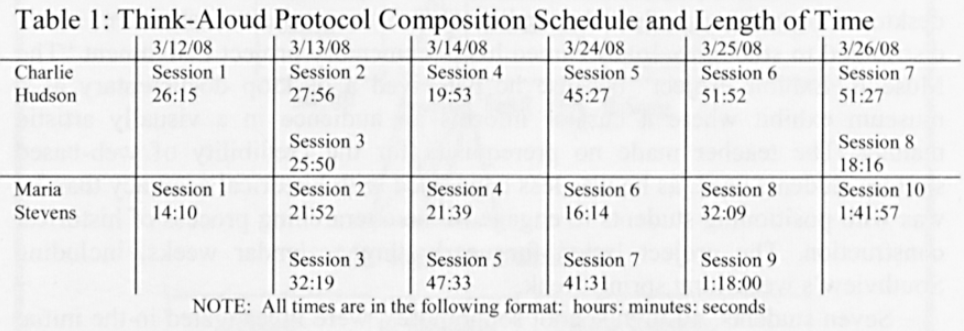
NOT: All times are in the following format: hours: minutes: seconds
Data Analysis
Data analysis and synthesis was inaugurated with the data collection process to ensure that the data remained focused (Merriam, 2009). To do so, I simply placed the code in parenthesis once I typed in a chunk of data. Qualitative case study research “usually means finding good moments to reveal the unique complexity of the case” (Stake, 1995, p. 63). Erickson (1986) claimed that assertions are formed through an inductive process of repeatedly searching through the entire data set, noticing prevailing patterns in the data and “establishing] an evidentiary warrant for the assertions one wishes to make” (p. 146). Prose was the primary vehicle used in this inductive process of sifting through the data as it simultaneously required an organization of the data around specific categories and patterns as well as a transformative reassembly of the data through the use of those categories and patterns. Since a case is complex by nature, this researcher took the advice of Stake (1995) and decided to “forego attention to the complexity of the case to concentrate on relationships identified in our research questions” (p. 77). The focus of analysis, therefore, targeted the research question. In order to answer the research question, a comparative content analysis was used where themes emerged through coding and categorizing of the data (Patton, 1990). Since this study focused on two cases, it was necessary to analyze patterns and themes across those cases. The themes and patterns that were generated during this data analysis resulted in this study's final assertions.
The Participants
When Harlan Jones assigned the Museum Exhibit Project, he required that each student make their documentary useful to their classmates. He allotted class days for a film festival where the entire class viewed one another's documentary at the conclusion of the project. Jones provided the students a list of topics from which they could each select their preferred topic (See Appendix A). Two of Jones' students, both high school sophomores at the time of this study, are introduced in this section along with the DDM historical topics that their teacher assigned to them.
Charlie Hudson and Vichy France
Charlie Hudson liked a challenge, which is why he signed up for Jones' AP European course. “I'm here so I might as well get challenged and take advantage of all my opportunities,” said Charlie (Interview, March 11, 2008). Charlie contended that he was not naturally good at history and was more inclined toward science. He did take a U.S. history course while he was a freshman, and preferred European history. “1 like European history because it's all new to me,” declared Charlie (Interview, March II, 2008). Charlie was inclined toward action, which was also partly why he preferred European history over American history. “American history is slow-paced,” he explained, “while European history is quick paced because there's so much of it” (Interview, March II, 2008). Charlie's assignment for the museum exhibit project was Vichy France, which he selected because he confessed that he knew nearly nothing about it and wanted to learn: “I know nothing, that's why I chose it.” he admitted (Interview, March 11, 2008).
Maria Stevens and the Purges
Maria Stevens viewed history essentially as a story, but pointed out its uniqueness in that “it's real” (Interview, March 11, 2008). She had always liked to see how cultures were formed, but traced her interest of history to the American Girt books that she began to read when she was but six years old. The American Girl books series, categorized as historical fiction, is commercially marketed to young girls and is a portrayal of pre-teen girls who lived through significant eras in American history and features the young girl's perspective of significant events that helped to shape the United States. The Soviet Union and the Purges was her primary choice because she was interested in Stalin and the Holocaust: “I read a book on my own time last year called Man is Wolf to Man (a memoir of Janusz Bardach's experience in a Russian labor camp) and I liked it” (Interview, March 1 I, 2008). Mari's assignment was, as she had hoped, the Soviet Union and the Purges.
Findings
Since activity is theoretically endless and thus complicated to study, this study narrowly focuses on the particular elements of a students' compositional activity that played a significant role in any changes in their historical narratives. In looking at the students' compositional practices through the CHAT theoretical lens, therefore, this researcher noticed and traced the various mediators that students encountered in their compositional process. CHAT was particularly helpful in enabling careful observation toward how the students used these mediators to further perpetuate their historical construction. This focus on student activity was guided by the primary research question of this investigative process: What historical practices did students employ in order to compose their desktop documentaries? This section discusses the interrelated themes that emerged from this research question.
Two themes emerged in this study. These themes point out that for both of the students in this study: (a) a narrative developed and evolved given the students' encounters with new content, images, and audio as they composed their historical documentaries, (b) tension in content was a catalyst that led the students to make judgments that enabled them to continue their historical narration.
Encounters with Sources Spur Narrative Evolvement
History is a construction of the past. It involves a close examination of sources from the past in order to construct an explanation of the past. This construction of the past requires historians to engage in adductive reasoning while selecting and organizing sources in such a way that they fit well together. One essential tool that historians use to construct and refine history is the narrative. Since the nature of history is to interpret cause-effect relationships, historical narrative is an ongoing process. The students in this study developed narratives throughout the course of their compositional process. As the students made desktop documentaries, they encountered a multitude of primary and secondary sources. Some were images, others artifacts, news articles, or encyclopedia entries, while others yet were audio clips and songs. These sources, at times, led the students to develop empathy for a certain event or person as a result of a particular source which the student later used to craft their new narrative.
The historian must make moral judgments when assimilating their sources into a narrative. He or she must decide, for instance, what influenced an individual's behaviors and decisions and the effect that those behaviors and decisions had on others. So, the students in this study, as is typical for historians, constructed histories while heavily influenced by their own encounters with primary and secondary sources. These sources, at times, led to an outcome of historical empathy that shaped a new construction of history (see Figure 2).
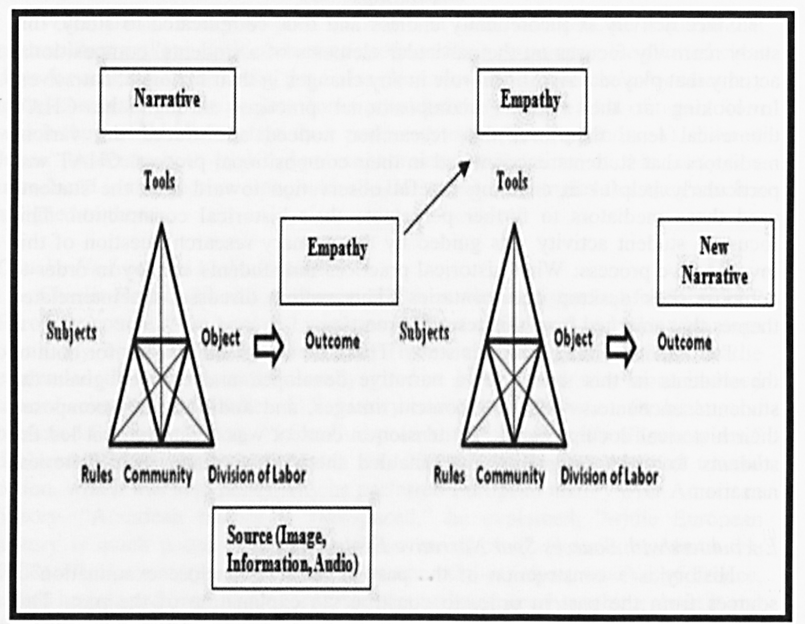
A Source Fosters Empathy for Student and Led to the Development of a New Narrative.
The triangle to the left in Figure 2 depicts how a student, when searching for a source (image, information, or audio) in order to fulfill their narrative, developed empathy for a particular event or person as a result of a particular source. This empathy then, as displayed in the triangle on the right in Figure 2, is used by the student to develop a new narrative. The outcomes of these encounters varied in their nature and effects for the students in this study.
Maria began her compositional process with a search for background information about her topic: Soviet Collectivization and the Purges. She found a website called Machohistory that contained an article about her topic. Through her search efforts, she learned about the Kulak class:
So, the Kulaks were the rich peasants. And the website says that many were transported to remote areas and then to new labor camps. Hmm … it kind of reminds me about what 1 know of the Nazis and the Holocaust. (Session I Think Aloud, March 12, 2008).
Maria's narrative began to take shape, as the content and language of the Machohistory website's articles helped her to make a conclusive comparison between the Purges and the Nazi Holocaust. This initial encounter with a source affected her entire compositional process as the Purges/Holocaust comparison became her narrative. For instance, in her second, third, and fourth sessions, Maria used her narrative of the Purges equaling the Holocaust as a tool to find images. “I'm looking for the people in the Kulak class murdered by the Soviet government” Maria said (Session 2 Think Aloud, March 13, 2008). Maria spent her subsequent second and third sessions in search of images of Kulak prisoners. In her third session, she did a Google linages search on “Soviet Gulag” (the government agency that operated the Soviet labor camps) and found an image of Soviet prisoners working. She explained why she liked the image: “It shows prisoners working. I think that to maybe show the punishment that they went through would be an effective way to present how Stalin's technique, or form of government, affected the people” (Session 3 Think Aloud, March 13, 2008).
Maria's narrative of comparing the Soviet Purges as a Holocaust continued to drive her image collection. She collected the aforementioned worker image along with other such images. The image search led her to an image of malnourished prisoners that she saved because she wanted “to show the prisoners weren't well taken care of' (Session 3 Think Aloud, March 13, 2008). She explained why she thought this image was special for her narrative: “It shows the man's actual face,” she said, “It shows the emotion better than some of the photos with a bunch of people” (Session 3 Think Aloud, March 13, 2008). Maria's search for images with an emotional appeal that supported her narrative led her to an image of Stalin next to a starving child. Maria thought that the image was very interesting, because it connected Stalin with the harsh conditions of his regime. Maria's intent with the image was to support her narrative of the Purges as an equal to the Holocaust through the image of Stalin connected with a child in misery. She thought that although Stalin told his people that he wanted to help them, he actually did great harm:
This is an image of Stalin and right next to it is a picture of a child starving. It might be interesting to show this and to show how Stalin sees children … it kind of shows the hypocrisy of the whole thing. (Session 3 Think Aloud, March 13, 2008)
Maria's contention that Stalin's regime was hypocritical lent support to how she compared the Purges with the Nazi Holocaust, with Stalin being the central figure who, like Hitler, had a hypnotic spell on his country.
What started out for her as an attempt to simply improve upon her background knowledge through a secondary source search resulted in the formation of her new narrative. Maria's narrative remained fixated on supporting this initial assertion that the Purges and the Jewish Holocaust were comparable in purpose and form. Maria's narrative evolvement as a result of an encounter with a web-based source was not unique among Harlan Jones' students. Charlie Hudson, for example, evolved his narrative when he encountered a primary source.
Charlie began his compositional process under the premise of providing an objective and unbiased account of Vichy France. His attempt at an unbiased account of Vichy France, however, took a sudden turn when he, through a Google search later in his fifth compositional session, encountered an image of a Vichy government official holding someone up at gunpoint. Charlie, who was at first determined to portray Vichy France through an unbiased lens and who merely wanted to tell the story of his topic, came across an image of a military officer from the Vichy government who had a gun pointed at a civilian. “I want people to realize that it wasn't fair what the Vichy government did to maintain power,” Charlie said, “You should never put someone up at gunpoint to get them to listen to you” (Session 5 Think Aloud, March 24, 2008).
An encounter with a singular image altered Charlie's conception of Vichy France and eventually led him to add sad, melancholic background music for his portrayal of the reign of the Vichy government. This image encounter also affected Charlie's image selection. For instance, near the end of his fifth compositional session, Charlie came across a political cartoon of Hitler trying to keep France oppressed. However, he had a problem with this cartoon: “I'm not sure that it is appropriate to use,” Charlie said “because it is humorous and I don't think this is a very funny period” (Session 5 Think Aloud, March 24, 2008). Charlie's narrative evolved to the point that his composition no longer possessed a plain, news-style nature to it, but instead became a dramatic account of a people mired in a dark situation. After completing his project and subsequently viewing his documentary in class with his classmates, Charlie even wondered if his documentary was dark enough:
After watching some of the ones from last class, I am hesitant with my song. It's happier than what I wanted. I wanted to show how sad it was. It was sad because a lot of people died and despite all of their efforts, France still fell (Interview, March 28, 2008)
It is difficult to overestimate the significance that an encounter with a singular image had on Charlie during his compositional process. Even after the completion of the project, Charlie remained convinced of the evil imbedded at the core of the Vichy regime.
As we have seen, Maria and Charlie's narratives developed over the course of time during their compositional processes. These student's narrative developments were triggered by exposures to various web-based artifacts as they collected resources for their desktop documentary. In turn, these students used the artifacts to develop a new construction of history by altering their narrative. Charlie went from a balanced portrayal of Vichy France to one that emphasized the sadness and harshness of France under the regime. Maria's early encounter with an article that focused on the Soviet Union's harsh treatment of the Kulak class moved her to make the direct connection between Stalin and the popular notoriety associated with Hitler and the Jewish Holocaust. Narrative is the essence of history construction, and when placed in the position of constructing history, the narratives that these students developed were influenced by the materials that they came across as they composed history through DDM.
Conflict in Content Led toward Judgment
Students' encounters with web-based sources were not the only factor that led toward narrative evolvement. The students in this study also encountered tensions, or missing gaps, in their content as they attempted to relay their narrative in their compositional process. Subsequently, the students made judgments based on evidence or lack thereof in order to resolve these tensions and thus perpetuating their historical narrative through the medium of DDM. As we have seen earlier with narrative construction, history-making requires judgment. However, sometimes historians lack sufficient evidence to support a claim. There are two possible routes that historians may take in order to resolve this evidence gap. First, there is speculation. To speculate means that opinion was formed without sufficient evidence to completely substantiate that opinion. Second, there is supposition. To suppose means that opinion was formed without any evidence to substantiate the opinion. As students came across various images and information during a compositional process, it was essential for them to make speculations or suppositions based on insufficient or absent evidence, or else they would not have been able to complete their project on time because they would not have been able to advance their narratives.
Figure 3 depicts the process that students engaged in so they could resolve tensions in content as they composed their desktop documentaries. In the triangle to the left, a student experienced a tension in their image or information search, as shown with the curved arrow. This tension led the student toward practicing historical judgment. This historical judgment, as shown in the right triangle in Figure 3, enabled the student to progress their narrative process. There were several instances of this occurring in this study. For example, Charlie began his composition through an image search of Marshall Petain, the head of state of the Vichy government, with very little understanding of who he was and what he did. “So, Marshall Petain was probably an important person,” Charlie declared after an initial search in an online encyclopedia, “I should probably write that down” (Session I Think Aloud, March 12, 2008). Charlie first became aware of existing historical narratives that painted Petain in an unflattering fashion as he came across a political cartoon of Petain that provided such an unflattering portrayal:
Well, one picture is kind of anti-Petain when he tried to take over Parker in Africa. I never fully read that before. I know that he tried to take over Africa and was unsuccessful, but I didn't know if that is relevant. However, it shows Petain as not being fully powerful and that a Nazi soldier is trying to pull him back, which explains why he didn't necessarily go along with the Nazis. (Session 5 Think Aloud, March 24, 2008)
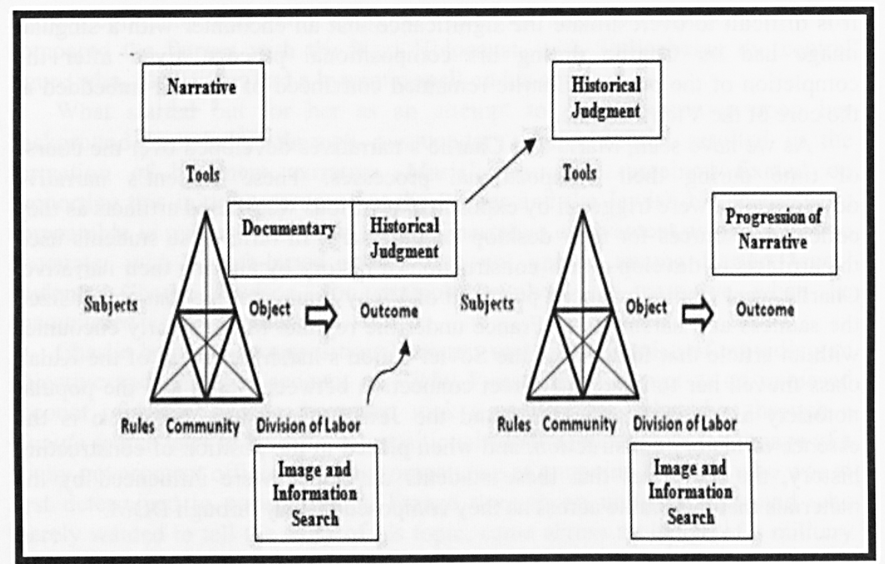
Tension With Content Led to Historical Judgment That Progressed History Construction.
As Charlie found images that portrayed Petain in a negative light and subsequently challenged his previous understanding of Petain, he resolved to provide a fair and balanced historical account: “I want the people to decide on their own”, he surmised, “I don't want to be pro-Petain or anti-Petain.” This resolve to be impartial and balanced in portraying Vichy France, in fact, stemmed from a key supposition that he made after finding this political cartoon of Petain: Vichy France was ill-suited to be portrayed as historically good or evil because, as Charlie surmised, “everything in life seems to have another side to it (Session 5 Think Aloud, March 24, 2008).
Charlie's judgment about Vichy France having a good and bad side, though he would later change, was not warranted by evidence but instead upon a personal principal of impartiality and objectivity. This supposition guided some of his future compositional process as he proceeded to seek out images that portrayed both the positives and negatives of Nazi control in France. This historical judgment was Charlie's way of resolving a content oriented conflict he encountered, namely that there were competing historical narratives floating around about Vichy France and he resolved that both narratives were equally correct. This historical judgment allowed Charlie to perpetuate his compositional process since it created an initial pro and con narrative of Vichy France upon which he could compose his documentary.
Charlie made other suppositions in his compositional process as a means to resolve a content oriented conflict and subsequently perpetuate his narrative. Charlie, for instance, had a difficult time finding a certain type of image to support his narrative. For Charlie, the difficulty rested in his inability to find images of anti-Vichy war propaganda images: “I think Europe was so involved with itself being invaded by Germany that countries weren't making propaganda for other countries to come and join them” (Session 5 Think Aloud, March 24, 2008). He concluded that Europe was simply too war torn to spend time manufacturing propaganda images. Thus, he continued with his narrative of Vichy France that would portray it with both a good and bad side.
Maria, like Charlie, had difficulty finding images of Soviet peasants at work, which she concluded was due to the absence of technology in isolated, rural areas during the time: “I'm having trouble finding pictures for this topic because I'm dealing with the rural part of Russia and there's little technology” (Session 9 Think Aloud, March 25, 2008). In each of the cases of Charlie and Maria, the students proceeded with their narrative by allowing the tension to enrich their narrative rather than disrupt it. Yet these students resolved their tensions with supposition since no evidence supported their judgments.
While Charlie and Maria, as we have just seen, made judgments without the warrant of evidence, they also made speculations that were guided by some form of evidence. This phenomenon was most pronounced during Maria's compositional process. Previously mentioned in this section for her supposition about the lack of images in her search, Maria altered her narrative on more than one occasion for various reasons including a conflict in content that derived from her encounter with a secondary source. In her sixth compositional session, Maria sought to learn more about her topic and came across an Encyclopedia Britannica entry that contrasted Stalin's policies with those of his predecessor, Lenin. “Some of Lenin's plans leaned more toward capitalism,” Maria concluded, “Stalin didn't really agree with that” (Session 6 Think Aloud, March 24, 2008). “I'm glad that I went to the encyclopedia,” Maria said, “I'm learning more about what collectivization was: it was a method to get rid of the Kulaks” (Session 6 Think Aloud, March 24, 2008). Maria then discovered the rationale behind Stalin's targeting of the Kulak class:
By getting rid of the Kulak class, he [Stalin] was getting rid of the policy set forth by the NEP [New Economic Policy], which was Lenin's policy. Stalin kept the policy because it helped him rise over Trotsky for leadership of the Communist party since with the NEP peasants could farm for profit and could sell some extra produce for profit and this helped stimulate the economy… The NEP really stimulated the economy and he [Stalin] didn't want people to think that if he came into power that he would get rid of it. (Session 6 Think Aloud, March 24, 2008)
This tension of contrasting views between Lenin and Stalin led Maria to speculate that the true cause of Stalin's purge of the Kulak class incorporated both ethnocentrism and economic policy. “The more I learn about this topic, the more I realize that the camps weren't as involved,” Maria concluded, “Maybe I want to focus on some other methods Stalin used to eliminate them, like collectivization” (Session 6 Think Aloud, March 24, 2008). While her narrative of the Purges as a Holocaust remained the same, it evolved into a more complicated story than what she had previously imagined because of a key speculation she made that stemmed from a content oriented conflict she had encountered based on secondary source evidence that claimed the cause of the Purges were rooted in economic policy.
Maria and Charlie encountered tensions in content that eventually led each of them to make both suppositions and speculations depending on the availability of evidence. These judgments were made by the students in this study so that they could continue with their compositional narration.
Limitations and Future Research
While this study provides a significant contribution toward understanding what history students actually do as they compose desktop documentaries, a major limitation of this study was that its participants were in an Advanced Placement course. A replication of this study in a general education classroom would lend some insight into the findings of this study. Also, as previously noted, the students were limited to using Photostory 3 in this study. While it may not make a significant difference, it was still nonetheless interference in the natural setting. Along with an investigation of a general education classroom that mirrors this one, a study of elementary and middle school students' historical practices with DDM would also fill a void in the research gap that currently exists with DDM. Also, future empirical research on students' historical practices with DDM should include an analysis of the students' documentary practices juxtaposed with students' practices while writing the typical history term paper, as a means to further clarify the differences and similarities between the two. Finally, this study opened up the issue of how teachers should address students' judgments during DDM. Extensive case study research of teachers who do address the students' judgments would further improve understanding on successful integration of DDM.
Implications and Discussion
This study showed what some history students actually do as they compose desktop documentaries. The findings from this investigation into students' activity as they composed desktop documentaries are numerous and significant. This section discusses these implications and how they may be interpreted by teachers and teacher educators who are interested in integrating DDM into classroom instruction.
First, this study revealed that DDM engages students into authentic historical inquiry. The students in this study encountered images or other sources that affected narration of their particular topic. Both Charlie and Maria, essentially, constructed historical narratives and worked to get a particular “fit” with each image or other sources into a narrative (Fischer, 1971). If either student could not find a place for the source in their narrative, then this tension may have led them to create a new narrative. Here lies where DDM and traditional history making are similar: traditional history is usually created by assembling written artifacts into a streamlined narrative, while a documentary film requires an assemblage of images into a narrative that ties those images together (Mitry, 1990). The documentary filmmaker, Robert Coles (1997) expanded further on this similarity between these two modes of history making:
… there still remains the task of assembling information, choosing what matters, what might be (is to be) left out, what is to be discussed briefly or summarily, what is to be highlighted, considered in great detail. The issue, finally, becomes one of judgment, and thereby a subjective matter: an opinion of someone whose mind has taken all that information, that documentation, and then given it the shape of sentences, of words used, with all their suggestive possibilities (p. 2122).
This study supports Coles' assumptions about the constructivist nature of documentary filmmaking. Teachers, therefore, have ample reason to use DDM as an inquiry-based instructional activity that may bear much fruit for students' intellectual and civic development (Drake & Nelson, 2009; Lévesque, 2008).
The findings from this study also provide some insight into the type of historical judgments students make about a particular historical era or individual during their compositional processes. These judgments, as evidenced from the findings from this study, suggest that students may authentically experience the complex and nuanced nature of history construction. This conclusion provides some optimism for those teachers who aspire to use DDM as a means to enrich students' experiences with history in the classroom. This study also legitimizes the fears of some researchers (i.e., Wineburg, Reisman, & Fogo, 2007) who warn that a reliance on the use of DDM fosters historical inaccuracy where students jump to irrational conclusions. This study also revealed that students make historical judgments during their compositional processes that may trouble teachers because of they are not grounded in evidence.
How, then, should teachers address students' historical understanding? There are perhaps two avenues that a teacher may consider in addressing this question. First, there are some steps teachers may want to take prior to students making their documentaries. For instance, teachers could emphasize in instruction the differences between history made with film and history made with prose as a means to foster critical consumption of the two mediums of history making as mentioned earlier in this section. Second, there are some steps teachers may want to take after students completed their documentaries that might address any concerns with historical inaccuracy. The teacher might consider positioning the students in the class to directly address any inaccuracies by nurturing a community of inquiry (Seixas, 1993) amongst the students. A multitude of questions should be asked by the teacher and students after viewing a classmates' documentary such as: What was your intent? What did you want your classmates to think/feel? How did you try to accomplish your intent? What did you learn and how did you learn it? Were your sources credible? A true discourse community of inquiry values student inquiry, including an inquiry into individual classmates' inquiries. Unleashing a community of inquiry to address students' historical understanding that arise from the students' compositional processes would likely enable students to be critical consumers of media productions in or outside of the classroom. The challenge for the future of research and practice with DDM is rooted in balancing out the possibilities imbedded in its capacity to empower students to engage in meaningful history construction while still addressing students' historical understanding. This is a daunting challenge since the secondary history curriculum is already constrained by a teacher's ever-pressing need for coverage of content in a limited allotment of time.
Footnotes
Appendix
Appendix
•
For further explanation on how this theoretical framework may be used see: Schul, J. E. (2010). The mergence of CHAT with TPCK: A new framework for researching the integration of desktop documentary making in history teaching and learning. Technology, Humanities, Education, & Narrative, 7.
•
Special thanks to Bruce Fehn and Kathy Schuh for their valuable insight and guidance during the shaping of this manuscript.