







Abstract
Incidents of prejudice and discrimination in K–12 schools have increased over the past decade around the world, including the United States. In 2018, more than two-thirds of the 2,776 U.S. educators surveyed reported witnessing a hate or bias incident in their school. Children and adolescents who experience prejudice, social exclusion, and discrimination are subject to compromised well-being and low academic achievement. Few educators feel prepared to incorporate this topic into the education curriculum. Given the long-term harm related to experiencing social exclusion and discrimination, school districts need to create positive school environments and directly address prejudice and bias. Several factors are currently undermining progress in this area. First, national debates in the United States and other countries have politicized the topic of creating fair and just school environments. Second, the COVID-19 pandemic has interrupted children's and adolescents’ education by halting academic progress which has particularly negatively affected students from marginalized and ethnic/racial minority backgrounds. Third, teachers have experienced significant stress during COVID-19 with an increase in anxiety around virtual instruction and communication with parents. Three strategies recommended to address these converging problems include creating inclusive and nondiscriminatory policies for schools, promoting opportunities for intergroup contact and mutual respect, and implementing evidence-based, developmentally appropriate education programs. It is anticipated that these strategies will help to reduce prejudice, increase ethnic and racial identity (ERI), and promote equity, fairness, and justice in school environments.
Tweet
Despite an increase in children's experiences of prejudice and its negative outcomes, few educators are prepared to address these issues in the classroom. Recommendations for policy focus on implementing curriculum programs that aim to foster fair and just classrooms.
Key Points
Despite an increase in children's experiences of prejudice, social exclusion, and harassment over the past 5 years in U.S. public schools, few educators are prepared to address these issues in the classroom.
Children's experiences of bias and harassment contribute to stress, depression, and low motivation to succeed academically; further students who perpetuate negative attitudes experience stress as well.
Effective curriculum programs require promoting an awareness of social status inequalities, recognizing that social inequalities are unfair, promoting intergroup friendships, and fostering teacher support for the goals of equity and equality.
Professional training for teachers, counselors, and educators needs to include creating a vocabulary and a set of strategies for talking about social and racial injustice with children
Policies that enable school districts to promote an awareness of social inequalities and intergroup friendships decrease peer exclusion and prejudicial attitudes, and increase school belonging and academic achievement.
Promoting Fair and Just School Environments: Developing Inclusive Youth
Incidents of prejudice and discrimination in K–12 schools have increased over the past decade around the world, including the United States. In 2018, more than two-thirds of the 2,776 U.S. educators surveyed reported witnessing a hate or bias incident in their school; yet few of these incidents were addressed by school leaders or raised as points of discussion in classrooms (Costello & Dillard, 2019). Children and adolescents who experience prejudice, social exclusion, and discrimination (e.g., name-calling, bullying, and exclusion) are subject to compromised well-being and low academic achievement (Rivas-Drake et al., 2014). Moreover, individuals who express biased attitudes about others also exhibit maladaptive stress responses and perceive more threats during intergroup encounters (Mendes et al., 2008). Few educators feel prepared to incorporate this topic into the education curriculum.
Given the long-term harm related to experiencing social exclusion and discrimination, school districts should create positive school environments and address prejudice and bias. According to media polls, most U.S. parents support this call (Richards & Wong, 2021). The disconnection between research evidence, practice, and policy, however, undermines social and racial justice programs in K–12 school classrooms. This review aims to close the gap among these constituencies, for several reasons.
First, national debate has politicized the topic of reducing prejudice and creating inclusive school environments for children. A central objection is that schools are forcing educators to teach Critical Race Theory (CRT) to children (Kreiss et al., 2021; Wallace-Wells, 2021). CRT, used incorrectly as a catch-all phrase, refers to any teaching that addresses structural racism. From the other perspective, this overly broad definition creates confusion about what CRT is, whether schools actually teach it, and why promoters endorse addressing structural inequality in school. CRT argues that legal statutes promote racist policies for maintaining the status quo and status hierarchies (Bell, 1973; Crenshaw et al., 1995). CRT is not a school-based curriculum, nor is it a theory about child development (Wallace-Wells, 2021).
Second, the COVID-19 pandemic has interrupted children's and adolescents’ education by halting academic progress as well as limiting the ability for children to develop social skills (McClain et al., 2021), and particularly for students from marginalized and ethnic/racial minority backgrounds (Martin & Sorensen, 2020). COVID-19 isolation removed children from normal developing opportunities for peer interaction, resulting in a need to relearn basic social skills, including navigating conflicts about peer inclusion and exclusion.
Third, teachers have experienced significant stress during COVID-19 with an increase in anxiety around virtual instruction and communication with parents (Pressley et al., 2021). Moreover, children's loss of learning academic skills (Engzell et al., 2021) combined with the lack of social interactions has created new obstacles for teachers. Thus, programs designed to increase school belonging, encourage positive peer interactions, and reduce prejudice and exclusionary attitudes will help ameliorate a convergence of problems currently plaguing children, families, and schools.
As the recommendations will suggest, policy makers, educators, teachers, and students should actively foster fair and just K–12 classroom environments. Given that the developmental database is cross-national, we intend for our recommendations to apply to non-U.S. contexts (Rutland & Killen, 2015), acknowledging differences across countries. To discuss policy recommendations, this review from developmental psychology will focus on children's group identity and adherence to group norms, which provide a window into children's motivations and intentions regarding social exclusion and bias (McGuire et al., 2015). The full scope of children's social cognitive abilities includes not only perceptions about group identity but also judgments about the fair and equal treatment of others, reflected by their developing moral cognition (Elenbaas, 2019; Killen & Dahl, 2021; Rutland et al., 2010).
In childhood, target groups include gender, race, ethnicity, sexual identity, nationality, immigrant status, religion, and socioeconomic status (Levy, et al., 2016). Prejudicial attitudes toward these various target groups manifest when children are forming friendships and group identities (Elenbaas et al., 2016), revealing implicit and explicit bias (Rizzo et al., 2021; Rutland et al., 2005) as well as stereotypic expectations (Durante & Fiske, 2017; Mulvey & Killen, 2015). Prejudicial attitudes emerge during the preschool period, albeit inconsistently, change throughout childhood, vary by target groups, and are more malleable in childhood than in adulthood. By adulthood, negative intergroup attitudes are deeply entrenched and difficult to change (Stangor & Schaller, 2000). Thus, childhood is a time for interventions designed to promote change.
Social Exclusion Based on Group Membership
Once peer groups form in childhood, decisions about whom to include and whom to exclude become a salient aspect of social life (Mulvey, 2016). Peer exclusion is a core facet of group dynamics that maintain social groups. Peer rejection and exclusion, however, also have a significant impact on children's social development and academic motivation. An important distinction to identify is experiences related to interpersonal peer rejection and those related to intergroup peer exclusion. Interpersonal peer rejection reveals individual differences related to individual personality traits, such as the inability to read social cues (e.g., bullies) and a shy, fearful, and wary profile (e.g., victims) to explain bully–victim relationships (Bierman, 2004). Intergroup social exclusion, in contrast, focuses on the group level. Examples of intergroup peer exclusion include being rejected based on one's group membership, such as gender, race, ethnicity, religion, and other categories (Cooley, et al., 2019; Møller & Tenenbaum, 2011). Intergroup social exclusion, then, stems from normative and societal expectations about group identity, which often results in prejudicial attitudes (Fiske, et al., 2016; Mulvey & Killen, 2015). These normative expectations can promote negative expectations about marginalized groups in order for high-status groups to maintain status, power, and privilege (Durante & Fiske, 2017). Intervention studies needs to focus on changing group norms, biases, and prejudice, along with enabling children to understand different sources of inequalities.
Children often have difficulties understanding the distinctions between interpersonal and intergroup social exclusion. When social exclusion occurs in intergroup contexts, children do not necessarily recognize what makes such actions unfair or inequitable. While children readily apply moral reasoning to interpersonal rejection when bullying occurs (“it's wrong because they will be hurt”), they often associate other reasons when condoning intergroup exclusion such as preserving group identity and concerns about group functioning (“they won’t have much in common” or “the group wants to be with their own kind”). Fortunately, children also understand the unfairness of intergroup exclusion when it is explicit and not competing with other considerations (e.g., “it's unfair not to let the girl play with them just because she's a girl”). Many social situations involve ambiguity and complexity, however, and in these situations, children's decision-making is often conflicted. As social psychologists have demonstrated, situations that reflect ambiguity are the most likely conditions to activate stereotypic and biased responses (Mendes et al., 2008).
One such area of ambiguity is the role of the bystander in intergroup bullying situations (Palmer et al., 2021). Determining when to intervene in a situation of harassment or intergroup victimization involves assessments of whether intervening will be effective (or desired) by those involved; this context creates uncertainty for children and adolescents. In fact, when bystanders do challenge bullying behavior it has been shown to be highly effective for stopping the harassment (Espalage et al., 2012), making it important to enable youth to understand this connection.
As adolescents gain knowledge that makes them aware of when prejudice and discrimination drive actions (Yüksel et al., 2021) they are more likely than children to show more support for bystanders who challenge intergroup social exclusion when peers from stigmatized minority-status groups are being excluded (Palmer et al., 2021). Adolescents bring their knowledge of social status and their experiences of social inequality to the bystander role, which leads them to support proactive bystanders. The next step is to turn their support for challenging bystanders to actively standing up to their peers when they observe intergroup harassment. With increasing age, children become attuned to information about social status differences and existing social and racial inequalities (Mandalaywala et al., 2020) which makes them willing to act when they view inequalities as unfair (Elenbaas, 2019).
Awareness of Social Inequalities and the Denial of Resources
Inequalities between social groups regarding resources create contexts where judgments about group identity, social status, and fairness converge (Elenbaas & Killen, 2016; Rizzo & Killen, 2020). When children become aware of social hierarchies and social status they pay attention to social inequalities and disadvantaged status based on group membership, using moral reasoning when giving priority to rectifying inequalities and social conventional reasoning when giving priority to the status quo. Deciding how to allocate resources when some groups are disadvantaged is difficult because in many cases dividing resources equally (a strategy preferred by children) will perpetuate the social inequality. As an example, when asked to allocate medical supplies to hospitals servicing neighborhoods with either African American or European American children, with increasing age, children from 5 to 11 years will judge a medical resource inequality between groups more negatively and rectify it by giving more to the disadvantaged group (Elenbaas et al., 2016). Children's reasoning changes with age from a focus on equality to a more complex notion surrounding group processes, such as addressing previous inequalities and ensuring rights to resources by giving more supplies to a historically disadvantaged group. In this case, an awareness of group processes and social inequalities contributes to moral judgments about fairness, equality, and equity.
To date, then, developmental science research has demonstrated that: (1) children who are the recipients and the perpetrators of exclusionary attitudes experience stress and negative outcomes; (2) normative societal expectations in the form of stereotypes, biases, and exclusion based on group identity emerge in childhood, (3) children become aware of social inequalities and disparities by middle childhood; and (4) as children move into adolescence they become aware of the connections between stereotypic expectations and unfair treatment from others which prompts them to support proactive bystanders. These orientations are forming, changing, and developing from childhood to adolescence.
Intergroup Contact and Mutual Respect
Overall, optimal conditions for reducing prejudice have been identified by the Intergroup Contact hypothesis, which has been modified for examining school-based contexts (Tropp et al., 2014). When peers from different backgrounds (defined by many categories) have equal status and share common goals this creates opportunities for creating empathy, perspective-taking, and mutual respect. Relevant for school contexts, authority figures who support goals of mutual respect and cooperative interactions for intergroup contact help create positive classroom environments.
The most robust findings for reducing prejudice and bias pertain to the experience of cross-group friendships (Echols & Graham, 2020; Levy, et al., 2016). Cross-group friendships enable individuals to have personal experiences that disconfirm stereotypic messages disseminated in the media and elsewhere in society (“my friend is not like that.”) (Killen et al., in press). Children who have cross-group friendships use more moral reasoning when rejecting race-based exclusion (Crystal, et al., 2008), want to be friends with students of other nationalities when they had previously excluded them (Feddes et al., 2009), and reduce attributions of negative intentions when a different-race character is shown in a morally ambiguous situation (McGlothlin & Killen, 2010). Moreover, two forms of cross-group friendships are effective: direct (actual positive interactions between individuals) and indirect (hearing or reading about friends who are from different groups) (Brown et al., 2018; Turner & Cameron, 2016). Intergroup friendships decline with age (Aboud, et al., 2003) indicating that interventions need to start early to be effective as mechanisms of change.
While intervention studies designed to reduce prejudice have had mixed results (Aboud et al., 2012) positive findings have emerged when intervening to change children's reported cross-group friendships (Brenick et al., 2019). Programs designed to change classroom environments need to do more than promote cross-group friendships, however. In addition to promoting intergroup friendships, children need to recognize status differences, view intergroup inequalities as wrong, and desire to rectify inequalities. Children have the social cognitive capacities to recognize social inequalities and rectify but need scaffolding and support to act on these judgments.
Programs designed to encourage children to reflect on peer experiences of social inclusion and exclusion (Killen et al., 2021), and strengthen one's own racial/ethnic identity (Umaña-Taylor et al., 2018) have demonstrated positive change in stereotypic expectations of peers, as well as a stronger sense of academic motivation, respectively. Three strategies can create inclusive school environments, with roles for policy makers, teachers, parents, and students (Grütter & Meyer, 2014; Perry et al., 2015).
What Strategies Work to Create Fair and Just School Environments?
Creating inclusive and nondiscriminatory school environments must be carried out at multiple levels to be effective. Policy makers need to enact and promote legislation and funding for bolstering inclusive classrooms. School districts need support for creating equity and diversity units that can evaluate programs designed to create inclusive classrooms. These programs need to be informed by developmental science and tested for whether they work and under what conditions. Principals need to have school personnel trained to implement programs and receive support from districts for communicating the goals of the programs to parents and students. Similarly, teacher support is needed for reinforcing the goals of equitable and fair treatment of students and enabling students to develop skills to support these principles in the peer cultures of school, home, and social media. Finally, parents need to receive materials describing the robust connections between fair and just treatment of others, inclusive peer interactions, school belonging, and academic achievement, and students need to be supported as agents of change.
As documented, students who feel excluded at school are less motivated to attend school, which directly affects their academic motivation and achievement. Providing opportunities for students to advocate for fair treatment in the school context has the potential to be a powerful impetus for creating environments that are more inclusive. Students are both the victims and the perpetrators of social exclusion and bias. As well, though, students are also resisters, challenging unfair treatment and rejecting stereotypic expectations about others (Killen & Dahl, 2021). The recommended policies are listed in Table 1. These policies are aimed to provide policy makers, school personnel, parents, and students with strategies for promoting fair and just school and home environments (see Table 1).
Recommendations for Strategies that Promote Fair and Just K–12 School Environments.
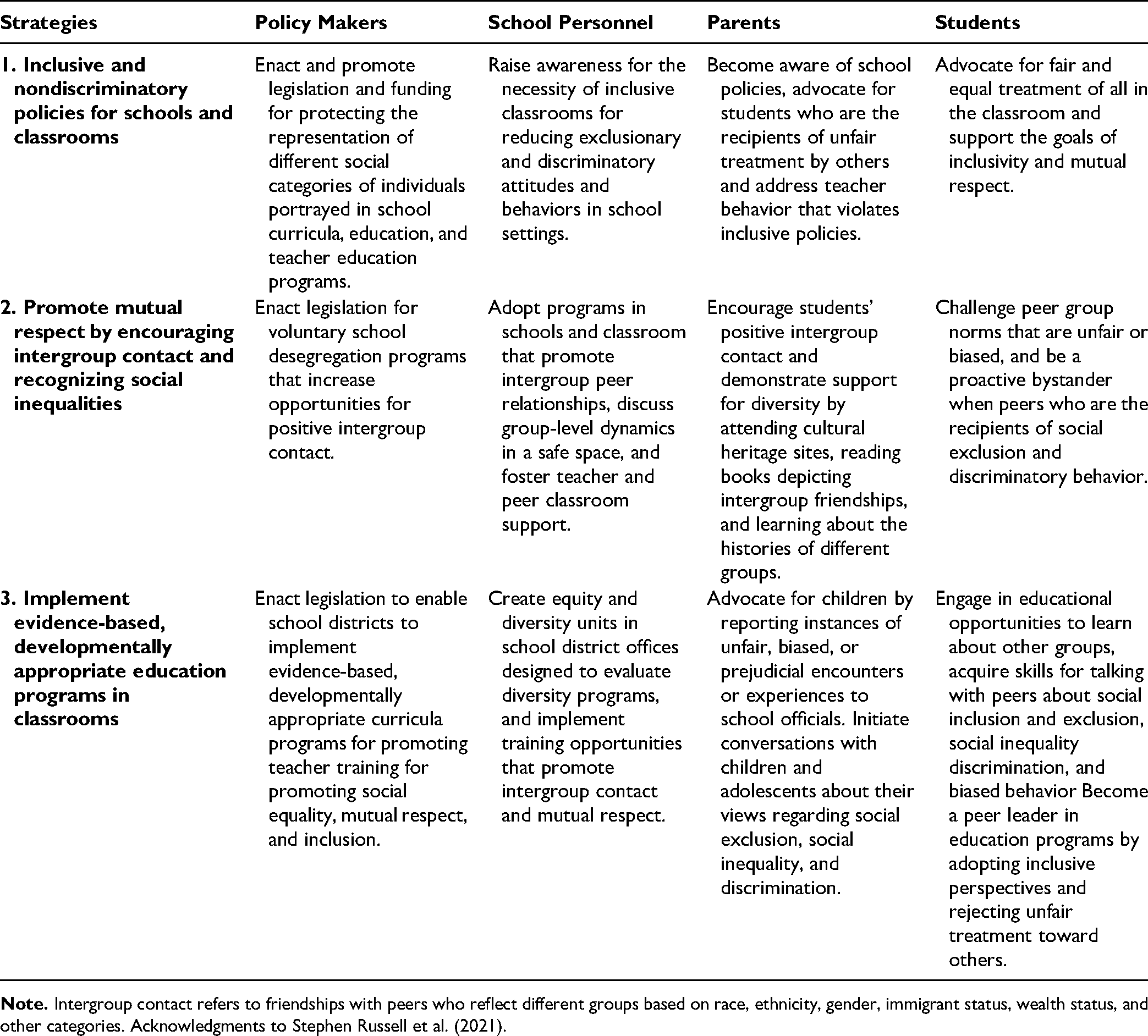
Strategy 1: Inclusive and Nondiscriminatory Policies for Schools and Classrooms
A key element for promoting just schools is the provision of legal frameworks and policies aimed at promoting inclusion and challenging prejudice in schools and classrooms (Barrett, 2018). Enacting and promoting legislation and funding for bolstering fair and just classrooms has implications for changing schools by providing school personnel, parents, and students a framework for creating change. These policies need to specifically support and protect members from different social groups with the school from discrimination and prejudice. Schools need to make it clear that they have a zero-tolerance policy toward discrimination. Teachers and parents should also aim to create a learning environment where all students can thrive together and understand the value of diversity and fairness for healthy development (Nenadal & Mistry, 2018).
The United States has become a more ethnically and racially diverse country with no majority group expected by 2044. Consequently, schools have also become more diverse, providing students with opportunities to learn from their peers from different backgrounds. Without programs designed to help students find common goals and create equal status, diversity may not result in positive outcomes given that support needs to exist at all levels for interactions to be beneficial (Barrett, 2018).
Currently, legislative efforts in the United States and other countries have shifted the focus beyond desegregation to the protection of marginalized students and ensuring that students’ civil rights are protected. These policies provide the legal power to enforce action against the continuation of discrimination. Change regarding issues of prejudice and bias are initiated at the district level in the United States rather than at the federal level, which creates different policies depending on where one lives. School districts can provide training for school personnel, discussing ways to talk about race and prejudice in the classroom, raise awareness of the necessity of fair and just classrooms, and close the achievement gap between marginalized and non-marginalized students. These policies are essential for supporting school personnel to adopt appropriate curriculum and training for teachers and educators (Kollerová & Killen, 2021).
District level offices that create Equity and Justice units, for example, can facilitate the implementation of research-based programs designed to facilitate children's awareness of social status differences, social inequities, and the history regarding how and why different groups have immigrated or brought by force to a given country. These programs help children to understand the context of disadvantaged groups and the existence of structural obstacles for success. Learning about disadvantaged groups and structural obstacles helps to mitigate prejudice because it shifts the underlying explanation of inequalities to factors outside of one's control. Programs need to be designed to help make these connections for children.
Legalization and policy initiatives at the broad level of the government, however, are only the first step toward reducing prejudice and creating fair and just schools. Modifying the social interactions and relationships, which influence psychological attitudes and contribute to discrimination is necessary (Verkuyten, 2008). There need to be policies and practices that explicitly encourage cooperation between children from different social groups within schools.
Strategy 2: Intergroup Contact for Promoting Mutual Respect
Interventions to promote fair and just schools should enact a multitude of strategies for promoting intergroup friendships, understanding the source of societal social inequalities, and fostering mutual respect for students of all ages. Positive intergroup contact directly leads to increased helping of out-group peers and assertive bystander responses (Abbott & Cameron, 2014). Intergroup contact challenges race-based exclusionary behaviors among ethnic majority and minority status children by providing new perspectives and vantage points (Jasinskaja-Lahti et al., 2011; Ruck, et al., 2014). School personnel and teachers can discuss group dynamics that contribute to unfair treatment and ask students to help problem solve these negative types of interactions. In this way, students can become agents of change by challenging peer interactions that reflect unfair treatment of others, particularly when they empathize with peers from different backgrounds. Parents who have friends from different backgrounds provide an example to their children about common ground and shared experiences.
Contact takes many forms both direct and indirect and these forms need to permeate throughout the school context. Short-term intergroup contact per se may not be strong enough to change intergroup attitudes and reduce discrimination (Dovidio et al., 2003). Instead of superficial intergroup encounters that fade away rapidly, established, positive, and reliable cross-group friendships promote inclusive, fair, and just forms of social interactions in schools. Changing school enviroments to promote long term intergroup friendships creates a foundation for dismantling racial biases and the denial of children's rights, as well as for facilitating academic achievement (Fiske, 2002; Orfield & Frankenberg, 2014; Ruck et al., 2014).
Strategy 3: Implement Evidence-Based, Developmentally Appropriate Education Programs in Classrooms
The third strategy recommended is for schools to implement evidence-based, developmentally appropriate education programs in classrooms. Currently, few intervention programs designed to reduce prejudice and bias have been tested for their efficacy. This requires evaluating programs to determine the feasibility of implementation, the likelihood for school adoption as well as parental and student support, and whether the program works. These programs have the potential to benefit their students in the long term and helps improve future programs, despite the investment to incorporate this into their scheduling. Further, these programs provide training for teachers and school personnel in terms of how to address the issues of prejudice and bias in the school context, something that is often absent in teacher training programs.
Two recent intervention programs have been shown to be effective for reducing prejudice in childhood (Killen et al., 2021) and increasing an awareness of discrimination as well as ethnic racial identity in minority adolescents (Umaña-Taylor et al., 2018). Developing Inclusive Youth is a school-based intervention for children aged 8–11 years (third, fourth, and fifth grades) and was tested for its effectiveness using a randomized control trial (Killen et al., 2021). Children used a web-based curriculum tool in the classroom in which they watched peer inclusion and exclusion scenarios making decisions about what the characters should do, their judgments, and feelings about their actions, and participate in a 30-min teacher-led class discussion. Analyses of the effectiveness of the program revealed that students enrolled in the program were more likely to view interracial and same-race exclusion as wrong, expect interracial inclusion, assign positive traits (e.g., hard-working, friendly, and smart) to peers from different racial, ethnic, and gender backgrounds, and report intergroup playmates. Viewing interracial social exclusion as wrong and holding positive traits about social groups are the first step toward reducing prejudice and bias.
Another intervention project called The Identity Project, focused on students’ ethnic–racial identity (ERI) development by fostering processes of exploration and resolution (Umaña-Taylor et al., 2018). An important component of ERI is to recognize that discrimination and stereotypes occur for members of different groups across history. A small-scale efficacy trial among eight classrooms of racially and ethnically diverse adolescents randomly assigned them to the intervention or control condition (Umaña-Taylor et al., 2018). Differences were consistent with the desired intervention effects for higher levels of ERI, supporting preliminary evidence of the effectiveness of the program. These intervention programs illustrate effective in-classroom programs for children and adolescents that contribute to promoting a fair and just school environment.
Conclusion
The current social climate has provided educators with an opportunity to improve efforts to establish just and fair school environments that promote learning and healthy development for all children. Many schools have adopted programs to address bullying. While this approach is much needed the focus is on providing social skills training for children identified as bullies or victims. Training a Muslim girl who has been rejected by her peers to be less wary, shy, and fearful (the “victim” profile) may be inappropriate, though, if the harassment that she experiences stems not from social skills deficits but from societal and group norms that perpetuate bias and stereotyping to maintain the status quo. Addressing prejudice, bias, and discrimination requires creating change at the broader group and societal level.
Children have the social cognitive competencies to think about the fair and just treatment of others (Killen & Rutland, 2011). Moreover, some but not all children recognize disadvantaged status and desire to rectify inequalities. The capacity to act in a way that promotes the fair treatment of others emerges early and develops from childhood to adulthood; as well, so does the propensity to affiliate with groups and adopt group norms that are often antithetical to goals of social equality and equity. Providing a basis for children to develop an inclusive orientation, one that includes mutual respect can, and should be a goal for education. Creating just and fair school environments are necessary for the healthy development and academic promise for all children and the goal of a more compassionate and civil society.
Footnotes
Acknowledgments
The authors would like to thank Susan T. Fiske, Arvid Samuelson, and Kathryn Yee for helpful feedback on the manuscript.
Declaration of Conflicting Interests
The author(s) declared no potential conflicts of interest with respect to the research, authorship, and/or publication of this article.
Funding
Melanie Killen, is supported, in part, by a National Science Foundation grant, BCS 1728918 and a grant from the National Institutes of Health, R01HD09368.
Adam Rutland is supported, in part, by an Economic Research Council grant, ES/R005540/1.
