






Abstract
Public health courses that provide opportunities for applied learning to develop students’ understanding of health disparities and methods for achieving health equity are of critical importance. Contemplative pedagogy can cultivate among students personal skills such as open awareness, introspection, nonjudgment, and compassion as students engage with communities across class, race, and other lines of difference. This article describes how contemplative practices are introduced and aligned with learning objectives in an undergraduate community-engaged course on health parity at a public liberal arts university in North Carolina, with the intent of contributing to the growing literature on contemplative education and how it may be appropriate in public health education. Contemplative pedagogy in this course offers opportunities for students to learn with their minds, bodies, and hearts. This article presents course context and structure, introducing contemplative practices to students, and two specific examples of contemplative activities that may help students better understand diversity and their role in sustainable health equity. The article concludes with a discussion and resources for instructors interested in contemplative pedagogy. As contemplative pedagogy gains ground in college instruction, it may also provide critical skill-building for students of public health.
Health disparities are a critical concern in the United States, and a major focus area of the U.S. Department of Health and Human Services’ (2016) Healthy People 2020 initiative and a key emphasis area of the American Public Health Association (2016). As such, public health courses that provide opportunities for applied learning that will develop students’ understanding of health disparities and methods for achieving health equity are important.
Learning about social change through community-engaged (or service-) learning has long been a component of public health and undergraduate education (Cashman & Seifer, 2008), engaging students in “learning that seeks inter- and multidisciplinary answers to unscripted real-world problems” (Petersen, Albertine, Plepys, & Calhoun, 2014, p. 426) such as health disparities. Within community-engaged courses, race, class, and power play critical roles (Catlett & Proweller, 2011; Endres & Gould, 2009; Green, 2003). Working with university students, many (but certainly not all) of whom come to the classroom privileged in some way, requires attention to cultivating open awareness and introspection as they engage in and process community engagement across class, race, gender, and other lines of difference.
One approach to cultivating such awareness and introspection is contemplative pedagogy. Contemplative pedagogy has the potential, as Caroline Barratt (2016) argues, to “overcome the gap between theory and practice and assist educators in equipping students to care compassionately and effectively in dynamic and demanding health[care] contexts” (p. 22). Contemplative pedagogy, according to former director of the Mind & Life Institute, Arthur Zajonc (2013), refers to “a wide range of educational methods that support the development of student attention, emotional balance, empathetic connection, compassion, and altruistic behavior” (p. 83). Associated educational methods in preschool through university level include stillness (such as meditation), creativity (such as journaling or drawing), relational practices (such as deep listening), movement (such as yoga), and others. Over the past two decades, contemplative pedagogy has spread through higher education in the United States with the help of the Center for Contemplative Mind in Society, and at least 10 campuses now offer degrees or concentrations in contemplative studies (Center for Contemplative Mind in Society, 2015).
Contemplative practices, including mindfulness-based activities that invite students to cultivate awareness of the present moment, have been used to assist students with addressing emotional stress (Bamber & Schneider, 2015), to strengthen student focus on course material (Ramsburg & Youmans, 2014), and to help students connect more deeply with and love themselves and others (Zajonc, 2005). In training of human services professions students, contemplative strategies have been used in social justice education (Kahane, 2009), teacher preparation (Roeser, Skinner, Beers, & Jennings, 2012), social work (Hick & Furlotte, 2009), and sociology (Song & Muschert, 2014). In the training of health professions students, at least two medical schools in the United States have integrated mindfulness into their curricula (Brown University, 2016; Dobkin & Hutchinson, 2013).
In social justice education, including public health education that involves community-engagement, contemplative pedagogy can promote learning through what David Kahane (2009) describes as “a first-person realization”(p. 53) that “can help students to understand the habits of thought, judgment, and reaction that keep them trapped in the cocoon of their own privilege” (p. 59). While instructors present facts and figures and involve students in community health projects with local organizations and community members, we also can help them develop personal skills to navigate privilege and power as it relates to the everyday work of addressing health disparities.
Contemplative Pedagogy, Community Engagement, and Health Parity
Over the past 5 years, I have utilized contemplative pedagogy in my courses. In this article, I describe the context and structure of my health parity course, how I introduce contemplative practices to the students, and two example student learner activities, followed by a brief discussion. It is my hope that this article contributes to the growing literature on how contemplative pedagogy is used on university campuses, and that it highlights its potential specifically in the training of public health professionals.
Course Context and Approach
Health Parity: Domestic and Global Contexts is a 200-level course in the Department of Health and Wellness Promotion at the University of North Carolina Asheville (UNCA), the state public liberal arts university. The course has been approved by faculty committees to carry the designations of Diversity-Intensive (DI) and service-learning (SL). To graduate, each UNCA student is required to take at least one DI course, which provides explicit opportunities for students to explore histories, power dynamics, and intersectionality related to diverse populations. SL courses must meet specific requirements related to hours of community engagement, integration into the course assessment, and critical reflection opportunities. This course is the first in a series of public health–oriented courses in our major, followed by courses in community health promotion and health communication. I have taught 14 sections of this course over the past 5 years. The majority of students taking the course are White and from middle-to-upper-class communities. We also have in each class of 27 to 30 a small number of students of color, students from lower wealth communities, students who identify outside or across the gender binary, students whose sexuality is fluid, and/or students who are older than 25 years. I am a woman of South Asian descent and I grew up in Canada and am a Canadian citizen. I attended college and graduate school in the United States and have lived here for more than 20 years. Because English is my first language and I have been part of American society including higher education settings in the United States, I believe that most students see me as relatable.
This course utilizes both reasoning and sentiment pedagogies to support student learning about health disparities and what we can and should be doing to address them. Reasoning pedagogy is the predominantly employed approach of presenting a rational argument to persuade students to attend to the condition of others, and sentiment pedagogy is an approach that utilizes personal stories to appeal to students’ empathy and compassion, thereby demonstrating interconnectedness and cultivating obligation (Kahane, 2009). Kahane asserts that both pedagogies are critical to global citizenship learning. Contemplative pedagogy also supports students in developing their worldviews and frameworks for how they make meaning in the world (Zajonc, 2006), which also is consistent with the critical thinking emphasis at my institution.
Course Structure, Learning Outcomes, and Links to Contemplative Concepts
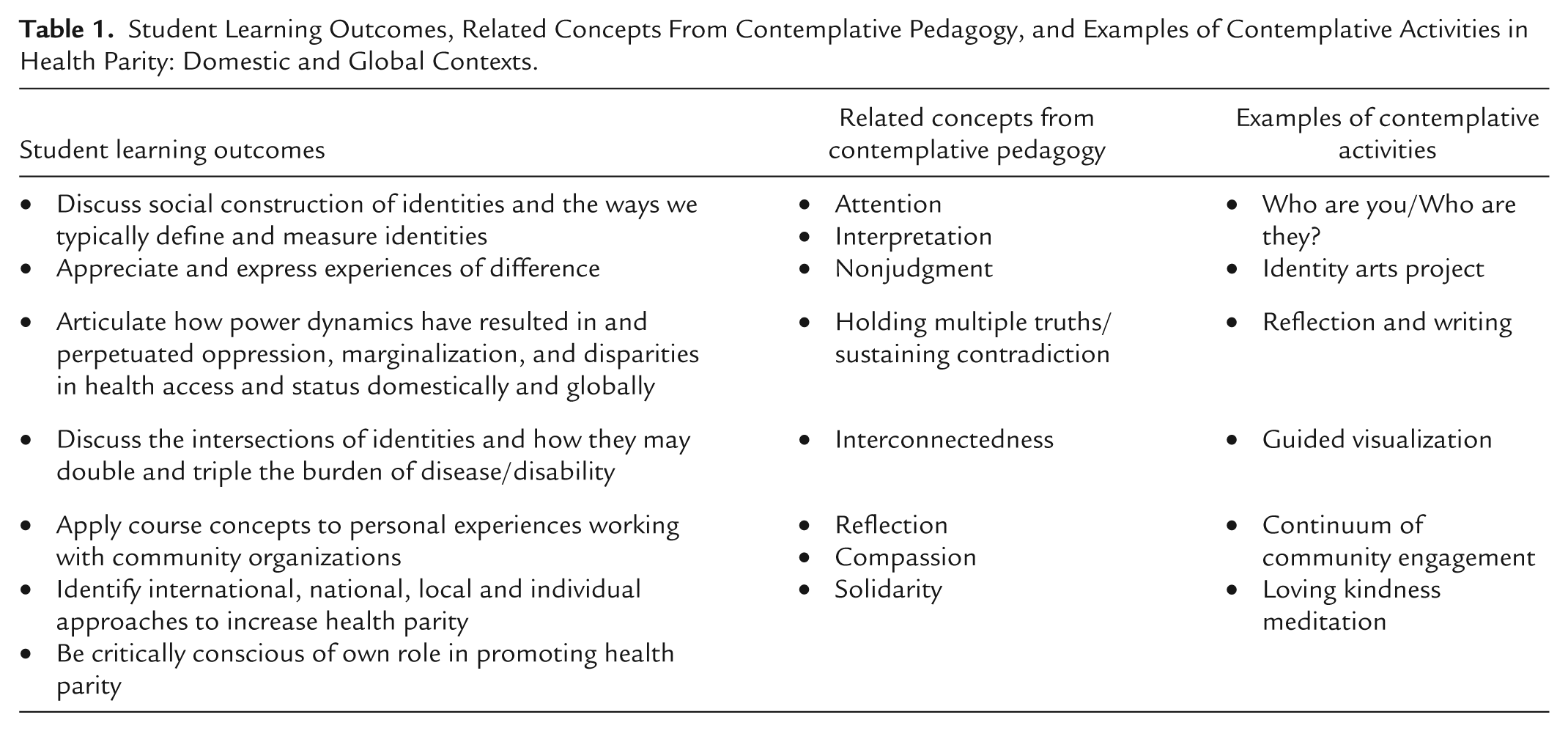
The health parity course is divided into three main sections: (a) Identities and Health: Construction and Measurement; (b) Health Disparities Across Class, Race/Ethnicity, Sexuality, Gender, and Intersecting Lines of Difference; and (c) Trends in Global Health. Over time, I have introduced contemplative activities around concepts that align with the student learning outcomes for the course. Table 1 presents major course learning outcomes along with aligning concepts from contemplative pedagogy, and examples of the contemplative activities that I use in the course. I use reflective writing throughout the course. In visualizations, I invite students to close their eyes and imagine something, such as a personal memory, with all their senses. In this class, I use visualization for remembering a time when they became conscious of their social class (related to income- and wealth-based health disparities), and later I use visualization for remembering the experiences and objects students encountered that morning before coming to class (related to how products such as alarm clocks are produced, and occupation-related disparities). In the next section, I describe in more detail two of the activities listed in Table 1.
Student Learning Outcomes, Related Concepts From Contemplative Pedagogy, and Examples of Contemplative Activities in Health Parity: Domestic and Global Contexts.
Setting the Tone
It is important to share with students what contemplative exercises are and why they are used in the course. When we discuss the learning environment on the first day of class, I emphasize that we will learn with our minds, our hearts, and our bodies because “whole-body” learning appeals to more learning styles and because our body also remembers (consider how we put ourselves in past situations to remember details about it). I describe contemplative practices as a set of exercises that we will do over the course of the semester to engage our minds, hearts, and bodies. I point out that the contemplative exercises provide space for us to notice and think about how we are feeling about an experience (introspection), and that sometimes it can be uncomfortable to do this. I come back to this point throughout the semester: that discomfort can be a gateway to deeper understanding of one’s self and a situation. I also note that discomfort is different from re-experiencing trauma, which is a concern given the historical and continued marginalization of subgroups that we explore almost daily in this course. As such, I also make a point of alerting students to upcoming topics and possible “trigger” content, and provide guidance on taking care of themselves, which may include stepping out for part of a session, speaking with me about how to obtain essential information if they are not able to be present, and/or meeting with a health and wellness counselor.
At several points throughout the semester, I invite students to sit quietly and think about how they feel about a reading, video, or other stimulus, before I ask them to write and/or before we begin discussion. This reflective writing is a contemplative practice. Just taking a few minutes to notice their physical, mental, and emotional sensations is a skill they can continue to cultivate in our class and as health promoters who will regularly interact with others and with policies, institutions, and systems that require thoughtful and “heartful” responses.
Two Contemplative Exercises
Among the contemplative activities in this course, I have found the two activities described to be effective in assisting students in noticing diversity and judgment, and in developing a sense of how their individual engagement may address the root causes of societal problems such as health disparities.
Who Are You/Who Are They?
At the end of the first day of class, I distribute a one-page handout to be completed and brought to the next class period. At the top in large letters is the question, “Who Are You” and a line underneath reads, “Answer this question. Fill all the lines.” I tell the students that all the instructions are on the page and I let them know that I and a small group of students in the class will read their response. Many students ask me for more information but I do not provide any other guidance.
At the next class period, we begin with a discussion of what the word “identity” means. I introduce some dictionary and scientific definitions and then ask them to bring out their completed handouts. I put up a slide that is entitled “Processing the Assignment” followed by a list: “structure; space; time; audience; others.” I then invite students to comment on what it was like to answer this question and how each of these elements played out for them. As we discuss, students share whether it was easy or difficult to fill the lines, how their descriptions flowed from surface to deep characteristics, how their voices changed based on the audience, and how long and in what ways they worked on the assignment. Together, we identify some of the aspects around the nature of identity that emerge from their comments: that it has to do with personal traits and with group memberships, that it is dynamic, that it is based in perception and even constructed, and so on. I ask them to share their written response with a partner and to look for commonalities, and always there are some that might never have been discovered were it not for the assignment. Students appear to see how this assignment fits, as a springboard into our material around identity and diversity. It also builds community in the classroom.
Then we shift gears and answer the question, “Who Are They?” Either as students walked in at the beginning of class or while they are in their pairs, I give each person a sticker with a large easy-to-see number written on it, such that each person has a unique number. When we get ready for this activity, I tell students that they will receive a paper with a number on it. Without talking to anyone they should answer the question and fill the lines. I distribute the ¼ page sheets, with the question “Who Are They? Fill all the lines” at the top and about 5 blank lines. Each sheet has a number corresponding to someone’s sticker. (As such, you will need to make sure that there are just the right number of sheets and stickers, and prepared for absences and new students.) At this point, someone usually asks for more information or asks how they are supposed to do this, and I respond with kindness that all they need is on the sheet and that we need to have quiet for the next 5 minutes.
When I tell students that they can stop, there is palpable relief in the air. I invite students to share what it was like for them to do this activity and usually students express concern about having to describe someone they do not know. (Some students receive the number of a student who they do know, and that can be easy or challenging for them as well.) Though students often are eager to discuss the ways this brief activity is related to social norms in our society, I ask them to start with their physical and emotional sensations first—what did they feel, and then we move on to what they did, from noticing a person’s physical characteristics, mannerisms, and brief interactions—because that is all we have experienced—and interpreting those to make broader conclusions about the person, and sometimes even judging them based on the clothes or accessories or short glimpses at behaviors.
Before we conclude, if no one has mentioned it yet, I ask if anyone had any thoughts on what it was like knowing someone they do not know is writing about them. Students usually express discomfort and the worry of being judged. Students also usually raise the importance of spending time with someone to really get to know who they are. We come back to these ideas throughout the semester, such as when we talk about the limitations of measures of health on national surveys.
Continuum of Community Engagement
In order to support students’ understanding of where their community engagement fits with addressing health disparities in meaningful and sustainable ways, I use a “Continuum of Community Engagement” that I adapted from a similar continuum presented by Daniel Barbezat of the Center for Contemplative Mind in Society (Barbezat, 2013). The continuum has five stages (see Figure 1), with each representing a way of relating between student and community.

Continuum of community engagement.
The continuum begins with Apathy, which is disengagement and not caring. Next, Pity/Sympathy/Charity is feeling bad or sorry for someone whose situation is removed from one’s own. Empathy is when one can relate to another’s troubles, even if their situations are different. Compassion is feeling bad about someone else’s struggle accompanied with the motivation to help alleviate their suffering. Solidarity is working with the person as equals in the alleviating the struggle.
I share the figure in a slide and I ask students to consider their community engagement in our course and where they believe they are, and then to write about it, giving specific examples from their experiences to support their thinking. I then invite students to share their thoughts and we begin to uncover both the limits and the opportunities in addressing social problems through our community engagement work. Students often recognize that community engagement is not necessarily supposed to make them feel good. We also discuss that solidarity work is rare—that crossing multiple lines of difference may be what is needed for communities to be empowered to make their own long-lasting change, and that it is a lot harder to do this work than the work earlier in the continuum because of power dynamics in our institutions and communities. However, if we engage only in the sympathy or empathy stages, such as distributing bags at a food bank, that the root causes of problems, such as food insecurity, likely will persist. We usually conclude that, given the realities of our current situations, that work across the continuum (from sympathy) is necessary but that there must be solidarity work in order for reductions in health disparities to be sustainable.
Discussion and Conclusion
In this course, I use a range of contemplative activities to complement cognitive understanding of a topic or issue, and to train students to ask questions of themselves in their studies and in their work with others. While these activities are likely similar to those used by other instructors, in this case they are part of a contemplative pedagogy that includes my own personal practice. As Barbezat and Bush (2014) describe in their introductory text, having personal experience with contemplative practices and cultivating one’s own awareness helps us guide and respond meaningfully to students.
While providing me with what I believe is a more authentic teaching experience, the use of contemplative practices in my classrooms is far from easy. I often question whether students will “buy” my proposal that learning with the mind, body, and heart is necessary, and whether the time it takes to be reflective is not a loss of time from other, more relevant pursuits. However, the perceived impact in my classes is encouraging. Beyond my description of how I introduce contemplative activities to students, instructors may find useful the intro material and activities in How to Train a Wild Elephant: And Other Adventures in Mindfulness in their courses (Bays, 2011).
It also is important to note the importance of substantive content on health disparities. Others have offered resources for teaching about health disparities among African Americans (Robillard, Annang, & Buchanan, 2015), using video and accompanying curricula on the effects of Hurricane Katrina (Kernan & Basch, 2016), and photovoice (Gutierrez & Wolff, 2016). The current article just scratches the surface of how contemplative pedagogy is a social justice/anti-oppression pedagogy, which is explored more deeply by Beth Berila (2016).
As this example of contemplative practices in a community-engaged course suggests, using contemplative pedagogy may help students in cultivating personal skills for understanding and addressing health disparities in their work in public health.
Footnotes
Acknowledgements
Special thanks to the UNC Asheville Key Center for Service Learning, student reflection leaders Rebecca Williams and Jesse Goldman, the many students who have engaged in contemplative practices in the health parity course, and the many community partners with whom we have partnered to address health disparities.
Declaration of Conflicting Interests
The author declared no potential conflicts of interest with respect to the research, authorship, and/or publication of this article.
Funding
The author disclosed receipt of the following financial support for the research, authorship, and/or publication of this article: The author wishes to thank the Roy Carroll Professor of Honors Arts & Sciences, the University Service Council, and the University of North Carolina Asheville for support to attend the Contemplative Mind & Society summer session, to conduct engaged learning activities, and to take professional development leave to write this article, respectively.