






Abstract
Conducting engaging experiential learning exercises is an exceptional strategy for teaching multidisciplinary teams of public health students. The objective of this article is to present an experiential student-driven exercise through a simulated food-borne outbreak. Through this process, students gain an understanding of the steps of an outbreak investigation, Incident Command Systems; identify and calculate appropriate measures of association; develop a questionnaire; and refine their communication techniques. This exercise is also unique in that it was codesigned by graduate teaching assistants who had previously taken the course. These targeted learning objectives created for students, and by students, allow for the development of peer-based training and also serve as a learning experience for student alumni. The authors provide all the needed teaching materials to provide an easy-to-follow guide for others to conduct similar exercises with their students.
Experiential learning exercises developed for multidisciplinary teams are effective and enjoyable for students (Myers & Burgess, 2003; Thistlethwaite et al., 2012; Willock, Goodrow, & Meyers, 2000). Although experiential and simulation-based learning exercises are extensively used in health professions, in public health, outbreak investigations are often conducted as tabletop or passive-listening lectures. However, exercises that use experiential learning for students who will conduct these types of investigations after graduation enhance learning outcomes and provide valuable hands-on experience (Karlsen, Mehli, Wahl, & Staberg, 2015). Experiential learning enhances active listening and collaboration between teams, which can improve the students’ risk assessment and decision-making capabilities as well as interpersonal and targeted teamwork competencies (Lateef, 2010). Progressive education such as experiential learning bridges education and experience but can create problems integrating theory and practice (Dewey, 1998). In other health education professions, such as nursing, attempts have been made to address the so-called theory–practice gap (Ehrenberg & Haggblom, 2007). This exercise attempts to intertwine practical experiences and theoretical knowledge, which may increase the integration between theory and practice in public health education. Despite the benefits of experiential learning, significant investment is required on the instructor’s part to develop and evaluate the exercises effectively (Gormally, Brickman, Hallar, & Armstrong, 2009). The purpose of this exercise is to simulate a food-borne outbreak in the classroom in order to engage students in all the steps of the outbreak investigation process.
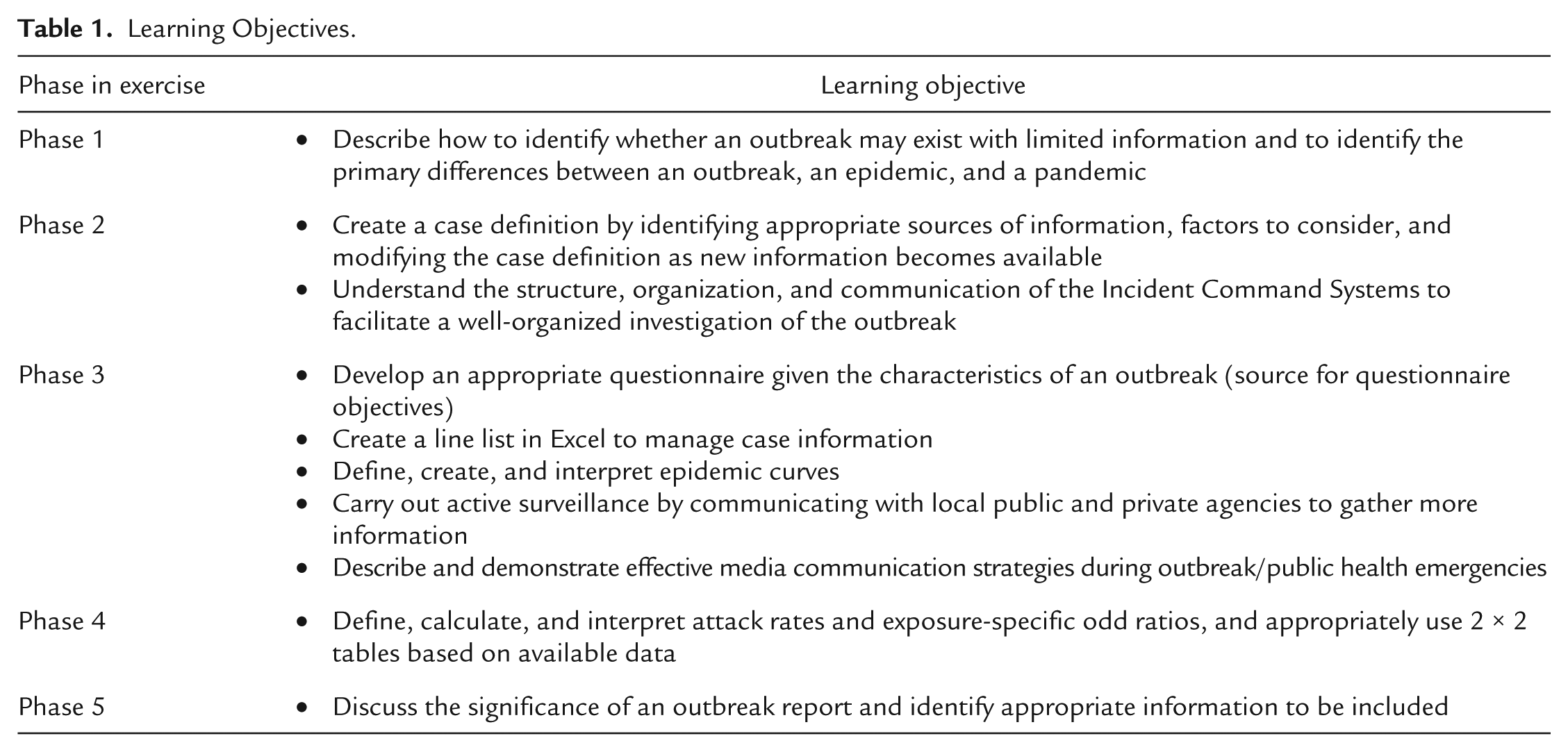
This experiential multiday exercise takes place in a required graduate-level course that teaches public health students about outbreak investigations. The Student Aid for Field Epidemiology and Response class at a large southwestern U.S. public university meets on a weekly basis, and as needed, to work with state and county health departments on actual outbreaks (Pogreba-Brown et al., 2010). Students are also expected to complete outside trainings at local health departments, and on their own, including the Federal Emergency Management Agency’s IS-100.b and IS-700.a online courses (Federal Emergency Management Institute, 2015). If students are not familiar with local health department structures or Incident Command Systems (ICS), a brief description may be needed in the previous class period. This exercise was codeveloped by the graduate teaching assistants for the course—both students who had taken the course previously. The exercise was completed multiple times with pre- and postassessments to evaluate learning objectives (Table 1) and lessons learned. Within this course, the exercise was conducted over 4 hours split between two consecutive class periods, with a homework assignment between the 2 days; however, it could take place as a full-day workshop. Three semesters of Master of Public Health (epidemiology and biostatistics concentrations) students have participated in this exercise through the Student Aid for Field Epidemiology and Response class for a total of 38 students (fall 2015 n = 18, spring 2016 n = 9, and fall 2016 n = 11; 60.5% female students overall); the exercise was successfully conducted in larger and smaller class sizes.
Learning Objectives.
Instructor Preparation
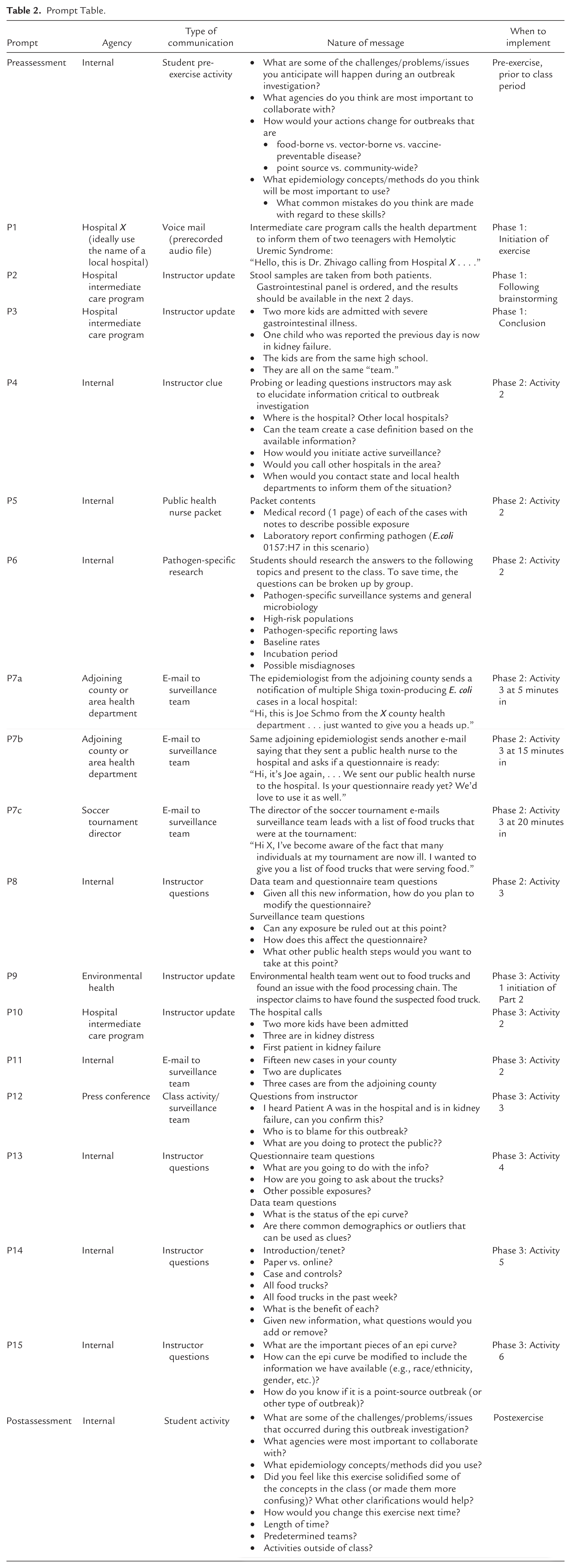
The first step in engineering an outbreak exercise is to decide the following: (a) pathogen, (b) environment and population, (c) scenario in which the outbreak occurs, and (d) sequence of events and other complicating factors. For this exercise, we have presented an outbreak scenario of (a) a food-borne pathogen Escherichia coli (E. coli) O157:H7 in (b) a population of high school students in Phoenix, Arizona, (c) attending a soccer tournament where food was available through vendors including food trucks, with (d) other visitors and food trucks serving food at multiple events. Instructors who wish to conduct this exercise can replicate this scenario or they can use the learning objectives and prompts designated as P# throughout and within Table 2 to engineer a different scenario. The important factor in engineering a different scenario is that the instructors use real-world information to make the exercise as likely and relatable as possible.
Prompt Table.
One of the critical pre-event activities for instructors is the creation of a master line list that serves as a key for instructors while conducting this exercise. The following is a list of suggested information to be included in the master line list:
Food truck exposure
Consumption of specific contaminated food item Date received (day and time in simulated outbreak scenario)
Patient first and last name
Age
Gender
Symptoms (depending on pathogen)
Symptom onset
Exposures of interest (soccer tournament, restaurants, food trucks, etc.)
Reporting agency
Laboratory results
Comments (school, relationship to other cases, etc.)
When information is revealed during exercise (e.g., Phase 1, Activity 1)—for instructors only to assist in the logistics of the exercise
To simulate a realistic outbreak, instructors will need to use the master line list to create the epidemic curve (epi curve) using the onset date of each case. Instructors can choose to present a point- or continuing-source outbreak and alter the curve from the magnitude and timeline of outbreak events. To more realistically simulate how an outbreak unfolds, we chose to present a point source outbreak and reveal cases to students over time rather than revealing the scope of the outbreak all at once (Figure 1).

Epidemic curve by onset date and phase introduction.
To simulate a realistic scenario, names and locations of real restaurants, event venues, health care facilities, and schools were used. Including this “real” information enhances experiential learning by allowing students to discover and confirm information through Internet research. For example, once students learn what locations the cases ate at or the name of the food trucks in this scenario, they were expected to look up the menu online and use this information in the investigation. Additionally, nonrelevant information was included with some cases that will eventually lead to “dead ends” to simulate the entirety of information that often accompanies case reports from reporting agencies.
Phase 1: Identifying a Potential Outbreak
Preassessment
Prior to the initiation of the exercise, instructors can conduct the preassessment with students (Table 2). This can be conducted in the previous class period, either handwritten or electronically.
Activity 1: Information Gathering (30 Minutes)
Day 1, Wednesday 4:45 P.M A prerecorded audio file simulates a voice mail message from a local health care provider concerning two recently admitted high school students with “HUS [hemolytic uremic syndrome]” (P1). The message can include language and acronyms commonly known and understood in the medical community even though they may not be understood by students. The voice mail should also include the time and date that coincide closely with the exercise, for example, in this scenario, 4:45 p.m. on Wednesday.
Student research and discussion
Students are asked to generate a list of questions or additional information that they think they need and to use the Internet and other resources to quickly research information that addresses and answers their questions. These could include incidence rates of HUS, common causes, complications, and populations at risk. A discussion of the questions and answers with the whole class follows. Before moving to the next activity, students should have an understanding of HUS, and instructors should provide examples of quick and reliable resources for medical and epidemiological information commonly used by working professionals.
Brainstorming and inquiry
Next, students must prepare a list of key questions to ask when gathering information from a health care provider to assess the situation for a potential outbreak. After brainstorming, instructors inform students that they have reached hospital infection control for an update (P2).
Conclusion of Phase 1
Day 2, Thursday 9:00 A.M. Students “arrive to work” the next morning and learn that there are additional cases and one case is in kidney failure (P3). After students have had the time to discuss the new information and ask clarifying questions, proceed with Phase 2.
Phase 2: Confirming an Outbreak and Initiating the ICS
Activity 1: Review of ICS (20 Minutes)
ICS is obviously an involved and detailed system. For the purposes of this exercise, students should focus on questions related to who is in charge, when (and what parts) of ICS should be operationalized, and characteristics of an event that determine ICS initiation (e.g., size of outbreak, severity, population effected, etc.).
After sufficient discussion of key ICS concepts, instructors should assign students into three teams: (1) data team (DT), (2) questionnaire team (QT), and (3) surveillance team (ST). For the size and student experience in our course, this resulted in four to five students per team, which was an ideal size for full participation and facilitation of necessary communication. For larger groups, instructors may need to operationalize other teams or divide tasks between multiple teams.
Once students have been assigned to teams, discussion of key communication concepts related to ICS can be addressed, including interteam communication (e.g., ICS-like or free communication), frequency of meetings, leadership responsibilities, and modes of communication (e.g., e-mail, phone, face-to-face). Before moving to the next prompt, each team should pick a leader who will speak for the team. For this exercise we provided the following recommendations:
Teams should send representatives and assign liaisons for communication between ICS teams.
Teams should meet every 30 minutes or as necessary if scope of outbreak changes.
Post the e-mail address of team leaders so they are accessible to all students.
Activity 2: Public Health Nurse Report (30 Minutes)
Day 2, Thursday 11:00 A.M. Instructors select two students who will temporarily assume the role of public health nurses and provide them with the public health nurse package (see next section). Allow them 15 minutes to review the package and prepare a report for the rest of the class. While the public health nurses are preparing their report, teams should begin the following activities:
DT: Begin creating a line list in Excel (or Epi Info) with the variables they anticipate will be most important to the initial investigation.
QT: Begin developing survey questions based on available information (if students have no previous experience with an investigation form, encourage them to find examples online through state or local health departments).
ST: Begin forming a surveillance strategy and determine other information sources and how to obtain them (P4).
The public health nurse report should summarize key information about the current cases from fake medical records provided to the students (P5). After the nurses present their findings, allow time for discussion and research of the new information and the pathogen of concern (P6) among the students (this is meant to simulate an internal meeting or conference call).
Activity 3: Communication From the Adjoining County (30 Minutes)
While students are processing the information from the nurse report, the first three simulated e-mails should be sent to the ST leader throughout Activity 3 (P7a-c). The ST should discuss the e-mails, reply with additional questions or requests for information, and update the QT and DT with new information.
Team Updates
After the teams have had sufficient time to complete the previous tasks, each team should prepare an update for the class to be presented by the team representative. Possible questions that can be used to prompt the teams are given in Table 2 (P8).
Team Assignments (1 Hour): In-Class or as a Group Homework Assignment
These assignments are designed to reinforce Day-1 learning objectives and understanding of team-specific responsibilities. If these are to be presented on a different day, students can e-mail written reports to instructors to review before the second class period.
DT: Complete the line list with current confirmed and suspected cases. The report should include an epi curve, case counts by age and gender, and any other information they deem important.
QT: Finalize the questionnaire based on the information currently available. Include a possible introduction explaining the outbreak and answers to anticipated questions. In addition to presenting the questionnaire to the class, the QT should identify who will be contacted to complete the questionnaire (e.g., confirmed cases, probable cases, and non-ill controls).
ST: Research the regulatory aspects of food trucks (including regulatory agencies, common practices, rules, etc.) that will aid further investigation and prepare a report to present.
Phase 3: Outbreak Investigation
Activity 1: Class Discussion of Team Assignments (10 Minutes)
Phase 3 begins with an update from environmental health (P9). Teams are asked to consider what other information they might request (e.g., menus, locations of trucks at different events, etc.).
Each team’s representative presents their work from the team assignments. Sufficient time should be allowed for class discussion and critique following each presentation.
Activity 2: Team-Specific Tasks (10 Minutes)
Day 2, Thursday 5:00 P.M. Students are informed through a departmental update on the status of the outbreak (P10) with additional cases reported and an update from the hospital on new and existing cases (P11). An Excel sheet with the information on these new cases is e-mailed to all students. After the students have had sufficient time to ask clarifying questions, teams are directed to finalize the questionnaire (QT), update the line list and epi curve (DT), and generate an official statement (ST) for the local news.
Activity 3: Press Conference (10 Minutes)
Day 2, Thursday 6:00 P.M. The local news has called and would like an update on the status of the outbreak and the students in the hospital. Members of the ST will provide a press conference to the class answering any questions from students. It is important to simulate questions public information officers might experience during a press conference to help students learn to communicate effectively and think on their feet (P12). Discussion of answers given can focus on issues such as patient confidentiality, partnerships with other agencies, and only providing current facts.
Activity 4: Team Updates (5 Minutes)
Day 3, Friday 6:30 A.M. After completion of the press conference and the discussion, students will briefly convene to update each other. The instructor should prompt the QT and the DT (P13) with questions to help them consider the new information they have received.
Activity 5: Critique of Questionnaire and Updates (15 Minutes)
Day 3, Friday 8:00 A.M. At this point in the exercise, it is important to do a complete critique of the questionnaire to help students understand the challenges with developing a good questionnaire during an outbreak. It is important to emphasize that a questionnaire can change over time; however, many health departments rely on “shotgun” questionnaires to broadly identify exposures during an outbreak. During the class critique of the questionnaire, the instructors should prompt all students with questions to consider not only how it is written but also the logistics behind completing the interviews (P14).
Activity 6: Study Design Considerations (10 Minutes)
Day 3, Friday 12:00 P.M. Students are responsible for figuring out how to call each case or control, organization of the contact sheet, and investigator caseload. Potential decision-making questions can address the study design, targeted interviewees, ratio of cases to controls, and analysis plan. If time permits, students can conduct mock interviews with each other with provided “cheat sheets” for exposures (allow for an additional 30-40 minutes for this).
Data team update
Request an update from the DT including the most up to date epi curve, which can be shared electronically or displayed on a whiteboard. Instructors should emphasize the integral parts of an epi curve and provide feedback on how it can be modified or improved based on the available data (P15).
New cases Day 4, Saturday 8 A.M.
Students are updated on the status of the outbreak. They learn that more cases have presented in the county, and two more have presented in an adjoining county. Students must decide whether they should bring in their staff to work through the weekend. Students should consider outbreak severity, if the exposure could still be continuing, and resource availability.
Phase 4: Data Analysis
Activity 1: Data From Interviews (25 Minutes)
Day 6, Monday 12:00 P.M. Students are notified that 22 cases and 24 controls were interviewed in total and are provided with all data from the master line list. Associated 2 × 2 tables and measures of association can be determined.
Conclusion of Phase 4
Day 10, Thursday 8:00 A.M. Class is updated that there have been no new cases reported since Day 6.
Phase 5: Outbreak Report and Lessons Learned
Activity 1: Outbreak Declared Over (5 Minutes)
Day 21. Notification that the outbreak has officially ended is given. In total, there were 45 laboratory-confirmed cases and 30 probable cases with no deaths. Teams were able to identify the food truck tied to the outbreak and the food of most concern.
Activity 2: Outbreak Report (10 Minutes)
Students lead a discussion on what information to include in the outbreak report, and articulate lessons learned from the investigation. It is also pertinent to have students discuss the effectiveness of the ICS and their communication strategies, steps the environmental health team or health department should take, as well as any policy implications based on the investigations findings.
Evaluation and Lessons Learned
To evaluate the effectiveness of the outbreak exercise and to assess areas for improvement in future iterations of the exercise, we conducted a qualitative pre- and postevaluation of the students’ achievement of intended objectives. Based on the pre- and postevaluations completed by the students, it was found that for the preassessment, anticipated challenges (e.g., lack of resources, communication) and needed skills (e.g., conducting a case–control study) were very broad, whereas responses for the postassessment were much more specific (e.g., speaking to the media, considering biases during questionnaire design and development). Communication was a noted challenge; however, while most students understood the importance and potential challenges of intra-agency communication, the postassessment revealed that they had a much better understanding of the challenges associated with interagency (i.e., between teams) communication. Finally, while we did not ask this directly, many students identified how having access to a student response team (e.g., the one they are a part of) would be beneficial for assistance with interviewing and data collection. While not intentional, this exercise seemed to reinforce what students felt their role in a public health response could be and likely increased their willingness to collaborate with these types of teams once they become professionals.
As with any class-based activity, there are always lessons to be learned. In the future, the preassessment should be conducted in the day or week prior to the exercise to allow instructors to modify the level of difficulty and content of the simulated outbreak. Adequate time should be given to creating and researching the scenario and reverse engineering the line list and epi curve. Instructors should ensure that they have covered all relevant course topics prior to conducting the exercise, or if students have not yet learned an important topic (e.g., how to conduct statistical analysis), the instructor could choose to place students on teams based on strengths. The postassessment should be completed immediately following the exercise completion, and if possible, a brief class discussion of the student’s responses at a later date would help solidify any final concepts.
Conclusion
This experiential exercise is an effective and engaging way to use experiential learning in public health classrooms. It was codesigned with previous students from a large southwestern U.S. public university to ensure that learning objectives matched with current skill sets to ensure full student engagement. This dynamic class exercise is challenging because it allows for greater variability in student responses and may result in errors along the way. However, it helps reinforce concepts students may have only been exposed to through didactic lectures and allows students to turn education into experience. Our goal was to create a road map for other educators looking to create this type of exercise and lend specific details to the investigation of an outbreak that work in a student setting.
Footnotes
Acknowledgements
Thank you to all the students who participated in these exercises and provided feedback on their experiences. Instructors wishing to conduct this exercise can refer to  for all resources including a PowerPoint, Public Health Nurse Report, sample master line list and concordant epi curve, and simulated e-mails and communication.
Declaration of Conflicting Interests
The authors declared no potential conflicts of interest with respect to the research, authorship, and/or publication of this article.
Funding
The authors received no financial support for the research, authorship, and/or publication of this article.