







Abstract
Specialist Community Public Health Nurses known as health visitors lead and deliver the U.K. government’s Healthy Child Programme aimed at promoting and protecting the healthy development of children from conception up to age 5 years. Health visitors work with families to influence the development of positive parent–infant relationships from the beginning of a child’s life. It is essential that health visitors are educated about the importance of promoting positive parent–infant relationships; however, research reveals health visitors report a lack of initial theoretical education surrounding the parent–infant dyad. Therefore, as a newly appointed public health nurse lecturer teaching student health visitors undertaking an academic diploma at master’s level within a university, a teaching workshop was developed to meet this need and facilitate the learning of registered professional nurses and midwives studying to become health visitors. This article takes a reflective approach to critically explore the evidence base underpinning teaching and learning strategies applied to educate 21 student health visitors about the importance of supporting the development of positive parent–infant relationships. The effects of andragogy as a combination of constructivist and humanistic learning theories applied to plan and deliver the teaching workshop is critically discussed with a focus on incorporating group work to facilitate active learning. Recommendations are made to promote professional development and quality learning opportunities for future student health visitors.
In the United Kingdom, specialist trained public health nurses, known as health visitors, lead and deliver the government’s Healthy Child Programme aimed at promoting and protecting the health and development of children from conception up to age 5 years (Department of Health [DH], 2009; Welsh Assembly Government [WAG], 2016). A key aspect of the health visitor role focuses on working closely with families to influence the development of positive and secure parent–infant relationships from the beginning of a child’s life (WAG, 2016).
It is essential that student health visitors gain knowledge and understanding about the importance of promoting positive parent–infant relationships while undertaking their postgraduate diploma course. However, health visitors report a lack of initial theoretical education surrounding the parent–infant relationship and describe feeling ill prepared for this area of practice (Appleton, Harris, Oates, & Kelly, 2013). Consequently, as a newly appointed public health nurse lecturer working within a university, a teaching workshop was developed to meet this need.
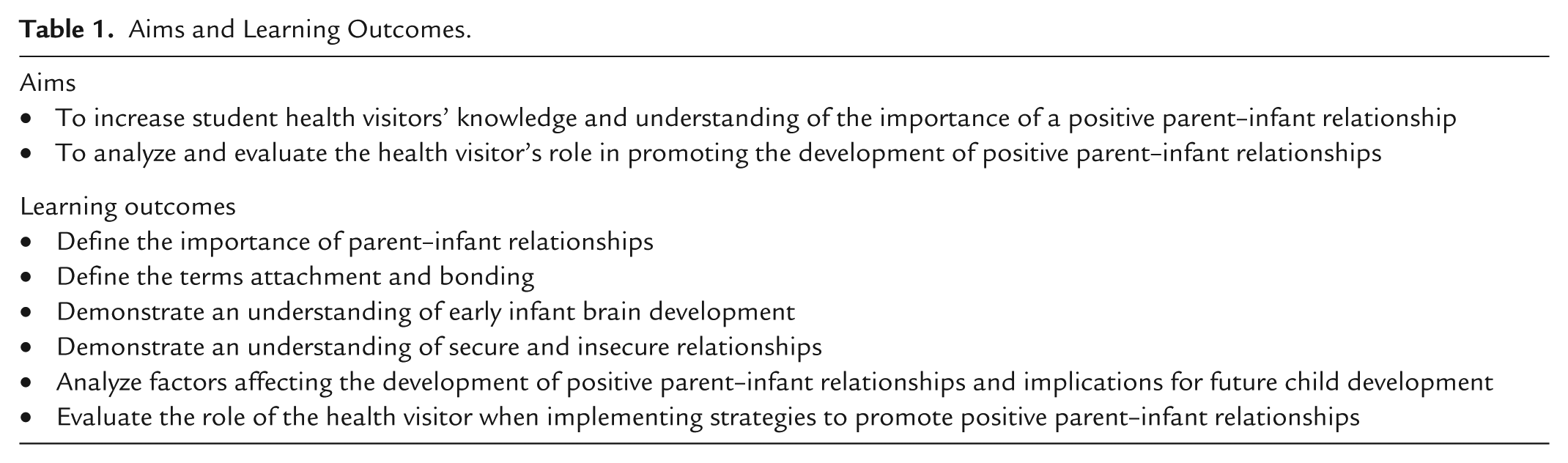
This article takes a reflective approach to critically explore the evidence base underpinning teaching and learning strategies applied to teach 21 student health visitors undertaking a module within the Specialist Community Public Health Nursing (SCPHN) postgraduate academic diploma program. The aims of the teaching workshop are
To increase student health visitors’ knowledge and understanding of the importance of positive parent–infant relationships
To analyze and evaluate the health visitor’s role in promoting the development of a positive parent–infant relationship
The effects of the constructivist and humanistic learning theories applied to plan and deliver the teaching workshop are critically discussed. This focuses on exploring the effectiveness of incorporating group work to facilitate active learning. Recommendations to develop teaching and learning practices will be made to promote a quality educational experience for future student health visitors.
Background
In the United Kingdom, health visitors are professional nurses or midwives who undertake a SCPHN postgraduate academic diploma at master’s level (Nursing and Midwifery Council [NMC], 2004). Learning outcomes for the program are set out in line with regulatory body requirements of the NMC (2004, 2015) and Quality Assurance Agency (QAA, 2013). The program consists of 50% theoretical teaching and learning modules within university, and 50% practical placement learning modules, where students’ learning is facilitated and assessed by qualified practice teachers (PTs) within the community setting and evidenced through completion of a practice portfolio. A PT is a registered health visitor who has received a further qualification to provide support for the learning and assessment of student health visitors in practice.
Ensuring the SCPHN program meets regulatory body requirements and quality assurance measures is essential to maintaining effective learning experiences (NMC, 2004; QAA, 2013) and increasing the health visitor workforce in the United Kingdom. It is therefore important to critically examine how quality learning opportunities are enabled within the SCPHN program. While student assessments and evaluations provide valuable data, nurse lecturers can also contribute to this knowledge base by critically appraising their own teaching and learning practices to consider how the effects of their teaching enables quality learning opportunities and experiences. According to the seminal work of Schon (1987), reflection enables opportunities to question teaching and learning practices and promotes professional development.
Developing the Teaching Plan
A teaching plan was developed to plan the venue, structure the teaching workshop, and ensure factors such as equality, diversity, and inclusivity matters were considered. In line with quality assurance measures and regulatory body requirements (NMC, 2004; QAA, 2013), the aims and learning outcomes of the workshop (Table 1)were mapped against module outcomes (Kinchin, Cabot, & Hay, 2008).
Aims and Learning Outcomes.
The teaching strategies adopted to facilitate learning aimed to accommodate a variety of different learning styles and preferences, as literature reports students learn in different ways through many modes of teaching (Bastable, 2014). An overarching andragogical approach to learning, defined by Knowles (1990, p. 54) as “the art and science of helping adults learn,” was applied. This considers the unique characteristics of adult learners, assuming they come motivated, ready to learn, with varied experiences and are responsible for their own learning. While this may be a generalized assumption about adult learners (Bowl, 2012), Rogers (1983) does indeed advocate the need for teachers to consider and build on students’ personal and professional backgrounds, existing knowledge and capacity for self-direction.
To meet the aims of an overarching andragogical approach to the workshop, seminal humanistic and constructivist learning theories underpinned the teaching strategies. The constructivist learning theories of Bruner (1996) and Vygotsky (1978) recognize learning to be an active student-centered process where teaching strategies enable students to discover the significance or relevance of the topic, build on existing knowledge, receive and interpret new knowledge, and construct understanding and meaning, thereby making connections to practice. Constructivist theory supported the aim of the teaching session as a strategy to facilitate active learning through group work. The humanistic theories of Maslow (1971) and Rogers (1983) advocate the need to consider and value the uniqueness of students, their motivations, prior knowledge, and personal and professional experiences in order to facilitate learning. Indeed, as adult learners the student health visitors would bring rich resources to the teaching workshop from past mental health, pediatric, general nursing, or midwifery experiences. This would be valuable to facilitate interprofessional learning (Centre for the Advancement of Interprofessional Education [CAIPE], 2015), an important aspect of collaborative working within health visiting (NMC, 2004; see Table 2).
Teaching and Learning Strategies.
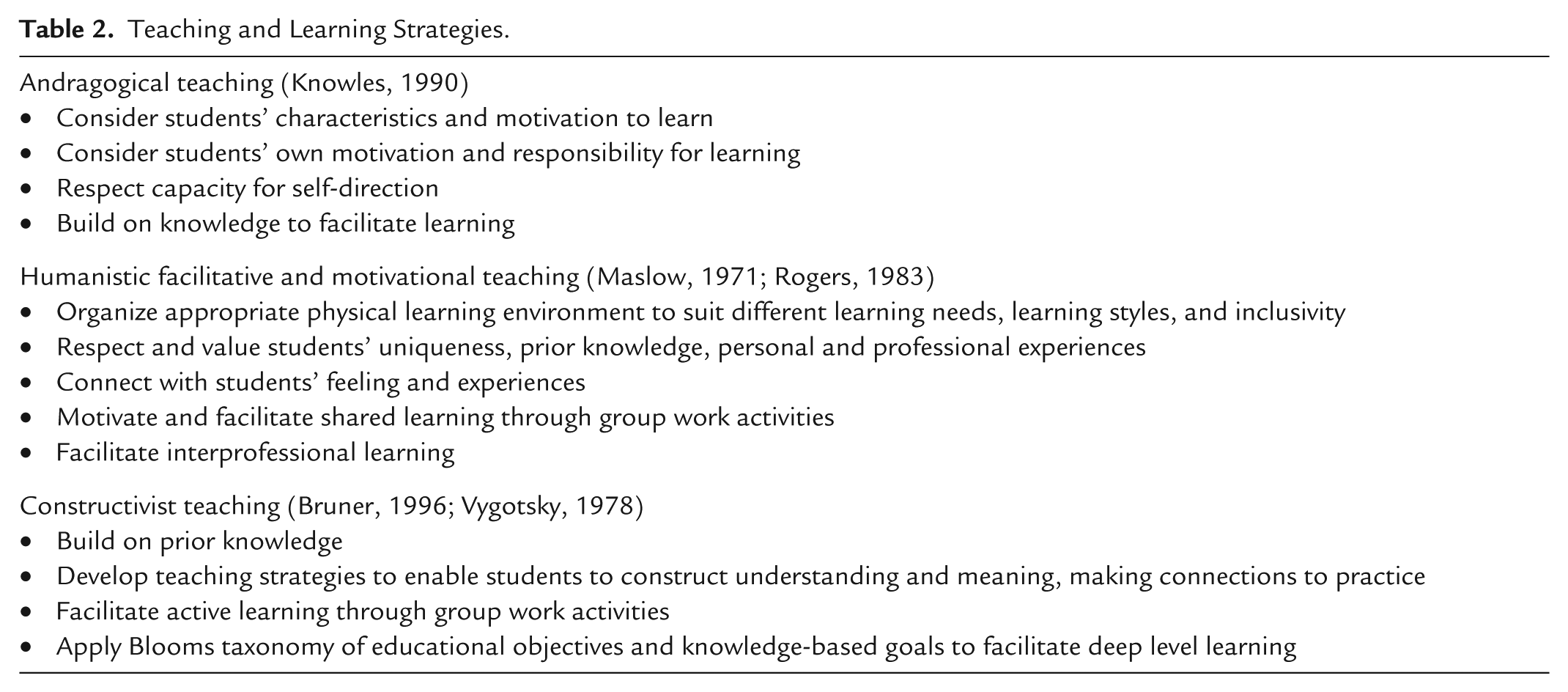
According to Maslow’s (1971) motivation theory individuals are motivated to achieve a hierarchy of needs with an aim of attaining self-actualization. As the students had chosen to undertake the SCPHN program this could mean they were ready and motivated to learn in order to achieve qualification and gain a role as a practicing health visitor. Dennick (2012) suggests a humanistic facilitative approach would enable the acquisition of new knowledge at a deeper level where student health visitors could achieve self-actualization (Maslow, 1971) in terms of higher level knowledge and thinking required to undertake the role of a health visitor (NMC, 2004). Certainly, research indicates that andragogy is fundamentally a combination of the constructivist and humanistic learning theories and are successful when facilitating leaning at postgraduate level (Johnson-Farmer & Frenn, 2009; Samarakoon, Fernando, & Rodrigo, 2013).
The aims of the teaching workshop and assessment of learning were constructed around six learning outcomes formulated in accordance with seminal work of Bloom’s (1956) taxonomy of educational objectives for knowledge-based goals. Bloom’s hierarchy of cognitive functions increases in complexity and enabled formulation of learning outcomes from simple factual knowledge (surface knowledge) to higher level thinking (deep knowledge) to encourage analysis and evaluation of theories and concepts.
Delivering the Teaching Workshop
The workshop began with outlining aims, learning outcomes (Table 1), and structure of the day’s workshop. Up-to-date policy, evidence, and literature relating to the parent–infant dyad and importance of promoting positive relationships to nurture infant mental health was presented. This was through a 2-hour teaching session using PowerPoint slides, video clips, evidence-informed handouts, and discussions relating theory to practice, highlighting the relevance of the subject to everyday health visiting. This gained students’ attention and triggered discussions and questions where students also spoke about their own views and previous professional experiences relating to the topic.
The first group activity was informed by constructivist (Bruner, 1996; Vygotsky, 1978) and humanistic (Rogers, 1983) theories as the aim was to enable an active approach to student-centered learning, facilitate joint problem solving, and promote interprofessional learning as students were encouraged to share existing knowledge and experiences from their previous professionals roles as nurses and midwives (CAIPE, 2015).
Students were allocated into five groups, four groups of four students and one group of five. They were briefed to work together for 20 minutes to discuss and define what they viewed as behaviors of parents and their infant where positive secure relationships and negative insecure relationships were developing. Although health visitors are not qualified to diagnose relationship disorders or insecure attachments, it is essential that they recognize the signs of relationship difficulties to facilitate and implement supportive strategies and appropriate timely referrals.
The group work strategy was underpinned by Kolb’s (1984) experiential learning approach (Table 3), which according to research promotes active learning (Dennick, 2012) and has become a firmly established learning strategy in SCPHN curricula today (Hughes & Quinn, 2013). Kolb (1984) describes a learning cycle of four generic adaptive abilities that the learner needs to go around at least once for an effective learning experience. For the purpose of the activity the more every day, simplistic terms described by Mortiboys (2010, p. 12) were applied to the teaching strategy: (1) doing; (2) reflecting and thinking; (3) theorizing, hypothesizing, and concluding; and (4) planning or testing (Table 3). By applying Kolb’s (1984) learning model using Mortiboys’ (2010) simplistic terms students were first encouraged to recall their knowledge and understanding gained from the evidence and discussions already presented (theorizing, hypothesizing, concluding). Then they were asked to reflect on their learning experiences of observing, assessing, and supporting parent–infant relationships in practice with their PTs and to draw on their past experiences as nurses and midwives (reflecting and thinking). The goal was to build on knowledge and past experiences, make connections to practice, and gain new insight (planning or testing). Student groups were all allocated 10 minutes each to verbally feedback to peers via a spokesperson(s) using flip chart paper and marker pen (doing).
Experiential Learning Models.

As a result of this student-centered activity, students were assessed to demonstrate learning as they were observed to not only recall evidence-based facts learnt during the workshop but also demonstrated deep thinking by connecting the facts to past and present professional experiences with a questioning approach making connections to the theory (constructivism; Dennick, 2012). Indeed, Scales (2008) points out it is not until students can connect the facts to experiences that deep learning occurs. Furthermore, the group work was seen to promote peer working, facilitate group discussion and learning by doing, principles of constructivist theory, which were facilitated through a humanistic teaching approach (Rogers, 1983).
The next group learning activity involved working in pairs to undertake a 5-minute evidence-based role-play activity based on The Still Face Experiment (Tronick, 2015; Table 4). The experiment involves a mother happily interacting with her infant and then holding an unresponsive still face for a few moments. The experiment was video recorded and shows how the infant becomes upset by the lack of responsiveness and demonstrates how a positive relationship between an infant and his or her parent depends on timely responsiveness.
Role-Play Activity.
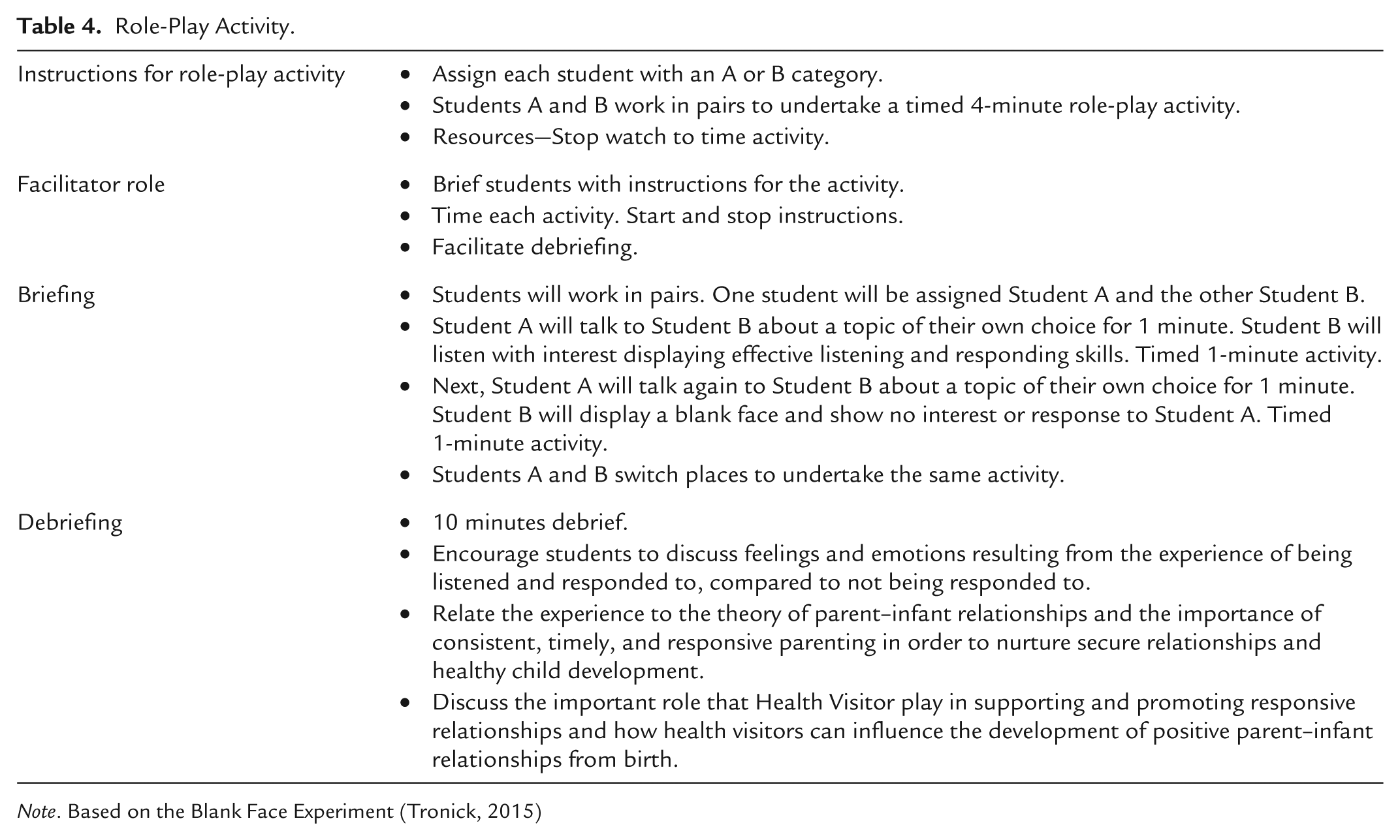
Note. Based on the Blank Face Experiment (Tronick, 2015)
This interactive humanistic activity aimed to evoke emotional intelligence and deepen learning in relation to the importance of nurturing responsive parent–infant relationships to promote healthy child development (Allen, 2011). Indeed, research demonstrates how role-play can be used to promote learning by closely mirroring real-life situations (Chen & Martin, 2015). Although Scales (2008) points out that role-play can feel uncomfortable for some, this was not evident during the activity possibly because students were briefed to choose a partner and all undertake the activity at the same time, therefore without an audience. Furthermore, the debriefing session revealed student satisfaction with the activity as some openly discussed their feelings and emotions resulting from the role-play, when they felt responded to and then ignored. This created discussions, analysis, and evaluation about the importance of the health visitors’ role in promoting responsive relationships between parents and their infants. This activity could have generated further student-centered debate; however, the 10-minute period allocated within the teaching plan for debrief was not long enough. The future teaching plan will need to devote more time to the debriefing process to fully examine the implications of role-play (Chen & Martin, 2015) to enhance the quality of learning opportunities from this activity.
The final group activity involved facilitation of knowledge, understanding, and higher intellectual skills through active learning and interactive demonstrations using dolls. PowerPoint slides and video clips were used to reinforce points, create analytical discussion, and evaluation of the health visitor’s role. The aim was to bring the whole workshop together by demonstrating to students how parent–infant relationships can be observed, assessed, supported, and promoted through partnership working with parents during observation and interpretation of their infant’s behaviors (Nugent, Keefer, Minear, Johnson, & Blanchard, 2007). Infant behaviors are elicited through maneuvers performed by health visitors at the primary birth visit and physical observation of the infant (Holland & Watkins, 2015). At this stage of the SCPHN program it was important to recognize that students would have different levels of proficiency based on their past professional experiences and learning opportunities in practice working with their PTs. For example, the midwives within the group would be proficient in handling and physically examining newborn babies, whereas the adult mental health nurses would have had no prior experience. Therefore, students were organized into groups and a midwife was allocate to each group in order to use and share their knowledge and skills of performing a physical examination of the infant to support less experienced students with practicing maneuvers with dolls (CAIPE, 2015). A series of maneuvers to elicit infant behaviors were explained and demonstrated using a doll, PowerPoint slides, and short video clips. Interpretations of typical behaviors resulting from the maneuvers were described and critically discussed. As each maneuver was demonstrated and explained students practiced on their dolls while being observed and supported through a facilitative teaching approach.
The activity was underpinned by the visual, auditory, read–write, and kinaesthetic approach to learning known as VARK (Fleming, 2006). This was used to facilitate inclusivity of different learning styles and preferences and enable learning for those who prefer to learn through one or more learning mode (Petty, 2009; Kitchie, 2014). Hughes and Quinn (2013) suggest the kinaesthetic or tactile approach may cause discomfort for some; however, research reveals the tactile approach of the VARK to be an effective and preferred mode of learning (Alkhasawneh, Mrayyan, Docherty, Alashram, & Yousef, 2008; Leung, McGregor, Sabiston, & Vriliotis, 2014). Moreover, the activity provided an opportunity to demonstrate the need to apply a kinaesthetic approach in practice, as a tactile hands-on approach is crucial in examining, assessing, and observing newborn infants as part of day-to-day health visiting practice and safeguarding children (Hall & Elliman, 2003; WAG, 2008). The teaching strategies adopted for the session facilitated a supportive, understanding, and motivational teaching approach to encourage students to engage in the learning opportunity, construct knowledge, and make connections to practice (Johnson-Farmer & Frenn, 2009).
Petty (2009) describes limitations to group work such as lack of contribution from some students or determined individuals taking over the group, yet the main limitation experienced was timing. There was not enough time to complete all the planned demonstrations due to time taken to explain maneuvers with dolls and multiple questions due to student enthusiasm. Mortiboys (2010) suggests timing to explain group work can often be underestimated and stresses the benefits of rehearsing, and furthermore suggests to cut questions short in the interest of time keeping, but not at the detriment of learning.
Student Evaluation
On reflection, the andragogical approach and constructivist and humanistic theories adopted to plan and deliver the workshop proved effective in terms of learning. This was reinforced by students’ written evaluation of the teaching workshop. Of the 21 students who attended, 17 completed a written evaluation. Evaluations revealed the workshop met students’ learning needs with 100% reporting the workshop increased their knowledge and understanding about the importance of promoting positive parent–infant relationships. Some commented that the workshop helped them understand how to promote positive parent–infant relationships, understand different types of attachment and emotional development, and helped them relate the theory to practice. Twelve students reported they enjoyed the practical elements of the workshop, others enjoyed group discussions and flip chart paper activities, and some commented how the video clips helped link the theory and practical elements together. Three students commented about how the variety of teaching strategies met their different learning styles. In terms of improvements, students suggested that they would benefit further from a session solely focusing on the physical assessment of the infant. Currently, the physical assessment of the infant is taught by PTs in practice; however, this element could be added to the teaching workshop from a theoretical point of view to enable students to relate the theory to practice. Furthermore, module timetable planning will need to be examined to consider this.
Conclusion
This article took a reflective approach to critically explore the underpinning evidence base of a teaching and learning strategy applied to plan and teach student health visitors about the importance of promoting positive parent–infant relationships. The effects of the andragogy and constructivist and humanistic learning theories were critically explored and revealed positive teaching and learning outcomes. The teaching and learning strategies applied facilitated critical thinking and deep-level learning where students demonstrated their ability to analyze and evaluate the theory making connections to practice. Facilitating learning to meet the highest level of Bloom’s taxonomy of intellectual thinking was appropriate and justified to meet the learning needs of student health visitors.
As a consumer of education, this reflection has facilitated analysis and evaluation of teaching and learning experiences and influenced professional development. It is evident that teaching can be enhanced and improved on by carefully considering adjustments to lesson planning, allowing more time for facilitating learning, explaining group work, debriefing after activities, and examining strategies to manage students’ questions. Continued professional development facilitated through reflection will promote and continually improve student learning opportunities and experiences.
Footnotes
Acknowledgements
I would like to acknowledge Dr Jane Ryan and Dr Sally Anstey.
Declaration of Conflicting Interests
The author declared no potential conflicts of interest with respect to the research, authorship, and/or publication of this article.
Funding
The author received no financial support for the research, authorship, and/or publication of this article.
