







Abstract
Active learning refers to activities that engage students in the learning process. To make the learning process more active, instructors should add opportunities for reflection. However, reflection is not limited to the classroom environment. Instruction is shifting toward incorporating opportunities for active learning through online platforms. We developed four online health topic modules—sexual health, nutrition, environmental health, and alcohol awareness—and evaluated 1,090 student responses to course content. Students provided feedback on the activities that aided in learning course content. Thematic analysis was conducted to systematically review the data and elicit meaning. Using an inductive approach to students’ feedback, we synthesized the excerpts, quotations, and entire passages from students’ open-ended responses. Three major themes constructed from the data were (a) mode of delivery of the course content, (b) applicability of the content to students’ lives and the community, and (c) structure of the modules. The design and implementation resulted in six lessons for educators: students were engaged when the content was applicable to their personal life, students valued learning about how public health affects their community, course content must provide opportunities for critical thinking and self-reflection, students valued the hybrid nature of the course, student feedback of the online modules promoted self-reflection, and students and instructors appreciated the worksheet that guided the online class.
In traditional learning environments, students learn from paying attention to the instructor and reading textbooks and other materials. Today, higher education is in a revolution of knowledge. With technology advancing at a fast pace and a large array of health information available on the Internet, educators must adapt to the changing environment and be creative in their approaches to student learning. Research in pedagogy indicates that students learn more and retain information longer if knowledge is acquired actively (Fink, 2003, 2013). Active learning refers to instructional methods that engage the students in the learning process; it can happen in the classroom and through online activities. To increase active learning, educators must add opportunities for reflection and application (Barkley, 2009; Fink, 2003).
Active learning creates a learner-centered environment, influencing students to move beyond taking notes and memorizing course content. This environment strengthens the process of understanding the content, and most important, aids in developing critical thinking skills. The goal is to engage students in solving problems, discussing possible controversial aspects of the topics, making applications beyond the classroom, interacting with the content to create their own knowledge, and creating a self-paced learning environment (Lumpkin, Achen, & Dodd, 2015). In other words, higher education should evoke a paradigm shift that gives responsibility to students for their own knowledge creation. For instance, Grebennikov and Shah (2013) found that guided reading questions, the use of personal response systems, process-oriented guided learning, and inquiry learning activities facilitated active learning and transformed the classroom experience to a learner-centered environment. Traditionally, educators have used active learning strategies in face-to-face teaching. However, higher education is shifting toward active learning strategies applied online.
This study addresses the need to provide instructors with strategies to improve student engagement with online resources and ways to present course information through multiple media sources (Young & Hoerig, 2013). The objective of this study is to describe the construction and evaluation of four online health topic modules for students in an undergraduate health promotion course, “Health and Wellness.” This study contains three sections. The first section describes the transformation of the four modules from in-person to hybrid, using a flipped classroom model. Thus, each module had an online component to increase knowledge and an in-class component to discuss the topic in further detail. The second section describes the students’ evaluation of the online modules. The purpose of this evaluation was to identify which aspects of the modules were most useful in the learning process from the students’ perspectives. The last section details the lessons learned in this process.
Course Development: From In-Person to Hybrid
The Department of Health Promotion at a large Southeastern university offers an introductory health promotion course, “Health and Wellness,” for undergraduate students. For decades, instructors have taught this course as face-to-face only. The course covers the most relevant topics related to individual and population health, including personal behavioral choices and social determinants of health. This section describes the process of creating the online content for four health-related topics: sexual health, nutrition, environmental health, and alcohol awareness. Two instructors with experience teaching the course developed the first draft of the online modules. A team of instructors revised and created the final draft. After implementing the modules, students from multiple sections of this course provided feedback.
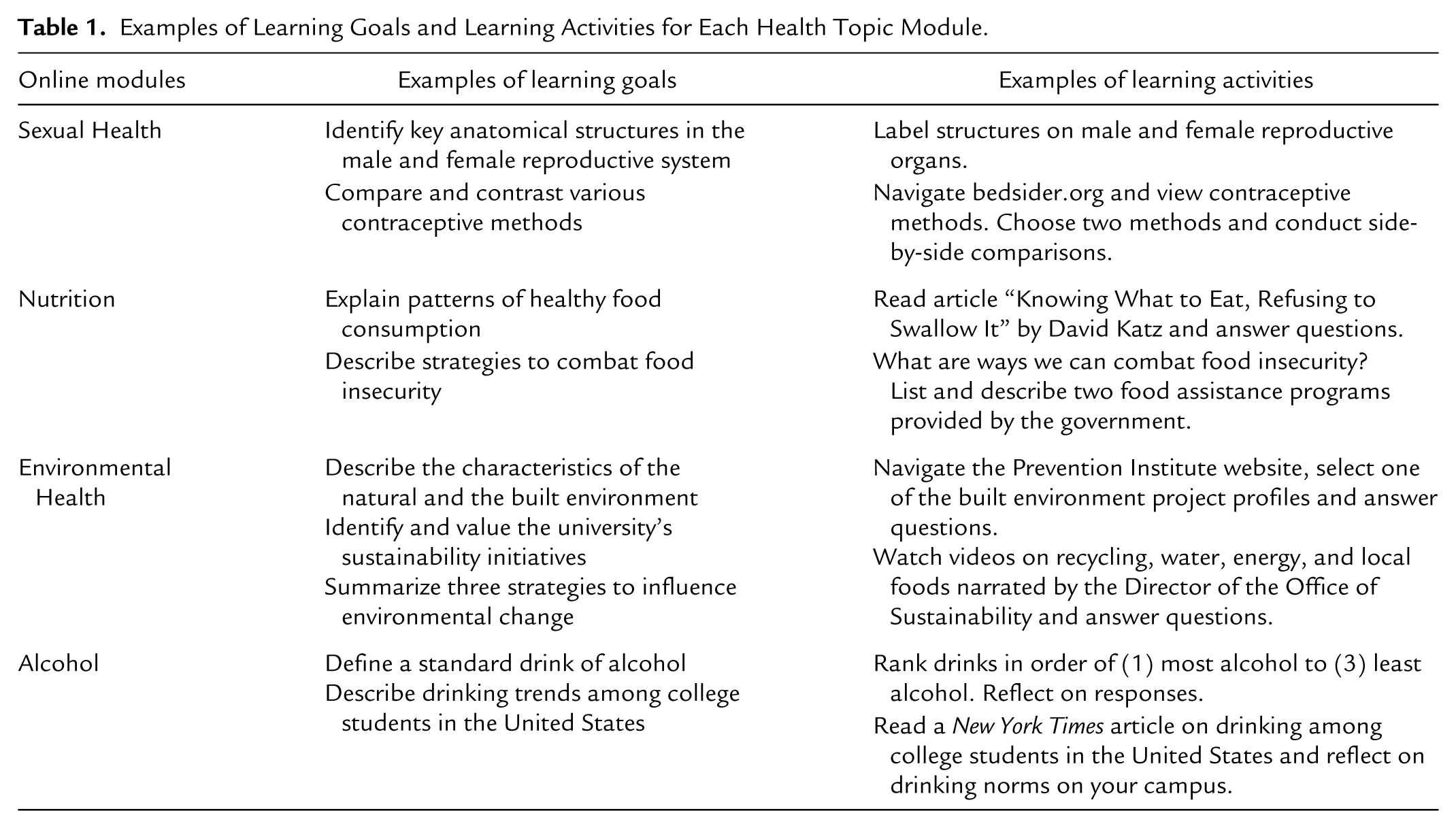
Using Fink’s Guide to Designing Courses for Significant Learning (Fink, 2003), the research team identified the situational factors, learning goals, feedback and assessment methods, and teaching/learning activities for the online modules. Table 1 provides a sample of goals and learning activities for each module.
Examples of Learning Goals and Learning Activities for Each Health Topic Module.
Situational factors refer to special instructional challenges and expectations by students and department administrators. The department offers five sections of this course each semester; each has between 20 and 80 students. A particular challenge is that students come to this course with diverse levels of interest, because the course is required for health promotion majors and is an elective for many disciplines across campus. An ultimate goal of the course is that students increase their knowledge about health, but most important increase the value that they give to health and improve their health-related behaviors. Another challenge—shared by many educators—is that health decisions are not guided solely by knowledge but also by cultural traditions, attitudes, self-efficacy, outcome expectations, support from family and friends, and social determinants (Bandura, 2004). Thus, blended or hybrid modules were chosen because students could learn content and reflect on the topics during the online portion of each module, while devoting class time for in-depth discussion.
To develop the learning goals for each module, we emphasized the information that students could and should use beyond the course, as well as topics that would pique their overall interest in health. According to Fink (2003), to promote significant student learning, educators must integrate foundational knowledge, components of caring, application, and human dimensions. The team of researchers identified learning goals that could potentially heighten emotions about health-related behaviors and help students reflect about the impact of those behaviors and the impact of the environment on themselves and others.
Feedback and assessment refers to two different components. First, it is an outcome evaluation—what students must do to show they achieved the learning goals. In addition to low-stake quizzes and exams, each module had a worksheet that students completed and uploaded to the university’s electronic course management system. The worksheet included diverse questions in which students applied their knowledge and reflected on what they learned. Responses to the worksheet allowed the instructors to verify that the student completed the module and identify areas that the instructor should reinforce or discuss in class. Second, it is a process evaluation—the evaluation of students’ satisfaction with the online modules. As the course was shifting toward a learner-centered approach, the last section of the worksheet asked questions to identify the activities that aided in the students’ learning process from their perspective.
The learning activities for each online module encompassed actively seeking information and providing opportunities for reflection (Fink, 2003). Using the course textbook (White, 2015) as the baseline resource, the research team created activities designed for students to actively seek course information. The learning activities focused primarily on accessing online resources that coincided with information presented in the textbook. Each activity was designed to address at least one of the stated learning objectives of the module. Activities in each module involved students in doing things and thinking about their own behaviors. Students sought information by navigating websites, watching short video clips, and reading articles. They identified opportunities to promote their own health, as well as factors that facilitate or challenge promoting health among others and on campus. Students engaged in in-depth reflective dialogue by writing responses to videos and articles discussing what they learned.
Evaluation of Online Modules
At the end of each module, students answered a few questions related to their interest and satisfaction with the online module. Students answered to the following question: “What aspects of the module were most useful in the learning process?” Responses were collected from 1,090 undergraduate students across the four modules: sexual health (429), nutrition (275), environmental health (174), and alcohol (212).
The research team used thematic analysis to systematically review and evaluate student responses. Thematic analysis is a method of qualitative research that allows researchers to identify, analyze, and report patterns within the data (Braun & Clarke, 2006). Data were synthesized from the students’ feedback using excerpts, quotations, or entire passages uploaded into the software MAXQDA, Version 12. A three-step process was used to skim, read, and interpret the data. Two researchers analyzed the data separately and then as a team. Researchers used an inductive approach to determine the codes and themes represented in the data. Individually, they skimmed, read, and organized student feedback into categories related to the research question. Because each module contained different activities, they coded each activity based on the frequency of appearance in the feedback provided by students. Together, the research team adjusted and created categories to reflect similarities and differences in the data. Last, the research team identified patterns from the categories to construct overarching themes. Depending on the written feedback, responses could have contained more than one code.
Results
The research team generated three themes from 903 coded segments: (a) delivery methods, (b) applicability, and (c) structure of module. Table 2 presents the themes, codes, frequency of each code, and examples of student comments. The frequency portion of the table identifies the counted segments of data, which included phrases and sentences.
Themes, Codes, and Examples.
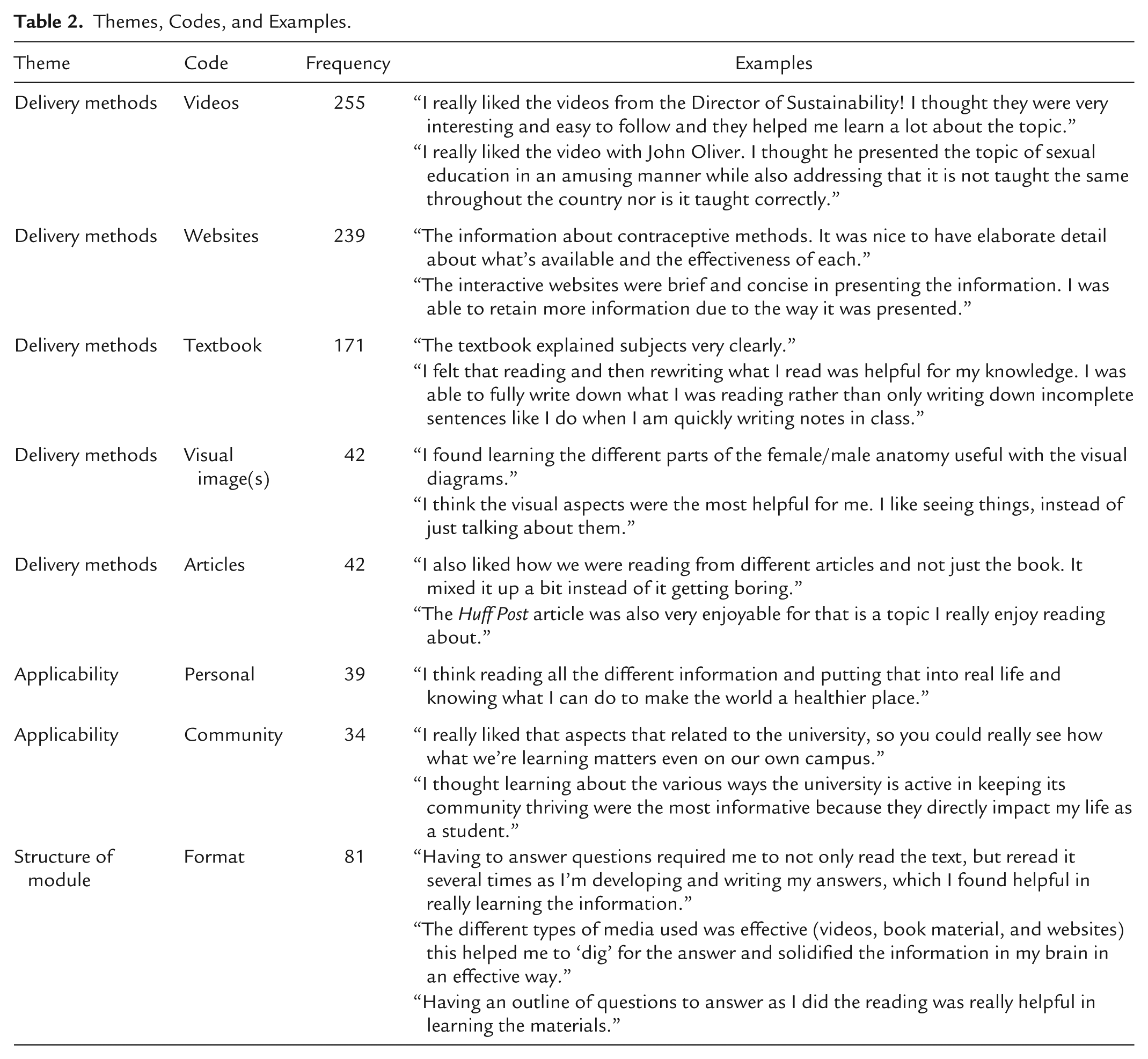
Delivery methods referred to comments associated with the types of media used to examine the topics. This theme includes the following codes: videos, interactive websites, visual images, articles, and textbook (White, 2015). For example, in one of the interactive websites, students calculated their carbon footprint. Students answered a number of questions related to their use of transportation, waste, and home energy expenditure. Then, students compared their footprint with national averages of CO2 emitted per household.
Applicability referred to comments that the online content aided in the learning process because students were able to apply it to their lives, the lives of others, or their community. This theme included two codes: community and personal. We differentiated between student comments that related to changes in their personal habits and ways to interact with their community. Students reported that they enjoyed activities that were applicable to their own life because it put into perspective how the health topics discussed affected them personally. When students were able to connect with the material, they became more interested in learning about the topic.
Structure of the module encompassed comments related to the format of the online module, including the questions used to evaluate a particular topic. This theme had one major code: format. For example, students mentioned the worksheet as a tool that guided them through the module content.
The large majority of the coded segments were classified under the theme Delivery Methods (83%), followed by Applicability (8%) and Structure of the Module (8%). Although these themes were classified separately, a strong overlap existed between delivery methods and applicability. For example, students enjoyed watching the videos and navigating the websites the most. However, those activities also represented a sense of personal and community affiliation that contributed to students learning the module content.
Lessons Learned
The process of developing and evaluating the online modules resulted in six lessons for educators who would like to add online content into their courses. The first four are related to the design of the modules and the last two are about both design and evaluation.
Students Were Engaged When the Content Was Applicable to Their Personal Life
Student responses highlighted the value of having online activities that used real-life examples related to their lives. When students could apply scenarios to their personal lives or develop strategies they could implement in their daily routines, they indicated that those activities helped with the learning of course content. Other researchers have highlighted the value of making assignments applicable to students’ lives and the importance of self-reflection (Holley & Taylor, 2009; Meyers, 2008; Mincey, 2015; Pinahs-Schultz & Beck, 2016).
Students Valued Learning About How Public Health Affects Their Community
Although students may not have actively participated in gardening on campus, based on their responses, they felt a sense of community by learning about the sustainability efforts occurring on campus and ways they could get involved in the local community. Findings highlight that active learning activities should be purposeful and evoke meaning for students.
Active learning as a pedagogical practice helped students generate a sense of community and social integration. In their review of literature, Bonwell and Eison (1991) also reported similar findings regarding college course feedback from students. They proposed that students felt a sense of community within the classroom when instructors used active learning strategies. Students from this project reported a similar sense of community, although it was based on larger ecosystems of community and society. Students mentioned that they retained course content because they could apply the information to themselves or others in their community.
Course Content Must Provide Opportunities for Critical Thinking and Self-Reflection
Students emphasized the importance of making online content more than just reading and comprehension. Beyond receiving information, students applied information and integrating opportunities for self-reflection, which are key components of the active learning process (Fink, 2003). Students connected class content to previous experiences. In doing so, they expanded their prior knowledge of content and related key public health topics to the communities and populations they will one day serve as health professionals. The online modules created opportunities for students to envision themselves as influencers of health and wellness from personal, community, and societal perspectives.
Students Valued the Hybrid Nature of the Course
Blended classes combine the best of the technological world and the value of the instructor–student interaction. Technology is particularly useful for increasing knowledge of the content, but the in-person interaction can help challenge values, examine conflicting ideas, and think about problems from different perspectives (Bowen, 2012). Simpson and Richards (2015) found that a blended classroom resulted in improved understanding of the relevance of population health and better course evaluations. Similarly, Luna and Winters (2017) found that students in blended classes improved their pre-to-post grades significantly more than students in lecture classes; this result was particularly strong among students of color. Blended classes have an additional value for the educators. In a study of undergraduate education, instructors who taught online or hybrid courses reported less stress than those teaching solely in-person classes (Cameron et al., 2016).
Student Feedback of the Online Modules Promoted Self-Reflection
Student feedback is an integral component of a learner-centered approach to teaching. Grebennikov and Shah (2013) emphasized that student feedback is traditionally quantitative, with less emphasis on qualitative feedback. Our study highlights the value of receiving qualitative feedback from students. This information was useful for both students and instructors. Asking open-ended questions gave students the freedom to express their opinions in a nonconstricting way. Student feedback also allowed instructors to reflect on course content, examine their role in facilitating the learning process, and make feasible adjustments to course content.
Students and Instructors Appreciated the Worksheet That Guided the Online Class
The worksheet that students completed as they followed the online class had several advantages. First, it guided students on which elements of the book, readings, or videos were most important. Thus, students were not stressed about the learning process. Second, questions in the worksheet prompted application to their lives, which facilitated learning. Third, after completing the worksheet, students uploaded it to the electronic course management system. Thus, instructors were certain that students completed the online class. Finally, the questions at the end of the worksheet were about the learning process; this information is valuable for improving the online class in subsequent semesters. Most important, instructors could identify areas that they needed to clarify or reinforce during the in-person class. To reduce the instructors’ workload, they did not grade the worksheet but gave students extra points toward the exam.
Footnotes
Declaration of Conflicting Interests
The author(s) declared no potential conflicts of interest with respect to the research, authorship, and/or publication of this article.
Funding
The author(s) disclosed receipt of the following financial support for the research, authorship, and/or publication of this article: University of Georgia, Center for Teaching and Learning.