







Abstract
Service-learning has many benefits for undergraduate students in health promotion. Research on health promotion service-learning in an online format, however, is limited. This pilot study aims to evaluate a fully online, undergraduate health promotion service-learning course from the perspective of students enrolled in the course, the project recipients, and the partnering organizations. We also provide details about the course development and process as a resource for faculty teaching health promotion programing and evaluation courses with a service-learning component. College students enrolled in the course (n = 44) completed a survey to assess learning outcomes. Service-learning program recipients (high school students; n = 127) completed a survey to assess program satisfaction, and teachers from the partnering schools (n = 4) participated in interviews to explore program perceptions. College students had high confidence in their ability to conduct a needs assessment (91%), develop a program plan (93%), and implement (91%) and evaluate (89%) a health program. The majority of high school students reported that the program was interesting (65%), engaging (86%), and that they learned something new (62%). Teachers reported valuing the program, yet suggested multiple strategies to improve engagement online, including the use of interactive technologies and developing a rapport with students. This study suggests that an online format is appropriate for facilitating health promotion skill development among college students and provides recommendations for future faculty to strengthen course design and partnerships in an online setting.
Introduction
Service-learning, defined as the integration of learning activities and service to the community, is a tenet of undergraduate public health education (Furco, 1996; Risisky et al., 2021). This learning approach has many benefits for students; it is associated with academic achievement, social skills, civic engagement, and student attitudes toward themselves and learning (Celio et al., 2011). In undergraduate health promotion education specifically, service-learning may help students build skill sets important for health promotion careers such as: program planning (Reising et al., 2008; Risisky et al., 2021), implementation, and soft skills such as public speaking and working in teams (Risisky et al., 2021). Even when students report that the service-learning experience did not facilitate course content learning, students who plan to pursue a career in public health report that engaging in a health-related service-learning project is relevant for their career development (Rooks & Rael, 2013).
Research on service-learning has primarily focused on in-person coursework, although studies of online service-learning are emerging. While assessment of online service-learning is limited (both in methodology and number of studies), online modalities (either fully online or in-person instruction with online service) appear to benefit students in terms of academic and personal growth, professional development, and skill refinement (Faulconer, 2021). In health promotion education, students from a pilot study of an online, health-focused, service-learning course reported a sense of community in the class, a motivation to learn, and that the project enhanced their learning. As this online course offered both in-person and fully online service-learning opportunities, it is unclear if students with a fully online class experience (e.g., both an online class and an online service-learning opportunity) experience different learning outcomes than those with a hybrid online experience (Early & Lasker, 2018).
Online learning has become increasingly popular over the past few decades (Dumford & Miller, 2018). In 2019, before the COVID-19 pandemic, nearly 40% of undergraduate students participated in some form of distance education (U.S. Department of Education, National Center for Education Statistics, 2020). The COVID-19 pandemic has further increased online learning; prompting universities across the United States to move coursework online (Hess, 2020). As the pandemic continues to limit in-person opportunities to engage in service-learning, and research on both student and service recipient outcomes in fully online service-learning courses in health promotion is limited, there is a need for additional research in this area. The current study aimed to provide an instructional framework for a fully online, service-learning designated course focused on public health program planning, implementation and evaluation. The purpose of this pilot study is threefold: (1) to describe the planning and implementation of a fully online service-learning course; (2) to evaluate student learning outcomes and outcomes reported by the service-learning project recipients and partners; and (3) to provide lessons learned on coursework planning and community partner engagement.
Methods
Instructional Framework
In this course, students learn theory and methods to facilitate individual and group behavior change to promote health. Students work in small groups to conduct a needs assessment and design, deliver, and evaluate a health promotion program for high school health classes. This course was taught by two public health instructors in the fall 2020 semester, each teaching one section of the course. Both class instruction and the service-learning projects were delivered in an online setting.
Course preparation
In summer 2020, the instructors recruited local high school teachers through mutual acquaintances or cold calling/emailing multiple schools to partner on the service learning project. The instructors met via Zoom with high school teachers to discuss the partnership and to plan for the semester. This conversation included a description of our class and its purpose, what we need from the partner to have a successful partnership, what the partner needs from us to have a successful partnership, and the timeline. In this conversation, we also conducted and video recorded a key informant interview with the teachers in which we asked the teachers questions about their students’ strengths and health education needs and interests.
The instructors worked together to develop the course in the summer of 2020 to cater to students learning in an online setting due to the COVID-19 pandemic restrictions at the university. Courses were coordinated to take similar formats and achieve the same learning outcomes. Finally, we developed and submitted the Institutional Review Board [IRB] protocol for evaluating the programs implemented at the high schools. This step was conducted by the instructors before the semester began to ensure that we had enough time to allow for IRB approval before data collection.
Course structure and content
The Public Health Program Planning course was designed to engage all students in each step of the program planning process, provide them with feedback to improve their designs and then implement and evaluate their health promotion programs. Each class section met once per week synchronously via Zoom. Students were provided readings and quizzes on the weekly content to complete. During class, the instructors went over content and engaged students in class activities for the first portion of designated time. Instructors used a variety of tools that allow for collaboration during class activities, including Zoom’s chat and annotate functions and Google Workspace applications such as Jamboard and Google Docs. In the second half of class, students met in small groups in breakout rooms to apply the weekly content to their own project. Instructors also met with student groups during this time to provide feedback.
Instructional content covered designing a needs assessment, a program plan, and an evaluation plan. For the needs assessments, we discussed assessing needs in diverse communities, introduced different health promotion theories such as Precede-Proceed, and practiced engaging with data that were relevant to the high schools where students would deliver their programs. For example, students reviewed California Healthy Kids Survey data specific to the target population school district and watched a key informant interview with their corresponding high school health teacher. Student groups then applied what they learned about needs assessments by writing a needs assessment report for their assigned high school health class. The needs assessment assignment included identifying the target population size and demographics, health issues impacting the target population, health promotion needs and strengths, and a description of the health issue that the group is planning to focus on with justification.
After conducting a needs assessment, students then created a health education program for their assigned high school that aligned with the needs that were identified. Instructors taught students how to create SMART objectives, a logic model, and an action plan for their program and also discussed evidence-based programs and considerations for implementation. This portion of the course culminated in a program and implementation plan report that included the groups’ SMART objectives, a detailed description of their program plan, considerations for program implementation, a logic model and an action plan. After feedback from the instructor, students implemented their programs as described in the section below (under Service Learning Experience).
In the final portion of the semester, students learned about program evaluation. Instructors introduced the different types of program evaluation, and students had the opportunity to create survey questions and a hypothetical evaluation plan (as if they were going to evaluate the program they designed). Student groups were then given post-program evaluation survey data to analyze and write a report on what they found. The evaluation survey was pre-developed by the instructors and given to the high school students who participated in the programs designed by the college students. The instructors separated the data by student group so that the students could analyze their specific evaluation data only. At the end of the semester, each student group presented their program (needs assessment, program plan and implementation, and evaluation results) in a 15-minute oral presentation format. This was primarily celebratory and to allow the students to showcase the work that they had done for the entire semester.
Service learning experience
For the service learning component of the course, students delivered their proposed program in the ninth grade health classes they were assigned to work with during the semester. These programs were delivered either synchronously via Zoom or asynchronously with pre-recorded videos. The instructors coordinated with the high school teachers to schedule approximately 40-minute time slots for the student programs.
The college student groups designed health education programs focused on topics such as mental health, vaping, healthy coping, alcohol and drug refusal skills, and healthy eating. Their programs included videos, facts and data, games, polls, art activities and open-discussion with the high school students. During the fall 2020 semester, students in the high school classes were either present in the classroom or were participating through Zoom from their homes. High school students took a post-program evaluation survey after participating in the health programs. The standardized survey was developed by the course instructors due to timing constraints.
Participants and Procedures
Participants included undergraduate students enrolled in two sections of a service-learning public health program planning and evaluation course during the fall 2020 semester, high school freshman enrolled in a health course, and four high school health class teachers. The study protocol was submitted to the IRB prior to the beginning of the semester and was approved before program evaluation data collection began. Prior to program implementation, teachers were given informed consent forms for the high school student parents where the parents could opt out of their child’s participation in the health program. After the programs were implemented, high school students were given a link to the anonymous and confidential online evaluation survey via Qualtrics. In addition to the procedures for the high school student evaluation, the college students were also given an anonymous and confidential electronic survey to complete. Finally, the four health class teachers were interviewed after the program was completed. They were asked questions about program quality and ideas for improvement. See Table 1 for participant demographics of the high school and college students.
High School and College Student Demographics.
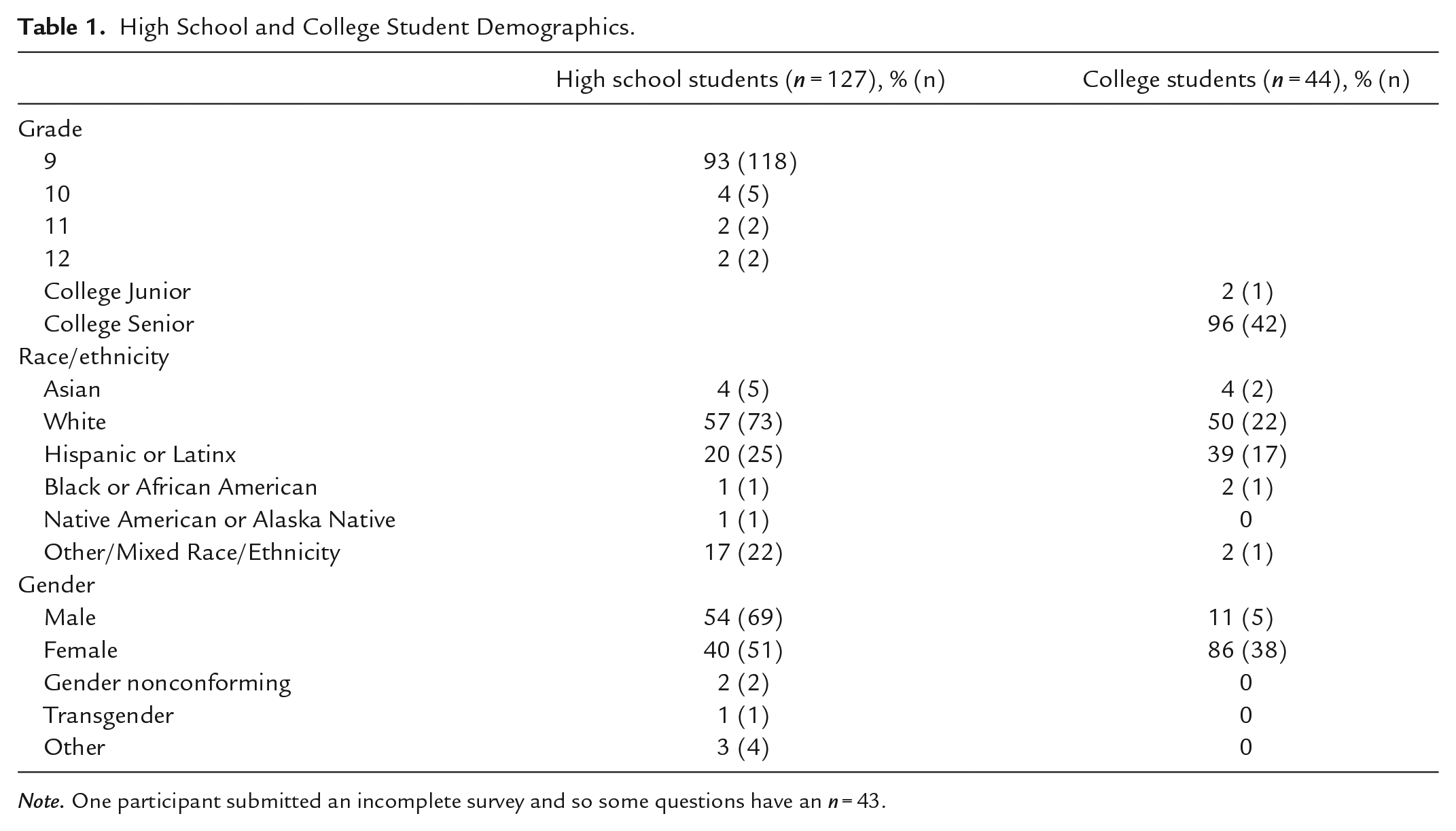
Note. One participant submitted an incomplete survey and so some questions have an n = 43.
Measures
High school student survey
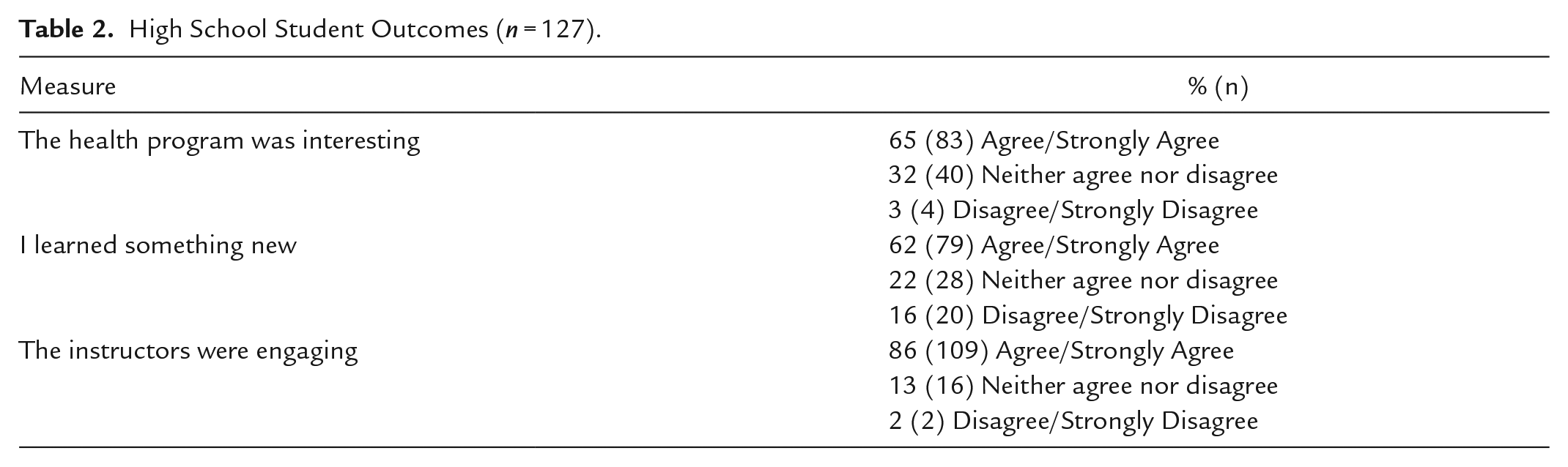
After the health programs were implemented, high school students completed an online survey to assess their interest in the program and what they learned. The survey consisted of demographic questions, Likert scale items, and open-ended questions. Student demographics including grade, age, race/ethnicity, and gender. Likert scale questions included the degree to which students agreed that “the program was interesting,” “I learned something new,” and “the instructors were engaging” (See Table 2). Students were asked two open-ended questions about what was their favourite part of the program and recommendations for improvement.
High School Student Outcomes (n = 127).
College student survey
College students were invited to participate in a semester-end survey to assess their satisfaction with the class, confidence in health promotion program planning skills, and online learning recommendations. Satisfaction was measured with one Likert scale question (“I am satisfied with this class”), and a two-part question ranking “how does your experience in this class compare with the expectations you had for this class at the beginning of the semester?” with an open-ended explanation of the response. Confidence was measured with three Likert scale questions (“I feel confident in my ability to: develop a program plan; implement a health program; and evaluate a health program”; See Table 3). Class year, race/ethnicity, and gender data was also collected. Recommendations for course improvement were assessed through two open-ended questions: “Out of the online strategies used in this class, what stands out as something that helped you learn the best?” and “What suggestions do you have to make this online class more meaningful for future students?”
College Student Outcomes (n = 44).
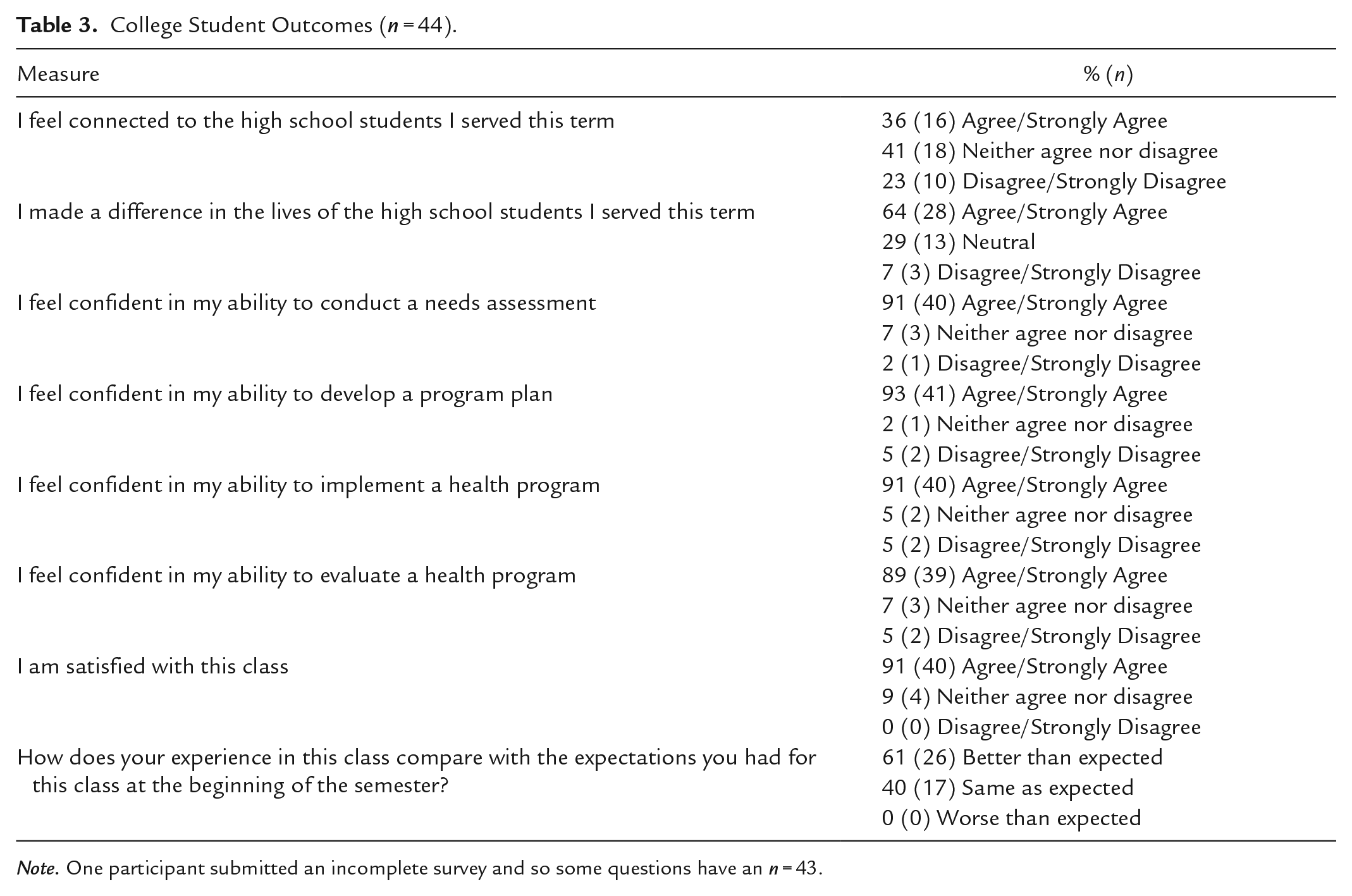
Note. One participant submitted an incomplete survey and so some questions have an n = 43.
High school teacher interviews
High school teachers that partnered with the service-learning classes participated in semi-structured interviews in Spring 2021 to understand their perceptions of the health service-learning program and their suggestions for improvement. Interviews were conducted by two research assistants. Participants gave informed consent prior to participation. The interview protocol included topics such as content learned by the high school students, presentation delivery, and the partnership with the college instructors. Three interviews, lasting approximately 30 minutes, were conducted online. One interviewee recorded themselves answering the questions in the interview protocol that the research assistant emailed to them prior to scheduling an interview. This recording was transcribed and included in the transcripts that were analyzed, but was not a formal interview. The other interviews were audio/video-recorded and transcribed verbatim. Microsoft Word was used for data management and coding.
Analysis
For both the college and high school student surveys, descriptive analyses were employed on the quantitative responses and content analysis was used to assess main themes in the open-ended survey questions. Survey data for high school students and college students respectively was analyzed in aggregate: school and class-level analyses were not performed due to small sample size. Quantitative analyses were performed in STATA and SAS. For interviews, we analyzed transcripts based on feedback that would be most helpful to the study. Transcripts were coded by two researchers. The coding process was iterative as researchers refined codes and added emergent codes as needed. The research team then discussed codes and came to a consensus on salient points.
Results
Results of High School Student Survey
There were 127 high school students that participated in the service-learning program. Overall, the majority of high school students agreed that the health programs were interesting (65%), they learned something new (62%), and the instructors were engaging (86%). See Table 2 for results of the high school student survey.
In the open-ended questions, students reported that the presentation topics, the teaching strategies, and the characteristics of the presenters were the primary things they liked about the health program. Students liked the topics that were presented to them, such as mental health, coping mechanisms, vaping, drugs, and alcohol. Students appreciated how interactive the presenters were and the modes of instruction they used, including videos, slideshows, polls, and asking questions. Students also appreciated that the presenters were engaging and friendly. In terms of recommendations for improvement, many students had no suggestions but some suggested using more teaching materials such as documents, surveys, or visuals, more explanation or depth around certain topics, and more engagement and interaction.
Results of College Student Survey
There were 44 college students that completed the evaluation survey. All students completed the survey except one who partially completed the survey. Overall, the college students reported feeling confident in their ability to perform the important health programing skills learned in class (89%–93%). The majority felt they made a difference in the lives of the high school students (64%) however, fewer (36%) felt connected to the high school students they served. The majority indicated (91%) that they were satisfied with the class. See Table 3 for college student survey results for each measure.
The college students were also asked three open-ended questions about the class and what was most helpful, what could be improved and to expand on how they experienced the class compared to their expectations. Results indicated that the students preferred synchronous Zoom meetings (offered in our course) in comparison to asynchronous online teaching formats (used in other courses they were taking that semester) and enjoyed the active learning components that were incorporated in the synchronous health programing course (e.g., Jamboards, breakout room group activities). The students perceived the class to be a safe and supportive learning environment. They also noted appreciating the opportunities for collaboration and accountability working in groups with other students and the time they were given to work in their groups during class time on Zoom.
The students reported that being able to design a real program for real people in the community (i.e., service-learning) was beneficial to their learning the course content. They also enjoyed the topics that we covered related to steps in health promotion program design, implementation and evaluation (e.g., implementing a program, using SMART objectives, using logic models). They also reported appreciating the organization of the class and the detailed assignment outlines and grading rubrics that were provided.
Results of the Teacher Interviews
Results of the four interviews that were conducted with high school teachers indicated both positive and negative feedback about the health programing and suggestions for improvement in the future. We identified three main points from the teacher interviews including the benefits of peer connection, improving engagement online, and factors impacting quality of the partnership.
One of the key results of these interviews was that all of the teachers valued the peer connection aspect of the programing. They stated that the closeness in age with the high school students and the college students enrolled in the class was a key advantage of the programing. Teachers saw the benefit of having someone else other than themselves delivering key health information.
“I think, as a teacher when you’re talking about lots of heavy subjects, which health has lots of, you can have quite a few moments where students. . .kind of. . .start to tune you out and maybe don’t listen just like they do to their parents. And so giving more voices, younger voices, closer in age, I think that’s the most beneficial part.”
Peer connection was described by teachers as the college students’ ability to resonate with the high school students’ experiences. One teacher mentioned that students appreciated hearing about personal experiences from the college students in particular.
“. . . .Somebody gave more of an analogy, or personal story about kind of their own issues with mental health and I think that definitely, you can hear in the students when they would unmute that they were more engaged, and I could see the chat a little bit more engaging there too. So, any of those personal scenarios, your students could speak to, like the students want to know that people in college are as well having the same mental health issues or anxiety and whatnot so I think that is what stood out to me. . .”
Another point that stood out from the teacher interviews was regarding student engagement during the programing. The teachers mentioned that logistics of online programing made engagement difficult at times. Teachers stated that assessing and promoting high school student engagement was difficult in an online setting and it was difficult as a teacher to understand student needs.
“I would say it [the program] was challenging because it was distance learning. My understanding of where the [high school] students were at was probably the lowest it’s ever been. So I feel a little uncomfortable knowing. . . I didn’t get a good read on where they were at just because of the infrequency of our interactions.
Teachers discussed specific strategies to foster engagement including using interactive technologies that allow students to answer questions in real-time that can be presented on-screen, like Peardeck, using the chat effectively, facilitating meaningful discussions, sharing personal stories, etc. One teacher noted that it was more difficult for the college students to facilitate these conversations in an online setting. This teacher also stated that if the college students would have been engaged with the students for longer than one-time, this would have likely fostered more rich discussions.
“. . ..but then even come back maybe for 10-15 minutes at another point and go hey, what did you think about my presentation and just kind of reiterate what you said before, and not very long and, I don’t know if that’s even doable, but to kind of reinforce what you said but maybe a week or two later.”
Another suggestion for engagement was to give the students a survey before coming to class for the program to better understand them and their health needs.
The final point made by the teachers was related to the partnership between the college public health programing class and the high schools. Teachers reiterated that the benefit of the partnership for them was the high school students’ exposure to the college students. Some teachers also mentioned that the organization and handling of logistics was helpful in terms of communication and making sure they had all of the materials and resources they needed for the college students to deliver their programs.
“I think what’s been going well is communication and just making sure that we kind of know what’s going on and when things are happening. It’s a pretty easy partnership, so I think that it’s going well. . . It’s been good. Everything’s been pretty seamless, no hiccups or issues, so good.”
While some teachers saw the value in giving up class time to accommodate the student programs, one teacher did not, primarily due to lack of engaging teaching methods. This teacher noted feeling excited about the partnership and slightly disappointed with the college student programs that were implemented.
In general, the teachers offered positive feedback about the peer-peer connection and aspects of the partnership including the strong communication and organizational skills of the college course instructors. The teachers also communicated that engagement in the online platform was difficult at times, and offered valuable suggestions for improving engagement.
Discussion
Overview of Findings
Overall, our evaluation of an instructional framework for teaching a service-learning public health program planning course in an online format was generally well-received by teachers and high school students. In addition, the college students reported increased levels of confidence in their abilities to perform the skills learned in the Public Health Programming course.
Regarding engagement in the programs that were implemented by the college students, the majority of the high school students (86%) noted that the programing was engaging on the evaluation survey. The high school students noted enjoying the varied modes of health education delivery (e.g., videos, activities), which may have contributed to their perceptions of engagement. However, in the qualitative interviews, the teachers highlighted that the online format made engagement difficult. This may indicate a disconnect between teacher and student perceptions of the health programing or it may be due to the differences in how the data were collected (close-ended survey question for students and open-ended interview for teachers). Future research may benefit from aligning the data collection methodology for the sake of comparison. To increase engagement, the high school students provided some helpful suggestions including wanting the college students to provide more teaching materials, go more in-depth for health topics, and more interaction with the college students. The teachers also provided helpful recommendations including using the Zoom chat function more effectively, incorporating meaningful discussions, sharing personal stories, and providing more interaction between high school and college students.
Peer-peer connection was another finding that we identified as an important aspect of our partnership with the high schools. The teachers noted that the peer (e.g., college and high school student) connection was a positive component of the programing, which may have increased the high school students’ perceptions of their own engagement during the programs. There is some evidence that reports peer-peer learning has unique advantages when compared to individual learning strategies. For example, one study reported that peer-peer activities enhanced learning assessment performance and those who engaged in the peer-peer aspect of the program reported appreciating the learning strategies more than those who did not participate in that aspect of the programing (Saeedakhtar et al., 2021). According to the teachers in our study, the peer-peer aspect of the program was a strength of the program and of value to the high school students.
In general, the teachers communicated that the partnership was beneficial for them and their students. This finding is aligned with the general research on quality service-learning projects in that they are beneficial for the community partners in addition to the college students (Horney et al., 2016). The teachers partnering with us noted the organizational strengths including excellent communication between professors and teachers and strong organization regarding timelines and planning. Strong communication between community partners and professors teaching the service-learning course was a “lesson learned” in previous work stating that this component is a key element of reciprocity between partners (Early & Lasker, 2018). Our study further reflects this sentiment. However, one of the high school teachers noted that she liked the idea of a partnership but was underwhelmed by the college students’ health education teaching styles. This highlights the importance of further ensuring strong communication between partners and teaching the college students specific health education and program implementation skills to enhance program quality.
For the college students, only 36% reported feeling connected to the high school students. Therefore, the benefits of connection may have been stronger for the high school students and teachers in comparison to the college students, although further research is needed to test for significant differences in connection. However, the majority (89%–93%) of college students did report high levels of confidence in their health promotion programing skills (e.g., assessing needs and developing, implementing, and evaluating a health program). This finding is aligned with a recent study evaluating the student outcomes of an in-person service-learning project embedded in health promotion programing courses also reporting increases in skills-based confidence (Risisky et al., 2021). However, we did not conduct a pre-post comparison in the current study, which would have been beneficial. This finding also speaks to the ways that the online class format was likely effective in delivering the skills-based learning objectives of the class. The college students noted appreciating the synchronous (weekly Zoom meeting), active-learning format, opportunities to work in groups and the class organization, which included detailed instructions and assignment outlines. The students identified the service-learning component as important for their learning of the class content. These findings are similar to recent work reporting that students engaging in service-learning as a part of a health programing course described the service-learning component as having a positive impact on their learning, explaining that the collaborative group work and practical skill-building were particularly important (Risisky et al., 2021). This work also highlights that many students believe these opportunities strengthen their experiences and skills for the job market in the future as public health professionals (Risisky et al., 2021).
Participating in service-learning opportunities (regardless of the focus) is highly beneficial for college students. A meta-analysis of 62 studies reported that students participating in service-learning activities experienced more positive attitudes toward themselves, college and learning and had increased academic performance and social skills when compared to controls (Celio et al., 2011). It seems that for our students, the online curriculum was also beneficial in similar ways. They reported appreciating the synchronous Zoom meetings in which they were able to ask questions, engage in active learning activities, and work on their assignments in breakout rooms with their groups. Many students commented that other courses they had during the same semester were in an asynchronous format and they preferred our synchronous format in comparison. These findings are supported by some (not all) of the mixed literature in this area. In a meta-analysis comparing online synchronous and traditional in-person courses, no differences were reported in terms of student outcomes for health science majors, but students reported being significantly more satisfied with the synchronous distance learning course (He et al., 2021). These findings may suggest that there are specific components of the synchronous format that students prefer without compromising the learning quality. However, other studies report that students experience challenges with synchronous online learning including easily becoming distracted, having difficulty with technology and not being in control of the learning pace (Lin & Gao, 2020). For these reasons, students in this study reported preferring the asynchronous format (Lin & Gao, 2020). Future research may consider comparing online health programing service-learning curriculum in terms of whether the delivery was synchronous or asynchronous or a hybrid.
Study Strengths and Limitations
The current study has a variety of strengths and limitations. A key strength of our study is that we evaluated the online service-learning project from multiple perspectives including teachers, high school students, and college students. Previous work may not have included all three evaluative pieces (Faulconer, 2021). For example, a recent meta-analysis of online service-learning courses revealed that community partner impacts were not often evaluated (Faulconer, 2021). However, it is difficult to compare the current study with past studies because previous research may not have been working with a public health programing course or may have included different study designs (e.g., longitudinal). Nevertheless, we believe that our evaluation approach gleaned unique differences in perspectives from each group. For example, we found that the high school students perceived there to be more of a peer connection than the college students. Additionally, the teachers perceived there to be less engagement than the high school students and the teachers’ perspectives on the partnership were vital in terms of improving program strategies in the future. However, we did not test for significant differences and so future research should include these varied perspectives utilizing the same measurement tools and methodology so that they can make comparisons.
The generalizability of this study is limited by sample size and study design. We had relatively small groups of high school students participating in the service-learning project and in the evaluation. Further, it is possible that high school students took the survey more than once if they received lessons from more than one college student group. Additionally, we did not include nested data by school or by college instructor and so there may be some school/class-level factors influencing our findings that were not accounted for in the current study.
The methodology of the study could be improved. For example, in the evaluation survey for the high school students, we asked the students to rate how interesting the program was to them. This is likely subjective in terms of what the individual students’ interests are and future research may need to consider controlling for program topic if the sample size is large enough. However, we believe that assessing topic interest was a relevant part of the evaluation process for this project because it should be directly related to how well the college students conducted the needs assessment. This informs another limitation, which is that the college students did not talk directly with the high school students while assessing their needs. Future projects should include a more thorough needs assessment in which the college students ask the high school students questions about their health and what would be interesting topics to focus on for the program.
Additionally, over one-third of the high school students reported being neutral or not learning something new and being neutral or not believing the programs were interesting. We included a response option that was neutral in the high school evaluation survey and many students responded in a neutral way to the questions (32% for how interesting the program was and 22% for learning something new). These are relatively high percentages of neutrality for those items. Future research should consider whether or not response options that are neutral are helpful as research is mixed in this area (Edwards & Smith, 2014; Nowlis et al., 2002). Some research indicates that including a neutral response option is associated with more extreme responses (Edwards & Smith, 2014) whereas other research indicates that the absence of a neutral response option is associated with more extreme responses (Nowlis et al., 2002). For our study, the neutral option may have provided a response that participants resonated with their ambivalence or could have been a way to avoid putting in effort to make a cognitive choice (Krosnick et al., 2002 ; Nowlis et al., 2002). Either way, in future studies teaching program planning in an online format, instructors may need to consider how to increase the ways that the programs are delivered to ensure students are learning something new.
Implications for the Field of Pedagogy in Health Promotion/Public Health
Based on our findings, there are several recommendations we have for service-learning, health programing online classes.
Conclusions
We aimed to evaluate a service-learning public health programing course and report lessons learned from this experience. Results suggest that online service-learning is a useful format for teaching health promotion skills, while additional support is needed to improve engagement and connection in an online setting. Our pilot findings and lessons learned can be used as a tool for designing new service-learning courses at the college level and/or improving existing courses in a future where educators will likely be required to provide more high-quality online instruction.
Footnotes
Declaration of Conflicting Interests
The author(s) declared no potential conflicts of interest with respect to the research, authorship, and/or publication of this article.
Funding
The author(s) received no financial support for the research, authorship, and/or publication of this article.
