






Abstract
Drawing is established as an effective teaching pedagogy in medical education, particularly in teaching anatomy. Research shows retention rates are significantly higher when learners engage in active learning techniques. Additionally, practical application is greater with active learning techniques. Drawing for retention (DfR) is an active learning technique involving instructor-led drawing, where students imitate the drawings while simultaneously rehearsing key concepts. There is a paucity of research examining the effectiveness of DfR for applied concepts such as 12-lead ECG interpretation. The purpose of this qualitative study was to explore student perceptions following their engagement with Drawing for Retention (DfR) as a teaching technique. Fourteen paramedic students (9 males, 5 females) participated in this phenomenological qualitative study. Data saturation guided the number of participants. Participants were interviewed via Zoom using a semi-structured interview guide. Data were analyzed through phenomenological reduction, with data coded for common themes and subthemes. Trustworthiness was established via member checks, peer review, and multi-analyst triangulation. Two themes emerged: perceptions of learning and application to patient care. Participants felt drawing allowed them to make connections with complex material while retaining the information. Additionally, participants did not need to spend as much time studying to retain the information, as compared to traditional lecture classes. Additionally, participants were able to bridge the knowledge-practice gap and apply the information clinically. This led to more effective and efficient patient diagnoses, increased confidence with patient care, and a resource for making decisions and providing patient education.
Introduction
Pre-professional students in many healthcare fields must translate information learned in the classroom to the workplace, and work readiness is a concern for many academic programs (Thompson & Houston, 2024). Paramedics encounter diverse populations while serving as the highest-certified prehospital care provider, and must complete patient assessments, determine a course of treatment following standing orders, deliver treatment, and transport independently in emergency situations. This degree of autonomy requires diagnostic impressions and treatments to be accurate and efficient. Therefore, students in paramedic programs must be able to transfer didactic knowledge to the clinical setting. While paramedic curriculum requirements are standardized (EMS Education Standards, 2021), delivery is not. It is imperative that professional programs employ evidence-based pedagogical methods to ensure competency and knowledge retention, enabling graduates to meet the demands of patient care. For paramedics, timely field interpretation can save lives. For cardiac patients, diagnosis of myocardial infarctions, or heart attack, is completed through interpretation of a 12-lead electrocardiogram (ECG). Efficient and accurate field interpretation of the ECG can improve patient outcomes by facilitating treatments (Antman, 2008).
Translating academic knowledge into clinical practice is a critical skill for students in healthcare fields, as it bridges theoretical learning with real-world patient care. This process involves applying classroom-acquired knowledge to clinical settings, thereby enhancing patient outcomes and fostering professional development (Welch Bacon et al., 2024). This practice gap can lead to decreased quality of patient care and is a big academic challenge in healthcare fields (Shoghi et al., 2019). Barriers exist for students translating knowledge to clinical practice, such as lack of opportunities to apply their skills in the clinical setting (Welch Bacon et al., 2024).
Professional healthcare programs have aimed to decrease this gap through experiential learning, simulation, and clinical education experiences (Michau et al., 2009). Active learning techniques have been demonstrated as more effective than passive methods for retention; however, there are theoretical concepts that are challenging to teach and practice through active, hands-on learning experiences. In paramedic education, accurate and timely field interpretation of a 12-lead ECG is challenging to initially teach through simulation. Skill mastery in 12-lead ECG interpretation is demonstrated through accurate and rapid analysis. This requires proficiency in interpretation but also the ability to confidently integrate patient presentation to develop a comprehensive, patient-centered care approach. Because of the urgent and unpredictable nature of paramedic practice, students must retain critical information to bridge the knowledge-practice gap. Drawing for retention (DfR) is an active learning technique that starts with instructor-led drawing during lecture while students draw the same images (Balemans et al., 2016). Following a cyclical and interactive process, the instructor draws images on the board while explaining the concept. Students are instructed to draw along with the instructor. The instructor pauses after delivering each concept to redraw key images. Simultaneously, students recall and replicate these images from memory. This cycle continues until students independently reproduce and explain the concept to others without assistance (Greene, 2018). Drawing enhances understanding and retention (Backhouse et al., 2017). For ECG interpretation, students must identify small changes in waveforms. Using this technique, students draw waveforms for various conditions on actual ECG paper. Active learning strategies have been found to have up to 90% retention rate, especially paired with teaching others (Fiorella & Kuhlmann, 2020; Fook et al., 2015).
Implementing effective teaching methodologies that enhance understanding and retention is imperative and leads to enhanced patient outcomes. However, it is unknown how using DfR impacts student learning and clinical application. Previous research has explored drawing in healthcare education, primarily anatomy and histology (Aisha et al., 2018; Balemans et al., 2016; Borelli et al., 2018; Alkhaifi et al., 2022). The purpose of this study was to explore paramedic student perceptions of DfR as a pedagogical technique. Two research questions guided this study: (1) What is the student’s perception of learning using DfR? and (2) What is the perceived value of using DfR for ECG reading and interpretation? This study yielded a large amount of data, and therefore this manuscript will focus on the second research question and the impact of DfR on student learning and application, while part 1 explored the perceptions of using DfR as a pedagogical technique (Thrasher & Braithwaite, 2024).
Methods
The theoretical framework employed was symbolic interactionism, which emphasizes how the interaction, culture, and environment shape how individuals construct the meaning of experience (Creswell & Poth, 2016). The methodology employed was phenomenology, as the goal was to explore perceptions of paramedic students’ experience with DfR. Institutional Review Board approval was obtained and participants provided informed consent prior to initiating this study.
Participants
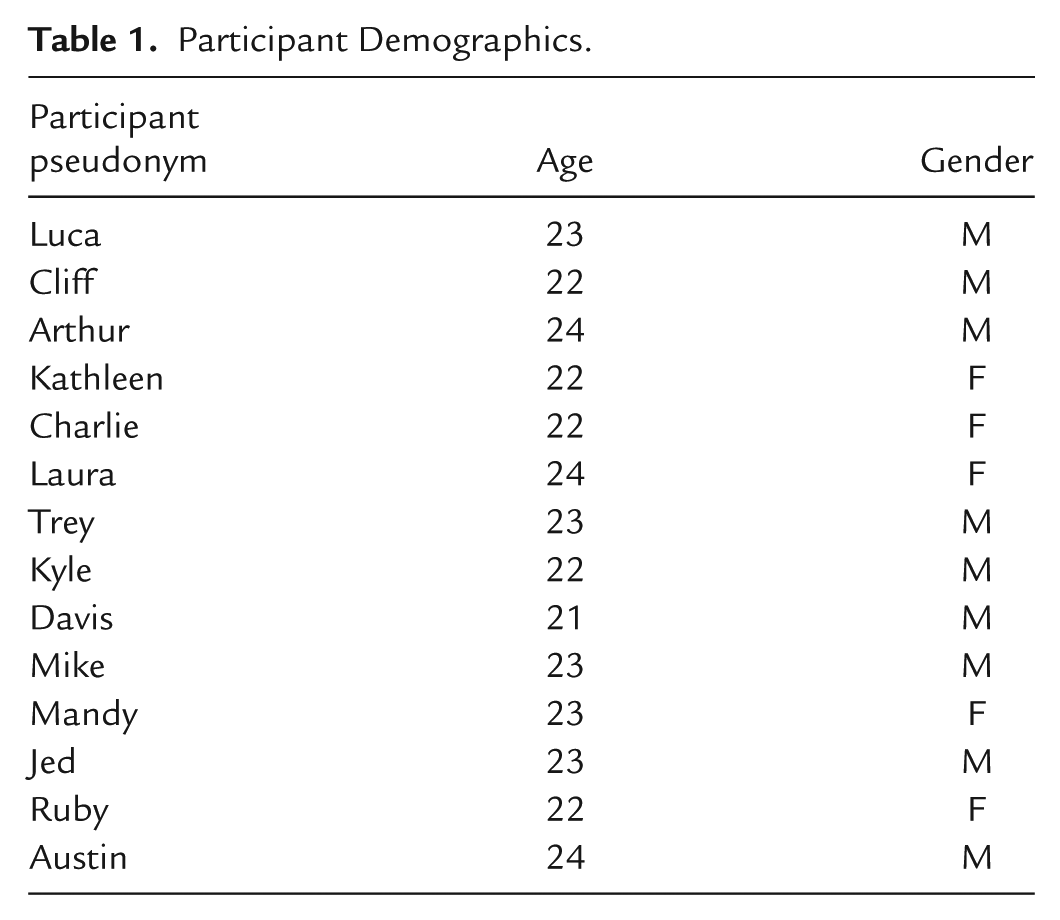
Fourteen students enrolled in an accredited Emergency Medical Care program in the Southeastern United States participated in this study. Inclusion criteria consisted of students who had completed a 12-lead electrocardiogram (ECG) course in the semester prior to the study. Exclusion criteria included individuals who were not enrolled in the ECG course in the prior semester, individuals who did not speak English, and individuals under 18 years old. Data saturation guided the number of participants. Participant demographics are in Table 1.
Participant Demographics.
Procedures
Participants were recruited through purposive sampling. A recruitment email containing study information and consent form was sent to all paramedic students who took the ECG class in the previous semester. Paramedic students who were interested in participating signed up for an interview time. The co-PI contacted potential participants to confirm inclusion criteria, answer questions, and obtain consent. Using a semi-structured interview guide, (see appendix, Semi-Structured Interview Guide) participants completed an 45 to 60-min individual Zoom interview. Interviews were recorded and transcribed. Data collection concluded upon reaching saturation, when no new information emerged, and findings aligned. A detailed overview of how DfR was taught has been published elsewhere (Thrasher & Braithwaite, 2024).
Instrumentation
A semi-structured interview guide was created based on the research questions and prior research related to using drawing as a pedagogical technique in healthcare. The interview guide was validated by three experts in qualitative methods and educational research. Using a 4-point Likert scale (1 = unclear, not relevant, or not important; 4 = very clear, highly relevant, very important), peer reviewers rated each interview question for clarity, relevance, and importance. Reviewers also provided qualitative feedback. Two individuals participated in pilot testing to ensure clarity, timing, and question flow. Data from the pilot study were excluded from the final analysis.
Data Analysis and Trustworthiness
Data were analyzed through phenomenological reduction with iterative multi-analyst triangulation. Each member of the research team independently read through the transcripts to get a sense of the whole. On the second reading, the researchers reviewed five transcripts and met to discuss common themes and subthemes to develop a codebook. The researchers then independently coded remaining transcripts. Next, the researchers reviewed each other’s coded transcripts to ensure consistency. Any discrepancies were resolved through discussion until consensus was achieved.
Trustworthiness and credibility were established through multi-analyst triangulation, as described above, peer review, and narrative accuracy member checks. Following data analysis, three peer reviewers performed an external audit. Each peer reviewer received three random transcripts and the codebook. They ensured the themes and subthemes were reflective of the transcripts and meaningful units of data were coded. Finally, participants reviewed their transcripts for accuracy to ensure their transcript was reflective of their experience. No changes were needed following this process.
Results
Two higher-order themes emerged describing the impact of DfR on student learning: perceptions of learning and application to patient care. Each higher-order theme was divided into subthemes. See Figure 1 for emerging themes with supplemental supporting quotes.

Emerging quotes.
Perceptions of Learning
The first theme was perceptions of learning, which described how the participants felt about learning while using the DfR pedagogical technique. This theme is described in the following subthemes: making connections, retention, and study time.
Making Connections
Making connections describes how participants were able to connect course material more effectively to understand concepts taught. Participants reported in lecture-based courses, they sometimes struggled to understand and connect material in their brains or with patient care. While drawing, they were able to not only see the information more effectively, but felt they could engage more deeply. Luca commented, “It really connects the spoken and written ideas to an image, it connects the vocal and visual aspects of it. It definitely helps, because once you put all the pieces together of interpreting, it makes sense.” Cliff shared, “The mental-hand connection and being able to go back on that and using your muscle memory to really think through a process or use it out into the field.” Participants shared drawing was a completely different way to learn, visualizing to understand instead of just memorizing. Trey commented, You pick up on the concepts much faster than it would take someone who reads it out of a textbook or PowerPoint. It’s less memorization of words and more getting into the habit of looking for things. It’s a different type of learning, and you get quicker at the skill.
Making connections through visualization helped participants understand the concepts more effectively, Davis commented, “I like to know why something is happening, and [instructor] drawing it and explaining why it happened. Even if I go back and read the textbook, I can better understand the words based off visualizing drawings in my head.” Mandy stated, “The mind/body connection was helpful in remembering topics and big concepts, that seem really big and scary, but it really helps to like condense it and make it easier.” Participants reported the drawing helped visualize what was occurring physiologically, which helped connect the didactic information to patient cases.
Retention
A primary goal of DfR is to retain the information, both short-term and long-term. Every participant discussed how drawing helped them remember information when needed for exams and beyond. Short-term, participants discussed being able to remember information for the examination. Arthur stated, “If I’m able to draw it, I know it. If you can draw something, you really understand something, and that is at the heart of why she’s doing it.”
While short-term retention is a positive outcome, the long-term retention highlights the impact of DfR. Participants stated they needed information for exams, but also needed to retain information for future patient care. Participants reported in other classes they still struggled to retain the information. Arthur commented, “It’s definitely more locked in my brain. I can’t deny there’s a lot of exams I’ve taken in this program where I just set it and forget it.” With drawing, Charlie stated, Long-term memory. I try to remember as much as I can before an exam, and then it falls out of my brain the second I click submit. Knowing I still know a lot of information is very nice compared to classes that were PowerPoint or lecture based. I couldn’t tell you half the things we talked about in those classes because it was not put into memory. But knowing I have mental images of things I drew is so beneficial in terms of me being able to remember the stuff I worked so hard to learn.
As participants studied for their terminal paramedic certification examinations, they reflected feeling more comfortable on the content learned with drawing than other content. Participants felt they were able to retain information more effectively when drawing as compared to lecture or PowerPoint based classes, which demonstrates a positive impact on learning.
Study Time
The final theme, study time describes how participants perceived the amount of time necessary for preparing for examinations and reinforcing content. Participants felt drawing took more time initially, but they spent less time reviewing materials before they felt confident with the content. They studied fewer cumulative hours when they drew. Arthur said, “This is very much front heavy and then maybe less on the back half of studying for whatever exam might be coming up.” Kathleen stated, “I noticed I have an easier time studying. I want to be in my notes more. I even noticed a difference in my test scores.” Jed stated, “For me the biggest advantage is that it just saves a lot of time.” Many participants noted that drawing during class cemented the information, and they just needed to review prior to the examination as compared to lecture classes, in which they spend more time studying or “cramming” right before the test. Kyle commented, “I had to study less to be more confident in my understanding.” Mike stated, Much less time for preparing for exams, because before drawing, I was spending at least 4 hours before exams. With drawing I spent less time to study for it. I barely had to look back at the drawings because you got used to it, versus the other classes you have to cram for. The non-drawing classes ended up taking more time to study.
In addition to spending less time studying the materials, participants reported drawing helped organize studying. They often studied by redrawing images or explaining what was happening with the drawings. Ruby commented that she redrew things to be “pretty” which helped her study. Learning through drawing helped participants remember the information and they felt it was more enjoyable than lecture style courses. Kathleen commented, “It doesn’t feel like I’m spending extra time because I’m actually enjoying what I’m doing. I’m not just sitting here with notecards saying, My gosh! Is this stack ever going to end!” Overall, participants felt DfR helped them learn the material more effectively, which reduced time needed to study for examinations. This was very impactful for the participants, who were busy students with clinical and heavy didactic course requirements.
Patient Care
Patient care describes the participants’ ability to apply content they learned through drawing to their patient cases during clinical education experiences. This theme is described in the following subthemes: facilitates diagnosis, confidence, resource, and patient education.
Facilitates Diagnosis
Participants were able to apply information they learned within the clinical setting, including how it facilitated diagnosis and made diagnoses quicker and automatic, which ultimately impacted timeliness and quality of care. Participants described the urgency of making diagnoses with cardiac patients, as that will direct treatments. Drawing facilitated decision making by automation and increased efficiency. Davis commented, “I have this drawn out. I have it exactly drawn out and I can compare it to other drawings within the same page of my notes and say ‘this is definitely what is going on with this patient.’” Participants described the importance of recognizing certain signs and symptoms, as missing certain signs could lead to catastrophic outcomes. Having good knowledge of what they are seeing could improve patient outcomes. Because of the importance of quick recognition and diagnoses in emergency situations, participants valued the depth of learning and understanding of cardiac emergencies, which ultimately leads to efficiency. Arthur stated, “Being able to have that framework makes you able to make more accurate and quick decisions. We’re taught to recognize within that map to read the signs and symptoms that we are provided, and the treatment that is appropriate.” Trey commented, “Everything goes faster. You don’t have to measure everything or count numbers to see it if meets the criteria. You can literally just look at it. You save from 3 to 5 min on scene with a critical patient.” Austin said, “Because I’ve drawn out this process, I can make that connection a little bit quicker.”
Another benefit related to patient care is automation, in which participants reported being able to look at the printout from the 12-lead and automatically know the diagnosis. This facilitates a treatment plan for patients. Mike commented, “You can do stuff without thinking. I could look and see that’s normal. That’s abnormal. It absolutely does [impact patient care].” Participants commented that they can make quick diagnoses and treatment plans because they visualize the rhythm and automatically connects it to the ECG report. Trey commented, It’s one of the things that clicks in your head. We talked about heart attacks or STEMIs in class and then being able to go on a call, match the physical presentation with the patient, and then see the 12-lead that looks exactly like our drawings. It’s kind of creepy, but it’s so satisfying because some people would sit there and measure everything out. I can just look at it.
Participants were able to recognize patterns they had drawn, and this facilitated diagnoses.
Confidence
The next subtheme was confidence, in which participants described how drawing in class increased their confidence as they applied the information in a clinical education setting with patients. Charlie stated, “Being able to confidently say, I see this on your strip, because I drew this in my notebook, and these things are identical was so helpful, and I know that is something that I still use with patients today.” Part of developing the confidence was validation when they were correct with patient cases. Trey shared his confidence with the skills translated to the clinical setting, where he was able to demonstrate his knowledge, thus increasing his confidence. “It [confidence] was honestly immediate. I beat my paramedic preceptor to a STEMI diagnosis on scene, which he said that’s never happened before. The more you interpret, the more confident you get.” Jed commented the biggest impact of drawing for him was, Confidence. I’m confident I can interpret an EKG and that’s huge. I mean cardiology, you shock the wrong patient, you pace [treat heart rhythm] the wrong patient, and that can be fatal to these patients. So confidence is really important. I feel like I was able to gain confidence from that course with cardiology.
Participants felt that by learning the material well in class through drawing, they could confidently apply the information to patients and have better patient outcomes. Participants commented feeling more confident with the skills they learned through drawing than skills learned through PowerPoint.
Resource
Participants described using their notebooks they created beyond the course, and many took their notebooks onto the ambulance to reference during calls. Cliff stated, We use it in the field because it’s a good resource. The heart is complicated, especially interpreting squeaky lines, basically everything for your heart. It’s a huge, huge benefit to have it on the back of a truck and use it as a resource.
Participants reported finding the information in their notebooks to ensure appropriate treatment are provided; they recognized the life-and-death situation they might find themselves in as paramedics and attribute knowledge gained through drawing as saving patients’ lives.
Participants also reported sharing their notebooks with preceptors. Initially preceptors tend do “poke fun” of the notebook, until they use it. Trey commented, We’ll get a 12-lead, and I’ll show [preceptors] how I interpret it. They always check over you most of the time, and they’re always “that [notebook’s] stupid.” Whatever. After I have a couple of calls, they come back, “I want a copy of that!”
Participants reported they used it more, earlier in their clinical education progression, but stopped using it as they gained confidence. They also shared with other providers.
Patient Education
While many participants used the notebooks to assist with patient care decisions, they also reported using the notebooks to educate patients about what was happening. This helps develop trust and allows the patients to better understand their condition. Austin commented how he used his drawings to explain a pathology to the patient, “Based off of my 12 lead drawings, I can see . . . Say, you have a bundle branch block.” Then I can apply that to the cardiology side. “This is how it works, this is the electrical pathway. This is where the block is. This is what’s happening” and that also helps to explain it to the patient what’s going on with everything. When the patient sees you identify the rhythm faster, and then explain things to the patient in a simpler way, they trust you more.
Kyle commented, “I drew pictures, ‘here’s what’s happening in your heart. This is why, this is most likely what your next steps and treatment are going to be.’ Once I did that, they said they understood what was going on.” Participants felt using the drawings assisted patient education, which ultimately improved patient perceptions of their care.
Discussion
DfR is a teaching technique designed to provide students with an active learning experience for complex, and often theoretical topics. This study explored student experiences with the technique and the impact on their learning and clinical application. While the study focused on paramedic students, the technique can be easily applied to other fields to enhance student learning.
Perceptions of Learning
In healthcare education, incorporating drawing into learning activities can enhance pattern recognition and stimulate neural pathways, thereby improving comprehension and retention of complex medical concepts (Aisha et al., 2018). As students draw, they make spatial relationships and connections, which reinforces learning and aids in the development of diagnostic skills. Additionally, engaging in drawing activates various neural pathways associated with visual processing, motor control, and memory (Raimo et al., 2021). Drawing involves kinesthetic, visual, and spatial processes and engage multiple areas of the brain (Likova, 2012). Activating multiple areas promotes neuroplasticity, which allows the brain to reorganize itself and form new neural connections leading to memory. Our results demonstrated that participants were able to make connections effectively with drawing, which led to retention. When drawing, participants noted an enhanced ability to “see” relationships between concepts and connect the information to patient care (Lyon et al., 2013; Shapiro et al., 2020). Using DfR, there is a connection between drawn images and physiological processes. In similar studies, participants learning clinical etiologies used visual representations to enhance comprehension. Through drawing, concepts are reinforced, and connections are made by associating medical terminology with rehearsed concepts and images (Reid et al., 2020). In other courses, concepts often required rote memorization; however, through drawing, terms became linked to rehearsed visual representations, enhancing retention and comprehension (Mathon et al., 2021; Reid et al., 2020). This, in turn, enabled participants to apply their knowledge more effectively in clinical patient care (Cromley et al., 2020).
In addition to making connections, drawing helped participants retain the information, which is consistent with literature (Alkhaifi et al., 2022). Drawing helps students recall information as the images reinforced the connection between visual representation and memory retention (Backhouse et al., 2017; Balemans et al., 2016). Professional students often learn through rote memorization (Kwan & Mafe, 2016). One challenge with rote memorization is students often emphasize short-term retention and may not be as effective for long-term retention and lifelong learning (Azzam, 2021). Participants reported techniques of “memorization and regurgitation” for previous content was easily forgotten once an exam had been passed, whereas drawn images were retained after the exam, which is consistent with previous research (Cromley et al., 2020).
One specific impact noted by participants was the time required to study. Participants in classes that utilized drawing as the pedagogy felt they spent less time studying with understanding and retention. Drawing was an efficient way to prepare for exams, while they previously reported “cramming” was necessary to prepare for exams in memorization heavy classes. Our participants align with the findings of other researchers (Alkhaifi et al., 2022; Gheysens et al., 2017) in that less study time was needed because they were confident in their understanding and felt they retained information from class. Participants also feel this technique will lead to the recall necessary for application in patient care, not just exams.
In addition to being more efficient, participants also reported that studying through drawing was an enjoyable process, a finding consistent with existing literature (Borelli et al., 2018). Drawing helps to organize studying as they rehearse information the way they had initially learned. Initial time investment in learning and drawing was substantial; however, their required study time for exams was reduced (Cracolici et al., 2019).
Patient Care
Healthcare professionals, including paramedics, nurses, athletic trainers, and physicians, must apply complex theoretical concepts in real-world settings. Through patient interactions, they identify disease patterns and contribute to public health efforts across various environments. Often, a knowledge to practice gap exists (Welch Bacon et al., 2024), which can have a negative impact on patient care (Shoghi et al., 2019). Active learning strategies, such as simulation, are often used to help bridge the gap; however, due to the intricate nature of waveform analysis, not all content is suitable for simulation. For paramedics, reading and interpreting ECGs is a critical skill, and students must be comfortable interpreting minute changes in waveforms. In this study, participants felt repetitive drawing of waveforms enhanced their ability to recognize patterns, facilitating quicker and more automatic interpretation, which in turn supported more efficient diagnosis. The ability to rapidly and accurately interpret ECGs has an exponential impact on patient care (Antman, 2008). In healthcare, achieving automatic and efficient decision-making is essential for delivering high-quality patient care. This proficiency is developed through deliberate practice and experiential learning, which enhance cognitive processes and facilitate rapid, accurate clinical judgments (Corrao & Argano, 2022). Expertise in pattern recognition is developed through extensive experience and deliberate practice (Loveday et al., 2013). Our results showed that participants were able to recognize patterns with different conditions on 12-lead ECGs, since they had engaged in deliberate practice of drawing waveforms of various conditions. This allowed them to automate decision making, contributing to a faster diagnosis and plan of care. Previous research shows the ability to use pattern recognition distinguishes experts from less competent clinicians (Loveday et al., 2013).
The knowledge practice gap is also impacted by confidence, which plays a pivotal role in bridging this gap (Singh et al., 2024). When clinicians feel confident in their abilities, they are more likely to apply their knowledge effectively, leading to improved patient outcomes. Conversely, a lack of confidence can result in hesitation, errors, and suboptimal care. Therefore, fostering confidence through education and training is essential for closing the knowledge-practice gap. New clinicians often lack confidence in making decisions; however, as they make more decisions and get them correct, they develop confidence (Walker et al., 2016). Confidence is a noted theme in literature associated with drawing repetition (Ainsworth et al., 2011; Backhouse et al., 2017; Reid et al., 2020). Our participants developed initial confidence when they interpreted ECG readings correctly on examinations, but their confidence increased even more when they were correct during their clinical education experiences. Clinical education experiences, or internships, are essential preparation for real-world practice, where autonomous patient care is critical, and lives depend on their decisions. Consistent with findings in the literature, participants reported that their confidence developed rapidly when preceptors validated their accurate interpretations during patient encounters (Gheysens et al., 2017). Some participants relate stories where they were able to interpret an ECG faster and with greater accuracy and in more detail than more seasoned providers, which escalated their confidence. Confidence influences healthcare professionals’ ability to perform clinical tasks effectively and increased confidence is associated with improved competence and better patient care outcomes (Singh et al., 2024).
One distinct advantage of DfR is that the drawn images serve as a lasting resource, a benefit also recognized in existing literature with anatomy drawings (Pickering, 2015). In our study, participants reported carrying their self-created notebooks in clinical settings, using them as a reference to enhance their experience and practice. Initially, they used it as a reference and soon felt confident enough to interpret without using the images in the notebook. Participants also noted sharing the notebook with field preceptors who are practicing paramedics entrusted to training participants in field intern opportunities. Preceptors often asked to see the notebook, and some asked for copies, again boosting the confidence of participants. Using the drawings as a continued resource is not well explored in the literature, and based on our results, future research should explore how DfR can be used to create lasting resources for students and clinicians.
A surprising result that emerged was our participants’ description of using drawing and their notebooks while providing patient education. Often, patients want to learn more about their condition and current health situation so they can increase their health literacy be empowered to join the decision-making process (Bhattad & Pacifico, 2022). While providing care, participants reported using their notebooks or drawing on paper to illustrate and clarify a patient’s condition. This reliance on visual representation as a teaching tool is also supported in existing literature (Mavridis, 2013; Narayanan & Shankar, 2021). Not only can this enhance patient trust, but using drawing to explain a condition to patients strengthens rapport, demonstrates competence, and fosters positive outcomes for both patients and providers (Ainsworth et al., 2011; Alkhaifi et al., 2022; Fiorella & Kuhlmann, 2020). Providing patients with written materials and simple drawings can improve their comprehension of complex medical information, leading to better health outcomes (Bhattad & Pacifico, 2022).
Overall, participants felt DfR was valuable for their learning, helped bridge the knowledge-to-practice gap, and facilitated decision-making. However, perhaps the most profound benefit of DfR is that participants attributed their ability to save patients’ lives to the knowledge gained through drawing, which they effectively applied in clinical practice (Ainsworth et al., 2011; Mavridis, 2013).
Limitations and Future Research
As with any study, there are inherent limitations. This study focused on paramedic students; however, healthcare students across disciplines need learn and apply complex topics. Future research should explore perceptions of DfR across disciplines and topics. Additionally, this study did not address patient or preceptor perceptions of performance. While our participants noted improvements in clinical practice, decision-making, and confidence, this was not directly assessed. We did not measure time saved for interpretation of ECGs, we merely explored participant perceptions of clinical application. Future research should address clinical applications of DfR. This study was conducted in the final weeks of the participants’ paramedic program, and the clinical applications were specific to clinical education experiences. Longitudinal research should explore perceptions of practicing clinicians through their transition to independent practice.
Conclusions
DfR is a cost-effective pedagogical technique for teaching concepts, particularly suited to those that are abstract. While DfR has noted benefits for anatomy education, this was the first study to examine perceptions of how students perceived this technique benefits patient care. Additionally, our study noted DfR reduces time needed for studying while enhancing students’ ability to make connections with the content. DfR facilitates practical application and is a viable option to teach complex topics in practical fields.
Footnotes
Appendix: Semi-Structured Interview Guide
Declaration of Conflicting Interests
The authors declared no potential conflicts of interest with respect to the research, authorship, and/or publication of this article.
Funding
The authors received no financial support for the research, authorship, and/or publication of this article.
