







Abstract
This study was the first to evaluate platelet donor satisfaction in Greece, addressing a gap in patient experience research related to apheresis services. A cross-sectional survey was conducted among 120 voluntary platelet donors recruited from five public hospital blood donation units in Attica between February and April 2025. Donor satisfaction was assessed using an adapted Greek version of the Blood Donor Satisfaction Questionnaire (BDSQ), which measures access/convenience, technical aspects, and interpersonal aspects of care. Overall satisfaction was high, with donors reporting the greatest satisfaction with interpersonal aspects, particularly staff politeness, respect, and attentiveness. Technical aspects, including hygiene, safety, and professional competence, were also rated positively. In contrast, access and convenience received only moderate ratings, with staff shortages, limited operating hours, and long waiting times identified as key sources of dissatisfaction. Repeat donors reported slightly higher satisfaction than first-time donors. Strong positive correlations among satisfaction dimensions underscored the holistic nature of donor experience. Overall, the findings highlight the need for targeted operational improvements to enhance service quality and support sustained platelet donor engagement.
Keywords
Introduction
Platelet apheresis is a medical procedure used to collect platelets from a donor’s blood, typically on a voluntary basis. This service is generally provided by blood donation units within hospitals or other healthcare settings. Platelet donation is facilitated by an apheresis machine, which extracts blood, isolates the platelets, and subsequently returns the remaining blood components to the donor. This procedure is more intricate and time-consuming than whole blood donation, typically requiring approximately 1.5 to 2 hours. 1
Donor satisfaction with platelet donation services is influenced by several critical factors. Ensuring a high-quality donation process is imperative for fostering positive donor experiences. An organized and efficient service not only fortifies donor trust and loyalty but also enhances the likelihood of donors recommending the service and returning for future donations. 2 Furthermore, providing donors with expanded choices regarding product quantity or assortment can enhance perceptions of fairness and satisfaction. 3 Anxiety significantly influences a donor’s experience, potentially diminishing their willingness to donate again due to heightened perceptions of pain and the occurrence of syncopal reactions. 4 The effective management of vasovagal reactions and other donation-related complications also enhances the donor’s experience. 5 Ultimately, donors motivated by altruism and those who feel secure during their donation are more likely to be satisfied and exhibit a higher intention to return for future donations. 6
Compared with whole blood donation, platelet donation involves longer procedure times, greater procedural complexity, and more prolonged interaction between donors and healthcare professionals. Donors remain connected to apheresis equipment for extended periods, which may heighten sensitivity to communication quality, staff attentiveness, physical comfort, and perceptions of safety. Collectively, these characteristics suggest that platelet donation constitutes a distinct patient experience, shaped not only by technical performance but also by sustained interpersonal engagement and organizational efficiency.
In Greece, while the literature on satisfaction with blood donation services is relatively well-developed,7-9 satisfaction specifically related to platelet donation services remains largely unexplored. To date, the only relevant study is that by Valsami et al. (2020), which, however, examined the practices of platelet transfusion across Greek hospitals rather than donor-reported experiences. 10 Thus, this study aims to fill this gap by being the first to assess donor satisfaction with platelet donation services in Greece.
Method
This study employed a cross-sectional survey to assess the experiences of voluntary platelet donors. Participants were recruited using consecutive sampling between February and April 2025 from donors who presented for scheduled platelet donation appointments at five public hospital blood donation units in Attica, namely Evangelismos, Attikon, Agioi Anargyroi, Agia Sofia Children’s Hospital, and Aglaia Kyriakou Children’s Hospital. Data were collected immediately after each donor’s apheresis session. Eligibility criteria required donors to be at least 18 years old and fluent in Greek. Participation was voluntary, uncompensated, and anonymous, with a target sample size of 120. The survey instrument was an adapted Greek version of the Blood Donor Satisfaction Questionnaire (BDSQ) by Trovão et al. (2020), 11 expanded to include demographic questions along with the 25 BDSQ items measuring satisfaction across three dimensions: access/convenience, technical aspects, and interpersonal aspects of care. Items were rated on a 5-point Likert scale, with higher scores indicating greater satisfaction. A pilot test with ten donors confirmed clarity and cultural appropriateness. Descriptive statistics, group comparisons, and correlation analyses were conducted. Ethical approval was granted by the Faculty of Social Sciences, Hellenic Open University (Ethics Committee approval no. 161938, 19 November 2024). All participants provided verbal informed consent because data collection involved an anonymous, minimal-risk survey administered immediately after donation, and no identifiable personal information was collected.
Results
A total of 120 voluntary platelet donors participated in the study. Participant demographics and donation history are summarized in Supplemental Table S1.
Platelet Donor Satisfaction Ratings by BDSQ Dimension and Item
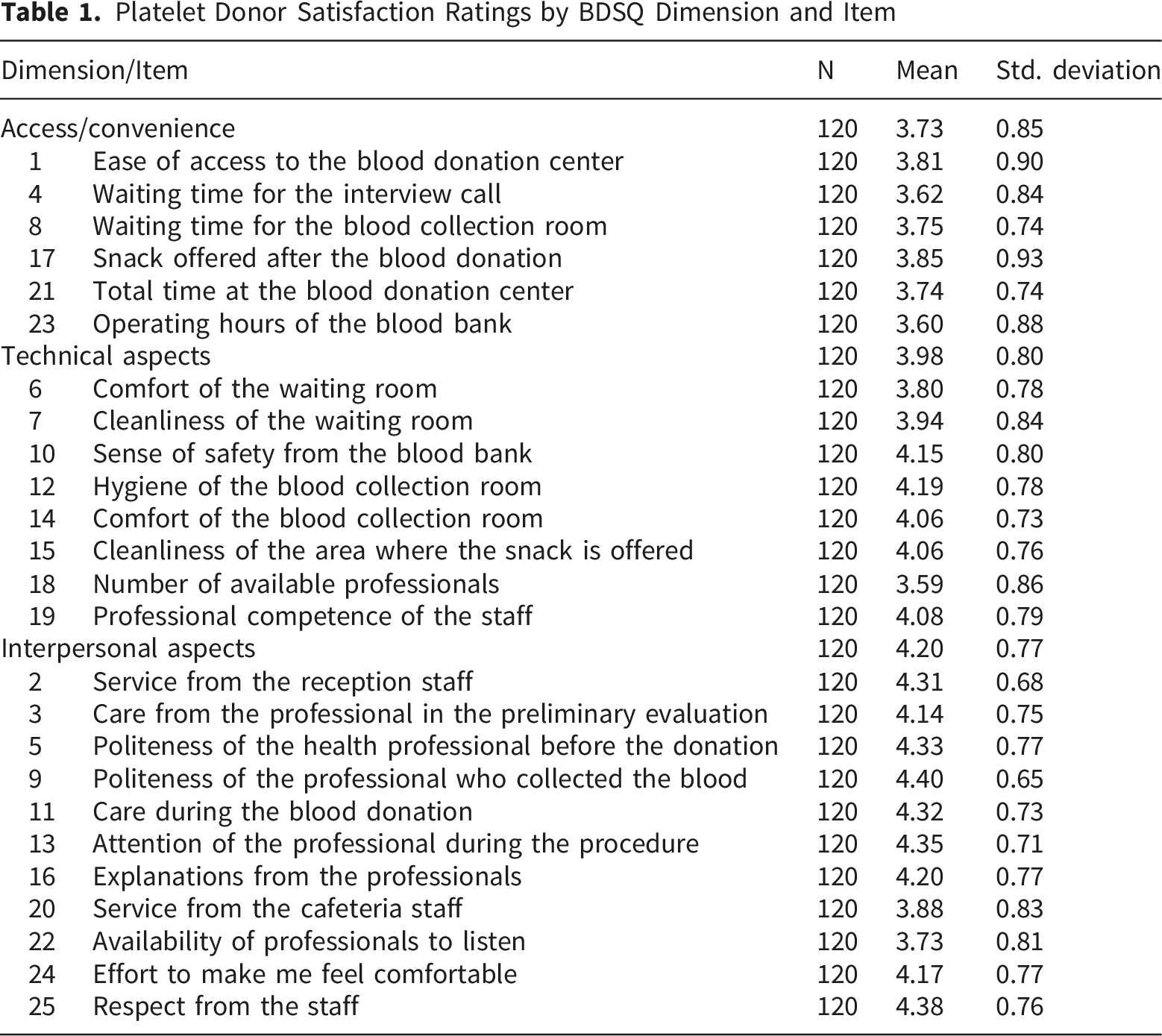
Within the access/convenience dimension, donors reported lower satisfaction with waiting times and blood bank operating hours, indicating logistical challenges in service delivery. Technical aspects were generally rated positively, particularly hygiene, safety, and professional competence; however, the perceived number of available professionals received lower ratings. Interpersonal aspects were consistently rated highly, with politeness, respect, attentiveness, and care from staff emerging as the strongest contributors to donor satisfaction. Item-level satisfaction ratings are detailed in Table 1.
Comparative analyses by gender, age group, and education level revealed no statistically significant differences in satisfaction across the three dimensions (Supplemental Tables S2–S4). Repeat donors reported higher mean satisfaction scores than first-time donors across all dimensions, although these differences reached only marginal statistical significance (Supplemental Table S5).
Correlations Among the BDSQ Dimensions

*Correlation is significant at the 0.01 level (2-tailed).
Discussion
This study provides novel insight into platelet donor experience in Greece by examining how interpersonal, technical, and organizational factors jointly shape donor satisfaction. From a broader patient experience perspective, these findings suggest that donor satisfaction functions not only as an evaluation of service quality but also as a potential driver of behavioral outcomes such as trust, willingness to return, and long-term donor retention. This highlights the relevance of platelet donation services beyond the Greek context.
The highest satisfaction ratings were observed for interpersonal aspects, highlighting the central role of staff behavior in shaping donor experience. Politeness, attentiveness, respect, and clear explanations likely provide emotional reassurance during a procedure that is more time-consuming and technically complex than whole blood donation. Effective communication has been shown to reduce donor anxiety and perceived pain, thereby improving satisfaction and increasing the likelihood of return donations.4,6 In this context, interpersonal care appears to function as a key driver of trust and perceived safety, reinforcing findings from previous research linking service quality to donor loyalty. 2
Technical aspects were also rated positively, particularly hygiene, safety, and professional competence. These findings suggest that donors felt physically secure during the apheresis process, which is critical given concerns about adverse reactions associated with frequent platelet donation.1,5 However, lower ratings related to staffing levels point to systemic constraints within Greek public hospitals, where staff shortages have been associated with burnout and reduced service capacity. 12 Insufficient staffing may indirectly affect donor experience by increasing waiting times and limiting opportunities for communication and individualized attention.
In contrast, access and convenience emerged as the weakest satisfaction dimension. Long waiting times and limited operating hours represent significant barriers from a donor experience standpoint, particularly for working-age donors. Previous studies have demonstrated that logistical inefficiencies and restricted scheduling negatively affect donor satisfaction and donation intention, while optimized scheduling and extended service hours can improve both satisfaction and retention.13,14 Addressing access-related barriers is therefore central to improving donor experience and sustaining platelet donation services. These findings also suggest that access, technical quality, and interpersonal care may operate as mutually reinforcing dimensions of donor experience. For instance, delays and limited staffing may affect not only convenience but also donors’ perceptions of professional responsiveness, procedural efficiency, and individualized attention during a lengthy apheresis session.
From a patient experience perspective, these findings suggest several actionable opportunities for service improvement. Ensuring adequate staffing and improving scheduling flexibility are likely to have the greatest immediate impact, as they directly address the lowest-rated aspects of donor experience, including waiting times, service flow, and operating hours. Secondary interventions, such as appointment-based scheduling, extended hours, and staff communication training, may further strengthen retention by preserving positive interpersonal experiences. Importantly, aligning organizational efficiency with interpersonal care may strengthen donor trust and satisfaction, thereby supporting donor retention. These practice-oriented implications highlight the value of integrating operational planning with patient experience principles in the design and delivery of platelet donation services. 15
Beyond individual service improvements, these findings have broader system-level implications for platelet donation services within publicly funded healthcare systems. Staffing shortages, limited operating hours, and access constraints reflect structural challenges that extend beyond individual donation units and require coordinated policy and organizational responses. Integrating patient experience metrics into service planning, workforce allocation, and scheduling decisions may support more efficient use of resources while enhancing donor satisfaction. At a system level, prioritizing patient-centered access and continuity of care may strengthen donor retention and contribute to the long-term sustainability of platelet supplies.
Repeat donors reported higher satisfaction across all dimensions; however, these differences were only marginally statistically significant. This pattern is consistent with prior evidence suggesting that familiarity with the donation process, lower anxiety, and greater trust in staff may contribute to more positive experiences over time.16,17 This finding underscores the importance of donor retention strategies, such as post-donation motivational interventions and consistent communication, which have been shown to enhance repeat donation behavior. 18
Taken together, the strong correlations among satisfaction dimensions reinforce the notion that donor experience is holistic, meaning that donors form an overall judgment of care from the combined effects of access, technical quality, and interpersonal interaction. Improvements in staffing, scheduling, and service flow may therefore amplify the positive effects of professional competence and respectful communication. A coordinated approach that integrates operational improvements with patient-centered communication strategies is therefore essential to enhance donor experience, promote retention, and ensure the sustainability of platelet donation services.
Limitations
This study has several limitations that should be acknowledged. First, generalizability is limited, as data were collected from five public hospitals in Attica and may not fully represent platelet donation experiences in other regions or healthcare settings. However, Attica encompasses a substantial proportion of the country’s public hospitals and blood donation activity, suggesting that the findings capture common organizational challenges within the Greek public healthcare system. Second, potential sources of bias should be considered. Voluntary participation may have introduced self-selection bias. Data collection immediately after donation may have inflated satisfaction ratings due to social desirability and recency effects, particularly when donors had recent interactions with staff. Moreover, the exclusion of non-Greek speakers further narrowed the sample. Finally, the exclusive reliance on quantitative survey data, without complementary qualitative methods, limits deeper exploration of the underlying factors shaping donor satisfaction and dissatisfaction.
Conclusion
This study, the first to examine platelet donor satisfaction in Greece, provides important insights into the patient experience of apheresis services within the public healthcare system. The findings highlight that while interpersonal aspects of care—such as staff politeness, respect, and attentiveness—are strong contributors to positive donor experience, operational challenges related to staffing, operating hours, and waiting times remain key barriers. The higher satisfaction reported by repeat donors underscores the importance of trust, familiarity, and effective communication in supporting donor retention. Moreover, the strong interrelationships among access, technical, and interpersonal dimensions emphasize that donor experience is holistic and shaped by both organizational and relational factors. These findings highlight that improving platelet donation is not solely a clinical or logistical challenge, but also a patient experience and service design priority for healthcare systems seeking to maintain stable platelet supplies. Future efforts should prioritize staffing capacity, scheduling redesign, and extended service accessibility, while evaluating how these interventions influence donor retention, repeat donation behavior, and long-term platelet supply sustainability.
Supplemental Material
Supplemental material - Understanding Platelet Donor Experience in Greece: Satisfaction Drivers, Service Gaps, and Implications for Service Design
Supplemental material for Understanding Platelet Donor Experience in Greece: Satisfaction Drivers, Service Gaps, and Implications for Service Design by Stefanos Karakolias, Artemis Palla in Journal of Patient Experience
Footnotes

Ethical Considerations
The study was approved by the Ethics Committee of the Faculty of Social Sciences of the Hellenic Open University (approval number 161938, November 19 2024).
Consent to Participate
Verbal informed consent was obtained from all participants upon reviewing the survey introduction.
Author Contributions
The conceptualization of this study was led by SK and AP. Data curation and investigation were performed by AP. The methodology was designed by SK and AP. Project administration was managed by SK. Supervision was provided by SK. The original draft was written by SK and AP, and all the authors contributed to the review and editing.
Funding
The authors received no financial support for the research, authorship, and/or publication of this article.
Declaration of Conflicting Interests
The authors declared no potential conflicts of interest with respect to the research, authorship, and/or publication of this article.
Data Availability Statement
Data supporting the findings of this study are available upon reasonable request from the corresponding author. Data sharing will be conducted in accordance with institutional guidelines and ethical considerations.
Supplemental Material
Supplemental material for this article is available online.
References
Supplementary Material
Please find the following supplemental material available below.
For Open Access articles published under a Creative Commons License, all supplemental material carries the same license as the article it is associated with.
For non-Open Access articles published, all supplemental material carries a non-exclusive license, and permission requests for re-use of supplemental material or any part of supplemental material shall be sent directly to the copyright owner as specified in the copyright notice associated with the article.
