






Abstract
Introduction
In Saudi Arabia, the Vision 2030 has charged e-health efforts in an attempt to enhance service quality, efficiency, and access. To date, there is little empirical evidence on the positive outcomes of digital application skills on nurses’ teamwork.
Purpose
This study sought to explore the association between nurses’ perceived digital skills and their perception of nursing team effectiveness in Saudi hospitals.
Methods
A quantitative descriptive-correlational cross-sectional design was employed. Data were collected from registered nurses at Prince Mutaib bin Abdulaziz Hospital and Dumat Al-Jandal Hospital using the Nursing Digital Application Skills Scale (NDASS; Qin et al., 2024) and the Team Effectiveness Scale for Nursing Units (TES-NU; Kim et al., 2024). Data were analyzed using IBM SPSS.
Results
Of 300 nurses invited, 210 completed usable surveys (response rate = 70%). Nurses reported moderate-to-high perceived digital skills and team effectiveness perceptions. There was a moderate positive correlation between digital skills and team effectiveness among nurses (r = 0.50, p < .001). Multiple linear regression identified digital skills as significantly associated with team effectiveness perceptions (B = 0.402, t = 7.868, p < .001).
Conclusion
Nurses’ perceived digital skills are significantly associated with their perceptions of nursing team effectiveness. These findings suggest targeted digital skills enhancement may be associated with improved nursing teamwork perceptions, informing workforce development strategies aligned with Saudi Vision 2030 healthcare transformation goals.
Introduction
Digital transformation has revolutionized healthcare systems worldwide, making nurses one of the central players in the modernization of health care systems with the adoption of new advanced technologies, including electronic health records (EHRs), clinical decision support systems (CDSS), telemedicine platforms, and AI-based diagnostics (Alharbi et al., 2025; Topaz & Pruinelli, 2017). Investments in these innovations promise streamlined working processes and sharing accurate data in real-time (Alshammari & Alanazi, 2023). The Health Sector Transformation Program of Vision 2030 in Saudi Arabia actively develops e-health with national projects such as Seha Virtual Hospital, Wasfaty e-prescriptions, Nabd unified EMRs, and smart hospital networks, which aim to enhance service quality, accessibility, and efficiency for a population of more than 35 million people (Ministry of Health, 2020). Nurses who constitute the largest group of healthcare employees play the main role in applying these tools to daily practice (Alasiri & Mohammed, 2022). Contemporary nursing literature increasingly frames digital capability as both a technical proficiency and a behavioral adaptation that influences communication patterns, professional confidence, and workforce integration (Kurup et al., 2026). However, despite substantial investments, gaps persist between technology implementation and nursing teams’ practical capacities to leverage digital tools for effective collaboration, particularly in high-acuity Saudi governmental hospitals where digital skills are essential for nurse team effectiveness (Alshammari & Alanazi, 2023; Ismail et al., 2025). This study examined the association between perceived digital skills and team effectiveness among nurses in Saudi governmental hospitals, addressing a critical evidence gap in Vision 2030-aligned research.
Literature Review
Digital skills include technical proficiency, cognitive abilities like data interpretation, and safe practical tool usage. Recent nursing education evidence shows that digital strategies such as simulations, gamification, and telehealth role-playing can strengthen engagement, communication, and collaborative learning in nursing contexts (Kurup et al., 2026). Digital skills vary markedly by age (older nurses showing lower confidence), nationality (expatriate vs. Saudi), education, training exposure, and facility type (tertiary urban vs. rural) (Longhini et al., 2024; Alshammari & Alanazi, 2023; Ismail et al., 2025; Troncoso & Breads, 2021). This heterogeneity disrupts digital team processes such as fragmented EHR handoffs, disconnected dashboard alerts, interface-induced cognitive overload, and reduced interpersonal trust, while cultural factors—including hierarchical structures limiting junior nurses (often female or expatriate) from challenging seniors and gender-segregated norms constraining virtual interactions—further complicate collaboration (Alshammari & Alanazi, 2023). Team effectiveness, defined by communication efficacy, role clarity, cohesion, conflict resolution, and adaptive performance, remains essential for preventing sentinel events and adverse outcomes (Burtscher & Manser, 2012), yet digital skill deficits exacerbate vulnerabilities in Saudi high-acuity wards amid acute staffing and workload pressures (Alrashdi et al., 2024).
Digital skills may be associated with nurses’ perceptions of team effectiveness through shared digital platforms that enable real-time communication, mutual situation awareness, and coordinated decision-making—processes essential for team effectiveness (Burtscher & Manser, 2012; Alshammari & Alanazi, 2023). This study was grounded in Team Process Theory (Burtscher & Manser, 2012), hypothesizing that digital platforms create shared situation awareness enabling team coordination (Burtscher & Manser, 2012).
While international studies link digital literacy to enhanced team productivity (Alenezi et al., 2024), local Saudi research focuses primarily on individual attitudes, infrastructure readiness, or training needs, lacking multisite, team-level analyses using validated scales like NDASS and TES-NU (Ismail et al., 2025). This study addressed this gap through examination of the association between perceived digital skills and nursing team effectiveness across hospitals in Riyadh, Jeddah, and Dammam—providing novel empirical evidence amid post-pandemic pressures, an aging population, and rising chronic disease burdens that heighten the need for digitally enabled, cohesive teams (Al-Ghabeesh et al., 2024; World Health Organization, 2023).
Research Questions
1. What levels characterize nurses’ perceived digital skills in Saudi hospitals? 2. How do nurses perceive their teams’ effectiveness? 3. Does a significant association exist between perceived digital skills and team effectiveness? 4. Are there significant differences in digital skills and team effectiveness perceptions by demographic characteristics and digital skills training? 5. Are perceived digital skills and digital skills training associated with perceptions of team effectiveness?
The Research Design
This study employed a quantitative descriptive-correlational cross-sectional design.
The Study Population and Setting
The study was conducted among registered nurses (RNs) at two governmental hospitals: Prince Mutaib bin Abdulaziz Hospital (300 beds, Riyadh) and Dumat Al-Jandal Hospital (150 beds, Dumat Al-Jandal). These medium-sized facilities were selected for their implementation of digital health systems as part of Saudi Arabia’s national health transformation initiatives.
Inclusion criteria: Licensed RNs, with more than 6 months of working experience in their respective units; Nurses, who were working in a team-based unit, including ICU, emergency, maternity, or general wards; Nurses, who used digital systems as part of their daily routine. The exclusion criteria were as follows: Nursing trainees or students; Nurses working in strictly administrative positions and lack of contact with patients; Nurses who do not operate digital systems at work.
Sampling Method and Sample Size
A convenience sampling approach across both hospitals was used. A priori power analysis (G*Power 3.1; multiple linear regression, fixed model, R2 deviation from zero) with a medium effect size (f2 = 0.15), α = 0.05, power (1−β) = 0.95, and 10 predictors indicated a minimum sample of N = 183. The target sample was increased to N = 210 to accommodate potential missing data. Participants were recruited from these two hospitals using convenience sampling, ensuring representation across ICU, emergency, medical-surgical wards, and outpatient units.
Instruments
The Nursing Digital Application Skills Scale (NDASS)
The NDASS (Qin et al., 2024) is a 12-item, single-factor scale assessing nurses’ perceived competence in digital technology application. Items use a 5-point Likert format (1=strongly disagree, 5=strongly agree). In the current sample, Cronbach’s α was 0.79, confirming excellent reliability. Original validation reported α was 0.968, test-retest r was 0.74 (Qin et al., 2024).
The Team Effectiveness Scale for Nursing Units (TES-NU)
The TES-NU (Kim et al., 2024) comprises 22 items across five subscales (leadership, job satisfaction, cohesion, work performance, nurse competency) using a 4-point Likert format. In the current sample, Cronbach’s α was 0.91(subscale range: 0.78-0.92). Original validation reported α > 0.90 (Kim et al., 2024).
Both instruments (NDASS and TES-NU) were pilot-tested with 25 registered nurses from the target population prior to full data collection. The pilot study confirmed excellent internal consistency (Cronbach’s α > 0.80 for both scales), adequate completion time (15-18 minutes), and clarity of items in the Saudi context. No translation, cultural adaptations, or item modifications were required, validating their suitability for use without changes.
Data Collection Process
Data collection occurred over six weeks (February 1–March 15, 2025) after the ethical approval was obtained from the IRB committee at Zarqa University; Approval Number: (101/2024/2025). Once an ethical clearance was obtained, formal approval was received from hospital administrators and nursing directors, who helped to access the study sites and assist in organization and coordination of data collection process.
The study inclusion criteria were used to identify qualified registered nurses who were invited to participate in the study on a voluntary basis. All the qualified nurses were provided with an electronic information sheet, which explained the objective of the study, procedures, possible benefits and risks, the voluntary nature of it, and guaranteed their confidentiality and anonymity. The informed consent was e-consent and received in advance.
Anonymous online questionnaire created with the help of Google Forms was used to obtain data. The survey was administered by scanning a QR code affixed in nursing units or via a secure electronic link that was sent to the participants via official communication channels. The questionnaire took about 15-20 minutes to be completed.
Reminder messages to potential subjects were dispatched on the 10th and 20th days after the original invitation so as to boost the response rate. No personal data was gathered and the answers were kept safely and only the research team had access to the answers. To prevent duplicate responses, Google Forms’ duplicate submission prevention was enabled. No duplicates were identified among the 210 responses.
Ethical Considerations
The ethical principles that were followed in this study involved those of the Declaration of Helsinki. All participants were informed about the purpose of the study, it was voluntary, and that they could withdraw at any time without any penalty after being informed of the purpose of the study. The privacy was ensured because no data were obtained that could identify the respondents, and all data were kept in a safe place on a password-protected computer that could be accessed by the research team. Anonymity of the respondents was achieved through anonymization of the responses at the collection stage and the analyses were done in groups.
All the electronic data were stored in the password-protected files, in adherence to the General Data Protection Regulation (GDPR) and the Saudi legislation on the health data. The research did not entail serious threats to participants, and they could have gained the advantage of considering their digital competencies. Ethical approval was obtained with the Ethical Review Committee of the ministry of Health in the Kingdom of Saudi Arabia and the institutional review board of respective participating hospitals.
Data Analysis Plan
The data were exported to IBM SPSS Statistics (Version 29) to be analyzed. Data cleaning was performed by eliminating the incomplete entries and duplicates. Before the principal analysis, comprehensive assumption checks confirming normality (Shapiro-Wilk), homoscedasticity (residual plots), linearity (scatterplots), and multicollinearity (VIF) were performed. The descriptive statistics, which consisted of frequencies, means, and standard deviations, were used to describe the demographic variables, level of digital skills, and frequency of team effectiveness, providing a rough picture of the data before delving into the detailed testing. Inferential analyses comprised independent t-tests and one-way ANOVA for demographic differences in NDASS/TES scores, Pearson correlation for the primary NDASS-TES association, and multiple linear regression examining the association between TES and NDASS total score and digital skills training. Complete regression model statistics (R2, adjusted R2, F-statistic, 95% CIs) were reported with significance set at α = 0.05.
Results
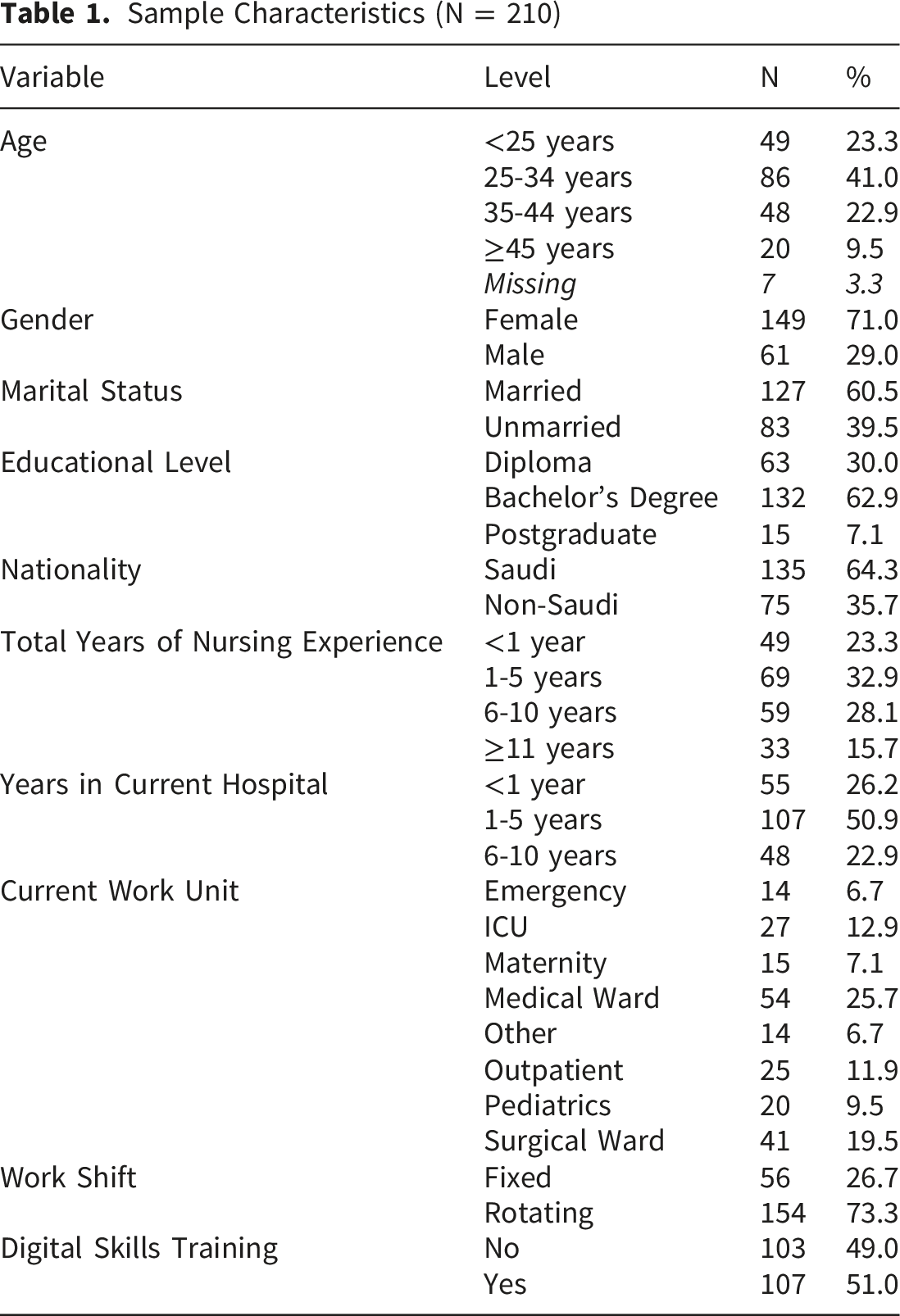
Characteristics of the Sample
Sample Characteristics (N = 210)
Descriptive Statistics of TES
TES-NU Subscale Scores

The Nursing Digital Application Skill Scale (NDASS)
Highest NDASS Items

Correlation between TES and NDASS Scores
Correlation Between TES and NDASS (N=210)

Note. NDASS = Nursing Digital Application and Skills Scale, TES = Teamwork Effectiveness Scale.
Associations Between Demographic/Professional Characteristics and TES and NDASS Scores
Association Between Baseline Characteristics, TES, and NADSS (N=210)

TES = Teamwork Effectiveness Scale; NDASS = Nursing Digital Adaptability and Skills Scale.
Predictors of TES and NDASS Scores
Multiple Linear Regression Examining Association With TES (N=210)
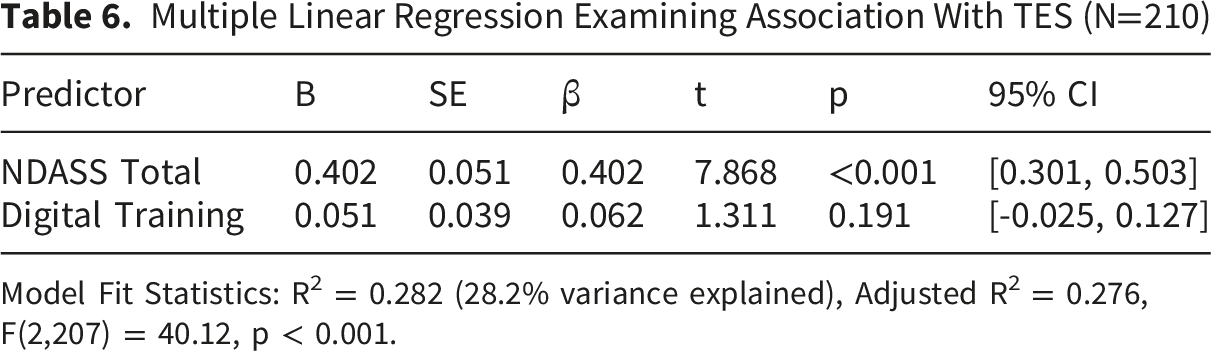
Model Fit Statistics: R2 = 0.282 (28.2% variance explained), Adjusted R2 = 0.276, F(2,207) = 40.12, p < 0.001.
Multiple linear regression (R2 = 0.282, Adjusted R2 = 0.276, F(2,207) = 40.12, p < 0.001) identified NDASS total score as significantly associated with TES (B = 0.402, β = 0.402, t = 7.868, p < 0.001, 95% CI [0.301, 0.503]), explaining 28.2% of variance. Digital skills training was non-significant (B = 0.051, β = 0.062, t = 1.311, p = 0.191, 95% CI [-0.025, 0.127]), suggesting that the bivariate association between digital skills training and team effectiveness may be explained by measured digital competencies (Table 6).
Discussion
Nurses exhibited a positive attitude toward team effectiveness on the TES (M = 4.1, SD = 0.7), signaling a functional climate of discipline, common purpose, and collegial assistance (Kim et al., 2024). This aligned with environments fostering nursing performance (Malik et al., 2025). Subscales of job satisfaction, work performance, and nurse competence yielded higher means than cohesion and leadership, consistent with operational interdependence surpassing supervisory perceptions (Alexander & Armstrong, 2003; West & Lyubovnikova, 2012).
NDASS scores reflected optimism for Vision 2030 tools such as EHRs, telehealth, and AI use (Ismail et al., 2025), with high digital literacy and adaptability indicating proactive use beyond basics like telemonitoring (Troncoso & Breads, 2021). Departmental analyses showed significant variances: outpatient/pediatrics exceeded emergency. Study data revealed routine documentation enabled focus in outpatient settings, while emergency pressures limited digital engagement. This pattern aligned with prior literature on acute demands ( Lokmic-Tomkins et al., 2026), hypothesizing targeted training to bridge such gaps. Digital skills training showed significant bivariate associations with both TES and NDASS, indicating that more training corresponds to stronger team effectiveness perceptions and higher digital proficiency. However, this effect likely attenuated in multivariate models (e.g., mediated by NDASS), as training enables skills that directly drive teamwork. This aligns with Vision 2030 upskilling needs, suggesting that targeted programs might bridge departmental gaps (e.g., emergency units (Ismail et al., 2025; Qin et al., 2024).
The correlations between NDASS and TES were moderate and positive, which means that digitally skilled nurses perceive a team as a more collaborative and competent team. This is consistent with recent nursing education literature showing that digital strategies can support engagement, communication, and teamwork-related learning behaviors (Kurup et al., 2026). This also echoes the data showing that digital mediation supports mutual awareness and productivity (Troncoso & Breads, 2021). This highlights competence in Saudi Arabia’s Vision 2030 digital initiatives as an enabler of teamwork. This interpretation is further supported by workforce capability literature showing that digital support can strengthen communication, leadership confidence, and professional self-concept among nurses transitioning into new practice contexts (Aggar et al., 2021). There were still departmental NDASS inequalities (outpatient over emergency), but TES consistency indicates the stabilizing effect of system protocols (Alrashdi et al., 2024).
Training was found to be bivariately related with both scales, but was attenuated in regression, so NDASS was positioned as mediator. The NDASS was strongly associated with TES hierarchically, which confirmed the role of skills as its proximal factor through workflows (Troncoso & Breads, 2021). Multifactorial interaction may require comprehensive interventions that focus on retention in high-acuity units (Lokmic-Tomkins et al., 2026). Digital capability must be considered as a relational and context dependent construct that is influenced by leadership, the culture in the workplace, communication systems and institutional readiness. In this way, the perceived digital skills of the nurse could affect the way the team works not only in terms of how they do things, but also how they communicate, understand, and adapt within the clinical context. This interpretation resonates with the current best practice literature on workforces and implementation and highlights the need for organisational support and the capacity for teams to embed technology into routine working within the healthcare sector (Morris et al., 2023). Therefore, the present results could be construed not only as individual competence in digital skills, but also as an indicator of the level of support provided in the workplace for digital tools to be used collaboratively and effectively.
Strengths and Limitations
The present research demonstrated strong methodological rigor through validated instruments (TES-NU and NDASS), a multisite sample from two governmental hospitals representing diverse clinical units (medical-surgical, ICU, maternity, outpatient), and advanced inferential analyses providing predictive depth that addressed critical evidence gaps in Middle Eastern nursing research aligned with Vision 2030 priorities. However, limitations include the cross-sectional design precluding causal inference and potential social desirability bias in self-reported measures. These methodological constraints necessitate longitudinal or interventional studies and objective audits/observations for future validation. Additional limitations encompass convenience sampling from two medium-sized urban governmental hospitals limiting generalizability to private sector, tertiary academic centers, or rural facilities, suggesting the need for multisite study in future research.
Implications for Clinical Practice
In Saudi governmental hospitals, nurse managers and educators should focus on developing and implementing specific digital skills training initiatives, especially in high-acuity areas such as emergency care departments, to facilitate real-time coordination through EHRs and telehealth systems in line with Vision 2030. Regular NDASS evaluations could highlight ability deficits among various populations and provide a basis for interventions to improve cohesion, job performance and nurse competence. Overall, these findings suggest that higher digital skills may be associated with better team effectiveness and may support improved coordination.
Conclusion
This quantitative descriptive-correlational cross-sectional study found that higher perceived digital skills (NDASS) were associated with higher perceived team effectiveness among 210 nurses from two Saudi governmental hospitals, with NDASS significantly and independently associated with TES perceptions. These perceptual relationships suggest digital competencies may support nursing teamwork perceptions amid Vision 2030 transformation. However, findings are limited to self-reported perceptions within two medium-sized governmental hospitals using convenience sampling. Further multicenter, longitudinal research is needed to determine whether this association holds across diverse Saudi healthcare settings (private, tertiary, rural), and whether perceived relationships translate into measurable organizational performance or patient-level outcomes. Future studies may also want to employ objective measures and experimental designs to establish causality.
Footnotes
Acknowledgement
The authors gratefully acknowledge the financial support provided by the Deanship of Scientific Research at Zarqa University, Jordan. The authors also extend their sincere appreciation to the Deanship of Scientific Research at Northern Border University, Arar, Saudi Arabia, for funding this research project (Project No. NBU-FFR-2026-112-05).

Ethical Considerations
The study was approved by the IRB committee at Zarqa University; Approval Number: (101/2024/2025).
Consent to Participate
Electronic informed consent obtained from all participants prior to data collection. Participants were informed of study purpose, voluntary nature, confidentiality guarantees, and right to withdraw without penalty.
Author Contributions
Ahmad Rayan: Conceptualization, Methodology, Formal analysis, Writing - Original Draft, Supervision, Funding acquisition. Afifa Musalim Alruwili: Conceptualization, Investigation, Data curation, Writing - Review & Editing. Manal Hassan Baqeas: Methodology, Validation, Writing - Review & Editing. Nidal Eshah: Formal analysis, Visualization, Writing - Review & Editing. Fadwa Alhalaiqa: Methodology, Writing - Review & Editing. Mirna Fawaz (Corresponding Author): Writing - Original Draft, Writing - Review & Editing, Project administration. Sally Abu Shairah: Data curation, Writing - Review & Editing.
Funding
The authors disclosed receipt of the following financial support for the research, authorship, and/or publication of this article: The authors acknowledge the funding from the Deanship of Scientific Research at Zarqa University, Jordan. The authors extend their appreciation to the Deanship of Scientific Research at Northern Border University, Arar, KSA, for funding this research work “through the project number “NBU-FFR-2026-112-05”.
Declaration of Conflicting Interests
The authors declared no potential conflicts of interest with respect to the research, authorship, and/or publication of this article.
Data Availability Statement
The data presented in this study are available on request from the corresponding author.