






Abstract
Migration by some household members has significant economic, social, and psychological impacts both on migrants and on members of the household who do not migrate, especially children. This study examines one dimension of children’s experiences of migration by exploring its associations with their time use, focusing on the sending context of Nepal, a country of high levels of primarily circular migration. Drawing on data from the Family Migration and Early Life Outcomes project, this study uses ordinary least squares regression to examine variation in time spent on household labor among children ages 5 to 17, comparing children in households with no migrants, households with only male migrants, and households with female migrants. We find that children in households with female migrants spend less time on household labor than children in households without migrants, with this association robust to controls for child and household characteristics and migrant remittances. Children in households with male migrants spend more time on household chores, but the magnitude and significance of this association vary across specifications. These results highlight migration’s complex associations with children’s time use and well-being, pushing migration scholarship toward a broader conceptualization of migration that incorporates multiple migrants and outcomes across multiple dimensions and domains.
Introduction
Migration has important economic, social, and psychological consequences both for migrants and for their household members who remain in the sending country (Thapa et al. 2024; Yabiku, Agadjanian, and Sevoyan 2010). Although migration is undertaken by individuals, its consequences are often felt at the household level because the departure of one member reshapes household resources, labor supply, caregiving arrangements, and responsibilities. These consequences may be especially salient for children, who are both well positioned to benefit from the resources that may be generated from migrant remittances and highly vulnerable to the social and psychological impacts of the absence of migrant family members. A substantial body of research has examined the social and economic consequences of migration for the physical health, mental health, and educational experiences of children who remain behind, finding variation in impacts across different domains as well as by child characteristics (Abrego 2014; Chae, Hayford, and Agadjanian 2016; Dreby 2010; Van Hook and Glick 2020).
The absence of a migrant household member and the receipt of remittances have potentially important implications for the supply of and demand for household labor. Because children make important contributions to household labor in most low-income countries, the departure of members of the household is likely to affect children’s labor in particular. The distribution of children’s time use has potentially important ramifications on subsequent investments in human capital and long-term well-being. However, only limited research has examined the relationship of migration by household members with the distribution of household labor, and that which does exist has found mixed results. Some research has found that husband’s migration increases household labor for wives (Ghimire, Zhang, and Williams 2021) or daughters (McKenzie and Rapoport 2011) who are left behind. Other research finds that remittances can offset the impact of migration on children’s household labor (Antman 2012; Chang, Dong, and MacPhail 2011). Given the highly gendered distribution of household labor, impacts of migration on household labor may differ for boys and girls or depend on the gender of the migrant (Antman 2011; McKenzie and Rapoport 2011; Pörtner 2016).
In this study, we seek to understand the gendered dimensions of the relationship between the migration of household members and the household labor of children and adolescents who remain in the context of origin. In this article, we use the term “household migration” to refer to the current absence of one or more household members due to migration, consistent with other research (e.g., Axxe, Hayford, and Ghimire 2024; Lu 2012b) and with theoretical frameworks that identify migration as a household-based economic strategy (Stark and Bloom 1985). We explore how current migration of household members is associated with children’s time spent in household labor, considering differences between boys and girls and differences by migrant gender. We draw on data from the Family Migration and Early Life Outcomes (FAMELO) project collected in the Chitwan Valley in Nepal, a context where migration is a common but relatively recently endemic household livelihood strategy and where economic and family life are highly gender stratified. In Nepal, migrant-sending households are common, making this a substantively important household arrangement. This study uses ordinary least squares (OLS) regression to predict time spent in household labor among children ages 5 to 17 (N = 2,822). Results indicate that female migration in the household is associated with children spending less time on household chores, while male migration is associated with greater time spent by children on household chores, although this varies across different model specifications. Contrary to our expectations, variation in children’s household labor according to household migration patterns is similar for boys and girls and is not significantly different based on remittances. Our findings underscore ways that children’s time use varies across migrant-sending and nonmigrant households. We discuss the potential implications of children’s time use for health and human capital development and for other dimensions of well-being.
Determinants and Consequences of Children’s Household Labor
In low- and middle-income countries (LMICs), particularly agricultural settings, children’s contributions to household functioning can be substantial, both in terms of the impact on household production and in terms of children’s time (Fares and Raju 2007). Children’s work for the family can range from cleaning, cooking, and caring for younger siblings to work in agriculture and animal husbandry, and it can include wage labor (when wages are used for household expenses) as well as unpaid work (Lloyd, Grant, and Ritchie 2008). For families, this investment can be pivotal as children help manage the daily life of the household (Dodson and Dickert 2004).
For children, time allocation can have both positive and negative implications for well-being (Larson and Verma 1999; Savahl et al. 2020). Time is a resource for both human and economic capital development as well as for the child’s own psychological development (Larson and Verma 1999). Participating in household work can help children develop skills that are necessary in adulthood. Contributing to the family can also support a sense of accomplishment and positive socioemotional development, particularly for adolescents (Fuligni 2019). But time spent on household labor can compete with time spent on school or leisure (Hsin 2007). For example, children who spend more time caring for siblings may have less time to spend with friends or to focus on schoolwork. In turn, these changes in time allocation can have downstream effects on children’s development and well-being (Hu and Mu 2020). Thus, the amount of time a child spends on housework can serve as an indicator of broader inequality within the household or more lasting effects on children’s development.
The allocation of household labor for children varies by social and economic factors, including broader sociocultural norms, the economic realities of the community and household, the nature of the work itself, and individual factors, such as the gender and age of the child (Lloyd et al. 2008). Both in high-income countries (HICs; Dodson and Dickert 2004) and LMICs (Hsin 2007; Lloyd et al. 2008; Vikram, Ganguly, and Goli 2024), gender differences persist in the allocation of household labor as boys and girls may do different types of work, reflecting patterns found in adulthood. In many low-income settings, particularly in South Asia, these differences across gender echo a larger preference toward sons, who have historically received more investment in human capital (Strauss and Thomas 1991) and thus may spend less time in household labor overall as well as doing different types of tasks. Other factors, such as age, can also shape the allocation of children’s time. Older children may take on greater household and economic responsibilities, particularly in more economically stressed families (Das 2022).
Household-level factors that determine the allocation of children’s labor can be broadly classified into factors related to the supply of household labor and factors related to the demand for household labor. In general, children do more work when there are fewer other sources to supply household labor and when there is greater demand for household labor. For example, children may do less work in larger households because there are more other people available to contribute to necessary domestic and agricultural labor. Children may do more work in households with greater need, such as more land or animals in need of tending or more young children in need of care. In this study, we examine how migration of a family member may be associated with children’s time spent in household labor by considering how migration may shape the supply of and demand for household labor.
Children’s Household Labor in Migrant-Sending Households
The migration of household members affects the experiences of children who remain in the context of origin. While the migration of parents may be especially consequential, the migration of other household members may also influence children’s resources and relationships. Because children’s daily lives are shaped by the broader household, the migration of siblings, grandparents, or other coresident kin may also alter caregiving arrangements, labor demands, economic resources, and the social ties that structure children’s lives. For example, research from China found that sibling migration could improve children’s educational prospects, underscoring that migration reorganizes resources and care across the wider household rather than only through parent-child separation (Lu 2012a).
Existing research has examined impacts of household migration on children’s schooling, the allocation of health and nutrition resources, household relationships, and emotional well-being, among other outcomes (Parreñas 2005; Van Hook and Glick 2020; Wassink and Viera 2021). Because migration of household members changes both the supply of household labor (through the departure of the migrant) and, potentially, the demand for household labor (through the possible investment of remittances in productive activities), it is likely to also shape children’s time spent in household labor in the origin context.
Migration directly reduces the supply of labor in the household by removing an adult household member. This absence requires others to take on new responsibilities (Antman 2012; Pörtner 2016), and children may take on additional work to compensate for the reduced supply. Previous research shows an association between parental migration and increased participation in housework and farm work (Antman 2012; Chang et al. 2011; Pörtner 2016). For example, Pörtner’s (2016) study in the Philippines found that boys whose fathers had migrated were more likely to engage in market work, including farm production, at the expense of leisure time. Given the gendered organization of household labor, the absence of migrants may be differentially consequential for children’s time use based upon their gender (Chang et al. 2011). McKenzie and Rapoport (2011) found that while both girls and boys experience negative effects of parental migration on schooling outcomes, these effects are attributed to increased time spent on household labor for girls only. The gender of the migrant may exert equal force in shaping the time use of nonmigrant children. Given the gendered division of labor in many Asian contexts (Hoang, Yeoh, and Wattie 2012; Lam and Yeoh 2018), the absence of a woman not only reduces the supply of labor, but it also reduces the supply of labor for female tasks specifically, creating a gendered gap in the supply of labor. While there is potential that men who remain in the household temporarily pick up this labor (Lam and Yeoh 2018), these gendered gaps in supply may trickle down to children differentially by gender.
Migration that results in remittances may further change household productive activities in ways that alter demand for labor. Remittances can be invested in land, livestock, or family businesses (de Haas 2007), potentially increasing labor demands that children must help meet. Conversely, remittances can be used to hire help or purchase labor-saving tools (Antman 2012), which could lead to a reduction in children’s household labor. When remittances are directed toward labor-intensive pursuits organized along gendered lines, they may have varying consequences for boys and girls (Ghimire et al. 2021).
In addition to differences in the supply of and demand for household labor, migrant-sending households may also have different preferences for how children allocate their time. Migration may be selective of households that prioritize education since parents often migrate to finance children’s schooling (Antman 2012; Hsin 2007). In such cases, migration could be negatively associated with household labor because parents who are more likely to migrate are also more likely to encourage their children to focus on school or studying rather than chores. More generally, preferences for the distribution of household labor may vary across migrant and nonmigrant households if migration introduces new ideas about family functioning (Ghimire et al. 2021; Levitt 1998).
Key contributions of this study
Family life and behavior are strongly associated with migration and gender through the supply of and demand for household labor. Yet the strands of literature that consider the impact of migration of household members on children in the sending context and those that look more broadly at time use seldom coalesce, obscuring our understanding of how migration is related to children’s time use. Our understanding of this process is also limited by the contexts of these studies as the few studies that exist focus on the contexts of China and Mexico, where migration is both normalized and largely expected (Kandel and Massey 2002). Migration flows that are less mature or more recently endemic may have more disruptive or untested consequences as families are still adjusting to the prevalence of migration in society. Furthermore, focusing exclusively on the parent-child dyad ignores the broader ramifications of the migration of household members on outcomes for children, particularly in settings where extended households are common.
This study builds on these gaps by examining how the migration of household members and remittances is related to children’s household labor in Nepal, emphasizing the gender of both the migrant and the child. We focus on how these processes operate through supply of and demand for labor.
Nepal Context
This study is set in the Chitwan Valley located in the southern part of Nepal. In the past three decades, Chitwan and, more broadly, Nepal have seen dramatic shifts in migration patterns. Until the 1980s, Nepal remained isolated, with migration almost exclusively to neighboring India. In the 1980s, the government passed the Foreign Employment Act of 1985, which made migration outside of India a possibility by licensing nongovernmental institutions to send Nepali workers abroad through organizations that seek workers for contract work (National Statistics Office 2025). This legal transformation, coupled with economic stagnation, environmental challenges, and the proliferation of recruitment agencies, has pushed young people, particularly young men, toward new forms of domestic and international migration (Bohra and Massey 2009; National Statistics Office 2025; Williams et al. 2020). Presently, around 2.2 million Nepalis are abroad (7.5 percent of the population), a share that is roughly double the global proportion of people living outside their country of birth (UN DESA 2025; World Bank 2024). Over half of Nepali households include someone currently abroad or a return migrant (IOM 2018). Chitwan specifically is one of the top origin districts for foreign labor migration (National Statistics Office 2025). The impact of this expansion on Nepal has been profound, with a quarter of Nepal’s GDP coming from remittances, which is nearly 3 times higher than the second highest remittances receiving country of Pakistan (7.8 percent of GDP; World Bank 2024). A recent study found that remittances were primarily used for consumption, followed by loan repayment, with only about 1 percent of remittances in the early 2020s used toward capital formation such as business investment (NiPoRe 2024).
Migration in Nepal has historically been dominated by men, with women and families staying behind. However, recently, international migration by women has increased. Between 2019 and 2022, the proportion of work permits awarded to women increased from 6 percent to 10 percent, with female migration increasing by 71 percent in the last decade (Rauniyar 2022). The absence of women from the household may have distinct consequences for household labor among family members who stay in Nepal, particularly for children. These patterns indicate that migrant-sending households are not rare but instead constitute a major component of Nepal’s social and economic landscape. In this context, many children grow up in households where one or more members are temporarily absent due to labor migration, making Nepal a particularly important site for examining how migration reshapes children’s everyday labor responsibilities.
Within Nepal, men are primarily responsible for certain agricultural tasks such as sowing the fields and the management of household activities; women’s tasks include taking care of children and the elderly, cooking, cleaning, and performing agricultural tasks such as planting and caring for livestock. Men’s absence has increased the household labor burden on wives and feminized some agricultural tasks (Ghimire et al. 2021; Thapa et al. 2019). In other culturally similar settings in South Asia, studies have shown these same gendered behaviors reflected in young girls, particularly in more rural areas as young girls perform more household work than boys (Vikram et al. 2024).
Nepal’s historical reliance on subsistence farming means that the household has served as the site of economic production, making the contribution of children paramount for economic development. As nonfamily production has become more common, wage labor has played a larger role in household economic conditions. Initially, men were the primary participants in wage labor, but women’s employment has become more common (Yabiku and Schlabach 2009). As in other contexts, even as more women leave the home to engage in paid labor, they continue to shoulder a vast majority of unpaid labor in the home (Chant 2008). It is not clear how these shifts in the broader economic contexts and subsequent migration impact children.
Present Study
The uptick in female migration coupled with the proliferation of male migration (Ghimire et al. 2021; Thapa et al. 2019) make Nepal a useful context to explore how both the gender of the child and the gender of the migrant are related to children’s experiences in migrant-sending households. These questions are also aided by the broader migration context as the few studies that have looked explicitly at the time use of nonmigrant children focus on China and Mexico (Chang et al. 2011; de Brauw and Mu 2011), which have a long-standing tradition of rural to urban migration. In Nepal, where the widespread nature of largely temporary male migration is a relatively new phenomenon, the children in this study are part of one of the first generations to grow up in a context of endemic migration. Female migration is even more recent, although it has increased rapidly over the past decade, meaning that households with female migrants may be more selectively composed than the far more prevalent male-migrant households.
Our study seeks to understand how migration is associated with children’s household labor in this gendered migration context of Nepal. Grounded in the conceptual framework outlined previously, we propose the following hypotheses based on the ways that migration is associated with supply of and demand for household labor. Because the distribution of household tasks in Nepal, as in most contexts, is highly gendered, we consider variation by both migrant and child gender.
Migration, by definition, removes a household member from the household and reduces the supply of household labor, potentially requiring more labor from children. Because household tasks are gendered, this mechanism may operate more strongly for same-gender migrants.
Migration that results in remittances may change household investments in productive assets such as land and livestock, leading to an increased demand for children’s labor, although how remittances are utilized may vary differently based upon the child’s gender.
These hypotheses and proposed mechanisms suggest some pathways for associations between the migration of household members and children’s time spent in housework. We estimate a series of nested models, with baseline models including only core sociodemographic characteristics (child’s age and gender, household wealth and caste) and subsequent models including potential mechanisms (household size and structure, ownership of land and livestock). Investments in children’s schooling may be a motivation for migration, and time spent on school may reduce time spent on housework. We include models controlling for parental aspirations for children’s schooling and children’s time spent studying.
Data and Measures
Data
This article uses data from the FAMELO project, a study that focuses on health and socioemotional outcomes for children in high-migration contexts (Glick, PD, P01 HD080659). The prolific nature of migration coupled with the gendered migration context in Nepal allowed us to explore different iterations of migration across gender and individuals in the household. This study specifically focused on the district of Chitwan, which, like much of the rest of Nepal, experienced a rapid rise in migration, with Chitwan being one of the most common origin districts for foreign labor migration (National Statistics Office 2025).
FAMELO is a two-stage household-based survey. Communities in the Chitwan area were randomly selected with probability proportional to size. In the selected communities, households were considered eligible if they included at least one child ages 5 to 17 and a primary caregiver, and eligible households were randomly selected to participate. Within these eligible households, one or two children were chosen randomly to participate in the study. The specific number of children to be interviewed per household was also randomly determined. Both the selected child(ren) and the primary caregiver were interviewed. Primary caregivers (in almost all cases the child’s mother) responded to questions about themselves, other household members (both those currently residing in and away from the household), and the child(ren) being interviewed. Meanwhile, children provided responses regarding themselves and their households. Given that this study relied on interviews with children, the FAMELO team worked closely with the Institute for Social and Environmental Research in Nepal, the organization implementing the survey, to ensure questions were both age and culturally appropriate and trained interviewers to work with children. The study protocol was reviewed and approved by Institutional Review Boards in both the United States and Nepal. The data we use in our analysis were collected in late 2017 and early 2018. This window captures a period in which labor migration from Nepal was overwhelmingly male but female labor migration was also rising. Recent evidence indicates these patterns persist as the number of Nepalis going abroad for employment has risen steadily over the past several decades and women’s share of new labor permits increased from below 1 percent in the mid-2000s to about 11 percent by 2022–2023. These trends also fit a broader regional pattern in Asia, where a large share of cross-border mobility is organized through temporary labor migration and where Gulf/Middle East and North Africa destinations remain central to labor migration systems (Bhattarai, Upadhyaya, and Sharma 2023; OECD, ADBI, and ILO 2020).
In Nepal, 2,333 households were surveyed for a sample of 3,202 children and 2,333 adult caregivers. In households with two children interviewed, information on time use was not collected for the second child if that child was younger than 11 years old. There were 142 such children; we do not include them in our analysis. Of the remaining 3,041 children, 219 were excluded due to missing data on caste and father’s age and education variables, bringing our final sample to 2,822.
Measures
Dependent variable
A series of time use questions were asked to either the child (for children age 11+) or the caregiver (for children ages 5–10) regarding how the child spent the previous day. For both child reports and caregiver reports, respondents were first presented with a series of household tasks and asked whether they/the child participated in those tasks (yes/no). Specifically, they were asked if they did any of the following activities: cooked, cleaned the house, tended the fire, washed clothes, obtained firewood or other fuel for cooking, bought food or other things for the household from the store, cared for animals, worked on anything related to growing food, and took care of family members. At the end of the list, respondents were asked “Taking all of these tasks together, along with any other tasks you did for your family/[child] did for the family, about how much time did you/[child] spend doing these things yesterday?” The structure of this questionnaire was designed to maximize accuracy, using the list of chores to prompt memory before asking about the amount of time spent. We used this measure to create a continuous variable for the total amount of time a child spent on household chores in a given day. We focused specifically on household labor as children in our sample rarely engaged in productive labor outside the home (46 children, around 1 percent of the sample, reported remunerative labor).
Key predictors
All measures of migration came from the household survey and were reported by the caregiver. Specifically, caregivers were asked, both for those currently there and those currently away, to list all individuals who normally stay or eat meals in the household. After caregivers listed the people that compose their household, they provided the demographics, location, and duration of migration for each individual, including both those reported as in the household and those away. This information was used to construct the migration variable.
We created several different measures to try to capture the diversity of migration experiences across households. Initially, we created two separate binary variables for whether any men were currently away from the household and whether any women were currently away from the household. We created two separate binary variables rather than a categorical variable, owing to the relatively low level of female migration. In almost all cases, households with a female migrant also had a male migrant. Thus, although the two variables were statistically independent, in practice, households with a female migrant almost always had a male migrant as well. We note this in our interpretation of the results.
In addition to this, we created a binary measure for remittances. When the caregiver was asked about the location of family members, they were also asked if each person sent any money or goods home in the past 12 months and if so, how much money they sent. We created a binary variable of any remittances in the past 12 months based on these questions. We tested models including measures of the amount of remittances sent (both a continuous measure and categorical one, i.e., none, low, high), but including variation in amount did not account for statistically significant variation (Appendix A).
Across all measures of migration, we did not distinguish migration by destination as we were interested in how current separation, regardless of location, is associated with children’s time use. It should be noted most moves were outside of the district of Chitwan (60 people, 4 percent of households with migrants, migrated within the district). We ran a secondary analysis that limited the migration variable to solely international (Appendix B). While international female migration was consistent with the aggregated measure, male migration loses its significance, and remittances became significant, likely a result of higher remittances from international destinations. The small sample size of female international migrants made a thorough analysis unreliable, and we therefore continue to use an aggregated measure.
Other independent variables
We control for individual- and household-level characteristics that were theoretically relevant to the relationship between household migration and the supply and demand for children’s household labor. We included basic sociodemographic controls for the child gender and age. In this sample, virtually all children were enrolled in school (98 percent), and thus school enrollment was unlikely to explain any association between migration and children’s time use; however, we controlled for the time they spent in school on the previous day in order to account for variation in the availability of time. Children who had not attended on the day in question (because school was not in session or for other reasons) were coded as spending zero hours in school. In sensitivity tests, we reran models limiting the sample to children enrolled in school and to children who were in school the previous day. Results were largely consistent.
In addition to characteristics of the child, we included several measures of household characteristics. We controlled for caste-ethnicity, which has been shown to shape time use of wives left behind by migration in Nepal (Ghimire et al. 2021) and more broadly influence social and economic life (Ghimire et al. 2006). We controlled for the five major caste-ethnicity groups (Brahmin/Chhetri, Newar, Terai Janajati, Hill Janajati, and Dalit), with Brahmin/Chhetri being the reference group. Household socioeconomic status was assessed through a principal component analysis (PCA) of household assets and construction materials of dwellings, coded as binary variables. This method, widely employed in the Demographic and Health Surveys program and research on LMICs (Corsi et al. 2012), is valuable in settings where gross income or other formal economic measures fail to comprehensively represent all available household resources. PCA identifies a set of indicators with the highest shared variance and constructs a weighted average from them. These indicators focus on long-term consumption and resources rather than short-term fluctuations in formal income (Filmer and Pritchett 2001). To construct the household wealth index, we retained indicators with eigenvector absolute values of 0.2 or higher in the initial PCA. The 13 indicators used in the final model included whether the household owns any of a range of durable goods (refrigerator, television, motor vehicle), whether the household had a flushing toilet, the main fuel source used, and the building material for the house (mud, concrete, brick), roof (tin, thatch), and floor (mud, concrete). The variable utilized here was a score predicted using the final PCA, following other research employing FAMELO data (Alcaraz, Hayford, and Glick 2022). Finally, we included an education variable that captured the highest level of educational attainment of any person in the household, ranging from play school (Level 2) through a PhD or equivalent (Level 27).
To account for the supply and demand of household labor, we focused on the composition of people in the household. Specifically, we accounted for the number of adult (age 18+) men and women in the household, excluding those who were currently away, and the dependency ratio in the household. Additionally, since younger children may require more intensive care from other members of the household, we controlled for whether there were any children under 8 in the household. Furthermore, since older children are likely to shoulder a larger burden of work, we controlled for whether the respondent was the oldest child out of their siblings. Given that agricultural work constituted a large part of household labor, we also controlled for whether the household owned any farmland and if the household owned any livestock. As the allocation of time to studying may represent constraints on children’s time and the available supply of labor in the household, we controlled for the number of hours children spent studying on the previous day. Finally, since migration may be selective of households that value children’s schooling, we accounted for caregiver’s educational goals.
Method
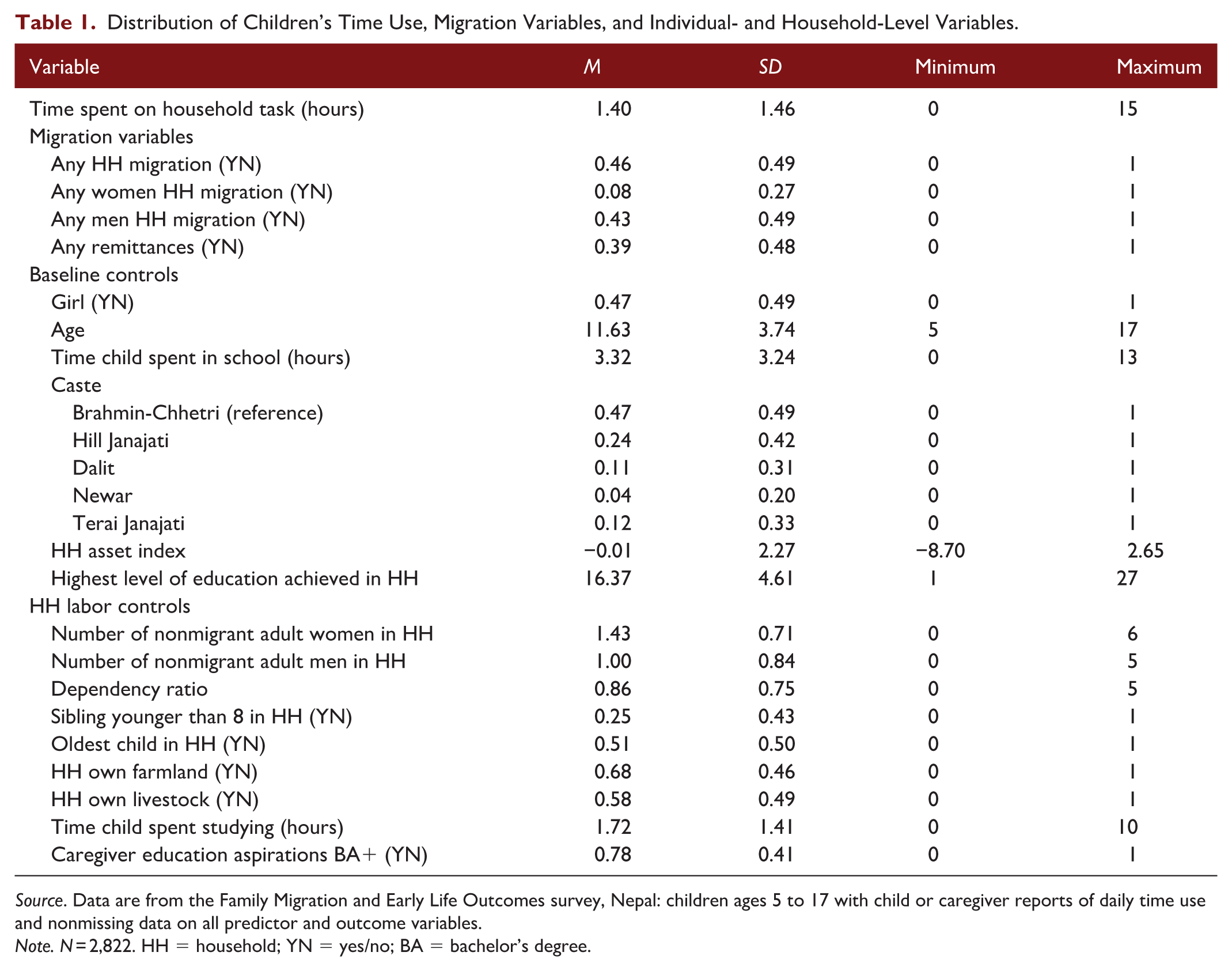
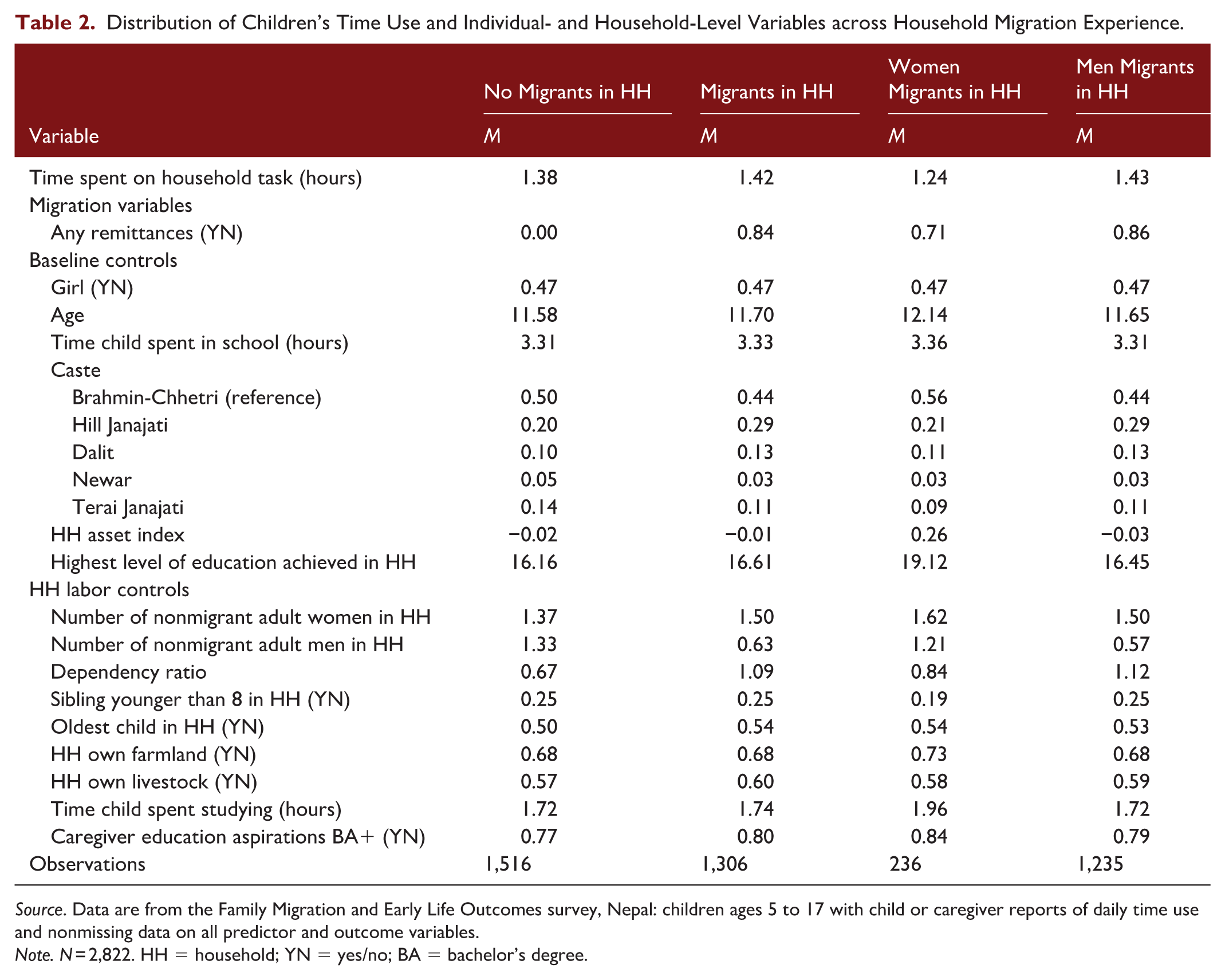
We first present basic descriptive statistics showing the mean, standard deviation, and distribution of dependent and independent variables for our sample (Table 1) as well as the mean of these variables between nonmigrant households, any migrant households, any female migrant households, and any male migrant households (Table 2). We then proceed to multivariable analyses, using OLS regression to predict the time children spent on household chores. We chose OLS given that our count variable was relatively normally distributed. In exploratory analyses, we estimated Poisson models as well (Appendix C); results from these models were not substantively different; thus for simplicity of interpretation, we present the OLS results. All models were estimated with standard errors clustered at the household level to account for nonindependence of children sampled within the same household.
Distribution of Children’s Time Use, Migration Variables, and Individual- and Household-Level Variables.
Source. Data are from the Family Migration and Early Life Outcomes survey, Nepal: children ages 5 to 17 with child or caregiver reports of daily time use and nonmissing data on all predictor and outcome variables.
Note. N = 2,822. HH = household; YN = yes/no; BA = bachelor’s degree.
Distribution of Children’s Time Use and Individual- and Household-Level Variables across Household Migration Experience.
Source. Data are from the Family Migration and Early Life Outcomes survey, Nepal: children ages 5 to 17 with child or caregiver reports of daily time use and nonmissing data on all predictor and outcome variables.
Note. N = 2,822. HH = household; YN = yes/no; BA = bachelor’s degree.
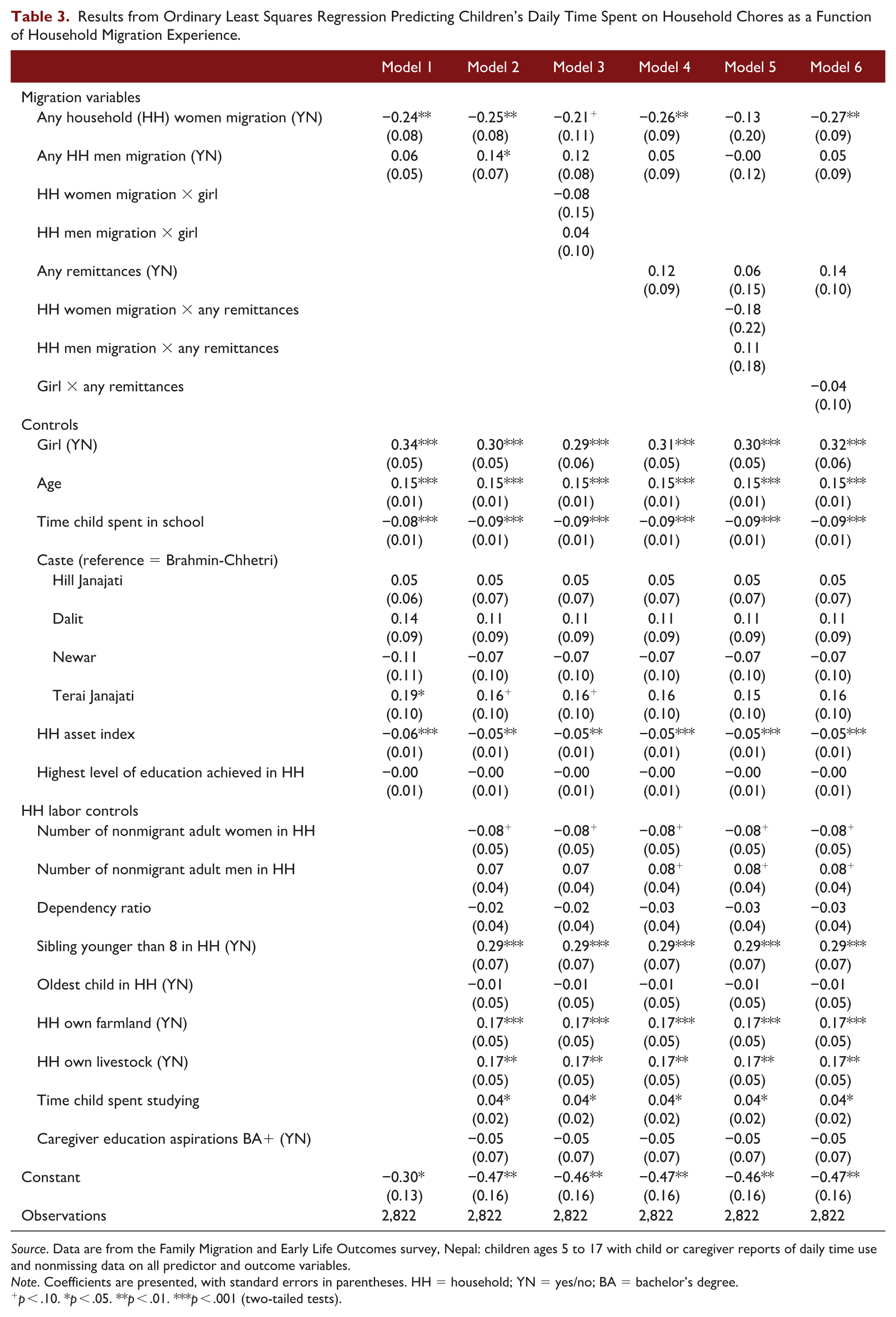
We ran six different models predicting time use in response to different types of migration. We first estimated a baseline model examining the association between the time spent on household labor and exposure to any current migration of men or women from the household controlling for basic socioeconomic and demographic measures (Model 1). Then, we estimated conditional models that controlled for household labor supply and demand (Model 2). We then reran the complete nested model with an interaction between the gender of the migrant in the household and the child’s gender (Model 3). Finally, we ran the complete nested models with a control for whether the household received any remittances (Models 4) and interacted receipt of remittances with the gender of the migrant (Model 5) and with the gender of the child (Model 6). Results are presented in Table 3.
Results from Ordinary Least Squares Regression Predicting Children’s Daily Time Spent on Household Chores as a Function of Household Migration Experience.
Source. Data are from the Family Migration and Early Life Outcomes survey, Nepal: children ages 5 to 17 with child or caregiver reports of daily time use and nonmissing data on all predictor and outcome variables.
Note. Coefficients are presented, with standard errors in parentheses. HH = household; YN = yes/no; BA = bachelor’s degree.
p < .10. *p < .05. **p < .01. ***p < .001 (two-tailed tests).
Results
Descriptive Results
On average, children in the sample spent about 1.4 hours a day on household-related tasks (Table 1). A little under half (46 percent) of the children had a family member currently away due to migration. Specifically, 8 percent of households had at least one female migrant, and 43 percent had at least one male migrant. In terms of remittances, 39 percent of all households reported receiving them. A breakdown of the proportion of migrant households receiving remittances is shown in Table 2.
For demographic and household variables, about half the children were boys and half girls, with an average age of 11.6 years. Children spent an average of 3.3 hours in school (5.9 hours among those attending school the previous day, not shown). By caste/ethnicity, 47 percent of children were from Brahmin-Chhetri households, 24 percent Hill Janajati, 11 percent Dalit, 4 percent Newar, and 12 percent Terai Janajati. The mean household asset index was near zero, reflecting standardization. The highest household education level averaged Grade 10/school-leaving certificate (16.4 years).
Households averaged 1.4 nonmigrant adult women and 1 nonmigrant adult man, with a mean dependency ratio of 0.86, indicating more working-age adults than dependents. One-quarter of children had a sibling under age 8, and around half of children were the oldest in their household. Sixty-eight percent of households owned farmland, and 58 percent owned livestock. Children studied for 1.7 hours outside of school on the previous day. Parents’ aspirations were high, with 78 percent desiring at least a bachelor’s degree for their children.
Table 2 shows characteristics by household migration. Average time spent on household labor was similar in nonmigrant and migrant households (1.38 vs. 1.42 hours), but children in households with female migrants spent less time (1.24 hours). Remittances were common but varied by migration type. Overall, 84 percent of migrant households received remittances, higher among male-migrant households (86 percent) and lower among female-migrant households (71 percent).
Demographic and household characteristics were broadly similar across groups. Girls made up 47 percent of children in all households, and mean age was about 11.6 years, although children in female-migrant households were slightly older (12.1 vs. 11.6 years). Caste distributions varied little by migration status. Resource levels diverged more clearly. Female-migrant households had the highest asset index (0.26) and education (19.1 years), while male-migrant households resembled nonmigrant households in both (–0.03 assets, 16.5 years education).
The average number of nonmigrant women in a household did not vary significantly across households; however, households with male migrants had half as many nonmigrant adult males in the household compared to households with no migrants or female migrants. Dependency ratios indicated more adults than children in nonmigrant and female-migrant households (<1) but the reverse in male-migrant households (>1). Female-migrant households were less likely to include a child under 8 (19 percent vs. 25 percent).
Farm ownership was slightly higher in female-migrant households (73 percent vs. 68 percent elsewhere), while livestock ownership did not vary substantially across other categories of household migration experience. Children in female-migrant households studied the most (2.0 hours), and parents expressed the highest aspirations (84 percent bachelor’s degree+) in female-migrant households (compared to 79 percent in male-migrant and 77 percent in nonmigrant households).
Overall, male-migrant households resembled nonmigrant households, while female-migrant households differed across multiple measures. This pattern is consistent with the prevalence of male migration in the study context, which likely makes it less selective than female migration, which is rarer and more distinctive. We control for these observable differences in multivariable analyses. Still, households with women migrants are likely selected on other characteristics as well, and it is not possible to rule out the possibility that distinctive patterns of child labor in female-migrant households are attributable to the selectivity of these households.
Multivariable Models
We considered the association between current migration of household members and time use for children in Nepal. Table 3 shows this association with two binary variables for any male migration and any female migration. The baseline model (Model 1) showed that children spent about 0.24 fewer hours (14 minutes) on household chores in households with female migrants compared with children in nonmigrant households. In the baseline model, the migration of men from the household was not significantly associated with children’s time spent on household tasks.
Adding measures of supply and demand for household labor did not attenuate the association between female migration and children’s time spent in household labor (Model 2). Meanwhile, the association for male migration shifted as children in households with a male migrant spent an additional 0.14 hours per day (8 minutes) on household chores.
In Model 3, we included interactions between the gender of the migrant and the child’s gender. Neither interaction term was statistically significant, indicating that the associations between migration and time use are broadly similar for boys and girls.
In the final set of models (Models 4–6), we incorporated remittances. Model 4 added remittances as a control and showed that the coefficient for male migration returned close to zero and was not statistically significant, consistent with the idea that remittances may compensate for household labor constraints associated with male migration. Female migration remained negatively associated with children’s household work, indicating that this relationship was not explained by household economic resources captured by remittance receipt. Models 5 and 6 directly tested whether migration effects vary by remittance receipt. These interaction terms were not statistically significant, providing little evidence that the association between migration and children’s household work was stronger in remittance-receiving households.
Across models, associations of control variables with household work were stable. As they were not our focus, we do not discuss them further.
Discussion and Conclusion
Our study builds upon the growing literature on the effect of migration on sending households by considering how the current absence of household members in Nepal is associated with children’s time use on household labor. Generally, we found that male migration was associated with children spending more time on household labor, when accounting for the supply and demand for labor in the household, although these findings were not robust when accounting for remittances. In contrast, children in households with female migration (many of which also had male migrants) spent less time on household labor compared to households with no female migration. Table 4 provides a summary of these findings, including specific hypotheses about mechanisms and processes.
Summary of Results.
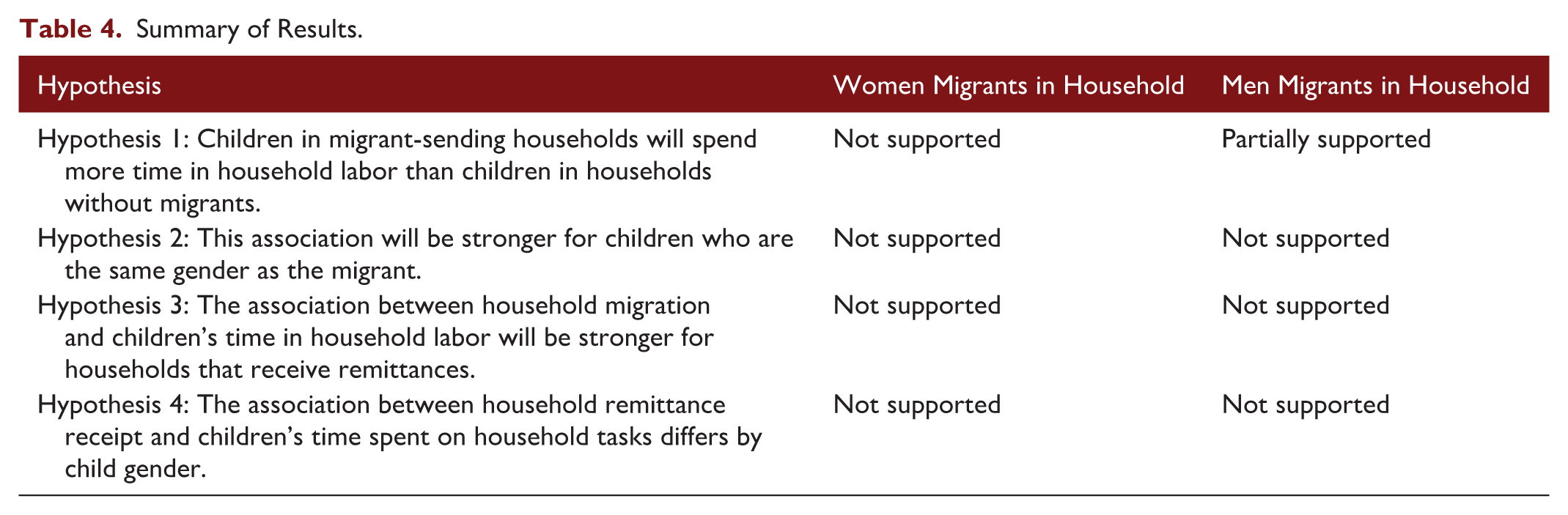
The magnitude of the differences for male migration was fairly small (around 8 minutes per day), but these small daily differences implied larger cumulative differences of about an hour per week. The association for female migration was double, with female migration associated with a smaller amount of time spent on chores by about 15 minutes a day, or nearly 2 hours over a week. Models testing for differences between boys and girls did not find a significant difference in the association between migration and time use. These findings provided mixed support for our hypotheses.
Our first hypothesis proposed that children in households with migrants spent more time on household labor than in households without migrants. Previous research points to parental absence leading to a reduction in instrumental support requiring children to supplement this loss (Antman 2012; Chang et al. 2011; Pörtner 2016). Our baseline model revealed directionally different outcomes. We found that in households with only male migrants when compared to households without migration, children spent more time on household chores, albeit this association was insignificant until we introduced controls for household labor supply and demand. While the association existed between male migrants and children’s household labor, its magnitude was small. This limited association was likely a result of the normative nature of male migration in Nepal such that male absence was less disruptive. Simultaneously, given that women do most productive labor in the household in Nepal, male absence created less of a gap and, in turn, required less of children’s time to make up for their absence.
Conversely, in households with female migrants, children spent less time on household chores, inconsistent with Hypothesis 1. Children spending less time on household chores may be positive as it could mean increased time for leisure or engagement in school. With more time for the development of human capital or social interactions and outlets, children may experience improvements in their well-being. However, the absence of a female household member may also be associated with a decline in oversight and discipline in the households. This lack of structure and support for adolescents may have negative implications on children’s well-being as less supervision and support for children may have negative impacts for children’s development and well-being (Dreby 2010; Parreñas 2005). We are not able to distinguish between these two processes using the existing data.
Future research could examine longer term outcomes for children’s schooling and socioemotional development in order to better understand how reduced time in household labor is related to other developmental outcomes. Unfortunately, due to sample size, we are not able to disaggregate the female migrant category by relationship to the child; it is possible that maternal absence has distinct implications for children’s time use or alternatively that the presence of other women in the household makes the relationship between the child and the departed woman less salient in the context of Nepal.
Lower levels of children’s time spent in housework with female migration may also be a function of selection as households with female migrants may place higher value on children’s schooling. The size and composition of our sample preclude fully testing this possibility. This prioritization of education may encourage women to leave in order to provide additional economic support for the children’s education. We partially address this possible mechanism by controlling for educational preferences and time spent studying, which does not change the association between female migration and children’s time use. Given that households with female migration typically also include male migrants and report higher levels of assets and education, the observed association may reflect not only women’s absence but also a more advantaged and distinctive household migration strategy. In turn, this may engender greater resources to buffer children from the negative effects, including increased workload, of migration. While speculative, these possibilities underscore that this article cannot fully mitigate the risk of selection and that results should be understood as interpretative rather than casual.
Nonetheless, there are many other factors that may drive this association as households with female migrants tend to report higher socioeconomic status; thus, unobserved factors may confound this association. For example, this change could be an artifact of different household strategies or configurations. Given that many of these households also contained male migrants, isolating the effect of solely female migration is not possible, and the association within this article may signal a specific household structure. In this sense, female migration can be interpreted less as an estimate of the independent effect of women’s migration but rather as an indicator of a distinctive household configuration in which migration, caregiving, and labor allocation are organized differently. Given the cross-sectional nature of the data, this is a limitation we cannot fully overcome, and further studies would benefit from testing these results across multiple waves of data.
The inclusion of an interaction between the gender of the migrant and child’s gender was not statistically significant, inconsistent with Hypothesis 2. Given the gendered nature of work in Nepal and several studies that point to a gendered impact of parental migration on children (Antman 2012), we expected that girls would shoulder a greater burden of work with the departure of family members. Across all models, we did not find a significant difference between the ways boys and girls adapt to migration, suggesting that while girls consistently engaged in more household labor, they did not pick up significantly more work than boys in a context of migration. The lack of a moderating effect of children’s gender seemed to underscore the importance of the gender of those who leave rather than the gender of who stays. It is also possible that girls and boys in migrant-sending households took on different types of tasks; given the structure of the data, we were not able to examine this variation across migrant and nonmigrant households.
Finally, we examined whether remittances were associated with children’s household labor. We hypothesized that remittances could increase the demand for children’s labor if invested in productive assets (Hypothesis 3) and that associations with remittance could differ by child gender (Hypothesis 4). In the models that included interactions between migrant’s gender and remittances, we found no evidence that remittance modified the association between the migration of female household members and children’s time in household tasks. This suggested that the association between female migration and children’s household labor may be linked more directly to the absence of women themselves rather than to shifts in the household’s financial status. When including remittances, the coefficient for male migration dropped close to zero and was statistically not significant. This change in magnitude likely reflected the strong correlation between male migration and the receipt of remittances, making it hard to disentangle their impact.
This study did have some limitations. Household decisions about migration are not random but are driven by household composition and preferences; thus, selectivity of migrant-sending households is always a potential confounder in studies of migration. Although we attempted to mitigate this by controlling for a wide range of observed characteristics, unmeasured confounders may still have biased our estimates. In addition, because the data were cross-sectional, we could not examine change over time; instead, our analyses captured a snapshot of current migration and household conditions. Even so, this snapshot was informative in the Nepali context, where large-scale labor migration has become widespread relatively recently. For adolescents in this study, they are growing up in a context much different than their parents, where parental migration is both normal and pervasive, offering a view into a distinctive stage in the expansion and consolidation of Nepal’s migration system.
Furthermore, we focused on a single element of time use, children’s time in household labor. Migration of household members may also be associated with children’s leisure time, time spent in schooling, and other activities, all of which may also have implications for children’s well-being. However, given that the data only ask about leisure time related to technology use and not about time spent with friends, we decided to focus specifically on household chores time use in this article. A related limitation concerns the specificity of our household labor measure. As the measure aggregates time across diverse household tasks, the analysis cannot determine whether migration alters the composition of children’s labor, such as shifting time between caregiving, domestic work, and more physically demanding manual tasks, potentially masking meaningful variation in the physical burden, social meaning, and gendered character of different tasks.
The time use measure itself introduces additional limitations related to both reporting source and age variation. Children ages 10 and under have their time use reported by a caregiver, while older children self-report, creating the potential for discrepancies between reported and actual time spent on tasks and potentially creating measurement bias across age groups. That said, the structure of the survey question that prompts respondents to first list the tasks they (or the child) engage in before estimating total time is designed to reduce some of this reporting bias. In a similar vein, the tasks that younger and older children participate in differ meaningfully in their nature, and migration may affect these age groups differently. This heterogeneity is partially obscured when treating them as a single group, although controls for age and sibship help account for some of this variation.
Finally, in this study, we focused on the gender of the migrant and found variation in how men’s and women’s migration is related to children’s time use. However, because of relatively small sample sizes for female migration, we were unable to test for differences according to the relationship with the migrant, for example, differences in how children experience migration of mothers versus aunts, older sisters, or other female relatives. Future research with larger female migrant populations could help better understand how relationships moderate the relationships between migration and children’s time use.
This study provides insight into an important aspect of migration by focusing on how it is associated with children’s time use for household chores and is one of the first articles to consider the relationship of gendered migration with children’s household chores outside of the migration contexts with a long history of migration, shedding light onto ways children adapt to potentially more disruptive and temporary migration patterns. We found there were clear gender differences depending on whether men or women leave that work in opposite directions, whereas these associations did not vary significantly based upon the gender of the child. Our results underscored the importance of considering both the gender of the migrant and the migration of all household members rather than only the parent-child dyad. Future scholarship on how nonmigrant children experience migration of household members should consider the migration of all household family members rather than focusing specifically on the parents as many households, particularly in LMICs, are extended households and may view the migration of all family members as part of a larger household strategy (Stark and Bloom 1985). Additionally, this study points to a potentially latent impact as a growing contingency of female migrants in Nepal, and globally, may mean less supervision and support for children. Previous research has identified potentially negative emotional and social implications of women’s migration; fully examining these processes is beyond the scope of this article but may be a part of a larger conversation of what the feminization of migration means for children in the sending context (Dreby 2010; Parreñas 2005).
Supplemental Material
sj-docx-1-srd-10.1177_23780231261459562 – Supplemental material for Redefining Roles: Household Migration and Childhood Labor
Supplemental material, sj-docx-1-srd-10.1177_23780231261459562 for Redefining Roles: Household Migration and Childhood Labor by Emma Labovitz and Sarah Hayford in Socius
Footnotes

Funding
The authors disclosed receipt of the following financial support for the research, authorship, and/or publication of this article: This research was supported in part by grants from the Eunice Kennedy Shriver National Institute of Child Health and Human Development (NICHD) to the Population Research Institute at the Pennsylvania State University (P2CHD041025 and T32HD007514). Hayford acknowledges additional support from NICHD via The Ohio State University’s Institute for Population Research (P2C-HD058484).
Declaration of Conflicting Interests
The authors declared no potential conflicts of interest with respect to the research, authorship, and/or publication of this article.
Data Availability Statement
The data that support the findings of this study are in preparation for submission to the Data Sharing for Demographic Research repository or available from the corresponding author upon reasonable request.
Supplemental Material
Supplemental material for this article is available online.
Author Biographies
References
Supplementary Material
Please find the following supplemental material available below.
For Open Access articles published under a Creative Commons License, all supplemental material carries the same license as the article it is associated with.
For non-Open Access articles published, all supplemental material carries a non-exclusive license, and permission requests for re-use of supplemental material or any part of supplemental material shall be sent directly to the copyright owner as specified in the copyright notice associated with the article.
