







Abstract
This article introduces an exercise that helps students make connections among course content, social capital, and career aspirations. It puts the student in the role of a qualitative researcher planning for, conducting, and sharing an interview designed to explore the contemporaneous experience of a working professional with whom the student is already acquainted. Developed for a sociology class, I have translated and regularly used it in a business law and ethics class. Likewise, it is suitable for use in most management and entrepreneurship classes. I aim for students to (1) learn and practice the courtesies of business communication, (2) observe the prevalence of issues studied in relation to those encountered by working professionals, (3) appreciate the relevance of what they have studied throughout the course in context, (4) learn to recognize and build on their social capital, and (5) acquire and construct knowledge by sharing and comparing experiences.
Keywords
It is disconcerting that the popular media and our students are questioning, more than ever, the value and relevance of a university education. (Zernike, 2009) According to a survey of college students at Kansas State, only 26% think that assigned readings are relevant to their life (Wesch, 2010). Thus, it is important to identify or create highly involving, relevant, and significant leaning experiences that help students make that connection to both their own lives and the work they aspire to take up after graduation. This article introduces an assignment and exercise (“Exercise”) that puts the student in the role of a qualitative researcher who will
identify a person who works full-time in the workplace to interview;
contact that person to arrange for the interview, confirm the details, and prepare written questions in advance in writing;
conduct a 30-minute interview exploring (1) the subject’s position, background, and career trajectory; (2) examples of how the law, ethics, or corporate social responsibility influences the subject’s work and life, as well as the laws or ethical codes or rules the individual and company are required to know and abide by; and (3) instances of failure to abide by those prescripts the subject has encountered or observed, including any associated consequences;
prepare a short written factual summary of the interview;
prepare a short reflective analysis connecting the interview to course content; and
verbally share their experience and reflection in class.
Through the Exercise, I aim for students to
learn and practice courtesies of written and verbal business communications,
observe the importance and variety of issues studied in relation to those encountered by working professionals,
appreciate the relevance and importance of what the material studied means in context,
learn to recognize, care for and build on their own social capital, and
acquire and construct knowledge by sharing and comparing experiences.
Theoretical Orientation
Inspired by my work as a sociologist with interviews as a qualitative research tool, I sought to design an exercise for students to experience the power of the interview for constructing knowledge and making connections with course content (Somers, 1994) and the value of connecting with, and exploring their own social capital (Jones, 2011) in anticipation of a search for professional employment. Putnam (1995) describes the concept of social capital concisely when he says, “Social networks provide the channel through which we recruit one another for good deeds, and social networks foster norms of reciprocity that encourage attention to others’ welfare” (p. 67). Social capital is accessed for both instrumental and expressive purposes. One accesses social capital for instrumental purposes when we want that contact to help us achieve something. One accesses social capital for expressive purposes out of a desire to care for and preserve the relationship, that is, to demonstrate it has value (Lin, Cook, & Burt, 2001).
Qualitative interviews are a particularly powerful tool for assessing process, the meaning associated with work, and the resources employed to accomplish the work: information that is hard to appreciate as a passive learner, difficult to get at using quantitative methods, and virtually impossible to obtain in a constructed social laboratory such as the classroom. Management educators have recommended using interviews for many purposes and have conveyed excellent guidance on structuring interviews to achieve one’s intended purpose (Whetten & Cameron, 2002). Because an individual’s connection to work (and, as used in the business law and ethics classroom, the confluence of the law and ethics with work) is a dynamic process most often communicated through storytelling, a qualitative approach is most likely to get at the essence of experience, one that many students have not yet had personally. Interviews are particularly well suited to enabling the researcher (and here students through sharing) to compare and contrast reported experiences of persons employed in different capacities, with different levels of experience, and on different career trajectories) that are dynamic and evolving in order to understand how they attribute meaning/importance to the experience (Kvale, 1996).
I have used this Exercise in over 20 sections of undergraduate courses to over 450 students from freshman to senior status in both business law and introductory sociology courses. Students respond to the reality, nearness, authenticity, and relevance of the exercise, as well as the personal responsibility associated with it. Based on self-reports contained within the students’ written assignment, for many (and for some of the persons they interviewed) it has proven to be a profound, life-altering experience. As an illustration, one student thanked me for making this assignment because she understood for the first time what “my father did for a living” and occasioned the first “real adult conversation” between them. A father who lost his daughter to death in an automobile accident just months after she conducted his interview reached out to share that the interview was a lasting memory of his daughter and testimony to who she was becoming, the respect she had for him, and their discovery of a shared passion for marketing about which they spoke for the first time during the interview.
The Exercise
As their final project for a survey class in the legal and ethical environment of business, I ask students to approach a working professional to seek an interview about how law and ethics influences his or her work life. I position the Exercise toward the end of the term because students then should have both the content knowledge and vocabulary needed for an effective interview.
Objectives
The objectives are for students to learn and practice the courtesies of business communications; observe the prevalence of legal and ethical issues in professional careers; appreciate the relevance and importance of what they have studied in context; recognize, care for, and build social capital and think about it as a resource as they pursue a career; and acquire and construct knowledge through reporting the shared experience.
Observing Professional Courtesies
In preparation for the interview, I educate students about the importance of observing and practicing professional courtesies: confirming the time and date for the interview in writing, preparing questions in advance that probe for meaning at different levels (Lofland, 1971, as detailed below), taking notes during the interview, and thanking the interview subject in writing. Students may conduct interviews by phone if necessary, but not through e-mail exchange or texting, being counseled that important nonverbal communications will be missed or obscured using those means.
Choosing a Subject
Students are counseled not to look far for choosing a full-time working professional to interview. I make it clear that they will not be rewarded for the big interview. Thus, they should not aspire to land the interview of Pope Francis, Oprah Winfrey, or Warren Buffet. Rather, I encourage them to interview those close at hand, for example, parents, siblings, extended family, neighbors, recently graduated friends, managers at their internships or jobs, and so on. I explain that these are the relationships that constitute a student’s own social capital. The idea is to learn from persons with whom the students already have at least a nominal relationship with the benefit of having the opportunity to identify and build on their own social capital. I have encouraged foreign students who express difficulty with finding an interview subject to seek out staff or professors at the university. In response, they have interviewed career services staff, librarians, and professors. Because I have used this most recently in a business law and ethics class, I actively discourage students from interviewing lawyers since one of the objectives is to demonstrate the prevalence of ethical and legal issues in the work lives of all professionals. In over 450 student-conducted interviews, fewer than 10 are of lawyers.
Preparing for the Interview
I ask students to design their interviews to probe for information at the six levels suggested by Lofland (1971): (1) acts, (2) activities, (3) meanings, (4) participation, (5) relationships, and (6) settings in order to identify what the respondent thinks about as he or she is engaged in the process (meaning), feels about his or her work, is doing (both individually and with others), as well as how and where the work is accomplished. By probing at these levels, students learn, for example, that professionals interface with laws and ethics because it is necessary to do their jobs to avoid personal and corporate liability, out of a personal sense that ethics is important; because their companies or professional certifying bodies require training and assessment, or because it affects their job performance evaluation. Likewise they learn that issues arise frequently, often require the assistance of, or conflict with, others to resolve and affect the respondent’s sense of self both in and outside of the workplace.
Documenting the Interview
Admonishing students that memories are faulty and critical information may be lost, I insist students take contemporaneous notes and prepare a short narrative summary of the interview. I choose this length so that students will practice short, direct meaningful writing such as that they might be asked to produce in the workplace. I emphasize that spelling and grammar count and permit them to have someone proofread their papers to help identify errors to be corrected. I explain that one’s written work will make an impression much like donning appropriate professional attire.
Reflecting on the Interview
Students are asked to prepare a short reflection that connects the interview to the subject matter of our class. I give students wide latitude, but they must indicate the connection with a text page reference and include information corresponding to the different levels identified by Lofland (1971). The appendix includes the one-page instructions as well as the grading rubric for the assignment.
Sharing the Interview
Finally, I ask students to verbally share their interviews in class and entertain questions from both the class and instructor. Students informally share their interview by introducing the person, their position, their relationship to the student, and their “biggest takeaway” related to both the class and their career aspirations. As students share, others comment about similar experiences or impressions, ask questions, gather information, and recognize possible resources relevant to their own anticipated careers. The instructor may wish to suggest additional connections to the course that students may have missed or chosen not to speak about and to emphasize emergent themes. As students express similar observations, they become aware of the prevalence of these issues, the circumstances under which they arise, and how often they occur—all in very different work domain. Students are impressed by the continuous effort required for employees to become knowledgeable about the law and ethical requirements in order to be compliant.
Translating the Exercise: Suitability for Other Classes
While discussed here in the context of a business law class, this Exercise is suitable for use in other classes. For example, in the sociology class, students were asked to interview a nonprofit volunteer about his or her work, the motivation for it, and the social problem it addresses. In the organizational behavior class, the interview could be about the subject’s experience with assembling or managing a team. In the power and influence class, students could inquire about a time when the respondent wielded (or was subject to) power or influence. In the human resources class, students could inquire about experience of giving (or receiving) a performance review. In the negotiations class, the subject could be a difficult negotiation, associated emotions, and lessons learned.
Conclusion
This Exercise employs the qualitative interview as a vehicle for students to recognize, approach, and build on their own relationships as sources of social capital while gaining and sharing knowledge about how professional identify, encounter, and handle legal and ethical issues in the workplace. While described here in connection with a law and ethics class, it is an exercise that can be translated for use in other management and entrepreneurial courses. By encouraging students to make connections among the course material, the student’s own life and relationships as well as their professional aspirations in an active and engaged way, this concluding Exercise has the potential to serve as a significant, integrative, and lasting learning experience.
Footnotes
Appendix A
Appendix B
Assignment Rubric.
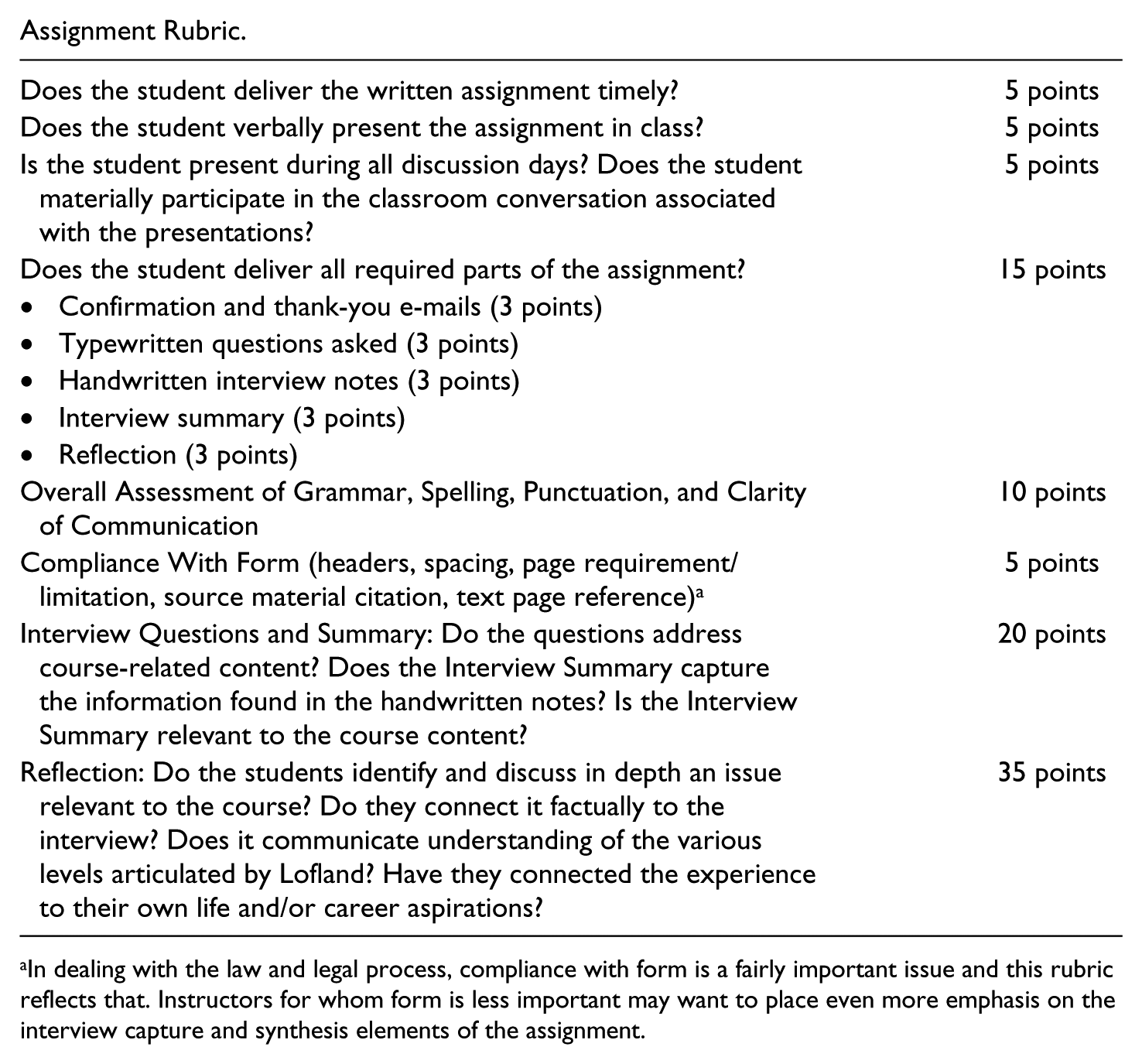
| Does the student deliver the written assignment timely? | 5 points |
| Does the student verbally present the assignment in class? | 5 points |
| Is the student present during all discussion days? Does the student materially participate in the classroom conversation associated with the presentations? | 5 points |
| Does the student deliver all required parts of the assignment? | 15 points |
| • Confirmation and thank-you e-mails (3 points) | |
| • Typewritten questions asked (3 points) | |
| • Handwritten interview notes (3 points) | |
| • Interview summary (3 points) | |
| • Reflection (3 points) | |
| Overall Assessment of Grammar, Spelling, Punctuation, and Clarity of Communication | 10 points |
| Compliance With Form (headers, spacing, page requirement/limitation, source material citation, text page reference) a | 5 points |
| Interview Questions and Summary: Do the questions address course-related content? Does the Interview Summary capture the information found in the handwritten notes? Is the Interview Summary relevant to the course content? | 20 points |
| Reflection: Do the students identify and discuss in depth an issue relevant to the course? Do they connect it factually to the interview? Does it communicate understanding of the various levels articulated by Lofland? Have they connected the experience to their own life and/or career aspirations? | 35 points |
In dealing with the law and legal process, compliance with form is a fairly important issue and this rubric reflects that. Instructors for whom form is less important may want to place even more emphasis on the interview capture and synthesis elements of the assignment.
Acknowledgements
The author recognizes her La Salle University colleagues, Drs. Joseph Seltzer and Steven Meisel, for their guidance and editorial assistance in the production of this article. She appreciates the work of Drs. Kathy Lund-Dean and Jeanie Forray, coeditors of Management Teaching Review, and the suggestions of the anonymous peer reviewers that helped shape and ready this article for publication.
Declaration of Conflicting Interests
The author(s) declared no potential conflicts of interest with respect to the research, authorship, and/or publication of this article.
Funding
The author(s) received no financial support for the research, authorship, and/or publication of this article.