







Abstract
Engaging undergraduate students in internalizing motivation theories is challenging. They live the concepts but have trouble applying their experiences to understanding the dynamics of motivation theories or deriving practical value from applying the theories to case analysis. We have adapted a human-centered design tool for an exercise that facilities personalizing an experience and then applying motivation concepts. We titled it delight/frustration letter and have used the activity in 17 sections of organizational behavior and leadership courses. The affective nature of the letters helps students understand the dynamics of motivation theories and the impact of motivation on attitudes, actions, and engagement.
We have taught motivation as a core component of undergraduate organizational behavior and leadership courses. Our pedagogical experiences reinforce our belief that, while motivating employees is critical for leaders, students have difficulty in understanding the complexity of motivation and its theoretical relevance and applying the theories to traditional case analysis.
Theories of motivation help to explain why people choose to engage in behaviors based on needs (e.g., Maslow, Alderfer, and McClelland), how people assign motivation to others (attribution), whether people are motivated intrinsically or extrinsically, the cause and effect relationship between emotions and motivation, the cognitive comparisons people make (expectancy), and the cognitive processes in which people engage (equity). Ultimately it is important to understand how the motivation theories work together to give an overall understanding of why people do what they do. Related to work, motivation concepts focus on understanding and structuring the environment to encourage productive engagement and discourage actions that are not proactive (Jex & Britt, 2008). Motivation is also important for understanding employees’ willingness to engage in the collaborative functions of work: teams, change, creativity, and innovation—with a central focus of understanding the role of intrinsic motivation (Anderson, Murphy, & Borsch, 2016; Grant, 2011; Krippendorff, 2004).
The scope of motivation theories and the application of the theories is complex. Frequently students share that theories are just academic and not relevant to their career plans, and they challenge having to learn about the theories. Sharing real-life examples about motivation in organizations helps students see some relevance, but that has not been sufficient to result in students accepting the importance of motivation. Using multiple methods have not resulted in students gaining the skill to apply motivation theories to real-life situations.
Given the unsatisfactory learning dynamics taking place in our classes, we explored nontraditional tools to engage students in understanding the experience of motivation before linking to the academic theories of motivation. We chose to use design methodologies to craft new learning experiences.
The Intersection of Design and Motivation
We drew from the human-centered design (HCD) perspective to develop the learning experience. At its core, HCD requires thinking about the experiences of the people in the situation and their real-world experiences with products and services (Battarbee, Suri, & Howard, n.d.; Giacomin, 2014). It requires developing empathy with others; understanding their needs (Allworth, 2012; Dam & Siang, 2017), acknowledging the importance of behavior, emotions, and the environmental context (Brown, 2009); and understanding our own selves (Selzer, 2015).
Today the dynamics of HCD have moved beyond products and services and are used by organizations to evaluate, visualize, and improve the experiences of people within organizations (Bersin, Solow, & Wakefield, 2016; Glen, Suciu, & Baughn, 2014; Kolki, 2015). By using HCD, leaders have fostered an engaged workplace where employees feel comfortable sharing, taking risks, and being energized to come into work each day (Big Think, n.d.; Lyons, 2016). This shift aligns well with the thinking required to shape motivation in the workplace since the concepts presented in organizational behavior and leadership textbooks relate to interactions that impact experiences: perception, the attitude–behavior relationship, team engagement, conflict, power and politics, and the impact of change. The combination of experiences can produce a sense of flow in a person—when one’s whole being is involved in an activity (Csikszentmihalyi, Abuhamdeh, & Nakamura, 2005). The experiences that employees have help determine how motivated a person will be.
HCD utilizes methodologies (tools) to interact with people to understand the meanings they give to experiences and their needs both present and anticipated (Giacomin, 2014).
In reviewing design tools, we looked for those that would foster conversations around defining parameters, synthesizing, and analysis/course correction. We chose to modify a tool called the love letter and the breakup letter. Martin and Hanington (2012) write that this tool “allows people to express their sentiments about a product or service using a medium and a format that are immediately understood” (p. 114). This creative indirect method provides insight into people’s perceptions, feelings, and interactions (Santee, 2014).
Learning Objectives
Learning objectives for this activity include
Analyzing motivation theories to explain how personal experiences can be motivating or demotivating.
Assessing the meaning of experiences and how those meanings shape motivation.
Evaluating the power of emotion in shaping the perception of experiences.
Instructions for Running the Exercise and Debriefing
We modified the instructions for the love letter and break up letter and named it a delight/frustration letter. Students write a delight/frustration letter to an experience where they were either motivated or not motivated. Students are to choose an experience where they were delighted or frustrated and then write a letter, using first person, to that experience. A delight letter would be written when they experienced magical moments and were excited and motivated through the experience; a frustration letter would be written when they were upset and unmotivated throughout the experience.
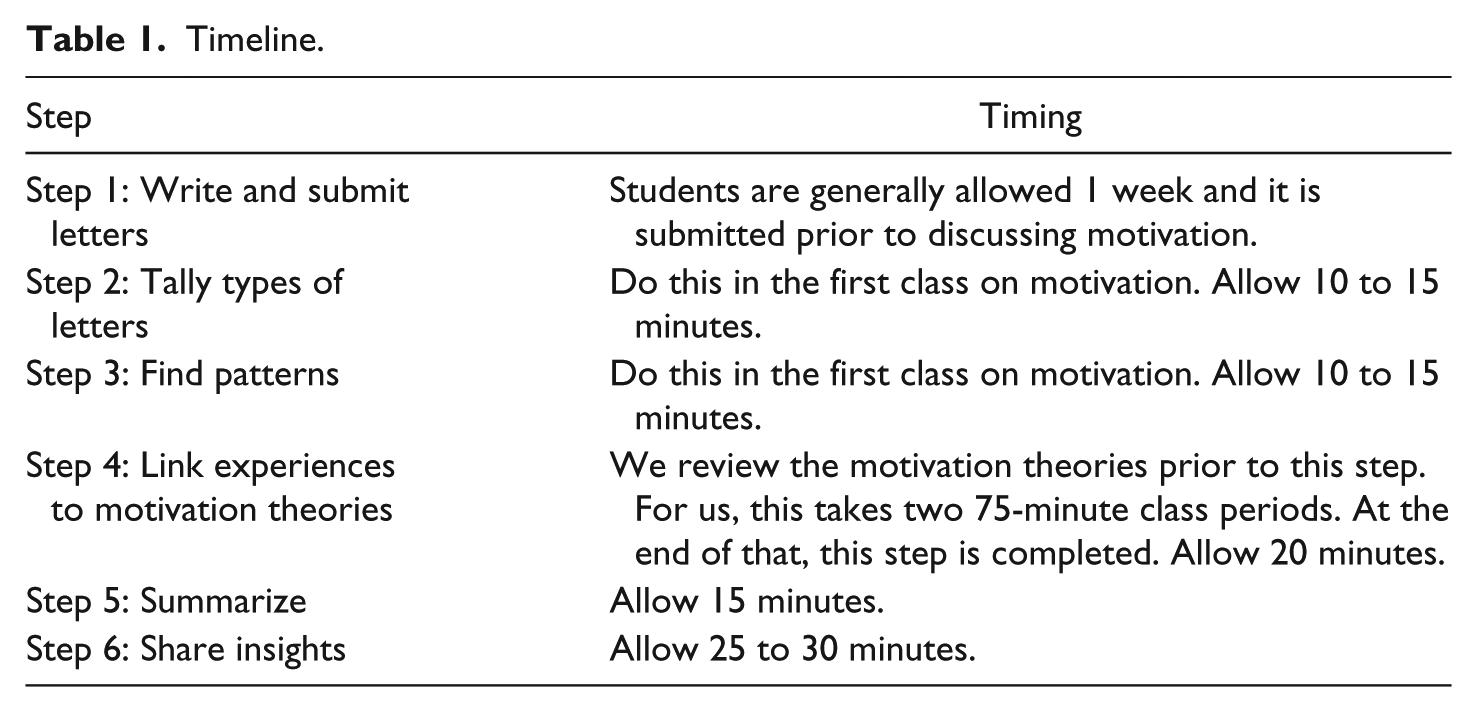
After the students write and submit their letter outside of class time (Step 1), the activity is conducted over two class sessions, one at the beginning of the motivation module and one at the end of the motivation module. Table 1 provides a timeline for this activity.
Timeline.
Step 1: Write and Submit Letters
Students write their letters prior to any discussion on motivation according to the guidelines in Appendix A. Excerpts from student letters are in Appendix B. We emphasize that they are to think about an experience that resulted in a sense of delight or of frustration. We ask them to select one experience that had a significant or on-going impact and write a letter to that experience. The letter can be addressed to a situation, organization, or an individual. Examples of possible experiences include writing to a situation they experienced in a company they work for, something that happened during an internship experience, or something from their personal life. We stress that they are not to overthink the content, and they should use a first-person, conversational style of writing. Their letter needs to be sufficiently detailed to capture their thoughts and feelings but not so long that it becomes academic. We have found that one to two single-spaced pages is a good length.
The students submit their letters electronically. This is an out-of-class assignment due 1 week after being requested. We do not grade the letters for content but do assign points for submission and how well their letter illustrates the focus of the design methodology, for example, writing it in first person, writing it to the experience, and providing a clear description about why they were delighted or frustrated. Students are informed the letters will be used for an in-class activity for the motivation module.
Step 2: Tally the Types of Letter
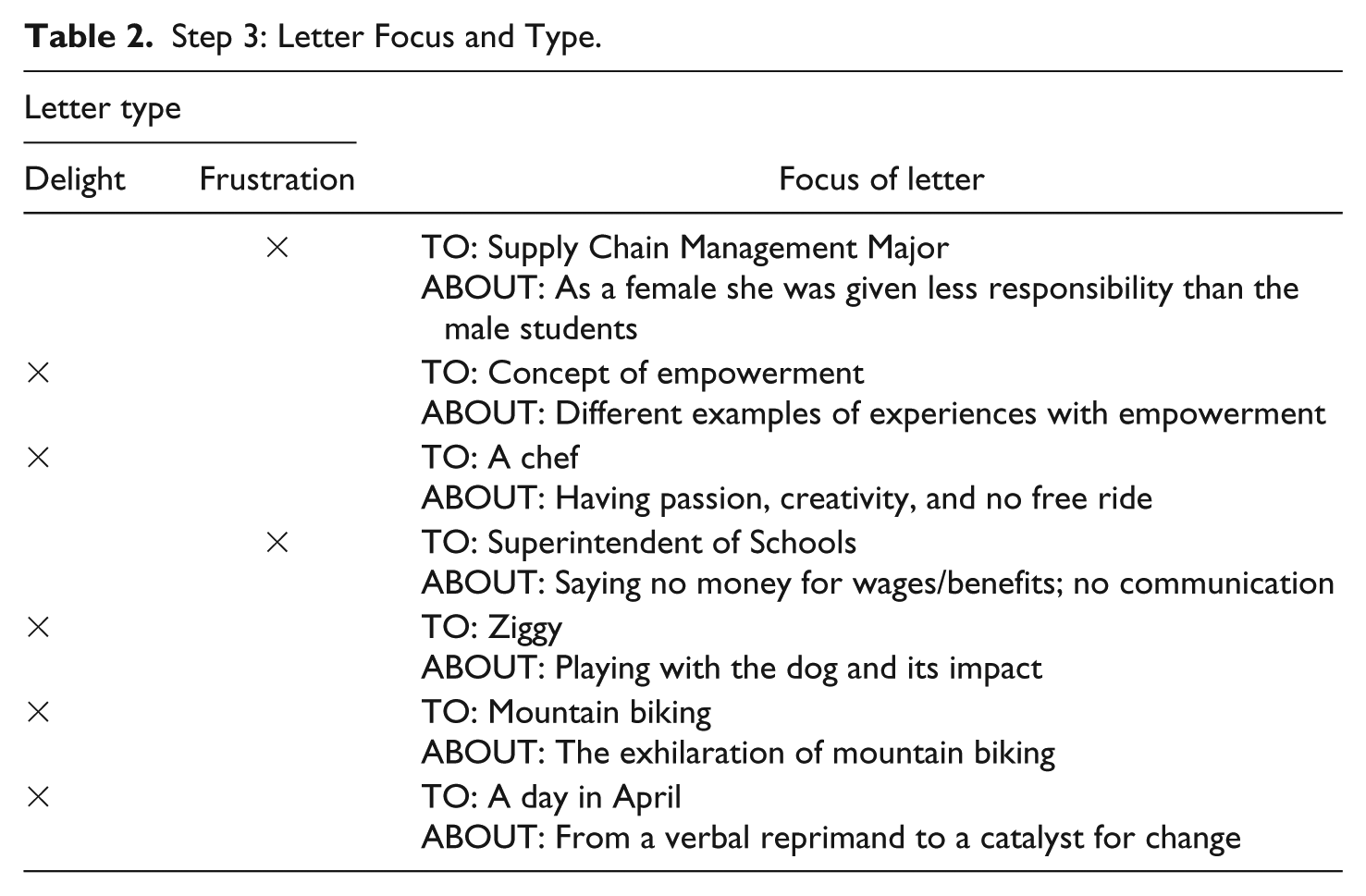
Ask students to identify whether they wrote a delight or a frustration letter. Tally the responses and share the results. Then ask the students to share the focus of their letter: a vacation, a work situation/person, a pet, a hobby, and so on. List the different experiences on the board and indicate the appropriate letter type (see Table 2).
Step 3: Letter Focus and Type.
Step 3: Find Patterns
Ask the students to quickly list what they see as common among the experiences, for example, a feeling of accomplishment or disappointment at promises not kept.
Step 4: Link Experiences to Motivation Theories
Present the individual motivation theories; if you use an integrated model of motivation such as Integrating Contemporary Theories of Motivation (Robbins & Judge, 2015), present that as well. We spend two class sessions on discussing the motivation theories. We focus on McClelland’s theory of needs, and theories of self-determination, self-efficacy, reinforcement, equity, and expectancy. However, the letters work with any of the motivation theories presented in typical organizational behavior and leadership textbooks.
Students then form groups of four to five and share with each other how their experience illustrates motivation theories. We let the letters drive the discussion. For example, what were the rewards and resulting valence, how much effort did they exert, and what was the instrumentality? We talk with each group and join the conversations as needed.
Step 5: Summarize
Students summarize and submit their insights to the course management system discussion board. To help the students organize their insights, an electronic form or a bulleted narrative can be used.
Step 6: Share Insights
Once their insights are posted to the discussion board, have students share their insights aloud. A variation could be asking the groups to make a presentation in front of the class, but that would take an additional class session.
Debriefing Results
The activity has been used in 17 sections of undergraduate leadership and organizational behavior courses. Table 3 summarizes the tallies of types of letters generated across those 17 sections. In class, when we tally the results of Step 2, we find that the percentages of delight/frustration letters are similar to the results across the 17 sections, and the difference between sections is within 7%.
Breakdown of Delight/Frustration Letters in 17 Sections.
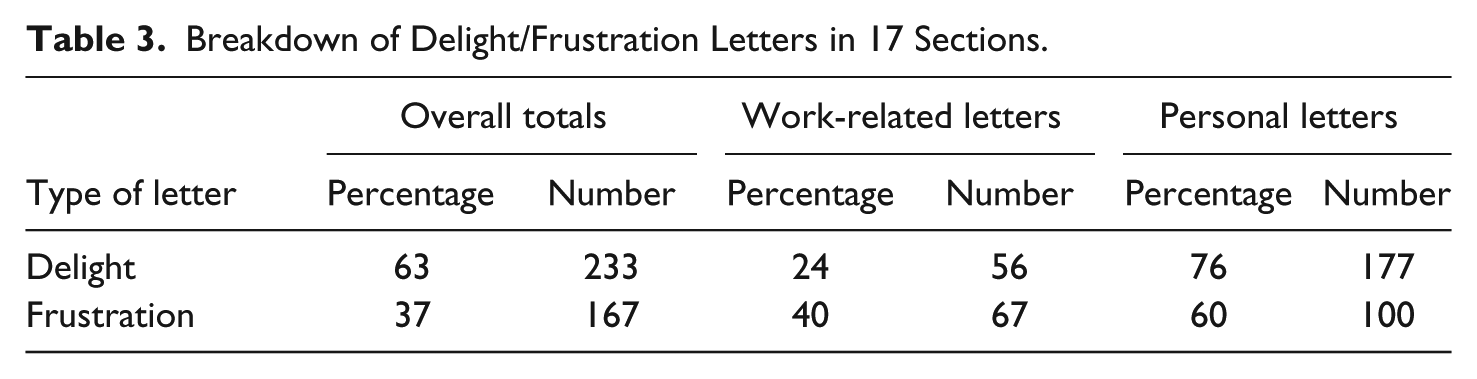
The low percentage of delight experiences at work is frequently noted by students and serves as a discussion point about how to create work experiences that produce delight. Insights gained from the delight/frustration letter activity commonly include:
Frustration at work focuses on a person, while delight at work focuses on opportunities and having a sense of control over the outcome.
Affect has a strong impact. This was true for both types of letters, but for work frustration letters, negative feelings dominate even if the tangible outcome was positive.
Delight is related to being so focused that the writer loses track of time. This was true in situations ranging from taking care of patients, running with a dog, to working in one’s butterfly garden. This finding led to discussions on flow and its impact on motivation.
The level of motivation changes, and a small action can cause a big change. Work frustration can be caused by something as simple as not following through on a promised $15 gift card. Moving from frustration to delight can be as simple as realizing that meeting a new and unwelcomed challenge produces value for the student.
No one is passive in the situation; the dynamics of the components make the experience good or bad.
We found that the letter activity has affected how students think about motivation. With this activity, theories of motivation are viewed less as something to memorize and more as dynamics that one can influence through one’s actions. When students are working with cases, leadership conversations are more grounded in thinking about the impact of the leader on others and an awareness of how the actions of followers influence the actions of leaders. When developing recommendations, students are more focused on the future rather than remediating the past.
Focusing on the dynamics/process of motivation and an integrated model of motivation allows us to emphasize the importance of the affective component of attitudes in students’ understanding of their own motivation and how their actions shape the motivation of others. We have asked students to draw on the insights gained in the delight/frustration activity to see the importance of motivation to other leadership and organizational behavior theories, including how understanding motivation helps:
Explain the impact of emotions on behavior.
Foster creativity in decision making.
Shape effective power dynamics in an organization.
Structure conflict resolution approaches that foster collaboration not alienation.
Create organizational structures that foster positive experiences.
Increase the use of leadership styles that foster engagement, empowerment, and innovation.
Create an environment where people know that it is acceptable to take risks and to welcome change.
The delight/frustration activity has provided students with a personal connection to motivation theories. Throughout the 17 sections, students have been able to identify the emotions involved in motivation and have increased their ability to empathize with others.
Footnotes
Appendix A
Appendix B
Declaration of Conflicting Interests
The authors declared no potential conflicts of interest with respect to the research, authorship, and/or publication of this article.
Funding
The authors received no financial support for the research, authorship, and/or publication of this article.
