







Abstract
Storytelling is an important skill in management education for leaders. However, even though students learn about storytelling, they do not often practice it. When students do practice storytelling, they frequently prepare speeches that they deliver in front of a class. Interacting with theater students can help management students convey a message in conversational format, which is more representative of the skill in practice. We present an experiential exercise involving collaboration between management and theater students that simulates a career networking event; the format of interactive drama offers a structured process for student engagement and leadership storytelling skill development.
The importance of storytelling as a skill for leaders is well documented (Anthony & Schwartz, 2017; Mahoney, 2017; Salicru, 2018). Storytelling helps leaders articulate their personal brand, reflect on past experiences, convey their values, and explain who they are as a leader (Denning, 2005, 2006; Gray, 2007; Kayes, 2007; Peterson, 2017). Storytelling is also important in enlivening a presentation to communicate goals or lead change efforts, and because of this, employers report the desire to hire students who have these storytelling communication skills (Baldoni, 2003; Ritter, Small, Mortimer, & Doll, 2018).
However, in the management education classroom, instructors often find that exercises to practice leadership storytelling are limited (Cleverley-Thompson, 2018). The lack of practice may result in leaders being less effective at employing storytelling skills in motivating others, building trust, or leveraging influence (Auvinen, Aaltio, & Blomqvist, 2013). Thus, we introduce an exercise in leadership storytelling that has helped our students think about, write, and practice storytelling in a unique setting. The exercise helps students practice leadership storytelling skills in a simulated career networking environment that involves theater students who are trained to act as “employers.” Instructors can adopt this experiential exercise to encourage student leadership storytelling skill development.
Theoretical Foundation
Experiential learning theory offers a process to improve student mastery of concepts and improve the overall learning process (Dewey, 1933, 1938; Kolb & Kolb, 2017). The four-phase cycle of learning in experiential learning theory involves students (1) taking in an experience, (2) reflecting on it, (3) making meaning of it through thinking, and (4) testing it out through action. The arts have often led in experiential techniques, as arts educators have sought to provide a learning space for experiencing, reflecting, thinking, and taking action (Lachapelle, 1997). Arts-based learning approaches can begin to resolve the tension in management education between prioritizing textual learning over skill development (Nissley, 2010). As Kolb and Kolb (2005) described, arts education integrates theory and practice into the learning process through the practice of student skills. The arts, and in particular theater, can replicate the complexities and ambiguities that are persistent in day-to-day work lives in a way that provides a useful context for skill development.
Drama techniques used in the management classroom include role-plays, improvisational theater techniques, film, and speeches (Sutherland, 2013; Urick & Sprinkle, 2019). Interactive drama is a particular theater method that involves live actors performing a scene where they interact with audience members (Boggs, Mickel, & Holtom, 2007; Steed, 2005). In a management classroom, interactive drama allows students to interact with actors in a context similar to a practice-based setting. This is different from a role-play exercise in that it involves live actors, whereas role-plays involve other management students who may not have the same level of acting skills.
Actors can be hired from professional acting companies or can be theater students. We prefer theater students because they are an important part of the university community, and as a university with considerable budget constraints, we do not have funding to hire professional acting companies. Plus the experience of interactive drama with management students provides a learning experience that theater students can draw on to further their career development. Interactive drama as a method in experiential education provides the rich context that is necessary for leadership skills practice (Boggs et al., 2007).
Experiential educators “teach around the learning cycle” by leading students through all four learning phases—experiencing, reflecting, thinking, and acting (Kolb, 2015). For this reason, the leadership storytelling exercise described in the next section involves interactive drama and is designed to create a learning space for management and theater students. Management students move through the experiential learning cycle by taking a personal experience they have had, reflecting on it, making meaning out of it by writing a story, and then taking action by telling the story in a workplace setting created by the theater students. Denning (2005) provided a variety of categories of stories for educators to facilitate; we describe one of these categories in the exercise, but many other types can be selected at the discretion of the instructor.
Learning Objectives for the Experiential Exercise
We assign a story that transmits a leadership value (see Denning, 2005) and let the management students select the specific experience they wish to describe. After completing this experiential exercise, management students will be able to:
Create a personal story that connects personal experience with one or more management course concepts
Articulate a personal leadership story that conveys an individual value
Practice communicating in a simulated workplace environment
Explain how to improve an interpersonal interaction
Theater students’ learning objectives are included in Appendix A.
Instructions for Running the Exercise
The exercise is run during two 90-minute consecutive class periods. The first class meeting (described as Day 1) involves warm-up activities. Boje, Rosile, Saylors, and Saylors (2015) discussed the importance of a warm-up when utilizing theater techniques in leadership development, as well as modeling and giving feedback on stagecraft. Day 1 activities (outlined in Appendix B) allow for instructor modeling of voice projection, eye contact, physical stance, and other theater techniques that may be unfamiliar to participants. The second class meeting (Day 2) consists of the leadership storytelling networking event, which includes four steps.
Step 1: Assign Prework
After the warm-up activities for the first class in Day 1, ask management students to create their leadership story using the prompt: “Describe an experience that you had that demonstrates who you are and what you stand for as a leader. This experience should demonstrate one of your values.” As a video example, provide a link to the opening story told by Oprah Winfrey (2018) in her acceptance speech at the Golden Globes. She describes her humble upbringing, her goal to become a leader in the entertainment industry, and her desire to find African American role models in the entertainment industry. Students often infer her values of “work ethic” and “mentoring and developing others” from her story. Instruct students to write down a few bullet points on an index card, but they should memorize their story and tell it in their own voice. Tell them to be prepared to share their leadership story during the next class at a “happy hour” and networking event for a major employer who is actively hiring new employees. Instruct them to wear business attire to the event.
Assign three theater students roles as Amazon executives:
Student 1: Executive in charge of social media advertising for Amazon
Student 2: Executive in charge of young women’s fashion for Amazon
Student 3: Executive in charge of networking technology for Amazon
The theater students should create full biographies for each of these characters. Appendix C provides a sample biography for the character of ‘Donna’ played by Student 2.
Step 2: Organize Physical Space
Design the room like a happy-hour networking event. Remove tables and chairs from the room and set up a refreshment table with “mock” drinks and small handheld snacks. Play background music.
Step 3: Run Improvisation Experiential Activity (70 Minutes)
Greet students as they enter the networking event, and remind the management students that executive team members from a leading e-retailer, Amazon, are present, and they want to hire employees who show leadership potential. Instruct management students to enter the space and begin to mingle, sharing their leadership stories with the executive team. Students should attempt to chat with all three of the Amazon executives.
Step 4: Debrief (20 Minutes)
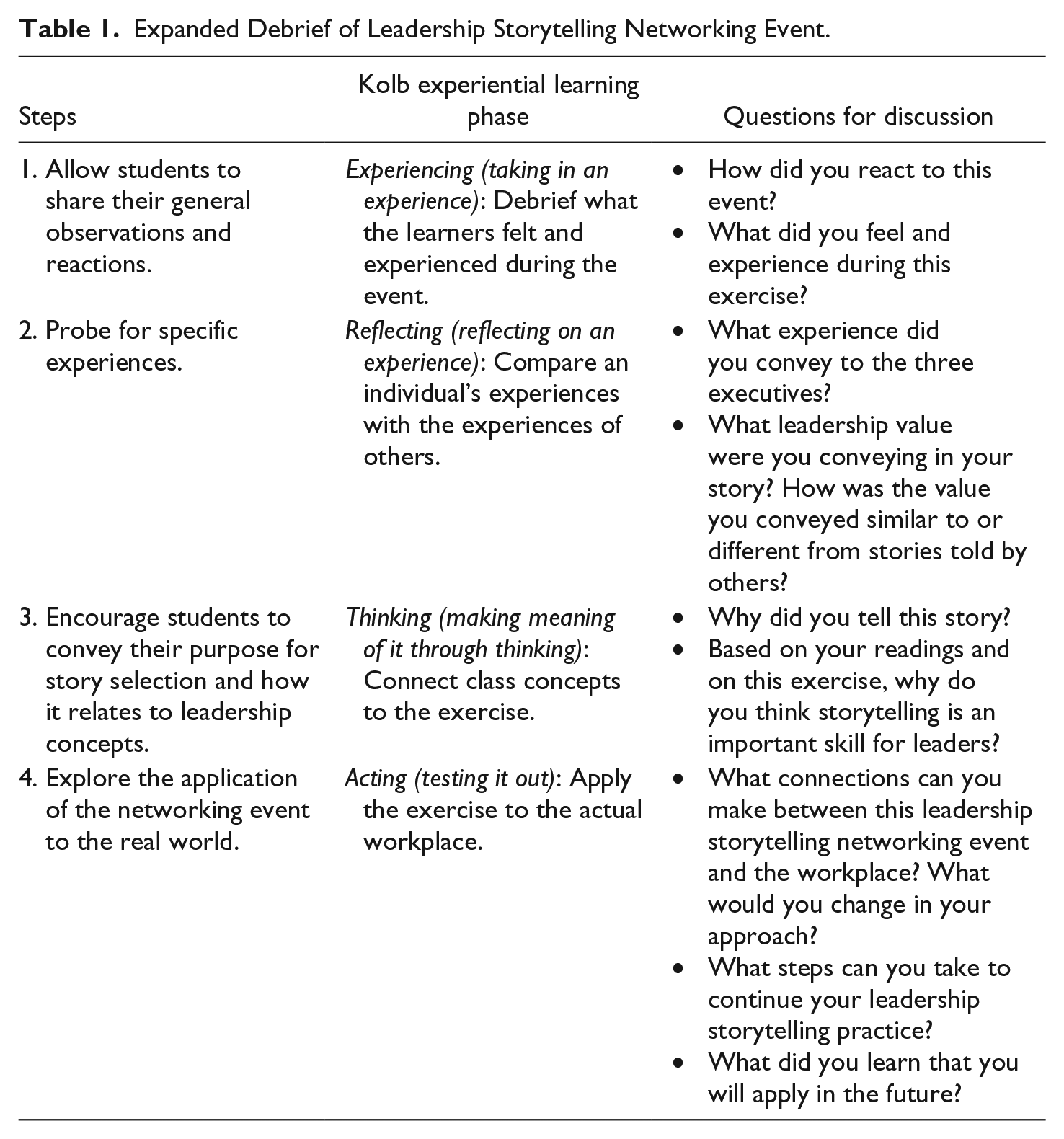
To wrap up, have students return to a common area for a group discussion. In the debrief, ask students to reflect on the experiential exercise. Probe theater students about memorable leadership stories, how clear the connection was between the story and a value, and whether the stories could be edited and revised for clarity. For the management students, share observations and ask what they learned from the experience. The specific questions that can be asked during the debrief of the storytellers are aligned with the four experiential learning phases (see Table 1). These questions allow the students to make a better connection between what the theater students perceived in the stories and what the management students intended in their stories.
Expanded Debrief of Leadership Storytelling Networking Event.
Student Feedback
Student reactions to the leadership storytelling skill building were positive, as demonstrated by written feedback after the event and end-of-course feedback. After the event, the management instructor collected feedback using three open-ended written questions:
How did Day 1 of the storytelling activity affect your learning? How could your learning be improved?
How did Day 2 of the storytelling activity affect your learning? How could your learning be improved?
How would you describe your overall experience?
The management education students expressed how the process of identifying an experience, reflecting on it, placing it in the context of a story, and then practicing the telling of the story in a workplace setting was one of the highlights of the semester. Some students described how the activity took them out of their comfort zone and stated that they learned that they were capable of communicating in a challenging environment. Other students realized that the individual value they were trying to convey in their story was misinterpreted and that they needed additional practice.
The theater students provided positive feedback around communication skills and stagecraft. The practice they had in developing a character biography and playing the role of a business professional in a networking event provided them with a powerful learning experience. The exercise was useful for them because often theater students are hired to play a specific part in the workplace, such as a patient in medical education or a customer in a business training video.
Conclusion
Creating opportunities for students to interact in a simulated workplace setting benefits communication skill development for management and theater students. This exercise enables management students to practice leadership storytelling skills and theater students to practice interactive drama. Using this exercise, instructors can move beyond just a text-based writing exercise into a more complete learning activity. The experiential learning process approach purposefully leads student through the four different phases of the learning cycle—experiencing, reflecting, thinking, and acting. In our experience, collaborating with theater students to provide interactive drama enhanced our students’ learning process, engagement, and skill development.
Footnotes
Appendix A
Appendix B
Appendix C
Acknowledgements
The authors recognize the students who were willing to move out of their comfort zone to learn and thank the reviewers and editorial team for their helpful comments.
Declaration of Conflicting Interests
The authors declared no potential conflicts of interest with respect to the research, authorship, and/or publication of this article.
Funding
The authors received no financial support for the research, authorship, and/or publication of this article.
