







Abstract
Undergraduate students, particularly those with limited experience in business, struggle to appreciate the complexity of organizational communication dynamics. Communication complexities such as role conflict, position power, and individual perception—and their influence on effective communication—are particularly challenging for this population. This article describes a classroom exercise based on the children’s game “Telephone” that connects organizational communication with considerations of role conflict, power and influence tactics, and individual perceptions as they influence engagement with communication involving a new initiative. During the full class reflection and debrief, students identify the connections between their role in the activity and how individual organizational elements and experiences may inform effective communication. Designed for an undergraduate organizational behavior course, the exercise is adaptable to other management topics or levels where communication is a consideration.
This exercise is designed to overcome learning difficulties that undergraduate business students, or others with limited business experience, have in recognizing the complexity of organizational communication dynamics. It draws on improvisational role-playing (Moshavi, 2001) to illuminate how the “noise” of everyday organizational life may affect organizational communication efficacy.
Theoretical Foundation
Effective communication is necessary for organizational success (Ruck & Welch, 2012) and for leadership and teams to work together (Bucăța & Rizescu, 2017). Communication between individuals allows for strategic initiatives (Bucăța & Rizescu, 2017) and other critical information (Dunn, 2015) to be communicated and understood by all members of the organization. The effectiveness of communication has been identified, in particular, as an essential element in organizational change (Aslam et al., 2018; Tucker et al., 2013).
The communication process is affected by the sender’s and receiver’s role as well as individual differences, trust, communication norms, and expectations (Henderson, 1987). Anything that gets in the way of effective communication is considered “noise” and includes both internal (e.g., biases) and external (e.g., the room is cold) sources (Gamble & Gamble, 2014). Communication is informed also by differences in role, responsibility, and position (Sethi & Seth, 2009), such that each participant may interpret the message differently. For example, if each individual’s responsibilities are at odds with the other (e.g., one person is responsible for the speed of assembly, while the other is responsible for the quality), this can cause noise in terms of role conflict and perceptual differences.
It is important to understand how members of the organization, not just the leaders, perceive the communication process (Ruck & Welch, 2012) and how noise may be affecting the message. Understanding the effect of various types of noise may allow the sender to adapt a message to ensure effective communication. Identifying forms of noise to ensure effective communication is a critical managerial capability that this activity, based on the children’s game “Telephone,” focuses on.
Learning Objectives
On completion of this exercise, students will be able to
describe multiple sources of noise in organizational communication
explain how organizational role may moderate effective communication
explain how individual perception may moderate effective communication
Instructions for Running the Exercise
Exercise Overview
In this exercise, students compete in small groups of eight to transmit a message about a new organizational initiative from the first student to the last in a circle. Each student in the group is given a card that is numbered and has a description of an organizational role. The first card in the deck (Card 1) also includes the instruction for the participant to begin a specific message. The last card in the deck (Card 8) also includes the instruction for the participant to write the message down on the back of the card and raise their hand. During each of two rounds, students whisper a message about a new initiative from one person to the next with the last person writing the message down. When all groups have completed the transmission, the last student in each group reads aloud the received message. After the first practice round, groups are given time to consider how they may improve communication effectiveness in the second round. Following the second round, the group that finishes first with the most accurately transmitted message is deemed the winner and receives a prize.
The instructor should prepare sufficient activity materials shown in Appendices A and B for the number of participants in advance and provide a reading and/or lecture on organizational communication, with specific attention to the benefits of effective communication such as enhanced employee morale, satisfaction, and engagement. For undergraduate students, most management textbooks offer a chapter on communication that provides a basic understanding of such managerial considerations.
The exercise requires a minimum of 16 students (two groups) and can accommodate larger classes quite well by forming additional groups of eight, with uneven numbers of students assigned to observer roles.
Preparing and Running the Exercise
Exercise logistics include setup and instruction, Round 1, group strategy discussion for Round 2, Round 2, group debrief discussion, and all-class debrief. A minimum of 60 minutes is required to complete the exercise and class debrief with four groups (32 students). If fewer groups are involved or more time is available, additional time may be allotted for group strategy discussion and debrief elements. The 60-minute exercise timing is shown in Table 1.
Timing for 60 Minute Exercise. a
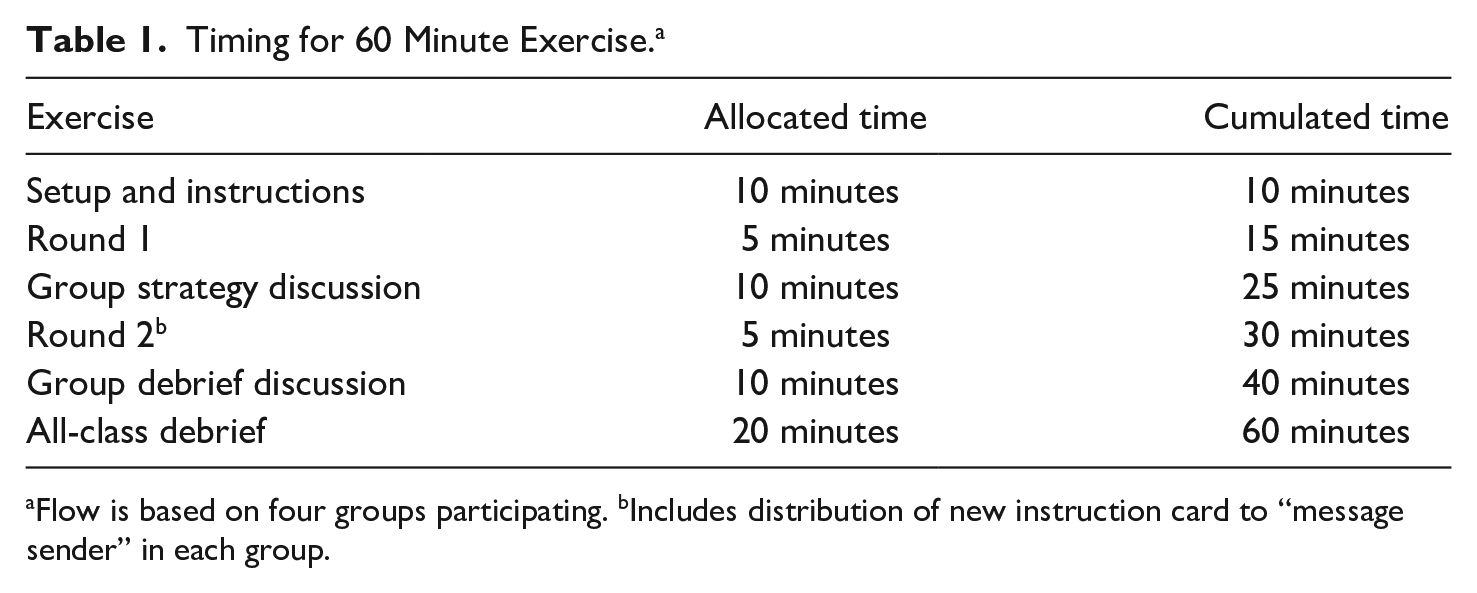
Flow is based on four groups participating. bIncludes distribution of new instruction card to “message sender” in each group.
Setup and Instructions
Divide participants into groups of eight and have each group form a circle, with any extra participants serving as observers. Groups need some space between them, but ambient noise is not a problem (and can be used as a basis for conversation in the debrief).
Once the groups have formed themselves into circles, tell them to turn outward so that they are not facing each other, and ask any observers to stand near one or two groups to observe what happens.
Explain to the assembled participants that the object of the “communication game” is to pass a message accurately from a sender through the group one at a time to a receiver in the shortest amount of time. All groups have the same message, which must be whispered from one group member to the next. The group that has the fastest time with a completely accurate message will be declared the winner. There will be two rounds, with the first round a practice round.
Tell participants that they each will receive a card and, when told to do so, should read what is written on the card but not show or discuss it with other members of the group. The cards are numbered on one side, which is the up side.
Provide a deck to one student in each group with the instruction to wait until all decks have been distributed before taking the top card and passing the remaining deck to the student on their left. 1 The individual who receives the last card (Card 8) is then given a pen or pencil.
Give participants a minute or two to read their role telling them that no answers to questions about the information on the cards will be provided before the practice round, and they may not discuss anything about the information on the card with members of their group.
Round 1
When all participants acknowledge that they have read their card, instruct the participant with Card 1 in each group to start. Given the competition element, most groups complete their message passing in 1 to 2 minutes. As each group completes their round, the last individual in the group must write down the message received before raising their hand.
Once all groups have completed the round, beginning with the fastest group and continuing in the order of time completed, the last person reads the message they have written on the card. The instructor notes only whether or not each group’s message is completely accurate.
Group Strategy Discussion
Give teams 10 minutes to discuss their results and what they could do in the second round to improve their performance. No restrictions are placed on options they may utilize, and the instructor answers no questions about those options other than to indicate that a new message will be provided and that the group may reorganize the order of individuals in the circle. Participants are not instructed to, nor are they prohibited from, discussing their role and how it may or may not have influenced them in Round 1.
Round 2
Give the first person from each group a new message, and instruct participants that their roles remain the same as in Round 1.
Instruct the first person in each group to begin.
On completion, repeat the reading process used in Round 1 with the fastest group whose message is completely accurate declared the winner. If there is no completely accurate message, there is no winner.
Group Debrief Discussion
Groups meet to develop responses to a set of debrief prompts for class discussion (see Appendix C).
All-Class Debrief
Ask each group to give a brief overview of their debrief conversation. Engage participants in a discussion of their experience with the exercise and any connections they are able to make to communication processes (see Appendix C). Comments may include the importance and limitations of communication in a new initiative, the relevance of role identity and organizational culture to organizational communication, individual commitment to the status quo, ambient noise as a disrupter of message clarity, other disruptive noise whether internal or external, and any other topics that may be identified by participants based on the specific course curriculum.
Exercise Variations
If social distance is a concern, the activity can also be done by writing the message rather than saying the message. Each student has paper and their own writing utensil and remains in their own seats. A communication center for each team of eight is established in the room. The first student (person with Card 1) goes to the communication center and has 10 seconds to read the written communication. They return to their seat to write the message on their paper and then deliver that “new” message to the communication station, setting it on top of the original message. The next person follows the same process of reading the message at the communication center (10 seconds maximum), returning to their seat to write the message, and then delivering their message back to the communication station. The process continues until all members have finished, and then the final message is read. By stacking the messages at the communication center, there is a record of how the message changed over time. Additional variations and scenarios are presented in Appendix D.
Two-Step Debrief
The debrief takes place first within groups and then expands to the entire class. The first step is designed to have students first consider their group’s experience in terms of communication dynamics, including any strategies they used to improve the group’s performance between the first and the second rounds, and to focus student attention specifically on the intended learning outcomes of the experience (noise, role, and individual perception). The second step of the debrief is a larger all-class debrief that highlights insights from the group discussion and includes how students might behave with respect to organizational communication in the future. Specific student responses to discussion prompts are informed by the course focus and readings. Sample debrief discussion prompts are included in Appendix C. While these prompts are intended to direct discussion toward various elements of noise in organizational communication, the specific focus of the course or concepts should be expected to influence student responses.
Depending on the timing of delivery (in connection with a specific curricular objective or as a summative exercise), an organizational behavior or communication class will focus primarily on one or more of the following forms of noise: power dynamics, formal and/or informal power, trust, individual differences, role conflicts, interpersonal conflict, multiple communication channels, or other related topics. A course on organizational change may lead to discussion related to the efficacy of different change processes, change agents, or resistance to change, while a human resource management course might identify cultural differences or other forms of diversity as most relevant.
FAQ teaching notes are included in Appendix E.
Conclusion
This experiential activity seeks to address the challenge of developing knowledge and skills related to organizational communication in students who have limited business experience. This activity experientially addresses noise elements such as role conflict, power and influence tactics, and individual perceptions and their impact on effective communication. The need for and complexity of communication to support a new initiative in the organization may be elusive to students who have limited business experience. This activity allows the students to experience firsthand the dynamics of effective communication.
Footnotes
Appendix A
Appendix B
Appendix C
Appendix D
Appendix E
Declaration of Conflicting Interests
The authors declared no potential conflicts of interest with respect to the research, authorship, and/or publication of this article.
Funding
The authors received no financial support for the research, authorship, and/or publication of this article.
