







Abstract
Despite declines in private-sector union membership in the United States, labor relations remains an essential topic within the field of human resource management. However, most undergraduate students have little experience with labor unions, making it difficult to enhance learning by applying labor relations concepts to their prior experiences. The current lesson addresses this gap by teaching students about labor relations through the exploration of an authentic collective bargaining agreement (CBA) and an analysis of an actual work stoppage (i.e., strike or lockout). Students will learn about how different elements of the CBA influenced negotiations and factors that contributed to a work stoppage, leading to a basic understanding of how the human resource management decisions they make as managers can directly impact organizational outcomes. The lesson also serves as a tool for synthesizing content from throughout the semester in an undergraduate human resource management course.
Keywords
Although labor union activity in the United States has declined since the 1970s (Bureau of Labor Statistics, 2022; Clawson & Clawson, 1999), the topic of labor relations remains relevant in both the United States and globally (Bray & Rasmussen, 2018; Gomez et al., 2019; Xi et al., 2021). In fact, workers are beginning to unionize at key employers such as Amazon (Selyukh & Willard, 2022) and Starbucks (Eidelson, 2022). Labor unions are of practical relevance to students’ lives as the largest labor union in the United States is the National Education Association (NEA), a labor union that represents public school teachers and university professors (Noe et al., 2019). Labor unions can provide employees with a voice (Freeman, 1980) and support equal employment opportunity by reducing the need for idiosyncratic deals that are often distributed inequitably (Obenauer, 2021a; Rousseau et al., 2006).
Unions achieve these objectives by negotiating on behalf of their members through a process called collective bargaining. In the United States, collective bargaining must comply with the guidelines outlined in the National Labor Relations Act (Noe et al., 2019). Because one party often enters these negotiations from a position of power, however, collective bargaining outcomes are rarely an accurate reflection of value creation and, thus, have the potential to become contentious (Post, 1990). The length and nature of the collective bargaining process are frequently influenced by factors such as the relationship between negotiating parties, existing contract language, subjects being negotiated, and the economic climate (Julius & DiGiovanni Jr., 2016). Negotiations can also be influenced by negotiators’ expressions of emotions (Adam & Shirako, 2013; Vuorela, 2005). Failed negotiations that result in mediation can take twice as long as successful negotiations (von Nordenflycht & Kochan, 2003).
The topics of labor relations and collective bargaining may be new to students. Workers under the age of 24 represent the age group with the lowest level of union membership (U.S. Bureau of Labor Statistics, 2022). Furthermore, important labor relations processes, such as collective bargaining, are often not visible to most union members (McAlevey & Lawlor, 2021). Consequently, when learning about labor relations, undergraduate students’ ability to apply life experiences to course content may be even more limited than when learning about other topics.
The lesson described here addresses this limitation by immersing undergraduate human resource management (HRM) students (in an introductory class) in an activity that incorporates an authentic collective bargaining agreement (CBA) and associated work stoppage. The activity focuses on the labor relations activities of the Southwest Vermont Supervisory Union (a public school system) and a local chapter of the NEA. This case is highly relevant as it involves the largest labor union in the United States (Noe et al., 2019). Students are introduced to real-world applications of CBA provisions described in the curriculum by reviewing the CBA to identify where different labor provisions present themselves. They then read about and discuss a related work stoppage. Having reviewed the relevant CBA, they have a basic understanding of contract provisions that influenced the work stoppage before learning about the actual work stoppage. The lesson closes with a discussion about key factors that influenced the work stoppage and alternative approaches management could have used.
This is an original activity that I developed after recognizing that student engagement seemed to drop during the labor relations unit of my undergraduate HRM class. Consistent with Fink’s (2013) model for significant learning, introducing students to a CBA and allowing them to recognize how provisions within the CBA directly influenced a work stoppage seem to have increased their level of “caring” for the topic. In addition, as I use examples from a public school system, an organization with which most of my students have experience, I can strengthen the “human dimension” of significant learning. The collaborative nature of the exercise builds on the socially interactive nature of learning (Hurst et al., 2013). The numerous small group debriefs allow more students to actively engage in discussion than they do during class debriefs, enabling them to realize the educational benefits associated with taking responsibility for their own learning (Billmeyer, 2006). Finally, by incorporating reading and interpreting relevant documents, this lesson provides a supportive educational environment that prepares students for realistic workplace responsibilities (Storm, 1993).
Learning Objectives
Learn how to identify different provisions of a CBA (LO1)
Identify key factors in a failed negotiation that contributed to a work stoppage (LO2)
Gain an introductory understanding of factors to consider when preparing for collective bargaining and steps that managers can take to avoid a work stoppage (LO3)
Note: The activity aims to support these learning objectives above through exposure to these labor relations activities. Failure to recognize the difference between that and an exhaustive analysis can make the timing associated with this activity appear challenging.
Instructions for Running the Exercise
Preparation Activities
Supplemental Appendix A contextualizes the steps outlined below through a comprehensive description of material preparation that provides insight into what to expect during the exercise.
Facilitation
Table 1 shows the steps, timing, and materials required for this lesson. Timing will be critical to the lesson’s success as optimal engagement requires this lesson to move quickly. If a single person or group has several questions during the introduction of an activity, the instructor may need to respond to them individually after the activity has started. The written instructions for this activity are detailed enough that students typically have very few questions.
Timing and Materials for Exercise.
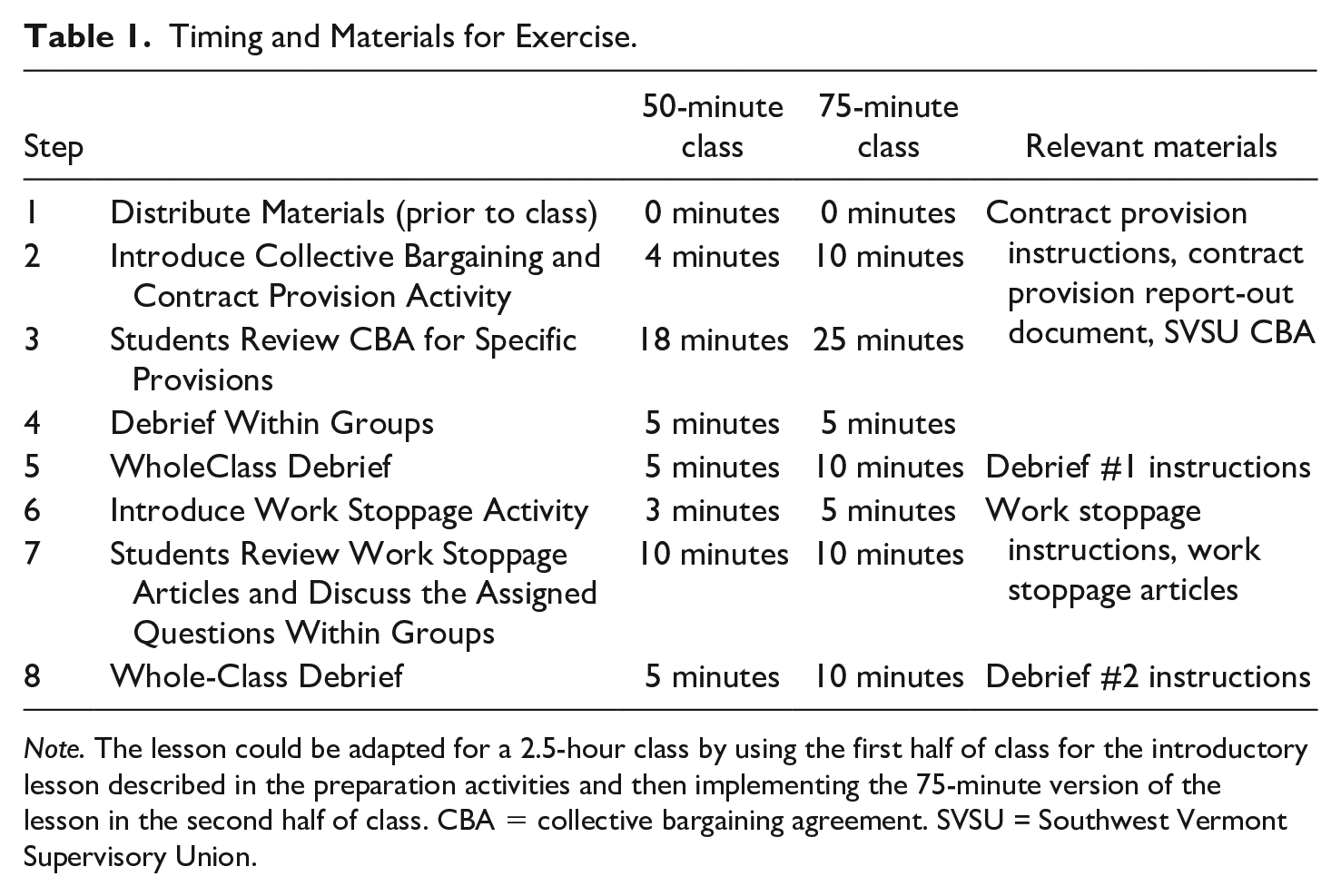
Note. The lesson could be adapted for a 2.5-hour class by using the first half of class for the introductory lesson described in the preparation activities and then implementing the 75-minute version of the lesson in the second half of class. CBA = collective bargaining agreement. SVSU = Southwest Vermont Supervisory Union.
Step 1: Distribute Materials (Prior to Class)
The instructor should make all materials for the activity available through the course’s learning management system (LMS) before class. For a seamless launch of the activity, I provide printed copies of the instructions (see Supplemental Appendix B) and a recording document (see Supplemental Appendix C) for the first activity as students enter the classroom. I also support student accessibility by placing multiple printed copies of the CBA around the classroom.
Step 2: Introduce Collective Bargaining and Contract Provision Activity (4–10 Minutes)
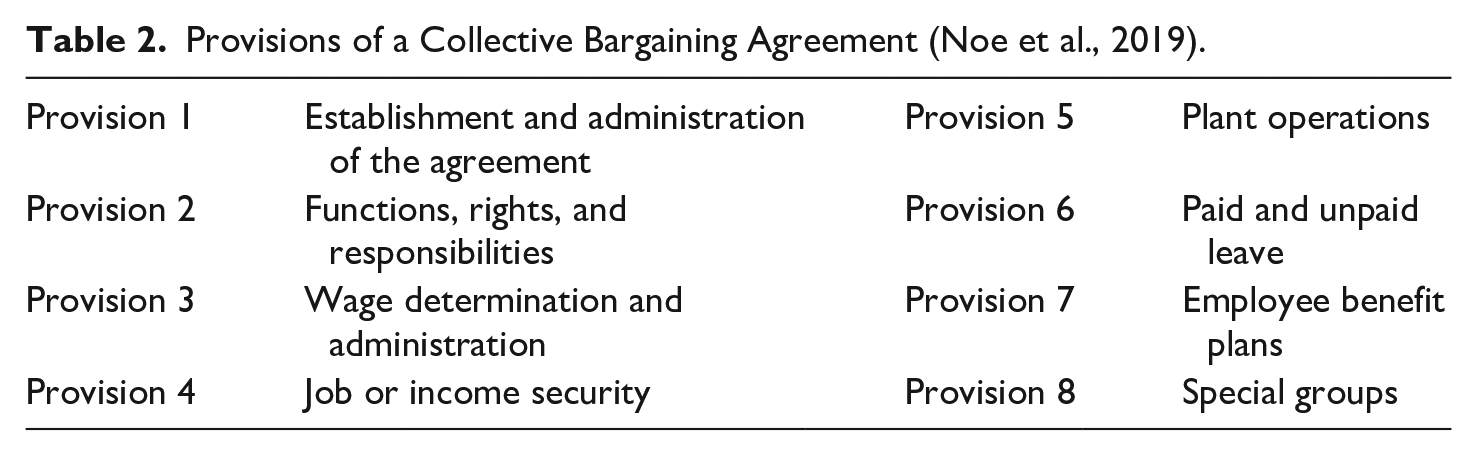
The instructor should begin class by providing a high-level overview of the collective bargaining process. Rather than focusing on the logistic steps of bargaining, this overview should focus on explaining the basic role of unions and management in negotiating contracts. The instructor should also explain that negotiations involve several different provisions within the contract, such as wages, benefits, operational rules, and employee leave (Noe et al., 2019).
Then, the instructor will direct students to break up into groups of 4–6 and provide an overview of the instructions for this activity (see Supplemental Appendix B). I spend limited time discussing instructions because (a) the written instructions have been developed and refined with students over several years, and (b) students more effectively identify questions that they have about the activity after they begin working with the CBA. I place emphasis on two key points. First, there is not time to read the entire contract, so it is important to use resources and tools effectively to find relevant language within the CBA (see Table 2). I encourage students to use Noe et al.’s (2019) Table 15.3 as a starting point for search terms, but I caution them that this is not an exhaustive list and that they should use their knowledge of human resource management to adapt and identify additional search terms. Second, students do not need to identify every occurrence of a provision within the contract, but each group should identify multiple examples of each provision.
Provisions of a Collective Bargaining Agreement (Noe et al., 2019).
Step 3: Students Review CBA for Specific Provisions (18–25 Minutes)
While reviewing the contract in their groups, students will work in pairs to identify a subset of provisions. They will record their findings using the report-out document (see Supplemental Appendices C and D). Within each page of the document (one per provision), there are five sections for students to record examples of language used for each provision within the CBA and the corresponding contract page numbers. Five sections provide students with enough room to recognize multiple examples of contract provisions without feeling overwhelmed.
Step 4: Debrief Within Groups (5 Minutes)
Students are instructed to stop reviewing the contract and discuss what they have found within their groups. Small group debriefs allow all students to participate in the debriefing process more actively than they would during an extended whole-class debrief. The instructor should walk around and identify observations that should be shared with the class while quietly distributing materials for the next activity.
Step 5: Whole-Class Debrief (5–10 Minutes)
Following the within-group debrief, the class should collectively discuss themes they observed. The instructor can ask students to share specific insights identified in the previous step. If the classroom is equipped with a document camera, it is helpful to display Report-Out Documents to the class while discussing what they learned and observed. This debrief aims not to provide an exhaustive review of the contract but to ensure that the class has successfully learned how to identify provisions within the CBA (LO1).
Because students have already debriefed within their groups, it is helpful to conceptualize the whole-class debrief as a “highlight reel.” I reduce the redundancy that can occur in debriefs by offering groups the opportunity to share additional insights rather than requiring each group to share findings. Examples of where contract provisions can be found in the CBA are included in Supplemental Appendix E. Guidelines for debrief questions are in Supplemental Appendix F.
Step 6: Introduce Work Stoppage Activity (3–5 Minutes)
This is a rapid introduction and transition. The instructor will explain that when unions and management fail to reach an agreement, it can lead to a work stoppage, briefly defining a strike and lockout for the class. The instructor will then introduce the instructions for the work stoppage activity (see Supplemental Appendix G).
Step7: Students Review Work Stoppage Articles and Discuss the Assigned Questions Within Groups (10 Minutes)
Students will divide articles (see Supplemental Appendix H) within their group and spend 5 minutes reviewing these articles individually. At the 5-minute mark, the instructor should direct students to complete their review of the articles and begin discussing the work stoppage within their groups by responding to the questions listed in the activity instructions. The instructor will identify student insights for discussion in the whole-class debrief by observing different groups.
Step 8: Whole-Class Debrief (5–10 Minutes)
This step is where the entire activity comes together. Students are asked to discuss what caused the work stoppage (LO2) and what the employer’s leadership could have done to avoid the work stoppage (LO3). Debrief questions and typical responses are shown in Supplemental Appendix I.
Supplemental Lesson
In the class following this lesson, the instructor should consider how to reinforce learning from these activities. I typically bring in a guest speaker who was directly involved in the labor stoppage that I reference in this activity, as she is well-positioned to talk to the students through labor relations using a context with which they are familiar. There are other options for guest speakers, however. If the instructor is at a school where faculty are unionized, they may consider inviting their union representative to speak about their own CBA negotiating experiences and compare these experiences with the case used for this activity. Alternatively, the instructor can integrate relevant lecture with a more extensive debriefing session in the following class.
Variations
Conclusion
The student response to this exercise has been overwhelmingly positive in terms of both direct feedback and engagement. Because this lesson occurs at the end of the semester in my HRM course, it shows students how the concepts they have been learning about all semester (e.g., selection procedures, compensation, benefits) are applied in the real world. Analyzing an actual work stoppage from an HRM perspective contributes to the significant learning experience by helping students to see how policy decisions they make as managers will impact their organizations. This exercise gives students an interactive learning experience related to labor relations while also serving as an excellent vehicle for synthesizing the content of an introductory HRM course.
Supplemental Material
sj-docx-1-mtr-10.1177_23792981231151911 – Supplemental material for Creating a Significant Learning Experience When Introducing Labor Relations to Students
Supplemental material, sj-docx-1-mtr-10.1177_23792981231151911 for Creating a Significant Learning Experience When Introducing Labor Relations to Students by William G. Obenauer in Management Teaching Review
Footnotes
Acknowledgements
I would like to thank Dr. Stephannie R. Peters for the insight she has provided into the case that I describe in this activity. In addition, I would like to thank Dr. Chen Wang, Dr. Ajay R. Ponnapalli, Dr. Laura Guerrero, and Shafagh Rezaei for their feedback on the manuscript in various stages of development.
Declaration of Conflicting Interests
The authors declared no potential conflicts of interest with respect to the research, authorship, and/or publication of this article.
Funding
The authors received no financial support for the research, authorship, and/or publication of this article.

References
Supplementary Material
Please find the following supplemental material available below.
For Open Access articles published under a Creative Commons License, all supplemental material carries the same license as the article it is associated with.
For non-Open Access articles published, all supplemental material carries a non-exclusive license, and permission requests for re-use of supplemental material or any part of supplemental material shall be sent directly to the copyright owner as specified in the copyright notice associated with the article.
