






Abstract
Although often denied or unnoticed, anti-fat bias exists in society and organizations. To battle anti-fat bias, educators must proactively address it in management education. Despite clear evidence of negative outcomes from stigma and stereotypes experienced by fat individuals, interventions remain limited. This experiential exercise uses role-play to challenge students’ explicit and implicit anti-fat biases, suitable for undergraduate, graduate, and executive education settings. Despite evidence of negative outcomes of the stigma and stereotypes experienced by fat persons, there has been little and nascent work done to disrupt the bias and reduce it. Our roles as management educators provide the opportunity to expand the notion of who deserves social justice and what it means to support body size equity. In this exercise, we present an experiential learning experience using role-play that educators can use to interrupt students’, undergraduate and graduate, explicit and implicit anti-fat biases.
Introduction
Anti-fat bias is a pervasive form of discrimination, often socially overlooked and even accepted, which deprives individuals in larger bodies of equal opportunities and respectful treatment. We management educators can embrace our role in reducing the pervasiveness of anti-fat bias and in changing the narrative (McCullough Campbell, 2020). As we send students into the working world to be managers and business leaders, we want to disarm the biases that students bring with them into the workforce, including anti-fatness. This article provides an exercise educators can use in the classroom, following the best practices found in prior research and activism, to inspire students to question their anti-fat attitudes and combat their own and others’ anti-fat bias. The exercise in this article is primarily targeted toward the undergraduate classroom and can be conducted either in-person or online in a synchronous setting. This exercise can be done in classes on management, diversity, organizational behavior, health care management, nursing, medicine, and any course that covers diversity issues.
Theoretical Foundation
What Is Anti-Fatness?
Anti-fatness, anti-fat: bias, attitudes, prejudice, weight stigma, weight bias, and fat phobia are all terms to describe a negative attitude and/or aversion to fatness and fat on bodies (Brochu, 2020; Brochu & Esses, 2011; Cain et al., 2022; Danielsdottir et al., 2022; Flint et al., 2013; Henderson et al., 2022). In this article, we primarily use the terms anti-fatness and anti-fat bias since these are the terms used by fat acceptance activists and most accurately name the attitude (Gordon, 2021).
Researchers studying anti-fat bias have theorized how the bias forms. Attribution theory characterizes the controllability one has over their weight as a source of anti-fat bias, where people believe that one has complete control over their weight based on their diet and exercise (Brochu, 2020; Crandall, 1994; Crocker et al., 1993; Danielsdottir et al., 2010; Elran-Barak & Bar-Anan, 2018). Self-identity theory posits that based on what “group” one identifies as (thin or fat), determines their fat bias (Elran-Barak & Bar-Anan, 2018; Ritzert et al., 2016). Finally, socio-cultural theory assumes that most people prefer thinness more than fatness and weight is an important factor (Carels & Musher-Eizenman, 2009; Elran-Barak & Bar-Anan, 2018; Ritzert et al., 2016; Strings, 2019).
Anti-Fat Discrimination
Like many biases, multiple stereotypes have arisen regarding fat people. Larger-bodied people are often considered less intelligent, less conscientious, less self-disciplined, lazier, and sloppier than thinner people (Henderson et al., 2022; Nolan et al., 2013). These stereotypes form from the controllability bias suggested by attribution theory, the belief that everyone can achieve their ideal weight (Brochu, 2020; Jovancevic & Jovic, 2022; Li et al., 2020).
These biased beliefs lead people to discriminate against fat persons individually and at the organizational and societal levels (Roehling, 1999, 2002; Rudolph et al., 2009; Shapiro et al., 2007). The bias negatively affects individuals’ interview and hiring prospects (Agerstrom & Rooth, 2011; Pingitore et al., 1994) and perceptions of leadership ability and competence (Bento et al., 2012; Bresnahan et al., 2016; Henderson et al, 2022; Ji et al., 2021; Merritt & Lynch, 2020). At the organizational and societal level are pay gaps (Judge & Cable, 2011), punitive health programs (Tannenbaum et al., 2013), and in organizations that signal fat as problematic, larger-bodied employees experience other negative outcomes throughout the organization (Kirkland, 2014; Powroznik, 2017).
Interventions’ Best Practices
Researchers have tested various methods of intervention to challenge the sources of the bias with mixed results (Alperin et al., 2014; Brochu, 2020; Breithaupt et al., 2020; Danielsdottir et al., 2010; Teachman et al., 2003). However, some best practices have emerged: interventions that address controllability bias have shown to reduce the negative stereotypes associated with being fat (Brochu, 2020; Crandall, 1994; Danielsdottir et al., 2010; Diedrichs & Barlow, 2011; Humphrey et al., 2015; Martingano et al., 2023; O’Brien et al., 2012; Swift et al., 2013) and when done in a way that is credible and does not reinforce that thinness is better, it shows positive changes in explicit and implicit attitudes toward fat persons (Brochu, 2020).
Role-Play
Role-plays often create a “learning by doing” process in the classroom, leading to higher engagement and lasting impact (Kolb, 2015; Kolb & Kolb, 2005; Monahan, 2002; Paschall & Wüstenhagen, 2012; Poitras et al., 2013; Wesner & Smith, 2019). Since role-plays have students step into someone else’s shoes, focusing on behaviors and skills in addition to generating awareness and knowledge, they help cover the four core objectives of teaching diversity, equity, and inclusion (Garavan, 1997; Hartwell et al., 2017; King et al., 2010; Schmidt-Wilk, 2020). Thus, because role-plays are effective tools in generating awareness and developing skills to combat explicit and implicit biases, we present a role-play exercise to address anti-fat bias.
Role-Play as Anti-Fat Bias Intervention
First, the role-play challenges controllability bias since the roles’ actions do not fulfill the stereotypes associated with fatness, leading to discussions on critical weight science. In addition, using role-plays evokes empathy and perspective taking (Duncan, 2018; Hartwell et al., 2017; King et al., 2010; Schmidt-Wilk, 2020). In this exercise, students are randomly assigned their roles, giving students a chance to identify with a role different from their own self, and thus prompting conflict between their own anti-fat bias and their temporary identity. Also, experiencing and being confronted by the alternative identity creates opportunities for cognitive dissonance if their role or others’ experiences challenges their identity as an empathetic person, non-biased person. Finally, using role-play allows us to challenge the socio-cultural bias that fatness is bad since the roles’ narrative treats the size of a body as neutral—it is a detail of a person, but not an important factor to playing the role.
In the following sections, we will outline the role-play exercise we devised using the theoretical foundation on anti-fat bias and accounting for best practices for challenging anti-fat bias. We will review the learning objectives, provide an overview of the exercise itself, explain how to debrief the exercise with students, and share past student outcomes.
Does Size Matter? Anti-Fat Bias Role-Play
At the conclusion of this exercise, students will be able to:
Define anti-fat bias.
Recognize how anti-fat bias affects perceptions and behaviors.
Examine everyday discrimination experiences faced by larger-bodied individuals.
Distinguish between anti-fat bias and controllability bias.
Evaluate the implications of anti-fat discrimination.
Develop strategies to overcome anti-fat bias and advocate for body size inclusivity.
Exercise Overview
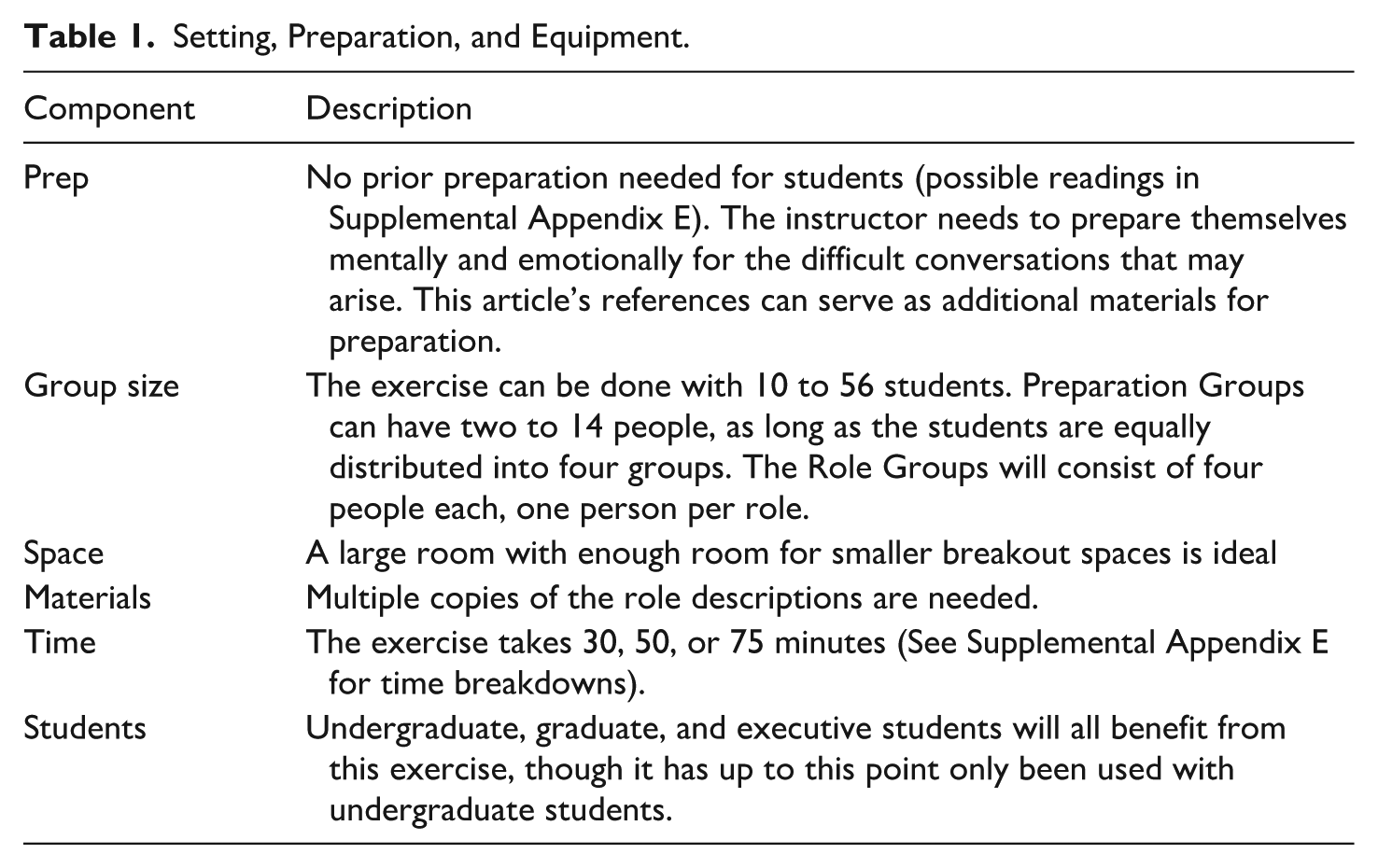
The goal of this exercise is to bring awareness to body image bias in professional settings. See Table 1 for information on the setting, preparation, and equipment needed for the exercise and Table 2 for an overview of the logistics. Students will role-play as one of four individuals who have traveled to interview for the same position. These four roles reflect individuals who vary in weight and health, but all have gender neutral names, are five foot six inches tall, and have the same credentials. Cameron is 250 lbs and is in good health; Kai is 135 lbs and in good health; Riley is 250 lbs and in poor health; and Asa is 135 lbs and in poor health. The individuals’ health status is included due to the prevalent conflation that weight is a direct reflection of someone’s health status. By including the health status for each character, we prompt reflection on how individuals’ who have health issues are often told or recommended to lose weight by well-meaning individuals without evidence that any health issues are directly because of an individual’s weight.
Setting, Preparation, and Equipment.
Does Size Matter? Role-Play Logistics.
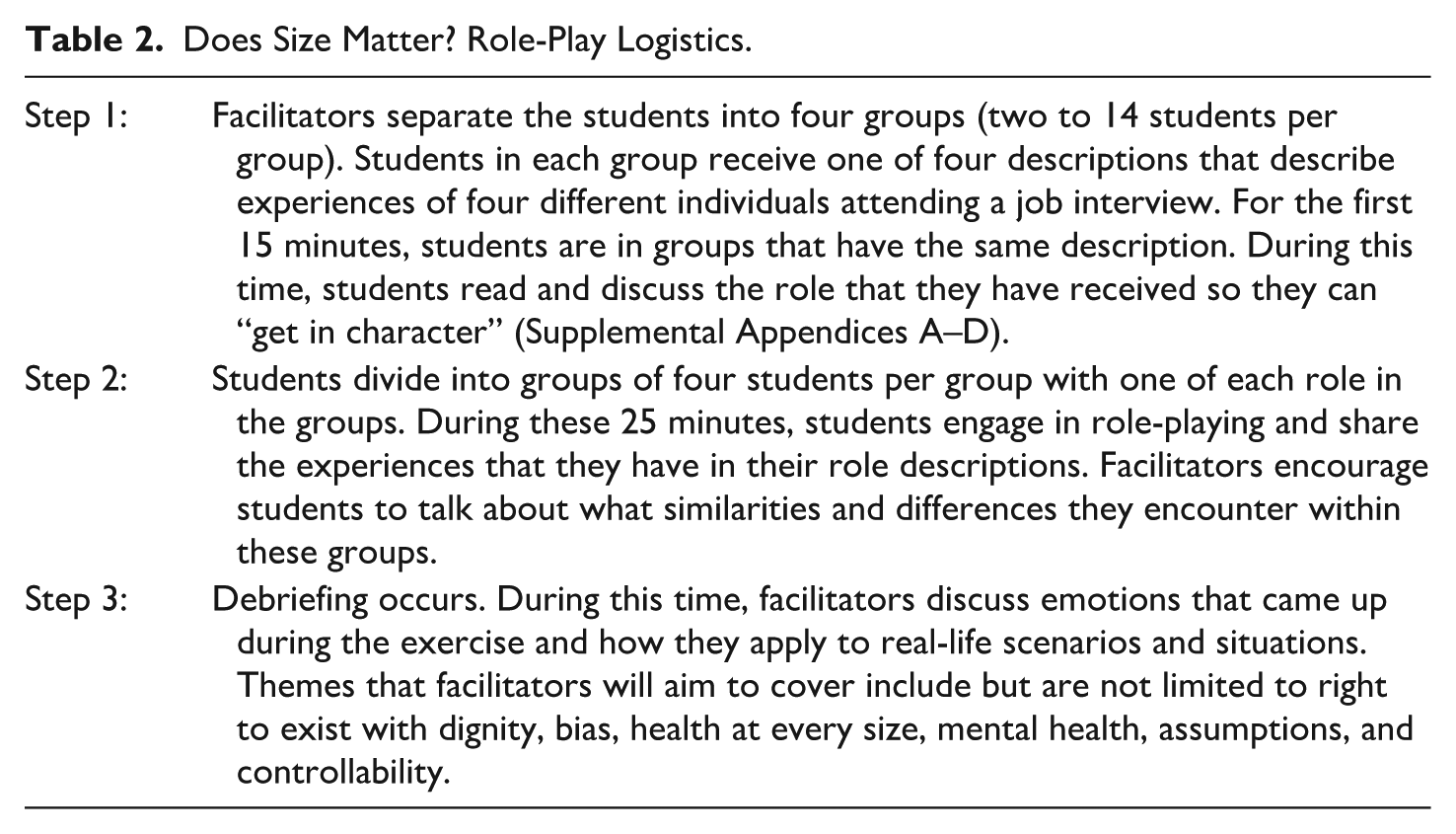
Each role is given reimbursement for their flight to the interview and modest hotel accommodations, go through a 3-hour flight, then a 2-hour layover, and a shorter 45-minute flight before landing. Each individual checks into the hotel, interacts with the staff when the individual requests something, goes to the free breakfast in the morning, and then interviews for the job. However, the details vary based on each individual’s unique weight and health situation. After reading through and preparing to role-play with others of the same role (students playing Cameron talk to other students playing Cameron), the role-play takes place as the four job candidates running into each other by chance at the hotel and they discuss their experiences traveling and interviewing for the job.
Teaching Notes
The facilitator should explicitly foster psychological safety by acknowledging emotional responses and providing clear guidelines to manage and address sensitive discussions, including a trigger warning at the start of the exercise and a statement assuring students that sharing personal stories in the debrief is voluntary (See Supplemental Appendix E for the trigger warning we recommend). Encourage participants to reflect openly, validating all experiences and feelings to promote a supportive learning environment. It is vital that the students share voluntarily instead of feeling pressured since this exercise may stimulate weight-consciousness for some students, and they need to feel safe to participate at their own pace.
Gender elements can also be discussed as the names in the exercise are designed to be gender neutral but assumptions about the gender of the roles can arise. In addition, ableism and disability elements can also be discussed as students recognize the nuances between the roles. This conversation can lead directly into discussing controllability bias, critical weight science, and more inclusive infrastructure.
We recommend a four-pronged approach: emotions, real–life application, bias recognition, and take-home message.
Discussion and Debrief
First, the facilitator must address any emotions that the role-play evoked. The students may feel very in-sync with the roles they were acting out, and as the emotions within the roles are being unpacked, some students will likely share their own experience with anti-fat bias. Others might comment how they don’t see the point of the content. The role of the facilitator here is to guide a discussion among these two opposing viewpoints. Emotions are indisputable in their individual validity, creating opportunity for the facilitator to challenge some of the individuals that might not initially “see the problem.” To help validate these emotions, defining the “problem” can help give a name to the source of the emotions: anti-fat bias (See Supplemental Appendix E and this manuscript’s supplementary slides to use as a companion resource to the debrief).
The emotional component of the debrief usually flows smoothly into the real-life application. While starting with emotions is ideal, it can instead be preceded by real-life examples students bring up. Often emotions might be directly related to students’ real life-experiences. If students share their stories right away, the facilitator can prompt students to also share the emotions they experienced in their own life’s example to emotions evoked by the exercise. During this part of the debrief, some students might share their own personal experiences with anti-fat bias, and this can be very difficult for them. To ensure these students feel safe to share, the facilitator must remain sensitive to those difficult emotions and be sure to validate the students’ experiences, showing support and belief in the students’ story. It might also help for the facilitator to share any experiences they’ve had if applicable and the facilitator is willing. For students who might not have personal experience with anti-fat bias, it is important to help them connect the exercise to real life, from the emotional to the meta-cognitive level of understanding, by prompting reflection on times they witnessed anything similar to the role-play (see Supplemental Appendix E for suggestions and questions). During this component of the debrief, the facilitator can help students examine everyday discrimination experiences faced by larger-bodied individuals through their own experiences, those of the role-play, and experiences they’ve witnessed. When students applied the role-play to real life, the debrief turned to topics of gender biases, cultural differences, and the role of the media and internet.
Third, bias recognition is vital to this exercise. Ideally, the small group discussion will have raised their awareness of their own potential bias so the facilitator can further help students process their biases by connecting cognitive processing to the emotional responses of their peers. The goal is to have students reflect on how their and others’ perceptions have affected behavior. We recommend using the supplementary slides provided with this manuscript to support information on biases and specifically address bias presented by the students for examination. This is often when students bring up concerns for health, ableism, differences in gender, and cultural differences in “ideal” body perceptions, and thus the facilitator has the chance to distinguish between the different sources of these biases and review them in more depth.
Finally, we end the debriefing process with a powerful takeaway. This is where the facilitator bridges the gap between the exercise, the emotional responses, and real-life implications. The goal is to come up with specific and actionable steps that the students can take to combat anti-fat bias within themselves, with others, and in organizations. We recommend having students record their ideas as a whole class. This is when the facilitator can present all the learning objectives to refine some of the discussion and cover any topics that were previously missed.
In the past, students have recognized that one role did not encounter any problems while the other three roles experience microaggressions. This difference often brings up feelings of guilt for “Kai” and a sense of unfairness for the others. Also, students have reflected how they would search for a justification for the treatment, like the requirements of the job being interviewed for. Students have also focused on the specific health conditions of “Riley” and “Asa” and tried to diagnose them. When this happens, it is important the facilitator brings the conversation back to the perceptions of those people the roles encountered while traveling, especially contrasting between the two roles’ experiences to see the role size may play in altering how people perceive and interact with the individual. The facilitator can also ask students to reflect on challenges the roles had with the physical space and typical requirements of travel that a smaller, able-bodied person may not notice or see as barriers for success professionally. This is especially important if students begin interpreting a negative or defeatist attitude.
Past Student Outcomes
This exercise greatly raised students’ awareness of anti-fat bias and the discriminatory behaviors people in larger bodies experience in daily personal and professional life. Many students stated that after going through the exercise, they understand that anti-fat bias is real, is easily overlooked by society, and has a greater impact on people than they had previously thought. Students found the role-play experience particularly helpful since it brought many new insights and provided a deeper experience, making it more personal for them.
Students found the resources provided at the end of their handout packet particularly helpful. Encouraging students to utilize these resources is a great way to extend the engagement outside of the classroom and to provide students with information that would be outside the scope of this exercise. We encourage facilitators to leave students with questions about how they can move forward to address anti-fat bias within themselves and around them. Past students have walked away from this exercise more aware of how their comments and attempts at helpful advice could affect others and resolved to be more mindful and sensitive in their language.
Conclusion
In this experiential learning activity, we present a role-play and debrief that raises awareness of anti-fat bias in society and in the workplace. This activity offers students a valuable chance to experience the daily life of someone else, discuss differences in treatment, and connect what they’ve learned to their own actions in the future.
Supplemental Material
sj-docx-1-mtr-10.1177_23792981261454355 – Supplemental material for Does Size Matter? Anti-Fat Bias Role-Play Exercise
Supplemental material, sj-docx-1-mtr-10.1177_23792981261454355 for Does Size Matter? Anti-Fat Bias Role-Play Exercise by Kaleigh L. May, Maria V. Feddeck and Pooja Khatija in Management Teaching Review
Footnotes

Funding
The authors received no financial support for the research, authorship, and/or publication of this article.
Declaration of Conflicting Interests
The authors declared no potential conflicts of interest with respect to the research, authorship, and/or publication of this article.
References
Supplementary Material
Please find the following supplemental material available below.
For Open Access articles published under a Creative Commons License, all supplemental material carries the same license as the article it is associated with.
For non-Open Access articles published, all supplemental material carries a non-exclusive license, and permission requests for re-use of supplemental material or any part of supplemental material shall be sent directly to the copyright owner as specified in the copyright notice associated with the article.
