







Abstract
This experiential exercise immerses students in the practical application of two distinct theories: the Thomas–Kilmann Conflict Mode Theory and the Communication Accommodation Theory. Students analyze how individuals approach and address conflict through collaborative theory review, application, role-play, and guided reflection. Designed for undergraduate and graduate management, leadership, or organizational behavior courses, the exercise offers a flexible and interactive format adaptable for both in-person and online instruction. It can be completed in a 90-minute class session and includes options for customization. By the end of the session, students develop a richer understanding of conflict dynamics, leadership styles, and cross-cultural communication, gaining insight into how personal behavior, context, and communication choices influence conflict outcomes. The exercise supports active learning and critical thinking while developing practical skills essential for navigating team interactions and resolving interpersonal conflicts in professional settings.
Keywords
Introduction
Conflict is inevitable in team-based environments, yet many students enter the workplace without the practical tools to navigate it effectively. This experiential exercise addresses that gap by combining conflict behavior and communication theory to strengthen students’ understanding of leadership, team dynamics, and workplace conflict. Designed for undergraduate and graduate learners in management, leadership, or organizational behavior courses, the activity is well-suited for diverse classrooms. Its interactive format promotes active learning through collaborative theory review, application, role-play, and reflection. Whether in person or online, the exercise prepares students to handle conflict thoughtfully in today’s complex professional settings.
Building on this value, this exercise contributes to the applied higher education research literature by integrating conflict behavior and communication accommodation frameworks into a structured, classroom-tested experiential activity that links theory and practice. This approach enhances real-world conflict competence.
Theoretical Foundation
The Thomas–Kilmann Conflict Mode Theory (TKT; used here to refer to the theoretical framework rather than the instrument) (Thomas & Kilmann, 2008) and the Communication Accommodation Theory (CAT) (Giles & Ogay, 2007) provide complementary perspectives on interpersonal and organizational conflict. Together, they help students examine how individuals approach conflict and how those approaches are communicated.
According to TKT, five conflict-handling modes are identified: competing, collaborating, compromising, avoiding, and accommodating (Figure 1). Figure 1 illustrates these modes based on the Thomas–Kilmann model (Thomas, 1976), conceptually informed by Blake and Mouton’s (1964, 1994) The Managerial Grid. Thomas and Kilmann (1974) grounded these modes in assertiveness, the extent to which individuals prioritize their own interests, and cooperativeness, the extent to which they consider the interests of others. For example, if a student is frustrated with a teammate who consistently submits work late, the student might collaborate by initiating an open discussion to find a solution that works for everyone. Educators use this theory in management education and organizational training because of its relevance across interpersonal, team, and organizational contexts (Rahim, 2011). Practicing the TKT modes helps individuals understand conflict situations and adjust their responses, supporting effective decision-making and conflict resolution (Thomas & Kilmann, 2008).
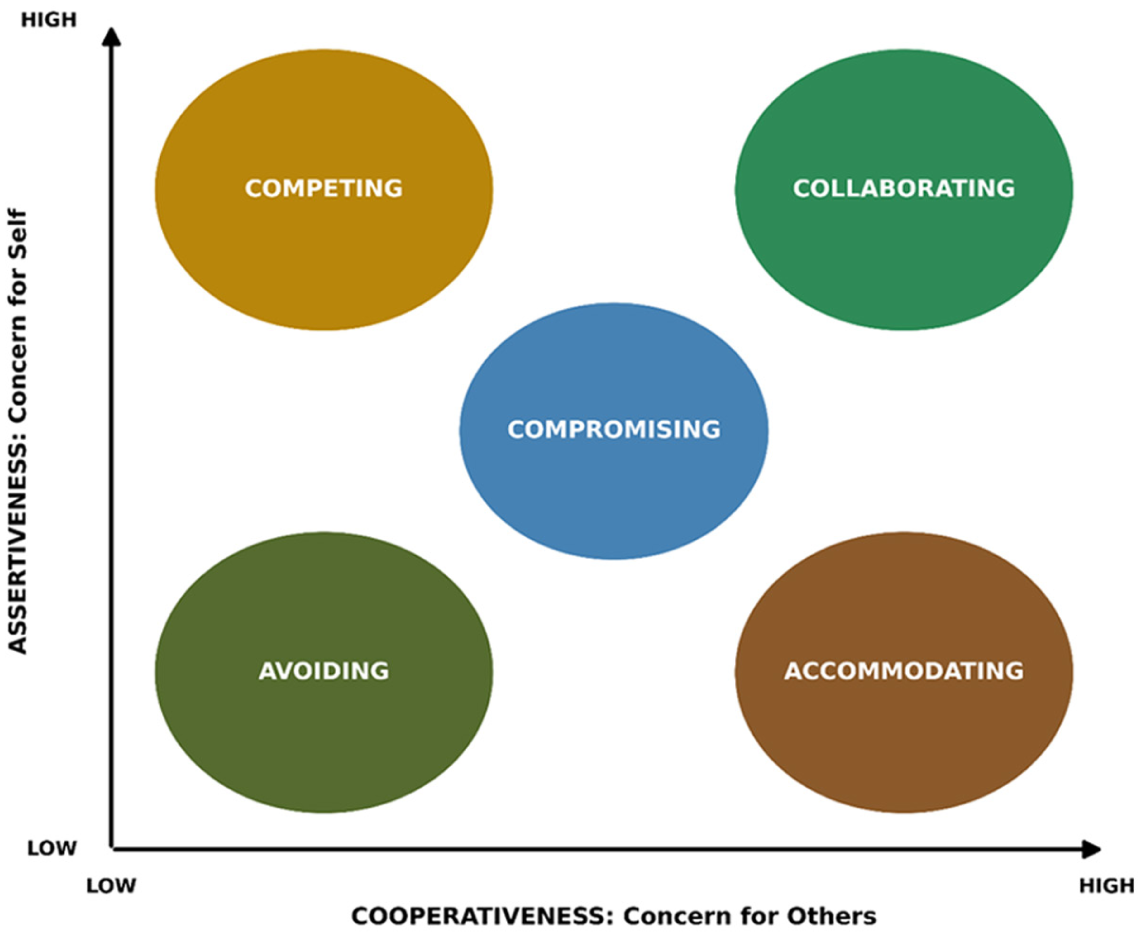
Two-dimensional model of conflict-handling behavior.
Using CAT, Giles (1973) explained how individuals adjust their speech, tone, pacing, and interactional behavior during social interaction. A central idea in CAT is that speakers may converge to reduce social distance and build rapport, or diverge to maintain distinctiveness, signal disagreement, or reinforce identity (Giles & Ogay, 2007). In conflict situations, these communication choices matter because the same position can be expressed in ways that either escalate tension or support collaboration. CAT is especially relevant in multicultural, hierarchical, and emotionally charged situations where how something is communicated is as important as the message itself (Coupland et al., 1991). It helps students examine relational dynamics that TKT alone does not fully explain, including how tone, formality, or communication style can affect perceived respect, power, and openness during disagreement.
The value of pairing TKT and CAT lies in their complementary focus. TKT helps students identify what conflict approach is being taken, whereas CAT helps them analyze how that approach is communicated. Together, the theories support analysis of both behavioral and communicative dimensions of conflict. This integrated focus is especially useful in management education, where conflict competence depends on choosing an appropriate conflict mode and communicating that choice effectively across differences in culture, status, and perspective. This emphasis on conflict communication also aligns with scholarship on teaching active listening and conflict expression in management education (Spataro & Bloch, 2018; Todorova & Barbuto, 2024).
Learning Objectives
Completing this exercise helps students navigate conflicts and leadership challenges using key concepts in practical situations. Specifically, students will be able to do the following:
Identify the primary assumptions and key concepts of TKT and CAT and explain how each theory informs conflict analysis.
Select and justify an appropriate conflict mode for a workplace scenario while analyzing how communication accommodation can strengthen or weaken that response.
Apply TKT and CAT to a role-play scenario by demonstrating theory-based choices in team presentations and performances.
Evaluate the strengths and limitations of each theory and reflect on how their own communication styles, leadership behaviors, and conflict responses compare with the theories.
These objectives are integrated throughout the activity to connect background literature with each phase of the exercise and final debrief. This alignment reinforces the relationship between theory, experiential learning, and reflection while encouraging deeper critical thinking.
Instructions for Implementing the Exercise
This 90-minute exercise immerses students in active learning and the application of two management theories: TKT and CAT. The exercise should be introduced after students have a foundational understanding of management or leadership principles. This approach helps students apply TKT and CAT effectively during the exercise, enhancing conflict resolution skills.
Instructors should begin by explaining the purpose and relevance of the exercise to help students understand its value, remain engaged, and connect it to real-world applications. Setting the stage is critical: students should understand conflict is not inherently negative and that effective leaders should recognize behavioral patterns and communication strategies when handling conflict (Giles & Ogay, 2007; Rahim, 2011).
Before beginning, the instructor should review the theory handout (Appendix C), clarify instructions, and prepare prompts (Appendix D). To keep the 90-minute format realistic, students should receive the theory handout before class or at the start of class. The intent is not for students to conduct extensive new research during the session; rather, they review provided theory material, discuss it, and apply it. Instructors can adjust their involvement based on class dynamics, stepping in for clarification or stepping back to give teams autonomy. For instructors seeking a fully asynchronous version, a complete step-by-step asynchronous adaptation is provided in Appendix E.
Logistics and Preparation
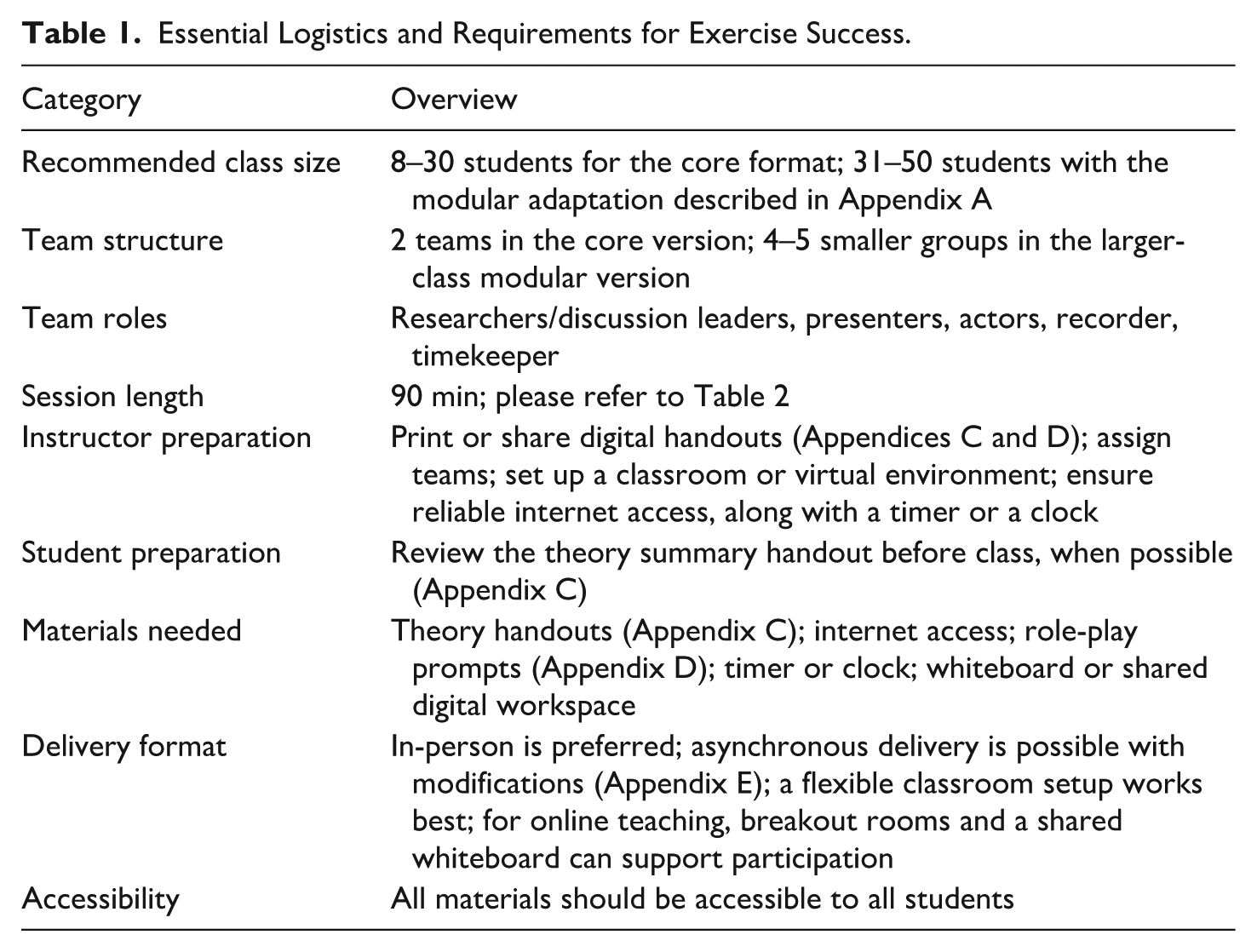
To ensure successful implementation of the exercise, Table 1 summarizes the key logistics, including preparation, setting requirements, materials, team roles, and a detailed timing breakdown. For more detailed information, please refer to Appendix A.
Essential Logistics and Requirements for Exercise Success.
Step-by-Step Facilitation Guide
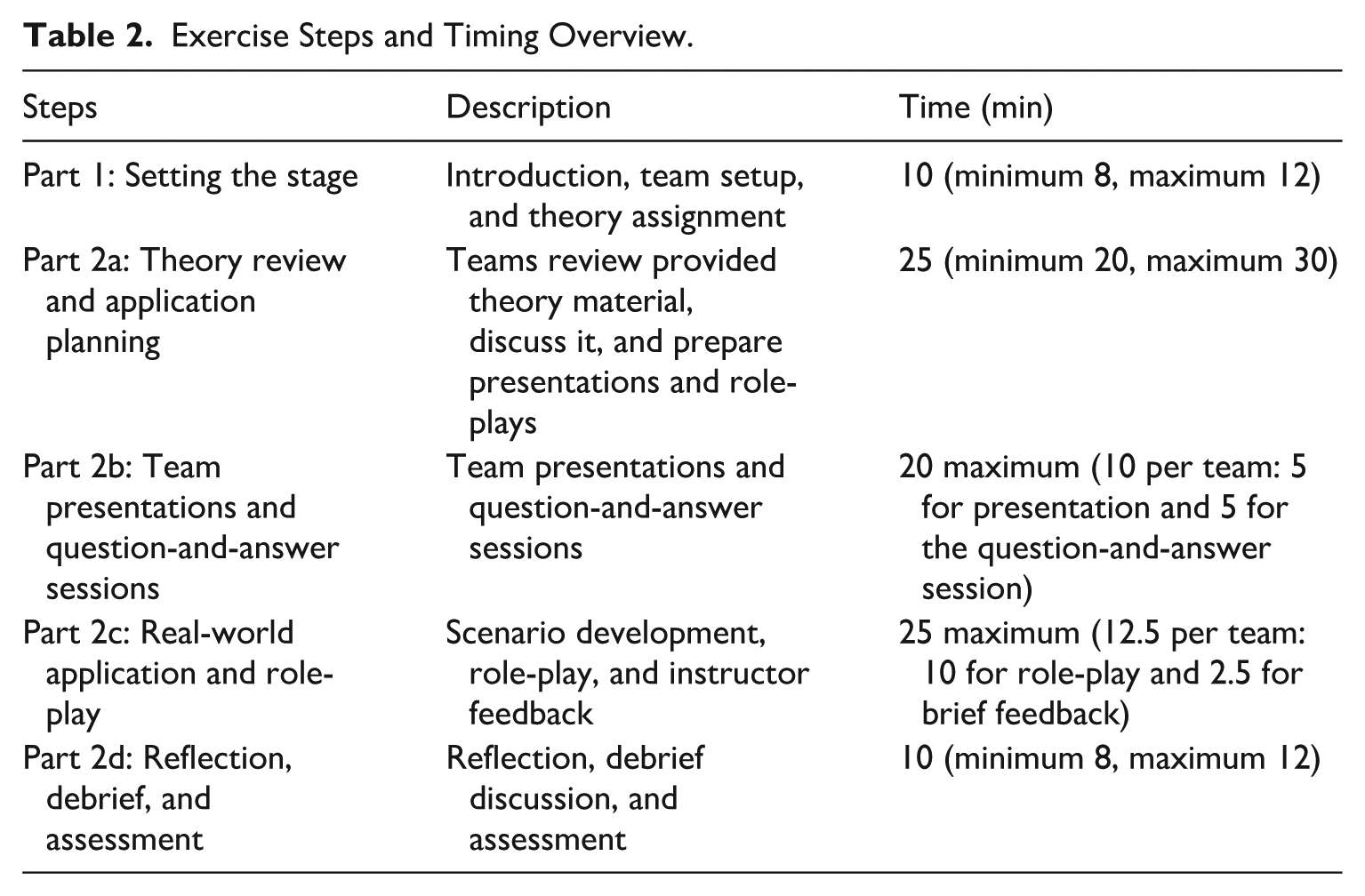
To provide an overview, Table 2 summarizes the key steps and suggested timings for this exercise. For a more detailed guide, including task instructions and timing, please refer to Appendix B.
Exercise Steps and Timing Overview.
Navigating Common Challenges in Experiential Learning
Experiential and team-based classrooms can present some challenges such as unequal participation, where some students may dominate while others remain passive. Assigning roles or rotating speakers can support balanced participation by scaffolding group interaction. Another common challenge is applying theory in real-world contexts. In experiential formats, this can be addressed through strategies such as offering simplified versions of key ideas or using teach-back, where students explain concepts to peers in their own words to deepen understanding and retention (Bransford et al., 2000). Peer teaching, question-and-answer sessions, and role-play also strengthen communication, memory, and critical thinking (Jehn, 1995).
Without structure, team discussions can drift or feel rushed. Instructors can help by setting a clear agenda, establishing time limits, or assigning a student to track time and keep the group on task (Millis, 2010). In addition, drawing on real conflict situations from work or previous classes can make exercises more meaningful and authentic (A. Y. Kolb & Kolb, 2005).
Role-plays can lack impact without genuine emotional engagement. Instructors can encourage meaningful participation by connecting role-plays to situations students have experienced. This approach helps students engage more fully in the activity, enhancing reflection. Prior teaching exercises in Management Teaching Review (MTR) similarly use role-play to help students synthesize theory, explore leadership practice, reduce role-play apprehension, and adapt active learning to online settings (Afota & Robinson, 2023; Donovan & Townsend, 2018; Egan, 2024; Gibson et al., 2018). Positioning this exercise within that stream highlights both its fit with MTR and its distinctive contribution: integrating conflict behavior with communication accommodation in one classroom activity.
Reflection can be challenging for some students, especially those unsure how to begin. Many of these obstacles stem from a lack of structure or meaningful engagement. Sentence starters or structured prompts can make reflection more accessible and productive (Ash & Clayton, 2009). The approach may address those barriers through scaffolding and flexible formats, such as clear time limits, theory-specific prompts, and shared responsibility within teams (Fink, 2013).
Integrating Theory With Classroom Flexibility
Building on this integrated foundation, this exercise is adaptable across (a) cross-cultural classrooms, where CAT’s emphasis on communication adjustment is especially relevant (Gudykunst, 2004); (b) graduate-level leadership programs, using executive conflict scenarios; and (c) online settings, using recorded or asynchronous interaction.
Instructors who prefer a less dense implementation can use a modular version of the exercise. For example, some groups may focus on TKT while others focus on CAT, with integration taking place in the debrief. This option is particularly effective in larger classes or when students need additional scaffolding. The core version retains the integrated approach because it allows students to compare theory, communication, and behavior in one exercise, while the modular option provides flexibility without sacrificing the learning goals.
The exercise’s adaptable format, characterized by clarity, flexibility, and layered learning, makes it well-suited for a variety of class sizes, educational levels, and teaching methods. These features align with experiential learning principles emphasizing adaptability and real-world application (D. A. Kolb, 1984). This exercise is effective because it connects theory with direct experience. It follows D. A. Kolb’s (1984) experiential learning cycle, providing a concrete experience (role-play), reflective observation (debrief and written reflection), abstract conceptualization (theory review and comparison), and active experimentation (scenario planning and performance). Instead of merely discussing theory or analyzing case studies, students actively apply concepts, deepening understanding and building practical skills. This experiential approach connects complex concepts to real-world leadership, an area occasionally overlooked in some conventional conflict exercises.
Debriefing the Exercise for Lasting Impact: Making It Stick
To maximize the exercise’s impact, effective debriefing is crucial. Debriefing links interactive experiences to deeper learning, helping students connect theory with their communication and leadership styles. Although no theory captures every nuance of real-world situations, research-based theories provide valuable frameworks for application. This exercise blends theory with direct experience through role-play, guided reflection, and scenario resolution, highlighting the interdependence of theory and practice within a holistic learning experience.
Two key elements related to the learning objectives are as follows:
Applying theory to real-world scenarios through presentations and role-playing activities.
Reflecting on personal communication styles, leadership behaviors, and conflict resolution strategies informed by relevant theories.
By applying frameworks such as TKT and CAT, students see how theory enhances real-world decision-making.
Instructors can evaluate whether students achieved the learning objectives using a simple rubric for presentations and role-plays, theory-based debrief questions, and a brief written reflection completed after class. Appendix B includes sample criteria and prompts instructors may adopt or adapt. These assessment tools help instructors determine whether students accurately identified a conflict mode, recognized communication accommodation strategies, justified their choices, and reflected meaningfully on leadership implications. Together, these assessment elements provide observable indicators of student learning aligned with the exercise objectives.
Initially, a couple of students were hesitant regarding role-playing, a common reaction to experiential exercises. However, with clear instructions, a supportive environment, and encouragement, they quickly became more comfortable and engaged. This pattern is consistent with role-play research suggesting that structure and thoughtful design can reduce apprehension and support participation (Donovan & Townsend, 2018). Observations from past sessions show that the exercise captures students’ attention, as evidenced by enthusiasm and active participation during the activity and in reflections afterward. This engagement supports learning and encourages deeper self-examination of communication strategies and leadership behaviors.
In addition to these assessment indicators, instructor experience can provide insight into how students engage with the exercise. As an instructor, I have found this exercise to be among the most engaging and impactful. Some students seem surprised at how quickly TKT and CAT resonate when applied to real-world conflict scenarios. The role-play activities produce genuine reactions that spark dynamic discussions. These discussions provide a critical platform for reflection, allowing students to assimilate theories and apply them to leadership practices.
To maintain focus and align with learning objectives, instructors should guide students through each step. Targeted questions—such as “How does this strategy apply to the leadership theories we have discussed?”—connect practice to theory and reinforce key concepts. Thoughtful debriefing deepens understanding and fosters ongoing dialogue, critical thinking, and skill development beyond the classroom.
Conclusion
The exercise offers students a hands-on opportunity to apply the core principles of TKT and CAT through experiential learning. By engaging in conflict scenarios, students deepen their understanding of communication, leadership, and conflict management. Role-playing and presentations reinforce these concepts while promoting reflection on communication styles and conflict resolution strategies, bridging theory and practice. More importantly, the exercise helps students diagnose and handle workplace conflict rather than simply recalling theory. As students navigate the complexities of interpersonal conflict, they develop essential skills in communication, collaboration, and leadership, competencies that are crucial for success in professional environments, especially those requiring teamwork and diversity (Ury, 1993; Whetten & Cameron, 2016). The exercise fosters cognitive learning and personal growth, cultivating a classroom culture where conflict is viewed as an opportunity for insight and leadership development. Its adaptable format supports effectiveness across diverse academic settings and delivery methods.
Footnotes
Appendix A
Detailed Logistics, Preparation, and Resources for Exercise Success.
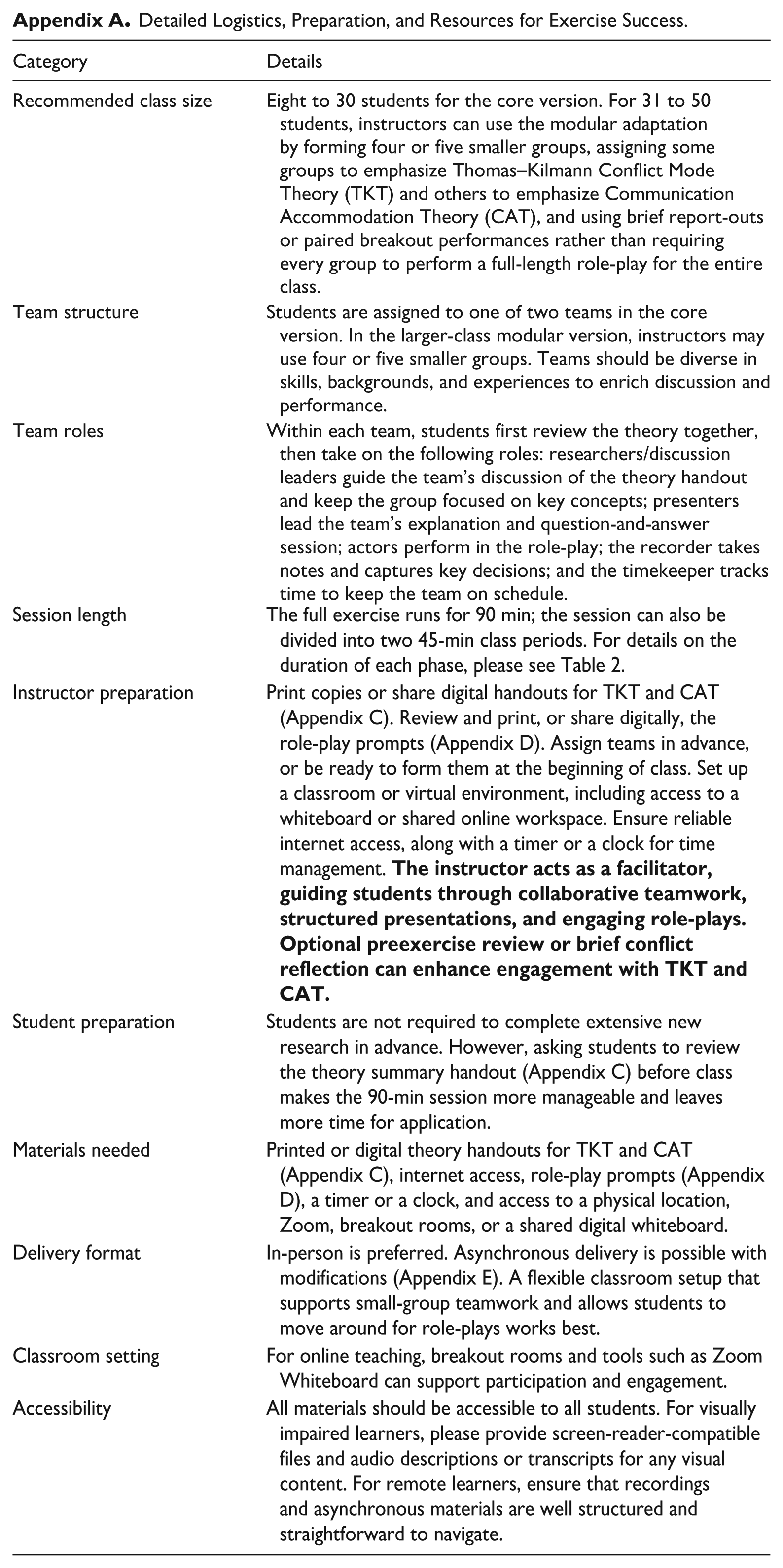
| Category | Details |
|---|---|
| Recommended class size | Eight to 30 students for the core version. For 31 to 50 students, instructors can use the modular adaptation by forming four or five smaller groups, assigning some groups to emphasize Thomas–Kilmann Conflict Mode Theory (TKT) and others to emphasize Communication Accommodation Theory (CAT), and using brief report-outs or paired breakout performances rather than requiring every group to perform a full-length role-play for the entire class. |
| Team structure | Students are assigned to one of two teams in the core version. In the larger-class modular version, instructors may use four or five smaller groups. Teams should be diverse in skills, backgrounds, and experiences to enrich discussion and performance. |
| Team roles | Within each team, students first review the theory together, then take on the following roles: researchers/discussion leaders guide the team’s discussion of the theory handout and keep the group focused on key concepts; presenters lead the team’s explanation and question-and-answer session; actors perform in the role-play; the recorder takes notes and captures key decisions; and the timekeeper tracks time to keep the team on schedule. |
| Session length | The full exercise runs for 90 min; the session can also be divided into two 45-min class periods. For details on the duration of each phase, please see Table 2. |
| Instructor preparation | Print copies or share digital handouts for TKT and CAT (Appendix C). Review and print, or share digitally, the role-play prompts (Appendix D). Assign teams in advance, or be ready to form them at the beginning of class. Set up a classroom or virtual environment, including access to a whiteboard or shared online workspace. Ensure reliable internet access, along with a timer or a clock for time management. |
| Student preparation | Students are not required to complete extensive new research in advance. However, asking students to review the theory summary handout (Appendix C) before class makes the 90-min session more manageable and leaves more time for application. |
| Materials needed | Printed or digital theory handouts for TKT and CAT (Appendix C), internet access, role-play prompts (Appendix D), a timer or a clock, and access to a physical location, Zoom, breakout rooms, or a shared digital whiteboard. |
| Delivery format | In-person is preferred. Asynchronous delivery is possible with modifications (Appendix E). A flexible classroom setup that supports small-group teamwork and allows students to move around for role-plays works best. |
| Classroom setting | For online teaching, breakout rooms and tools such as Zoom Whiteboard can support participation and engagement. |
| Accessibility | All materials should be accessible to all students. For visually impaired learners, please provide screen-reader-compatible files and audio descriptions or transcripts for any visual content. For remote learners, ensure that recordings and asynchronous materials are well structured and straightforward to navigate. |
Appendix B
Appendix C
Appendix D
Appendix E

Author Contributions
No other individuals contributed substantially to this work.
Funding
The author received no financial support for the research, authorship, and/or publication of this article.
Declaration of Conflicting Interests
The author declared no potential conflicts of interest with respect to the research, authorship, and/or publication of this article.