







Abstract
This article introduces an experiential learning exercise that uses mind mapping as a tool to develop oral communication skills among MBA students. Students first present their thought process through a collaborative mind map (“how” of a presentation) as a group before moving on to a content-rich formal presentation (“what” of a presentation). Both iterations are video recorded, and students rework their mind maps after the first feedback. The exercise integrates individual communication practice with teamwork, delegation, and reflection. Framed within Kolb’s Experiential Learning Cycle and cognitive load theory, the activity highlights the innovative use of mind maps for iterative oral communication improvement. The exercise is useful in a business communication course both at the undergraduate and post-graduate levels.
Business schools emphasize analytical and technical knowledge, but employers consistently note that MBA graduates often lack oral communication and soft skills such as teamwork and delegation or the knowledge of how this is a crucial competency to be built furthermore (Andrews & Higson, 2008; Fletcher & Thornton, 2023; Graduate Management Admission Council [GMAC], 2025; Robles, 2012; Vargas-Saritama et al., 2025). Research also notes that curricular interventions for MBA students to deliver structured, impactful oral presentations and build human competencies are not strong (Thornhill-Miller et al., 2023). Oral communication is not only about speaking clearly; it is central to leadership, persuasion, and collaborative problem-solving (Loyless, 2023). Traditional instruction often separates content organization (writing outlines, making slides) from delivery practice, leading to fragmented skill development, and hence requires an equally intentional pedagogical design. Therefore, designing a pedagogic strategy that positions mind maps as mediating tools between cognitive organization and rhetorical performance is central to this experiential narrative.
This teaching note presents a classroom exercise where students construct mind maps in teams, present them in video-recorded settings, receive peer/faculty feedback, and iteratively refine their ideas into more structured and polished oral presentations. While the use of mind maps for coherent organization is evidenced in research (Grant & Archer, 2019; Orlova, 2017), this narrative triangulates iteration, team-based oral delivery, and video-supported reflection in management learning. By requiring students to articulate transitions, hierarchies, and relationships directly from the map, the activity makes structural coherence audible, helping learners understand how organized thinking translates into clearer, more persuasive oral communication.
A mind map organizes information radially from a central concept. Key themes are represented as labelled branches extending from the core image. These primary branches then give rise to smaller, related sub-topics, creating a structured yet fluid network of ideas and their connections (Budd, 2004). Mind maps have been widely used in education to aid reading comprehension, brainstorming, and memory retention (Buzan, 2024; Nesbit & Adesope, 2006). However, their integration into oral communication pedagogy, particularly in iterative and collaborative formats, remains underexplored. This exercise addresses this gap by positioning mind maps not just as content organizers but as scaffolding tools for speaking improvement. Mind mapping provides a bridge between ideation and presentation by allowing students to visualize and structure their thoughts in a non-linear, yet coherent, manner, while also working closely with team members.
The exercise was part of an MBA business communication course. The exercise can be best replicated in business communication courses that provide scope for sustained, iterative development of speaking and presentation skills, alongside incidental skills like teamwork and collaboration. However, this can also be replicated in courses that include assessment designs like structured group presentations in courses on leadership, strategy, and organizational behaviour too.
Theoretical Foundation
This exercise is grounded in complementary theoretical frameworks that justify its use for developing both oral communication and teamwork competencies in management education. The activity is built on the foundation of David Kolb’s (1984) Experiential Learning Cycle. The structure—presentation, reflection, feedback, and iteration—mirrors Kolb’s four stages. Students engage in a concrete experience (initial presentation of a mind map), undertake reflective observation (peer/instructor feedback and video review), move towards abstract conceptualization (restructuring the map and delivery strategies), and finally, engage in active experimentation (delivering the second, refined presentation). By embedding communication training in Kolb’s cycle, the exercise creates a structured pathway for students to practice oral communication as a skill that evolves through content organization, feedback, and self-reflection rather than a one-time performance.
Mind maps draw strength from cognitive psychology. They externalize mental structures, enabling students to process and recall ideas more effectively during oral delivery. Cognitive load theory (Sweller, 1988) highlights that learners have limited working memory capacity. By offloading structural complexity onto a visual map, students reduce extraneous load, freeing cognitive resources for delivery, persuasion, and engagement. This explains why iterative use of mind maps often results in visibly smoother second presentations.
A growing body of research demonstrates that mind maps enhance learning across disciplines by improving knowledge retention, critical thinking, and even speaking proficiency. For example, Setiawan and Axelina (2023) found measurable gains in speaking ability through structured mind mapping activities. In professional education, mind maps have been shown to improve long-term recall and reasoning in medical contexts (Aljamal et al., 2026) and to support engagement and communication in nursing education (He et al., 2024). Similarly, a systematic review of language learning highlights their positive role in enhancing speaking, vocabulary, and learner confidence (Jun & Jamaludin, 2022).
Despite these findings, most research situates mind mapping in language learning or content mastery rather than as a scaffold for oral communication. This creates a clear pedagogical gap: While evidence supports mind maps as tools for comprehension and fluency, their potential for fostering team-based presentation skills, rhetorical development, and soft skill integration in business schools is a fertile ground for pedagogic exploration. The present exercise addresses this gap by combining cognitive structuring with collaborative oral practice, thereby offering a novel, evidence-informed approach to business communication pedagogy.
Learning Objectives
As a part of this exercise, mind maps as a strategy were introduced to learners not merely as a planning artifact, but as a blueprint for oral delivery: Each branch corresponds to a spoken move in the presentation. Students articulate relationships between ideas verbally and navigate their conceptual pathways in real time. Presenting the mind map was equivalent to translating visual structure into spoken transitions. This approach serves as a mediating tool between cognitive organization and oral performance, fundamentally shifting learner focus from reading or rehearsing scripted content to actively producing spontaneous spoken discourse. By repeatedly tracing visual pathways and verbalizing connections, students develop critical oral delivery skills like adaptability in pacing, clarity in explaining complex relationships, and confidence in speaking without verbatim text. The mind map thus becomes both a cognitive organizer and a performance tool, training students to think and speak simultaneously. Following feedback from peers and instructors, learners get an opportunity to refine the coherence of their content for the final presentation. At the conclusion of this exercise, students will be able to:
Speak from visual schema rather than slides or notes.
Distinguish between presentation structure (how) and content (what) during delivery.
Reflect critically on their own speaking and teamwork strategies through video-based self-analysis.
Instructions to Run the Exercise
Overview
This two-iteration exercise spans approximately 1 week, with clear delineation between in-class and out-of-class group work. Students receive preliminary in-class instruction on mind mapping techniques and Belbin team roles (Aritzeta et al., 2007; Belbin, 2014) prior to the exercise. Belbin team roles are useful to reiterate and structure team collaboration in a manner that supports organized idea development, clear speaker transitions, and a coherent oral delivery. Topics are assigned in advance, drawing from course materials including case studies, lectures, and assigned readings, tailored to the specific course context. They should ideally be drawn from MBA-relevant contexts to ensure both relevance and challenge. Instructors may distribute varied topics across the class to promote diversity of thought. This can be based on some instructional materials discussed in the course. Rubrics are explained at the outset to guide both peer-feedback and self-monitoring. This ensures learners are able to align their preparation, delivery, and revision strategies with the assessed learning objectives.
In this two-part exercise, the first part of the exercise spans three sessions (depending on cohort strength) of approximately 75–90 min each. This phase is dedicated solely to the presentation of mind maps, the oral presentations, and the provision of feedback. In the first iteration, teams walk the audience through their mind map, explaining the logic, sequencing, and role handovers and rhetorical flow, while the second iteration is for the final, graded presentation; both are video recorded. Presentations are video recorded to facilitate reflection. Simple solutions such as smartphones or laptops with webcams are sufficient. Recordings provide students with opportunities for self-assessment and help instructors track growth across iterations. Students often notice non-verbal cues, filler words, and delivery issues only when they watch themselves, which increases self-awareness and reflection in action (Chang, 2019; Dutta et al., 2023). All preparatory works, including the initial and revised brainstorming, mind map creation, and slide deck preparation, are completed by students outside of class during the intervening periods between sessions. Working in teams, students develop mind maps that facilitate idea generation and conceptual organization for their presentations.
Oral Delivery Iterations
The first stage involves an oral presentation of these mind maps, which is video recorded for iterative feedback. Students present their preliminary ideas and demonstrate how concepts transition and connect within their mind maps. They also explain the role transitions in the presentation of the ideas. Slides or argumentation is not presented at this stage. Following this initial presentation, students receive feedback from both peers and the instructor. Using this feedback, teams further revise and refine their content before proceeding to the second stage, the formal presentation on their assigned topic. Therefore, presenting the architecture of ideas enables learners to internalize the logical argument, strengthening adaptive delivery in the final presentation.
To begin with, a board, flipchart, or large sheets of chart paper with coloured chalks or markers are recommended. The use of colours allows students to distinguish between main ideas, sub-branches, and supporting evidence within the mind map. This aligns with the dual coding theory (Paivio, 1986) by visually reinforcing verbal content. Ample wall or board space enables teams to create large, visible maps that can be easily shared with the class during presentations (see Supplemental Image 1). While the exercise encourages manual, hand-drawn maps to promote group brainstorming and tactile engagement, digital alternatives (like Excalidraw and Coggle) can be incorporated in hybrid or online classrooms.
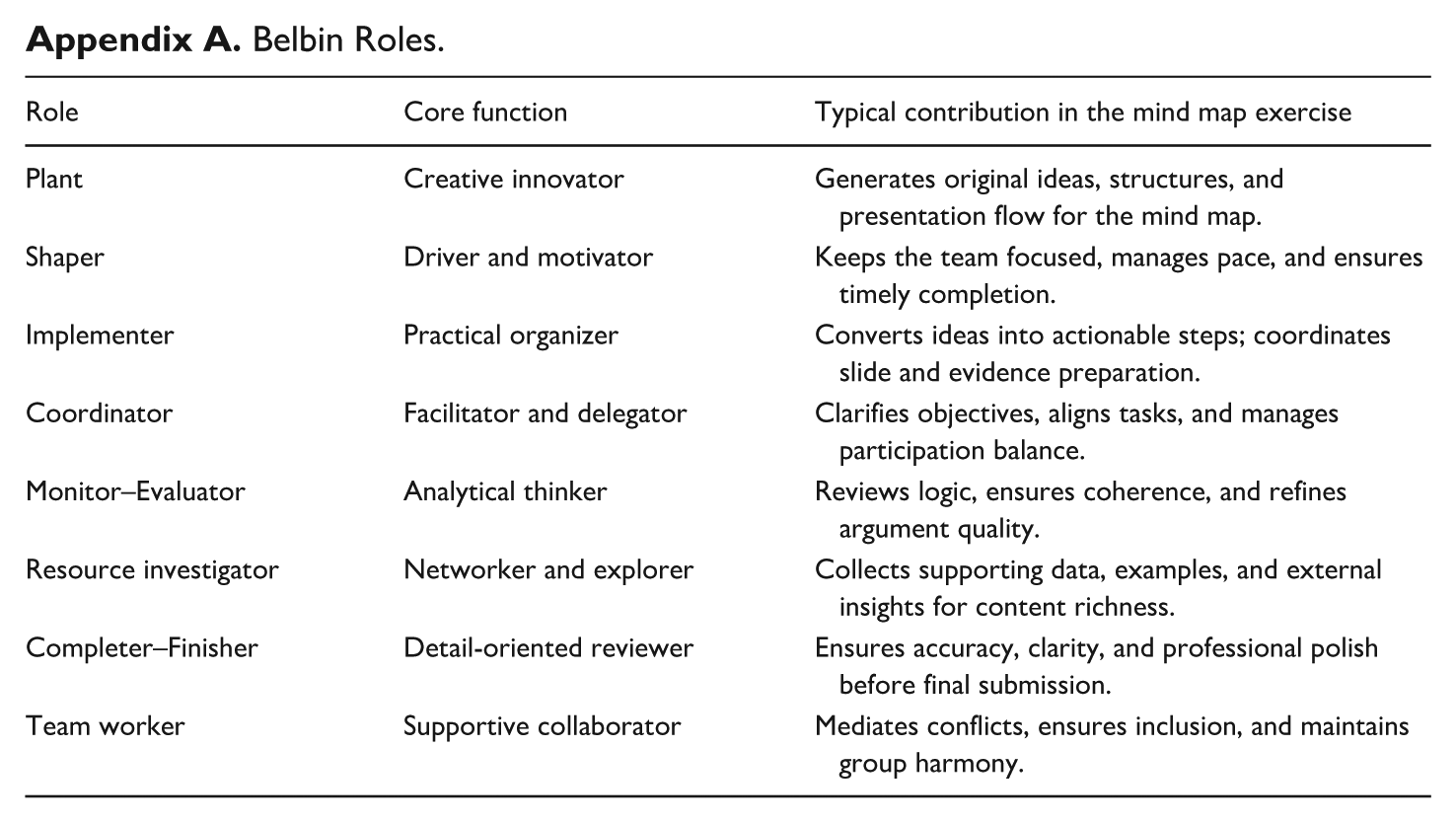
As collaboration with teams is an important learning objective, team division and role clarity must be clearly explicated. Teams of 6–7 students ensure sufficient diversity of ideas while maintaining manageable group sizes and presenter roles (Appendix A). Instructors may pre-assign teams and Belbin roles (Aritzeta et al., 2007; Belbin, 2014) to simulate real workplace diversity. In groups of six, one or more roles may be combined (e.g., coordinator and completer–finisher), and students are encouraged to rotate or share responsibilities during the two iterations of the task. The purpose is not to impose strict hierarchies but to promote awareness of role diversity, interdependence, and accountability within teams.
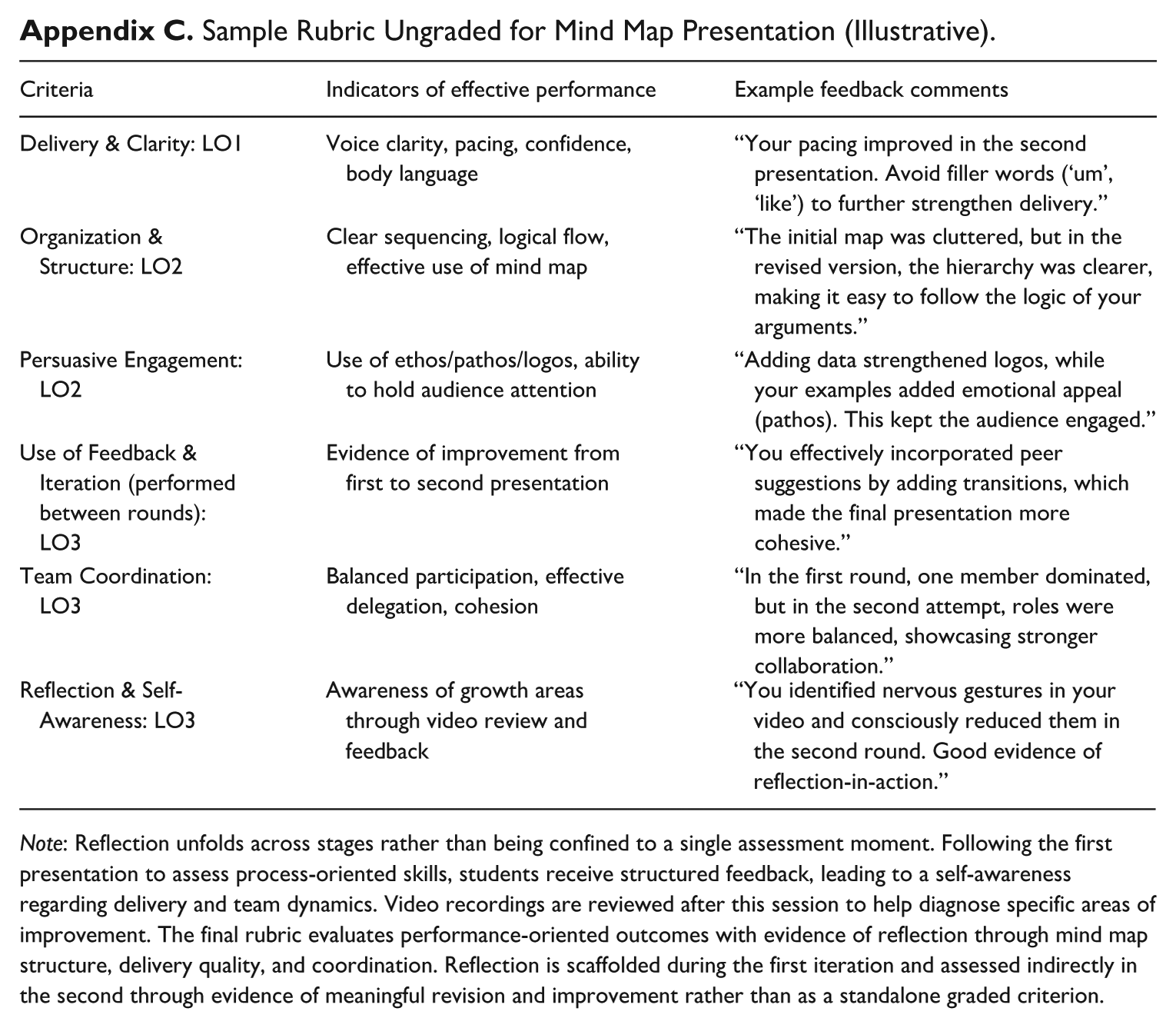
Preparation time for the first mind map should be 1 day to encourage focus and collaboration under constraints. Clear time allocations for in-class presentations (10–12 min) and feedback sessions (5–8 min) should be announced in advance. Structured timing ensures discipline and fairness (see Appendix B), while mimicking workplace constraints. Both peer and instructor feedback are encouraged, focusing on delivery and organization, and rhetorical insights. Although the first iteration is ungraded, a rubric for feedback is essential (see Appendix C).
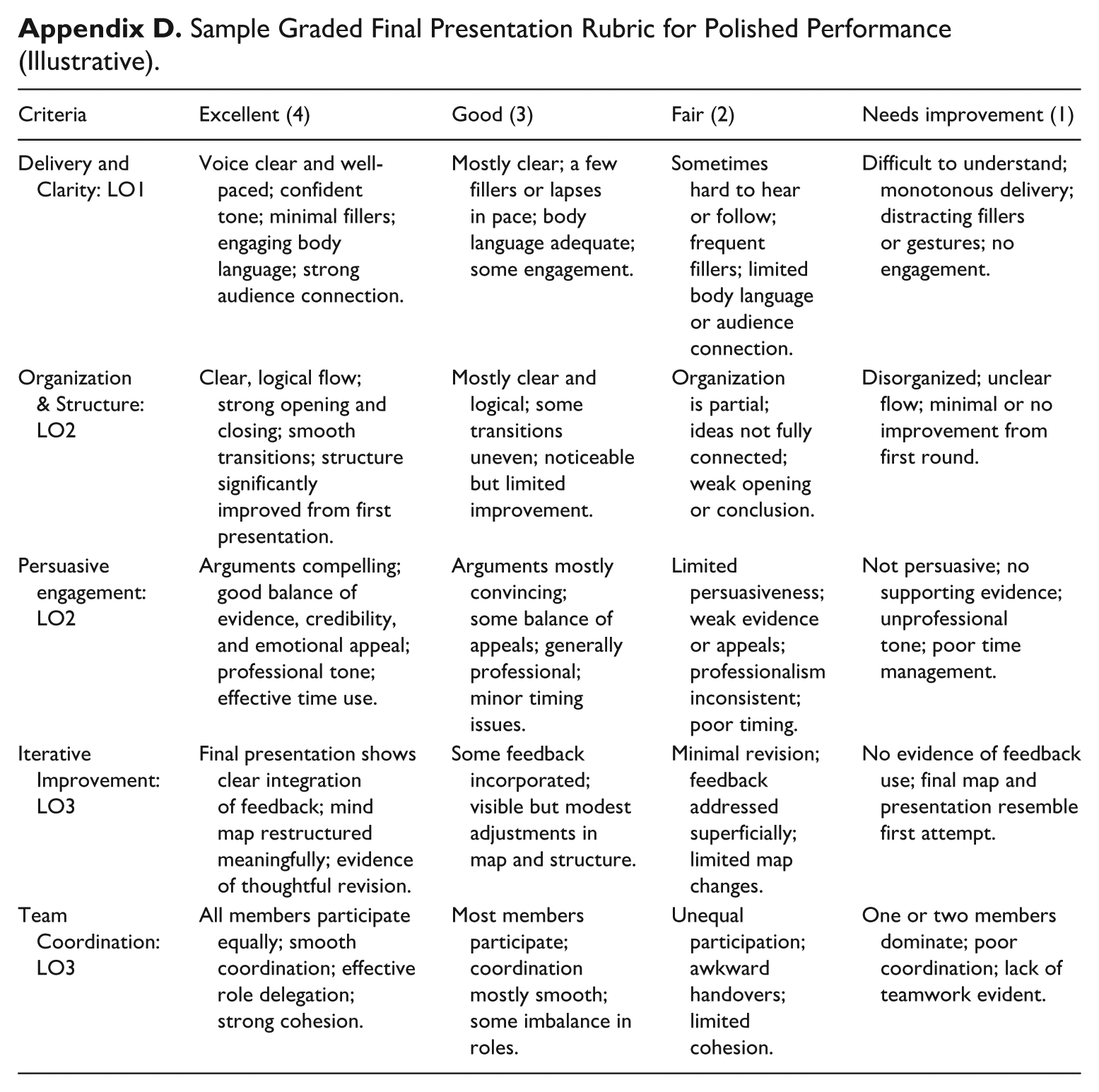
The final presentation is graded work (see Appendix D). The formative and summative rubrics are intentionally differentiated to demonstrate a developmental progression of the exercise. Both the rubrics include overlapping criteria; however, their expectations move from exploratory rehearsal in the first iteration to polished execution in the second iteration. Developed as a diagnostic design rubric, each rubric is mapped to the same learning objectives to ensure constructive alignment across iterations. Both rubrics are shared with students at the outset of the exercise to guide peer-feedback, as well as self-reflection. Peers are instructed on the principles of constructive criticism and encouraged to anchor their feedback in the rubric criteria to ensure their commentary remains specific. To promote fairness and psychological safety in peer feedback, instructor intervention must be ensured to maintain specificity and alignment with rubric criteria.
Debriefing
During debriefing, instructors explicitly revisit rubric criteria to help students articulate how specific changes in structure, delivery, or teamwork contributed to improved performance between two iterations. The debriefing process helps students consolidate their learning by explicitly linking the activity learning outcomes (LO) to the objectives of the exercise. Students see how mind maps allowed them to organize their ideas into clearer, more coherent structures (LO1), and how the first round of presentations highlighted the process of delivery while the second round emphasized content (LO2). The act of revising their mind maps and comparing two iterations of their presentations reinforces the value of feedback and demonstrates how even small adjustments in structure or delivery can significantly improve oral communication (LO3).
At the same time, reviewing video recordings and discussing peer and instructor feedback develop greater self-awareness of both individual delivery and group dynamics. The teamwork dimension becomes visible when students reflect on how initial brainstorming may have been uneven but improved through clearer role division and smoother coordination in the second round (LO3). By tying these experiences to targeted reflection questions (questions for debriefing can be seen in Appendix E), the debriefing stage makes explicit that the exercise is not just about producing a single presentation, but also about cultivating transferable skills in organizing, presenting, collaborating, and continuously improving.
Reflection is central here. Students learn from reviewing their own recordings, from seeing how their mind maps evolve, and from listening to peer feedback. To guide this process, structured debriefing questions help focus attention on growth areas and highlight lessons that can be carried into other professional contexts.
Conclusion
This exercise offers a replicable teaching model for business communication courses that responds directly to the persistent gap between technical knowledge and oral communication competence in MBA classrooms. By incorporating mind maps into presentation training, the activity demonstrates a practical way to integrate visual thinking tools into oral communication pedagogy, making the process of structuring ideas as important as the content delivered. A writing reflection task after the completion of the exercise revealed that learners benefitted from differentiating between the what and how of oral presentations, making their second iterations easier and more confident. Many students described how presenting from a mind map required them to articulate the logic of their ideas more deliberately, particularly in terms of sequencing, transitions, and emphasis, rather than relying on pre-scripted content. This shift appeared to strengthen their ability to communicate key ideas concisely and with greater clarity.
A second recurring theme was the value of iteration. Students noted that the contrast between the initial and final presentations made improvements in organization, coherence, and delivery more visible, with early-stage gaps in structure becoming more apparent during the first presentation. These gaps were subsequently addressed through revision, resulting in more logically connected and focused final presentations. Feedback emerged as a critical mechanism within this process. Students frequently indicated that peer and instructor feedback helped them identify weaknesses in how ideas were structured and connected, prompting more deliberate alignment between subtopics and overall argument flow. In several cases, reflections suggested that what initially appeared as loosely connected ideas evolved into more cohesive and integrated presentations through feedback-driven revision. These observations are presented illustratively to capture student experience and are not intended as formal evaluative evidence of learning outcomes.
These reflections clearly demonstrate that the mind map approach creates a bridge between cognitive organization and rhetorical delivery: Students learn to see how clarity in planning supports persuasiveness in speaking. In doing so, the exercise moves beyond the conventional use of mind mapping as a note-taking or brainstorming tool and extends it into the realm of active communication pedagogy. This contribution enriches the literature on experiential learning and business communication by showing how mind maps, feedback, iteration, and teamwork can be combined to develop communication skills that are transferable, reflective, and aligned with workplace demands.
Supplemental Material
sj-docx-1-mtr-10.1177_23792981261454372 – Supplemental material for Bridging Structure and Delivery: A Mind Map–Based Approach to Oral Communication in Management Education
Supplemental material, sj-docx-1-mtr-10.1177_23792981261454372 for Bridging Structure and Delivery: A Mind Map–Based Approach to Oral Communication in Management Education by Gaana Jayagopalan in Management Teaching Review
Footnotes
Appendix A
Belbin Roles.
| Role | Core function | Typical contribution in the mind map exercise |
|---|---|---|
| Plant | Creative innovator | Generates original ideas, structures, and presentation flow for the mind map. |
| Shaper | Driver and motivator | Keeps the team focused, manages pace, and ensures timely completion. |
| Implementer | Practical organizer | Converts ideas into actionable steps; coordinates slide and evidence preparation. |
| Coordinator | Facilitator and delegator | Clarifies objectives, aligns tasks, and manages participation balance. |
| Monitor–Evaluator | Analytical thinker | Reviews logic, ensures coherence, and refines argument quality. |
| Resource investigator | Networker and explorer | Collects supporting data, examples, and external insights for content richness. |
| Completer–Finisher | Detail-oriented reviewer | Ensures accuracy, clarity, and professional polish before final submission. |
| Team worker | Supportive collaborator | Mediates conflicts, ensures inclusion, and maintains group harmony. |
Appendix B
Appendix C
Sample Rubric Ungraded for Mind Map Presentation (Illustrative).
| Criteria | Indicators of effective performance | Example feedback comments |
|---|---|---|
| Delivery & Clarity: LO1 | Voice clarity, pacing, confidence, body language | “Your pacing improved in the second presentation. Avoid filler words (‘um’, ‘like’) to further strengthen delivery.” |
| Organization & Structure: LO2 | Clear sequencing, logical flow, effective use of mind map | “The initial map was cluttered, but in the revised version, the hierarchy was clearer, making it easy to follow the logic of your arguments.” |
| Persuasive Engagement: LO2 | Use of ethos/pathos/logos, ability to hold audience attention | “Adding data strengthened logos, while your examples added emotional appeal (pathos). This kept the audience engaged.” |
| Use of Feedback & Iteration (performed between rounds): LO3 | Evidence of improvement from first to second presentation | “You effectively incorporated peer suggestions by adding transitions, which made the final presentation more cohesive.” |
| Team Coordination: LO3 | Balanced participation, effective delegation, cohesion | “In the first round, one member dominated, but in the second attempt, roles were more balanced, showcasing stronger collaboration.” |
| Reflection & Self-Awareness: LO3 | Awareness of growth areas through video review and feedback | “You identified nervous gestures in your video and consciously reduced them in the second round. Good evidence of reflection-in-action.” |
Note: Reflection unfolds across stages rather than being confined to a single assessment moment. Following the first presentation to assess process-oriented skills, students receive structured feedback, leading to a self-awareness regarding delivery and team dynamics. Video recordings are reviewed after this session to help diagnose specific areas of improvement. The final rubric evaluates performance-oriented outcomes with evidence of reflection through mind map structure, delivery quality, and coordination. Reflection is scaffolded during the first iteration and assessed indirectly in the second through evidence of meaningful revision and improvement rather than as a standalone graded criterion.
Appendix D
Sample Graded Final Presentation Rubric for Polished Performance (Illustrative).
| Criteria | Excellent (4) | Good (3) | Fair (2) | Needs improvement (1) |
|---|---|---|---|---|
| Delivery and Clarity: LO1 | Voice clear and well-paced; confident tone; minimal fillers; engaging body language; strong audience connection. | Mostly clear; a few fillers or lapses in pace; body language adequate; some engagement. | Sometimes hard to hear or follow; frequent fillers; limited body language or audience connection. | Difficult to understand; monotonous delivery; distracting fillers or gestures; no engagement. |
| Organization & Structure: LO2 | Clear, logical flow; strong opening and closing; smooth transitions; structure significantly improved from first presentation. | Mostly clear and logical; some transitions uneven; noticeable but limited improvement. | Organization is partial; ideas not fully connected; weak opening or conclusion. | Disorganized; unclear flow; minimal or no improvement from first round. |
| Persuasive engagement: LO2 | Arguments compelling; good balance of evidence, credibility, and emotional appeal; professional tone; effective time use. | Arguments mostly convincing; some balance of appeals; generally professional; minor timing issues. | Limited persuasiveness; weak evidence or appeals; professionalism inconsistent; poor timing. | Not persuasive; no supporting evidence; unprofessional tone; poor time management. |
| Iterative Improvement: LO3 | Final presentation shows clear integration of feedback; mind map restructured meaningfully; evidence of thoughtful revision. | Some feedback incorporated; visible but modest adjustments in map and structure. | Minimal revision; feedback addressed superficially; limited map changes. | No evidence of feedback use; final map and presentation resemble first attempt. |
| Team Coordination: LO3 | All members participate equally; smooth coordination; effective role delegation; strong cohesion. | Most members participate; coordination mostly smooth; some imbalance in roles. | Unequal participation; awkward handovers; limited cohesion. | One or two members dominate; poor coordination; lack of teamwork evident. |
Appendix E

Funding
The author received no financial support for the research, authorship, and/or publication of this article.
Declaration of Conflicting Interests
The author declared no potential conflicts of interest with respect to the research, authorship, and/or publication of this article.
References
Supplementary Material
Please find the following supplemental material available below.
For Open Access articles published under a Creative Commons License, all supplemental material carries the same license as the article it is associated with.
For non-Open Access articles published, all supplemental material carries a non-exclusive license, and permission requests for re-use of supplemental material or any part of supplemental material shall be sent directly to the copyright owner as specified in the copyright notice associated with the article.
