







Abstract
This experiential exercise immerses students in allocating limited resources across work, health, finances, and relationships while encountering fixed costs and unpredictable events. The version presented here reflects how the activity is most commonly implemented in undergraduate and early graduate management courses. The Burnout Budget illustrates how unfair starting points, depletion, and constrained choices can fuel stress and burnout. The activity draws on Conservation of Resources (COR) theory and experiential learning, and fits within a 40- to 60-min session, adapting easily to undergraduate, graduate, and executive contexts. Students connect firsthand experience to theory by examining tradeoffs, inequality, and recovery. The instructions, materials, and debrief guidance help instructors foster engagement and reflection on resilience and values in management education.
Keywords
Experiential learning connects theory to practice by immersing students in situations that reflect real-world complexity and constraint (D. A. Kolb, 1984; A. Y. Kolb & Kolb, 2005). Games, simulations, and role-plays deepen learning by requiring students to confront trade-offs, uncertainty, and interdependence firsthand, particularly in areas such as cooperation, decision-making, and tacit knowledge development (Conklin & Boulamatsi, 2020; Deutsch, 1949; Humpherys et al., 2021).
Within management education, experiential exercises increasingly emphasize designs that expose students to ambiguity, tension, and competing demands while remaining adaptable across instructional contexts. Recent work in Management Teaching Review demonstrates how such activities can be used to engage students in persuasion and communication challenges in virtual environments (Sackett & Amoroso, 2022). Other experiential designs place students in situations requiring them to navigate conflict, influence, and competing priorities, highlighting how learning emerges through action and reflection rather than scripted outcomes (Dunn, 2024). More recently, role-based simulations have been used to help students explore leadership styles and behavioral flexibility under constraint, reinforcing the value of experiential approaches for developing applied managerial insight (Wooldridge et al., 2025). Collectively, this work underscores the pedagogical value of exercises that mirror the uncertainty and pressure of organizational life while remaining flexible for instructors.
The Burnout Budget builds on this pedagogical approach by immersing students in the challenges of resource allocation, stress, and resilience. Using unequal starting resources, fixed costs, and unpredictable life events, the exercise allows participants to experience the precarious balance among work, health, finances, and relationships. The activity is grounded in Conservation of Resources (COR) theory, which posits that individuals seek to obtain, protect, and build resources, and that stress arises when these resources are threatened or lost (Hobfoll, 1989; Hobfoll et al., 2018). By experiencing resource loss and recovery in real time, students develop an embodied understanding of the dynamics that underlie burnout, tradeoffs, and resilience in organizational life.
Theoretical Foundation
The exercise is grounded in COR theory, which views human behavior through the lens of resource acquisition, protection, and loss. Hobfoll (1989) proposed that individuals strive to retain, protect, and build valued resources, and that stress occurs when these resources are threatened or depleted. The Burnout Budget operationalizes these ideas by placing students in situations where they must allocate limited resources across competing life domains, surfacing the tension between preservation and depletion.
D. A. Kolb’s (1984) experiential learning cycle explains how concrete experience and reflection foster lasting insight. By simulating real-world constraints, the exercise complements COR theory, making resource scarcity both practical and developmental (A. Y. Kolb & Kolb, 2005).
Deutsch (1949) demonstrated that cooperation and competition emerge when outcomes are interdependent, shaping both results and psychological processes. Subsequent classroom research shows that decision-making itself becomes a source of learning when students must navigate competing priorities and interdependence (Conklin & Boulamatsi, 2020).
Finally, the exercise resonates with research on creativity and tacit knowledge. Amabile (1996) and Amabile and Pratt (2016) highlighted how resource availability shapes creativity, while Humpherys et al. (2021) showed that role-play simulations foster tacit knowledge by requiring students to grapple with complex, resource-laden scenarios. In this way, The Burnout Budget highlights the principles of COR while extending experiential research on stress, creativity, and resilience.
Learning Objectives
After completing The Burnout Budget, students will be able to
Exercise Overview
Overview and Timing
The Burnout Budget is a classroom simulation that runs approximately 40 to 60 min. Students allocate tokens representing personal resources across five life domains: Work, Health, Finances, Family/Friends, and Leisure/Recovery. Each domain contains subcategories (e.g., Work includes Required Tasks, Extra Hours, Extra Effort, and Coworker Relationships).
At the start of the exercise, students are intentionally given unequal numbers of tokens to reflect differences in starting resources. Instructors should distribute between 16 and 24 tokens per student (typical range: 18–22), which provides enough resources to meet required fixed costs while still forcing meaningful tradeoffs and vulnerability to loss events.
Rounds include free allocation, introduction of fixed costs, and unpredictable “life events” that alter resource totals. After each round, students rebalance their allocations and record results on their allocation sheet.
Logistics
Setup: 5 min. Rounds: 20 to 25 min. Debrief: 15 to 30 min. Total: 40 to 60 min.
Step-by-Step Instructions
1.
2.
3.
4.
5.
6.
Variations
While the core exercise is designed for whole-class play (all students facing the same sequence of events simultaneously), instructors may adapt it in several ways:
Debriefing and Discussion
Debriefing is critical to helping students connect their game experience with broader management concepts. Instructors should begin by inviting participants to share immediate reactions: Was the game frustrating? Did certain events feel unfair? Did anyone feel “lucky” compared with others? These reflections often spark lively discussion about inequity, chance, and systemic constraints, since students face the same life events but begin the exercise with unequal resources.
Encouraging students to reflect on their emotional responses critically deepens learning and strengthens transfer (Brookfield, 1995). For example, moments of scarcity may trigger frustration, while small unexpected gains often produce outsized relief, mirroring how workers experience resource loss and support in organizational life. Instructors can connect these reactions to COR theory, highlighting loss spirals and recovery dynamics (Hobfoll, 1989; Hobfoll et al., 2018).
Discussion can also highlight the importance of social resources. For example, support from coworkers or family often buffers against losses in the game over time, as cumulative investments in relationships can mitigate later resource shocks, reinforcing the role of social resources in organizational life (Amabile, 1996; Amabile & Pratt, 2016). Similarly, financial or time constraints often forced trade-offs in health and leisure, underscoring the interdependence of these categories.
Discussion Prompts
Which domains received the most consistent investment, and why?
Where did you choose to cut back, and how did that affect later rounds?
How did unexpected events change your allocation strategy?
Looking back, what tradeoffs were most challenging to make?
In what ways does this exercise mirror real-world decisions about work, health, and relationships?
Typical Student Responses
Many students report prioritizing work and finances early, only to experience strain in health or relationships later in the exercise.
Others focus heavily on personal life, which creates short-term satisfaction but leads to financial or career setbacks in later stages.
Students often express frustration when unexpected events undo careful planning, creating “loss spirals” that feel both realistic and stressful.
Instructor Strategies
Encourage students to link their experiences to COR theory, highlighting how stress arises from threatened or depleted resources (Hobfoll, 1989; Hobfoll et al., 2018).
Draw attention to the cumulative effect of tradeoffs, reinforcing that small sacrifices can compound into larger challenges.
Use contrasting student strategies (e.g., one student heavily favoring work, another prioritizing family) as examples for class-wide reflection.
If appropriate, connect the exercise to organizational settings by asking how leaders and HR systems might influence resource allocation at the employee level.
Optional Reflective Assignment
Instructors may ask students to write a short reflection (1–2 pages) describing their decision-making process, what they learned about themselves, and how the exercise relates to workplace stress and resilience. This helps reinforce learning outcomes and provides an opportunity for more personal application.
Student Feedback Summary
Students responded positively to The Burnout Budget, describing the activity as engaging, intuitive, and emotionally resonant (see Appendix D). Many connected the exercise to balancing work, school, finances, and family, noting that it prompted more intentional reflection on how they allocate time and energy. Students also offered constructive feedback, including requests for clearer allocation instructions and additional life-event rounds to enhance realism, while generally agreeing that unequal starting resources reinforced meaningful differences in opportunity and constraint.
Instructor Reflection
Across all pilot sessions, student reactions affirmed the exercise’s ability to make resource scarcity, loss spirals, and tradeoffs tangible. Their questions highlighted areas where a brief clarification on the allocation sheet would facilitate smoother play, and feedback suggested that adding an extra life-event round could improve realism and engagement (see Appendix D). Instructors may further enhance realism by adding one or two additional life-event rounds once students have adjusted to fixed costs, particularly in longer class sessions, as these added rounds tend to amplify cumulative loss spirals and recovery dynamics central to COR theory. Future adaptations may also invite instructors to foreground differences in starting resources more explicitly, such as by pairing the exercise with brief background profiles or self-assessments that prompt discussion of how socioeconomic, time, or support resources vary across individuals. These insights will help refine the exercise and strengthen the clarity of the materials provided to instructors.
Conclusion
The Burnout Budget offers a vivid, firsthand experience that enables students to understand how resource dynamics affect well-being and performance. By linking these trade-offs to the complexity of managerial roles and responsibilities (Cerecedo Lopez, 2025), the game highlights how stress and burnout arise not only from individual choices but also from structural conditions.
The exercise is adaptable across student levels and course contexts, from undergraduate introductions to graduate seminars. It can be scaled in length by adjusting the number of life-event rounds and tailored to online or face-to-face formats. Most importantly, it provides a shared experience that anchors rich classroom discussion about burnout, fairness, resilience, and organizational design.
Footnotes
Appendix A
Appendix B
Appendix C
Appendix
Summary of Student Feedback From Classroom Pilots.
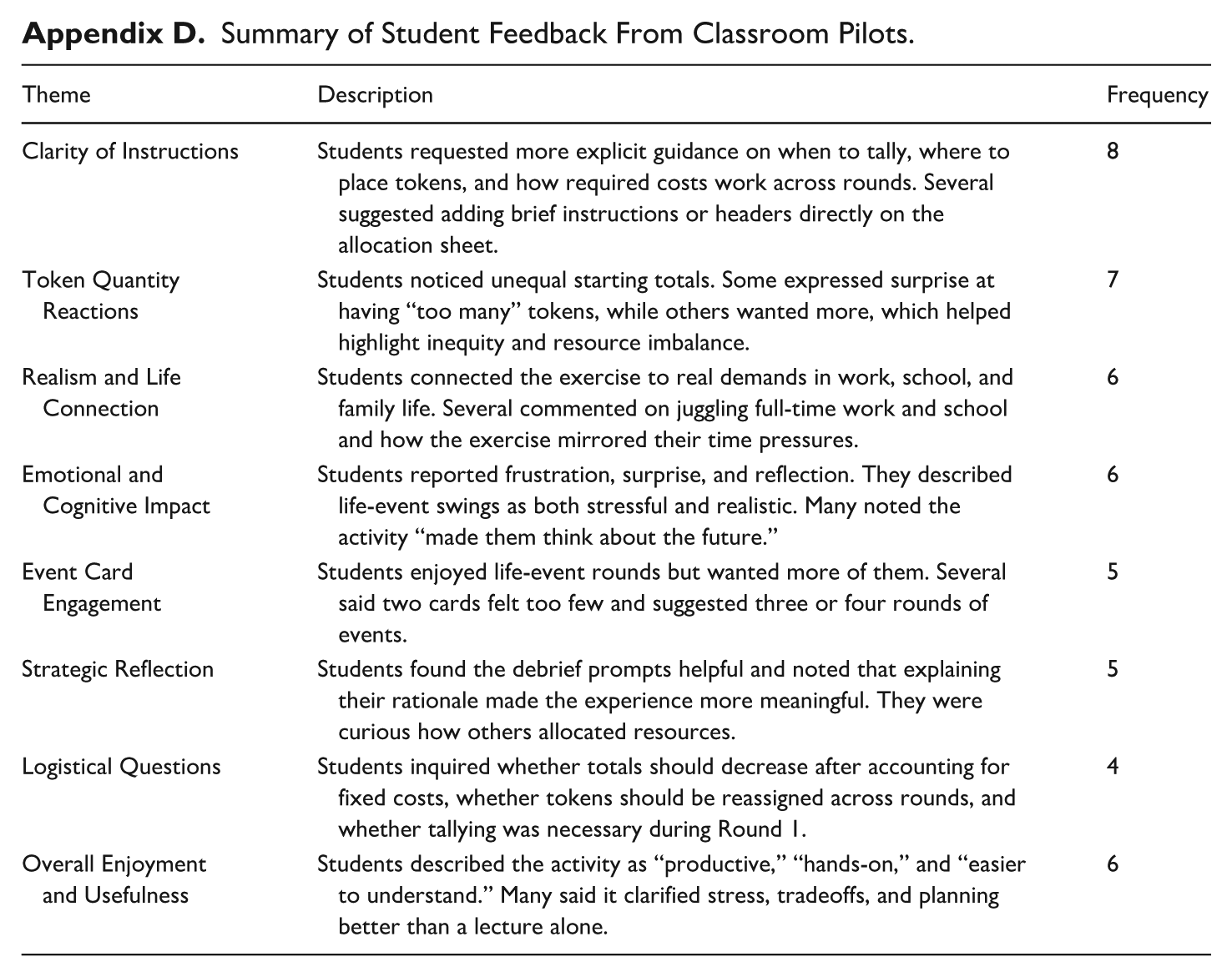
| Theme | Description | Frequency |
|---|---|---|
| Clarity of Instructions | Students requested more explicit guidance on when to tally, where to place tokens, and how required costs work across rounds. Several suggested adding brief instructions or headers directly on the allocation sheet. | 8 |
| Token Quantity Reactions | Students noticed unequal starting totals. Some expressed surprise at having “too many” tokens, while others wanted more, which helped highlight inequity and resource imbalance. | 7 |
| Realism and Life Connection | Students connected the exercise to real demands in work, school, and family life. Several commented on juggling full-time work and school and how the exercise mirrored their time pressures. | 6 |
| Emotional and Cognitive Impact | Students reported frustration, surprise, and reflection. They described life-event swings as both stressful and realistic. Many noted the activity “made them think about the future.” | 6 |
| Event Card Engagement | Students enjoyed life-event rounds but wanted more of them. Several said two cards felt too few and suggested three or four rounds of events. | 5 |
| Strategic Reflection | Students found the debrief prompts helpful and noted that explaining their rationale made the experience more meaningful. They were curious how others allocated resources. | 5 |
| Logistical Questions | Students inquired whether totals should decrease after accounting for fixed costs, whether tokens should be reassigned across rounds, and whether tallying was necessary during Round 1. | 4 |
| Overall Enjoyment and Usefulness | Students described the activity as “productive,” “hands-on,” and “easier to understand.” Many said it clarified stress, tradeoffs, and planning better than a lecture alone. | 6 |

Funding
The authors received no financial support for the research, authorship, and/or publication of this article.
Declaration of Conflicting Interests
The authors declared no potential conflicts of interest with respect to the research, authorship, and/or publication of this article.