






Abstract
This JRA Market Case provides management educators with a replicable experiential exercise that simulates complex managerial decision-making by requiring MBA students to collaborate with Social Work peers to navigate real-world organizational crises. The case engages students in solving a complex, real-world problem faced by a grocery store chain during the COVID-19 pandemic, simulating workplace dynamics that require communication, coordination, and cross-disciplinary decision-making. Grounded in principles of Interprofessional Education, the activity provides a controlled environment in which students can reconcile disciplinary differences, examine decision-making processes, and navigate communication challenges. Through collaborative analysis and structured reflection, participants learn with, from, and about one another while integrating organizational and human-centered perspectives. Thematic insights from student reflections show increased appreciation for interdisciplinary collaboration, reduced stereotypes between the fields, and a deeper understanding of multi-stakeholder problem-solving. The JRA Market Case offers an adaptable pedagogical model that prepares students for the complex, interconnected challenges common in contemporary managerial practice.
Keywords
Introduction
This paper introduces the JRA Market Case, an experiential exercise bringing management and social work students together to address a shared organizational problem through structured interdisciplinary communication, collaboration, and decision-making. While management courses frequently incorporate case studies and group projects, these experiences rarely extend beyond business disciplines, leaving graduate students with limited opportunities for sustained cross-disciplinary collaboration. By embedding Interprofessional Education (IPE) principles within the business curriculum, this exercise addresses a critical gap in management education, forcing students to navigate the trade-offs between operational efficiency and human-centered outcomes inherent in high-stakes leadership.
The exercise draws on IPE principles, initially developed in health care to reduce disciplinary silos. Implemented in a graduate management course, it assigns MBA and MS students to teams alongside social work students. Although both fields focus on people and organizational systems, they differ in emphasis—management prioritizes organizational outcomes, while social work centers on individual well-being (Kim et al., 2024; Lopes et al., 2017). Human resource management and social work also share a recognition of human potential and workplace needs (Ghosh, 2021), creating strong opportunities for collaboration in both practice and research (Calderón-Orellana et al., 2024). Their complementary expertise positions them well to address complex organizational challenges, as illustrated in the JRA Market Case (Pearl & Oliver, 2020).
In practice, HR professionals and social workers often collaborate on employee wellness, workplace equity, and crisis response (Bogdan et al., 2022; Grise-Owens & Miller, 2021), yet students rarely encounter this in their academic programs. The JRA Market Case simulates this real-world interaction, mirroring workplace communication and decision-making processes. The exercise’s structured reflection component further supports students’ understanding of their own and others’ perspectives, and the values-based lens of social work encourages management students to consider factors beyond efficiency and profit.
Theoretical Background
Management education is often criticized as overly theoretical and fragmented (Nisula & Pekkola, 2018). Business graduates are frequently viewed as underprepared for employment (Jose, 2025; Pfeffer, 2016; Sheppard et al., 2015) because curricula tend to emphasize technical expertise at the expense of problem-solving, critical thinking, and communication skills (Brown & Rubin, 2017; David et al., 2011). Although capstones, research projects, service-learning, and case studies attempt to address these gaps (Hurst et al., 2018; Karagozoglu, 2017; Nisula & Pekkola, 2018; Pleggenkuhle-Miles et al., 2016), they typically occur within disciplinary boundaries and offer limited exposure to peers trained in other fields. Professional practice increasingly demands cross-disciplinary collaboration, yet graduates often lack the skills employers prioritize in this area (Hurst et al., 2018; Ritter et al., 2018). Recent work suggests that experiential approaches like internships, live projects, and case-based learning can help close these gaps (Jose, 2025).
Social work has long collaborated across disciplines in crisis response, including in libraries (Ogden & Williams, 2022) and higher education (González & Soufleris, 2025). Its focus on individuals within organizational contexts aligns closely with human resource management (Ghosh, 2021) and supports growing partnerships in wellness (Calderón-Orellana et al., 2024; Pfeilstetter, 2017) and crisis intervention (Bogdan et al., 2022), highlighting the value of strengthening management–social work collaboration in graduate education.
IPE, originally developed to reduce professional silos in health care (Thistlethwaite & Xyrichis, 2022), provides the pedagogical foundation for this exercise. Defined by the World Health Organization (1988) as collaborative learning among students from different professions, IPE enables learners to work together on complex problems in a structured, low-stakes environment, learning with, from, and about one another (Xyrichis, 2020). Scholars call for extending IPE into fields such as engineering, economics, and law (Ganotice et al., 2024; Tomchuk et al., 2023). Its application to management education is a natural fit, as managers routinely coordinate across functional and disciplinary boundaries. IPE mirrors Kolb’s (1984) Experiential Learning Cycle and aligns with team-based learning approaches shown to be effective in IPE contexts (Abu-Rish et al., 2012; Michaelsen et al., 2011) making it well suited to classrooms where no single functional perspective is sufficient.
The JRA Market Case applies these IPE principles by pairing management and social work students to address a multi-dimensional workplace problem, providing a structured, low-stakes environment for experimentation and reflection, allowing students to reconcile disciplinary differences, reach common ground, and evaluate their communication and decision-making processes. By integrating social work perspectives, future managers gain deeper insight into stakeholder needs and the broader social impact of organizational decisions.
Learning Objectives
In the JRA Market Interactive sessions, management and social work students collaborate on a case study involving a supermarket impacted by COVID-19, working toward a mutually agreeable solution. At the end, they reflect on their process, decisions, and interdisciplinary interactions. The learning objectives include:
(a)
(b)
(c)
(d)
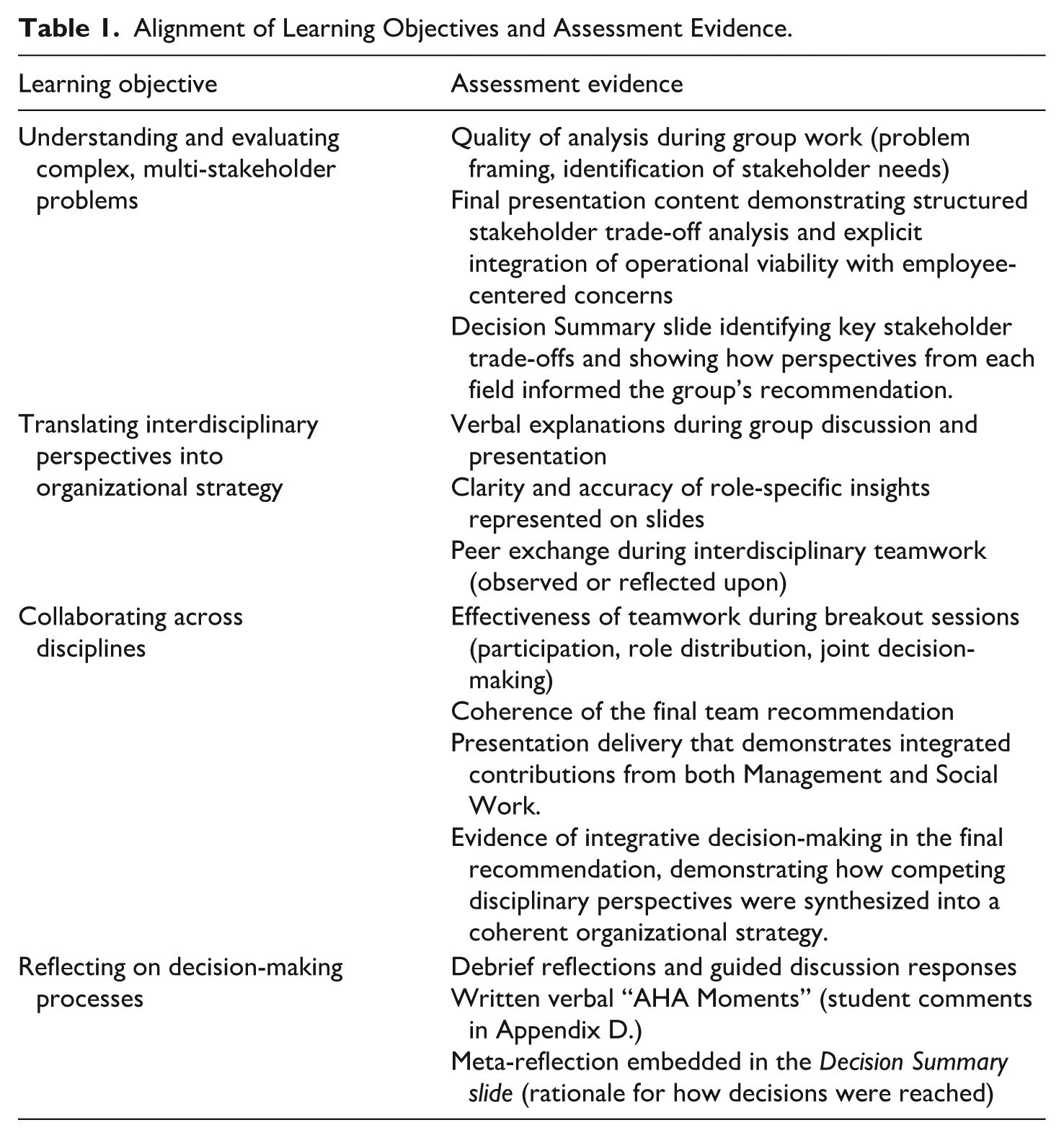
These learning objectives are aligned with the assessment evidence shown in Table 1.
Alignment of Learning Objectives and Assessment Evidence.
Exercise Description
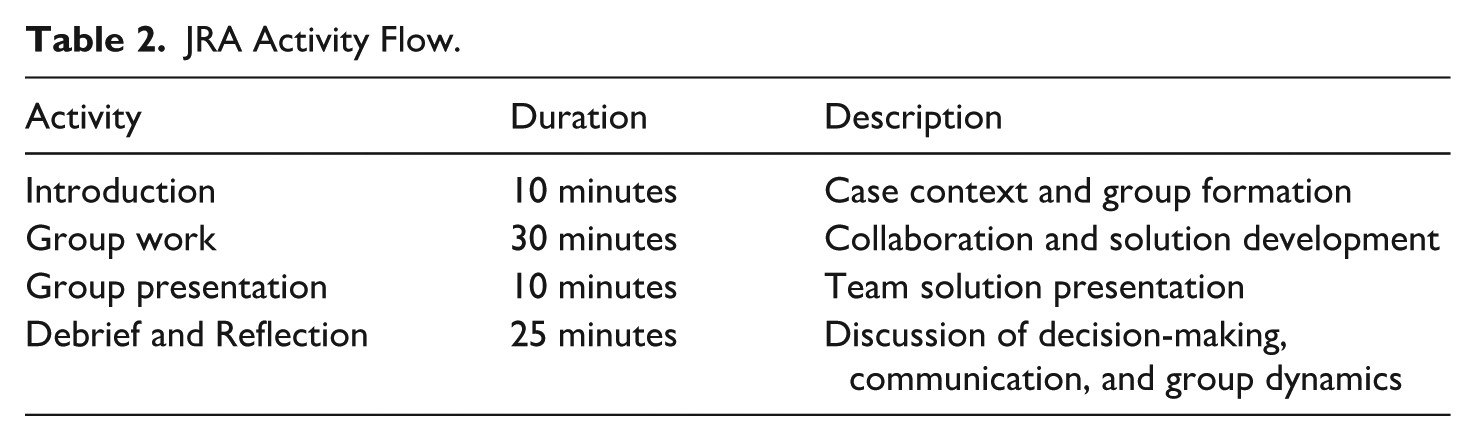
The JRA Market case (Appendix A) is a structured, 75-minute exercise based on a grocery store heavily affected by the COVID-19 pandemic. Designed for synchronous online or in-person delivery, the activity follows a sequential flow. The session opens with a 10-minute introduction that outlines the case and the workplace disruptions created by the pandemic. Students are then assigned to interdisciplinary teams balanced across management and social work. They are encouraged to exchange perspectives, engage in constructive dialogue, and develop inclusive, cross-disciplinary ideas.
During the next 30 minutes, teams analyze the case and propose solutions, ensuring broad participation across disciplines. Roles such as facilitator, note-taker, or presenter often emerge organically. Instructors remain available for clarification but do not contribute to the content of team discussions. Teams then spend 10 minutes preparing a brief slide presentation that includes a “Decision Summary” slide outlining their recommended course of action, rationale, and key considerations from both disciplinary lenses. This requirement helps students practice synthesizing diverse input into a clear, actionable decision.
The final 25 minutes are dedicated to debrief and reflection. The instructor reviews the purpose of the exercise and emphasizes the value of interdisciplinary problem-solving for addressing complex workplace challenges. Students reflect on group dynamics, communication styles, decision-making processes, and the contributions of each discipline. Guiding prompts include questions such as “How did your group reach consensus?” and “What did you learn about your communication style?” Throughout the debrief, the instructor facilitates reflection without re-engaging the case content. The Activity Flow is detailed in Table 2.
JRA Activity Flow.
This activity is suitable for both in-person and online classes. A facilitation guide is available in Appendix B.
The JRA Market case is set during the COVID-19 pandemic, but its core structure can be adapted to other organizational crises. Instructors may substitute the pandemic context with scenarios involving downsizing, restructuring, leadership transitions, workplace safety incidents, DEI (Diversity, Equity, and Inclusion)-related challenges, burnout and well-being, or any other situation requiring human-centered and management perspectives to work together. While the pandemic grounds the exercise in a complex, emotionally realistic setting, the focus remains on the interdisciplinary process rather than the specific crisis. This flexibility makes the activity well suited for MBA and other Master’s programs, where students engage with a broad range of organizational and people-focused challenges.
Group Formation Logistics
The ideal group size is four to six students, expandable to eight to accommodate enrollment constraints. Groups should include equal numbers of management and social work students whenever possible; imbalances should not exceed a +1 difference (e.g., 3:2 is acceptable, 4:2 is not). In cases of significant enrollment disparities, additional students may serve as facilitation helpers who observe communication patterns and encourage balanced participation without engaging directly in decision-making.
Facilitation Strategies for Managing Interdisciplinary Dynamics
Interdisciplinary discussions may drift into parallel monologues, with management students emphasizing operational concerns and social work students focusing on individual well-being. When this occurs, facilitators can pause the conversation, neutrally reframe both perspectives, and prompt synthesis (e.g., by asking what improves when viewpoints are integrated, or by inviting students to argue briefly from the other discipline’s standpoint). Facilitators can also surface assumptions by asking groups to articulate their core goals and how these align or conflict.
Because the case involves emotionally charged topics such as burnout, customer aggression, and pandemic-related stress, intense emotional reactions may arise. Facilitators should acknowledge the emotion, connect insights back to the case task, and gently re-establish boundaries if the discussion becomes personal. Neutral guiding questions—such as “What outcome are we trying to achieve for employees?”—can redirect focus. Brief pauses may also help students reset before proceeding.
In Zoom-based sessions, the same facilitation practices apply. Facilitators rotate through breakout rooms to monitor disciplinary balance, support integration of ideas, and intervene when needed. Chat prompts, shared documents, and whiteboard tools can aid synthesis. Features such as “Ask for Help” or short returns to the main room can help manage emotional moments. Facilitators also reinforce psychological safety by establishing respectful engagement norms and guiding groups back to the case when conversations drift. Across formats, the goal is to maintain a constructive interdisciplinary dialogue in which both disciplinary perspectives are integrated and generative (see Appendix C).
Student Feedback
The JRA Market case has been effective in prompting students to reflect on their own disciplines and the value of cross-disciplinary collaboration in addressing complex social issues. In the management class, an in-class “AHA Moment” activity is employed as a reflective learning strategy to prompt students to articulate their immediate insights regarding the material covered in each session. During the session focused on the JRA activity, students recorded their reflections through this exercise, and these unedited responses were included in the paper as primary qualitative data. Using Braun and Clarke’s (2006) thematic framework, the lead author inductively coded all unedited responses, reading them multiple times to identify recurring patterns and develop initial themes. These were then refined through discussion between both authors. The six themes represent instructor-observed learning patterns and are not the product of a formal qualitative study.
The analysis showed that students recognized shared values between HR and social work, gained insight into how each discipline approaches problems differently, and found that the activity challenged common stereotypes about both fields. Many students described a broadened understanding of the relationship between HR and social work. They reflected on how the experience contributed to a more integrated sense of their own emerging professional identities. Others emphasized the benefit of working together in a low-stakes, respectful environment that supported curiosity, mutual learning, and meaningful interdisciplinary dialogue. These themes and observations are detailed in Table 3.
Themes and Summary Observations From Student Reflections.
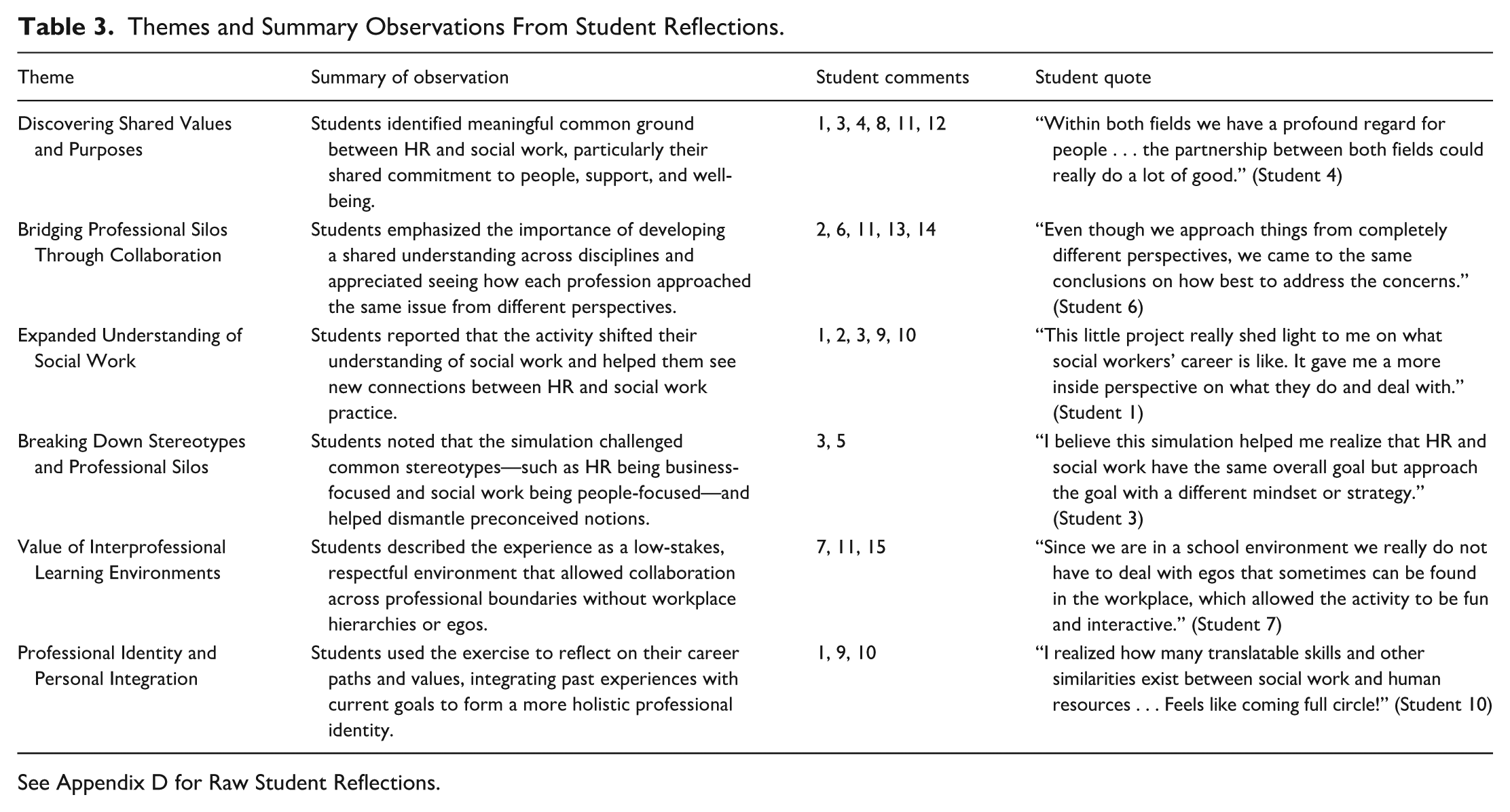
See Appendix D for Raw Student Reflections.
Conclusion
The JRA Market Case demonstrates how IPE principles can be effectively adapted to management classrooms to strengthen cross-disciplinary collaboration skills. By bringing management and social work students together to address a complex organizational challenge, the exercise enables learners to practice communicating across disciplinary boundaries, synthesizing diverse perspectives, and engaging in shared decision-making within a structured, low-stakes environment. The activity’s combination of collaborative problem-solving, guided reflection, and facilitated dialogue helps students recognize the complementary strengths of their fields and develop deeper insights into the human and organizational dimensions of managerial work.
Student reflections show that the experience broadened understanding of professional roles, challenged assumptions, and fostered appreciation for interdisciplinary approaches to workplace issues. These outcomes underscore the value of IPE-inspired methods in management education, where navigating stakeholder trade-offs, making integrative decisions, and acting on input from multiple disciplines are becoming essential skills. Ultimately, the JRA Market Case provides instructors with a replicable, adaptable pedagogical framework for preparing graduate students to navigate complex, multi-stakeholder organizations, thus ensuring future managers graduate with the competence and confidence to synthesize diverse stakeholder inputs into cohesive organizational strategies.
Footnotes
Appendix A
Appendix B
Appendix D

Funding
The authors received no financial support for the research, authorship, and/or publication of this article.
Declaration of Conflicting Interests
The authors declared no potential conflicts of interest with respect to the research, authorship, and/or publication of this article.