






Abstract
This article presents Trial by Trolley, a commercially available card game adapted for use in management classrooms to teach ethical reasoning and decision-making. In each round, one learner plays the “conductor,” deciding which of two tracks the trolley will take, while peers construct morally charged scenarios using character and modifier cards. The accessible mechanics, humor, and time pressure of the game create a low-stakes yet emotionally engaging environment that prompts learners to grapple with core ethical principles. When used in small groups, the game encourages learners to explore and articulate competing moral frameworks such as consequentialist, deontological, and virtue-based reasoning. It also fosters respectful deliberation and ethical self-reflection. Trial by Trolley has been implemented with more than 75 master’s-level students and provides a flexible, scalable activity that supports experiential learning objectives in ethics and responsible management education.
Keywords
Introduction
Teaching ethics to management students remains a pedagogical challenge, particularly when learners are asked to navigate morally complex situations characterized by uncertainty, competing values, and emotional salience. Recent work in management education highlights the need to increase students’ abilities in making ethical judgments (Baïada-Hirèche et al., 2024). Contemporary accreditation guidance further emphasizes the need to move beyond abstract ethical principles and to cultivate ethical courage and judgment through experiential learning approaches that engage students affectively and socially (AACSB International, 2024). This shift calls for teaching designs that allow students to confront moral ambiguity collectively and reflect on the reasoning underlying their decisions.
A number of experiential approaches have been developed to address this gap, including structured debates (Baldo et al., 2023), short-story analysis (Comer & Holbrook, 2024), and virtual simulations such as the Moral Machine (Awad et al., 2018). These exercises offer valuable opportunities for students to analyze ethical issues from different perspectives but often rely on predefined scenarios and emphasize individual or written reflection. Board game mechanics, described as effective for engaging students (van Esch & Wiggen, 2020), remain underexplored in ethics education. In this article, we explore how Trial by Trolley, a commercially available party game created by Cyanide & Happiness and published by Skybound Games, can be used to teach ethical decision-making to graduate students. Trial by Trolley is a card-based game requiring players to navigate moral dilemmas in real time under social and time pressure, transforming abstract thought experiments into concrete decisions. The game creates an environment for grappling with moral complexity and promotes ethical ownership and deliberative dialog.
Resource Description
Trial by Trolley is a commercially available card-based party game designed around exaggerated moral dilemmas inspired by the trolley problem. The game invites players to decide which of two tracks a runaway trolley should take, each track containing characters, groups, or objects presented on cards.
The game is played in small groups and assigns rotating roles: One player acts as the train conductor, while the others advocate for one of two tracks. Players construct each track using a combination of “angelic” cards (depicting beings or objects that might be considered worth saving), “demonic” cards (depicting beings or objects framed as less worthy), and modifier cards that alter the moral context (Appendix A). Advocates attempt to persuade the conductor through argumentation, after which the conductor must make and justify a decision. Roles rotate between rounds, ensuring that all players assume responsibility for decision-making during the session.
Trial by Trolley is intentionally playful and occasionally dark in tone, which lowers barriers to participation and encourages spontaneous ethical discussion. However, this same feature can introduce content that is culturally opaque or potentially sensitive depending on the student cohort. For this reason, the use of the game in a classroom setting requires explicit card governance, whereby instructors review and, if necessary, adapt the set of cards in advance and establish norms for their use during the activity. The game is available in several languages, requires no digital infrastructure, and can be purchased through standard board game retailers and online distributors at a relatively low cost (approximately $15–$25). Its simple mechanics, short rounds, and minimal setup make it well suited for classroom use as a flexible resource to stimulate ethical discussion and deliberation.
Use in Teaching
The following description illustrates one way the resource has been used in a graduate-level course. Instructors are encouraged to adapt the scope, timing, and depth of engagement to their own pedagogical objectives and constraints.
Theoretical Foundation
Trial by Trolley is grounded in the trolley problem (Foot, 1967), which confronts an agent with a forced choice between actively sacrificing one individual to save many and refraining from action and thereby allowing greater harm to occur. Crucially, the problem cannot be resolved by any single ethical theory. This foundation is vital for overcoming the bias by which utilitarianism largely explains how human decisions in moral dilemmas are made (Faulhaber et al., 2019). The trolley problem forces decision-makers to confront not only consequences but also issues of intention, moral distance, and responsibility (Kamm, 2015). Teaching ethics should encompass building students’ understanding of key ethical concepts and theories, enabling students to identify a variety of ethical perspectives in a scenario, thus informing their decision-making (Floyd et al., 2013). The trolley problem, and by extension Trial by Trolley, enables instructors to do so.
Students typically express emotional reactions before articulating values and justifications, reflecting dual-process models of moral judgment (Greene et al., 2001). This process leads students to develop new solutions, often rethinking their initial utilitarian perspective (Hashimoto et al., 2022), and fosters ethical self-awareness among students as they begin to notice their ethical reflexes. Students construct justifications from fragmented insights, values, and reactions, a process known as ethical bricolage (Lobet-Maris et al., 2019).
Trial by Trolley can also be used to take students through steps of the ethical cycle (Van de Poel & Royakkers, 2007): formulating a dilemma, analyzing stakeholders, evaluating potential actions, and justifying a decision. This step contributes to moral development by requiring students to explain and justify their decisions to the group. I encourage students to pay attention to cultural differences, emphasizing that divergent value systems can reveal alternative ethical perspectives. Establishing psychological safety (Edmondson, 1999) in the classroom is essential for students to take ethical risks, voice moral uncertainty, and reflect openly, so they can ultimately develop both confidence and humility in their ethical decision-making.
As a result, the activity supports the following learning objectives:
Apply the ethical cycle to morally ambiguous scenarios.
Distinguish between consequentialist, deontological, and virtue-based reasoning.
Reflect on situational and cultural influences on ethical decision-making.
Reflect on and articulate their personal value system.
Develop ethical leadership by defending decisions under peer scrutiny.
Implementation Steps
I use this activity in the first session of an ethics and technology course. Students are organized into groups of 5–6 prior to class.
Card governance is implemented as follows: Prior to class, instructors must review all cards in advance to identify any content that may be culturally opaque or potentially sensitive for their specific student cohort. Based on this review, instructors may remove or adapt selected cards as appropriate. During the activity, students are given the option to set aside cards they find unclear or uncomfortable and are reminded to engage respectfully throughout the discussion. Each group receives a subset of the cards rather than a full game deck. Cards are reshuffled and redistributed partway through the activity to renew scenario combinations and maintain engagement.
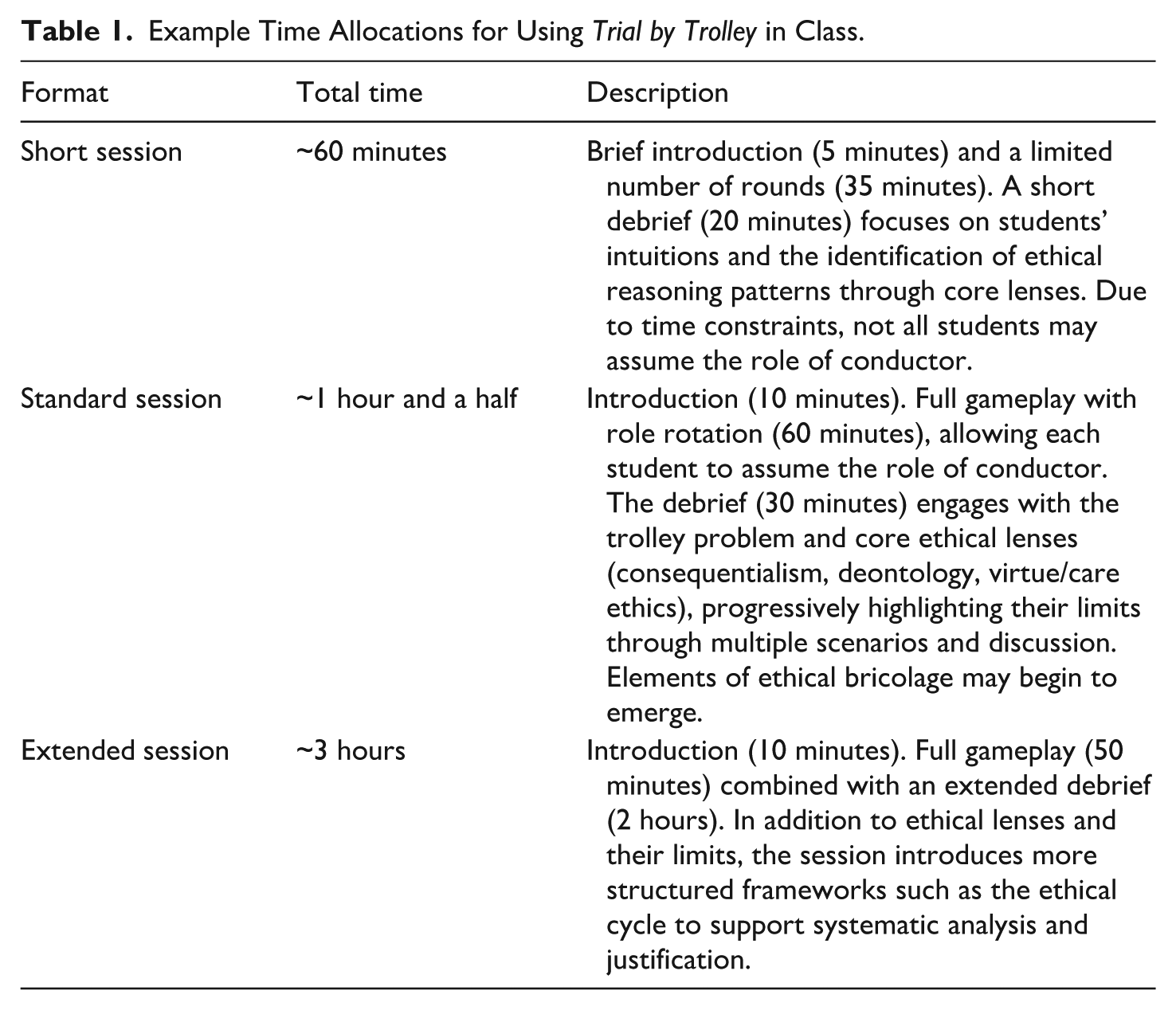
As shown in Table 1, this resource can be played in different session formats. In practice, a 90-minute format allows full role rotation, ensuring that each student assumes the role of conductor at least once.
Example Time Allocations for Using Trial by Trolley in Class.
Gameplay unfolds through a sequence of structured rounds that combine card selection, argumentation, and collective decision-making. The process begins with an initial guided round to anchor students in the mechanics, followed by shorter, more autonomous rounds that introduce increasing decision pressure. Throughout this process, the instructor circulates among the groups to facilitate respectful engagement and to prompt students to reflect beyond their default moral intuitions. Following the activity, each group completes a short written assignment designed to support reflective ethical reasoning. Groups analyze one dilemma in depth, synthesize patterns across rounds, and formalize a decision-making approach. Individual reflections are incorporated to capture how personal intuitions interact with group dynamics.
Debriefing
The debrief takes the shape of an in-class discussion based on the group assignments. Alternatively, it can be organized straight after playing the game as a collective discussion. A standard debrief aims at unpacking the ethical decision-making process: We outline the scenario, discuss initial intuitions, and examine how the arguments relate to different ethical theories. We then discuss how combining ethical perspectives can lead to more nuanced solutions. Finally, we revisit a scenario using the ethical cycle. In shorter formats, the debrief may focus on the trolley problem and core ethical lenses, while simplifying the use of more structured frameworks such as the ethical cycle.
For undergraduate cohorts, the game can be played using the same mechanics but with additional scaffolding to support ethical articulation during gameplay. The instructor can ask groups to justify their decisions using a particular type of guiding question (Appendix C). For example, one round may focus on consequences and harms, another on moral limits or rules, and another on responsibility or integrity. This approach directs students’ attention to different dimensions of the dilemma without prescribing a theoretical stance or turning ethical frameworks into decision algorithms. At this level, the debrief remains deliberately descriptive and focuses on identifying and naming recurring patterns of ethical reasoning that emerged during play, while a more advanced analysis, comparison, or critique of ethical frameworks is reserved for graduate-level teaching.
This debrief can also be extended to address ethical questions of responsibility and fairness with minimal modification. Students are invited to reflect on who bears responsibility for the outcome of a dilemma, whether this responsibility lies with the train conductor as a decision-maker, the advocates who shape the available options through argumentation, or the game structure that constrains choice. In parallel, the discussion can foreground fairness by examining how lives are compared, whether similar cases are treated consistently across scenarios, and whether certain groups are implicitly valued more than others. These lenses shift the focus from identifying the “right” decision to examining accountability, equity, and ethical justification under constraints, making the activity particularly relevant for courses addressing organizational ethics or responsible AI.
Analysis and Comparison
Trial by Trolley engages students in ethical decision-making through rapid, socially embedded dilemmas that foreground intuitive and affective responses. This format contrasts with more structured approaches such as debates or written case analyses, which allow for slower, more deliberate reasoning. While the immediacy of the game promotes engagement and spontaneous argumentation, it may also privilege students who are more comfortable speaking in real time and limit opportunities for reflective ethical analysis. To address this limitation, we require students to complete an assignment, so they revisit a dilemma they played, compare alternative views on the dilemma, and articulate their reasoning under reduced time pressure. This combination supports the development of ethical literacy by linking intuitive judgment with more structured reflection.
Compared to individual simulations such as the MIT Moral Machine (Awad et al., 2018), Trial by Trolley emphasizes collective deliberation rather than isolated decision-making. Besides, the Moral Machine presents standardized, algorithmic dilemmas and highlights aggregate patterns and cultural variation in ethical choices. In contrast, Trial by Trolley exposes students directly to disagreement, negotiation, and justification in a social setting. The physical manipulation of cards and the need to publicly defend choices reduce distance from the decision and make ethical tensions more immediate.
These approaches can be used complementarily. While the Moral Machine is effective for illustrating large-scale patterns and individual moral intuitions, Trial by Trolley is better suited for developing dialogic skills, ethical confrontation, and what has been described as ethical bricolage. Used together or separately, they support different dimensions of ethical learning. Trial by Trolley thus offers a flexible pedagogical resource for engaging students in collective ethical deliberation and making moral reasoning processes visible.
Footnotes
Appendix A
Appendix B
Appendix C
Author’s Note
Trial by Trolley is a registered trademark of Skybound Games and Cyanide & Happiness. This article is not affiliated with or endorsed by the trademark holders.

Funding
The author received no financial support for the research, authorship, and/or publication of this article.
Declaration of Conflicting Interests
The author declared no potential conflicts of interest with respect to the research, authorship, and/or publication of this article.
AI Disclosure
Generative artificial intelligence (ChatGPT–4o and ChatGPT–5.2) was used to improve the clarity, grammar, and flow of this manuscript. All the content and pedagogical insights are my own.