







Abstract
In this article, we report findings from a yearlong design research project that worked to leverage the language brokering skills of Latina/Latino middle school youth in an urban school setting. We began the project by asking seventh-grade students to talk about the many languages they speak in their daily lives. Throughout the project, their teacher, Ms. Reyes, drew on youths’ tacit understandings of language to engage them, metalinguistically, in learning activities that went beyond classroom activities, with specific attention to the various ways language is used to persuade different audiences across contexts. We concluded with documenting their reflections on the project and their understandings of their language use. We share data of transcripts from focus group discussions between four students. Findings revealed that student’s tacit understandings about language fell into four categories, “language of respect,” “diverse ways of speaking,” “what they learned” about language, and an emerging sense of their “academic confidence.” We use these data to show how youth shared knowledge and understandings about language that they had not been asked to share before. We conclude with suggestions for how classroom teachers can work toward expanding what counts for language in English Language Arts classrooms.
“It’s Not Perfect English”
On our first day observing Ms. Reyes’ 1 seventh-grade English Language Arts (ELA) classroom while conducting research about leveraging the language brokering skills of middle school youth, she asked her students to generate a list of languages they spoke throughout their day. We believed these youth would name a range of languages that we imagined they spoke. However, after hands eagerly sprang into the air to add English, Spanish, and Spanglish to the list, hands dropped down to desks and Ms. Reyes found herself asking several questions of her students, hoping a few might consider “other” kinds of languages to “represent.” After prodding by Ms. Reyes, formal English and formal Spanish were listed in addition to French and Italian contributed by one student, Vinvin, who knew “bits and pieces” of these languages (Blommeart & Backus, 2011). Asking students to name their languages demanded more explanation and time than we planned.
After a few moments of silence Ms. Reyes asked, “I want you to think, in your everyday, from the moment you wake up, to the moment you go back to bed, what are the different situations that you’re in where you’re speaking a different language?” (November 27, 2007, transcript). Ms. Reyes tapped her index finger to her lips, briefly fixed in a thinking pose that her students were familiar with. A Latina youth, Celia raised her hand. “Um I have a question. Do you mean language like the language? Or like different words that you say?” Ms. Reyes replied, “I want you to think about that. Is it a language that you have when you have your own words that you use with certain different groups?” After a few seconds, Slash, a youth who identified as Black and whose parents were immigrants from Belize, raised his hand and in a quiet voice uttered, “That’s like, like when I speak at my house, it’s like English, but like sometimes you don’t understand like what we’re saying, so it’s not like perfect English, but it’s English … But in my country it’s called Creole” (for further analysis, see D’warte, 2012).
The vignette above highlights how having the youth in Ms. Reyes class talk about language was more difficult than expected, and made clear that for students in ELA classrooms, there is simply too little talk about language. The responses we did get—English and Spanish, formal English and formal Spanish, and Spanglish—were dominant languages in this context and, perhaps the adjective “formal” was used by youth to describe the kind of Englishes they spoke in school, standard English varieties that are often normalized as the language of school (Dyson & Smitherman, 2009) and society (Kroskrity, 2000; Wortham, 2009). However, with additional time, and with additional questions, youth began to consider other “languages” they used to communicate at school, or at home and with family. Table 1 lists those languages in the order in which students offered them during the discussion.
Languages of Pueblo Unido Seventh Graders in an English Language Arts Classroom.
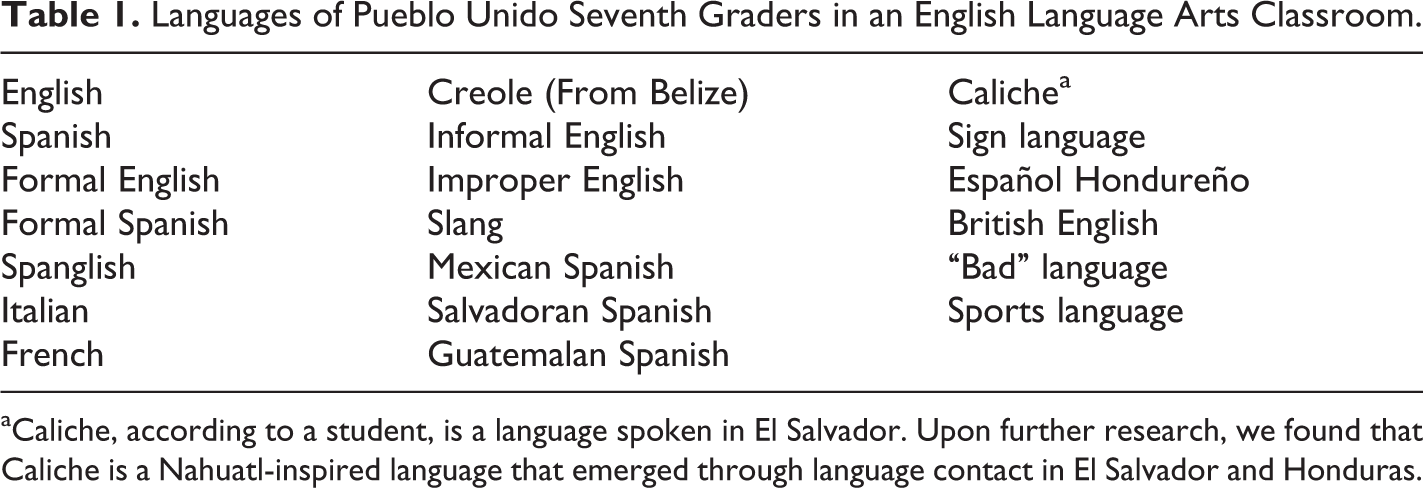
aCaliche, according to a student, is a language spoken in El Salvador. Upon further research, we found that Caliche is a Nahuatl-inspired language that emerged through language contact in El Salvador and Honduras.
In this article, we will fast-forward to the end of the year in which this research started to document the final reflections of youth in Ms. Reyes’ seventh-grade ELA class. We will highlight findings that emerged from youths’ reflections where they made sense of language through their tacit notions about the “language of respect,” and their “diverse ways of speaking.” Additionally, we drew on youths’ reflections to consider “what [they] learned,” and their emerging “academic confidence.” Throughout this project, Ms. Reyes continued to draw on youths’ tacit understandings of language to engage them, metalinguistically, in ways of learning that would deeply support both vertical and horizontal forms of learning (Engeström, 1991; Gutierrez, 2008) with specific attention to the various ways language is used for different audiences and contexts (see D’warte, 2012; Orellana, Martinez, Lee, & Montaño, 2012). This article specifically draws on youths’ reflections during a focus group at the end of the first year of our research to consider how explorations of language in Ms. Reyes’ ELA classroom mediated youths’ ideas about their own language practices, in school and beyond. While the larger project focused on having students consider how their language brokering skills could be leveraged in their classroom interactions based on previous research (Martínez, Orellana, Pacheco, & Carbone, 2008), here we center youths’ opinions about language. We therefore asked the following question: How do youth reflections about language help move a classroom toward expanding what counts as language?
Theoretical Framework
What Counts as Language?
The research we conducted was framed within a sociocultural perspective on the relationship between home and school practices, a view that treats language as the premier tool mediating: learning (Cole, 1996; Vygotsky, 1978), human development (Rogoff, 1995, 2003; Rogoff, Paradise, Arauz, Correa-Chavez, & Angelillo, 2003), and socialization to communities of practice (Garrett & Baquedano-Lopez, 2002; Ochs & Schieffelin, 1979). We also build on Linguistic Anthropological research that documents children and youths’ linguistic dexterity (Alim, 2004; Goodwin, 1990; Paris, 2012; Zentella, 1997) and that identifies continuities as well as discontinuities between home and school practices (Lee, 2007; Orellana et al., 2012; Rogers, 2001). Rather than trying to reconcile differences, as called for by earlier research that identified cultural “mismatches” (Au, 1980; Philips, 1983), we aim to make these skills visible to youth and their teacher to serve as a resource for learning on school-based tasks.
We also build on research that has shown how the language practices of children and youth of color are too often treated by teachers—and youth themselves—as inferior to dominant varieties of English privileged in schools (Alim, 2004; Godley, Sweetland, Wheeler, Mannici, & Carpenter, 2006; Martinez, 2016), despite research that recognizes these practices as complex and sophisticated (Martínez, 2010; Orellana et al., 2012). Calls to leverage the range of languages youth display across their everyday lives are complicated to enact with teachers expressing a lack of confidence in their ability to effectively teach linguistically diverse students (Ball, 2009; Gándara, Maxwell-Jolly, & Driscoll, 2005). This is a concern given increases in culturally and linguistically diverse student populations in U.S. public schools, coupled with our over reliance on assessments that privilege dominant varieties of English as an indicator of academic success (Menken, 2008).
Expansive Learning
Our research benefited from Engeström’s (1991) notion of expansive learning. Students’ reflections on language moved us toward breaking through what he calls the “encapsulation of learning,” that is, learning that does not connect what students are learning to their lives outside of classrooms. Engeström argues that expansive learning experiences are necessary to disrupt traditional forms of learning that fail to consider the networks of learning students bring to their classrooms. He states, Since school is a historically formed practice, perhaps the initial step toward breaking its encapsulation is that students are invited to look at its contents and procedures critically, in the light of their history. Why not let the students themselves find out how their misconceptions are manufactured in school? (p. 254)
While the research reported in the manuscript did not facilitate a process of “breaking through the encapsulation of learning,” we do argue that youth participated in activities that moved them toward critically analyzing their languages and uses of their home and community languages in their schooling experiences. For a group of predominantly Latina/Latino youth, having conversations about language offers a contribution to the field where students’ reflections about how language operates in their lives can allow for critical youth perspectives to emerge.
Youth Reflections on Language
Some scholars have explored youths’ language ideologies or youths’ awareness of the stigmatized nature of their languages in urban contexts (Kinloch, 2010; Martínez, 2013). Kinloch (2010) documented the perceptions of two Black male youth participants whom she followed since their final two years in high school and into their first two years of college. These youth detailed the nuances of being speakers of Black English while attempting to be academically successful in a university that demanded “standard” English proficiency. While they were able to do both (as do many youth of color who are speakers of stigmatized languages), Kinloch highlights the tensions these youth felt navigating and engaging in language practices that mediate “doing being” Black, and the expectations of college work. She goes on to argue, Youth perceptions of language, I argue, can serve as responses to the lamentation of educators to do more than simply affirm the language rights of students … More significantly, understanding youth language perceptions can help us improve our curricular choices, honor the lived experiences of youth in classrooms, and address a systemic problem within a larger sociopolitical context: the continued failure of American public schools to adequately educate Black students and other students of color. (p. 105)
Martínez’ (2013) research with middle school Latina/Latino youth in Los Angeles reminds us again of the difficulty of capturing youth perceptions about their language practices since often these practices remain an unconscious practice. While focusing specifically on students’ “awareness” of their Spanish–English code-switching practices, Martínez highlights the “continuum” of their awareness. That is, while youth were both implicitly and explicitly aware of their code switching, he argues that this awareness existed on a continuum. He specifically returns to the title of his article, “Do they even know that they do it?” a question often posed to him by practitioners and researchers, to suggest that asking that question reifies standard language ideologies that normalize standard varieties of English. Instead, he highlights that for youth themselves, their language practices are fairly normalized within their school and community contexts.
Kinloch’s and Martínez’ research support the need for both teachers and students to understand the language of the classroom, an argument made by Cazden (2001) in order to begin the complex task of uncovering reductive approaches to classroom instruction. The research presented in this article takes up Cazden’s challenge by working alongside a Latina teacher, Ms. Reyes, and her diverse Latina and Latino middle school youth to examine their own language practices for the purposes of moving toward expanding what can count as language for youth in their learning in school and beyond.
The research reported in this manuscript builds on and extends the work of Kinloch and Martínez in highlighting Latina/Latino youths’ tacit reflections about language as mediated by our design research. This manuscript considers both the theoretical and practical significance of providing youth from nondominant groups in ELA classrooms the ability to speak about language, and to discuss how language is used in their everyday lives, and their own understandings of how language functions in their own lives. The findings presented provide a launch pad to consider how youths’ tacit knowledge of their linguistic repertoires can contribute to our knowledge base about the current nature of urban youths’ language and literacy practices, how practitioners can leverage and level these practices for school tasks, and how we can reimagine expanding what counts for language in our diverse learning contexts.
Method
The youth in Ms. Reyes’ class attended Pueblo Unido Charter Academy (a pseudonym), a small kindergarten through eighth-grade charter school located near Downtown Los Angeles. We worked with these youth and their teacher, Ms. Reyes, during their seventh- and eighth-grade years between 2007 and 2009. The larger projects were a form of design research (Brown, 1992) and youth participatory action research (Cammarota & Fine, 2008). This article draws on data from a focus group held with youth at the end of the first year in the project, in addition to transcripts of video recorded and data collected throughout the year with these youth in their classrooms.
The Project
Using a design research method (Brown, 1992), the team worked with Ms. Reyes to plan and implement lessons that treated the full linguistic resources of youth as tools for learning (Cole, 1996) while engaging students in a “standards-based” persuasive writing unit. Although the project initially focused on leveraging youths’ translation skills for academic tasks (based on previous research from Martínez et al., 2008), we became more interested in how students made sense of their language practices via a group discussion that prompted their reflections after their involvement in our design research with their teacher. We asked youth to reflect on what they learned from paying closer attention to the various ways in which they use language across their daily activities. By doing so, the authors call attention to the varied messages these youth present, while arguing for applications of these youth metalinguistic messages to the ELA classroom where explicit talk about language is absent or narrow in its purpose.
The design of this project was developed under the guidance of Marjorie Faulstich Orellana who served as the principal investigator. This work builds on her decade long ethnographic work with children of immigrants who serve as language brokers for adults in their homes and communities (Orellana, 2009). In the first year, our research team and Ms. Reyes created a curriculum derived from California seventh-grade persuasive writing standards. Using translation as a construct, we asked youth to write to and prepare remarks for two different audiences: informal and professional/formal. Youth made sense of “informal” audiences through the use of terms such as “friend,” “family member,” or “peer,” which they distinguished from “professional” audiences that included some teachers and administrators and interlocutors they did not know well. Using these audiences allowed students to build on their translation skills for schooling tasks such as role-playing how they would speak to each type of audience member, writing persuasive letters and essays to individuals from these audience groups, and most importantly discussions around the differences noted in language shifts made in the language and literacy tasks. While the larger project focused on the discourse practices of youth and their teacher, for this article we zoomed in on a focus group held with youth at the end of the academic year. In the data presented, reflections about student writing bled into reflections about their linguistic repertoires, central themes of our focus group discussions.
The Teacher
It is important to note that the teacher, Ms. Reyes, was part of the research team, is an author in this work, and is the spouse of a research team member, the first author. We continue to use Mr. Reyes as a pseudonym in this work, following Cazden’s decisions to refer to herself as “the teacher” in her work. Ms. Reyes was in her seventh year of teaching at the time of this project, having taught all content area courses at Pueblo Unido during her time there. Based on interactions with school administrators, other teachers, and the families of Pueblo Unido youth, Ms. Reyes was considered an “English Learner” expert at her school, a teacher leader, and someone with strong connections to the families and community having grown up herself in the surrounding community. While there is a close relationship with Ms. Reyes, she has participated, along with the research team, in close critique and analysis of her own practices and other lines of analyses related to the larger project (Orellana et al., 2012).
The Youth
The youth in Ms. Reyes’ class mirrored the demographic of Pueblo Unido as well as the surrounding schools in the neighborhood. The majority of students (97%) qualified for free or reduced lunch and almost 40% of seventh graders were labeled English Language Learners by their school. Ms. Reyes’ class was composed of over 90% Latina/Latino youth with one student identifying as Asian and one as Black. When asked to write about the languages they used across their daily lives, most youth reported speaking Spanish at home and in their community, with a few others identifying other languages.
For this article, we will hear reflections from Jimmy, Sergio, Celia, and Julio, all Latina/Latino youth, in addition to contributions from other students like Slash who was mentioned in the opening vignette. All youth attended Pueblo Unido since their sixth-grade year. These youth were chosen for this article because they were all members of one of three focus groups audio recorded at the end of our first research year (their seventh-grade year), and all three were also participants during our second year of research (their eighth-grade year). Jimmy, Sergio, Celia and Julio represent the voices of all of the youth participants in the project. Additionally, this one focus group interaction highlights the themes that emerged across all four focus groups that were facilitated by the research team. We also draw on data from interactions with these youth that occurred throughout the project to support various arguments made.
Data Collection and Analysis
A research team member conducted each focus group interview with a group of 5–6 youth participants from Ms. Reyes’ ELA class. Four focus groups were conducted and each was video recorded and later transcribed by a research team member. Focus group notes were fleshed out into field notes written by each team member. Since these focus group interviews were conducted at the end of our first year working alongside these youth, they were conducted to capture youths’ reflections and understandings about language, in addition to asking youth “what they learned” from the project. Despite youth becoming fairly comfortable with the research team, the video cameras, and the practices involved in “doing” research, these middle school youth also agreed that we asked too many questions about language! Despite this, the opinions and reflections garnered by focal youth participants represent ideas that we saw prominent throughout the research.
We began analysis by considering the larger category of “students talking about language” and “students talking about what they learned from the projects.” In reviewing the data, we found that talk about language and what they learned from the project were most explicit in the focus groups conducted at the end of our first year. Therefore, this article reports on explicit moments, rather than implicit moments indexed through the youths’ everyday classroom discourse. We then coded for these moments and reduced codes to the following: “notions of respect,” diverse ways of speaking, “what we [the students] learned,” and academic confidence.
Findings
Respect emerged as a theme the youth themselves spoke about during the focus group interview. Youth understandings about their diverse ways of speaking were mediated by notions of respect. Throughout the data, youth reported, “what we learned.” This ranged from the project making clear the diverse ways they spoke, to how they learned about themselves as writers, speakers and speakers of diverse languages. Lastly, we found that academic confidence emerged as a theme that deserved attention. Evidence of academic confidence ranged from youth speaking explicitly about changes in their academic opportunities or participation over time, or simply suggesting that they believed the project prepared them to be confident in their writing and speaking.
Relationships and Notions of Respect
During the focus group, we asked Celia, Jimmy, Sergio, and Julio to reflect on what they learned during the “translation project.” Sergio quickly stated, It helped us, or it helped me because, like, you even had to think about specific audiences. And you weren’t gonna go to a principal and talk the way you talk to your friends or write to your friends, so you have to use like more professional ways.
Sergio stated, “We’re more respectful to our parents and adults than we are with our friends,” signaling their metalinguistic awareness of their language shifts based on the relational status of their interlocutors or audiences for written text. According to the group, their language might be littered with less polite words, and might even contain “bad words” when they spoke to friends or siblings. Celia added, “That’s just how we talk” when the group giggled about the use of bad words littered in their conversations. The first author asked the group if they always used “bad” words with friends. After some reflection, a couple of the youth decided, “no, not really.” Celia followed up by explaining “like ‘yo wassup’ and stuff. Cause it might be, teachers might think it’s the wrong way because we come in and say, ‘yo wassup ese.’” Here Celia is leading the group into a nuanced understanding of what respect means across the groups with which they communicate. She is making clear that in “doing school” and talking with teachers, teachers may perceive someone saying “yo wassup” as disrespectful, or not appropriate for classroom exchanges.
Notions of respect were consistent when youth explained the changes in their languages across the various individuals they spoke to on a daily basis. After some discussion, the youth agreed that you respect your friends, even when you speak using “bad words” because you can only use these words after you have gotten to know someone. Jimmy supported this idea when he stated that whenever he met anyone new, he noticed how his language changed over time. “Once you get to know each other like more, like in a friend type of way, then basically yea, that’s how to me it all starts.” In his statement, Jimmy alluded to prior statements by his peers who made the claim that using bad words or making fun of friends can only happen when there is respect. Jimmy’s statement provided evidence of this, making sure to communicate that respect and knowing someone over time is necessary for such banter.
Professional Talk and Other Nuances
The discussion on respect led some youth to express their ideas about speaking formally or “professionally” in class. Jimmy shared that speaking what he called more “formally” often caused him to think about his utterances more carefully before uttering a word. He stated, Cause like we’re so used to talking like in that form, like eh, so we’re like not used to talking really formal than how we would do with our friends. So, but we sometimes get stuck on saying something that we’re supposed to say, but we’re about to say it how like we talk to our friends.
It was through his reflection, however, that Jimmy spoke about how he felt when he was presenting in front of the class, to the more professional audience, a genre that was much different from everyday classroom interaction, according to the group, since there was usually an audience of their peers evaluating their performance, and not a panel of adults from the school and community. Sergio added to this point saying, “It’s like right now is the time to act like a kid and talk like a kid but when we grow up, we’ll start being more [unintelligible], and talking more responsible.” Aligning with Jimmy’s previous comment, Sergio added that the tension that he and his peers experienced came from their age, and the expectation that they will not speak like adults, who may speak more formally than youth his age.
Although these youth preferred to speak to their friends, there were some experiences for these youth when speaking formally or professionally benefited them. For example, during our initial months of research, the Pueblo Unido principal communicated to the research team that Jimmy was sent to her office after being involved in a minor discipline incident. Since Jimmy had been in this situation previously, the principal recognized a shift in the ways he presented his side of the incident. For one, the principal noticed how he shifted into a more standard way of speaking, while also making a point to declare that he was going to provide her with “two arguments and a counterargument” to prove his point, a feature of persuasive writing and speaking covered by Ms. Reyes during a unit that began our research. In this example, Jimmy chose to speak formally, prepared his speech in an organized manner that would best persuade his audience, and utilized those skills to essentially get himself out of trouble.
Academic Confidence
The talk of professional or formal language led students to reflect on their sense of academic confidence. In terms of the youths’ perspectives on how this made them understand language in relation to academic tasks, Jimmy spoke in ways that put this notion into perspective. Prior to the focus group meeting, the youth in Ms. Reyes’ class reflected on their own writing history over 2 years. They had their sixth- and seventh-grade writing portfolios in front of them and were asked by Ms. Reyes to write a reflective letter to themselves and to their English teachers about the changes in their writing over time. In front of Jimmy were his own binders, and throughout the focus group session, he and others pointed to their binders and made comments about how “awful” their writing used to be. In his statement about how thinking about language helped him, Jimmy shared, uhm in the sixth grade, I was looking at some of my writing comparing it to today, and I did not understand a word (laughter) I was writing. And like to see it now, I’m using commas, uhm like apostrophes, standard, more standard and like more understandable. Just how somebody like, not how anybody else would say it but like a business person and everything how they would talk, like, I compare myself to that and I sometimes think that I’m ready to that level that they’re talking and writing.
Overall, the youth in the focus group reported feeling supported in their language development, in the ways of writing and speaking the way you are “supposed to” at school. They also spoke about how difficult it was to actually write the way you speak to your friends. “None of our teachers have ever asked us to do that,” stated Sergio. However, they talked about how important that step was because it helped them consider communicating something across various audiences, starting with the more “comfortable” audience, then translating to the more difficult one, the professional audience. The focus on the changes a speaker makes across audiences allowed these youth to feel more confident in their academic abilities. Interestingly, while Ms. Reyes asked these youth to write and practice making a persuasive argument to a peer, family member, or a “more comfortable” audience, there was no explicit mention about how this might have added to their academic achievement. However, we noticed through focus groups that youth were more aware of the linguistic shifts made across the audience members they were asked to consider in their academic tasks.
Linguistic Awareness
It was through this conversation that the youth began to speak about how thinking about language through this project, made them realize how many kinds of languages they actually spoke, their linguistic awareness. Sergio began, “[the project] made us see how we, different types of languages that we use. It helped us see that.” Julio, who did not say too much during the focus group, interjected with, “Salvadorans and Mexicans don’t talk alike, Puerto Ricans, uh.” Here he was pointing to his own tacit knowledge that even among Latina/Latino communities, there was great variance in language practices. This was particularly interesting, given previous discussions with Ms. Reyes’ entire class where they discussed how some people believe all Latinas/Latinos are Mexican. To take Julio’s initial point further, Celia stated, “… My mom’s from the city and my dad’s from the country, I realize there’s like a big difference.” During the focus group and in the entire year of our research, students made similar statements to voice their disgust about and tacit understanding of differences with Latinas/Latinos altogether, but also within different countries. Celia was becoming more aware of the differences between “city” Spanish and “country” Spanish even in Mexico.
These youth also demonstrated their linguistic awareness based on their own code-switching practices. Celia pointed to how she now thought about her Spanglish language practices more than she had prior to the project. When I asked what Spanglish was, she quickly responded, “Like you be talking Spanish, I mean English, and then lo cambias a español.” In explaining what Spanglish was, Celia deployed an intersentential code switch, one of many features that the youth deployed in class, and reported using in their everyday speech. A few students eventually integrated their code-switching practice onto their written and spoken persuasive arguments. Attention to “stigmatized’ language practices were variously interpreted by these youth. Celia did not seem to worry about her use of Spanglish, but she reported being more aware of it. Similarly, Jimmy and Julio expressed the same sentiments despite nuancing these perspectives with notions of also wanting to speak good English. On the other hand, Sergio found himself more likely to engage in “fixing” his language so that he could use English or Spanish more “correctly.” Despite these reflections, overall, we heard youth and their teacher engaging in a range of practices that also include hybrid languages.
Discussion
The findings discussed earlier take us back to our opening vignette. While our initial conversations about the languages students speak “in their everyday” proved to be a slow and somewhat sluggish one (with blame accepted by the research team for not leading into this activity better), we ended our first year of research with these youth with dynamic and nuanced conversations about language. While Engeström (1991) discusses expansive learning to break through the encapsulation of learning, we view youths’ reflections as one step toward breaking through the encapsulation of monolingual and standard ideologies of language (Lippi-Green, 1997). Building on the notion of expansive, we see youths’ reflections as their emerging movement toward expanding what counts for language in their lives. While much work needs to be done to get students to unpack their deficit rationales (Martinez, 2010), allowing students to speak about language in ways that highlight tensions they experience in schools is a critical step toward transforming language and literacy ideologies youth may have.
In terms of the language of respect, youth conversations provided an interesting understanding about stigmatized languages in general, since often, speakers of dominant languages perceive the marginalized language practices of Black and Latina/Latino youth identifiable by the use of profanity as disrespectful (Jordan, 1988). The late June Jordan and her community college students made rules for Black Language, and Rule number one read, “Black English is about a whole lot more than mothafuckin” (p. 366, emphasis in original). In this spirit, the youth came to realize that speaking the way they do, with their friends, does not always have to include bad words. And when it did, it did not negate the respect they had for these peers. Interestingly youth also began to notice how when they spoke to their peers, who were also good friends in out of school contexts, comfort levels were higher, therefore their language use was more free flowing.
As youth discussed “professional talk,” they pointed out how different this kind of talk was for them when compared to their everyday talk. Sergio also makes clear that when he and his peers reach a certain age, perhaps they will speak different, more professional, formal, or simply like an adult. This point supports Blommaert and Backus’s (2011) argument that there exists a biographic dimension to an individual’s repertoire of languages where the languages an individual once used as a child or youth may not exist to the same extent when an individual grows older. Interestingly, Sergio linked the notion of his language being more formal or “responsible” to age, and that for now, his language practices were aligned with being “a kid.” Through the project, Sergio demonstrated his keen ability to style shift into and out of standard varieties of English. Both Jimmy and Sergio point to formal or professional talk as being more difficult, and a conscious shift in the way they prefer to speak based on their age and their friendships.
Providing youth a space to consider the differences between their everyday talk and “school” talk highlights the great disconnect that schools are failing to leverage as a resource for learning. While youths’ reflections noted the “differences” by no means was the research trying to reconcile these differences. Instead, we can implicitly hear youth attempting to make sense of these differences and they expressed how thinking about differences helped them make the shifts expected of them in schools. We will admit here, that while we genuinely wanted youth to use language more flexibly, the research team did not use language flexibly. We believe the constraints of schooling also limited our team just as youth may have felt limited in using languages that are otherwise stigmatized outside of schools, in schools (see Orellana, Martínez, Lee & Montaño, 2012).
The academic confidence and linguistic awareness discussed by youth in the focus group points to a larger need for engaging in pedagogical practices that allow students to discuss their languages and how these languages, either contribute to or hinder their academic confidence. A thorough discussion of this kind occurred in Ms. Reyes class, and was similar to research discussed by Martínez, Orellana, Pacheco, and Carbone (2008), where perceptions about language were linked to larger racial and political perceptions about Latina/Latino and other communities of color in the United States. We are well aware that youth continued to link speaking and writing professionally with being a good student. However, we were confident with how these youth nuanced their understandings of language, what it meant in different contexts, and how they needed to think about language when interacting with diverse interlocutors. This linguistic awareness, we argue, will facilitate their movement toward expanding what counts as language in their own educational lives, in particular in urban educational contexts.
Conclusion
The voices of Celia, Jimmy, Sergio, and Julio highlight a voice that is too often missing in language research in schools, that of urban youth of color in ELA classrooms. In their piece titled, “Putting Language Back Into the Language Arts: When the Radical Middle Meets the Third Space,” Gutierrez, Baquedano-Lopez, and Turner (1997) argue for an examination of spaces where children’s unofficial language practices enter the official space of the classroom, where all languages are invited to contribute to learning. They argued that too much attention was being paid to discrete components of the language arts classroom and too little time paid to socializing children to diverse language communities in academic contexts and beyond. Unfortunately, with the narrowing of the curriculum in the United States and the introduction of Common Core State Standards, conversations with youth about their language practices will still not be a part of the ELA framework. However, the youth in this study provide evidence that understanding language, and talking and reflecting about their own language practices can lead to emerging expansive learning opportunities
The work in this project did not completely bring the “marginalized” languages of these youth on equal footing with more standard language varieties sanctioned in schools, yet we would argue that getting youth to speak about and reflect on their own language practices produced, for them and for our research team, a more nuanced understanding of language that widens for these youth, what can count as language for learning. In addition to complicating their ideas and beliefs about language in ways that are less narrow, we realized that even when we had full intentions of leveraging the nondominant language practices of youth, powerful language ideologies that circulate in schools and society continue to pull students toward privileging standard varieties of English.
Footnotes
Declaration of Conflicting Interests
The author(s) declared no potential conflicts of interest with respect to the research, authorship, and/or publication of this article.
Funding
The author(s) disclosed receipt of the following financial support for the research, authorship, and/or publication of this article: Funding for the project reported in this manuscript was provided by a Spencer Foundation Small Grant awarded to Marjorie Faulstich Orellana.