







Abstract
Stemming from my personal encounter with what I consider a racial affliction imposed by a White female teacher, I provide a glimpse of my racial narrative as a young Black male to illustrate a reference point for thinking through how racism functions in homes and schools. It touches on the importance of race-based conversations within school and out of school spaces. In this article, I illustrate the creation of a “critical” relationship between parents, youth, and educators in that I used a critical family book club as a mechanism for engaging parents and students in discussions about race and racism. Drawing from interviews, memos, field notes, and other forms of research data, I analyze participants’ experiences with race, racism, and power. I conclude with the pedagogical possibilities of enacting critical race pedagogy and critical family book clubs in K–12 spaces.
Keywords
The contention of being a Black male teacher in a world where Black lives are oftentimes mistreated and silenced informs my pedagogical approaches and how I educate my students. For this reason and more, the prologue below is a recollection of a racial-related childhood experience that helped me to make clear of the many ways race situates itself within schools and out-of-school spaces. In addition, this particular racial-related experience serves as the foundation for the critical family book club, illustrates how I view literacy, and provides a caricature of how I teach English language arts (ELA).
Prologue
As a devastated young boy, I sat in my living room replaying the indelible words my mom so vociferously exclaimed to my former second-grade teacher. While standing in the kitchen with the phone clutched firmly in her hand, my mom stood erect, her body tensed, with her right hand propped on her hip, she inquired, “How can you call yourself a teacher and you are behaving like this?” This question came in response to my mother’s ostensible anger and frustration toward my former White teacher who rescinded my invitation to her son’s birthday party. During this time, I was 10 years old. It was my fifth-grade year, and Mrs. Thomas’ (all names and places are pseudonyms) son and I were in the same class. As my mom continued her conversation, her voice drifted from one room to the next. There I sat looking at her—my stare touching hers. With every fiber in her being, I saw her struggling to maintain her composure.
While speaking with Mrs. Thomas, my mother’s nonverbal expressions and body language underscored her pain and the collective damage that whiteness or white supremacy causes cognitively. Further, her communicative and uncommunicative reactions articulated this boundless love that depicted her tenacity to stand against and to speak back to racial subordination and not of trepidation. My mother’s actions illustrated love as an action-oriented process wrapped in heartache and struggle that, “positively binds the humanity of one person to another” (Matias & Allen, 2013, p. 289). In short, our conversation moved beyond mere words.
Racism crept into my home—a place of safe haven had become a space of racial conflict. This was the moment that I recall coming to an understanding of how my race positions me and how racism intersects with my experiences. A space where I often found safety and security morphed into a site of cultural, racial, and ethnic struggle. I sat confused in my parents’ living room. The space where my family frequently bust out the latest cool dances as we imitated the Soul Train line and an area where we resided to play family board games became a racially contested space. I was a young Black male trying to understand my place in a world where my race prevented me from engaging in a desirable social opportunity.
This act of immoral and malevolent racism triggered an uneasy feeling within me. Immediately, after the phone call with my teacher, my mom explained that Mrs. Thomas and her husband did not want any of the Black children at the party because of the color of our skin. As a child, I was confused and did not fully understand the situation. However, as a critical race scholar (re)entering this moment, I now have a clearer racial analysis of the incident. Although the follow-up conversation between my mom and me did not explore the paradoxical nature of racism, those words, “Mrs. Thomas and her husband did not want any of the Black children at the party because of the color of your skin,” resonated deeply within me. At that time, my mom did not have to say anymore to help me to understand the extent of race-based conversation between mother and son. I would grow to understand it on my own through graduate school coursework, critical friends, and personal research on race and racism.
Statement of Problem and Significance of the Study
As I critically reflect on the racial incidents I encountered as a young child, I believe parents are essential players who can help shape knowledge of race and racism (Ladson-Billings, 2009). Indeed, families and educators remain two of the most essential learning resources children have. However, families are typically not involved in discussions with teachers about race unless a problem emerges (see Boutte, 2015). Hence, families should be invited into critical discussions about race and racism. In addition, few studies have examined the effect of educating families and students through a critical race theoretical framework in a secondary school space (Matias, 2013). Therefore, through a critical family book club, in the present study, I sought to illuminate, and thus better understand, the racial experiences and understandings of parents and students across various racial and ethnic backgrounds. More specifically, it was designed to capture the voices of parents and students of color regarding their experiences with, and challenges to, race, racism, and power and to welcome the voices and experiences of White parents and students as a way to begin critical dialogue across different racial and age-groups.
Thus, such queries led me to ask the following questions: What happens when parents/guardians, students, and a researcher/educator/facilitator are engaged in a critical family book club? As parents and children read a book that focuses on critical race issues, what dominant or counterstories emerge from their stories? How do parents’ race-related experiences impact how they create critical dialogue with their children pertaining to issues such as race and racism?
In the present study, I utilized critical race theory (CRT) as a theoretical and methodological tool in a secondary school space to document and illustrate how race and racism functions within school and out-of school spaces, particularly in families and children’s lives. Family involvement is one of the many conversations that remain at the nexus of various educational reforms in American public K–12 schools (Johnson, 2015); however, a disheartening reality is that in many of these schools, the familial roles and cultural considerations of families of color have been ignored and limited by color-blind and cultural-blind family involvement policies (Boutte & Johnson, 2014). Thus, many scholars (Boutte, 2015; Stovall, 2013) have called for a greater two-way relationship between communities and families of color and the schools their children attend, nationally and internationally. And, among this clarion call is the need to conduct research that focuses on how issues of race, racism, and power play essential roles in the shaping of American families’ outlook on family involvement, and more importantly, how these oppressive forces impede on the academic achievement, learning, and excellence of children of color.
What follows, first, is a revisit of my vignette through CRT and how this conceptual framework influences my individual queries. Then, I provide a rationale for my decisions to employ a critical family book club. Following is an overview of critical race methodology and the methods and analysis I employed to tell the cultured stories and lived experiences of families from different racial and ethnic backgrounds. I, then, provide an analysis of the themes that derived from the critical family book club. I conclude with the pedagogical possibilities and implications of critical family book clubs.
Revisiting My Counterstory Through CRT
When I look back at my experiences, I unveil more than the mere hurt and pain. CRT has helped make clear the endemic nature of race, racism, and white supremacy (Bell, 1992; Matias, 2013). As demonstrated by the historical and contemporary (mis)treatment of Black and Brown people, none of these malicious and racial acts are incidental (Perry, Steele, & Hilliard, 2003). For me, I realized the mistreatment was not being able to attend a predominantly White social event, the mistreatment of not feeling good enough in my own skin, and the mistreatment of the racial affliction enforced by a White female teacher. Stated more pointedly, there is pervasive and systematic devaluation of people of color in society, which systematically seeks to eradicate critical and racial consciousness from people who have been marginalized (Perry et al., 2003). To illustrate, oftentimes in K–12 classrooms, students of color receive curricula that contains distorted narratives about who they are culturally and ethnically. King (2005) contends that when students of color receive distorted narratives that these stories often interfere with people of color human rights to being literate about their own heritage and cultural knowledge.
From the dismantling of “traditional” ideologies and epistemologies while encouraging new ideological and epistemological understandings that aim to restore a positive racial identity development and transformative practices, I was drawn to the commitment of CRT scholars in educational research (Cook, 2013; Ladson-Billings & Tate, 1995; Stovall, 2013). Crucial to my commitment with this conceptual framework were the pivotal writings of Harris (1995), Hughes and North (2012), Ladson-Billings and Tate (1995), and Solorzano and Yosso (2002). Each of these writings informed my understanding on how to conceptualize, implement, and examine a critical literacy book study with parent–student dyads in a secondary school setting, which I will document in the following sections.
Further, CRT used in the field of education calls for a critical analysis of race in U.S. schools. Seven major propositions guide CRT when used as an analytic framework. CRT: (1) recognizes and accepts the permanence of racism; (2) recognizes the intersectionality of race, racism, and power with other forms of oppression, such as sexism, classism, and ableism; (3) challenges and critiques liberalism’s notions of color blindness, meritocracy, and neutrality; (4) challenges white supremacy and Whiteness as property; (5) exposes and challenges deficit thinking and language through the lived experiences of the oppressed individuals and groups through counterstorytelling; (6) recognizes racial equality for people of color can transpire or can be accommodated when it converges with the interests of the individual in power; and (7) is committed to racial justice and equity (Bell, 1992; Cook, 2013; Delgado & Stefancic, 2012; Ladson-Billings & Tate, 1995; Lynn & Parker, 2006; Solorzano & Yosso, 2002; Yosso, 2002).
A key component of CRT is counterstorytelling. Counterstorytelling is a methodological component of CRT that centers the voices and lived experiences of marginalized people of color (Cook, 2013) while simultaneously dismissing the positivistic ways of knowing and truth. Hayes (2014) exclaims, “counternarratives can be loosely described as the narratives or testimonies from marginalized groups whose secondary status in society defines the boundaries of the mainstream and whose voices and perspectives have been suppressed, devalued, and abnormalized” (p. 251). In conjunction with Geraci (2003) and Polleck (2010), critical family book clubs can serve as a tool to foster the voices of marginalized identities.
Further, if ELA educators and teachers begin to select texts that represent the racial, linguistic, historical, and contemporary struggles, joys, and triumphs of people of color, ELA classrooms would begin to center the lived experiences and voices of people who have been historically and currently marginalized. Therefore, when selecting texts, the employment of a critical race theoretical approach provides students with a mirror that allows them to see themselves positively represented in texts and windows that enable them to see the world through multiple perspectives (Boutte, 2015). However, it is not a revelation to note that many secondary ELA classrooms serve their students a steady diet of texts that mirror a Eurocentric way of existing and being in the world (Kirkland, 2013). In her powerful book Cultivating racial and linguistic diversity in literacy teacher education: Teachers like me, Haddix (2016) reflects on her personal experiences with being a student of color in her high school English class. The author makes clear of the fact that traditional English courses disregard racial diversity while highlighting the perspectives of mostly White, male, and monolingual speakers. She states, “My English courses were taught by teachers who worshipped the literary canon and whose ideas of American literature did not include many of the authors who looked like me or who had common histories” (Haddix, 2016, p. 25). Thus, CRT serves as a launching pad for selecting texts that move the lived realities of people of color from the margins to the center and focuses on texts that explicate race and racism from a nondeficit lens. Taking the key tenets of CRT into consideration allowed me to create a contested space that invited families and secondary-aged children from different racial and ethnic backgrounds to participate in a critical family book club centered on race and racism. In addition, I employed critically responsive family involvement practices, which are culturally responsive to families and communities whose culture is often unacknowledged in schools (Johnson, 2015).
Rationale for a Critical Family Book Club
In the prologue, I provided a glimpse of my racial narrative as a young Black male as a reference point for thinking through how racism functions in homes and schools. It is an important story to tell essentially because it touches on the importance of race-based conversations within school and out-of-school spaces. Nevertheless, I believe educators need to further explore how school practices (i.e., teaching) can overflow into students’ home life. That is to say, the acts of racism that are interwoven throughout U.S. society are also mirrored in social institutions, such as schools (Bell, 1992; Hammond, Hoover, & McPhail, 2005; Landsman & Lewis, 2011). Furthermore, Bell (1992) develops the claim that racism is worldwide and deeply rooted in society that it has become normal and inescapable. Although a significant body of literature exists on best practices for serving students from culturally and linguistically diverse backgrounds (Delpit, 1995; Ladson-Billings, 2009), dialogues about how racism and racist ideologies shape our country, our lives (particularly our schooling), our sense of self, and our ways of knowing are not transpiring between families, teachers, and students (Bolgatz, 2005; Lynn & Parker, 2006).
However, oftentimes, adults such as teachers and parents do not fully address the issue of race and racism, which in return perpetuates racial inequities. Matias (2013) explains racial discussions are sometimes viewed as awkward and taboo or what I refer to in the present study as the “elephant in the room” (the issue people know exists, but do not talk about). In a society where discussions of racism are considered taboo, it is not surprising that teachers and parents may experience discomfort around discussions on race and racism (Bolgatz, 2005). It is important to note that parents of color may have difficulty with race-based conversations. They are painful even for people of color to have with their own children; it is a burden that many parents of color struggle to make lighter for them. To explicate, people of color also face myriad of challenges with tackling conversations about race and racism with their children. I am in agreement with Stevenson (2014), “although teaching children about racial matters is stressful for all parents, there are different challenges for parents of color as their children receive disproportionate negative consequences because of racial discrimination” (p. 158). Race-based conversations open the window for those who witness, live, or possess knowledge about racial inequity to speak their truth about particular racialized experiences (Kirkland, 2013). Those who do not live with the everyday burden of racism can learn about people who are racially oppressed. In the meantime, those who are free from such a burden can challenge their roles in the oppression of people from culturally and linguistically diverse backgrounds. That is, avoidance of discussions of race and racism stifles the humanity and critical consciousness of people who are disenfranchised—while reproducing Eurocentric ideologies and values that pathologize people of color in a negative light.
Background
This study was conducted at Pine Ridge High School, a large predominantly Black high school in the southeastern region of the United States. At the time of this study, the school enrolled 1,456 students in grades 9 through 12. Virtually 45% of the students receive free and reduced lunch. Pine Ridge is an urban high school and, although students of color make up most of the student demographics, this is not reflected in the faculty and staff, which consists of 80% White and 20% of color. The past and current literature abounds with theoretical and empirical research that illustrates the cultural-blindness/mismatch that obfuscates many urban classrooms (Haddix & Price-Dennis, 2013). This is particularly true in a profession that is comprised of 85% White, middle-class, and monolingual females teaching a diverse group of students whose racial, cultural, ethnic, and linguistic identities may or may not resemble theirs.
Furthermore, it is important to explicate the scant number of Black male teachers. Being one of the few Black male teachers speaks to a larger sociopolitical issue in teacher education. In the United States, Black male teachers make up 1% of the teaching force (Hayes, 2014). The racial encounter that I experienced my fifth-grade year is the impetus for the book club and the architecture for how I approach my secondary ELA courses. At times, I found myself in difficult positions within the school. Being a teacher in Pine Ridge High School for 3 years meant I was not merely observing from the outside. I was inside and committed to this school and the community; therefore, I ascertained more than verbal statements from the families and students. For example, many communities of color share similar linguistic, cultural, racial, ethnic, and religious distinctions (King, 2005). Although I was a teacher within the school, being a Black male living in the South and one who struggles with systemic subordination and systems of oppression made my role as the researcher complicated and what Stovall (2013) refers to as “messy.” To illuminate, during the critical family book club, my role was participant/researcher versus observer. My racial experiences and multiple identities enabled me to become a participant of the critical book club since my reality allows me to connect with other families and students of color and to share collective stories.
Data Collection and Data Analysis
I present findings to the three research questions that guided this study: (1) What happens when parents, students, and a researcher/educator/facilitator are engaged in a critical family book club? (2) What dominant or counterstories emerge from parents and children as they read a book that focuses on critical race issues? (3) How do parents’ racial-related experiences impact how they create critical dialogue with their children pertaining to issues, such as race and racism? Convenience sampling was utilized to select the participants for this study. Maxwell (2013) explains how convenience sampling is a nonprobability sampling technique and the subjects are selected because of their proximity and accessibility. I chose this method because I had access to these participants because of my position at the school and had an established rapport and relationships with my participants. To participate in the study, all of my students’ parents and guardians completed a form stating they wanted to participate in the book club. Although 30 parents agreed to participate, only 18 participants actually participated in the critical family book club. Of the 18 participants, 7 identified as Black, 8 identified as White, and 3 identified as biracial. There were a total of 8 students and 10 parents.
Engagement in the critical family book club spanned two semesters. The teacher (myself), parents and/or guardians, and students were expected to read the book Mexican Whiteboy by Matt de la Peña. I selected the book because this novel helps illustrate how parents’ racial identities can have an impact on how they create critical dialogue pertaining to issues of race, racism, poverty, gender, and power. In addition, the families and children in this study were from various diverse backgrounds, and the novel incorporates the voices and lived experiences of multiple families from different racial and ethnic backgrounds. In this novel, de la Peña (2008) tells the story of a timid biracial adolescent who attends a prep school in San Diego, CA. This coming of age story illustrates the main character, Danny, a young man who struggles with his identity. To illuminate, Danny experiences an ongoing battle with being White and Mexican. He attends a predominantly White school—where he feels different and does not fit in. At school, Danny is ostracized because of his slightly darker skin tone. When he goes to Mexico to visit his father’s side of the family, he is too light, and they place Danny on a pedestal because they view him as White.
In addition, I selected the book because this novel shows how parents’ racial identities can have an impact on how they create critical dialogue pertaining to issues of race, racism, poverty, gender, and power with their children. Also, the participants in this study were from various diverse backgrounds, and the novel incorporated the voices and lived experiences of multiple families from different racial and ethnic contexts.
The participants attended monthly book club meetings from August 2012 to May 2013. The primary data in this study are the book club. The families and students were asked to bring in open-ended questions that pertained to the novel, the characters, or their personal experiences. Each book club session was an amalgamation of participant and researcher-generated questions. The primary data in this study derive from the book club. There were seven book club meetings, one semistructured interview, and two focus groups. These data sources captured the dialogue, narratives, and verbal interactions of parents and students as well as my observations and reflections upon families’ interactions. Table 1 provides a summary, which presents the dates, topics/discussions, and themes from the book club. The topics, discussions, and sample questions were teacher/researcher generated and participant generated.
Critical Family Book Club Meetings.
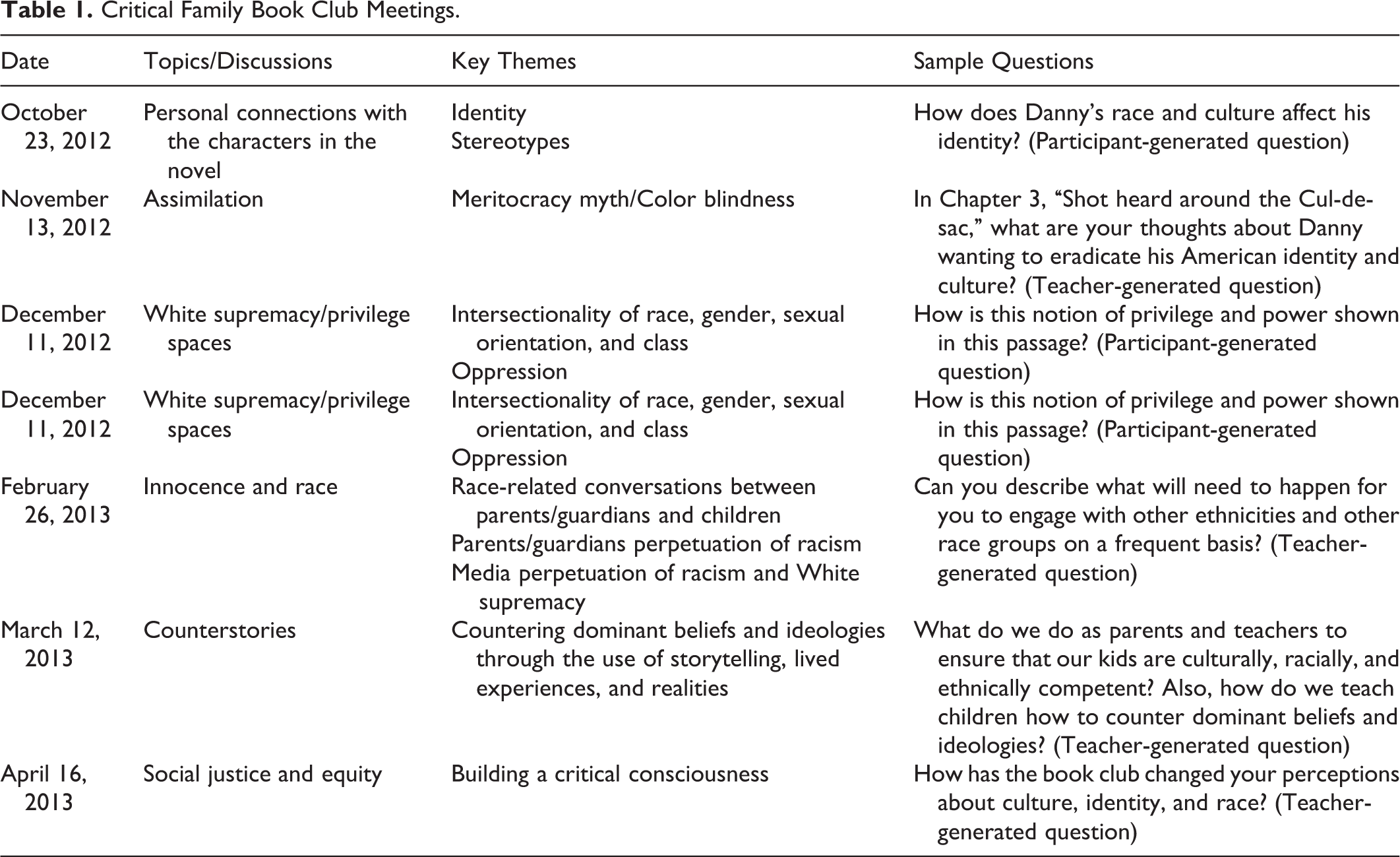
To code and analyze the data, I listened to interviews and took additional notes. In coding the book club transcripts, documents, and interviews, I paid close attention to the counterstories, dominant stories, and the detailed roles race, racism, and power play in education and in homes. After coding all the data, I mined the data for what questions were answered or addressed. Furthermore, I analyzed the emerging themes for if and how they correlate with the tenets of CRT, more specifically counterstorytelling (Bell, 1992). Each book club lasted 1 hr and 30 min. The first individual interview was a semistructured interview. The participants were asked to recall a memory or memories that made them realize their racial identity. The semistructured interviews were approximately 30 min long and audio recorded. I conducted these interviews more as a discussion rather than a formal interview. Each of the two focus groups was 30 min. One focus group took place during the beginning of the study, and the second was conducted at the end. In addition, I noted pivotal events from the meetings based on themes, which emerged from the data. I observed, audio recorded, and then transcribed the discussions of parents and students, as they participated in the critical family book club. I paid particular attention to parents and students’ perceptions and beliefs about race, racism, and power and how their conversations, thoughts, and perceptions changed throughout the book club.
Findings
Parents Educating Black Males on the Permanence of Racism
One of my research goals was to see how parents and students’ formation of the racialized self and racial experiences were (if at all) similar to the main character, Danny and issues he encountered with racial identity development and racism. During the first critical family book club, I posed the following questions: “Do the characters seem real and believable? Can you relate to their predicaments? To what extent do they remind you of yourself or someone you know?” These questions laid the foundation for this particular book club and the following meetings.
The families were opened about their relation to the main character, Danny. They empathized with Danny and with the issues he encountered. The following is a response from David a 15-year-old Black male, “Black males are born with targets on their backs, the target of being labeled as thugs and thieves. My mom taught me how the world works.” In this statement, David sheds light on the deficit depictions of Black males. Kirkland (2013) states, “Black people often must think about race without the consequence of choice but as matter of life” (p. 117). Furthermore, this statement from David made clear of how Black males are born into a world that oftentimes devalues their strengths and possibilities and view them as “miscreants,” “disadvantaged,” and “uneducable.” In addition, David highlights the fact he and his mom have been having critical conversations. Because he is a Black male, whose everyday experiences could be replete with race and racism (Boutte, 2015), David’s mom engages in critical dialogue with him about the societal limitations he could potentially encounter.
Building from David’s response, Cynthia, a biracial nurse at the feeder middle school, explains how she witnesses the mistreatment of Black males within the middle school. After discussing the disparities that many Black males encounter within school settings, Cynthia began to critically reflect on her role as a parent of color who is raising a young Black male. To illuminate, Cynthia reflected on a moment when she made her 15-year-old son, Matthew, change his Black hoodie before they left their home to go grocery shopping. Matthew is this tall guy. You know … a tall Black guy and he’s wearing his hoodie. And, I did tell him this, and I don’t know if this is right or wrong; but, I told him that he is perceived as a threat. Especially with the Trayvon Martin case, he has to be careful. But, it’s the truth. He is a threat. Although, in actuality, he isn’t a threat; he needs to know how some people may perceive him to be.
Enactments of Color-Blindness and Challenges to Those Enactments
Oftentimes, critical conversations around issues of race and racism do not transpire in many social institutions, such as schools and homes (Ladson-Billings, 2009); in part, because we live in a world where people often view everyone as the same and embrace a color-blind approach in regard to race. That is, if we intentionally or unintentionally refuse to see race, we will not be able to build a critical race consciousness because color blindness stifles us from seeing the racial and systemic issues that are prevalent in society-writ-large (Bell, 1992).
During a semistructured interview, Dan Cooper, a middle-aged White male, made clear how he views people as individuals without recognizing the person’s race. Landsman and Lewis (2011) argue, “On the surface, racism seemed to disappear according to many White people because to them it had only been overtly visible. Whites began to perceive society as being equal for all individuals” (p. 126). This notion of color blindness also came to the forefront during the book club meetings. For example, Dan stated: Noah understood at a very young age that the color of your skin doesn’t matter. It is what is in here (He points to his heart). And, how you treat other people…you know it’s what makes the difference of who you are; and, I think that served him well.
The two public figures had incidents that went viral around the same time. The picture was split in half. Below Richard Sherman’s face was the word “Thug,” and the other side was a picture of Justin Bieber and it had the label “Confused Kid.” This juxtaposition showcases the paradoxical nature of our society. As stated in the aforementioned, color-blind ideology suggests we will not acknowledge race and we will treat everybody the same. Thus, Jessica’s example illustrates that we live in a society that views people of color from a negative lens—because in actuality, we do recognize color. A color-blind approach not only blocks on the humanity of people of color but also it blocks the humanity of White people (King, 2005). On the contrary, a commitment to color consciousness positions us to honor the humanity of people while being fully cognizant of race and understanding racial differences.
Issues of Power and Privilege
The text for the book club illustrated the notions of power and privilege. It examined how White people possess privilege and power individually and collectively. In the novel, when Danny is in Mexico visiting his family, his grandma feeds him first whenever it is time to eat dinner. Danny does not understand why she does this. He exclaims how his grandma makes his Hispanic uncles, aunts, and cousins wait until he is served. During the book club, I posed the question: How are notions of privilege and power shown in the passage? A sampling of responses from two male White parents is presented below. I wonder if he wasn’t good in school or smart would she had done this? In the book he mentioned she is ashamed of her Mexican heritage. (C. H., personal communication, September 5, 2012) She is probably glad that he is part White. She sees it as a good thing. (C. J., personal communication, September 5, 2012) He is going to have opportunities. (C. H., personal communication, September 5, 2012) Because he would make it as a White person than Mexican. (C. H., personal communication, September 5, 2012) I would be curious to know what the rest of the family thinks about Grandma treating him like this. (C. J., personal communication, September 5, 2012)
This was an ongoing conversation between two White male participants. When the question pertaining to power and privilege was first posed, the White participants did not address this question and they highlighted how the grandma serves Danny first because he is intelligent and makes good grades. Consciously or unconsciously there seemed to be an underlying notion of meritocracy and color blindness. The two White males did not understand how oftentimes White people are privileged and obtain power because of their skin color (Landsman & Lewis, 2011). Thus, these two White males discussed and argued how the grandmother is rewarding Danny for being intelligent and subliminally making a statement to the rest of the family—if Danny can do this why can’t you?
After this conversation, an African American parent, Denise Jacobs, explicated how the grandmother may feel inferior to Danny because she sees his White skin as superior. The two White males did not understand how oftentimes White people are privileged and obtain power since this, “White privilege is the way that White people benefit from a racist society, refers to unearned advantages that are based solely on skin color and sometimes unnoticed by White people” (Rogers & Mosley, 2006, p. 466). White privilege automatically places White people at an advantage while positioning people from other racial and ethnic backgrounds at a disadvantage; therefore, we do not all equally begin at the same start-line. In fact, we will never begin at the same “start-line” because racism continues to situate itself in other progressive struggles such as health care, unemployment, laws, and education. In short, racial inequities cross the life span in multiple areas of life.
Recommendations: Critical Race Pedagogy and Book Clubs as Contested Spaces
Stevenson (2014) documents that an explicit focus on the discourse around racism in schools often receive major pushback. Regardless, if we choose to discuss racial matters or not, race is always present. Moreover, educators must challenge the hidden denial of race-related dilemmas. The endemic nature of racism invades multiple spaces such as schools, homes, and communities (Boutte, 2015). Because of the rapidly changing racial demographics in U.S. schools, critical race theoretical and pedagogical frameworks in educational spaces are vital if schools are to avoid mirroring historical and current types of inequities that are prevalent within the American fabric (Lynn, 1999). To assist in this process, I offer three recommendations that illustrate the importance of infusing CRT as a pedagogical tool and utilizing critical book clubs as tools to address and disrupt racial inequities. Recommendation 1: I propose that educators embrace critical race pedagogy as part of their curriculum. It engages students and teachers in self-reflexivity and critical dialogue about race, while disrupting issues of unequal distributions of power (Lynn, 1999). Educators should view critical race pedagogy as the impetus for approaching critical race theoretical issues in the classroom. It provides a contested environment that critiques, challenges, and evaluates systemic issues, which requires naming the key players and how these significant people or events exacerbate and sustain racial oppression. Recommendation 2: Second, critical race pedagogy should be a part of praxis. This will encourage teachers to create a space for critical dialogue in K–12 classrooms. In contrast to issues of gender and social class, race remains largely untheorized (Hughes & North, 2012). That is, there is not a language that enables us to discuss race and racial disparities in manners that are beneficial and emancipatory to those who are oppressed by racism. This pedagogy sheds light on the endemic nature of racism and enables teachers to reconceptualize critical race studies by situating race at the forefront of classroom practices, while moving oppressive situations from private to public spaces (Lynn, 1999; Lynn & Parker, 2006). Recommendation 3: Using critical race pedagogy to facilitate a critical family book club serves as a tool of activism in its creation of alliances across families from various racial and ethnic backgrounds. Most importantly, I believe critical family book clubs in conjunction with critical race pedagogy generate cross-generational racial dialogue. In addition, those who are victims of racism and those who are reproducers of marginalizing ideologies (intentionally or not) have become conscious through actively listening to their own stories as well as stories of others. It is my hope that people who participate in a critical book club will take at least one thing away with them—something that resonates deeply within their souls that will help them grow and continue on a trajectory to critical transformation.
Footnotes
Declaration of Conflicting Interests
The author(s) declared no potential conflicts of interest with respect to the research, authorship, and/or publication of this article.
Funding
The author(s) received no financial support for the research, authorship, and/or publication of this article.