







Abstract
This embedded case study investigates the nature of authorship in a secondary English Language Arts classroom by examining two adolescents’ writing identities and experiences writing across genres. Using rhetorical genre theory, the study illustrates how composition and notions of authorship in this context were strongly informed by conversations—both with peers and the teacher. An additional finding was that students wrote themselves into different genre identities as they composed poetry, editorials, and memoirs, drawing on different authorial stances and sources of knowledge. Finally, this analysis documents robust learning about the nature of writing, including transferring rhetorical strategies across contexts and purposes, skills often called for in education policy as well as career and college writing, not documented in secondary schools. Implications for teaching include valuing relationship-building conversations, offering students multiple genre positions across secondary writing experiences, and considering ways to build upon writers’ self-described and socially constructed identities as successful writers.
Recent research related to adolescents’ experiences of writing in schools indicates that, despite the increased importance of writing in professional, personal, and civic contexts (Brandt, 2015), writing instruction in secondary English Language Arts (ELA) remains highly formulaic and controlled by teachers in the form of prompts and literary analysis (Kiuhara, Graham, & Hawken, 2009). Even in high schools with reputations of exemplary writing instruction (Applebee & Langer, 2011), students spend very little time writing texts longer than a paragraph. In Applebee and Langer’s (2011) study, an average of 12% of observed instructional time was devoted to writing tasks of more than a paragraph, consistent with research indicating short answer responses are the most common type of writing in high school. Despite frequent calls for emphasis on writing instruction in policy and theory, students in contemporary ELA classes do not generally have opportunities to compose texts across time or in genres other than literary analysis. This study explores this highly regulated space of ELA classrooms (Brauer & Clark, 2008) in Midgard High (a pseudonym), a school where teachers changed their writing pedagogy to be more student centered, heeding Caraballo’s (2017) call for “curriculum that supports students’ construction and leveraging of multiple identities” (p. 587).
During a 2-year professional development (PD) initiative, some teachers at Midgard High demonstrated interest in shifts toward resource-based perspectives for diverse students (Skerrett, 2012) and classroom structures to support students’ autonomy (Bomer, 2011), including student choice and genre study (Whitney, Ridgeman, & Masquelier, 2011). This change was an activist stance taken on by teachers seeking to undo harm done to young people’s writing identities, bringing personhood back to the often dehumanizing space of school. Other scholars have documented similar work happening in out-of-school spaces (Jocson, 2006; Muhammad, 2015), but there are few contemporary examples of high school students writing in topics they choose or in genres other than response to literature in mainstream ELA courses. Mr. Roman was one of Midgard’s teachers who, in his seventh year of teaching, decided to try out writing workshop for the first time as a way to reinvigorate his teaching practice (Williamson, 2018). Rearranging work structures in his classes opened up possibilities for adolescents in his class to write themselves into more complex and meaningful selves.
Seeking to better understand how writing identity works in secondary ELA instruction, I explore the following questions: In a writing classroom centered on choice-based instruction in real-world genres, how do adolescents develop writing identities? What role does genre play in adolescents’ authorship? Cleo and Molly, the focal students in this study, show how students in public schools, particularly took up different identity positions in an ELA classroom that countered the traditional expectations of writing that persist in classroom practice: their personal histories and understandings of the world served as primary source material for writing. In most ELA classrooms, teacher-selected literature drives students’ writing agendas and positions adolescent writers as subservient to high-status literary authors.
Theory
Writing identity involves different positions or stances authors take up as they compose texts and engage in conversation (Davies & Harré, 1990), as well as relationships authors form with others as they compose (Bawarshi, 2003) and individuals’ self-ascribed and externally imposed concepts of self-efficacy (Jeffery & Wilcox, 2014; Pajares, Johnson, & Usher, 2007). The lens of rhetorical genre theory combined with theories of writing as dialogic, including the concept of plática (Fierros & Delgado Bernal, 2016; Flores-Dueñas, 1999), illuminate writing identity as socially situated and influenced by reciprocal conversations.
Rhetorical Genre Theory
In writing, rhetorical genre theory is a way to understand the relationship between a writer, the act of writing, and the type of text produced in a particular social context. Genre theory, drawing on Foucault’s (1969) concept of authorship as embedded in power structures, explains how “when writers begin to write in different genres, they participate within these different sets of relations, relations that motivate them, consciously or unconsciously, to invent both their texts and themselves” (Bawarshi, 2003, p. 17). Making a text requires the writer to draw on particular knowledge sets and orientations—writing an op-ed often involves drawing upon research and facts published by others in order to support a focused topic, while composing a memoir a writer relies primarily on lived experience as the source of knowledge for that text. The specific genre of text that people, more specifically students in school, write determines particular subject positions available to the author. The conditions for authorship are determined by a particular cultural context (here, the culture of Mr. Roman’s class), and authorship elevates a writer’s discourse to special status (Foucault, 1969).
As the act of composing a text in a genre influences the writer’s identity, writers and their texts have a reciprocal effect on genre. Their work becomes part of an existing and evolving body of texts that defines the genre. For example, Cleopatria and Molly’s texts shaped the nature of what a memoir could be in Mr. Roman’s classroom and beyond.
Bawarshi (2003) explains that knowledge of genres and participation within genres is a kind of power, “enabling students to participate in [sociopolitical] spaces more meaningfully and critically” (p. 18). Creating space in the ELA curriculum for students to publish their writing in the social space of the classroom positions them as makers of “a certain text and its author as deserving of privileged status—a text worthy of our study” (Bawarshi, 2003, p. 20) in the intellectual space of school. The author function has not been offered to students in public schools, particularly students of color and those from working-class neighborhoods (Jackson, 1986; Newell, Van Der Heide, & Olsen, 2014; Wahleithner, 2018).
Dialogic Perspectives on Writing: Conversations and Pláticas
In rhetorical genre theory, identity forms primarily through the production and reception of print texts; however, in Mr. Roman’s classroom, talk also influenced notions of authorship. The Bakhtinian concept of heteroglossia explains influences of other voices in writing: That any utterance an author produces has already lived “in other people’s mouths, in other people’s contexts” (Bakhtin, 1981, p. 294). The conversations that take place before and during writing shape the nature of written texts. In understanding authorship and identity, it is important to attend to the ephemeral oral language of the composing environment, as “writing and talking happened as simultaneous acts…this reciprocal exchange often contribute(s) to the content of the written piece” (Yoon, 2013, p. 168).
From Latina feminist theory, I also theorize informal conversations as critical for identity and relationship development (Fierros & Delgado Bernal, 2016; Flores-Dueñas, 1999) and thus for authorship. Traditionally feminized “small talk” seen through the Latina feminist lens of the plática serves to speak back to traditional notions of on-task behavior in schools. Platicar is “talk, but not just any talk, it’s talk about sharing inner truths, life’s challenges and achievements, and more importantly, to ‘catch up’ with someone you care deeply about” (Flores-Dueñas, 1999, p. 1). This talk is critical for building trust and providing space for reflection, learning, and addressing social issues (Fierros & Delgado Bernal, 2016). It contributed to how Cleopatria and Molly enacted complex identities as writers and audience members in their ELA class.
Related Literature
Many adolescents do not have strong personal connections to the writing they are asked to do in schools, a phenomenon documented across time in empirical research (Jeffery & Wilcox, 2014; Murillo, 2010; Scherff & Piazza, 2005), despite students’ desires for connections to their academic writing. Youth who identify as writers in out-of-school contexts tend to be alienated by the writing tasks assigned to them in classroom contexts (Brandt, 2015), particularly young people who write in genres historically marginalized by schools, such as songwriting (Bickerstaff, 2012), spoken word poetry (Fisher, 2003), blogging and fan fiction (Roozen, 2009), as well as political opinion and how-to texts (Brandt, 2015).
Most of the writing assignments students do in high school ELA classes take place in two traditional school genres: literary analysis and a prompted five-paragraph essay (Applebee & Langer, 2011; Kiuhara et al., 2009; Scherff & Piazza, 2005). These particular genres have been linked to disengagement with writing (Emig, 1971; Newell et al., 2014; Whitney, 2011) yet remain dominant in high school writing instruction and thus an influential force in shaping identity. Prompts for these genres may be teacher composed, as Bawarshi (2003) analyzes in the context of college writing, or more often externally imposed by an authoritative other and assessed by standardized rubrics (Caraballo, 2017; Schunn, Godley, & DeMartino, 2016). However, there is evidence from extracurricular contexts (Johnson, 2017; Muhammad, 2015) and remedial classes (Skerrett & Bomer, 2013), indicating teachers can provide experiences in other genres—memoir, poetry, and short fiction—that allow students to draw upon a more full and complex representation of their various identities (Moje & Luke, 2009) as writers. The current study illustrates how writing practices more often seen in out-of-school contexts can be part of school writing to offer students more variety in authorial positions. This authorial flexibility is of critical importance, given the Common Core State Standards’ focus on students’ abilities to write multiple types of texts.
In addition to the genres available to students, research indicates the role of conversation in writing instruction. Several studies in high school classrooms illustrate the importance of talk in developing ideas and composing practices (VanDerHeide, 2017; Vetter, 2010). This talk might be teacher–student in the form of assessment and writing conferences or peer conversations (Marsh, 2018). This current study extends the notion that “unplanned classroom interactions” (Vetter, 2010, p. 40) through talk can be valuable for writing instruction, particularly with respect to relationship-building pláticas (Flores-Dueñas, 1999).
Method
This embedded case study (Yin, 2014) is situated within a larger qualitative study (Williamson, 2018) of ELA curriculum and instruction at a large urban high school in the southwest. I spent the 2016–2017 school year at Midgard High observing ELA professional learning communities as well as focal classes that represented a wide range of approaches to teaching English. Teachers initially knew me as a colleague of a consultant providing PD in collaboration with the National Writing Project—I had come to Midgard hoping to document the complexity of taking up new teaching practices. This prior relationship meant that teachers positioned me as allied with new practices and stances toward writing presented in the PD. Mr. Roman’s class was the one where I spent the most time, visiting his fifth period 10th grade Pre-AP class from December to May. This analysis examines the phenomenon of writing identity by focusing on two students: Cleopatria and Molly—both self-selected pseudonyms. I purposively selected these two girls as cases from the seven possible focal students because I as a reader was moved by their writing, there was rich data about writing identity for both, and they represented different dispositions toward writing, social relationships during writing, as well as different racial and linguistic identities. The combination of similarities (high-quality writing, data sources) and differences (dispositions, race, language, and approaches to memoir) allowed for a complex and robust consideration of the research questions.
Cleopatria, or the diminutive Cleo, as I will refer to her, identified as a Spanish-English bilingual Hispanic girl of Mexican American heritage and chose to enroll in an advanced English class. She was not labeled by the school as an English-language learner (ELL). This absence of institutional labeling is important due to negative associations of ELL (Brooks, 2015) and minimal research documenting positive literacy experiences of bilingual adolescents. Molly identified as a White monolingual English speaker with Scottish and Irish heritage. Like Cleo, Molly chose to enroll in the Pre-AP section, adding “I knew it would give me more of a chance to write” (Survey, May 9, 2017).
Data Collection
I observed 45 hours of Mr. Roman’s class (30 visits), taking field jottings and regularly expanding these jottings into ethnographic field notes (Emerson, Fretz, & Shaw, 1995). During writing time, I conferenced with Cleo’s and Molly’s table groups, asking them questions and talking with them about their writing. My regular observation space was a seat next to Cleo’s group, where I frequently overheard students’ chismes and thoughts about their classwork. I use the Spanish term chismes instead of the English “gossip” here to highlight the archetype of the “chismosa” in Latinx narratives (Anthony, 2013): a representation of girls as engaging in frivolous talk. Here, relationship-building talk served to strengthen their academic work, as it did for many students in Mr. Roman’s class.
After spending time participating in the daily routines of Mr. Roman’s class and establishing relationships, I solicited students’ opinions by drawing on aspects of Latina feminist methodologies. Asking youth to reflect on the value of curricula acknowledges the importance of interviews not to “extract information from youth, but to allow them to assess or theorize about their own lived experiences” (Fierros & Delgado Bernal, 2016, p. 109) as we seek to understand social phenomena. The class completed a written survey—Both Cleo’s table group and Molly indicated on their surveys they would be interested in talking with me more about their learning. For both girls, I chose interview structures that fit into the different ways of being I observed in their classroom community. For example, I interviewed Cleo as part of a group interview with three of her tablemates. This technique of reflection through group conversation draws on traditions of the plática and its role in Latina feminist methodologies (Fierros & Delgado Bernal, 2016; Flores-Dueñas, 1999). Asking Cleo to participate in an interview separately from her conversation partners felt isolating to me, so I offered them the option to talk with me together—platicar—as I had observed them do regularly. I asked the group questions in both English and Spanish, replicating the language mixing present in their ordinary discourse. Molly participated in an individual interview (Mertens, 2009). Molly frequently sought out her teacher for advice on writing. As a White woman and former ELA teacher, I thought it likely a one-on-one conversation with Molly would be a comfortable discourse structure. While the interview protocols had reflective questions and the flexibility for back-and-forth talk, I did not build in time for youth to generate questions for me the researcher, nor focus explicitly on issues of power and healing, both called for by Fierros and Delgado Bernal (2016). I hope to do so in future research.
Frequent observations combined with youth reflections on experience allowed me to better understand the relational nature of composition—the different “social code(s) of behavior” (Bawarshi, 2003, p. 28) that influenced the girls’ genre performances and the classroom discourse community. Additional artifacts I collected were 10 published texts that showed identity constructions across genres, process, and reflective writing, as well as three interviews with Mr. Roman about his curriculum, instruction, and impressions of students.
Data Analysis
To begin data analysis, I read across data closest to Cleo’s and Molly’s experiences of writing instruction: their interviews, surveys, and student work projects, identifying moments when they articulated understandings of their identities as writers and relationships with others. This initial reading of data yielded the first theme of authorship informed by conversations as both Molly and Cleo explicitly described collaborative composing with tablemates as important for their writing. Then, drawing on Bawarshi’s (2003) concept of genres as socially situated sites of action, I wrote within-case analytic memos (see Online Supplemental Materials) for each girl, attending to genre conventions in all of their published texts: memoir, op-ed, poetry, scary story, including authorial positioning, pronoun usage, sources of knowledge, and social relationships in composing. I coded field notes from days when the girls were present for instances of peer conversation to confirm the girls’ statements about this being an important practice. Cross-case analysis complicated findings about the role of memoir as important for identity formation, specifically their different interpretations of conventions within that genre. I examined Mr. Roman’s interviews for confirming statements about the nature of writing and identity, as well as classroom relationships. To present findings around genre positioning in the next section, I selected two pieces of writing for each student to illustrate flexible performances of authorship: for Molly, moving between vagueness and specificity and for Cleo, manipulating time on different scales.
Findings
In this section, I present three major findings to answer the questions: In a writing classroom centered on choice-based instruction in real-world genres, how do adolescents develop writing identities? What role does genre play in adolescents’ authorship? First, in the space of this classroom, students’ writing identities were informed by conversations with peers and their teacher, with those people as immediate audiences for writing. Secondly, writing across genres allowed for flexible and robust enactments of identity, as students drew on different constructions of knowledge and genre conventions throughout the year. It is important to note this robust learning about writing took place within a Title 1 school under intense scrutiny from district authorities with respect to standardized test performance (Williamson, 2017). Finally, both girls employed specific rhetorical strategies across genres, indicating their ability to transfer writing-related knowledge to novel tasks, a competency called for in college writing standards.
To illustrate these findings, I present an overview of how Mr. Roman’s classroom worked as a space where authorship was shaped by conversations, then move to examine Molly and Cleo as individual cases, exploring how writing and authorship shifted as they moved across genres.
Authorship Informed by Conversations
The humans in Mr. Roman’s fifth period talked a great deal during class time; Cleo and Molly were frequent participants in whole-class and small-group conversations. Class routines and space allowed for small-scale talk to occur among students at their table groups as well as between students and their teacher. This dynamic environment was one where it was possible to check in with potential audience members throughout the composing process, a practice Molly and Cleo engaged in throughout the school year. Thus, the girls simultaneously acted as readers of their peers’ work and offered up their own work for review in addition to having their writing assessed through conversation by their teacher, building trust through reciprocity and dialogue.
Both girls engaged in conversations with their tablemates, self-selected groups that remained relatively stable across time. Peer discussion in table groups was built around caring relationships, often self-directed by students but not closed to the teacher’s participation. The morning warm-up was frequently a time for Cleo and her friends to catch up with one another about their lives and concerns: sharing “family stories, consejos, regaños, and jests” (Fierros & Delgado Bernal, 2016). Normalizing plática in Mr. Roman’s classroom meant that students were expected and encouraged to talk with one another, allowing authorship to take place in a multivocal, social environment (Bawarshi, 2003). Mr. Roman described Cleo’s group as “very supportive…they’re laughing about their work…it’s just so interesting how they work together” (Interview, December 1, 2016). Valuing traditionally feminized discourse patterns acknowledges the power of collective meaning-making through relationships.
A midyear conversation during the poetry unit illustrates the nature of multivocal informal talk and social relationships in this class: The table near me chats in Spanish and English, about half and half, moving between Cleo’s possible poem topics (her 10-month-old nephew who she doesn’t want to grow up) and a possible relationship with an older boy for another girl (this may be related to Natalia?). Mr. Roman stops by the table and talks with them a bit, offering girls writing suggestions for those that seem stuck. (Fieldnotes, January 12, 2017)
Several weeks later, traces of this conversation on the first day of the unit emerged in one of Cleo’s poems shared on publication day:
The topic for this writing emerged in conversation over time—with peers, with me the researcher, and with her teacher. This illustrates the social nature of composing (Bawarshi, 2003), where invention and the generation of ideas for writing happens amid catching up about ordinary life (Fierros & Delgado Bernal, 2016). This composing environment is one that has been documented in professional writing contexts (Brandt, 2015) and collaborative online spaces (Lammers & Marsh, 2018; Roozen, 2009) but not necessarily offered to students in school contexts.
Cleo also drew on the practice of centering life experience as she prepared for the high stakes state exit exam, noticing that a high-scoring response the class read as a model drew primarily on examples “from their life.” Mr. Roman reaffirmed this in whole-group discussion by including Cleo’s suggestion on a list of writing strategies for the exam, naming this as “the power of personal experience” in writing (Fieldnotes, March 8, 2017). In the final writing unit of the year, Mr. Roman reminded students to think about “places where you’ve lived, what you’ve experienced” (Fieldnotes, April 18, 2017) as the setting for a short story, to ground students’ writing in something familiar. Throughout the year, in small- and whole-group conversations, Mr. Roman encouraged students to draw upon their lives and everyday concerns, positioning them as authors who could write from a wealth of experiences.
Not all conversations were immediately generative for writing—the informal nature of talk in table groups sometimes veered away from the assigned writing task. This happened for an entire 20-min work session for both Molly and Cleo’s table groups during the spring scary story unit, on different days for each table. In both cases, these extended off-topic conversations centered on romantic relationships: In May, Molly debated with her tablemate Elijah whether or not he would intervene on her behalf to talk to a boy she liked, and in April, Cleo’s table discussed an ongoing relationship. Ignoring writing for an entire work session was atypical behavior, and in the case of Cleo’s group, it was a tablemate, Natalia, who redirected the group back to their assigned task of analyzing the plot of a mentor text.
Here authorship meant writers had the responsibility of serving as the springboard for others’ ideas, engaging in critiques of peers’ published texts, and actively participating in identifying elements of good writing (VanDerHeide, 2017; Vetter, 2010). The process of social interaction through conversation transformed writing into a discursively dynamic space where the voices of peers and the teacher constantly contributed to the process of authorship. Rather than a monologic interaction between a teacher assigning a writing task and a student who completes it, composing in this space was a collective endeavor, with students’ knowledge centered as a resource for composition. In allowing space for students to be humans with each other and “catch up” (Flores-Dueñas, 1999) and reflect in conversation when they needed, these humans wrote complex and meaningful texts.
Assessing writing in conversation: Dialogic author feedback
Writing in Mr. Roman’s classroom was evaluated primarily through conversations, with the teacher and among classmates—both audiences receiving equal consideration. Students were conscious their published work would receive a grade, but on publication day, the focus of writing was on the writers in the class sharing their work with the peers whose voices informed the creation of the text. To introduce the poetry publication, Mr. Roman explained to the class: There were moments when you’ve enlisted help from your table [writing these poems] and I thought it might be nice for you to show them your final product. Take turns reading everyone’s poems, talk about what you liked, just enjoy the poetry, I don’t want you to over-think it. (Fieldnotes, January 31, 2017)
Conversation was also how Molly knew her memoir had achieved the goal of creating an affective text: a lot of kids said that it was really powerful and good, and this one kid joked around ‘cause I was like ‘Can I get like actual feedback?’ and some guy was like ‘well you could use more commas’ and he was practically crying. (Interview, May 24, 2017)
Sharing writing with others positioned both Cleo and Molly as important members of a class community of authors, all with stories to tell. Cleo explained her writing environment as one where “we all help each other out, like…oh does it make sense? and we all read it and then we all give ideas” (Focus Group Interview, May 18, 2017). Molly identified this as her favorite aspect of English class: “how freely we all help each other out like especially my table. I’m always helping Elijah and he’s helping me” (Interview, May 24, 2017). She repeated this idea, explaining “I like how everyone helps each other write” (Survey, May 10, 2017). Through conversations, Molly positioned herself as a reciprocal collaborator, eager to give and receive advice. It was also important for her to share her writing with her teacher. On three separate occasions, twice during poetry and once during the scary story unit, Molly brought a draft up to Mr. Roman and asked for his immediate feedback. She explained these one-on-one conversations were how she understood how her writing was going. Molly declared the most important writing feedback from her teacher came in conversation: “I always know that I did a good job cause I always like talk to him” (Interview, May 24, 2017).
Molly Moving Across Genres: Memoir and Editorial
The genre of memoir created opportunities for intimacy between Molly, the texts she wrote, and her peer audience, as she drew on knowledge of self and shared that in her writing. In contrast, the genre of the editorial allowed Molly to manipulate news articles and statistics to create another moving text.
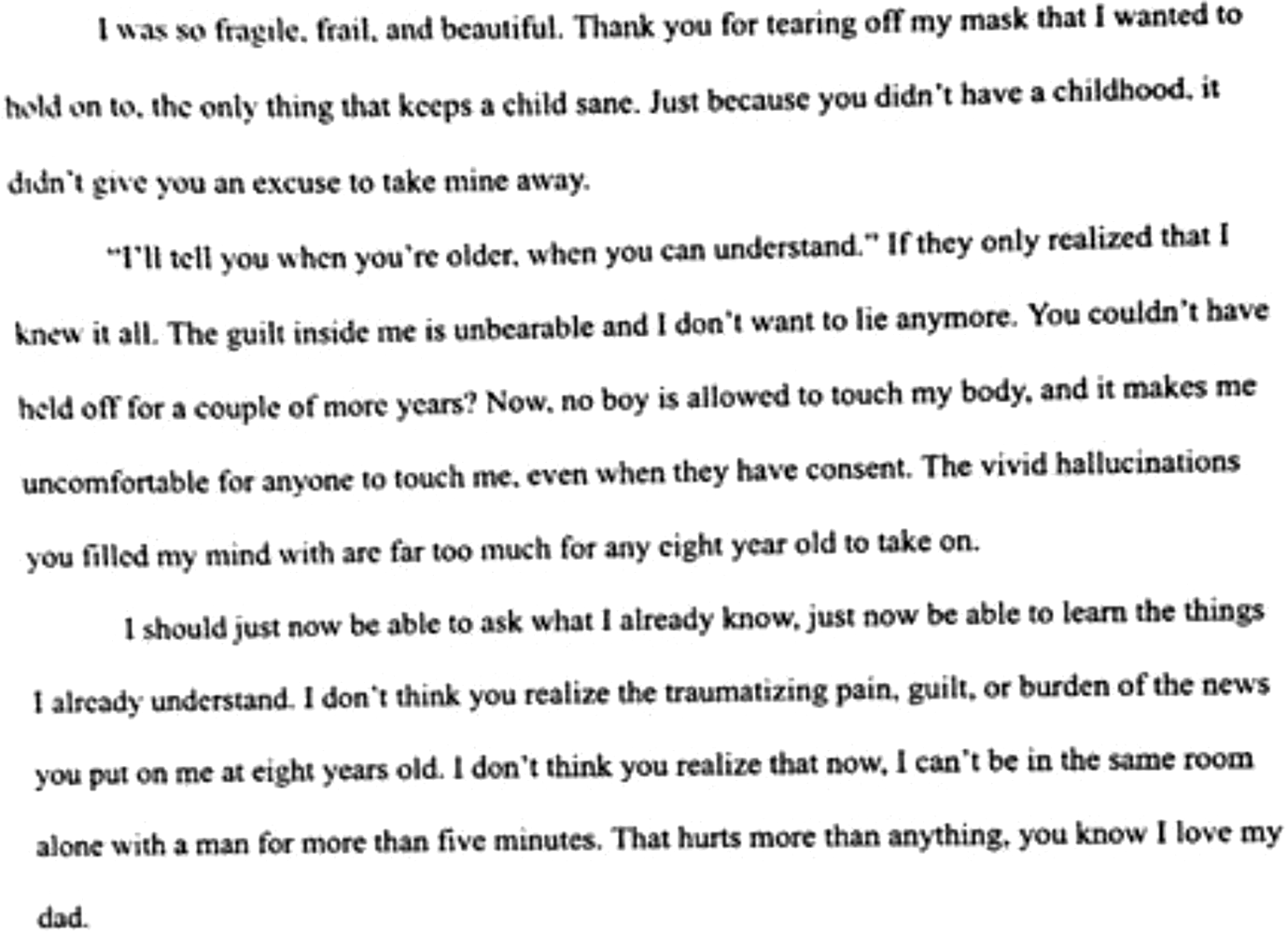
Molly identified her memoir as the most important text she wrote that year, describing the task as having to select “a memory in your childhood that…was significant to you…And make it I guess come to life” (Interview, May 24, 2017). Her interpretation of her teacher’s directive was reflective of a school context that allowed for intimacy and memory to become the center of learning. In Molly’s case, the memories were of ambiguously traumatic conversations. Her memoir narrates a specific story her mother told her when she was in elementary school. The details of the story remain hidden—the reader has to infer a foggy picture of what Molly’s mother revealed. Given the strong language Molly used to describe the event, it would seem some sort of intrafamilial violence transpired, illustrated by Figure 1.
Excerpt from Molly’s memoir.
Presenting a story so vague is in stark contrast to how she presented information in her editorial. All that Molly provided in the memoir was a visceral internal monologue directed at her mother. The one quotation in the text, “I’ll tell you when you’re older…” is not clearly attributed to any character and floats in the story like misremembered family lore. The “you” she addressed consistently within the text is her mother, yet Molly was also clearly aware of writing for the immediate audience of her classmates, allowing them a shadowy glimpse into her family life. As an author in her memoir, Molly obscured and withheld facts, revealing flashes of emotion instead of details or scenery. Molly judged this piece of writing, full of slippery meanings and sophisticated constructions of audience, as her best. As noted above, the publication experience and her peers’ emotional responses were evidence of the text’s success in fulfilling its purpose.
Molly also found value in reading other students’ memoirs. When describing this experience, she explained “you kinda learned a lot about people, and get closer as a whole…that’s a big, like that’s a big part [of class] for me. I love knowing people.” Intimacy here for Molly was not only individual, but collective, as she came to know her classmates more deeply through their writing—reflective writing that offered “inner truths, life’s challenges” (Flores-Dueñas, 1999, p. 1). Mr. Roman invited his students to transform his classroom into a place where personal experience, history, and memory mattered deeply, where individual subjectivity and self-reflection were valued aspects of writing identity.
In contrast to the nebulous memoir, Molly’s editorial began with a barrage of facts, moving from local to state-wide statistics and drawing on three news-related sources and one “fictional” blog post called “It’s Almost Tuesday” (Murphy, 2006). Following conventions of editorial writing, Molly opened the piece by reaching outward into the world to gather information about the topic and present it to readers, weaving her opinion into the text through multiple first-person statements. An authoritative voice made judgments on these facts: “to me, that seems like a lot of foster care cases gone wrong in 2016…not to mention years before that” (Editorial). This process of judgment positioned Molly in control of and with power over information, yet the editorial also included individually subjective expressions written in the first person.
In this text, Molly created the persona of an author as increasingly angry over the course of the editorial, building into a righteous fury that ends in a call to action. She asked repeated rhetorical questions: “Why isn’t anyone looking at the big picture?” “Can you really blame them?” “Who’s with me?” and engaged in a few instances of all-caps textual shouting: “COMPLETELY RANDOM house checks” and “DO NOT put the kid in the home they will be staying in, when the kid still looks completely horrified.” Molly enacted editorial genre norms by including rhetorical questions and a call to action, while also disrupting them with informal orthography more characteristic of texting or online writing. The shouting tone positions her rhetorically as a writer in this genre—passionately engaged and angry about injustices in the world. This engagement with her topic shows how the editorial wrote Molly into an identity as an activist and allowed her to “enact certain situated commitments” (Bawarshi, 2003, p. 14) to social change. Choosing her topic and writing within the real-world genre of editorial allowed Molly to “participate in [school] more meaningfully and critically” (Bawarshi, 2003, p. 18) bringing her emotions and political concerns into the classroom. “Invention, in this case, is an act of turning outward, not just inward” (Bawarshi, 2003, p. 97).
In both genres, Molly drew on her strength of first-person narration and second- person address in narrative construction. While this was less present in the editorial, due to the conventions of this genre, she still inserted references inward (“me”) eventually directing her writing outward, toward a second person “you” of the reader. In her memoir, the explicitly stated “you” in the title is her Mother, whereas the reading public of “you” in “can you really blame them” in the editorial shifts to a larger plural conception of audience. Bawarshi hypothesizes that the use of first- and second-person pronouns have a universalizing effect on the relationship between the writer and reader, drawing the reader into the story. This technique “locates readers in positions of interpretation” (Bawarshi, 2003, p. 28) directly connected to Molly or the persona she created in the text. The collapse of narrative distance and subsequent intimacy is difficult to imagine in a classroom with standardized prompts and preselected topics for writing.
Cleopatria Moving Across Genres: Poetry and Memoir
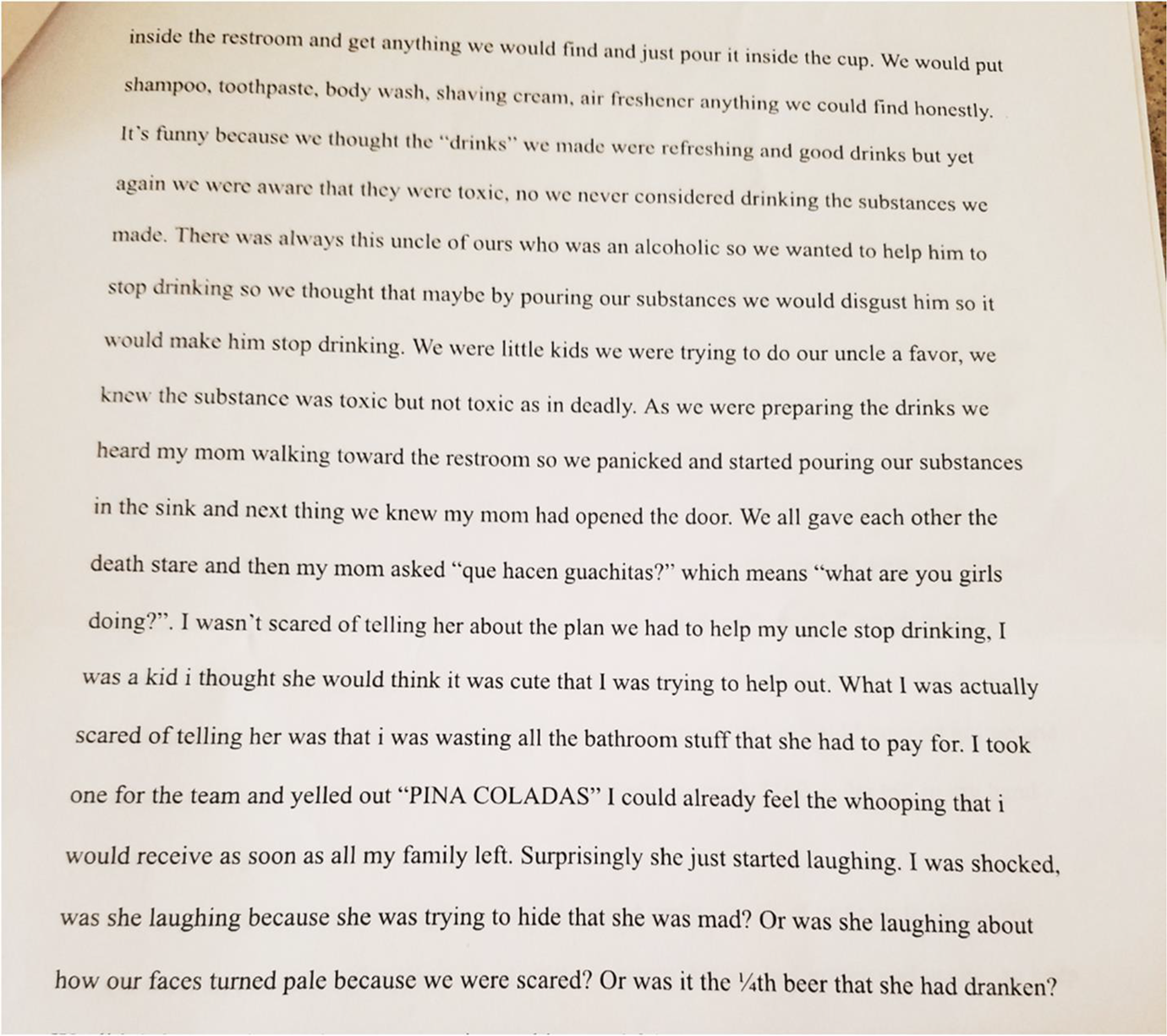
Like Molly, Cleopatria named memoir as her most successful piece of writing for the school year, explaining “for me what I think I’m good at is memoirs…because well I like stuff that I can relate to and that I can write about, way better than things that I make up” (Focus Group Interview, May 18, 2017). Students across the country also indicated a preference for writing about their lives, stating that being able to “say something about myself” (Jeffery & Wilcox, 2014, p. 1107) was a reason they liked writing. For Cleo, connecting texts to the real world was an important part of being a writer. This sense of the materiality of the world around her, grounded in personal experience, was evident as she narrated the story of an extended family Christmas party. In contrast to Molly’s obscured story, Cleo used the genre of memoir to fill her writing with specific details and a strong sense of place, as shown in Figure 2.
Excerpt from Cleopatria’s memoir.
A reader has an immediate image of the house Cleo and her cousins played in, down to the contents of the bathroom cabinets. The text has a sense of physical movement, and tension builds as her mother approaches from outside. This miniclimax in the story is filled with drama: the young girls frantically emptying bottles into the sink, giving “each other the death stare,” and the final comic relief of “PINA COLADAS!” Writing this memoir meant Cleo had to dig deeply into her experience to remember (or recreate) a vibrant scene in a particular moment in time, constructing the activity, materiality, and hilarity of the original experience for the reader.
While she used a different descriptive approach than Molly, Cleo shared some of the rhetorical moves Molly used in her memoir, such as creating a list of rhetorical questions, incorporating the “I” as presence through first-person narration, and choosing an event from a similar time frame in her life. This shows the presence of genre structure in the social space of the classroom: a set of habits and “social code of behavior” (Bawarshi, 2003, p. 28). Cleo positioned herself as both a discloser and a withholder of information, giving minute details as in Figure 2 and inviting the reader into the story world of her Southwestern Mexican American home, while simultaneously setting up the reader for a powerful reveal at the end. In the last paragraph, she revealed that joyful and extended family gatherings like the one she described exist only in her memory (and the text). After her parents’ divorce, she had to choose which parent to spend every holiday with and they never had the same exuberant celebrations. In a stark change of tone, she declared at the end “I would do anything to go back to the way it was” (Memoir, p. 4). Within one genre, Cleo worked to position the reader with knowledge and without knowledge, making the reading of the text a shifting experience.
Cleo’s poem (quoted previously) was, like her memoir, drawn from a real event and her experiences of becoming an aunt. In this sense, the genre of poetry also enabled Cleo to draw on knowledge of self and personal relationships for her writing. In the poem, instead of specificity of place, Cleopatria created intense flashes of imagery around characters: crying after holding her nephew for the first time, and reactions to various early developmental stages, moving from infancy (“you learned how to grab a bottle”) to toddler (“you stand up for yourself now”). Events in the poem are distributed across time, with the text serving as a condensed 1-year narrative. This collapse of time in poetry is the opposite of what Cleo did in her memoir: extending a few hours on Christmas Eve across five pages of text.
Despite the poem coming from a set of lived experiences, in class, Cleo played around with the concept of a literary “speaker,” a fictional construct created by the poet to displace identity. This talk was tied to Mr. Roman’s teaching points, as the poetic distance between author and speaker was part of whole and small-group analysis of poetry on three class days. On the final day of the poetry unit, Cleo shared she learned “it’s not the author, it’s the speaker” that is the voice of the poem. Mr. Roman responded “That’s right, there’s this character that the poet can create” (Fieldnotes, January 31, 2017). “Our identity is always plural and always in the process of presencing” (Bawarshi, 2003, p. 110); in this way, Cleo shifted between her role as an aunt and the literary distance of a poet in the process of writing this text.
Interestingly, in May, Cleopatria checked the box next to “not much, writing is not great” to describe on her survey how much she liked writing. In November, Cleo wrote “I am a better writer now than when school started because before I wouldn’t practice writing” (Reflection, November 16, 2016), and in May, she reflected on “all the certain requirements for types of writing” (Survey, May 10, 2017) she was familiar with by the end of the year. Despite extensive practice, receptive audiences, and multiple experiences of social positioning as a successful author, Cleo was reluctant to position herself as someone who enjoys writing and takes up that practice voluntarily. Examining this “social and rhetorical location in the world” (Bawarshi, 2003, p. 111) is important because despite successful publication experiences and begrudging smiles in response to Mr. Roman’s, her peers, and my compliments on her memoir, Cleo’s writing identity remained fragile. Considering the many classes in which students do not have such successful experiences nor personal connections to writing, it is no wonder many students leave school lacking confidence in writing. Teachers seeking to build up writers’ identities may learn from this example: it takes multiple cycles of publication as well as routine conversations about and during writing for students to compose meaningful texts. Even then, one year may not be enough to cultivate a positive writing identity for a young person.
Discussion
Both Cleopatria and Molly moved skillfully across genres, drawing from the intimacy of family histories and information from public discourse. Writing from multiple author positions yielded important learning for both girls about the nature of writing and presented distinct stances from which they wrote: as memoirists, poets, opinion writers. They wrote for and with their peers, receiving meaningful feedback in conversation with their teacher, trying out different representations of who they could be. In their writing classroom, their teacher provided a space for talk infused with memories, social issues, and emotions. Both girls demonstrated writing competencies called for by college courses: an awareness of writing as it changes across genres and purposes (Yancey, Robertson, & Taczak, 2014) and a theory of composition where meaning emerges in process (Sommers, 1980) and conversations (Canagarajah, 2013). Here I discuss the significance of writing skills traversing genres and address notable silences in Mr. Roman’s classroom.
Deploying Rhetorical Strategies Across Genres
Across genres, the girls had a set of writerly moves they relied upon regardless of text conventions. A common thread in this story line (Davies & Harré, 1990) of what it meant to be a writer was authors’ ability to draw upon their lives and experiences to shape the texts they created. For Molly, the use of “I” and the presence of a first-person narrator was present across all of the text genres she wrote that year, from her editorial to the scary story quick draft. Cleo drew from life experiences as material for writing across genres: poetry, memoir, and the high-stakes test essay. It is notable that for the standardized test essay, students in Mr. Roman’s class saw the possibility to center their life experience in the writing of a text, even one as impersonal as a mandatory state-wide exam. These writerly moves that remained constant indicate the girls had a generalized approach to writing in addition to genre-specific habits, a hallmark of learning transfer and expert writing ability (Yancey et al., 2014). For both girls, choosing topics and writing material from their personal histories was a consistent practice. They both framed good writing as work that connected to their lived understanding of the world. This understanding of writing as grounded in personal experience is not necessarily a universal characteristic held by any high school writer (Jeffery & Wilcox, 2014); however, Molly and Cleopatria’s construction of writing—and themselves as writers—defined it so.
Cleopatria and Molly took up various authorial identity positions in their English class, a significant finding when contextualized in the local environment of Midgard High school: an urban emergent high school under high surveillance with respect to literacy achievement (Williamson, 2017). This study shows that young people with histories linked to perceptions of risk and failure here had the opportunity to belong in school in a powerful way: as authors with important things to say in the world
Absences and Silences
Related to traditions in ELA instruction, there are two important aspects of writing missing in this analysis: the composing of fictional texts and writing to analyze literature. Of the many genres students had the opportunity to write, a text set in an imaginary world or filled with invented characters was not something this group of students enjoyed. The final writing unit of the year was a horror story unit, which neither of the girls mentioned as work they thought was excellent. Attention and motivation can wane so near to summer break, or it might have been that for these girls, their alpha genres (Bawarshi, 2003) were realistic or fact-based texts. Other classes I observed at Midgard High had students who used the genre of short story to create science fiction space adventures, but this did not happen in Mr. Roman’s class.
Another interesting silence was the relationship between literature and the teaching of writing. Because of the gradual site entry built into my research design, I did not enter Mr. Roman’s classroom until the beginning of December. As such, I did not observe the one novel unit he taught that year. From the department chair and grade-level meetings, I know each 10th grade class wrote some sort of literary analysis essay related to themes in Night (Wiesel & Mauriac, 1982). However, neither students nor Mr. Roman discussed this composition in future writing units. Students’ memoirs, written after the Night literary unit, were referenced from time to time, and as discussed above, were important in shaping writers’ identities. This disconnection between writing about literature and writing in real-world genres has important implications for writing instruction and identity positions. Here, students did not make connections between literary analysis and general writing ability nor did discussions of writing process or quality relate to the most commonly assigned type of writing seen in secondary schools.
Mr. Roman intentionally shielded his students from the genre of standardized test writing, a phenomenon I describe with more detail elsewhere (Williamson, 2017). He explained that centering testing in his teaching “killed some joy” (Interview, December 16, 2016) in his professional life, and it was important to not have test preparation consume his classroom. Thus, students did not come into contact with test writing until the end of February, five weeks before the test administration. Concentrating exposure to the test in this time period and treating it as just another genre study was how some teachers at Midgard balanced the realities of high-stakes assessment with their commitments to humanized writing instruction.
Implications
It would seem that the skills and dispositions students drew on to be successful writers came from writing from within text genres not often seen in secondary ELA classrooms: editorials, memoirs, poetry. Students were “written…by the genres” (Bawarshi, 2003, p. 11) they produced, participating in literacy activities within the social rules of these genres within Mr. Roman’s classroom. This was a space where literature—particularly poetry—served to model authorship, not to explicitly provide an aesthetic reading transaction (Rosenblatt, 1994) or practice with close reading. The genres in Mr. Roman’s classroom allowed students to write from “social and rhetorical locations” (Bawarshi, 2003, p. 111) grounded in personal histories, emotions, and social issues that mattered to them, like foster care and being a family.
If teachers are interested in truly developing flexibility and dexterity in writing, students must have opportunities to write across genres, ideally genres that exist beyond school walls. This is an urgent need, when students report frustration with secondary curriculum that is “structured to the point of being repressive” (Murillo & Schall, 2016, p. 318). The “Writing Next” policy report explains that “modern writing instruction in the United States recognizes that students need to write clearly and for a wide variety of real-life purposes…[it] instills in writers the command of a wide variety of forms, genres, styles, and tones, and the ability to adapt to different contexts and purposes” (Graham & Perin, 2007). Molly’s and Cleo’s cases show adaptability and a wide repertoire of skills and forms of knowledge applied to writing, in a space where their teacher respected their need to engage in interpersonal communication—plática—during work time. This allows students to construct more dynamic, creative, and emotional selves in school, even in the context of high surveillance around standardized achievement measures. Access to sophisticated roles and plural identities is not something given “only to literary activities” (Bawarshi, 2003, p. 31)—it is how everyday writers can author themselves too. These young women brought humor, joy, and trauma into their writing lives, disrupting oppressive structures that strip humanity from the texts students compose in school. More young people deserve opportunities like this in their ELA classes and are waiting for better chances to write themselves into being in ways that honor their complex identities and lives.
Supplemental Material
Supplemental Material, final_williamson_onlineappendix_appendix - Authoring Selves in School: Adolescent Writing Identity
Supplemental Material, final_williamson_onlineappendix_appendix for Authoring Selves in School: Adolescent Writing Identity by Thea Williamson in Literacy Research: Theory, Method, and Practice
Footnotes
Declaration of Conflicting Interests
The author(s) declared no potential conflicts of interest with respect to the research, authorship, and/or publication of this article.
Funding
The author(s) received no financial support for the research, authorship, and/or publication of this article.

Supplemental Material
Supplemental material for this article is available online.
References
Supplementary Material
Please find the following supplemental material available below.
For Open Access articles published under a Creative Commons License, all supplemental material carries the same license as the article it is associated with.
For non-Open Access articles published, all supplemental material carries a non-exclusive license, and permission requests for re-use of supplemental material or any part of supplemental material shall be sent directly to the copyright owner as specified in the copyright notice associated with the article.
