







Abstract
Abstract
This article will focus on the ‘blogosphere’ in India as an emerging forum for critical readings of social and political events and issues. By concentrating on the blogosphere, read as a morphology of horizontal societal communication enabled through a network of blogs and social media sites on the internet, we have tried to offer a glimpse into the kind of issues and interactions that various groups and communities are engaging with and the scope for such online activism to usher in social transformation. For this study, we have limited our discussion to a close reading of contents on blogs as one confronts the positions and critiques offered by individuals and groups and gets a sense of the local concerns articulated in the blog entries. Our concern in this article is to fathom the potential of blogs in transformative politics and mass mobilisation, namely civic engagement against the framework of an emerging public sphere on the Internet by analysing case studies of select blogs, primarily—Kafila, an academic-activist blog, Youth Ki Awaaz (YKA ), a students’ blog and Round Table India, a Dalit blog.
In April 2011, in Delhi, a movement against corruption led by activists, academics and bureaucrats, commonly referred to in popular discourse as ‘the Anna Hazare movement’, ‘India against corruption’ and ‘Anti-corruption movement’, challenged the treatise on media and politics in the country. The mobilisation of hundreds of people was recorded and transmitted through different media enterprises. Crucial to the popularity of the movement was the widespread use of social media and blogs to articulate ideas, mobilise sentiments and chart out the general mood of the movement. In turn, citizens responded to the call for mobilisation and joined in large numbers to support the agitators at sites such as Ramlila Maidan, India Gate, Jantar Mantar, among others, all of which are central locations in Delhi’s politico-spatial landscape publically and collectively recognised as sites of protest. A year later, in December 2012, a young woman in her early 20s was attacked and gang-raped by six men in a moving bus. The incident saw thousands of students come out in protests in the capital city, New Delhi. Here too, the role of the new media was palpably felt, as through the network of blogs and microblogging, the mobilisation of people for protests gained popularity as well as legitimacy. This rippled across India, though many observers deemed it was confined to the middle class in urban centres. Be it as it may, it is important to ask if the appendages of ‘new media’ and, in particular, the domain of the ‘blogosphere’, has moulded a new discourse in civic engagement, and as a consequence, do we need to reimagine the idea of an Indian public sphere? 1
1 It ought to be mentioned that it is not a phenomenon confined to India. For an account of the regional spread of a similar phenomenon, which points to the emergence of popular politics of blogging in South Asia (Pathak and Roy 2017).
This essay will focus on the ‘blogosphere’ in India as an emerging forum for critical readings of social and political events and issues. The blogosphere can be read as a morphology of horizontal societal communication on the Internet enabled through a network of blogs and social media sites. Needless to say, it unfolds an intersection of not only blogs, but also social networking websites, as well as conventional mediums such as print (newspapers and periodicals) and electronic (television and radio). There is ample evidence of the intersecting mediums arising in the context of transformative politics, mobilisation of masses and appeals for movements. This is not to say that the intersections, or any single entity, lead to a successful movement. But, they do play crucial roles in the politics of contemporary India. Given the mammoth size of the intersecting entities and their equally expansive contents, this essay avoids being an encyclopaedic representation of the intersecting mediums. Instead, we restrict our attention to select blogs and their contents (discursive narratives and counter-narratives) to fathom the potential of blogs in transformative politics and mass mobilisation. An exercise to explore discussions on social media sites such as Facebook and Twitter is saved for another occasion. However, to reiterate, these social networking websites are invariably the engines in circulating the contents of the blogs. By concentrating on the blogosphere, we have tried to offer a glimpse into the kind of issues and interactions that various groups and communities are engaging with and the scope for such online activism to usher in social transformation. For a study of this kind, it is particularly useful to closely read discussions on blogs as one confronts the positions and critiques offered by individuals and groups and gets a sense of the local concerns articulated in the blog entries.
Hence, we try to present a discussion on the blogosphere and its sociopolitical implications, namely, its effect on civic engagement. By civic engagement, we mean the practices through which society partakes in the political, economic and social overtures to bring about change. The wider implication of the phrase civic engagement alludes to the idea of social movements and transformative politics, duly flagged in the discussion in the subsequent part of this essay. Suffice to say, at this juncture, that our concern in this essay is to understand the context, strength and character of civic engagement against the framework of an emerging public sphere on the Internet by analysing case studies of select blogs, primarily—Kafila, an academic-activist blog, Youth Ki Awaaz (YKA), a students’ blog and Round Table India, a Dalit blog. 2
2 The literal meanings of Kafila and Youth Ki Awaaz are ‘caravan’ and ‘voice of youth’, respectively. Round Table India, a Dalit blog, is dedicated to discussions on issues pertaining to the social group, Dalit. Literally meaning downtrodden, it implies the lower caste and untouchable groups placed low in the caste-hierarchy in India, and subject to the socio-political and cultural exclusion.
Conceptual Framework: Public Sphere, Civic Engagement and Blogging
A brief perusal in the following underlines the fundamental of the analytical framework for this essay. It is that public sphere, in association with the idea of civic engagement, is fraught with polyphony of transformative politics. This is enabled by the burgeoning blogosphere in contemporary India. But then, transformative politics is not a monolith, nor is public sphere and civic engagement. Hence, we encounter complex narratives and counter-narratives in the domain of blogosphere.
A quick reflection on the basic idea of public sphere could lead to make sense of its political valence in Indian context and subsequently its relation with the mediums of communication. This may suffice for us to arrive at the conceptual framework imperative for this essay. As a concept, the idea of the ‘public sphere’ arose in the European context of England and France. Habermas described the ideal public sphere as ‘a network for communicating information and points of view’ (Habermas 1996: 360) that exists between the state and society. By studying the public sphere, one can formulate a framework within which a rational-critical discourse in a society took place. This process is carved out in tandem with the changing contours of the public and private and the state and its citizens. Therefore, the study of the public sphere provides an entry point into the discussion on interface of political and social. In order to engage in such a study, it is important to historicise the emergence of the public sphere. The trajectory of the Indian public sphere, in this regard, is qualitatively different from that of its European counterpart. The difference is related to the way in which the interaction between the state and its people developed. In the case of India, the public sphere was shaped by its colonial and postcolonial underpinnings.
The colonial policies of governance privileged certain sets of individuals as representing and mediating the interests of the community (Freitag 1989). As a consequence, in the final moment of independence from the colonial state and the emergence of the Indian state, the public sphere was constituted by the norms and symbols of dominant groups that inevitably led to the de-recognition of minority voices (Tamir 1993). Hence, the Indian public sphere could be construed as a site of power struggle among different communities clamouring for representation. According to Ali (2001), such distorted representations have continued to constitute the current public sphere of India. We see that the interlinkages between the public sphere, the civil society and the state shaped the discourse of the public sphere; now, there is a fourth appendage to the idea of public sphere, that is, the Internet. It is here that one needs to ask if with the appearance of new technology and ways of communication, the public sphere has undergone changes?
Critics such as Shapiro (1999) and Sunstein (2001) argue that the mediated communication on the Internet undermines the development of the public sphere due to the gap in disseminating technology to various social groups and communities, what is referred to as the ‘digital divide’. There are other scholars, such as Castells (2008), who argue that the Internet has introduced a global form of public communication beyond the confines of the nation state framework. However, it is still unclear as to how the forms of communication enabled by the Internet can lead to a public sphere that is different from its earlier form. Here Bohman (2004) argues that it is the manner in which technological mediation is realised by its users that indicates possibilities for democratic change in the public sphere. Hence, the ‘“hardware” of the internet is largely indeterminate and must be given shape by “software”, a term which he interprets broadly to include human uses of the technology and its organization’ (Roberts and Crossley 2004: 23). Thus, with the shift in the political, economical and social scaffolding, it is quite plausible to think of a new phase in the Indian public sphere that has until now been shaped by different modes of governance.
Speaking of the public sphere in societies marked by institutionalised differences, the question of ‘who is the public’ or to whom does a public sphere address its concerns is perhaps a vital one to ponder. In the case of overlapping publics, can we speak of an umbrella concept of the public sphere on the Internet or should we understand the public sphere as working with the idea of an ‘indefiniteness of the audience’ (Bohman 2004: 137). If one thinks about the latter case, then it is crucial that the public forums of dialogue raise issues reflective of concerns across the social plane. It is here that one can invoke the idea of dialogue, debate and deliberations in the public sphere, fostering a sense of civic engagement that can promote views of collective and individual accounts on a multitude of issues. This essay adopts this line of reasoning to fathom civic engagement stemming from the phenomenon of blogosphere. The latter, a benign usage to indicate the mediation of public sphere through blogs, assume detailed substantiation in the latter part of the essay.
Besides, public sphere in the scheme of politics in contemporary India is creatively shadowed by the idea of civic engagement, so far as blogosphere is concerned. The term ‘civic engagement’ alludes to the practices through which society partakes in the political, economic and social negotiations to bring about change. According to Putnam (2000), civic engagement is of two kinds, cooperative and expressive. The cooperative sort of civic engagement embraces ‘broader public interests, whereas expressive forms are more individualistic and correspond to more narrowly defined interests’ (Putnam 2000: 45). Put together, the double-edged significance of civic engagement brings about a sense of citizens’ political consciousness and roles played in various forums. Manifestly, it correlates to the idea of transformative politics, as citizens express as well as cooperate towards political and partisan objectives. This also aids in understanding that civic engagement is a heterogeneous phenomenon, which encapsulates diverse expressions of choices, political sides and objectives. A closely related concept to that of civic engagement is the civil society. The general consensus is that the civil society is representative of a ‘modern, non-violent political order in which political authorities are accountable to the sovereign people and their mission is to service the needs of society’ (Sassi 2001: 91). The need of society, however, is not to be mistaken for short-lived troubleshooting. For example, if there is mobilisation against the issues of corruption, political malpractices, structural anomalies or incidents of violence against women, it underlines deeper political churning. Along with civic engagement, civil society plays a crucial role in transformative politics. Furthermore, the concept of civil society has come into focus with the rise of networks across the globe with the growing assertion of pluralism, the blogosphere as watchdogs of the government, media and dominant ideologies. In this wake, a few probing points are important, such as with the blogosphere, do we see new participants engaging in the social space, qua public space, or is it a recast of the old divisions on a new terrain? Also, in what ways and to what extent has the blogosphere enabled civic engagement? What sense of transformative politics stem from the contents (narratives and counter narratives) on the blogs? The idea is to evaluate how the discussions and deliberations on blogs engender a sense of civic engagement and thereby understand the changing nature and potential of the public sphere in India. Before probing deeper into these concerns, it is important to undertake an understanding of blogs and their political significance.
The ubiquitous question is ‘why do blogs have any influence at all’ (Drezner and Farell 2008: 3). Perhaps, there isn’t a more appropriate moment to speak about new media and its impact in fostering civic engagement than the wave with which electronic technologies of an increasingly proliferating virtual age that shaped the way the General Elections in India took place in 2014. Vibrant debates were hosted on blogs and microblogging sites such as Facebook and Twitter. What does this tell us about the impact of blogs in the Indian political scene? Does it point to the rising potency of blogs keeping in mind the fact that they opened channels of communication and negotiation of power relationships? Does it mean that political blogs are emerging in a big way and can no longer be seen as networks of uncertainties? What are the sociopolitical implications of such developments on our understanding of public sphere and civic engagement then? Are blogs, then, a part and catalyst to a new kind of politics that is aimed at a gradual change rather than the broad dreams of an overthrow of existing hierarchies? These questions guide us in exploring the contents on the blogs studied in this essay, even though they are not answered entirely. As of now, with these questions, we are flagging issues, which reflect the moot importance of blogging and micro-blogging in the contemporary sociopolitical milieu in India. In the light of these questions, we explore blogosphere wherein the bloggers do not seem to merely indulge in individual wish fulfilment. Instead, blogging becomes a potent tool for civic engagement, as we seek to substantiate in the latter part of the essay.
In the Indian context, there has been a silent proliferation of blogs since the turn of the millennium. 3
Rodrigues (2010) and Sonwalkar (2009) inform about the emergence of several blogs around events such as the Asian Tsunami in 2005, the Mumbai terror attacks in November 2008 and other burning issues.
In the larger context of the region of South Asia, the issue of performative politics entails the usages of new media along with other forms of cultural expressions; see Pathak and Perera (2017).
In this context, the next section will gauge the sociopolitical transitions introduced by the emergence of blogosphere that can be viewed in the following ways. First, increasing civic engagement in meaningful debates centred on a range of political and social issues. With exceptions, few and far between, blogging in India has been limited to the public sphere where political arguments are vociferously debated; however, one may also view it as a blog addressing important issues to its readers and attempting to shape public opinion. Second, one can ascertain an emerging challenge to the traditional forms of knowledge creation and dissemination from the authors, writers and readers of blogs. Conversations between blogs by virtue of hyperlinks are seen as increasing the transparency of information sourcing and dissemination. Third, a new kind of knowledge among people and their opinions are being generated and increasingly archived in the blog spaces. Thus, blogs are also serving as digital archives and artefacts for the new regime of information.
Therefore, in order to understand the shift in the nature of public sphere, we look at the blog phenomenon currently exploding on the Indian political scene. In order to do so, this essay ventures into the content of the blogs, Kafila, YKA and Round Table India. Kafila was set up in 2006 as a voluntary, ad-free, zero marketing budget, and a radical model of critical writing by a group of academics and journalists that includes Aditya Nigam, Shivam Vij, Ravi Sundaram, Shuddhabrata Sengupta, Prashant Jha, among several others. YKA, on the other hand, founded in 2008 by Anshul Trivedi, functions as a crowd-sourced, community-led model providing a digital media platform for the opinions and reportage of a young generation on pressing issues. The blog expresses a refreshing engagement of the youth on issues of critical importance. It seeks to function as a blog that bridges the youth and the larger media apparatus by bringing to table diverse voices. Over 30,000 (Menta 2015) writers have contributed to a mammoth body of stories on YKA. In doing so, it hopes to enable social change by breaking stereotypes and creating social impact. Our third blog, Round Table India, conceived in 2008 by Kuffir Nalgundwar, Anuram Das among other bloggers, projects itself as a platform for the broadest expression of Dalit-Bahujan voices, and a resource centre for alternate Dalit histories and a tool for young Dalits to interact and connect with each other. In brief, it seeks to function as ‘uniquely Dalit-Bahujan media actor’ 5
For more on the objectives of Round table India on its ‘about’ section, refer to
To reiterate the necessary disclaimer, our objective is not to delve into an exhaustive trajectory of innumerable blog operation in India. Hence, we do not indulge in blog-profiling, which could be an interesting task for another occasion. We restrict our focus on the selected blogs to comprehend the complexity underpinning sociopolitical implications of blogosphere.
Blogging: Reimagining Civic Engagement and Mobilisation
Violence Against Women
Corruption
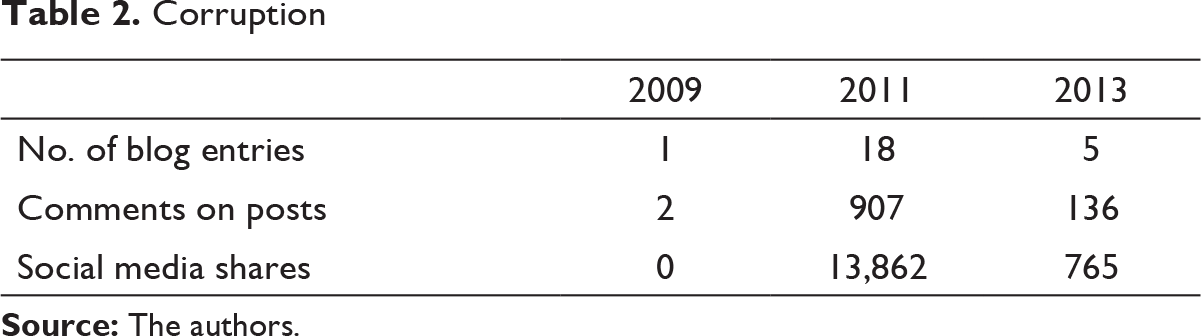
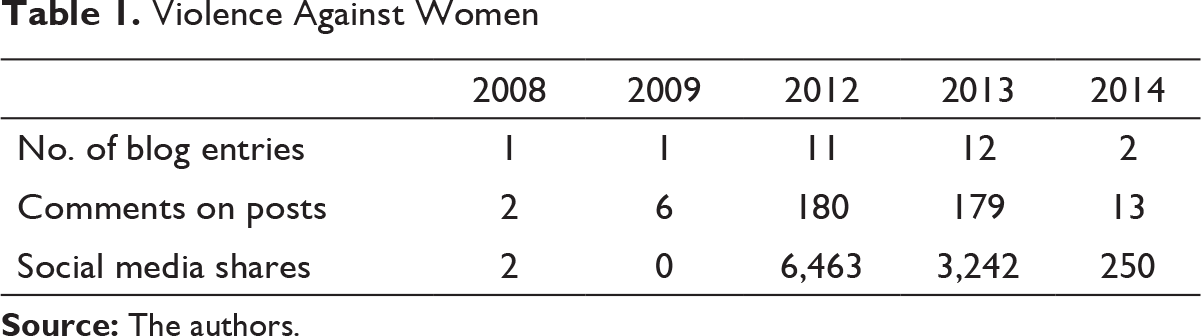
The blog submissions on Kafila cover a range of issues, most notably, Maoist politics, political formations and movements, violence against women, metropolis studies, human right struggles and many other issues of contemporary significance. The content on the blog mostly covers issues based in India, although there are several posts pertaining to other South Asian countries such as Pakistan, Sri Lanka, Bangladesh, Nepal and so on. In our study, we tried to compile an estimated numbers of blog entries on select themes along with comments on posts and shares on social media. By doing so, we expected to gauge the period of maximum civic engagement with the blog. This would certainly lead us to understand the reasons for the surge of interests in the blog. At the outset, we selected two themes that the blog has engaged with in a consistent manner. The themes are violence against women and corruption. Upon selection, we tabulated the number of blog entries, comments and social media shares 6
Only data for Facebook shares have been listed.
In Table 2, under ‘corruption’, we note that, in 2011, the blog entries, comments and shares on social media show an exponential increase in their numbers. Similarly, the tabulation on ‘violence against women’ too displays a rise in its figures in 2012. One way to think about the change in figures is to relate it to the larger sociopolitical churnings occurring during that period. In April 2011, the anti-corruption movement helmed by social activists, bureaucrats and academics such as Anna Hazare, Arvind Kejriwal, Yogendra Yadav, Kiran Bedi, Prashant Bhushan, Shanti Bhushan, Anand Kumar, among several others began a series of demonstrations, protests and hunger strikes at various sites such as India Gate, Jantar Mantar and Ramlila Maidan in New Delhi to rally against political corruption. The main demand of the movement was the institutionalisation of a strong anti-corruption law by means of the ombudsman bill, known as Jan Lokpal Bill, a bill proposed to investigate and punish corrupt officials within 2 years. While supporters of the movement lauded the peaceful methods adopted to fight against corruption, others were sceptical of its composition and excessive media concentration, terming it as a ‘smear campaign’ (Williams and Roychoudhury 2012). Thus, though there were debates on the nature and character of the movement, one could not deny the fervour generated by the movement. The Time magazine registered the movement among the ‘Top 10 News Stories of 2011’ along with Arab Spring and the killing of Osama Bin Laden (Tharoor 2011). Simultaneously, there appears to be a shift towards increasing civic engagement and interaction with blogs post the anti-corruption movement. Kafila in its initial years since 2006 had fewer social media shares; however, post 2011, there seems to be an increase in the traffic to and from blogs as indicated by the figures in Tables 1 and 2. One might ask here how does the increasing clicks on the blog transcend into a meaningful process of civic engagement? In brief, are the discussions on blogs enlarging the scope of civic engagement beyond the numbers? Let us look at the interactive debates on Kafila and YKA.
As noted in Table 1, the year 2012 saw a large number of blog entries and social media shares of posts tagged under ‘violence against women’. One can attribute it to the larger civil society protests against the Delhi gang rape in December 2012. The National Crime Records Bureau, in the previous year, recorded 24,923 reported rape cases (Sugden 2013); however, the violence involved in the gang rape of the 23-year-old female physiotherapy intern by six men, including the driver of the bus, received widespread attention and media coverage. The protests against the culture of rape manifested both on ground and in cyber space. The ground activism of civil society groups was complemented by a strong online component of organising and gathering political sentiments of citizens on issues apart from a synchronised detailing of the act itself. The question of ‘rape’ was included in a larger discourse of sexuality, politics and violence. The following is a passage from a blog entry by Pratiksha Baxi titled ‘Rape Cultures in India’:
The judiciary, tall exceptions apart, construct rape as sex. This perspective from the rapist’s point of view, does not frame rape as political violence, which posits all women as sexual objects. Rape is repeatedly constructed as an act of aberrant lust, pathological sexual desire or isolated sexual deviancy… most political actors convert rape into a technique of doing party politics. No one reflects seriously on why India sports a rape culture—surely the political and social toleration of intolerable sexual violence in everyday and extraordinary contexts of violence produces an effect of immunity and impunity to men who enjoy rape… Nor has any political party even acknowledged or apologised for the sexual violence during mass scale violence. (https://kafila.online/2012/12/23/rape-cultures-in-india-pratiksha-baxi/)
In response to the preceding post, commentators such as Arpita states, ‘Thank you for this post which is clear and precise about all the aspects of this case… I see this as evidence for the fact that the ambit of debate continues to be around the vulnerable female body, and invasive ways of protecting it’ (https://kafila.online/2012/12/23/rape-cultures-in-india-pratiksha-baxi/). Another reader, Nikita wrote, ‘Nor has any political party even acknowledged or apologised for the sexual violence during mass scale violence, I find this point most pertinent’ (https://kafila.online/2012/12/23/rape-cultures-in-india-pratiksha-baxi/). However, she goes on to add her own point of view, ‘One must not isolate incidents of rape, accept and even condone some while protesting against others. One can’t have this hierarchy in mind while demanding an end to violence against women. Somehow this point is not getting articulated very well’ (https://kafila.online/2012/12/23/rape-cultures-in-india-pratiksha-baxi/). Ramesh Narendrarai Desai argued, ‘Social reforms can only happen when everyone, not merely the government, chips in. All of us, barring none, have to work towards it. It is not an instant job. It has to be persistently and diligently pursued till results that are effectively in place’ (https://kafila.online/2012/12/23/rape-cultures-in-india-pratiksha-baxi/). Mukesh Srivastava chips in by pointing out that ‘Pratikhsha Baxi’s inaugural intervention raises several questions, issues and contradictions. We need to advance its critical tempo further rather than look for easy or immediate solutions. There aren’t any immediate solutions, no matter how strongly we wished for them!’ (https://kafila.online/2012/12/23/rape-cultures-in-india-pratiksha-baxi/).
It can be argued that apart from the blog post itself that projects an undertaking of rape cultures within a political ambit, the responses generated by the post too are reflecting a sense of critical engagement subverting the conventional discourse on rape and sexuality prevalent in the society. Moreover, it is interesting to note that the comment by Mukesh Srivastava on the need to explore the debate on sexuality judiciously rather than going for quick fixes such as the death penalty perhaps speaks of a concern with uncovering the deeper malaise in the framing of the question on rape in the larger society. The engagement of the readers with the article, therefore, is a prime example of an evolving public sphere whereby the community of bloggers and readers subjects conventional ideas and norms to critical analysis. By mobilising information and perspectives distinct from the news shared in conventional media, Kafila has enabled citizens to gather new information. Hence, one cannot overlook the role of the blog in generating a discourse on online platforms. This can be ascertained from a blog post addressed ‘To the Young Women and Men of Delhi: Thinking about Rape from India Gate’ by Shuddhabrata Sengupta (2012). He lists what one could do in order to combat sexual violence,
Young women, do not retreat from public space. Take back the night… Demand more public transport. Demand a thousand more buses that ply all night. Demand a metro system that stays open late into the night. Demand street lighting… Understand that people can never be property and must never be viewed as such. Combat and confront anyone who says they can be… Shame and expose those politicians and police or army officers who try to cover up cases of sexual assault and rape in Kashmir and the North East and elsewhere… Young men, decide now, and for all time, that you will treat the women you encounter first of all as friends, as equals, as people who have as much right to your city as you… Young men and young women, do not ever let anyone tell you that under any circumstances, that your life is not worth living. (https://kafila.online/2012/12/23/rape-cultures-in-india-pratiksha-baxi/)
This article reflects the potential of blogs ‘to get people to act and do something to make their voices heard, and to spread their opinions through blogs’ (El-Nawawy and Khamis 2013: 90). The relatively intimate and interactive form of addressing concerns directly to a certain audience, as in this case, can be read as creating an environment of solidarity and trust among the youth. Such purposeful civic engagement has also been noticed in other cases. On 13 February 2012, Shivam Vij, a journalist and a regular blogger on Kafila, posted an article (Vij 2012) urging the readers to observe the following day, that is, 14 February 2012 as Free Speech Day. This article was published on the heels of a social media-organised protest against book bans in India. Literary figures such as Vikram Seth, Nilanjana S. Roy, Hari Khunzu and Jeet Thayil were in the forefront of this protest. 7
See India #flashreads seeks to defend free speech,
February 14 or Valentine’s Day has also become a flashpoint in India, a day when protests against ‘Western culture’ by the Shiv Sena have become an annual feature. In Chandigarh, 51 Sena activists were arrested by the police after V-day protests turned violent in 2011. Our hope is to take back the day, and observe it as a day dedicated to the free flow of ideas, speech and expression. #flashreads is a simple way of registering your protest against the rising intolerance that has spread across India in the last few decades. At any time on February 14th—we suggest 3 pm, but pick a time of your convenience—go out with a friend or a group of friends and do a quick reading. We’ve made some suggestions (below) but feel free to pick your favourite passage on free speech, or passages from a challenged book or the works of any writer who has faced sedition charges, a book ban or other forms of censorship. (Vij 2012)
It went on to list places where one might exercise the right to free speech and expression such as the subways, metro stations, public parks, malls and so on. Additionally, Rabindranath Tagore’s poem ‘Where the mind is without fear’ was reclaimed by the protesters as symbolic of the struggle for free speech. Readers were urged to read passages from banned books such as Salman Rushdie’s The Satanic Verses, A. K. Ramanujan’s Three Hundred Ramayanas and Rohinton Mistry’s Such a Long Journey. Kafila published passages from such censored texts. 8
This includes A. K. Ramanujan’s Three Hundred Ramayanas that was withdrawn from the Delhi University syllabus in the aftermath of protests from Hindu right-wing groups and passages from Rohinton Mistry’s Such a Long Journey that was removed from the Mumbai University courses, following protests and burning of copies of the book by the members of Shiv Sena.
In this manner, bloggers’ attempt at carving out a virtual space entails various possible reasons. It could be as simply as about being safe in a virtual space, free from the hassles of machinery as well as less vulnerable to direct threats from the reactionary forces. Though the logic of security need not last longer in the face of the examples of witch-hunting, almost a wildfire, in other countries in the region of South Asia. But in a more durable explanation, these virtual-spatial designs favour not only political dissent, but also urge people to commit to political reformation. This is what Putnam (1993) referred to as social capital that can be seen as ‘the features of social organization...that can improve the efficiency of society by facilitating coordinated actions’ (Diamond 1997: 12). An effort is being made to achieve common good for the society by partaking in finding solutions to problems in the community. This has been made possible due to the rise of the ‘networked public sphere’ (Castells 2007). It has enabled the circulation of information, ideas and solutions seen as ‘social capital’. The ‘networks of civic engagement’ (Diamond 1997: 12) in this case can be read as fostering relations of trust and reciprocity among the bloggers and readers. This indeed refers to, in a larger scheme of analysis, the fundamentals of transformative politics rather than mere figment of wish fulfilment. It seems a probability that with social capital in the scheme of networked civic engagement, the virtual space has potential for mass mobilisation. At the same time, one needs to be cautious of the different projections and interest of blogs. For instance, the manner in which the debate on censorship culture has been dealt with in the youth blog YKA is qualitatively different from that on Kafila. Articles on YKA explore the issue of censorship in pop culture, films, television, censor board ruling, humour, pornography, cartoons and menstruation. Its founder Anshul Trivedi raises the question of freedom of expression in cinema by invoking the subtle censorship on nudity in cinema on the grounds of ‘reasonable restrictions’ and ‘in the interests of the sovereignty and integrity of India or public order or morality’. 9
See opinion poll by Trivedi (2009).
although a section of the youth that we address through our paper is indifferent to age old norms and medieval mindsets, there is another section of society which remains as judgemental…as ever before. This section of the society continues to thrive on gossip, questions anything that is out of the box and remains as intolerant as ever when it comes to breaking new ground. This mindset percolates down to our administrators who often exercise their powers to curb, ban or prevent avant-garde (read experimental) forms of art and craft to thrive within the realms of Indian society. Quite remarkably controversial, experimental and avant-garde forms of art and cinema have still managed to thrive in recent years despite the bans and stringent rules of censorship in the country. This has been fortunately made possible by the Internet through which the youth has access to books, movies, videos and other works of art which have been prohibited from being sold, screened or exhibited. (Mukherjee 2013)
Blogs are opening up new spaces to articulate curiosity and dissent. As a consequence, they are also creating new and effective forms of protest as can be evidenced in the circulation of open letters. Kafila has published letters of solidarity and open letters to the government by different civil society groups on various issues. In the past, it has published open letters to the Hindu Mahasabha for protesting against Valentine’s Day celebrations, to Mr Gajendra Chauhan displaying the message from the Film and Television Institute of India students, to the President of India by several civil society groups such as Jagori, Pragatisheel Mahila Sangathan, AIDWA and Saheli 10
In italics are some of the well-known organisations which work on women’s issues in India.
See the post on Kafila (2015).
Central government should invest more resources in teacher education and development, principal training, ICT in education and assessments. Furthermore, a portion of the budget allocation to states should be contingent upon the adoption of progressive education policies and improvement of outcomes. There is an opportunity to create version 2.0 of the central education budget that shifts focus from inputs and outlays to outcomes and impact, while holding states accountable. (Dhawan et al. 2014)
To this, Moushumi Mukherjee replied,
Can the authors explain what they mean by ‘progressive education policies’ within the Indian context? The suggestion of the shift of focus in budget from ‘inputs and outlays to outcomes and impact’ is a much-used global discourse about education reform in contemporary times. But, what is the actual input or public investment in education within India compared to other countries in the world, especially since the market for education has been historically highly privatized as cited by the authors themselves? (Dhawan et al. 2014)
In response, among the commentators, Aniket Bakshy, while providing several hyperlinks to other websites such as Times of India, the Hindu and nisaindia.org, sought to iterate that though crony capitalism derails prospects of an equitable education for all, it has led to far better student outcomes than that in the government schools.
In this manner, the author of the open letter and its readers engaged with the polemics of the matter by linking to debates and discussions on other blogs. The open letters, in this regard, are an example of the manifestation of social capital to engender cooperation on various issues, as in the case of the open letter to Facebook to change its authentic name policy. Hence, the coming together of people, resources and solutions helps to highlight subtle issues that may have political and social consequences.
By exploring issues otherwise considered as non-issues in a conventional discourse, blogs have opened a new field of relatedness of cross-cutting ideas. Such deliberations challenge the normativity around a discourse and contribute to a condensation of abstract ideas about an issue and make it relevant in our immediate context. Apart from facilitating interaction, coordination and organisation of citizens for mobilisations, it is quite plausible to think of the blogging medium as fostering a politics aimed at introducing creative ways of asserting political dissent which is essentially what transformative politics seeks to engender. Thus, the existence of a ‘horizontal, that is, peer-to-peer in nature...Citizens share, discuss, provoke and argue with each other in this environment’ (Goode 2009: 1294) can be seen as an important feature of civic engagement and transformative politics on the Internet. In this sense, the public sphere on blogs can be seen as contributing strongly to the larger discourse of social change advocated by the civil society agents and institutions. However, one important point to consider is the diversity of people, interest and opinions of the public sphere on the blogosphere. In recent times, the figure of a citizen journalist has loomed large in debates on civic engagement and the digital public sphere. In the next section, we will try to tease out some understanding in this direction.
Rise of the Citizen Journalist
In the year 2014, while the world became familiar with Edward Snowden and his trials, a discreet digital activist by the name of Shubhranshu Choudhary won the London-based Index Award for digital activism. Through his organisation, CGNet Swara, Choudhary sought to democratise technology by taking the media to the people at grassroots level of Central Gondwana (the region comprising Madhya Pradesh, Maharashtra, Andhra Pradesh and Telangana) in India. The fascinating bit is that the people of the area enact the role of ‘citizen journalists’ and update daily news onto the blog of the organisation. The organisation now has the support of international non-governmental organisations (NGOs) and think tanks, among which Gates Foundation, International Center for Journalists, MacArthur Foundation, United Nations Democracy Fund and Environs Trust feature prominently. In a blog titled ‘How Citizen Journalism Has Been Aiding Tribal India in Ways Like No Other’ (Sharma 2013), an interview with Shubhranshu Choudhary reveals that
There’s a complete disconnect: reader, writer, (media) owners all on one side, this 100 million population on the other. The journalism is completely one-sided. Not only were the tribal people absent as voices in the media—they had no access as consumers either.
In this context, the idea of the ‘citizen journalist’ is invoked to refer to the practices of ordinary citizens who document their versions of stories through the medium of words and images. The controversial figure of the citizen journalist augments both serious criticism and praise. It is argued that the advent of the Internet has trivialised the discourse of professional journalism (Badran 2014). However, we contend that though one has to exercise caution when speaking of the uninhibited power of the citizen journalist, one cannot deny the need to engage with the idea of a ‘citizen journalist’ who—through the use of social media tools—uploads stories and contributes to a larger discourse on informed citizenry. Singh (2008) in her study on women and blogging in India takes up the case of women panchayat leaders of Bihar enacting the role of citizen journalist. Through a project, Making My own News (MYOWN), women were trained to make videos and upload them on the MYOWN blog. The training included interactions with local NGOs to highlight critical issues, videography and web-training sessions and community viewing of the videos and blogs to encourage feedback. The initiative unearthed stories on local issues faced by the people on matters of health and sanitation, malpractices in schools and the panchayats and transportation woes among others. The blog, however, has ceased to operate. In this regard, it is important to note that often due to crunch of financial aid and human resources, individualistic pursuits as observed in the case of MYOWN become less feasible. 12
Shweta Singh (2008: 88) speaks of the difficulties of executing MYOWN, ‘Since the project is a voluntary effort of an individual, it is still at an experimental stage. Project sustainability and its replication remain uncertain. Due to lack of human resources and financial aid, the project is yet to become viable.’
See Anshul Tiwari’s report on the partnership between CNN-IBN and YKA on ‘The YKA Internship Now Power Packs Video Blogging Training, Powered By “CNN IBN Citizen Journalist”’ (30 January 2014)
https://economictimes.indiatimes.com/news/politics-and-nation/india-has-worlds-largest-youth-population-un-report/articleshow/45190294.cms
In this context, YKA published a video of a citizen journalist, Sunita Kasera, who identifies herself as a video-activist. Sunita documents women injustice and through the medium of video uploads on blogs such as Video Volunteer 15
Video Volunteer is a community-driven media organisation that trains citizen journalists to bring to light underreported stories of individuals and communities through the medium of video journalism. For more, see
Diverse Voices: Networks of the Marginalised
Blogs emerging from among the marginalised social groups such as Round Table India, or from the Northeast like the Raiot, are demonstrative of politically active citizens using the medium of blogging to communicate points of interest to each other. The Round Table India blog, in this regard, is a prime mover of an increasingly assertive Dalit identity politics manoeuvring the digital space that is seen by some as fertile for new ideas and discussions while others view it as yet another realm propagating social injustice. In this regard, Pardeep Attri of Ambedkar’s Caravan writes, ‘Dalits are still untouchable on social media; if I post anything about Dr. Ambedkar or Dalit history in a general forum, I get blocked in a few minutes’ (Gopalakrishnan 2015). Yet others such as Bathran Ravichandran of Dalit Camera 16
Dalit Camera, launched in 2011 by Bathran Ravichandran, is a popular YouTube channel portraying narratives, stories and injustices against the Dalit community. For more, see
Let us look at blog posts on Round Table India, a blogging platform that seeks to highlight and discuss caste atrocities in India. The need for the forum stemmed from the widespread de-recognition and misrepresentation of caste-based violence in conventional media In a blog entry, titled ‘Social Justice on Social Media’, one of its founders, Naren Bedide, while being interviewed by Amulya Gopalakrishnan is of the idea that, ‘We don’t have, and don’t expect access in the media. It’s a conscious decision to build spaces of our own’ (Gopalakrishnan 2015). The structure of the free and neutral space of the blog then becomes a platform for fighting structural conflict that can’t be fought using the tools of the privileged. This can be exemplified if one looks at the way the blog has engaged with the issue of ostracisation of Dalit students in educational institutions. The recent suicide of a Dalit scholar, Rohith Vemula, at the University of Hyderabad sparked off intense protest among the students and teachers across universities in India. While the traditional media chose to present the issue as an ‘event’ to be categorised and sensationalised, the blogs giving voice to the marginalised such as Dalit Camera and Round Table India, however, was engrossed in a deep discussion of the manifest and latent ways in which discrimination against Dalit students took place in higher education institutes. For instance, in an article, Dr N. Sukumar, a professor of Political Science at University of Delhi, writes,
Rohith’s suicide note is a protest against the social hierarchy which sapped his intellectual growth and a plea for assistance from his fellow beings to actualize his sense of ‘freedom’… The dalit student testimonies reflect a deep sense of fear, stigma and exclusion by the upper caste teachers, administrative officials and the peer group… One could locate his suicide as protest; however, it is extremely important to establish the ‘politics of presence’, which would ensure that subaltern bodies need not always dismember themselves when confronted by the Agraharas. (Sukumar 2015)
The preceding excerpt, thus, points to the politics of assertion that unfolds in the blogosphere. In this case, the blogosphere serves as a platform for expression of newly emerging particularistic individuals invested in challenging traditional notions of politics, history and conventional media. This has resulted in the celebration of such articulation of emancipation as the reinvigoration of the public sphere (Kumar and Subramani 2014). While the limitations of participation on online forums imposed by the lack of access to technology resulting in a digital divide is still prevalent, there is a sense of optimism regarding the use of information technology to transcend caste barriers and forging solidarities among the marginalised (Thirumal and Tartakov 2011).
Moreover, the use of blogs by the historically silenced voices can be traced back to the practice of autobiographical writings to communicate emancipatory potentials of the marginalised. Sidonie Smith (1998: 435) writes, ‘Purposeful, bold, contentious, the autobiographical manifesto contests the old inscriptions, the old histories, the old politics, the ancient regime, by working to dislodge the hold of the universal subject through an expressly political collocation of a new “I”.’ In this regard, the blogs can be seen as continuing the political rearticulations of the Dalit identity initiated by Dalit writers of the 1960s such as Daya Pawar and Namdeo Dhasal in publications like the Marathi magazine Asmita. Blogs, here, is seen as a bridging platform to connect to people and overcoming an elitist leaning of literary cultures. 17
Pradeep Attri, the founder of Dr Ambedkar’s Caravan, noted in a news report. See Write Back in Anger, Indian Express, 31 January 2016,
Furthermore, there is an attempt at resisting bracketing as ‘Dalit social media’, as different blogs, feeds and accounts highlight various aspects of Dalit subjectivity. The clubbing of the various interests under an overarching term is seen as flattening their diversity. Blogs such as Atrocities News 18
Atrocity News is a forum for portraying images and videos of caste-based violence in India. It has been operating as a network for Dalit solidarity since 2006. For more, see
The Khairlanji massacre refers to murders of Dalits in 2006 by the politically dominant Kunbi caste in a village in India named Kherlanji, situated in the Bhandara district of the state of Maharashtra. Atrocity News provides widespread details of the case. See
Shared Mirror is a literary blog operating since April 2010 to spread the work of Dalit Bahujan voices. See
Velivada documents Dalit social histories. For more, see
Muslims are misunderstood in term of a monolithic/homogeneity community… This community is just as diversified ethnically, linguistically and culturally as any other religious community in India on similar lines of caste and class… it is essentially needed to focus on how caste becomes a source of discrimination and exclusion from the mainstream not only for lower caste Muslim men, but equally or even more deeply for lower caste Muslim women. The Muslim Islamic leaders portray the politically manipulated Islamic ideologies to group them all Muslims in one homogenous bowl and hide heterogeneity. Therefore, the heterogeneity is not only restricted/confined at d level of socio-economic condition but in fact, it is widely at d level of ideology and a politically manipulated menu being served or presented in front of ‘others’. (Jahan 2016)
In this context, across the blogs, one observant feature is the critique of the status quo and challenging the normative discourse on matters of development, distinction and identity and rights. In this regard, the blogs operate as a new form of political activism enabled by the spread of new media that seeks to mobilise alternative ideas. The focus of agenda-setting blogs such as Kafila and Round Table India is on expressing dissent on matters of governmentality and marginalisation. Beyond critiquing, writers on the blogs also offer thoughts on dealing with systemic injustice as noted in the case of the Delhi gang rape. At the same time, the blogs emerge out of a particular sociopolitical context that reflects in the way it engages with its readers. For instance, while the Raiot, a political blog from Meghalaya, has writings on the Khasi script, there is an absence of writings in Hindi, whereas Kafila has several submissions in Hindi as well. Moreover, YKA in its aim for an appeal to the urban youth projects English as its medium of language. Also, one notes that a further distinction needs to be made between blogs that concentrate on bringing to light underreported stories and making a direct intervention in the kind of information available for processing and safekeeping. At the same time, few blogs seek to turn mainstream news on its head and offer alternative accounts of it. One needs to note a third kind of blog, that is, amid the increasing utilisation of blogosphere by blogs created and organised by the youths such as YKA, for instance, that act as general interest intermediaries and share stories across a spectrum of issues thereby enabling more of a conversation between its readers by sharing, engaging and empowering. Furthermore, the online activism displayed by the blogs we have studied, however, does not negate other varied voices on the blogosphere. Here, blogs such as Swarajya founded by Prasanna Vishwanathan and Amarnath Govindarajan debate on political, economic and social issues from a liberal centre-right front. Political and social satire blog, AmreekanDesi, a personal blogging initiative started in 2007 by Atulya Mahajan uses the medium of spoofs to argue the writer’s opinions on various matters. Hence, the larger blog-environment in India is fraught with diversity, and we have made an attempt to capture only a slice of it conducive for our discussion in the essay.
Conclusion
Finally, in the light of the above reading, it is plausible to propose a rethinking on the nature and development of the public sphere in India, which was hitherto characterised as elitist. The blogs are introducing new processes of organising and disseminating ideas on different agendas for mobilisations, be it by circulating open letters to critique agendas such as the harsh appraisal of students in universities, or by gradually prepping up space, script and access for digital participation to marginalised communities. By doing so, it is transforming agendas, ideas and processes in politics towards a more people-centric network of knowledge creation and circulation. While traditionally, politics has been conducted in the Machiavellian way, be it for security, internal or external and other regulations in a state, where the blogosphere perhaps has vital transformative potential is its ability to reach directly to masses and become the medium via which offline disgruntles and dissatisfaction can be channellised meaningfully through participating online and connecting with similar networks of interest. Of course, all of this has to be preceded by strong initiatives by citizens on ground, but the blogosphere in this matter then becomes a kind of catalyst churning and aiding a revitalised transformative politics.
However, one needs to sound caution against viewing the blogosphere as a platform of ‘truth’ or ‘truths’ based on debate and evidence. As Munger (2008) points out, it is quite likely that bloggers align with particular ideas and attitudes and thereby resist information emanating from other belief systems. Even the network of a blog or blogs thus can be restricted to a smaller circumference of humans and information due to political polarisation that may occur from self-segregation of blogs and bloggers based on their specific sensitivities. To add to this, the language divide between blogs and the larger public in a multilingual state may inhibit communication of ideas. It is here that the idea of blogging in non-Western formats may introduce novel ideas into the blogosphere. The propagation of certain ideologies and the resistance to others, then, makes the act of blogging a political act, and one must differentiate it from an act of simply transmitting information. In this respect, the blogosphere can function as a potential indicator of social transformations and at the same time as one that may reinforce certain values and tastes. Here, it must be stated that blogging for now in India is limited to a certain socio-economic class and ideology. Some of the blogs that have been discussed in this essay are exclusive in nature and scope. It is evident that they post entries with professed commitment to politically correct issues. With the admission of this limitation, we discern the entry of various stakeholders. With the advent of other technological devices such as the smartphone [India being the second largest consumer of the smartphone (Pathak 2016)], one needs to look out for future trend of political dissent on online platforms in India. The assumption that only a slim proportion of the society engages in political dissent online should by no means negate the impact of such discourse. ‘Given that, it may seem that with such small numbers, the potential impact of the bloggers is limited. But has that not always been the way of political dissent?’ (Seymour 2008: 62). Additionally, unlike the power corridors of centres and institutions of states, the blogosphere at least suggests a strong presence of women writers and activists blogging on various issues such as caste abuse, racial discrimination, freedom of expression, corruption and so on. Perhaps it is here that the growing networks of erstwhile neglected groups online can feed the ideal of a transformative politics centred on participatory and egalitarian ideals.
A key question to moot at this juncture is if one can speak of an ‘Indian blogosphere’ or is it more of a nodal network of blogs loosely linked with each other? As the profile of most bloggers suggest, blogging is predominantly occupied by educated, urban bloggers. However, as we see in the case of Round Table India and the Raiot, there is an emergence of blogs from the marginalised communities and regions as well. Moreover, the range of thematic engagement of the blogs is from ‘political and apolitical, personal and activist, secular and religious, liberal and conservative’ (El-Nawawy and Khamis 2013: 67). In this sense, though one can’t categorise a deliberate formation of an unified Indian blogosphere, there seems to be an attempt to engage the public on issues such as violence against women, corruption, political fatigue and so on. Moreover, in all of this, one senses the desire to be in control of the political future, as blogging is seen as agentive, deliberate and transformative.
It is interesting to note that the blogs mentioned in this article such as Round Table India, Dr Ambedkar’s Caravan and the Raiot seek to challenge traditional modes of linguistic and cultural representation used to delineate an issue as political. The blogosphere, in particular, appears to reflect the emphasis on signification in communication. The virtual project of creating an alternative discourse is certainly political, but it seeks to achieve its aim through means that requires a fine balance between the ideals of particularism and universalism. The virtual public sphere, then, imagines new ways of thinking about politics wherein the symbolic and material cultures of communities is key to understanding the transformations in social politics on the Internet. Perhaps this is what Sassi wants to point out, ‘The media, the Net included, is primarily focused on symbols and meanings, using its discursive power for questioning established conventions. In addition, many struggles have moved off the streets and factories into the space of representation, changing socially bound action into mediated ones’ (Sassi 2001: 104). In this understanding, it would be insightful to trace the transition of politics across the real and the virtual and the circumstances that enable such transformations. However, caution needs to be sounded for one notices the increasing media-industrial complex tightening its grip over deliberations on the blogosphere in an increasingly commoditised world market. This is imperative to prepare a body of knowledge on how the Internet and the new media operate in order to counter the threats they beget.
The essay has made a modest attempt, with many unavoidable jump cuts, to underline the presence, nature and scope of blogosphere in contemporary India. Despite the grimness of sociopolitical issues, and larger mediated environments, we have made a conscious endeavour to emphasise the silver linings, with optimistic perspective on the potentials for transformative future in India.
Footnotes
Declaration of Conflicting Interests
The authors declared no potential conflicts of interest with respect to the research, authorship and/or publication of this article.
Funding
The authors received no financial support for the research, authorship and/or publication of this article.