







Abstract
This paper explores how articulations of diverse learners’ identities and subjectivities emerge through everyday life experiences within a modern public university in India. The study adopts a constructivist grounded theory approach and, through in-depth conversational interviews, focuses on the voices of 35 learners belonging to diverse marginalised communities. Massification and the shifting demographics of learners in higher education have made university spaces a composite of heterogeneous identities. As learners belonging to diverse marginalised social groups began to increasingly navigate campus life, contestations emerged, due to the lack of recognition of these unfamiliar socio-political sensibilities and the emerging alternate discourses within these elite corridors of knowledge. Further, inherent elitism and meritocracy saliently dominating the normative cultural behaviour within the institutions, hindered the participation and inclusion of these learners, resulting in exclusivity and marginalisation in everyday life. As a result, the articulation and voice of learners emerged as acts of resistance and their agency freedom, leading to the emergence of a learner’s identity, an agential and assertive reflection of how learners articulate their self, succumb to or resist marginalisation, get excluded or participate and make choices for their future. Everyday life experiences, determined by learners’ situated articulations of their life course, became a framework explicating and articulating their distinct subjectivities, negotiations, challenges and aspirations. Therefore, learners’ capacity and will to negotiate, resist and persist, against the normativity in practice and processes in higher education, leads to cultivation of their agency freedom.
Keywords
Introduction
Accommodating learner diversity in higher education (HE) has become a fundamental concern for institutions and policymakers in the era of the knowledge society. With the rising tide of social movements (Fraser 2000) and emerging alternate political discourses (Deshpande 2013; Parekh 1999), 1 university spaces have evolved as sites for contestation and the articulation of multiple discourses, transforming them into public spheres (Babu 2020). Massification and expansion of the sector, 2 liberal educational policies, 3 affirmative action 4 and protective provisions, 5 as well as institutional-level initiatives, made HE more accessible to the masses (Ghosh 2006 as cited in Deshpande 2013; Rao 2002; Sharma & Jenkins 2014; Tilak 2015; Weisskopf, 2004), resulting in increased representation 6 of diverse social groups, especially the marginalised communities. Expanding educational opportunities meant that historically excluded and marginalised communities could now access college education and seize opportunities in the sector that had previously been denied to them (Sharma 1989). As learners from historically excluded and marginalised communities began navigating HE, bringing in their varied socio-cultural capital, socio-economic belongings, needs and aspirations, demands for diversification of campus processes began to emerge. Growing heterogeneity of identities (Young 1990, 2000) in HE in India, thus, re-emphasised the transformative potential of universities as civic and social institutions, making them sites for emerging contestations between the-historically excluded political sensibilities and the elite knowledge processes, and, critical spaces for determining and re-articulating the representation and recognition (Fraser 1990) of diverse marginalities, within the public sphere. Diversity in institutions of HE, thus, emerged as a democratising and educational value (Indiresan 2000), critical for developing inclusive practices and sensitive learning environments, and challenging the dominant narratives and elite cultural behaviour, within campuses. However, widening regional disparities and persisting social inequalities continued to exacerbate the challenges of access to HE (Rao 2017; Varghese et al. 2017), multiplied by expansion mainly of private 7 institutions, that are typically accessible only to the privileged classes. Inequalities in education lead to socio-economic and political inequalities (Tilak 2015). Equity in HE, on the other hand, does not merely imply providing access, but continuation and the successful completion (determining academic success) leading to their participation or entry into the labour market—employment (Tilak 2015).
Education for long has been considered a liberating and modernising force for marginalised communities, ensuring socio-political mobility by increasing access to social opportunities (Sukumar 2013). However, a lack of recognition and accommodation of the emerging voices of these marginalised identities resulted in increasing assertions and conflicts in everyday campus life. Addressing campus diversity (Indiresan 2000) emerged as a prime concern (Sabharwal & Malish 2018) due to the rising instances of social exclusion and discrimination experienced by marginalised learners, 8 as observed in the case of even some of the most pioneering institutions 9 in India, making identification of structural and institutionalised forms and patterns of exclusivity and discrimination crucial. As a selective and elite sector, exclusivity and discrimination in the sense of principled exclusion are embedded in the fundamental structure of HE (Deshpande 2016; Madan 2017), shaping the institutional culture and practices, and influencing the academic lives of learners. Modern institutions of HE, thus, emerged as domains of duality, ensuring mobility and social justice (Deshpande 2013) by increasing access and representation for marginalised subjectivities, on one hand, while systematically perpetuating structural inequalities and socio-political hierarchies, on the other. Further, hostile institutional climate within these institutions, traditionally designed to cater to a homogeneous elite population, impede learning (Sabharwal et al. 2014) and participation (Sturm et al. 2011) of marginalised learners, resulting in their elimination from campus processes, drop-outs and, in extreme cases, suicide, due to the atrocities experienced by these learners within the campus (Singh 2013), in academic as well as social spaces, hostel and mess (Sukumar 2008). Sturm et al. (2011) observe that the participation of learners has an affirmative value, in creating institutions that, irrespective of their identity, background, or institutional position, enable them to thrive, realise their capabilities, engage meaningfully in institutional life and contribute to the flourishing of others. Ensuring participation can become a means to conceptualise their distinct subjectivities, or as Reay (2001) suggests, their ‘authentic selves’, when they engage in difficult negotiations around their identities, when the potential benefits of improved opportunities and an ‘improved’ self have to be balanced with the potential cost of losing one’s cultural identity. However, Reay indicates that transformation for marginalised learners, means transforming themselves in order to succeed, in a context wherein they and their community are positioned as the other, to the educated and cultured subjects. Therefore, given that merit and academic success are not normative for these learners, Reay (2001) observes that learners often have to think and enact like the ‘other’ in order to do well.
Modern meritocratic societies (Deshpande 2016), characterised by their inherent elitism, inadvertently privilege the historically dominant or elite minority, by emphasising the notions of merit, 10 socio-cultural capital (Bourdieu 1986), academic knowledge and abilities as their normative, depriving many others. Misrecognition 11 of marginalised identities and their abilities, due to the stigma of being a potential beneficiary of targeted assistance, 12 prejudicial socio-political narratives, 13 normative exclusion and persisting inequalities (Rao 2017), labelled them as weak (Deshpande 2018), or mere policy objects (Deshpande 2013), further undermining their agency (Archer 2000). This has led to the emergence of marginalised learners 14 within elite corridors of HE, articulating their everyday campus life as an alienating and exclusionary experience. Suresh (2016) explains HE institutions in their everyday practice, frequently fail to address such challenges, ultimately emerging as sites of inclusion for only those with initial advantages. Social markers within a competitive and status-driven society like India does not get diluted or nullified despite educational attainment (or employment), since social and occupational stinkers continue to persist, perpetuated through interpersonal, intra-community and cross-community transactions. As a result, women, Dalit-Bahujan and Adivasis (SC and ST), Muslim and other religious minorities, persons with disabilities (PWD), the LGBTQIA+ and other disadvantaged (and socio-politically stigmatised) groups, continue to live on the margins of society and even within HE institutions. In such a scenario, Mahajan (2009) suggests that to address issues of discrimination and accommodate diversity, it is critical to open up the public domain to differences 15 and possible expressions of cultural differences. 16 Representation of cultural and group differences (Young 1990), 17 thus, becomes a means for re-creating a public sphere that reflects the diversity 18 of the country. The question, however, remains that how does a system that is inherently elitist, exclusionary and based on competitive elimination (Deshpande 2016; Madan 2017) recognises and facilitates articulation of diverse subjectivities (self) of marginalised learners, thus determining them as political subjects (Deshpande 2013) through everyday life experiences?
Learners’ identities and subjectivities evolve through a process of situated articulations emerging from the practice, culture and experiences of campus life as lived, through consistent interactions between discourses relating to social structure and power (Jeffrey & Troman 2011) their social world, and their being. Post-modern narratives of identity and subjectivity emphasise that everyday life experiences can be a framework (Ilaiah 1990) for subjective articulations of the self (Guru & Sarukkai 2012). The Foucauldian notion of the ‘self’ emphasises that the self gets constructed within particular contexts, thus making the aspect of space or context critical in articulating the self (Guru & Sarukkai 2012). The social constructivist account of the self (subjectivity) as advocated by Foucault testifies that a subject is constituted not only through language but many different types of practices, both discursive and institutional (Jeffrey & Troman 2011). Today, the prior notions of social identity and legislative categories, observe Guru and Sarukkai (2012), have tilted towards a more agential understanding of the self, through a combination of personal identifiers, social labels and self-concept (Jenkins 1996), emerging and changing experiences of everyday life. Realising the authentic self for marginalised learners in HE, thus, necessitates development and exploration of an agentic perspective of articulations of the learner’s subjective self within particular contexts. Sarukkai (2012), however, contends that experiences of marginalised communities demonstrate the externality of their experiences, meaning they are externalised in the various types of spaces around them; their experiences are driven by the external and they do not have the luxury of having private, subjective and ‘internal’ experiences. Their sense of self is, therefore, always mediated by a sense of self-attributed to them by the spaces that they inhabit or get excluded from. Their sense of self, thus, emerges as supplementary to the sense of self that defines others, inhabiting the same spaces. This paper, therefore, focuses that while socio-cultural capital, worldviews, realities of positionality, cultural knowledge, early belongings and socialisation, and academic knowledge of learners articulate the grammar of everyday life and determine the participation of marginalised learners in practices and processes in HE, they also contribute to the subjective articulation of their self.
Aim of the Study
This paper explores how diverse articulations of learners’ identities and subjectivities emerge through everyday life experiences, within a modern public university in India, focusing on the voices of learners from diverse marginalised communities.
Methodology
Research Approach
This exploratory qualitative study adopted a constructivist grounded theory (CGT) approach (Charmaz 2006, 2008, 2014, 2017) for systematic data collection and analysis by pursuing questions emerging from the field. Raising critical questions for exploring the emergent themes, the researcher followed an iterative analysis, from the initial stages of data collection, which helped in fostering the theoretical depth of the analysis, and the recognition and revelation of nascent critique that may otherwise have been invisible. Focusing on the voices of the participants through the critical articulations and analysis of their lives, CGT helped in developing new understandings of experiences and redressal of injustice (Charmaz 2017). To address the looming risk of preconceived individualism (Charmaz 2017), methodological consciousness was maintained throughout the research process, for excavating the structural contexts, power arrangements and collective ideologies on which the specific analysis shall rest. As a result, subjectivity and positionality of both the researcher and participants (Charmaz 2008) became prime considerations, for the purpose of gathering narratives of everyday life experiences 19 of diverse learners, based on co-construction of their experiential reality, with participants as agentic actors within the social context (Charmaz 2017). Theoretical sensitivity of the researcher, her engagement and level of insight developed into the research area. Her understanding of the complexities of the participant’s words and actions, and her relationship with the participants, became instrumental in determining the relativistic potential of the grounded data. Researcher’s reflexivity and consciousness of her ontological and epistemic positionality guided her in exploring the themes, maintaining methodological consciousness (Charmaz 2017) and eliminating preconceived ideas, while learning the realities of the world as experienced by knowers 20 or participants through their voices. CGT, thus, assisted in exploring everyday life experiences of diversity in HE, by consistently sensitising the research process, making it accommodative of diverse and multiple perspectives of realities.
Research Setting
The fieldwork was carried out at a modern public central university in India, established in 1969 in the post-independence scenario. This institution draws its modern-liberal character based on the democratic principles inscribed in the Constitution of India and the liberal educational policies, 21 making diversity, inclusion, equality and social justice its core values, ensuring equitable educational opportunities for learners across communities. The university (Batabyal 2014) became an ideal site for the study due to its liberal ethos, inclusive institutional policies (admission, scholarship, hostel, and support services apart from schemes and policies of the state), diverse composition and schools of teaching and research across disciplines (social sciences, sciences, area studies, engineering, molecular medicine, linguistics, management, science policy and others), with hostel/residential facilities for learners, faculty and administration contributing to its vibrant discourses. This university is accessed by learners belonging to varied castes, class, gender, sexualities, cultural, socio-economic and linguistic backgrounds, nationalities, religion, PWD, societies, age, marital status, region (rural, urban, remote and hilly areas), ethnicities, food cultures, so on, including first-generation learners. Given the range of diversity, contradictions and contestation are an integral part of everyday campus life (across academic and non-academic spaces), shaping its vibrant discourse and practices.
Description of Participants
The study focuses on learners from varied socio-economic backgrounds, disciplines, courses and levels (bachelors, postgraduate, MPhil and PhD) in HE, focusing on their everyday life experiences. Reflexive campus navigation and engagement with diverse learners helped the researcher identify potential participants, while learners voluntarily participated and engaged in the meaning-making process for exploring the notion of diversity in everyday campus life (the central phenomenon of the doctoral study), sketching their campus lives and sharing insights about their life course through informal interaction. This resulted in a participatory process of generating the grounded data, facilitating a voice-centred analysis of their experiences within academic, co-academic, civic and social spaces. Thus, purposeful and snowball sampling methods (Creswell, 2012) facilitated in reaching an initial cohort of 75 potential participants. Of these, 50 participants consented to participate and were interviewed. 22 Based on self-identification during in-depth conversational interviews, the participants included: females (n = 24), males (n = 24), queer/transgender (n = 2), belonging to diverse disciplinary backgrounds: sciences (n = 12), social sciences (n = 15), area studies (n = 8), arts and aesthetics (n = 5), language and linguistics (n = 5), and law and governance (n = 3), engineering (n = 2), including first-generation learners (n = 25). The majority of the participants (n = 48) belonged to diverse marginalised communities, 23 including learners with disabilities (n = 6); religious minorities such as Muslim, Christian, Buddhist and so on (n = 10); SCs, STs, OBCs, historically excluded classes and ethnic groups (n = 45); gender and sexual minorities (n = 3); with two participants from general category (upper caste). All participants are actively involved in campus activities and collectives/groups (academic, socio-cultural and political) participate in social awareness campaigns, protests and debates, the dissemination of research developments in their respective disciplines through different platforms (academic seminars, print and social media, talks), and extra-curricular associations on campus that inform the habitus and discourse of the field, reflecting its grammar and culture of everyday life. Through verbatim transcription, coding and memoing, a cohort of 35 responses were filtered and extracted for analysis for their linkages to the core categories: diversity, inclusion/exclusion and marginalisation in HE. Specific themes emerging from the remaining (n = 12) 24 helped mark the saturation of the emergent themes.
Data Collection and Analysis
In-depth conversational interviews and informal interactions facilitated data collection. An interview-guided method was used to explore the narratives of participants’ everyday life experiences through a cycle of three rounds of interactions, one and a half to two hours each. Each round of interaction laid the groundwork for the next round of interview with the particular participant. Participants as agents construct the narratives of their life course based on their subjective worldviews of life within community, family, socio-economic conditioning, negotiations with societal realities, interaction with others; academic trajectories; their civic engagement with electoral and/or socio-cultural groups; support groups; co-academic activities such as sports, music, theatre, teaching underprivileged children, activism; their aspirations and so on, within the campus and beyond, articulating the grammar of their life. Subsequently, participant and non-participant observation of campus activities, socio-political and cultural events, classroom engagements and other life spaces such as hostels, canteen, protest march and campaign sites were carried out to map the everydayness, discourse and habitus of campus life. Analysis was carried out through a constant comparison method (Charmaz 2014), iteratively comparing the interpretations of verbatim-transcribed data, translating them into categories and codes for further data exploration, until saturation was achieved, in three phases: open coding, involving naming each line or segment of data; a focused axial phase, utilising initial codes to synthesise the data; and selective or theoretical coding. Verification of codes was carried out in two parts: first, with the coding mentor (doctoral supervisor of the author); second, by sharing results at academic conferences and seminars. Triangulation of data was maintained throughout the research process with the help of the participant’s meaning-making process.
Analysis and Discussion
In the university spaces, entry of marginalised section students makes it a site of confrontation with elite knowledge system. It Challenges the authenticity of reason, technologies of power and science. It deconstructs what is seen as ‘natural’ and ‘objective fact’. It challenges cultural hegemony and intervention of the state in private sphere…
For the students from the marginalised section… university remains one of the significant sites of building consciousness and knowledge production. The student becomes conscious about histories, and in the light of ‘new social-political consciousness’, he/she redefine his/her personal biography radically.
The lived experience becomes a significant source of knowledge production. The narrative without claiming objectivity becomes an important relativistic source to understand categories of hierarchy. The social disadvantage becomes an epistemic advantage for the students. They can theorize, articulate their lived experience for knowledge production. The languages give space to articulate Dalit experience through poetry, short story, novel, (auto)biography, which become a source of knowledge production.
—SA (male learner, belonging to OBC category, Dalit activist and writer, pursuing MA in social sciences at the University)
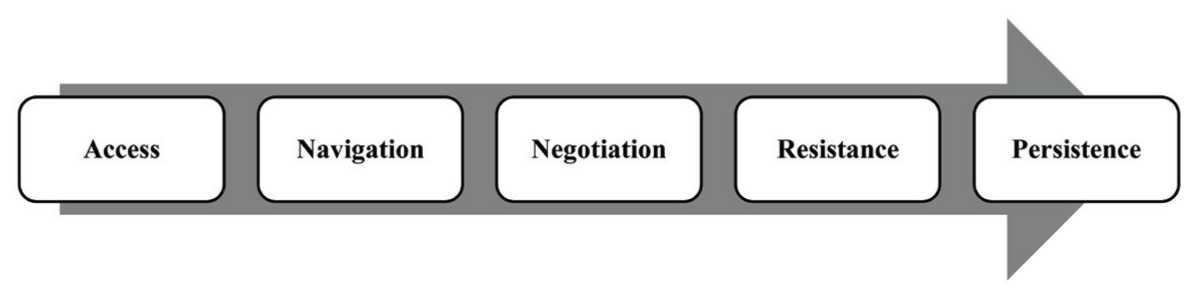
The analysis resulted in the identification of five emergent themes, indicating a process that explicates how diverse articulations of learners’ identities and subjectivities emerge through everyday campus life, namely access, navigation, negotiation, resistance and persistence (depicted in Figure 1). Factors determining access to HE become the basis for learners to initiate the process of navigating campus life (post-access), influencing everyday interactions. As learners begin to navigate campus spaces, living the everyday rituals and practices that form the campus discourse (within both academic and non-academic spaces), their personal cultural behaviour and knowledge come into contact with the institutional culture, practices and knowledge (Tierney and Lanford 2018), along with that of others. Woods and Jeffrey (2002) argue that this creates opportunities for intercultural interactions while, at the same time, exposing them to confrontations or conflicts between diverse or multiple worldviews and ideas expressed through expressions of their multiple selves. While unfamiliarity often leads to contradictions amongst diverse social groups, it also nurtures a new awareness and sensitivity amongst others, shaping the subjective experiences and negotiations within these elite spaces. Negotiations for marginalised learners emerge with normative othering, exclusivity and marginalisation through academic and co-academic processes and social or civic engagements, wherein microaggressions and the consistent need for ‘adjustments’ and ‘figuring out’ become their everyday reality, often leading to silencing, self-exclusion or resistance. Resistance emerges as a key dimension in determining learners’ experiential realities and assertions against normative behaviour, while articulating their distinct voices and cultivating their capital (capacity) and agency. According to Bourdieu (1986), HE processes become sites for cultivating cultural and social capital that enable learners to navigate and acquire other institutionalised forms of capital, such as titles, authorship, research papers, dialogue, debate, accolades, prizes and so on, thus transmuting between objectified and institutionalised states, while also nurturing individuals’ knowledge and consciousness, leading to the embodiment of capabilities and nurturing their agency. Social capital, on the other hand, provides them with linkages and networks for learning, socialisation and exploring new dimensions, supporting their journeys and everyday life. However, the normativity of capital and associated presuppositions make HE institutions elite and exclusive spaces, thereby othering the historically excluded communities by marginalising their cultural behaviour, knowledge and being. Marginalised learners bring in new learning challenges and alternate political sensibilities to campus life, transforming practice (Bourdieu 1977) and institutional habitus (Reay 1998, 2004) into fundamental factors shaping their subjective experiences and raising demands for critical inclusion. Persistence in HE by learners becomes critical here, bringing them closer to identifying their self, as they resist the power structures and elitism in everyday life to continue their journeys, thus determining their political subjectivity and agency freedom (Archer 2000; Sen 1985). The articulation and voice of learners from marginalised communities, thus, emerge as acts of resistance or assertion, constructing their subjective self.
Articulating Diverse Subjectivities through Everyday Life Experiences of Learners in Higher Education: Emergent Themes.
Access
Being and becoming a learner in HE involves successful passage through the competitive screening processes, facilitated by merit, academic knowledge, socio-cultural capital and the capacity to persist. For learners from marginalised communities, academic success is not limited to just ensuring entry into HE. Access or academic success is a product of lifelong persistence of situated individuals, conditioned by their familial and community background factors such as parental education, occupation and habitus of household; positionality within the hierarchical society, influenced by locally nested norms, socio-political challenges and economic limitations; schooling, early-life belongings and socialisation, shaping their worldviews, aspirations and grammar of everyday life, assisted by affirmative policies of the state. In the case of PV, a male learner from OBC category, in science discipline, belonging to a village in Kushinagar district of Western UP, or, in case of MB, a female learner from SC (Dalit-Bahujan)
25
background in area studies belonging to a village in Satara district in Maharashtra, their contexts and situated experiences have provided them with a vocabulary and grammar for articulating their self. PV shares that:
My parents are marginal farmers. While the zamindari system no longer exists, the oppressive norms and practices still prevail, and hierarchies of caste continue to remain. My mother, whenever she refers to the landlords, she would still call them as Maalik or Maalikaan (meaning owners). The caste-based prejudices, discrimination and exploitations remain. My father always says that—how will you fight and survive in the society? We cannot fight them with money and muscle power. We do not know how to use the lathi (or baton)…The only way for us is to strive for education and fight through knowledge. My 3 siblings have also completed their postgraduate studies, while I am pursuing a PhD.
Sharing anecdotes of untouchability and discrimination faced at his friend’s house, or during schooling (not being appreciated for his achievements, or being denied accolades despite winning competitions), PV shares that the power struggles and violence experienced in high school, have had a profound impact on him:
I just can’t stand violence of any kind. My journey has been rooted in assertion, which the social anomalies of caste, and oppression ingrained in the practices in HE, have re-emphasised. HE is still a potential medium for changing the dominant social discourse and knowledge system.
Similarly, MB emphasises the importance of recognising diverse voices and challenges, particularly the women, Muslims, queer people, PWD, Adivasis and other marginalised groups. While socio-political mobility is one of the prime motivating factors for these learners to access HE, the stigma of being a learner from a minority or historically excluded/marginalised groups or politically contested categories, such as PWD, Kashmiri Muslims (Muslim minorities), transgenders/LGBTQIA+, Dalit women, women, learners from north-eastern states in India and so on, become determining factors shaping their journeys. While the normative ableist tendencies of HE questions the legitimacy of their presence and eligibility to qualify as learners within the elite corridors of knowledge, a lack of familiarity with their distinct subjectivities, worldviews, needs and cultures sustains the prejudices in common narratives 26 around their social identities.
Misrecognition begins with the admission process itself due to the clash between merit and affirmative action policies. For MK, a female learner from Meena tribe (OBC category) of Rajasthan, pursuing a PhD in economics, or PV, shares that admission under the reservation policy (including the institution’s policies) was a new experience. Both suggest that their education up till now has been in the open category on the basis of merit. PV argues that:
merit, when coupled with elite academic culture and capital, becomes a factor for normative exclusion; recognition of what qualifies as merit is itself highly discriminatory. If merit is inclusive, only then can learners like us compete, otherwise, this system is designed to marginalise us. I question the logic of merit itself. It is a casteist logic. It fails to recognise the varied abilities, cultural knowledge and merit of the historically excluded communities; it has to be diverse too. There is no space in the education system for the experiences and knowledge of the oppressed sections, neither any mechanism to evaluate it.
While affirmative action policies have facilitated access, they often have adverse consequences for the target group of beneficiaries. Hostilities within academic and non-academic spaces turn campus discourse and practices into a domain of negotiation and contestation, stigmatising the learners, misrecognising their abilities based on their marginalised social identities, while ignoring the numerous challenges that these learners face and excel over to determine their journeys and succeed. Participant, DF, a female learner from ST category, in science policy belonging to a suburban town near Bokaro, Jharkhand, shares:
some of my batchmates made efforts to get hold of my entrance marksheets and viva evaluation, just to show how less I scored, and that I got admission just because of my category. Sadly, I too continued believing that I got admission only because of my category. I felt bad because they made me feel inferior and incapable of doing things.
Such othering emerges as a result of prejudicial common narratives within the campus community, reproduced by the learners, as well as marginalisation and the exclusion of knowledge and awareness of learners’ subjective experiences within the campus discourse. AD shares that othering is common even within hostels, while DF adds an alternate perspective suggesting that hostel space is crucial as zones of intercultural exchange and learning, discussions, shaping political discourses and one’s own thought, and a community for support within the institution. Today, the neoliberal discourse along with meritocracy is acting against the anti-discriminatory values of equity, inclusion, freedom and choice in HE.
Navigation and Negotiation
Institutions as cultural spaces or situated contexts
27
provide a lexical grammar (visual, verbal and cognitive) and language for understanding their practices and habitus. Navigating these spaces becomes an interactive process between the learner’s subjectivities and the norms, cultural behaviour and attitudes characterising campus life. As learners navigate through the academic processes within the departments and the non-academic spaces and come in contact with other learners and faculty, a new learning of their self begins. For AD, a male learner belonging to the Meitei Tribe of Manipur studying at this university since the past seven years, or for AS, a female learner from the most backward tribes in Nagaland pursuing her PhD, both belonging to ST category, their distinctiveness on the grounds of ethnicity, culture, class, race, language, appearance and region shape their everyday campus life as outsiders or others within the larger narrative of the country (polity). AD shares that:
Racism is rampant and common within the campus just as in the outside world. Just yesterday two boys in the hostel referred to me as ‘chinki’… further stating, that be it amongst learners, or while determining the research area, allocation of supervisor, and appraisal of research work at review seminars by faculty, their identity as a ‘person from the northeast’ matters. AD contemplates that—it is not their fault. The mainstream discourse in India lacks knowledge about us. I have gone through the text books and there is hardly any information about Manipur. That is why the mainland discourse does not have much knowledge about us. Our choice of institution also gets determined by these factors.
Though both AD and AS suggest that this university is far more democratic than many other sites due to its liberal discourse, labelling and stigmatisation continue to persist in everyday life. AS shares that:
I do not let it affect my life. I know how people treat me differently, and, what often happens is if you are a minority or if you have been discriminated against, as a human being you have a tendency to discriminate against others, give the same treatment. If you are cheated, you are inclined to get revenge by cheating someone else, but that thing has to stop somewhere, the cycle has to stop. I negotiate the fact that staying with people from different cultures is enriching, and I understand. I avoid cooking certain food items from my culture, because they are quite “smelly”… I have them only when my hostel roommate has gone home.
While systemic inequalities and biases continue to persist, how learners choose to navigate, transform or construct themselves through these challenges varies depending upon their agency, self-concept and personal identity. KN, a male learner from SC category studying political science, belonging to a rural district in Haryana, shares that:
when I came to this university, it was extremely difficult for me because everything was in English, I could not understand anything. It is not like this where I come from. I thought that I would fail. I was worried, what will I tell my parents. So, I decided to leave and go back to my village. I was leaving after a month, when one person from administration, he is from my state and also from my background, had said to me that—I should not leave. I wanted to go, but he said that he will wait for me to come back. He said that very few people from our community who get admission here. At that time, I had got admission there also, so I went back and attended classes, but I realised the hell of a difference between the classes here and there…I came back eventually and I worked very hard. I did succeed.
Reay (2001) writes that transformation itself is a fraught and risky business for learners from marginalised communities being placed as the other within the HE context against the educated and cultured subjects. Further adding that since academic success is not normative for these learners, they often have to think and enact themselves as others ‘to do well’. BJ, a male learner from ST category belonging to a village in Odisha, pursuing postgraduation in sociology, shares that:
I come from a rural area where there were not many facilities. I have studied in schools where we used to get mid-day meals, not in private school. I saw that the people who spoke English and studied well had a group. But, I have this thing—I think this is a good thing in me; I have that competitive thing. I saw that the good people (acche log or acche ghar ke, as BJ refers) who spoke well and would write in English, they form a group and they discuss amongst themselves. They don’t talk to others. So, I worked hard and got good marks, and when these people saw that I was scoring well, they included me in their group. Earlier they would not even look at me. I am always friends with good people (acche log), so I can learn something. Even here, most of my friends are my seniors. I used to see how they studied and then how I studied. I have always had this thing in me that I would do better.
Resistance and negotiations, thus, emerge as integral to navigation and pursuit of HE for these learners. HE, though, has become an opportunity to cultivate merit and capital essential for success and persistence, emphasising the transformative potential of education; it is the grit and persistence of the marginalised learners themselves, as O’Shea (2020) articulates—an indefatigable resistance to not give up, that determines their journeys. BJ asserts that:
sometimes when I speak in class, these people, they exchange smiles amongst themselves. They laugh. They think I don’t know anything. BJ asserts—other people (like him) will sit at the back, but I always sit in the first row. These people will be friends with people like them, I cannot be their friend. Their lifestyle. I don’t have ‘that much’ money. It would be problematic for me, and I will feel bad. Hostel life too has problems. My earlier roommate would not talk to me and would refuse to eat anything I got from home. I had to broom and clean the room; he would not do it.
Therefore, two observations emerge: class and its intersectionality with caste, tribe, gender, language, region, culture and so on, have evolved as a critical marker, shaping the subjective experiences and socialisation of learners in everyday campus life, triggering or challenging the agential articulation of their self; and, social engineering within classrooms, structure the positionality, navigation and participation of learners within academic spaces.
Negotiating exclusivity and marginalisation is a crude reality. Negotiations in everyday campus life take place across life spaces—within hostels, classrooms, socio-cultural and political groups, amongst peers and faculty, challenging the self in both the private and public spheres of life. ZA, a Muslim female learner from medicinal research, shares that:
it has not been easy for me. I have barely had any friends all my life. There is a difference. I don’t really ‘fit in’… I like interacting with people, but it is different here because I am a Muslim. I am the only Muslim female in my lab. Even with my supervisor, I was apprehensive since I noted the difference in our political opinion, but (she shares), my supervisor one day called me to his office and during the discussion made it clear that any ideological difference shall have nothing to do with the learner-faculty equation that we have.
However, negotiations for ZA are not limited to the campus life but are part of her everyday life within the private sphere and the life choices she makes. She shares:
my mother always says that my life is like living in a glasshouse, so I have to be very careful for not only because I have got an opportunity that not many Muslim girls get, not even in my family, to aspire, but because if anything goes wrong—one wrong decision will hamper the prospects for all the other girls who are looking up to me.
Stigmatisation and prejudices continue to dominate social interactions with universities, as civic institutions, imbibing the prevalent norms and values of the society as well as the politicisation of identities (for queer, Muslims and Kashmiri Muslims, Dalit-Bahujan, women, PWD and so on), often taking violent forms and leading to campus violence, suicides and drop-outs. MS, a Muslim male learner from Kashmir pursuing his MPhil in International Studies, shares that:
this campus has a lot of diversity and different social groups, but not everyone has the equal space to voice their opinions. Even within socio-political groups on campus, some of them show that they are inclusive and care for the marginalised and the minorities, but then when you try to speak they silence you; there isn’t any space to share our experiences, what we go through. Yes, it is a little different. When we share somethings (learners with similar identities), only then they will come to know that our context is different and then they realise, but otherwise it is very difficult.
On further interaction, MS shares that:
We would like to share and speak about our experiences and interact with other learners on campus, but we are worried about the consequences.
For MS, unfamiliarity with the distinct culture, subjectivity and life experiences of the learners and the prevalent common socio-political narratives stigmatises their identities leading to persistence of prejudices even in campus life, shaping everyday interactions and navigation. In the case of learners like MS, challenges in everyday interactions, navigation and their expression of the self, both within and outside the campus, hinder their participation in academic, civic and social engagements within the larger campus discourse, leading to self-exclusion within classrooms and lectures, while at the same time, a constant trauma of being othered by peer and faculty members and campus violence (as shared by the participant) diminish the possibility of intercultural interactions, awareness and exchange of knowledge.
Negotiations, however, are not limited to university space only. As learners begin to re-articulate their self through knowledge and increased self-awareness, challenges emerge within family, in community life and the society. BK, a Dalit transgender woman learner belonging to a village in Haryana pursuing postgraduation in social sciences, explains:
I belong to the Dalit community. When I came out as queer, I had to read a lot, because you need a basis to understand yourself, but it was very difficult to explain to my family. They would often say ‘insaan ban ja’ (act like a human). I would explain that before the Constitution of India was there, you were not even considered human; your life was the life of a pig; you got recognition post the Constitution, I got my recognition now. Further emphasising that—if I ever have to return home, I won’t be able to, because I came out as queer, which they obviously don’t understand. BK contends that—the university community responds to the emerging voices of LGBTQIA+ identities, but it is their guilt. I don’t think they are sensitive. Within the classroom, there are very subtle and pronounced ways of caste discrimination, or rather the unrecognition of the privilege of people; adding that—we might be sitting on the same benches and reading under the same professors, but the fact remains that we come from very different context. In the hostel, I had a very good friend there, people would stare, their gaze. So, I stopped eating at the mess. I usually take my food and go to my room. I had a very difficult time with my roommate. He sent me long messages saying how my identity and lifestyle are against social health and decency; he majorly started all this after I put a poster of Savitribai Phule in the room. He too had his posters in the room. So, these kinds of dimensions, I don’t think get recognised. It is very hostile. When people say that everyone is equal… but everyone is not equal!
Everyday violence in dialogue and discourse and the gaze, as observed in the case of BK, shape the everyday experiences of these learners, raising a vital question of does HE acknowledge how diverse marginalised learners experience and articulate campus life differently. Sukumar (2013) elaborates that denying social opportunities leads to capability deprivation and diverse capability failure for learners. Navigation and negotiations lead to both—experiencing marginalisation and exclusion, as well as resistance of various forms including assertions by the marginalised voices and knowledge systems, by forming collectives (sub-groups or subcultures), sensitisation and awareness generation around the unfamiliar political sensibilities or marginalised identities by organising campaigns across campus spaces (as seen in case of PWD learners, LGBTQIA+ and others in everyday campus life), and, in extreme cases, drop-outs and suicides. Ironically, the multiple forms of oppressions and resistance, and the articulations of diverse learners’ subjectivities (self) despite and through challenges with elite HE spaces, go largely unnoticed.
Resistance and Persistence
Resistance and persistence in everyday campus life are action- or practice-based aspects, emerging from expressions of agency and freedom 28 of learners. Yosso (2005) comprehends resistance as capital for the historically excluded and marginalised communities, transferred generationally and socially as community/cultural knowledges. Further suggesting that resistance capital is referred to knowledge and skills that get fostered through oppositional behaviour, challenging inequality (Delgado Bernal, 1997; Freire, 1970, 1973; Giroux, 1983; McLaren, 1994; Solórzano & Delgado Bernal, 2001 as cited in Yosso [2005]). This form of cultural wealth is, thus, grounded in the legacy of resistance to subordination. In HE, for learners belonging to diverse marginalities, like—learners with disabilities, Dalit-Bahujan identities and other oppressed 29 caste groups, women, gender and sexual minorities, religious minorities, ethnic minorities belonging to specific political contexts or economically weaker sections—resistance gets cultivated (as individuals and collectivities/group entities) through everyday social interactions and engagement, within the academic and co-academic spaces (through academic and cultural knowledge), non-academic spaces (including their private sphere), within socio-political collectivities that they may be a part of, as they assert for the legitimacy of their voices and their presence within the Indian public sphere. The context of these situated experiences, that is the institution, with its discourses (against structural dominance and power) and culture of learning (Foucauldian social constructivist narrative of context as emphasised in Jeffrey & Troman 2011), and the institutional habitus (Reay 1998, 2004) act as architects of everyday life experiences within these elite cultural spaces; determining their campus engagement 30 (academic, social and civic) and articulation of their self.
Resistance as a practice aspect may or may not only be for the self of an individual learner but facilitate in enriching the performativity discourses
31
of campus life for the self and for others. Participants, however, suggest that it is not the opportunity itself but the ability to act on that opportunity and participate substantially in academic life that matters, guided by their cultural capacity, belongingness and agency. MK shares that—
I often get into discussions and debates, and that is what leads to a lot of conflicts, but I feel that coming to HE has made me aware of my being that “I too am”… I too exist… and conscious of my choices. I faced a lot of problems in classroom engagement and academic activities, but I did not take any help; I did it on my own. None of the fellow learners supported me, nor did I seek help from the faculty or the linguistic empowerment cell. In the hostel, people try to intimidate you and look down upon you. They compare, and try to make you feel inferior about yourself. So, these women in my hostel, they comment… on my habits, if I oil my hair, or my clothes and other things. They try to make you feel that they are better than you, have better clothes than you and belong to a better family than you. I try, not to give them any opportunities where they can say anything.
Increasing representation of marginalised identities and subjectivities, in and through knowledge, emerges as a critical theme, as these learners from diverse marginalised communities in India assert based on their personal challenges, negotiations and journeys, and the socio-political relevance of their voice as a community. K, a female visually impaired (VI) learner from Banaras, UP pursuing her studies in international relations shares that:
For me, knowledge is a medium of assertions. As a visually-impaired person when I did my fieldwork for research, my fellow researcher would often tell me that the respondents were baffled to see ‘someone like me’ is doing research so confidently. It makes me feel great. The very fact that learners like me are heard is because there is a discourse on this campus that identifies us and gives us the space to raise our voices, assert our being and learn. Though, availability of academic material in accessible format, disabled friendly architecture, software packages, infrastructure, and safety of female VI learners, fundamentally challenge our freedom, our campus navigation and our choices in everyday campus life.
She further shares that:
there are significant challenges in terms of sexuality for us, be it men or women with disabilities, since ‘we people are often considered asexual’… and that undermines my agency in several aspects. She asserts that—people have a tendency to act sympathetic. I know they are being nice and trying to help, but why not create conditions and situations where we ‘do not need’ help.
On the other hand, cultivating persistence behaviour (O’Shea 2020) as capital emerges as not an end, but a lifelong process for these learners enacted despite challenges to succeed at each stage, fulfil their aspirations (Appadurai 2004) and participate in public life. While structural and personal factors (Benson et al. 2013) have a determining role in the continuation, completion and academic success (Reay 2001; Tilak 2015) of the learners, navigating everyday life, articulating the self and persisting in their journeys is rooted in the learner’s agency. Learner’s agency gains strength through practice, expression and articulations of alternate discourses in HE, reflecting the distinct capital and nature of persistence (O’Shea 2020), ideas and worldviews, emerging from their multiple and intersectional identities, as situated realities. These also serve as a knowledge base—informing the campus discourses and enabling, encouraging, challenging or mobilising fellow learners and peers from similar backgrounds, in their journeys to self-formation. Persistence, therefore, emerges as a reflection of agency (Archer 2000) and aspirations (the capacity to aspire [Hart 2012]) of learners, emerging from their ‘enriched’ resistance capital, 32 nurtured not only with their distinct socio-cultural capital and early-life belongings but also through acquired knowledge and capital, cultivated throughout their journeys to HE. Learner’s identity construction, therefore, evolves as a combination of personal identifiers and social labels embedded in their self-concept, as stated by Jeffrey and Troman (2011), making it an agential process.
Despite its fundamental elite character, HE as a knowledge domain may, thus, play two contradictory roles—oppression and perpetuation of hegemony and institutionalisation of equality and social justice. Today, the emerging alternate discourses in HE are asserting against the epistemic hegemony and power of articulation historically captured by the dominant groups, depriving and marginalising the voices of learners from oppressed communities. PV asserts that:
I am not just a data; I am the assertion and that must come in the knowledge sphere.
PA, a female learner from the other minority category (Christian) belonging to Kerala, shares that the reason she dropped out was the hostilities in campus life.
It was unforthcoming, and being a fall semester admission, you had no peer support. No political group on the campus helped me out. Even the professor and department I enrolled in told me that I should look for some other faculty. I did not have a place to stay and I knew no one at the university, so it was difficult to for me to ‘find your way’ in such a huge space. I eventually went into depression and had to leave the campus.
The stigma of being a marginalised learner, based on their positionality, early-life belonging and capital, gets perpetuated through academic processes, classroom engagement and social interactions, challenging the learners’ agency, since despite access and inclusionary policies, a lack of situated understanding of who the learner is, their distinct attributes and personal identities lead to generalisations and biases that often minimalises their abilities and life experiences (situated in their positionality or location within the socio-political fabric). MA, a female learner from the EWS category belonging to Delhi, pursuing a PhD in educational studies shares that:
initially I was not very good in English because at home the environment was that we spoke in Hindi only, so it did challenge me. In graduation, I was in an elite college, so you are often mocked-upon when you are not able to speak fluently. I do not have a good vocabulary but I am trying, I write articles for newspapers, and you know it matters. I have seen teachers choosing students on these grounds. Region and language do matter because people identify you on these grounds; and personal life also gets greatly influenced by your academics and knowledge.
Academic success, merit or accepted ‘forms of capital’ are not normative for these learners, belonging to marginalised communities in India. Continuation, completion and success in HE, thus, require a combination of persistence and resistance behaviour and knowledges, culminating into capital for learners from marginalised communities. Resistance and negotiations emerging from unfamiliarity highlight the gaps between prevalent discourses and the realities of the alternate sensibilities. This brings them closer to identifying their self as a learner, their self-identity, and, how others see them, their social identity (Jenkins 1996) as unfamiliar political sensibilities within the elite knowledge spaces.
Constructing and understanding of the self is a continuous and evolving process, wherein the identification of the self remains an iterative process for these learners as they reflect on their present experiential realities vis-à-vis their early belongingness, as against the others. K further asserts that:
being a late blind, for me, family support was very important without whom I don’t think I would ever be able to ‘accept’ myself. I still haven’t completely. One’s self-perception as a person matters a lot, more so since you are seen differently by the others. ‘I don’t like being seen as a disabled person; I am a person with a certain type of disability.’
Role of institutional habitus (Reay 1998, 2004)
33
and campus discourse, here, becomes vital as an enabler for learners to deconstruct their identities and self, and re-articulate their subjectivity to determine their personhood. Institutional policies and support services are essential facilitators for creating conditions for success, but the functioning and sensitivity of the agents heading these services and their applied results are questionable for they often label certain learners as marginalised, under-prepared or weak. Generating awareness, becoming allies and seeing the distinct subjectivities of the marginalised learners by the non-marginalised peer groups, learners, faculty and staff, and developing institutional consciousness through reflexive cultures and processes shall evolve institutions into diversified and accommodative spaces. YD, a male visually impaired learner from Lucknow, UP pursuing his MPhil in area studies shares:
it is important to raise for the cause of a community that you so closely understand and not only because it affects you. I do not wish to be politically active, but the institution has to be a place that is inclusive of all identities even the VI learners, and I work to make it more inclusive. I am working on making the campus more sensitive to the challenges and requirements of the learners with disability, and sensitise the not-disabled students. Family support becomes essential for us, especially for the female (PWD) learners. Things are grim for the female VI learners; their vulnerability to sexual abuse and violence, experienced on campus, within the community, and even in NGOs. This is a very big challenge that we are facing despite all the developments… the (PWD and specially VI) female representation and voice has not been given an equal space as yet, neither in the campus voices, nor representation in enrolments in HE.
YD further asserts that:
you have to make the efforts yourself, even in an inclusive space like this, and I think this is the biggest learning and lesson.
Resistance and persistence of learners, thus, make them critical agents articulating an alternate discourse to that of the prevalent dominant narratives, recognising and determining their political subjectivity and agency freedom, for charting their future.
Conclusion
Learners’ subjective articulations of self, for marginalised 34 learners, therefore emerge as acts of resistance against the deficit and ableist common narratives that stigmatise their presence in HE and misrecognise their abilities, labelling them as ‘non-meritorious’, ‘under-prepared’ or ‘difficult’. Navigating and negotiating dominant culture at the social and institutional levels, as well as prejudicial narratives about their identities and community in the eyes of others, and the undeniable realities of socio-economic exploitation (Rao 2017) in everyday life, shapes their experiences across social, political, economic, cultural and academic domains of life, influencing the construction of their personal identities and self-concept. 35 Articulating learners’ identities for the historically marginalised subjectivities, thus, makes their agency ‘causal’ (Kockelman 2006), acting as a channel of positive aspirations in terms of which narratives of self-identity are articulated (Woods & Jeffrey 2002), catalysing the cultivation of the self. Learners’ identities emerge as distinct cultural constructions (Sheikh 2017) of self, rooted in everyday life experiences and articulated through the assertive persistence (O’Shea 2020) and resistance (Yosso 2005) of learners. Learners’ identity develops as a combination of self-identity (personal identity and self-concept) and social identity within a specific context, 36 where the etymology of diversity as articulated through the normative culture of the institution and enacted through its practices and processes, becomes fundamental. Learners’ self, on the other hand, develops through a multi-layered lifelong process, reflected through the narratives of positionality, unfreedoms and persistence of the individuals as socio-political beings, conditioned by their situatedness (contexts) as members of their communities of origin and the successive communities of aspiration that they become a part of, both within and outside the institutions. Further, class (Deshpande 2018), along with the multiple/intersectional identity markers of caste, gender, sexuality, disability, ethnicity, race, religion, language, region and so on, as emphasised by participants, has emerged as a key factor influencing everyday life experiences, negotiations and choices made by learners that determine the construction of their agential selves vis-à-vis others. This paper views marginalised learners as self-forming (Marginson 2018) 37 agents (Kockelman 2006) or political subjects within Indian HE, rather than as targets, beneficiaries or policy objects (Deshpande 2013). Normativity and epistemic othering in the era of growing consciousness of diverse voices in HE have resulted in the emergence of counter-cultures on Indian campuses, shaping diverse alternate discourses advocating for social justice, inclusion of historically excluded identities and accommodating their distinct voices. Learners’ agency, therefore, emerges through recognition of the learners as political subjects, nurturing their cultural capacity (Appadurai 2004) to challenge and resist the dominant socio-political narratives through knowledge (Oommen 2009), practice and participation in campus life, emerging from and nurturing their capacity and will to act on their own behalf (Marginson, 2011) that is their agency freedom (Archer 2000 Sen 1985), making choices for their future, and evolving as sovereign and self-determining (Ryan & Deci 2000) individuals. Today, despite their meritocratic character, HE institutions have become sites for enriching and nurturing persistence behaviour and resistance as capital amongst the learners, emphasising that merit 38 and capital are created and not only inherited. The emergent process of access, navigation, negotiation, resistance and persistence, thus, generated two theoretical categories: learner’s identities and self, and learner’s agency. Embedded norms, practices and processes within institutional contexts, as well as the larger socio-political discourse of a pluralistic society, influence learners’ subjective experiences. Prejudices and hostilities within modern HE institutions suggest that institutions as porous conclaves continue to imbibe and perpetuate the socio-political anomalies existing within society, while also serving as sites for recognition and contestation of power dynamics and marginalisation through social justice practices. Recognition and contextualisation of distinct learner subjectivities have today become critical for its strategic value in developing inclusive learning environments. Systematic efforts are, therefore, required to explore, recognise and respond to the diverse marginalised subjectivities, allowing institutions (DiMaggio and Powell 1991) to understand the distinct subjectivities, needs, challenges and aspirations of their heterogeneous learners and identify the multiple forms of exclusion and oppression experienced by them, potentially altering the everydayness of marginalisation.
Despite efforts, some limitations may exist in this study. The paper attempts to initiate a critical conceptualisation of diversity in HE based on diverse articulations of learners’ subjectivities, their distinct voices and the political relevance of articulation itself. Participant narratives were retroactively constructed, and the degree of transferability to other contexts is limited, since everyday life experiences vary across contexts and participants. The discussions seek to generate theoretical categories for further testing and do not claim a definitive model for recognition, representation and inclusion in HE. Future research may replicate the study with a different cohort of participants by contextualising their experiences.
Footnotes
Acknowledgements
The author is thankful to the participants of the study for their support in facilitating the research process. The author expresses her heartfelt gratitude to the reviewers for their insightful feedback and guidance. This paper is based on the presently ongoing doctoral research of the author titled Diversity Competency of Institutions of Higher Education: Understanding Through the Lens of Interface Between the Institution and Student Experiences under the supervision of Professor Kumar Suresh, Head and Professor, Department of Educational Administration at the National Institute of Educational Planning and Administration, New Delhi, India.
Declaration of Conflicting Interests
The author declared no potential conflicts of interest with respect to the research, authorship and/or publication of this article.
Funding
This paper is a part of the presently ongoing doctoral research of the author, carried out under the Doctoral Research Fellowship awarded by the National Institute of Educational Planning and Administration, New Delhi (under the Ministry of Human Resource Development, Government of India).