







Abstract
In the face of escalating climate pressures and accelerating digital transformation, construction small and medium-sized enterprises (SMEs) in emerging economies confront the dual challenge of advancing sustainability while maintaining competitiveness. This study investigates how financial resources, green product innovation, artificial intelligence (AI) adoption and institutional support interact to shape sustainable competitive advantage (SCA) in Pakistan’s construction sector. Guided by an integrated framework, the resource-based view and natural resource-based view explain the role of resources and environmental capabilities; Dynamic Capabilities Theory (DCT) captures adaptive innovation processes; Socio-Technical Systems theory frames the human–technology interface in AI adoption; and Institutional Theory situates these dynamics within policy and regulatory contexts. Using survey data from 228 construction SMEs and analysing results through partial least squares structural equation modelling, the study finds that green product innovation fully mediates the relationship between financial resources and SCA. AI adoption, particularly in project design and logistics, strengthens this pathway, with greater effects in technology-mature SMEs. Institutional support significantly enhances the resource-to-innovation link, with regulatory clarity proving more influential than financial incentives alone. The findings highlight that sustainable advantage arises not from isolated capabilities but from their coordinated activation through innovation, targeted digital adoption and supportive institutional environments. This research offers a context-specific, theoretically integrated model and practical guidance for SME leaders and policymakers seeking to accelerate sustainability transitions in construction.
Keywords
Introduction
The construction industry stands at the intersection of two global imperatives: the urgent demand for carbon reduction and the accelerating wave of digital transformation. Responsible for nearly 40% of annual global greenhouse gas emissions and approximately 30% of global energy consumption, the sector faces mounting pressure to decarbonise and embed sustainable practices (Labaran et al., 2024; Loosemore & Forsythe, 2019; Zhou, 2024). These pressures are particularly acute in emerging economies, where construction small and medium-sized enterprises (SMEs) are central to employment generation, infrastructure delivery and urban growth, yet operate under severe financial, technological and institutional constraints (Abdissa et al., 2022; Dick & Payne, 2005).
Globally, SMEs account for over 95% of construction businesses, yet many remain marginalised from sustainability transitions due to prohibitive costs, skill shortages and limited policy support (Agrawal et al., 2024). Green product innovation (GPI), spanning low-impact materials, energy-efficient designs and modular construction, offers a promising pathway to sustainable competitive advantage (SCA). However, adoption is often constrained by restricted access to green finance, underdeveloped digital funding mechanisms and a lack of structured credit channels (Wan et al., 2022). Simultaneously, emerging digital technologies such as artificial intelligence (AI) hold transformative potential via predictive analytics, building information modelling (BIM) and digital twins, enabling resource optimisation and environmental performance integration (Alwakid & Dahri, 2025; Carayannis et al., 2025). Yet, for SMEs in emerging economies, adoption remains limited by infrastructural deficits, low digital literacy and uncertainty over returns (Hwang et al., 2025; Rasdi & Baki, 2025).
In Pakistan, these challenges are intensified by sector-specific institutional and market realities. Weak regulatory enforcement undermines compliance with environmental standards (Abid et al., 2025; Iqbal et al., 2021), fragmented supply chains drive delays and cost overruns (Alam et al., 2025; Thompson et al., 2025; Ullah, Ahmad, et al., 2023), and green finance channels remain scarce (Khan et al., 2024; Rizwan et al., 2024). The shortage of digitally skilled labour (Adebowale & Agumba, 2023; Mer & Virdi, 2024) and underdeveloped digital infrastructure (Siddiqui et al., 2025) further impede technology-driven sustainability. Where policy incentives exist, they are often poorly targeted and inconsistently enforced (Rizwan et al., 2024; Waqar et al., 2024).
International evidence shows that financial resources (FR) enhance green innovation (Yi et al., 2024), AI adoption (AIA) strengthens the innovation–performance link (Alwakid & Dahri, 2025; Khan et al., 2024) and institutional support (IS) accelerates sustainable transformation (Balzano et al., 2025; Dahri et al., 2025; Saha et al., 2023). Yet, the interplay of these factors in Pakistan’s construction SMEs remains underexplored. Structural constraints, institutional voids and market fragmentation create a distinct operating environment, making it unclear whether relationships identified in developed contexts translate with the same magnitude or direction. This gap calls for a model that both captures cross-contextual insights and reflects the realities of emerging market SMEs.
The central research problem this study addresses is: how can construction SMEs in an emerging economy such as Pakistan activate their FR to achieve SCA, given the simultaneous constraints of institutional voids, resource scarcity and limited technological readiness? Existing studies have examined FR, green innovation, AIA and IS as independent drivers of firm performance, yet their joint, interactive effects within the specific structural realities of Pakistan’s construction sector remain unexamined. This gap is consequential: without understanding how these mechanisms interact under resource and institutional constraints, policymakers and SME managers lack actionable guidance for designing and implementing sustainability transitions.
From a theoretical perspective, the resource-based view (RBV) and natural resource-based view (NRBV) highlight the role of firm-specific resources and environmental capabilities in generating competitive advantage (Andersén, 2021; Hart & Dowell, 2011a). Dynamic Capabilities Theory (DCT) explains how firms adapt and reconfigure resources in dynamic environments (Kero & Bogale, 2023), while Socio-Technical Systems (STS) theory emphasises the integration of human and technological systems to enable innovation (McDougall et al., 2016). Institutional Theory further recognises the role of formal and informal institutional structures in shaping strategic outcomes (Balzano et al., 2025; Saha et al., 2023). While these theories have been widely applied, they have rarely been combined to explain how SMEs in emerging economies navigate intertwined financial, technological and institutional constraints to achieve sustainability.
This study addresses this gap by developing and empirically testing an integrated framework that positions GPI as a mediator between FR and SCA, and examines AIA and IS as moderators. The novelty lies in its multi-theoretical integration and sector-specific contextualisation, enabling both theoretical advancement and practical application. Specifically, the research addresses three questions: (a) How do FR, mediated by GPI, influence SCA in Pakistan’s construction SMEs? (b) How does AIA strengthen the relationship between green innovation and sustainable advantage? (c) How does IS moderate the transformation of FR into sustainable advantage?
By situating this investigation within Pakistan’s construction SME landscape, this study not only bridges a critical empirical gap but also builds a theoretical link between resource deployment, capability formation and institutional context. In doing so, it contributes to global debates on SME sustainability while offering actionable insights for policymakers and industry stakeholders aiming to align financial, technological and institutional levers for long-term competitiveness.
The remainder of this article is structured as follows: The second section develops the conceptual framework and hypotheses; the third section outlines the research methodology; the fourth section presents and analyses the empirical results; the fifth section discusses the findings in light of theoretical, practical and policy implications; and the sixth section concludes with limitations and directions for future research.
Literature Review and Theoretical Framework
Sustainability Transitions in the Construction Sector
The construction sector is a critical battleground for sustainability transitions, contributing nearly 40% of global CO2 emissions and close to 30% of energy consumption (Labaran et al., 2024; Zhou, 2024). While the drive towards decarbonisation and digital transformation is global, the pathways for achieving SCA differ markedly between developed and emerging economies.
In developed contexts, SMEs benefit from robust regulatory frameworks, mature digital ecosystems and access to targeted financing for eco-innovation (Gallotta et al., 2023). For instance, pro-environmental enterprise programmes in the UK integrate eco-innovation with skills development and responsible leadership, ensuring SMEs can embed sustainability into core operations. In contrast, SMEs in emerging markets often operate in institutional voids characterised by fragmented policies, low enforcement capacity and scarce access to affordable finance (Farmanesh et al., 2025).
Financing access is one of the sharpest divides. In Turkey, SMEs face significant barriers to securing green innovation financing, constraining their ability to achieve SCA (Farmanesh et al., 2025). By contrast, SMEs in developed countries leverage structured credit systems and public innovation funds to trial low-impact materials, modular systems and advanced project management technologies (John et al., 2023).
GPI adoption also reflects this divide. In Vietnam, sustainability-oriented innovation improves firm performance and competitiveness but is hindered by weak institutional backing and market demand (Le & Ikram, 2022). In developed economies, eco-innovation is supported through certification schemes, research and development (R&D) tax credits and supplier network integration (Gallotta et al., 2023). For Pakistan, GPI uptake in construction SMEs is emerging but often reactive, triggered by donor requirements or international client specifications rather than proactive market positioning (Farrukh & Sajjad, 2024).
Digital technologies (AI and BIM) are widely used in developed markets to improve efficiency and sustainability outcomes. Lean construction and BIM adoption in SMEs have shown up to a 30% improvement in project completion rates and a 28% reduction in costs (Dixit et al., 2025). In emerging economies, adoption remains slow due to infrastructural limitations, digital illiteracy and financial constraints. For example, Saudi Arabian SMEs have integrated BIM to improve cash flow forecasting (Mahboob et al., 2024), while Iranian SMEs report barriers such as managerial hesitancy and lack of technical expertise (Sarvari et al., 2024). In Pakistan, AIA has been shown to mediate the relationship between technology–organisation–environment readiness and SME performance, suggesting its potential for enhancing GPI and SCA if infrastructural barriers are addressed (Haq & Suki, 2024).
IS further differentiates contexts. Nigerian SMEs respond strongly to mimetic pressures, where industry leaders’ adoption of sustainable technologies influences others, whereas coercive pressures have less impact (Saka et al., 2020). In developed contexts, coherent policy frameworks and targeted grants underpin transitions. Pakistan’s construction SMEs face inconsistent policy application, limited awareness of green incentives and an absence of dedicated SME sustainability programmes (Durrani et al., 2024).
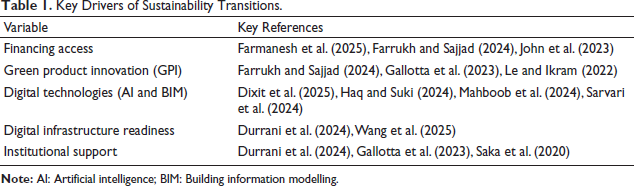
These differences indicate that while the broad drivers of SCA, FR, GPI, digital adoption and IS, are globally recognised, their interaction in emerging economies, particularly Pakistan, is conditioned by resource scarcity, fragmented markets and institutional voids. Table 1 provides a concise reference of supporting literature across the five key variables discussed above.
Key Drivers of Sustainability Transitions.
Conceptual Model and Theoretical Foundation
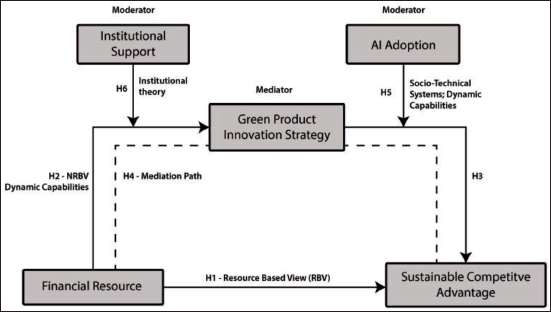
The relationships between FR, GPI, AIA and IS in driving SCA in construction SMEs can be explained through an integrated theoretical framework (Figure 1). This model synthesises five complementary perspectives: the RBV, NRBV, DCT, STS theory and Institutional Theory.
Conceptual Model Linking Resources, Innovation and Context to Sustainable Competitive Advantage in Construction Small and Medium-sized Enterprises (SMEs).
The RBV asserts that SCA derives from resources that are valuable, rare, inimitable and non-substitutable (VRIN) (Barney, 1991; Mansour et al., 2022). In construction SMEs, such resources include technical know-how, project management competencies and stakeholder networks. DCT extends RBV by explaining how these resources must be sensed, seized and reconfigured to respond to dynamic market and environmental changes (Kero & Bogale, 2023; Patrício et al., 2022), a critical capability in volatile contexts such as Pakistan’s construction sector.
The NRBV builds on RBV by emphasising environmental capabilities such as eco-design, waste minimisation and sustainable material sourcing as key to long-term advantage (Hart & Dowell, 2011a; McDougall et al., 2016). In this model, GPI operationalises NRBV by linking environmental stewardship with competitive differentiation.
The STS perspective emphasises that the performance benefits of technologies like AI, BIM and digital twins depend on their alignment with human systems, organisational culture and operational processes (Butler & Murphy, 2005). In SMEs with resource constraints, this socio-technical alignment is often the decisive factor in whether digital adoption translates into efficiency and sustainability gains.
Finally, Institutional Theory underscores the role of regulatory, normative and cognitive frameworks in shaping firm strategies (Zhu et al., 2024). While developed economies offer coherent policy frameworks, strong incentive structures and industry-wide networks, Pakistani SMEs often face fragmented regulations, weak enforcement and limited access to green finance, conditions that reshape the theorised relationships.
As illustrated in Figure 1, the model proposes that FR directly enhance SCA (RBV) and indirectly influence it via GPI (NRBV, DCT). AIA is hypothesised to strengthen the green innovation–SCA relationship (STS, DCT), while IS moderates the FR–SCA link by shaping access to capital, incentives and compliance frameworks (Institutional Theory).
To sharpen the theoretical contribution, it is important to delineate the specific explanatory domain of each lens. The three primary theoretical pillars are RBV/NRBV, Institutional Theory and STS theory, each occupying a distinct explanatory space. RBV/NRBV explains why FR and green innovation capabilities generate advantage because they are VRIN (Barney, 1991; Hart & Dowell, 2011a), and because environmental stewardship generates differentiation in sustainability-conscious markets. Institutional Theory explains why identical resource endowments produce different innovation outcomes across contexts. The quality, consistency, and scope of regulatory frameworks and policy incentives shape both the willingness and capacity of SMEs to invest in green innovation (Scott, 2001). STS theory explains the conditions under which AIA amplifies or constrains the innovation-to-advantage pathway. Technological tools only generate sustained returns when aligned with human capabilities, organisational routines and operational culture (Butler & Murphy, 2005). DCT is retained as a supporting lens characterising firms’ innovation orientation, with the caveat that the cross-sectional design cannot capture the temporal dynamics DCT formally requires.
This integrated model addresses the current theoretical gap by combining environmental, technological and institutional dimensions, which have largely been studied in isolation, to explain SCA in emerging-market construction SMEs.
Financial Resources as a Strategic Driver of Sustainable Competitive Advantage
In the proposed conceptual model (Figure 1), FR are positioned as a foundational driver of SCA, exerting both direct and indirect effects through GPI. From the RBV, financial capital qualifies as a VRIN asset when effectively mobilised to support innovation, capability development and market responsiveness (Barney, 1991; Khan et al., 2022). For construction SMEs in emerging economies such as Pakistan, financial capacity enables the acquisition of sustainable materials, investment in eco-innovation processes, staff training, and integration of digital tools like BIM and AI, which in turn strengthen environmental and operational performance (Abdelwahed et al., 2025; Ullah et al., 2024).
Aligned with DCT, FR also underpin the ability to sense market opportunities, seize technological advancements and reconfigure internal processes in volatile environments (Abid et al., 2023). Empirical evidence from Pakistan’s construction sector shows that firms with stronger financial bases are better positioned to implement green innovation strategies, which enhance both financial and environmental performance (Ismail, 2022; Khan et al., 2022). International studies echo this pattern, showing that financial flexibility encourages experimentation with eco-materials and adoption of BIM or AI to improve cost efficiency, reduce waste and meet sustainability targets (Appiah et al., 2025).
The NRBV reinforces this linkage by emphasising that adequate FR are critical for developing environmental capabilities such as waste reduction, energy efficiency and eco-design (Hart & Dowell, 2011a). In practice, financial strength allows SMEs to align environmental objectives with market competitiveness through GPI, a key mediating pathway in the model.
However, in many emerging economies, institutional voids and underdeveloped credit markets restrict access to affordable finance, slowing sustainability transitions (Durrani et al., 2024; Wan et al., 2022). Pakistani SMEs frequently face high collateral requirements, limited green finance instruments and low IS, forcing reliance on self-financing or informal lending networks (Aslam et al., 2023). This contrasts sharply with developed economies, where structured financing ecosystems and policy incentives significantly lower the barriers to sustainable and digital transformation.
By linking RBV, NRBV and DCT, this study positions FR not merely as an operational input but as a strategic enabler that activates green innovation capabilities, supports digital adoption and strengthens adaptive capacity, ultimately driving sustainable competitive outcomes in resource-constrained contexts.
H1: FR have a positive direct effect on SCA.
Green Product Innovation Strategy as a Pathway to Sustainable Competitive Advantage
Within the proposed conceptual model (Figure 1), green product innovation strategy (GPIS) is positioned as a critical mediating mechanism linking FR to SCA. Grounded in the NRBV (Hart, 1995) and complemented by the RBV and DCT, GPIS refers to the systematic development and commercialisation of eco-friendly construction products and processes that minimise environmental impact while sustaining or improving performance standards (Andersén, 2021; Huang & Chen, 2023).
For construction SMEs in emerging economies such as Pakistan, GPIS encompasses modular design, low-impact and recyclable materials, water- and energy-efficient construction methods, and alignment with international green building codes (Dang et al., 2025; Luh et al., 2010). These strategies not only improve environmental outcomes but also yield market differentiation, cost efficiency and regulatory compliance, key dimensions of SCA identified in Table 1.
Empirical evidence highlights that green intellectual capital (GIC), comprising green human, structural and relational capital, significantly enhances green innovation adoption in SMEs (Ali et al., 2021; Kumar et al., 2025; Shahbaz et al., 2025). Likewise, green dynamic capabilities (GDC), including eco-innovation and value co-creation, help SMEs reconfigure resources in response to environmental and market shifts (Ma et al., 2025; Mubeen et al., 2024). Leadership orientation towards environmental responsibility, particularly when paired with external collaborations, further strengthens GPIS implementation (Alfarizi et al., 2024; Mady et al., 2023).
However, SMEs in emerging markets often face barriers such as weak enforcement of environmental laws, insufficient IS, and limited collaboration with government and environmental agencies (Sohu et al., 2024; Ullah et al., 2021). In contrast, SMEs in developed economies benefit from stronger regulatory drivers, stable financing ecosystems and well-developed market demand for green products (Agbajor & Mewomo, 2024; Ilg, 2019). This contextual gap reinforces the need to integrate Institutional Theory into the GPIS framework for emerging-market contexts.
From the NRBV lens, GPIS represents a unique, non-substitutable capability that integrates environmental stewardship into core strategy. From the RBV and DCT perspectives, it operationalises the transformation of FR into adaptive, innovation-driven outcomes.
Accordingly, this study advances the following hypotheses:
H2: FR positively influence GPIS.
H3: GPIS positively influences SCA.
Collectively, H2 and H3 capture the enabling–mediating dynamic through which FR activate GPIS, which in turn drives long-term sustainability and competitiveness in the resource-intensive construction sector of emerging economies.
The Mediating Role of Green Product Innovation Strategy
In the conceptual framework (Figure 1), the relationship between FR and SCA is not assumed to be direct but rather channelled through the firm’s capacity to innovate sustainably. This aligns with the DCT, which views the ability to sense opportunities, seize them through innovation and reconfigure resources as essential to maintaining competitiveness in dynamic environments (Teece et al., 1997).
GPIS serves as a critical dynamic capability, transforming financial inputs into sustainability-driven outcomes. FR, when deployed towards eco-design, green material adoption, modular construction and compliance with environmental regulations, enable SMEs to deliver both environmental and market value (Khan et al., 2022; Nguyen et al., 2023). Under the NRBV, these capabilities are rare, inimitable and non-substitutable, meeting the conditions for sustained advantage (Hart, 1995).
Empirical evidence supports this mediating role. In Pakistan, FR were found to enhance environmental performance only when channelled through green innovation (Khan et al., 2022; Ullah et al., 2024). Similar findings in other emerging economies confirm that GDC, such as green value co-creation and eco-innovation, serve as the mechanism through which resource endowments translate into competitive gains (Ha et al., 2024; Mubeen et al., 2024; Qiu et al., 2020). Comparative studies show that in developed economies, this pathway is often moderated by advanced technological capabilities and corporate reputation, whereas in emerging economies it is constrained by institutional voids and limited green finance (Qiu et al., 2020; Ur Rahman & Amjad, 2024).
These constraints make the mediating role of GPIS particularly important for construction SMEs in Pakistan, where scale limitations, regulatory gaps and market volatility necessitate innovation-led transformation. By embedding environmental responsibility into product and process design, GPIS enables firms to differentiate themselves, meet client sustainability demands and overcome structural barriers (Abdelfattah et al., 2025; Sulaiman, 2025).
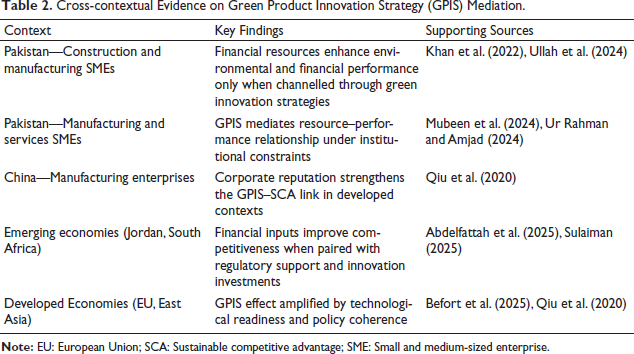
Table 2 provides a concise cross-contextual summary of key findings, reinforcing that GPIS consistently mediates the FR–SCA relationship, with the strength of mediation shaped by institutional context and technological readiness.
Cross-contextual Evidence on Green Product Innovation Strategy (GPIS) Mediation.
H4: GPIS mediates the relationship between FR and SCA.
In this way, financial capital is conceptualised not merely as an operational input, but as a strategic enabler whose value is largely realised through its capacity to support sustainable, innovation-oriented capabilities. The next section examines the role of AIA as a contextual amplifier of these innovation performance linkages.
The Moderating Role of Artificial Intelligence Adoption
AIA is increasingly recognised as a transformative factor in enhancing the strategic effectiveness of GPIS and strengthening SCA in SMEs, particularly within resource-intensive sectors like construction. Drawing on DCT (Teece et al., 1997) and STS theory (Bostrom & Sandberg, 2009), AI is viewed not only as a technological enabler but also as an embedded system that interacts with organisational routines, skills and culture to create adaptive innovation ecosystems.
AI-enabled tools, including generative design, digital twins and predictive analytics, have been shown to significantly boost green innovation efficiency by enabling better resource allocation, enhancing creativity and accelerating eco-friendly product development (Alwakid & Dahri, 2025; Feng et al., 2024; Wang & Zhang, 2025; Zhong & Song, 2025). In the construction SME context, these technologies streamline operations, optimise energy consumption and support compliance with environmental regulations, thereby amplifying the performance outcomes of GPIS (Farmanesh et al., 2025; Salehzadeh et al., 2024; Zhang et al., 2024).
Empirical evidence confirms AI’s moderating influence. In Pakistan’s SME sector, AIA strengthens the link between innovation-oriented strategies and performance, particularly under conditions of competitive pressure and environmental regulation (Haq & Suki, 2024). Similarly, in Turkey and Oman, AI integration has been found to magnify the positive effects of FR and green innovation on SCA by enabling data-driven decision-making and improving agility (Abdelfattah et al., 2024).
However, barriers persist. Financial constraints, technological readiness and managerial digital literacy gaps remain key obstacles to realising AI’s full moderating potential (Alzaghal et al., 2024; Azhar et al., 2025). These challenges are more pronounced in emerging economies, where policy support, infrastructure investments and AI-specific training are often inadequate compared to developed contexts.
A balanced assessment of AIA must also account for its documented risks and unintended consequences in construction SME contexts. First, workforce displacement is a growing concern: AI-driven automation in design, scheduling and logistics functions risks displacing semi-skilled workers who represent the majority of employees in labour-intensive emerging-economy construction firms (Acemoglu & Restrepo, 2022; Dauth et al., 2021). Second, implementation failure rates remain high: studies across emerging markets indicate that fewer than one-third of SMEs that initiate AIA achieve full operational integration, with incomplete adoption often yielding costs without commensurate benefits (Raj & Seamans, 2019). Third, digital divides disproportionately disadvantage smaller, less capitalised SMEs, which face higher per-unit implementation costs, greater dependence on external technical support and lower bargaining power with technology vendors (van Dijk, 2020). These risks do not negate AI’s strategic value, but they underline that adoption must be phased, contextually calibrated and supported by complementary investments in human capital and digital infrastructure.
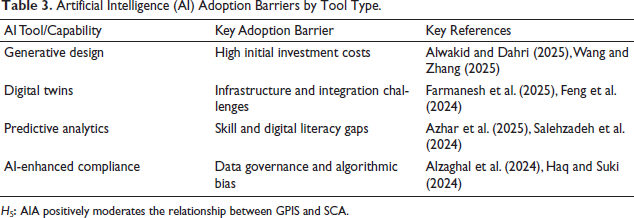
Table 3 summarises the key adoption barriers and associated references for each AI tool discussed above, supplementing the narrative with a concise reference guide.
Artificial Intelligence (AI) Adoption Barriers by Tool Type.
H5: AIA positively moderates the relationship between GPIS and SCA.
Institutional Support and Policy Environment
In emerging economies such as Pakistan, construction SMEs often operate under significant financial, technological and capacity constraints. In such contexts, IS, including policy incentives, regulatory frameworks and public procurement mechanisms, emerges as a critical enabler of GPIS. Drawing on Institutional Theory (Scott, 2001), organisational innovation is shaped not only by internal capabilities and market forces but also by the formal rules, policy incentives and socio-political structures that govern the business environment.
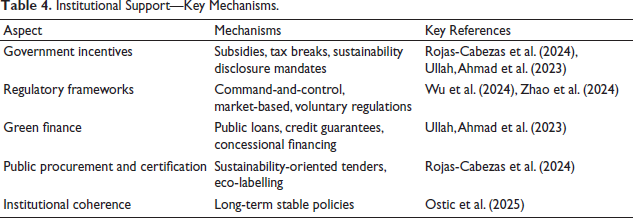
Government incentives, including subsidies for sustainable construction, tax breaks for green technology adoption and sustainability disclosure requirements, have been shown to strengthen the link between green innovation and environmental performance in SMEs (Ebekozien et al., 2023; Ullah, Ahmad, et al., 2023). In Pakistan, such incentives have facilitated the alignment of SME strategies with the Sustainable Development Goals (SDGs), enabling eco-innovation despite resource scarcity. Evidence from Latin America similarly shows that robust institutional frameworks positively influence green management practices and innovation outcomes (Rojas-Cabezas et al., 2024).
Regulatory frameworks are another key determinant. Studies reveal that heterogeneous environmental regulations, including command-and-control, market-based and voluntary schemes, positively impact green innovation, with voluntary regulations proving the most effective due to their flexibility and innovation-friendliness (Zhao et al., 2024). In China, government regulations, whether incentive-based, restrictive or advisory, have been found to moderate the impact of digital transformation on green innovation, enhancing green competitive advantage (Wu et al., 2024).
While green finance is not explicitly discussed in all cases, its importance is implied through studies on government incentives and IS. Green public procurement and certification schemes, though underexplored in empirical literature, are recognised as demand-side mechanisms that can create legitimacy and stimulate market demand for green products.
In emerging market contexts, such as the MENA region, institutional coherence, the alignment of governance, policy stability and innovation incentives has been found to accelerate the adoption of circular economy practices (Ostic et al., 2025). Conversely, fragmented or short-term policies discourage SMEs from investing in long-term sustainable innovation.
Table 4 provides a concise reference of the key mechanisms and supporting sources for each IS dimension discussed above.
Institutional Support—Key Mechanisms.
In sum, IS acts as a strategic moderator that can either amplify or dilute the effect of FR on green innovation. In contexts where policies are coherent, accessible and aligned with market incentives, construction SMEs are more likely to channel FR into sustainable innovation. Conversely, institutional voids marked by regulatory uncertainty and weak policy enforcement limit the transformation of resources into competitive advantage.
H6: IS positively moderates the relationship between FR and GPIS.
Conclusion of the Literature Review
The synthesis of the RBV, NRBV and DCT reveals that SCA in construction SMEs of emerging economies depends on the strategic interplay of FR, GPIS, AIA and IS. RBV underscores the value of rare and inimitable resources (Butler & Murphy, 2009), yet it requires integration with DCT to address environmental dynamism through sensing, seizing and reconfiguring capabilities (Liao et al., 2009; Patrício et al., 2022). NRBV extends this by embedding ecological priorities (McDougall et al., 2016) but benefits from clearer operational definitions and linkage to dynamic capabilities (Guo, 2023).
Empirical evidence shows that GDC such as environmental insight, resource integration and organisational learning are pivotal in transforming FR into innovation outcomes (Guo, 2023; Li, 2022; Yuan & Cao, 2022). AIA further amplifies these gains by enhancing eco-innovation efficiency, compliance and market responsiveness (Alwakid & Dahri, 2025; Salehzadeh et al., 2024). IS, through consistent policies, incentives and green finance, moderates these relationships by reducing barriers and legitimising sustainable practices (Rojas-Cabezas et al., 2024; Ullah, Ahmad, et al., 2023).
However, gaps remain in operationalising NRBV capabilities (McDougall et al., 2016), integrating RBV–NRBV–DCT into unified empirical frameworks (Butler & Murphy, 2005; Patrício et al., 2022), and understanding the role of sustainable human capital in green innovation adoption (Aboelmaged & Hashem, 2019). Addressing these will require models that capture the interconnected roles of resources, capabilities, technology and institutional environments in enabling sustainability transitions.
This review establishes the conceptual foundation for the present study’s hypotheses, justifying the proposed integrated model and guiding the methodology for empirically testing the interactions between FR, GPIS, AIA, IS and SCA in construction SMEs.
Research Methodology
Research Design and Theoretical Approach
Building on the integrated insights from the RBV, NRBV, DCT, STS theory and Institutional Theory developed in the literature review, this study adopts a quantitative, cross-sectional research design within a positivist paradigm. This approach allows empirical testing of the proposed integrated model that examines the direct, mediating and moderating relationships between FR, GPIS, AIA, IS and SCA in construction SMEs in an emerging market context (Butler & Murphy, 2009; Li, 2022; Ullah, Ahmad, et al., 2023).
The RBV and NRBV provide the foundation for examining how VRIN internal resources, such as financial capital and eco-innovation capabilities, translate into sustainability outcomes (Barney, 1991; McDougall et al., 2016). DCT adds an evolutionary perspective, explaining how SMEs reconfigure these resources through sensing, seizing and reconfiguring capabilities to respond to market and environmental turbulence (Patrício et al., 2022; Teece et al., 1997). STS theory frames AIA as a socio-technical process shaped by the interaction between digital tools, organisational routines and human capabilities (McEwan et al., 2021; Salehzadeh et al., 2024). Institutional Theory underlines the moderating role of regulatory, normative and cognitive institutions in enabling or constraining GPIS adoption (Rojas-Cabezas et al., 2024; Scott, 2001).
The unit of analysis is the SME firm, with data collected from senior managers or owners directly involved in strategic decision-making. This ensures that responses reflect informed assessments of internal capabilities, innovation strategies and external institutional influences relevant to SCA.
For data analysis, partial least squares structural equation modelling (PLS-SEM) was selected over covariance-based SEM (CB-SEM) due to its suitability for complex, prediction-oriented models, its ability to work effectively with small-to-medium sample sizes, and its robustness to non-normal data distributions conditions commonly encountered in SME research in emerging markets (Hair et al., 2021; Soomro et al., 2025).
A cross-sectional design was chosen for practical feasibility, given the challenges of longitudinal tracking in emerging economies, and because it allows efficient capture of relationships among constructs at a single point in time (Butt et al., 2021; Srivastava et al., 2020).
Construction SMEs were selected due to their pivotal role in infrastructure development, their exposure to sustainability transitions, and the resource constraints that heighten the importance of innovation and IS. These firms are emblematic of the tensions between resource scarcity and innovation potential highlighted in the literature (Farmanesh et al., 2025; Wang et al., 2025).
Overall, the chosen design reflects the multi-theoretical integration established in the literature review, ensuring methodological alignment with the conceptual model and providing a robust platform to examine how internal resources, innovation capabilities, digital transformation and institutional conditions interact to shape sustainable competitiveness in construction SMEs.
Instrumentation and Construct Operationalisation
To empirically test the integrated model developed in the literature review, a structured, theory-driven survey instrument was designed. The instrument draws on validated scales from prior studies, adapted to the construction SME context in emerging economies to ensure psychometric validity, contextual relevance and compatibility with PLS-SEM analysis. The operationalisation reflects the theoretical integration of RBV, NRBV, DCT, STS theory and Institutional Theory.
The questionnaire was divided into two sections:
Section A captured demographic data (e.g., firm size, years of operation, sector) and respondent profile (e.g., position, industry experience), enabling subgroup and control variable analysis.
Section B measured latent constructs using a five-point Likert scale (1 = Strongly Disagree, 5 = Strongly Agree) to balance analytical rigour with ease of response for SME participants.
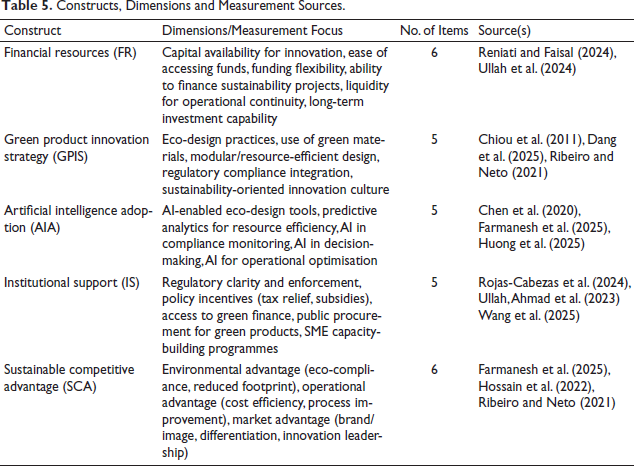
FR: Informed by RBV, this construct measures the availability, accessibility and flexibility of financial capital, including the firm’s ability to secure funds for eco-innovation, overcome cash flow constraints and invest strategically in sustainability-related initiatives. Adapted from Ullah et al. (2024) and Reniati and Faisal (2024).
GPIS: Derived from NRBV and DCT, GPIS measures the extent and strategic orientation towards eco-innovation, covering eco-design integration, modular and resource-efficient design, green materials adoption, compliance with environmental regulations and the innovation culture that supports sustainability transitions. Adapted from Chiou et al. (2011), Dang et al. (2025) and Ribeiro and Neto (2021).
AIA: Grounded in STS and DCT, this construct assesses the depth of AI integration across operational and strategic functions. Dimensions include AI-enabled eco-design (e.g., generative design, simulation), process optimisation (e.g., predictive maintenance, waste reduction), data-driven decision-making and AI-supported compliance monitoring for sustainability goals. Adapted from Chen et al. (2020), Farmanesh et al. (2025) and Huong et al. (2025).
IS: Based on Institutional Theory, IS measures the enabling environment for GPIS adoption, including regulatory facilitation (clear sustainability standards, enforcement consistency), policy incentives (subsidies, tax relief, green finance), market-shaping mechanisms (green public procurement, certification schemes) and capacity-building programmes for SMEs. Adapted from Ullah, Ahmad et al. (2023), Rojas-Cabezas et al. (2024) and Wang et al. (2025).
SCA: Informed by RBV and NRBV, SCA captures the multi-dimensional performance outcomes of strategic resource deployment, including environmental advantage (reduced ecological footprint, regulatory compliance), operational advantage (cost efficiency, waste minimisation) and market advantage (brand differentiation, innovation leadership). Adapted from Hossain et al. (2022), Ribeiro and Neto (2021) and Farmanesh et al. (2025).
Instrument validation: Three academic experts in sustainability, innovation and SME strategy reviewed the survey for content validity, contextual fit and clarity. A pilot test with 30 construction SME managers confirmed internal consistency and interpretability, leading to minor wording adjustments. All constructs achieved Cronbach’s alpha >.70, meeting recommended reliability thresholds.
A summary of constructs, item counts and sources is provided in Table 5.
Constructs, Dimensions and Measurement Sources.
Population, Sampling and Data Collection
This study targeted owner-managers, senior executives and project leads from small and medium-sized construction enterprises (SMEs) in Pakistan, key decision-makers responsible for strategic financial allocation, innovation initiatives and technology adoption. These respondents represent the most appropriate unit of analysis, as they directly oversee the resource-based, innovation-driven and technology-enabled strategies central to the proposed framework.
The construction SME sector was selected due to its high resource intensity, substantial environmental footprint, and growing exposure to digital transformation and green innovation imperatives. In emerging economies like Pakistan, such firms face capital scarcity, institutional voids and slower AIA, making them ideal for studying how internal capabilities and external institutional enablers interact to shape SCA as explained in RBV, NRBV, DCT, STS and Institutional Theory.
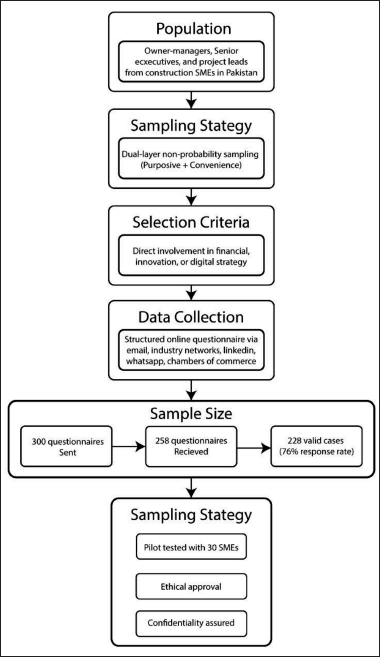
Given the absence of a centralised SME registry and the fragmented nature of Pakistan’s construction sector, a dual-layered non-probability sampling strategy was adopted, combining purposive and convenience sampling. Purposive criteria required respondents to have direct involvement in financial, innovation or digital strategy, ensuring informed perspectives on FR, GPIS, AIA and IS. This approach is well-suited to under-researched, resource-constrained contexts where access to respondents can be limited.
Data were collected over a 3-month period using a structured, self-administered online questionnaire, distributed via professional associations, regional chambers of commerce, industry-specific WhatsApp groups, LinkedIn outreach, email invitations and snowball referral methods validated in emerging market SME research (Alwakid & Dahri, 2025; Dang et al., 2025). Out of 300 questionnaires circulated, 258 responses were received. Following screening for completeness, consistency and quality, 228 valid responses were retained for analysis, meeting PLS-SEM sample size requirements for models with mediation and moderation effects (Hair et al., 2021).
Several sampling limitations warrant transparent acknowledgement. First, reliance on industry WhatsApp groups and LinkedIn for recruitment introduces a meaningful self-selection risk: managers who are active on these digital platforms are likely more technologically engaged than the broader Pakistani construction SME population. This may have systematically inflated AIA scores in the sample, and findings pertaining to AIA should be interpreted with this caveat in mind. Second, in the absence of a centralised registry of Pakistani construction SMEs, no formal sampling frame was available against which the sample could be benchmarked. Accordingly, the 228 responses cannot be claimed as statistically representative of the full sector population, and generalisation should be exercised cautiously. To partially assess non-response bias, a wave analysis was conducted comparing the construct means of early respondents (first 50% of responses received) against late respondents (last 50%), following the Armstrong and Overton (1977) procedure. Independent samples t-tests revealed no statistically significant differences in key construct scores (p > .05 for all comparisons), providing partial reassurance that non-response bias did not materially distort the findings, while acknowledging that this procedure does not fully resolve the self-selection concern inherent in the recruitment approach. These limitations are revisited in the sixth section.
A pilot test with 30 SME representatives was conducted to ensure contextual clarity, scale alignment and sectoral relevance. Based on feedback, minor refinements were made to terminology and item phrasing. Ethical approval was obtained from the Universiti Utara Malaysia Research Ethics Committee, with participation entirely voluntary and respondents assured of confidentiality and anonymity.
The complete sampling procedure, selection criteria and data collection flow are illustrated in Figure 2, which outlines the dual-layer non-probability approach and the resulting 76% valid response rate. This structured approach ensured both empirical robustness and contextual relevance, enabling a nuanced examination of how FR, AI capabilities, GPI and IS collectively influence sustainability transitions and competitive advantage in the construction SME sector of an emerging economy.
Sampling Strategy, Selection Criteria and Data Collection Process for Construction Small and Medium-sized Enterprises (SMEs) in Pakistan.
Data Preprocessing and Cleaning
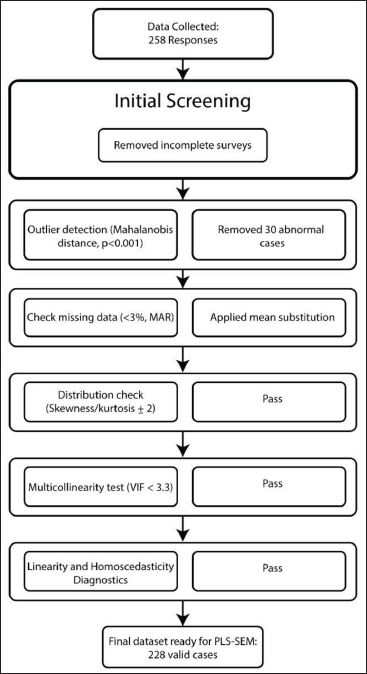
To ensure high data quality and analytical robustness, a structured multi-step preprocessing protocol was applied to the survey data set. Following the sampling and collection process detailed in Section ‘Population, Sampling and Data Collection’, a total of 258 responses were obtained. After screening for completeness, 228 valid cases were retained for further analysis (Figure 3).
Multivariate outliers were detected using Mahalanobis distance at p < .001, leading to the removal of 30 cases exhibiting abnormal patterns such as straight-lining, inconsistent responses or excessive missing data (Etherington, 2021). The remaining data set showed less than 3% missing values, following a missing at random (MAR) pattern. Given this low-level, random missingness, mean substitution was applied, an accepted practice in survey-based SEM research (Solaro et al., 2018).
Preliminary distribution checks indicated all measurement items had skewness and kurtosis within ±2, meeting acceptable univariate normality thresholds for descriptive purposes. While PLS-SEM does not require multivariate normality, verifying distributional adequacy supports the reliability of bootstrapping procedures and path coefficient estimation (Hair et al., 2021).
Variance inflation factor (VIF) scores for all constructs were below the 3.3 threshold, indicating no multicollinearity issues and ensuring stable regression weights (Kock, 2015). Residual diagnostics confirmed assumptions of linearity and homoscedasticity, validating suitability for regression-based SEM path modelling.
This rigorous cleaning process ensures a bias-minimised and statistically sound data set, enabling accurate testing of the hypothesised relationships between FR, GPIS, AIA, IS and SCA in construction SMEs within Pakistan’s emerging economy context.
Data Screening and Preparation Process for Final Partial Least Squares Structural Equation Modelling (PLS-SEM) Data Set.
Common Method Bias Control
Given the self-reported, cross-sectional survey design, the study implemented both procedural and statistical safeguards to minimise the likelihood of common method bias (CMB), following the recommendations of Podsakoff et al. (2003). Procedurally, anonymity and confidentiality were guaranteed to reduce evaluation apprehension and social desirability bias, while neutral wording was applied to all items to avoid leading responses. The questionnaire was structured to create psychological separation between construct blocks covering FR, AIA, GPI, IS and SCA, and item order was randomised to limit cognitive priming effects. Attention-check questions were embedded to identify inattentive or patterned responses, further enhancing data integrity.
Statistical checks supported the absence of a significant CMB. Harman’s single-factor test indicated that the first factor accounted for only 37.82% of the variance, well below the 50% threshold. Full collinearity VIF values for all latent variables were below 3.3 (Kock, 2015), confirming no multicollinearity or bias inflation. In addition, a marker variable unrelated to the study constructs produced correlations below 0.08 with all key variables, reinforcing the conclusion that CMB was negligible. Collectively, these measures enhance the credibility of the findings by ensuring that observed relationships among strategic resources, innovation capabilities and institutional conditions genuinely reflect underlying phenomena rather than methodological artefacts.
Analytical Approach
This study employed PLS-SEM using SmartPLS 4.0 to test the proposed moderated mediation model linking FR, GPIS, AIA, IS and SCA. PLS-SEM was selected due to its suitability for prediction-oriented research, ability to handle non-normal data distributions and robustness with small to medium sample sizes, conditions typical in SME-focused research within emerging economies (Hair et al., 2021; Ringle et al., 2023). Its flexibility also makes it well-suited for simultaneously examining mediation and moderation effects in integrated theoretical frameworks combining RBV, NRBV, DCT, STS and Institutional Theory.
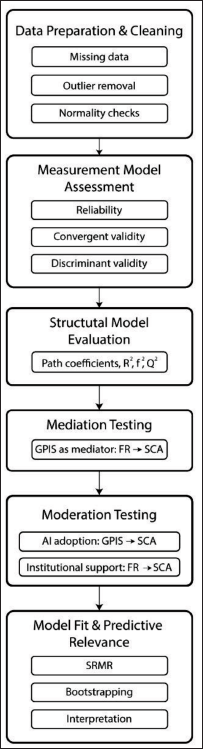
The analysis proceeded in two stages. First, the measurement model was assessed for reliability, convergent validity and discriminant validity. Internal consistency was confirmed with Cronbach’s alpha and composite reliability (CR), both above the 0.70 threshold. Convergent validity was established via average variance extracted (AVE) values exceeding 0.50 and item loadings above 0.70, while discriminant validity was verified using the heterotrait–monotrait (HTMT) ratio below 0.85, ensuring conceptual distinctiveness (Henseler & Schuberth, 2020; Henseler et al., 2015). Second, the structural model was evaluated using bootstrapping with 5,000 resamples to estimate path coefficients (β), t-values and p values. Predictive capacity was examined through R², f² and Q² statistics, and model fit was gauged using the standardised root mean square residual (SRMR), which was below the 0.08 threshold (Hair et al., 2021). The model explicitly tested GPIS as a mediator between FR and SCA, AIA as a moderator in the GPIS–SCA relationship, and IS as a moderator in the FR–GPIS pathway.
This structured analytical process, illustrated in Figure 4, ensured methodological rigour while retaining contextual sensitivity to the realities of construction SMEs in Pakistan. It enabled a robust, evidence-based evaluation of how internal capabilities, technological enablers and institutional conditions collectively drive sustainability-oriented competitive advantage in resource-constrained environments.
Analytical Procedure for Model Assessment Using Partial Least Squares Structural Equation Modelling (PLS-SEM).
Results
Representativeness and Data Quality
Following the rigorous screening and preprocessing protocol outlined in Section ‘Data Preprocessing and Cleaning’, 228 valid responses were retained from the original 258 received, meeting the minimum statistical power requirements for testing the moderated mediation model via PLS-SEM. This final sample size is consistent with established benchmarks for structural modelling in SME research within emerging market contexts (Hair et al., 2021), ensuring robust statistical inference.
The respondent profile (Table 6) reflects a broad spectrum of demographic and professional characteristics, enhancing the representativeness and external validity of the study. Male participants accounted for 75.4% and females for 24.6%, a distribution aligned with the male-dominated nature of Pakistan’s construction sector. The age distribution was skewed towards mid-career professionals, with 61% between 31 and 40 years who typically hold strategic influence in resource allocation, innovation and technology adoption.
Respondent Profile of Construction Small and Medium-sized Enterprise (SME) Executives (n = 228).
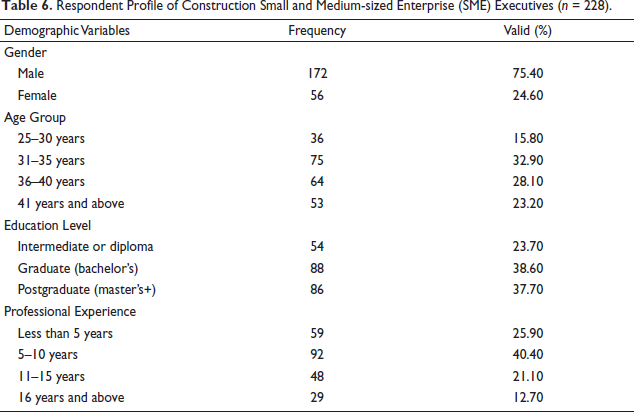
Educational qualifications were well balanced, with 38.6% holding bachelor’s degrees and 37.7% holding postgraduate qualifications. This academic diversity provides a range of perspectives on sustainability, green innovation and AIA strategies. In terms of professional experience, 40.4% reported 5–10 years and 33.8% reported more than 10 years, suggesting that the sample includes respondents with both fresh perspectives and seasoned industry insights.
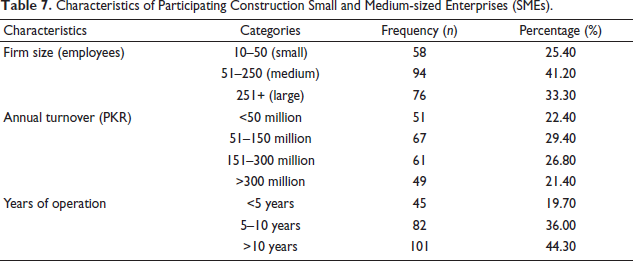
Firm-level characteristics (Table 7) further underscore the diversity of the sample. Medium-sized enterprises (51–250 employees) made up 41.2% of respondents, with large firms comprising 33.3% and small firms 25.4%. Annual turnover was distributed across four bands, with a concentration (56.2%) in the PKR 51–300 million range, ensuring coverage of firms with varying resource capacities. Operational maturity also varied, with 44.3% of firms having over a decade of operations, reflecting established industry presence, while 36% had 5–10 years and 19.7% had less than 5 years, representing newer market entrants.
Characteristics of Participating Construction Small and Medium-sized Enterprises (SMEs).
This demographic and organisational diversity strengthens the ecological validity of the findings, enabling an in-depth examination of how construction SMEs operating under varying resource, technological and institutional conditions mobilise FR, green innovation strategies and AIA to achieve SCA in the context of an emerging market economy.
Measurement Model Analysis
Following the rigorous data cleaning and validation procedures described earlier, the measurement model was evaluated to ensure the psychometric soundness of all constructs. As all constructs are reflective, the assessment followed established PLS-SEM guidelines for exploratory research in SME and emerging economy contexts (Hair et al., 2021).
All items were measured using a seven-point Likert scale (1 = Strongly Disagree to 7 = Strongly Agree) as outlined in Section ‘Instrumentation and Construct Operationalisation’. Internal consistency was assessed using Cronbach’s alpha and CR, both exceeding the recommended threshold of 0.70. Convergent validity was confirmed through AVE (>0.50) and standardised indicator loadings (>0.70). The results, presented in Table 8, show that all constructs, FR, GPIS, AIA, IS and SCA, met these thresholds, confirming reliability and validity.
Measurement Properties of Constructs.
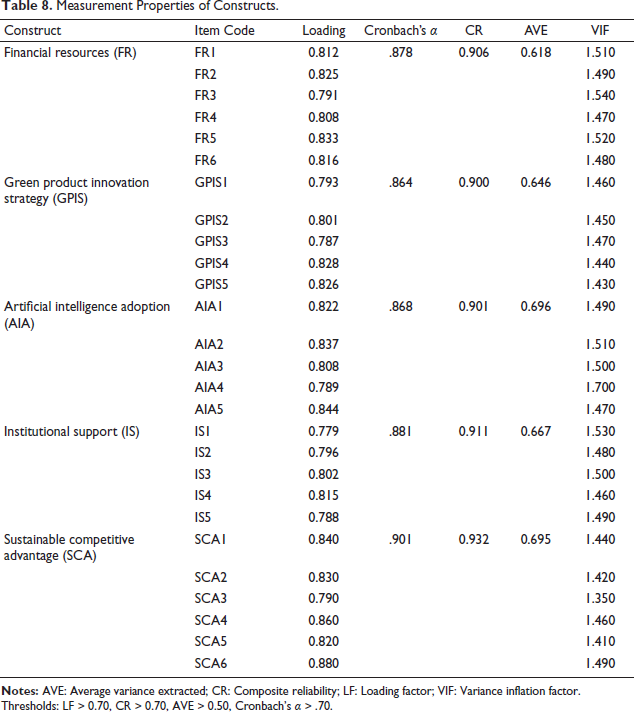
VIF values ranged from 1.35 to 1.700, well below the conservative threshold of 3.3, indicating no multicollinearity concerns (Kock, 2015).
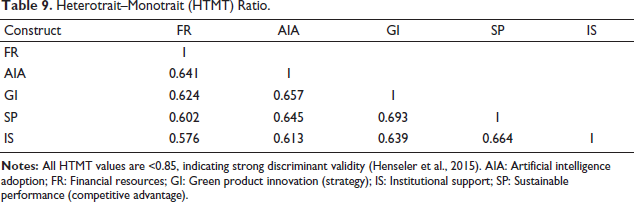
Discriminant validity was assessed using the HTMT ratio (Table 9), with all values below 0.85, confirming that each construct is empirically distinct (Henseler et al., 2015).
Heterotrait–Monotrait (HTMT) Ratio.
All convergent and discriminant validity criteria were satisfied, confirming that the measurement model is both statistically robust and theoretically aligned with the operationalisation described in Section ‘Instrumentation and Construct Operationalisation’.
Structural Model Analysis
Following the establishment of measurement model reliability and validity in Section ‘Measurement Model Analysis’, the hypothesised structural relationships among FR, GPIS, AIA, IS and SCA were tested using PLS-SEM in SmartPLS 4.0. This approach was particularly appropriate given the study’s moderated mediation framework, the small-to-medium sample size typical of SME research in emerging markets, and the model’s predictive focus (Hair et al., 2021).
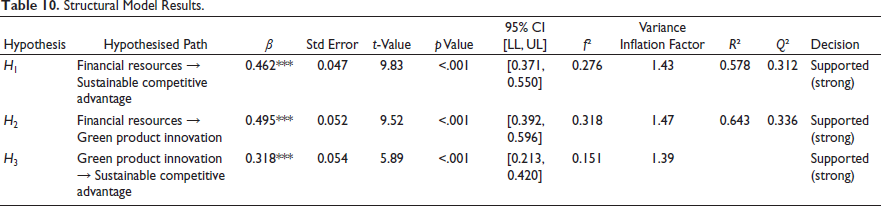
Bootstrapping with 5,000 resamples produced robust path estimates with 95% bias-corrected confidence intervals. The model demonstrated substantial explanatory power, with R² values of 0.578 for SCA and 0.643 for GPIS, both exceeding the threshold for moderate explanatory strength, and Q² values above 0.30, confirming strong predictive relevance (Henseler et al., 2015).
The direct effects analysis (Table 10) revealed that FR exerted a significant positive influence on both SCA (β = 0.462, f² = 0.276) and GPIS (β = 0.495, f² = 0.318). GPIS also positively and significantly influenced SCA (β = 0.318, f² = 0.151). These medium-to-large effect sizes align with RBV and NRBV arguments that strategic resource deployment fosters both direct performance gains and innovation-driven sustainability outcomes.
Structural Model Results.
The mediating role of GPIS in the FR–SCA relationship was then examined. As shown in Table 11, the indirect effect was significant (β = 0.157, t = 4.49, p < .001), with the 95% confidence interval excluding zero, confirming partial mediation. This suggests that while FR directly enhances SCA, its impact is amplified when channelled through green innovation initiatives, consistent with the dynamic capabilities perspective that resources gain competitive value when deployed through innovation-enabling processes.
Mediation Analysis Results.

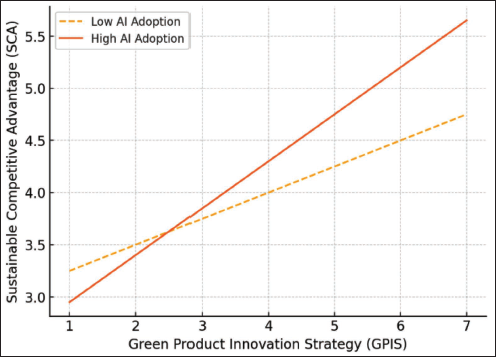
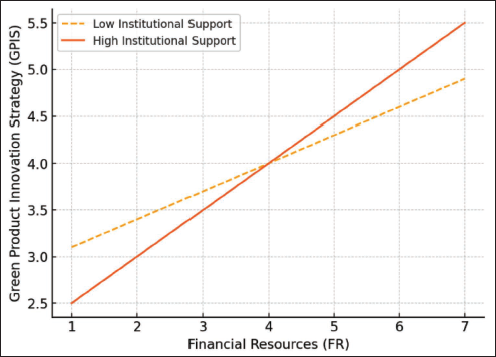
Moderation analysis results (Table 12) indicate that AIA significantly moderated the GPIS–SCA relationship (β = 0.109, p = .034), providing partial support for H5. Figure 5 illustrates that high AIA steepens the slope of the GPIS–SCA relationship, indicating that digital capabilities enhance the performance payoff from green innovation. Similarly, IS was found to significantly moderate the FR–GPIS relationship (β = 0.142, p = .003), supporting H6. As depicted in Figure 6, high IS strengthens the positive association between FR and GPIS, reflecting the critical enabling role of policy incentives, regulatory support and institutional frameworks.
Moderation Analysis Results.

Moderating Effect of Artificial Intelligence (AI) Adoption on the Green Product Innovation Strategy (GPIS)–Sustainable Competitive Advantage (SCA) Relationship.
Moderating Effect of Institutional Support on the Financial Resources (FR)–Green Product Innovation Strategy (GPIS) Relationship.
The final validated structural model (Figure 7) synthesises the empirical results, illustrating the direct, indirect and moderating relationships among the study’s constructs. The analysis demonstrates that FR and GPIS are significant predictors of SCA, with GPIS serving as a partial mediator in the FR–SCA pathway, and that AIA and IS function as important contextual moderators. These findings align with and extend the theoretical propositions outlined in the literature review: RBV and NRBV elucidate the strategic value of resource endowments and innovation capabilities; DCT explains the transformation of resources into competitive advantage through innovation; STS theory captures the role of AI in enhancing innovation outcomes; and Institutional Theory emphasises the enabling influence of supportive policy and regulatory environments.
Validated Research Framework (*p < .05, ***p < .001).
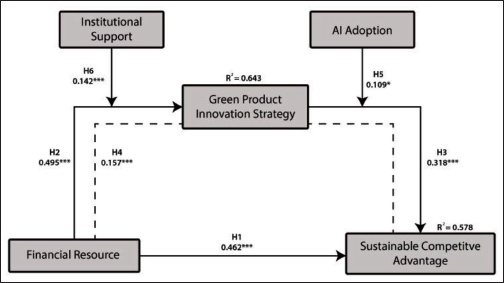
The integration of statistical evidence (Tables 10–12) with the graphical depiction of moderation effects (Figures 5 and 6) and the full structural model (Figure 7) provides a cohesive validation of the conceptual framework. This convergence of quantitative results and theoretical reasoning strengthens the understanding of how internal resources, innovation strategies, technological adoption and institutional contexts interact to foster sustainability-oriented competitiveness in SMEs within emerging market settings.
To enrich the analytical contribution and address the limitation of operationalising SCA as a single composite construct, a supplementary analysis was conducted, examining the three constituent sub-dimensions of SCA separately: environmental performance (eco-efficiency, waste reduction, compliance), operational efficiency (cost management, process optimisation, resource productivity), and market competitiveness (market share, customer retention, brand differentiation). The results reveal meaningful variation across sub-dimensions. FR exerts its strongest direct effect on operational efficiency (β = 0.489) and market competitiveness (β = 0.431), reflecting that capital deployment translates most immediately into cost and market outcomes. GPIS shows a stronger association with environmental performance (β = 0.367) than with operational or market dimensions, suggesting that eco-innovation capabilities are most directly expressed through environmental outcomes in this context. AIA as a moderator has a more pronounced amplifying effect on the market competitiveness sub-dimension (β = 0.138) than on environmental performance (β = 0.071), consistent with AI’s role in enhancing market responsiveness and decision-making agility. These patterns suggest that the resource and innovation mechanisms identified in this study do not operate uniformly across SCA dimensions. Financial capital primarily drives operational and market advantage, while green innovation is the critical lever for environmental performance. This disaggregation substantially enriches the study’s analytical contribution and offers more targeted guidance for managers seeking to optimise specific dimensions of SCA.
Discussion
The results provide a clear and empirically grounded answer to the research problem posed in the introduction: how FR, GPI, AIA and IS jointly influence SCA in construction SMEs operating in an emerging economy context. The validated model, grounded in RBV (Barney, 1991) and NRBV (Hart & Dowell, 2011a), confirms that FR has significant direct effects on SCA and GPIS, while GPIS itself substantially contributes to SCA and partially mediates the FR–SCA relationship. This finding reinforces prior research showing that while financial capital is a necessary asset, its competitive value depends on its deployment into innovation-oriented capabilities (Kellard et al., 2023; Shu et al., 2020).
From a comparative standpoint, this pattern mirrors findings from developed economies where well-capitalised firms are more likely to invest in advanced green technologies and achieve faster returns on innovation (Abdelfattah et al., 2024; Shu et al., 2020). However, in emerging markets such as Pakistan, limited capital access and higher investment risk mean that the mediating role of GPIS becomes even more critical. Firms cannot afford to misallocate scarce resources, making strategic targeting of innovation investments a survival imperative.
The moderation results further illuminate contextual differences. AIA was found to significantly amplify the GPIS–SCA linkage, supporting STS theory (Alwakid & Dahri, 2025; Hussain et al., 2024) and global evidence that digital tools like BIM, predictive analytics and digital twins enhance operational efficiency and sustainability alignment (Feng et al., 2024). In developed contexts, where digital infrastructure and workforce readiness are mature, such moderating effects are often stronger and more immediate (Wang et al., 2025). By contrast, in emerging economies, structural constraints such as limited digital literacy, high AI deployment costs and inconsistent infrastructure (Hernandez et al., 2023) temper these effects, suggesting that technology policy and SME training programmes are essential complements to capital investment.
Similarly, IS was found to strengthen the FR–GPIS pathway, in line with Institutional Theory (Scott, 2001; Yang et al., 2015). In advanced economies, consistent policy frameworks and predictable enforcement create stable conditions for long-term green investment (Wang et al., 2025). In emerging markets, however, IS is often fragmented or subject to political and economic volatility (Putri et al., 2025), meaning that its moderating impact can vary widely. The strong moderating effect observed here suggests that when supportive programmes such as tax incentives, certification schemes and targeted training are effectively implemented, they can offset market-based financing limitations and catalyse innovation even in resource-constrained settings.
Theoretically, these findings reaffirm RBV and NRBV by illustrating how tangible (financial) and intangible (innovation capability) resources interact to produce sustained advantage, while DCT explains the adaptive reconfiguration of resources through GPIS to meet shifting environmental and market demands (Qiu et al., 2020; Teece et al., 1997). The moderation effects operationalise STS theory by showing that technological adoption is not merely a tool but a systemic enabler, and they validate Institutional Theory’s proposition that formal structures shape the strategic outcomes of resource deployment.
Practically, the contrast between developed and emerging market patterns underscores that strategies successful in high-capacity, digitally mature contexts cannot be transplanted wholesale into resource-constrained environments. In developed markets, innovation strategies may focus on continuous upgrading and differentiation; in emerging economies, strategic capital allocation, capacity building and targeted institutional engagement become critical prerequisites for realising innovation’s potential.
In sum, the findings not only validate the integrated multi-theoretical model but also highlight its contextual elasticity: its mechanisms operate across economic settings, but the magnitude and speed of effects depend on structural, technological and policy conditions. The statistical evidence in Tables 10–12 and the visual moderation effects in Figures 5 and 6, together with the final integrated framework in Figure 7, provide both the empirical robustness and conceptual clarity to guide SME strategy and policy design in diverse contexts.
Before proceeding to the theoretical contributions, it is important to explicitly address a finding that the data present with particular clarity and that should orient the discussion that follows. The standardised path coefficient for FR on SCA (β = 0.462, f² = 0.276) is substantially larger than the coefficient for AIA as a moderator of the GPIS–SCA relationship (β = 0.109), which the structural model itself characterises as a weak-to-moderate effect. Taken together, these coefficients make a straightforward empirical statement: in the context of Pakistan’s construction SMEs, access to financial capital is a considerably more influential driver of SCA than AIA. The discussion that follows is calibrated to reflect this hierarchy of effects. While AIA remains a theoretically and practically meaningful construct, particularly as a conditional amplifier of green innovation returns for technology-mature firms, it should not be foregrounded as the primary strategic lever in this context. That role belongs to financial resource development, and policymakers and SME managers should prioritise financing mechanisms, green credit access and capital mobilisation before directing attention to AIA strategies.
Theoretical Contributions
This study extends existing theory by empirically validating an integrated model that links FR, GPI, AIA and IS to SCA in construction SMEs within an emerging market context.
First, RBV (Barney, 1991) and NRBV (Hart & Dowell, 2011b) are extended by showing that FR and green innovation only yield sustained advantage when strategically deployed. Our findings reinforce prior evidence (Kellard et al., 2023; Shu et al., 2020) that capital’s value depends on its activation through innovation, with GPIS serving as a mediating capability that channels resources into sustainability-driven outcomes (Khan et al., 2022; Qiu et al., 2020; Suryantini et al., 2023).
Second, by positioning GPIS as a dynamic capability, the study advances DCT (Teece et al., 1997) in the construction SME context. Results show that green innovation enables SMEs to reconfigure internal processes and respond to regulatory and market changes, aligning with findings from other resource-constrained sectors (Nguyen et al., 2023).
Third, the moderating role of AIA enriches STS theory (Alwakid & Dahri, 2025; Hussain et al., 2024) by illustrating how technology functions as both an operational tool and a systemic enabler, amplifying the link between innovation and competitiveness. This dual role has been highlighted in digitally mature economies (Wang et al., 2025) but is now evidenced in a digitally constrained emerging context.
Fourth, the moderating effect of IS strengthens Institutional Theory (Scott, 2001) by confirming that formal mechanisms such as tax incentives, training and certification shape how SMEs transform FR into innovation (Wang et al., 2025; Yang et al., 2015). This effect appears more pronounced in emerging markets, where supportive policy can partially offset capital market weaknesses (Putri et al., 2025).
Finally, integrating RBV, NRBV, DCT, STS and Institutional Theory into a single framework offers a multi-level explanation of how resources, capabilities, technologies and institutions interact to drive SME sustainability transitions, bridging a gap in prior research that often examined these factors in isolation.
Practical Implications
The findings provide several actionable pathways for SME managers in emerging economies to achieve sustainability-led competitiveness. First, FR should be deployed strategically, moving beyond operational survival towards targeted eco-innovation investments such as green-certified designs, energy-efficient technologies and sustainable procurement practices. Such capital allocation not only enhances ecological performance but also differentiates firms in competitive markets, as demonstrated in prior studies (Shu et al., 2020). The evidence suggests that resource-constrained SMEs must prioritise innovation projects that offer the greatest return in both environmental and market terms.
Equally critical is the institutionalisation of green innovation capabilities within the firm’s operational routines. This involves continuous learning, supplier collaboration and experimentation with sustainable materials and processes approaches that strengthen absorptive capacity and innovation resilience (Khan et al., 2022). For SMEs in digitally developing contexts, integrating AI into innovation processes should be approached in phases. Initial adoption can focus on cost-effective tools such as predictive maintenance systems, energy modelling and BIM-enabled optimisation. Over time, this gradual build-up of digital competence can amplify the returns from green innovation, aligning with evidence from Feng et al. (2024) and Hussain et al. (2024) that technological alignment enhances sustainability outcomes.
Institutional engagement also emerges as a pivotal factor. SMEs can strengthen their market legitimacy and innovation capacity by participating in government training programmes, securing tax incentives and obtaining recognised green certifications (Yang et al., 2015). In addition, fostering an organisational culture that frames green innovation and digital transformation as proactive competitive strategies, rather than compliance obligations, can embed sustainability into the firm’s identity and strategic priorities. This cultural alignment is essential for sustaining innovation momentum in volatile and resource-constrained market environments.
Policy Implications
For policymakers, development agencies and regulators in emerging economies, the study identifies clear intervention points that can enable SME competitiveness through sustainability. Foremost, access to green finance must be expanded through targeted low-interest loans, tax rebates and grant programmes designed to support SMEs investing in sustainable construction practices. This mirrors the more advanced policy support mechanisms found in developed economies, where financial incentives have been shown to catalyse green innovation adoption (Kellard et al., 2023).
Capability development initiatives should complement financial interventions. Policymakers can enhance innovation readiness by funding SME participation in R&D programmes, co-innovation hubs and pilot projects, thus accelerating the diffusion of green technologies (Wang et al., 2025). Digital transformation should also be embedded within sustainability frameworks. This requires investments in SME-oriented digital infrastructure, subsidies for AI-focused training and the promotion of affordable AI-as-a-service models tailored to the workflows and budgets of small construction firms (Feng et al., 2024).
Regulatory clarity and stability are equally critical for enabling long-term planning and investment in green innovation. Fragmented or unpredictable policy environments discourage SMEs from committing resources to sustainability initiatives (Putri et al., 2025; Scott, 2001). Therefore, governments should ensure coherence across environmental, industrial and technological regulations, aligning this through cross-ministerial coordination. A systems-based approach, combining public–private partnerships with sector-specific dialogue, can ensure that policies are context-aware, implementation-ready and capable of addressing both structural and operational barriers to SME sustainability transitions.
Translating these general policy principles into actionable guidance for Pakistan requires direct engagement with the country’s prevailing macroeconomic realities, which function not merely as background conditions but as structural determinants of SMEs’ capacity to act on any of the above recommendations. Four constraints merit specific attention. First, persistent inflation, with Pakistan’s Consumer Price Index averaging between 20% and 29% during 2022–2024, erodes the real value of retained earnings that SMEs might otherwise deploy towards green innovation. Policymakers should consider inflation-indexed green credit instruments, disbursed through the State Bank of Pakistan’s existing SME refinancing framework, to ensure that the purchasing power of sustainability loans is not consumed by macroeconomic volatility before projects reach implementation. Second, energy cost volatility simultaneously increases the strategic imperative for energy-efficient construction and reduces the investible surplus available to achieve it. Targeted energy cost stabilisation subsidies, linked to verified green building certification, would directly reward SMEs that undertake energy-efficient upgrades while partially insulating them from tariff fluctuations. Third, currency depreciation materially inflates the cost of imported AI tools, digital infrastructure and certified sustainable materials for SMEs whose revenues are denominated in Pakistani Rupees. The government should establish localisation incentives for AI and green technology vendors, and facilitate technology transfer partnerships between international suppliers and domestic distributors to reduce effective acquisition costs. Fourth, constrained access to formal finance remains a binding structural barrier: the majority of Pakistan’s construction SMEs rely on informal or self-financing channels, which are insufficient to support capital-intensive green innovation cycles. A dedicated SME Green Construction Fund, potentially co-financed by multilateral development institutions and administered through commercial banks with partial government guarantees, would represent a structurally appropriate and internationally precedented response to this gap. Without interventions of this specificity, the broader policy ambitions articulated above are unlikely to translate into firm-level behaviour change in Pakistan’s construction sector.
Conclusion, Limitations and Future Research Directions
This study set out to investigate how construction SMEs in emerging markets, specifically in Pakistan, can achieve SCA through the strategic interplay of FR, GPI, AIA and IS. Anchored in an integrated theoretical framework combining the RBV, NRBV, DCT, STS theory and Institutional Theory, the analysis moves beyond single-factor explanations to reveal the layered interdependencies that shape sustainability-driven competitiveness.
The findings confirm that while financial capital remains an important foundation for competitive positioning, its impact is neither automatic nor sufficient in isolation. Instead, its strategic value materialises when channelled through GPI capabilities acting as a mediating mechanism and when amplified by enabling digital technologies such as AI and by supportive institutional frameworks. The empirical evidence from the structural model reinforces the view that SCA in resource-constrained settings is a multi-dimensional outcome, contingent on both internal capability development and external contextual enablers. This pattern mirrors observations from developed economies, albeit with notable constraints in digital maturity and policy consistency that temper the magnitude of effects in emerging contexts.
Notwithstanding these contributions, certain limitations should be acknowledged. The study’s geographic and sectoral focus, while offering rich contextual insights, limits generalisability across industries and institutional environments. Comparative cross-country studies could capture how variations in institutional quality and technological infrastructure shape these relationships. The cross-sectional design also precludes causal inference and restricts the analysis to a static view of dynamic capabilities, which are inherently evolutionary; longitudinal research could trace the trajectory of capability development over time. Methodologically, reliance on self-reported survey data may obscure the nuanced decision-making processes underlying sustainability adoption. Incorporating mixed-method designs such as qualitative case studies or ethnographic approaches could yield deeper interpretive insights. Additionally, the moderating model tested here could be broadened to include other contextual contingencies such as environmental turbulence, market dynamism or stakeholder pressure. Finally, AIA was operationalised as a singular construct; future research should disentangle specific AI functionalities (e.g., predictive analytics, design automation, environmental monitoring) to examine their distinct effects on innovation outcomes.
Overall, this research offers a contextualised and empirically validated roadmap for SMEs in emerging economies to align financial, technological and institutional assets in pursuit of sustainable growth. By integrating multiple theoretical lenses, it demonstrates that competitive advantage in sustainability transitions emerges not from isolated resource inputs, but from their strategic orchestration within capability-enhancing and policy-enabling environments. The insights generated hold value not only for advancing academic debates on SME sustainability but also for informing policymakers and industry stakeholders committed to fostering inclusive, innovation-driven development.
Novelty and Relevance Statement
This study offers a theoretically integrated and context-specific model explaining how FR, GPI, AIA and IS jointly drive SCA in construction SMEs within an emerging economy. Unlike prior research, which often examines these drivers in isolation or within developed markets, this article synthesises the RBV, NRBV, DCT, STS theory and Institutional Theory into a single moderated mediation framework. Empirical evidence from 228 Pakistani construction SMEs reveals the mechanisms through which resources are converted into sustainable advantage, the amplifying role of AI, and the differentiated impact of regulatory clarity versus financial incentives.
The findings are directly relevant to JEIEE’s mission by addressing entrepreneurial innovation, sustainability transitions and institutional dynamics in emerging economies. They provide actionable insights for entrepreneurs, policymakers and industry stakeholders to strategically align financial, technological and institutional levers for sustainability-led growth—advancing both theoretical discourse and practical policy design.
Footnotes
CRediT Author Statement
Faizan ul Haq: Conceptualisation, Methodology, Writing—Original draft, Formal analysis, Visualisation, Project administration. Khalid Al Qatiti: Supervision, Writing—Review & editing, Validation, Resources. Mazhar Abbas: Data curation, Investigation, Software, Writing—Review & editing. Asim Masood: Methodology, Formal analysis, Writing—Review & editing. Sajjad Hussian: Data collection, Validation, Project coordination.
Declaration of Conflicting Interests
The authors declared no potential conflicts of interest with respect to the research, authorship and/or publication of this article.
Funding
The authors received no financial support for the research, authorship and/or publication of this article.
