






Abstract
Diverse supporting measures implemented in various countries to promote small, medium and micro enterprises (SMMEs) have been ineffective, as several internal and external constraints inhibit their growth. This study examined the impact of individual entrepreneurial orientation (IEO) inclinations, risk-taking, innovativeness and proactiveness on the discovery, ideation, start-up and growth of SMMEs. The researcher distributed 280 structured questionnaires to SMME owners in KwaZulu-Natal Province, South Africa. The study employed SmartPLS 3.0, using partial least squares structural equation modelling, to analyse the collected data. The findings suggest a positive relationship between IEO propensities and business initiation. The tendency for innovativeness had the most substantial effect on the discovery of SMMEs (0.493), followed by proactiveness (0.230) and risk-taking (0.214). Individuals need to understand and develop these propensities to enhance their inclination and ability to establish successful SMMEs. Restructuring educational institutions to integrate entrepreneurial skills training, alongside teaching approaches that foster innovation and open-mindedness among students, can be beneficial. At every level of education, there is a need to emphasise that securing employment is not the sole outcome of education; instead, students can build their own businesses, thereby creating opportunities for themselves.
Keywords
Introduction
Entrepreneurship through small, medium and micro enterprises (SMMEs) is recognised as essential for economic growth (Wiid & Cant, 2021), as they generate employment and income (Bhorat et al., 2018; OECD, 2017). Globally, countries acknowledge the significance of SMMEs (Jamali et al., 2017), and scholars have given them considerable attention due to their impact on economic development (Herrington & Coduras, 2019). In emerging and developed economies, SMMEs account for more than a third of gross domestic product (GDP) and employ 34% and 52% of the workforce, respectively (Cusmano et al., 2018). They drive innovation and growth, as evidenced by SMMEs employing more than half of the labour force in the private sector in OECD countries and accounting for 99% of the private enterprises in the European Union (OECD, 2017). In South Africa, the government emphasises the significance of SMMEs in generating employment in its National Development Plan and envisions them creating 90% of all job opportunities by 2030 (Bhorat et al., 2018; Tala, 2021).
Despite the immense contribution of SMMEs to economic development, their growth rate in South Africa remains low compared with similar economies (Nieuwenhuizen, 2019; Olanrewaju et al., 2019; Puppim de Oliveira & Jabbour, 2017). Researchers reported an estimated 4.5% increase in the total number of SMMEs from 2008 to 2015 (Nieuwenhuizen, 2019) and a 13% increase between 2015 and 2022 (OECD, 2022). A lack of individual entrepreneurial orientation (IEO) propensities in potential entrepreneurs constrains the development of SMMEs in South Africa. IEO propensities determine an individual’s willingness to take risks, adopt innovation and make proactive decisions (Irwin et al., 2018). Research into entrepreneurial orientation (EO) as a construct at an individual level, representing the discovery, ideation, start-up and growth of SMMEs, remains limited. Therefore, the study aimed to provide new insights into the influence of IEO propensities as antecedents of SMME start-ups in South Africa.
Human capital theory posits that internal and external constraints influence individual behaviour within an EO culture, which plays a crucial role in initiating SMMEs (Prasetyo & Kistanti, 2020; Rogerson, 2008). Internal constraints to IEO propensities involve a mindset that inhibits entrepreneurial action (Van der Westhuizen, 2023b). Van der Westhuizen (2023b) believes that an individual constitutes a microsystem of risk-taking, innovation and proactiveness, which relate closely to the entrepreneurial processes of SMME development. Therefore, strengthening this mindset in individuals and developing their IEO propensities would increase entrepreneurial activities, SMMEs, job creation and economic growth in South Africa (Rogerson, 2008; Vogelsang, 2015). According to Van der Westhuizen (2017), SMMEs have not succeeded in contributing to job creation in South Africa due to a lack of essential entrepreneurial drive and IEO propensities, which are necessary for innovative ideas, unawareness of business opportunities and an inability to make bold decisions.
External constraints include political and technological forces, laws and regulations, crime, economic factors, market competition and taxation. However, these factors remain broad socio-economic influences beyond an individual’s control (Cant & Wiid, 2013; Hamann et al., 2017) and require contextualisation through a systemic approach.
Bolton and Lane (2012) posit that individuals can achieve entrepreneurship through SMMEs by developing the IEO propensities of risk-taking, innovativeness and proactiveness, which represent entrepreneurial competencies. Viana et al. (2018) reveal that the survival of SMMEs depends on IEO tendencies towards risk-taking, innovativeness and proactiveness. Harrington (2016) suggests that the discovery, ideation, start-up, growth, and continuous and efficient running of SMMEs emerge from these IEO propensities.
This study employed SmartPLS 3.0 through partial least squares structural equation modelling (PLS-SEM) to analyse the relationships among IEO propensities: risk-taking, innovativeness and proactiveness, and the discovery, ideation, start-up and growth of SMMEs. South Africa has implemented several initiatives, including business development services, mentorship and training programmes, access to finance schemes and preferential procurement policies to support the performance and growth of SMMEs (Ingle, 2014; Mahadea & Pillay, 2008). These programmes include the Economic Empowerment Scheme, the Small Enterprise Development Agency (SEDA), the Venture Capital Scheme, the SMME Development Programme, the Accelerated and Shared Growth Initiative for South Africa (ASGISA), the National Empowerment Fund and the Emerging Entrepreneur Scheme.
According to the Global Entrepreneurship Monitor (GEM) South Africa report, the percentage of adults who started businesses or became operational increased from 10.8% in 2019 to 17.5% in 2021. However, the rate at which ventures discontinued operations rose from 4.9% in 2019 to 13.9% in 2021. The reasons for closure included bureaucracy, lack of access to finance and the COVID-19 pandemic lockdown protocols. The GEM report further indicates that 53% of South Africans who are aware of potential opportunities do not start new businesses due to fear of failure.
South Africa ranked 45th out of 50 countries in the GEM National Entrepreneurial Context Index, which measures the favourability of the environment for entrepreneurship and new business creation. Bowmaker-Falconer stated that the uptick in the established business rate was particularly encouraging: ‘Given the generally high failure rate of startups, the overall positive entrepreneurial activity in 2021 is to be welcomed. However, there were also mixed signals around the confidence of entrepreneurs, fear of failure, business exits, and adoption of digital technology’. More than half (53%) of those who recognise promising opportunities, however, do not start a new business due to fear of failure, which limits the potential increase in new venture creation.
The research contributes to the literature by exploring the links between EO and SMME development in South Africa, addressing a gap in empirical studies. Furthermore, it addresses the limited empirical analysis of human capital as a competitive advantage for SMMEs and enhances understanding of human capital strategies’ impact on performance. The study also enriches EO literature by demonstrating that human resource outsourcing (HRO) strengthens the EO–performance relationship, with strategic human capital as a significant factor. Lastly, it utilises the knowledge-based view (KBV) framework, diverging from much existing EO literature, to investigate determinants of SMME performance.
The study aimed to provide policymakers with additional knowledge on IEO propensities affecting the development of SMMEs and to expand their understanding of the impact of EO on SMME success. The researcher anticipates that the findings will benefit researchers investigating IEO and related entrepreneurial constructs, as well as business support organisations, such as the SEDA, the Small Business Institute and private incubators that seek evidence-based frameworks to design more effective entrepreneur development programmes. It also aimed to address the knowledge gap regarding the lack of IEO propensities by investigating the link between risk-taking, innovativeness and proactiveness and the discovery, ideation, start-up and growth of SMMEs. Therefore, the study examined whether IEO propensities for risk-taking, innovativeness and proactiveness have a direct relationship with the discovery, ideation, start-up and growth of SMMEs.
Literature Review and Theoretical Framework
Foundational Theory
The theoretical foundation for this study focused on those theories that facilitate an understanding of human behaviour regarding entrepreneurship.
Personality Theory
Personality theory provides a comprehensive personality typology and explains the effects of propensities (Cervone & Pervin, 2015). According to Littunen (2000), personality theory emphasises individual propensities that define entrepreneurial activities in SMMEs, such as risk-taking, innovativeness and proactiveness. The theory posits that IEO propensities are unique, and a combination of these attributes contributes to the success of SMMEs (Bilal & Fatima, 2021; Bolton & Lane, 2012).
Personality theory views individuals with a strong risk-taking personality as more likely to pursue uncertain actions that may result in failure and to manage risky situations, such as launching a new business. Empirical research supports this theory by revealing that individuals with a propensity for risk-taking are more likely to engage in entrepreneurship (Farrukh et al., 2018). According to this theory, the propensity for innovativeness stimulates business ideas, leading to innovative products, services or technological processes (Çolakoğlu & Gözükara, 2016). The theory perceives proactiveness as an essential IEO propensity for forward-thinking, which is necessary for the success of any business (Van der Westhuizen, 2023a).
The Human Capital Theory
The theory of human capital posits that an individual’s experience, skills and education influence entrepreneurial success. It links IEO to SMMEs by suggesting that individuals with higher levels of EO are more entrepreneurially inclined, which influences the discovery, ideation, start-up and growth of SMMEs. Mabaso and Ontong (2025) posit that human capital theory applies at the microeconomic and macroeconomic levels and that individuals at the microeconomic level engage in entrepreneurial education to learn how to initiate a business. At the macroeconomic level, IEO, which drives SMMEs, expands, leading to the creation of SMMEs. Moreover, human capital theory predicts that improved EO benefits individuals and society because the acquired propensities can yield economic growth through business creation.
Entrepreneurship Through Small, Medium and Micro Enterprises
Taken together, personality theory and human capital theory provide complementary lenses for understanding IEO as a hybrid construct. From a personality theory perspective (Cervone & Pervin, 2015; Littunen, 2000), IEO is dispositional and grounded in relatively stable individual traits such as a tolerance for risk, openness to experience and proactive temperament. From a human capital perspective (Mabaso & Ontong, 2025; Prasetyo & Kistanti, 2020), IEO is acquired and malleable—capable of being cultivated through education, training and entrepreneurial experience. This study adopted an integrative position: IEO propensities emerge from dispositional foundations but are shaped and activated by accumulated human capital. This framing explains why personality theory illuminates the discovery and ideation stages (where inherent propensities drive opportunity recognition). Human capital theory becomes increasingly relevant at the start-up and growth stages (where knowledge, skills and experience determine whether initial propensities translate into operational outcomes). This theoretical synthesis directly informed the research hypotheses and shaped the interpretation of differential IEO effects across the stages of SMME development.
The term ‘entrepreneurship’ denotes a situation in which individuals recognise self-employment as a career option, which involves formulating novel ideas, taking and mitigating risks, discovering new approaches and initiating businesses (Bushe, 2019). Scholars posit that entrepreneurship can provide a viable solution to a country’s unemployment crisis (Audretsch & Moog, 2020; Herrington & Coduras, 2019).
Trevor Manuel, the former Minister of Trade and Industry of South Africa, identified unemployment as one of the most significant challenges confronting the new administration as early as 1995. He emphasised that SMMEs serve as critical mechanisms for addressing national challenges such as job creation, economic growth and sustainability (Bhorat et al., 2018). However, despite widespread recognition of their value, many SMMEs face numerous obstacles and fail to survive beyond a short period, predominantly due to a lack of IEO among prospective entrepreneurs (Van der Westhuizen, 2023b). This situation highlights the need to examine how IEO propensities encourage and stimulate entrepreneurial activities.
In the 20th century, SMMEs played a crucial role in boosting economic growth in developed and developing countries worldwide. Scholars acknowledge that entrepreneurs who establish small businesses based on strong IEO propensities position SMMEs as key contributors to economic development, as they generate employment and serve as a foundation for economic expansion (Rogerson, 2008). However, Bhorat et al. (2018) report that South Africa still has a relatively low number of SMMEs that generate new jobs and drive economic growth, largely because many individuals lack IEO tendencies. This research examined the effects of IEO propensities on the discovery, ideation, start-up and growth of SMMEs to address this issue.
Entrepreneurial Orientation
Bolton and Lane (2012) conceptualise EO as an organisational strategy-making process involving entrepreneurial activities. Similarly, Edmond and Wiklund (2010) argue that EO originates from a strategic perspective and maintain that organisations can pursue new entry opportunities effectively through purposeful enactment. Bolton and Lane (2012) further observe that EO has its roots in the strategy-making process, based on early indications from firms’ internal and external environments, as suggested by Lumpkin and Dess (1996). In this sense, EO can expedite an individual’s decision to initiate a new business. Likewise, Viana et al. (2018) opine that EO at the individual level reflects an entrepreneurial strategic posture that enables informed entrepreneurial decisions and actions.
At the individual level, EO can be described as a set of behaviours characterised by risk-taking, innovativeness and proactiveness, which are essential to entrepreneurial activity (Awang et al., 2016). Scholars generally assume that individuals with higher levels of EO perform better than those with lower levels, as stronger EO enables individuals to identify and seize opportunities in ways that differentiate them from non-entrepreneurs. Overall, EO represents strategy-making processes that provide businesses with a foundation for entrepreneurial decisions and actions, encompassing specific business-level behaviours such as risk-taking, innovation and proactiveness that ultimately enhance the performance of SMMEs (Van der Westhuizen, 2023a).
Propensity for Risk-taking
The propensity for risk-taking is a fundamental component of entrepreneurship, which reveals an individual’s inclination to either avoid or take risks (Biswas & Verma, 2021). Lumpkin and Dess (1996) posit that risk-taking involves the willingness to engage with uncertainty and unfamiliar situations when seeking to improve prospects. Van der Westhuizen (2023b) describes risk-taking as a tolerance for uncertainty and a willingness to engage in entrepreneurial activities. Bolton and Lane (2012) believe that the propensity for risk-taking in individuals is a personal orientation towards taking chances in uncertain decision-making situations.
The propensity for risk-taking reflects an individual’s ability to be unique, deliberately break away from what is known and venture into the unknown. It involves a determination to allocate resources to projects with a high risk of failure or unknown outcomes (Charupongsopon & Puriwat, 2017). Tipu (2017) opines that risk-taking requires the investment of significant resources in a new venture with uncertain outcomes. Potential entrepreneurs who are willing to take risks demonstrate strong performance on core functions, such as implementing strategies uncompromisingly to exploit business opportunities.
Propensity for Innovativeness
Van der Westhuizen (2023b) views innovativeness as a crucial factor that enhances the entrepreneurial process, defining it as a willingness to try unique ways of conducting business. Ferreira et al. (2020) confirm that innovativeness reflects creativity that generates new business opportunities. Lumpkin and Dess (1996) define innovativeness as the ability to engage in and support new ideas, novelty, experimentation and creative processes, which enable shifts from old to new methods.
Lumpkin and Dess (1996) maintain that innovativeness is the tendency to create or develop new ideas that improve standards of living or solve specific problems, thereby leading to the creation of wealth. According to Charupongsopon and Puriwat (2017), innovativeness is an essential component of EO that reflects an individual’s ability to pursue unique opportunities and promote experimentation, creative processes and openness to new ideas.
Propensity for Proactiveness
Proactiveness is another IEO propensity that indicates a willingness to implement change rather than remain passive (Crant, 2000). Bolton and Lane (2012) define proactiveness as a tendency to be forward-looking and opportunity-seeking by introducing new services in anticipation of future demand. Proactiveness reflects an inclination to foresee future demands and act as the first mover ahead of competitors, thereby shaping the business environment (Lumpkin & Dess, 1996). Zhao and Smallbone (2019) perceive proactiveness as the core characteristic of a successful entrepreneur, as it influences decision-making that shapes the environment. Proactiveness refers to the propensity to have foresight, initiate the entrepreneurial process in anticipation of future wants and needs, and effect significant change (Anwar et al., 2021).
Effect of Individual Entrepreneurial Orientation Propensities on Small, Medium and Micro Enterprises
The literature on EO identifies IEO propensities as a significant and necessary tool for developing the entrepreneurial competencies required to operate successful SMMEs (Bolton & Lane, 2012; Viana et al., 2018). Van der Westhuizen (2024a, 2024b) asserts that IEO propensities are key to establishing successful businesses because individuals exploit new ideas and generate business opportunities through risk-taking, innovativeness and proactiveness. These tendencies enable potential entrepreneurs to initiate successful SMMEs. Van der Westhuizen (2023a, 2023b) acknowledges that the survival of SMMEs depends on IEO propensities because entrepreneurial activities require bold decision-making, translation of ideas into unique offerings and adoption of a forward-looking perspective to act on opportunities ahead of competitors.
Lumpkin and Dess (1996) maintain that risk-taking, innovativeness and proactiveness in SMME owners are indispensable characteristics for business success. Vogelsang (2015) confirms that SMME success depends on owners having IEO propensities, which serve as momentum for engaging in business and form the foundation upon which SMME viability is built. Practically, individuals can develop IEO propensities through several mechanisms: experiential entrepreneurship education that exposes individuals to real-world business challenges (Bilal & Fatima, 2021), mentorship programmes that pair aspiring entrepreneurs with experienced SMME owners (Van der Westhuizen, 2023a), structured innovation workshops and design-thinking boot camps that build creative confidence, and risk-simulation exercises that normalise calculated risk-taking in a safe learning environment. Such interventions recognise that although dispositional tendencies form a foundation, deliberate practice and supportive ecosystems can strengthen these propensities (Prasetyo & Kistanti, 2020). Over the years, studies have revealed a significant positive relationship between IEO propensities and the success of SMMEs. For example, Van der Westhuizen (2023a, 2023b) emphasises the importance of developing IEO propensities among potential entrepreneurs, as these tendencies enable them to establish successful SMMEs.
Goktan and Gupta (2015) note that IEO propensities are fundamental to the survival of SMMEs in the USA, Turkey, India and Hong Kong (Bushe, 2019; Cant & Wiid, 2013). Gupta and Batra (2016) opine that in India, SMME success has a positive correlation with the degree of EO in individuals. Bolton and Lane (2012) assert that high levels of risk-taking, innovativeness and proactiveness motivate SMME owners in Norway. According to Awang et al. (2016) and Bolton and Lane (2012), IEO propensities correlate not only with a positive attitude towards establishing SMMEs but also with their success. Entrepreneurship, particularly through SMMEs, has emerged as a crucial driver of economic growth and job creation in various global contexts, including emerging economies such as South Africa.
SMMEs contribute significantly to employment and income generation, highlighting their importance, as they account for a substantial portion of GDP and job creation in developed and developing economies. Despite their recognised importance, SMMEs in South Africa face numerous challenges that hinder their growth and sustainability, including a lack of IEO propensities, namely risk-taking, innovativeness and proactiveness. This study examined the relationship between IEO propensities and the stages of SMME development—discovery, idea generation, start-up and growth—using empirical evidence gathered from 280 SMME owners in KwaZulu-Natal (KZN) Province, South Africa.
The existing literature highlights internal and external constraints that impede the entrepreneurial drive necessary for SMME success. Although policymakers have implemented various initiatives to support SMME development, the low growth rates of these enterprises in South Africa indicate a pressing need to understand the underlying factors that foster entrepreneurial activity. Human capital theory posits that individual experiences, skills and education influence entrepreneurial behaviour, suggesting that enhancing IEO propensities could increase entrepreneurial engagement.
This study aimed to provide new insights into how IEO propensities serve as essential antecedents for the successful establishment and growth of SMMEs in South Africa by employing PLS-SEM to analyse the data. In doing so, this research contributes to the broader discourse on entrepreneurship by addressing the gaps in understanding the individual-level factors that drive SMME development. It aimed to inform policymakers and educators about the importance of fostering an entrepreneurial mindset through targeted educational initiatives and support systems, ultimately enhancing the potential for job creation and economic growth in the region.
Methodology
The study population comprised business owners from various towns, cities and settlements in KZN who attended the Womenomics Conference in Durban. The researcher selected KZN as the study province for several reasons. As one of South Africa’s most populous provinces, KZN hosts a significant and diverse SMME sector, encompassing formal and informal enterprises across urban centres such as Durban and eThekwini, as well as rural and peri-urban communities (Mahadea & Pillay, 2008). Furthermore, national policy documents identify KZN as a priority region for entrepreneurship development, given its high unemployment rate and the government’s emphasis on SMME-driven economic recovery (Rogerson, 2008). The Womenomics Conference in Durban provided access to a purposively selected group of SMME owners actively engaged in the entrepreneurial ecosystem and knowledgeable about the business environment, characteristics well-suited to the research objectives.
The researcher employed purposive sampling to select participants for the survey. The selection criteria included business owners who were knowledgeable about the business environment and operated in KZN. The researcher distributed a structured, self-administered questionnaire to 280 conference attendees. Before the primary data collection, the researcher pre-tested the questionnaire with ten SMME owners who were not part of the research sample. Their feedback helped refine the wording of the questions for clarity and ensured content validity before the researcher finalised and administered the questionnaire. Of the 280 distributed questionnaires, 238 participants returned their surveys. However, three had not completed them correctly, and consequently, the study analysed data from 235 completed questionnaires.
The structured questionnaire consisted of 26 items (statements) derived from Bolton and Lane’s (2012) IEO propensities of risk-taking, innovativeness and proactiveness. A six-point Likert scale measured responses to the statements, ranging from 1 = strongly disagree to 6 = strongly agree. This scale encouraged honest responses and enabled respondents to express their opinions freely. The research employed SmartPLS 3.0 and PLS-SEM to analyse the data. Researchers have widely applied PLS-SEM in entrepreneurship research, including studies by Farooq and Radovic-Markovic (2016), which investigated complex relationships among latent variables, making PLS-SEM a suitable method of analysis. Moleiro Martins, Nuno Mata, Naz, Akhtar and Abreu investigated the effects of organisational commitment, EO and transformational leadership on innovation performance. Farooq and Radovic-Markovic focused on entrepreneurial skills and education as determinants of entrepreneurial intention among single mothers. PLS-SEM is particularly effective for emphasising prediction in statistical models designed to provide causal explanations (Hair et al., 2019). This analytical approach aligned well with the study’s aim, which was to understand the impact of EO on the success of SMMEs.
The study developed a model to examine the impact of IEO propensities on SMMEs and applied an IEO measurement scale based on the three dimensions of risk-taking, innovativeness and proactiveness to assess the discovery, ideation, start-up and growth of SMMEs. The structural model evaluated the reliability, as well as the convergent and discriminant validity, of the latent constructs. Cronbach’s alpha (CA) and composite reliability (CR) measured construct reliability, while the average variance extracted (AVE) assessed convergent validity. This assessment indicates the extent to which indicators correlate positively with other indicators of the same construct (Hair et al., 2016).
The study applied the Fornell and Larcker (1981) criterion to establish discriminant validity by comparing the square roots of the AVE with inter-construct correlations, as indicated by the diagonal values. The ensuing section presents the results of the CA, CR and AVE analyses.
Results of the Data Analysis
This section presents the results of the data analysis, beginning with the demographic structure of respondents.
Demographic Structure of Respondents
As stated above, the study gathered data from 235 entrepreneurs, of whom 224 were female (95.3%) and 11 were male (4.7%). Most respondents were older than 45 (31.1%). Concerning job descriptions, 91 respondents were self-employed (38.7%). Moreover, 96 respondents (40.9%) had more than 10 years of business experience.
Descriptive Statistics of Items
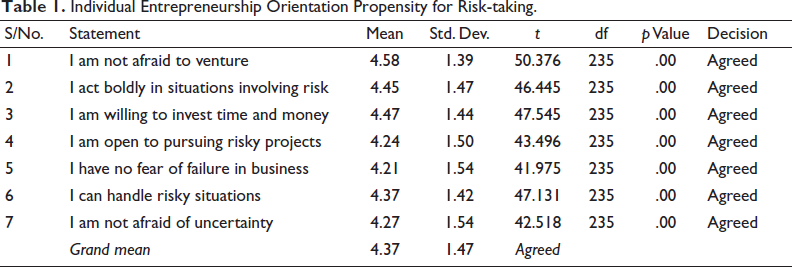
Tables 1–4 present the descriptive statistics from the data analysis.
Individual Entrepreneurship Orientation Propensity for Risk-taking.
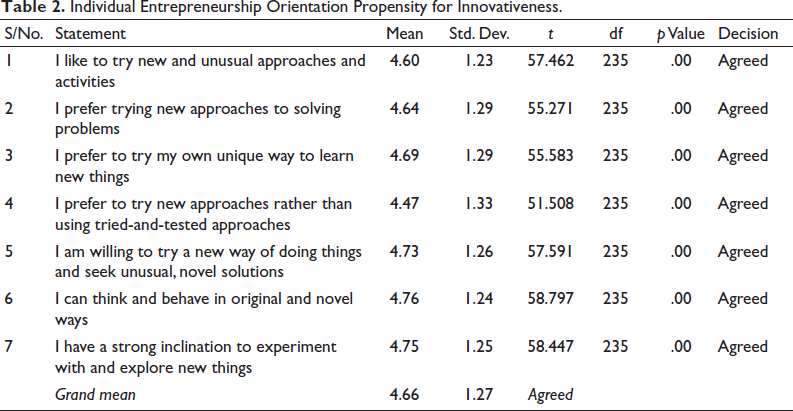
Individual Entrepreneurship Orientation Propensity for Innovativeness.
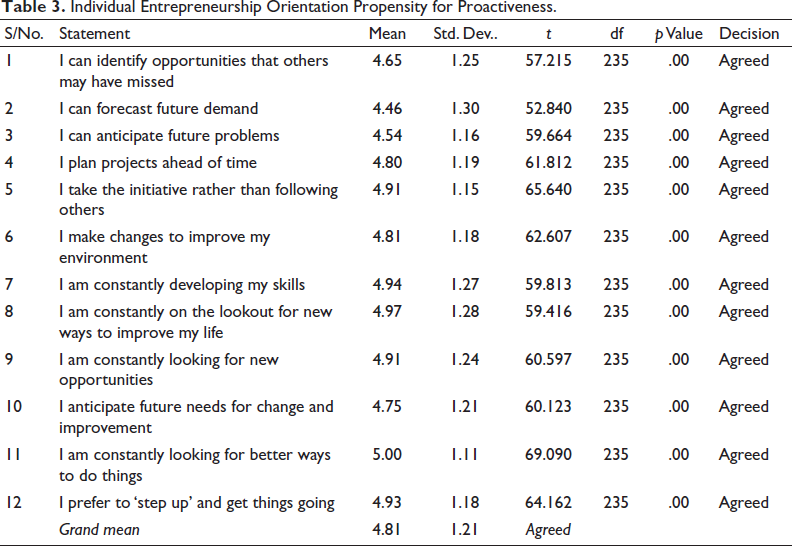
Individual Entrepreneurship Orientation Propensity for Proactiveness.
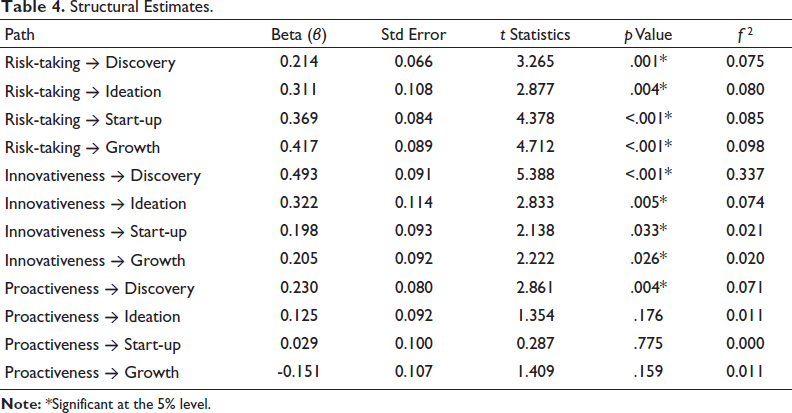
Structural Estimates.
The results presented in Table 1 indicate that participants agreed with all seven statements measuring the IEO propensity for risk-taking, which is defined as the willingness to act boldly and engage in SMMEs. As shown in Table 1, the mean rating for each item exceeded the benchmark value of 3.50, which represents the acceptance threshold on a six-point Likert-type scale (Hair et al., 2016; Kock, 2015). These findings indicate that respondents were not afraid to venture into unknown businesses (M = 4.58 > 3.50, t = 50.38, p < .05). Participants were all willing to act boldly in situations involving risk (M = 4.45 > 3.50, t = 46.45, p < .05), invest a significant amount of time and/or financial resources in opportunities with high profit potential (M = 4.47 > 3.50, t = 47.55, p < .05) and pursue risky projects (M = 4.24 > 3.50, t = 43.50, p < .05). In addition, respondents reported no fear of business failure (M = 4.21 > 3.50, t = 41.98, p < .05), expressed confidence in managing risky situations (M = 4.37 > 3.50, t = 47.13, p < .05) and reported comfort with future uncertainty (M = 4.27 > 3.50, t = 42.52, p < .05).
The overall mean and standard deviation for the risk-taking items were 4.37 and 1.47, respectively. These results reveal that respondents perceived individual risk-taking as a foundational element of entrepreneurship. This result is consistent with Musawa and Ahmad’s (2019) assertion that the propensity for risk-taking contributes significantly to SMME success. Van der Westhuizen (2023b) highlight the role of risk-taking in SMME development, noting that entrepreneurs realise and actualise their ideas through risk-taking.
Table 2 presents the responses to the items measuring the IEO propensity for innovativeness.
The analysis of data on the propensity for innovativeness, defined as an individual’s tendency to utilise creativity and experimentation when developing new ideas, as presented in Table 2, indicates that all participants agreed with the seven listed items. Respondents reported that they consistently enjoyed trying new and unusual ways of doing things (M = 4.60 > 3.50, t = 57.46, p < .05), preferred new approaches to solving problems (M = 4.64 > 3.50, t = 55.27, p < .05) and favoured developing unique ways of learning new things (M = 4.69 > 3.50, t = 55.58, p < .05). The participants also reported that they enjoyed experimenting with new approaches rather than relying on tried-and-tested methods (M = 4.47 > 3.50, t = 51.51, p < .05). Furthermore, respondents expressed a willingness to try new ways of doing things and to seek novel solutions to problems (M = 4.73 > 3.50, t = 57.59, p < .05), thereby indicating their ability to think and behave in novel ways (M = 4.76 > 3.50, t = 58.80, p < .05), and demonstrated a strong inclination to experiment with and explore new ideas (M = 4.75 > 3.50, t = 58.45, p < .05).
The overall mean and standard deviation of the responses were 4.66 and 1.27, respectively. Each item exceeded the benchmark mean of 3.50 used to indicate agreement on a six-point Likert-type scale (Hair et al., 2016; Kock, 2015). These findings confirm that the participants viewed the individual tendency to introduce new and unique approaches as essential for creating positive change in the business world and for achieving SMME success. This finding supports the view that transforming ideas into action is an effective strategy for generating new services and business opportunities (Nyamunda & van der Westhuizen, 2018; Wang & Hu, 2020). This result also aligns with that of Müller et al. (2021), who maintain that innovativeness involves exploiting ideas to create new services and business opportunities.
Table 3 presents the analysis of the data on the IEO propensity for proactiveness.
The results presented in Table 3 from the analysis of the data on the IEO propensity for proactiveness, which denotes a forward-looking perspective, show that participants agreed with all 12 items in the questionnaire. The mean rating of each item exceeded the 3.50 benchmark, following the criteria of Hair et al. (2016) and Kock (2015) for accepting a statement measured using a six-point Likert-type scale. Thus, all respondents agreed that they could identify opportunities when they saw them (M = 4.65 > 3.50, t = 57.22, p < .05), forecast future demand in their businesses (M = 4.46 > 3.50, t = 52.84, p < .05), anticipate future problems (M = 4.54 > 3.50, t = 59.66, p < .05), plan for their projects (M = 4.80 > 3.50, t = 61.81, p < .05), take the initiative (M = 4.91 > 3.50, t = 65.64, p < .05) and make changes to improve their environment (M = 4.81 > 3.50, t = 62.61, p < .05).
Participants also reported that they were constantly developing their skills (M = 4.94 > 3.50, t = 59.81, p < .05), were on the lookout for new ways to improve their lives (M = 4.97 > 3.50, t = 59.42, p < .05) and actively sought new opportunities (M = 4.91 > 3.50, t = 60.60, p < .05). Furthermore, the results indicated that participants anticipated future needs for change and improvement (M = 4.75 > 3.50, t = 60.12, p < .05), looked for better ways to do things, and preferred to step up and get things going (M = 4.93 > 3.50, t = 64.16, p < .05). The mean and standard deviation of the items listed in the table were 4.81 and 1.21, respectively.
The results indicate that a tendency to think ahead, strategise and act in advance to address or cope with changing business trends leads to the discovery, idea generation, start-up and growth of SMMEs (Zhang et al., 2021). These findings align with those of Zhao and Smallbone (2019), who argue that proactiveness influences the orientation of prospective entrepreneurs towards being action-oriented individuals who drive change in their environment by viewing future contingencies as opportunities.
Structural Model for Individual Entrepreneurial Orientation Propensities as Drivers of Small, Medium and Micro Enterprises
The study assessed the structural model according to the guidelines developed by Hair et al. (2016) and reported the coefficient of determination (R²), the path coefficients (beta), corresponding t-values and their significance tests. In addition to using R² to evaluate the structural model, the analysis reported the effect sizes (f²) and predictive relevance (Q²). Based on the blindfolding procedure, Q² indicates how well the model and PLS parameters can empirically reconstruct the data (Chin et al., 2008). Table 4 presents the construct estimates, and Figure 1 illustrates the measurement and structural model path coefficients.
The Measurement and Structural Model Path Coefficients.
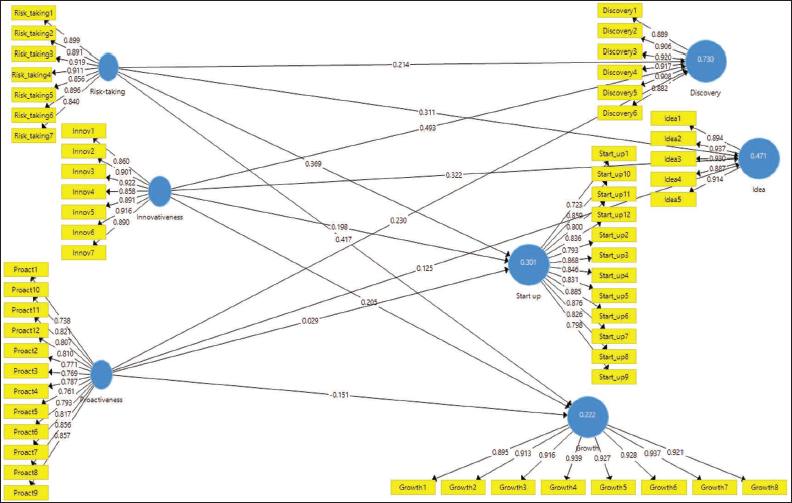
Figure 1 presents the structural model path significance at the 5% level of significance (p < .05). The path coefficient of the propensity for innovativeness reveals a positive and significant relationship with the discovery (β = 0.493, p ≤ .001), idea (β = 0.322, p = .005), start-up (β = 0.198, p = .033) and growth (β = 0.205, p = .026) of SMMEs. A positive relationship also emerges between the path coefficient of the propensity for risk-taking and the discovery (β = 0.214, p = .001), ideation (β = 0.311, p = .004), start-up (β = 0.369, p ≤ .001) and growth (β = 0.417, p ≤ .001) of SMMEs. The study reveals a relationship between the propensity for proactiveness and the discovery of SMMEs (β = 0.230, p = .004). However, the results show no substantial relationship between the path coefficient of the propensity for proactiveness and the ideation (β = 0.125, p = .176), start-up (β = 0.029, p = .775) and growth (β = –0.151, p = .159) of SMMEs.
Regarding variable significance, the propensity for innovativeness had the most substantial effect on the discovery of SMMEs (0.493), followed by the predisposition for proactiveness (0.230) and risk-taking (0.214). In addition, innovativeness had a significant effect (0.322) on the ideation of SMMEs. Risk-taking exerted a notable influence on the start-up of SMMEs (0.369). Regarding the predictive power of the structural model, the discovery of SMMEs explains 73% of the variance in the model (R² = 0.73). Growth explains 22.2% of the variance (R² = 0.222), ideation explains 47.1% (R² = 0.471) and start-up explains 30.1% (R² = 0.301). The R² values, except for growth, were higher than the 0.26 threshold suggested by Cohen (1988) as indicative of a substantial model. Based on its R² value, the growth model was considered moderate.
The study assessed the effect sizes (f²) using Cohen’s (1988) guidelines. The results reveal that all relationships exhibited a small effect, except for the propensity for innovativeness on the discovery of SMMEs. The research assessed the predictive ability (Q²) using cross-validated redundancy procedures. A positive Q² value indicates that a model has predictive relevance, whereas a negative Q² value suggests a lack of predictive relevance. As shown in Figure 1, the Q² values for all dependent variables indicate acceptable predictive relevance.
Discussion
The findings of this study reveal nuanced relationships among IEO propensities and the stages of SMME development in South Africa’s emerging economy context. The structural equation modelling results demonstrate that innovativeness is the strongest predictor of SMME discovery (β = 0.493, p < .001), substantially outweighing proactiveness (β = 0.230, p < .05) and risk-taking (β = 0.214, p < .05). This pattern suggests that, in resource-constrained emerging economies, the capacity to generate novel solutions and identify creative opportunities serves as the primary catalyst for entrepreneurial discovery. The prominence of innovativeness aligns with contemporary entrepreneurship theory, which emphasises that opportunity recognition in challenging environments requires cognitive flexibility and the ability to perceive value where others see only obstacles.
The sustained significance of risk-taking across all SMME stages, from discovery (β = 0.214) through idea development (β = 0.311), start-up (β = 0.329) and growth (β = 0.417), highlights its function as a cross-stage enabler rather than a stage-specific driver. This progressive strengthening of risk-taking’s effect as ventures mature contradicts simplistic assumptions that risk propensity matters most at inception. Instead, the findings suggest that as SMMEs navigate increasingly complex operational challenges, the willingness to accept uncertainty and commit resources to unproven strategies becomes progressively more critical. This interpretation resonates with scholarship on entrepreneurial resilience in emerging markets, where environmental volatility necessitates continuous risk calibration (Lumpkin & Dess, 1996).
Perhaps the most theoretically intriguing finding concerns the limited influence of proactiveness beyond the discovery stage. Although proactiveness significantly affects initial opportunity discovery (β = 0.230, p < .05), it shows no statistically significant relationship with idea development, start-up or growth. This unexpected pattern warrants careful theoretical consideration. Proactiveness, defined as forward-looking and opportunity-seeking behaviour, may be necessary but insufficient for venture progression in emerging economy contexts. One plausible explanation lies in the competency gap between recognising opportunities and successfully implementing them. South African entrepreneurs may exhibit proactive tendencies in identifying market gaps, and they may lack complementary capabilities, such as financial literacy, network access and technical skills, required to translate foresight into operational reality.
Alternatively, the limited effect of proactiveness may reflect contextual boundaries within South Africa’s institutional environment. Proactive behaviour assumes a degree of environmental malleability and responsiveness that may not characterise emerging economies, which may experience institutional voids, regulatory unpredictability and resource scarcity. When external constraints severely limit entrepreneurs’ capacity to shape their competitive environment, proactive orientation may yield diminishing returns relative to adaptive capabilities such as innovativeness and risk tolerance.
The declining explanatory power across SMME stages, from 73.0% variance explained at discovery to 22.2% at growth, provides crucial insight into the shifting determinants of entrepreneurial success. Individual-level IEO propensities appear to exert their most significant influence during the cognitive and pre-operational phases of entrepreneurship, whilst external factors, market conditions, competitive dynamics, institutional support and resource availability, increasingly dominate as ventures mature. This pattern supports theoretical frameworks that posit that entrepreneurial success results from the interaction between individual characteristics and environmental conditions, with the relative weight of each factor varying systematically across the venture lifecycle.
Contextualising these findings within South Africa’s entrepreneurial ecosystem highlights their practical significance. The GEM reports that 53% of South Africans who perceive entrepreneurial opportunities nevertheless refrain from starting businesses due to fear of failure (Herrington & Coduras, 2019). This statistic emphasises the importance of risk-taking propensity, not merely as an individual trait but as a socially constructed orientation shaped by cultural norms, educational experiences and institutional support structures. Similarly, South Africa’s relatively low innovation index ranking suggests systemic deficits in cultivating the innovative mindset that this study identifies as central to entrepreneurial discovery.
Comparing these results with studies from other emerging economies reveals convergence and divergence. Research in Nigeria, Kenya and West Africa similarly identifies innovativeness as a primary driver of entrepreneurial activity (Galadanchi & Alkali, 2023; Musara & Nieuwenhuizen, 2020; Pulka et al., 2019), yet contexts with more developed entrepreneurial ecosystems demonstrate more substantial effects for proactiveness. The relatively weaker role of proactiveness in this South African sample may thus reflect not individual deficiency but rather institutional underdevelopment that constrains the returns to forward-looking behaviour.
From a theoretical perspective, these findings contribute to ongoing debates about the dimensionality and context-dependence of EO. The differential effects of IEO dimensions across venture stages challenge unidimensional conceptualisations of EO and support calls for disaggregated, contingency-based models (Van der Westhuizen, 2023b). Moreover, the declining explanatory power of individual-level factors as ventures mature suggests that entrepreneurship theory must more explicitly incorporate stage-contingent frameworks that recognise the evolving balance between individual agency and environmental determinism. The integration of personality theory and human capital theory provides a robust explanatory framework for understanding these patterns, explaining how relatively stable individual dispositions shape entrepreneurial cognition while highlighting how knowledge, skills and experience moderate the translation of dispositional tendencies into entrepreneurial outcomes.
Theoretical Contributions
The primary scholarly contribution of this study lies in its empirical demonstration that IEO dimensions exert differential influence across entrepreneurial development stages—a finding that challenges unidimensional conceptualisations of EO and advances contingency-based, multidimensional frameworks (Van der Westhuizen, 2023a). Specifically, innovativeness dominates the discovery stage, risk-taking strengthens progressively across all stages and proactiveness shows limited effects beyond initial opportunity identification. This stage-differentiated pattern constitutes a distinctive theoretical advance over prior studies that have examined IEO–SMME performance associations without disaggregating them by venture stage. The theoretical integration of personality theory (Cervone & Pervin, 2015; Littunen, 2000) and human capital theory (Mabaso & Ontong, 2025; Prasetyo & Kistanti, 2020) positions IEO as a hybrid construct: dispositional in origin yet acquired and malleable through education and experience. This synthesis resolves the ontological ambiguity of IEO and provides a more generative theoretical architecture for future research.
The theoretical integration of personality theory (Cervone & Pervin, 2015; Littunen, 2000) and human capital theory (Prasetyo & Kistanti, 2020) demonstrates that although individual propensities provide motivational foundations for entrepreneurial action, their effectiveness depends critically on complementary capabilities and supportive environmental conditions. The competency gap implied by the limited effect of proactiveness beyond discovery illustrates this integration, suggesting that dispositional orientation without corresponding implementation capability produces frustrated intention rather than successful ventures.
Policy Implications
Educational Reform
The identification of innovativeness as the primary driver of entrepreneurial discovery suggests that educational policy must prioritise creativity, problem-solving and opportunity recognition. South African institutions should restructure curricula to emphasise experiential learning, design thinking and real-world problem-solving through project-based learning, in which students identify authentic community problems and develop innovative solutions.
Addressing South Africa’s pronounced fear of failure requires targeted interventions that normalise entrepreneurial risk-taking and reframe failure as a learning opportunity. Policymakers should implement national campaigns that celebrate entrepreneurial resilience, while educational institutions should create safe spaces for low-stakes entrepreneurial experimentation.
Stage-differentiated Small, Medium and Micro Enterprise Support
Support programmes should adopt differentiated strategies rather than one-size-fits-all approaches. During the discovery and idea stages, interventions should focus on enhancing innovative thinking through ideation workshops and mentorship. As ventures progress, support should shift towards risk management training, financial planning and strategic decision-making. Incubators and accelerators should design programmes that explicitly map support activities to developmental stages.
The limited effect of proactiveness beyond discovery indicates critical competency gaps. SMME support programmes must integrate skills development, including financial literacy, marketing capabilities, operational management and technology adoption, with motivational interventions. The most effective models combine capability-building with mentorship from experienced entrepreneurs who provide technical guidance and psychological support.
Institutional Framework Strengthening
The declining explanatory power of individual-level factors as ventures mature implies that environmental conditions increasingly determine entrepreneurial outcomes. Policymakers must address institutional voids that constrain SMME development, including access to finance, regulatory complexity, infrastructure deficits and market access barriers through streamlined business registration, dedicated SMME financing facilities, infrastructure development and favourable public procurement policies.
Limitations
Several limitations shape the interpretation of the findings. A primary limitation concerns the sampling strategy: the study drew data from a single conference in KZN Province, and the sample was overwhelmingly female (95.3%). This limitation introduces selection bias and demographic imbalance, which the study explicitly acknowledges. Accordingly, the findings are specific to the sampled entrepreneurial population, female SMME owners in KZN, and cannot be generalised to South Africa as a whole or to emerging economies more broadly. Future studies should employ more geographically and demographically diverse sampling strategies, ideally across multiple provinces and sectors, to enhance the representativeness and transferability of findings.
The cross-sectional design precludes causal inference, as observed relationships may reflect selection effects rather than causal impacts. Reliance on self-reported data introduces potential bias, although statistical tests suggest that this does not severely compromise findings. Furthermore, the operationalisation of SMME development stages relies on perceptual self-assessment rather than objective performance metrics such as revenue growth, employment size or venture survival duration. Although perceptual measures are widely used in entrepreneurship research and have been validated as proxies for venture performance (Fatima & Bilal, 2019; Wang & Hu, 2020), they are susceptible to self-enhancement bias. The use of subjective stage assessment in this study reflects the exploratory nature of the research and the difficulty of obtaining objective financial data from owner-managed SMMEs in emerging economies. Future research should triangulate these perceptual assessments with objective performance indicators to enhance criterion validity. Convenience sampling may also limit representativeness, as it likely over-represents established SMMEs while under-representing informal sector entrepreneurs.
Contextually, the study’s focus on South Africa limits generalisability to other emerging economies with different institutional configurations. The measurement of IEO through three dimensions excludes autonomy and competitive aggressiveness, which some scholars consider integral to the success of SMMEs. Additionally, the study does not explore how IEO propensities interact with other individual characteristics, such as entrepreneurial self-efficacy, prior experience or social capital in the SMME context.
Practical Implications for Entrepreneurs and Future Research Directions
Aspiring entrepreneurs should deliberately cultivate creative thinking through diverse experiences and systematic practice in problem identification and solution generation using techniques such as design thinking and lateral thinking. Understanding the progressive importance of risk-taking suggests that entrepreneurs should develop sophisticated risk assessment and management capabilities rather than merely exhibiting high risk tolerance. The limited effect of proactiveness beyond discovery implies that entrepreneurs should complement their forward-looking orientation with formal capability development in financial management, marketing, operations and human resource management.
Longitudinal designs tracking cohorts of aspiring entrepreneurs would enable causal inference and reveal developmental trajectories. Investigating moderating factors, including educational background, gender, age, industry sector, access to finance and ecosystem maturity, would help specify conditions under which IEO propensities exert stronger or weaker effects. Mixed-methods research combining quantitative analysis with qualitative case studies would provide richer insights into how entrepreneurs enact IEO propensities in practice. Intervention research that evaluates programmes designed to enhance IEO propensities would provide evidence regarding trait malleability and the effectiveness of educational interventions.
Conclusion
This study provides empirical evidence that IEO propensities, particularly innovativeness and risk-taking, influence the development of SMMEs among entrepreneurs in South Africa. However, their relative importance varies across developmental stages. Although individual propensities provide motivational foundations for entrepreneurship, their effectiveness depends on complementary capabilities and supportive environmental conditions.
The research provides clear direction for educational reform that emphasises creativity and problem-solving, identifies innovativeness as the primary driver of entrepreneurial discovery, reveals the persistent importance of risk-taking across all stages and exposes critical competency gaps that require integrated capability-building interventions. Entrepreneurship represents not merely an economic activity but a complex interplay of individual disposition, developed capabilities and environmental opportunities. Enhancing SMME development in emerging economies requires coordinated interventions that address all three dimensions: cultivating appropriate entrepreneurial propensities through education, building complementary capabilities through training and support, and creating enabling institutional environments through policy reform. This study provides an evidence-based foundation for designing such interventions in South Africa and similar emerging economy contexts.
Footnotes
Declaration of Conflicting Interests
The authors declared no potential conflicts of interest with respect to the research, authorship and/or publication of this article.
Funding
The author(s) disclosed receipt of the following financial support for the research, authorship, and/or publication of this article: This research was supported by the South African National Research Foundation SASAC Grant.
