






Abstract
This study examines the evolution of entrepreneurship education (EE) and entrepreneurial intention (EI) research within Southern Africa through an egocentric co-authorship network analysis centred on the scholarly collaborations of Professor Chux Gervase Iwu between 2014 and 2025. Drawing on publications retrieved from Scopus and Google Scholar, the study analyses the development of themes, collaboration patterns, theoretical orientations and methodological tendencies within a regional entrepreneurship research network. The findings indicate that the network’s scholarship evolved from foundational concerns about integrating entrepreneurship curriculum to broader themes of experiential learning, digital entrepreneurship, contextualised pedagogy and inclusion in EE. The analysis further reveals a strong reliance on the Theory of Planned Behaviour and self-efficacy frameworks to explain EI, alongside growing calls for African-centred and practice-oriented EE models. At the same time, the study identifies several persistent limitations in the reviewed scholarship, including a methodological focus on cross-sectional, student-based studies, limited ecosystem-level analysis and insufficient longitudinal evidence on entrepreneurial outcomes. The study contributes to entrepreneurship scholarship by demonstrating how egocentric co-authorship network analysis can be used to examine the thematic evolution and knowledge structure of regional entrepreneurship research communities in Africa. The findings further highlight the importance of context-sensitive EE frameworks and provide directions for future research on African entrepreneurship.
Keywords
Introduction
Global entrepreneurship research is arguably maturing to the point where mapping regional and geographic patterns is now possible. In fact, Sternberg (2009) observed that, while the regional perspective has long been ignored by entrepreneurship research, the situation is changing as researchers have become more focused on the regional causes and consequences of entrepreneurial activities within the broader globalisation and regionalisation discourse. Thus, several scholars and institutional entities, such as government, civil society and the private sector, have contributed towards producing what is known about various aspects of entrepreneurship. For example, methodologies such as the Global Entrepreneurship Monitor (GEM) provide extensive data on entrepreneurial activity across several countries, helping researchers and governments gain insight into evolving entrepreneurial patterns, including the development of entrepreneurial intention (EI) (
To address the inherent anonymity of entrepreneurship trends, this study adopts an egocentric single-author network trace analysis approach to provide insights into the development of EE and EI research in Africa. Several studies have similarly adopted this approach to analyse authors’ social network connections and research influence within a particular field. For example, Hara et al. (2017) used an egocentric analysis to investigate the professional networks and productivity of graduate students and faculty in the life sciences in Japan, Singapore and Taiwan. Similarly, Ortega (2014) explored the influence of co-authorship networks on research impact using a similar method. Tracing a single author’s networked works provides a convenient entry point to a topic that attracted varied attention, such as entrepreneurship. It is argued that, by coalescing the analysis into a single-author network, this article presents a consolidated view of the theoretical and empirical body of knowledge on EE and EI emerging from Southern Africa, from a specific network of authors. In that regard, it provides a snapshot of the history of EE and research on EI in Southern Africa by consolidating the contributions of over 20 authors, who, together with Iwu, explore key International Entrepreneurship Forum (IEF) themes. These themes include policies and instruments for entrepreneurial learning and education, the role of technology in shaping the evolution of EE and the application of AI as an entrepreneurial technology, among others. Broadly, this article is timely in considering the ever-increasing body of entrepreneurship studies from the African continent and its growing role as a social, economic and political intervention to address poverty, unemployment, youth despondency and stagnating economic growth facing many African economies.
Despite the growing body of research on EE and EI in Africa, limited attention has been given to how knowledge in this field is structured and developed within regional scholarly networks. Existing studies tend to focus on individual empirical findings or on broad literature reviews, with little emphasis on collaboration patterns and the evolution of themes over time. This study addresses this gap by applying an egocentric co-authorship network analysis to examine the development of EE and EI research within a Southern African scholarly cluster. By focusing on a defined academic network, the study provides insights into how research themes emerge, how collaborations shape knowledge production and how regional scholarship contributes to broader entrepreneurship discourse.
Literature Gap
Although EE and EI research have expanded considerably over the past two decades, much of the global literature has focused on identifying the determinants of EI, evaluating entrepreneurship curricula and examining the effectiveness of EE interventions (Fayolle, 2013; Kuratko, 2005; Mwasalwiba, 2010) in non-African contexts. Other studies have examined psychological predictors such as self-efficacy, attitudes, subjective norms and perceived behavioural control, with the Theory of Planned Behaviour (TPB) as a dominant theoretical framework in EI research (Ajzen, 1991; Schlaegel & Koenig, 2014). While these studies have generated important insights into entrepreneurial behaviour globally, they hardly narrate how entrepreneurship knowledge itself evolves through regional scholarly collaborations and academic research networks in Africa.
Incidentally, entrepreneurship research in Africa continues to expand in response to persistent socio-economic challenges, including unemployment, poverty, inequality and limited formal employment opportunities (Ratten, 2020) and the potency of EE as a developmental intervention that can foster entrepreneurial capabilities and promote economic participation among youth (Ajani et al., 2023; Rashid, 2019). Thus, studies across Southern Africa increasingly examine the relationship between EE and EI among university students (Mwiya et al., 2017; Neneh, 2019; Puni et al., 2018). However, this literature remains fragmented, with few studies systematically tracing how regional scholarly communities shape the evolution of EE and EI discourse over time. In fact, limited attention has been given to scholarly collaboration structures, thematic evolution and knowledge production processes within African entrepreneurship research networks, as the field of research continues to grow. Consequently, there remains insufficient understanding of how regional academic collaborations influence theoretical development, research priorities and pedagogical directions within EE and EI scholarship in Southern Africa.
This study addresses this gap by applying an egocentric co-authorship network analysis to examine the development of EE and EI research within a Southern African scholarly network centred on Professor Chux Gervase Iwu, an SBDG Chair in Entrepreneurship at the University of the Western Cape, South Africa and his collaborators between 2014 and 2025. The study does not position a single scholar (Professor Chux Gervase Iwu) as representative of all African entrepreneurship scholarship. Rather, the selected scholarly network is treated as a bounded analytical case through which patterns of collaboration, thematic development, theoretical orientation and methodological tendencies can be examined longitudinally in the Southern Africa regional context. Thus, using this traceable scholarly cluster, the study provides insight into how entrepreneurship knowledge is produced, consolidated and contextualised within Southern Africa.
Additionally, this study is important as it demonstrates the value of egocentric co-authorship network analysis as a methodological approach for examining regional entrepreneurship scholarship. It is also critical to note that fewer studies have examined how single, clustered academic networks themselves shape entrepreneurship discourse in Africa, suggesting that this study can provide foundational direction for further research in this area. Importantly, this article extends existing EE and EI scholarship by integrating thematic analysis with network-based examination of scholarly collaboration patterns, thereby offering a more structured understanding of the intellectual development of EE research in Southern Africa.
Methodology
Research Design
This study adopts a qualitative bibliometric review approach, utilising an egocentric co-authorship network analysis method to examine the evolution of EE and EI scholarship within a Southern African academic network. As Abbasi et al. (2011) and Xu and Chang (2020) explain, egocentric network analysis involves analysing a central actor (ego) and the relationships established with connected collaborators (alters), enabling the examination of central actors’ scholarly influence towards thematic development and knowledge diffusion within a bounded research community. In this study, Professor Chux Gervase Iwu serves as the ego node through which patterns of collaboration and thematic evolution of EE and EI concepts in Southern Africa are examined between 2014 and 2025. In practice, the time span covered leans the study towards a longitudinal analytical approach. It is stated that longitudinal analysis examines samples at a single time scale (Hopwood et al., 2022), as defined in this study to trace the development of EE and EI scholarship within Professor Chux’s scholarly network. Importantly, rather than seeking continental generalisation, the study methodology prioritises contextual depth and analytical specificity by focusing on a traceable regional collaboration cluster. This approach enables the examination of how entrepreneurship knowledge has evolved within Southern Africa in response to regional socio-economic realities, educational reforms and shifting entrepreneurship discourses.
Data Sources and Search Strategy
The data for the study were retrieved from Google Scholar and Scopus databases. These databases were selected for their improved coverage of African entrepreneurship, education and social science studies (Kanyika & Kim, 2026). The search strategy targeted the retrieval of relevant self- and co-authored publications by Professor Chux Gervase Iwu on EE and EI published between 2014 and 2025. The following keyword search combinations associated with EE, EI and co-authorship were utilised:
‘entrepreneurship education’ AND ‘entrepreneurial intention’ ‘entrepreneurship education’ AND ‘Iwu’ ‘entrepreneurial intention’ AND ‘Southern Africa’ ‘Chux Gervase Iwu’ AND ‘entrepreneurship’ ‘entrepreneurship education’ AND ‘Africa’
Additional manual searches were conducted by perusing Professor Chux’s Google Scholar profile (
Inclusion and Exclusion Criteria
The inclusion criteria used to select studies qualified publications from Professor Chux’s network that were peer-reviewed journal articles, scholarly book chapters, edited book contributions, empirical and conceptual studies, publications directly addressing EE or EI and studies published between 2014 and 2025. Thus, the study excluded conference abstracts, non-scholarly opinion articles, duplicate records, publications unrelated to EE or EI and studies lacking sufficient bibliographic information from this network cohort. These search restrictions aimed to produce a publications list with closer thematic relevance to EE, EI, entrepreneurial pedagogy, curriculum design, entrepreneurial ecosystems (EES) or entrepreneurship-related educational interventions within Southern Africa.
Screening and Sample Selection
After the search, publications were screened. The screening process involved removing duplicates and a preliminary relevance assessment. Thereafter, the authors conducted a title review, an abstract assessment, a thematic relevance evaluation and a full-text examination to ensure alignment with the study objectives, resulting in a final sample comprising publications directly related to EE and EI. This final data set included quantitative, qualitative, mixed-methods, conceptual and review-based studies published between 2014 and 2025. These studies collectively provided the empirical and theoretical basis for analysing the network’s thematic evolution, collaboration structures and methodological tendencies.
Network Construction and Analysis
The study constructed an egocentric co-authorship network of Professor Chux Gervase Iwu’s publications. Ties within the network structure were traced through co-authorship relationships across identified publications, facilitating the identification of recurring collaborations, thematic clusters and patterns of scholarly interaction within this regional entrepreneurship research community. As done in previous co-authorship network studies (Abbasi et al., 2011; Xu & Chang, 2020), the analysis examined indicators such as collaboration frequency, thematic clustering, continuity of scholarly partnerships and longitudinal publication patterns. Thematic content analysis was then applied to identify dominant research themes, theoretical orientations and evolving research priorities across the network. These themes were inductively derived from publication objectives, findings, methodological approaches and conceptual discussions across the reviewed studies.
Data Analysis and Visualisation
The analysed publications were categorised according to:
publication year, thematic orientation, methodological approach, theoretical framework and key findings.
This enabled the identification of shifts in EE and EI scholarship over time, particularly regarding experiential learning, Africanisation of EE, digital entrepreneurship, gender inclusion and entrepreneurial self-efficacy.
The network findings were presented through descriptive thematic mapping and visualisation of publication trends. Figures illustrating publication frequency and thematic concentrations were used to support the interpretation of longitudinal developments within the scholarly network. The integration of network analysis and thematic synthesis enabled the study to move beyond a traditional literature review by examining both the intellectual content and collaborative structure underpinning EE scholarship in Southern Africa.
Thematic Concentrations
It is evident that between 2014 and 2025, studies conducted by Iwu and colleagues (Gwija et al., 2014; Tengeh et al., 2015) initially identified gaps in EE within South African institutions. Similar to the work of Dzomonda and Fatoki (2019), these studies raised pertinent questions regarding the role of educational institutions in fostering students’ entrepreneurial capabilities and skills. From 2019 onwards, research efforts shifted towards the integration of curriculum design and digital tools (Iwu & Opute, 2021; Udekwe & Iwu, 2024), reflecting a broader global emphasis on EE practices. These thematic areas, as studied by African scholars, stand in contrast to Sternberg’s (2022) claims, suggesting that EES have been the predominant topic within entrepreneurship discourse. Sternberg’s observations also conflict with the findings of a systematic literature review conducted by Kansheba and Wald (2020), which indicates that there remains a significant need for empirical investigations into EES in Africa, given the comparatively low research output relative to Europe and the USA. Consequently, issues related to ecosystems are under-researched on the continent, partly due to limited scholarly attention (Sheriff & Muffatto, 2015), though other scholars (Abdulai & Hussain, 2023) suggest otherwise. Nonetheless, (Sheriff & Muffatto, 2015) contend there appears to be widespread acknowledgement that systemic challenges hinder the development of EES in Africa. This process is expected to take time, making it a lower immediate priority amid the continent’s nascent efforts to formalise entrepreneurship as a recognised career path. Therefore, it is argued that the immediate priorities for Africa include legitimising entrepreneurship as a viable career option (Dzomonda & Fatoki, 2019; Makwara et al., 2022), fostering entrepreneurial interest among youth and establishing formal institutional infrastructures for EE.
It follows that these consolidated works by African scholars within the educational institutional domain constitute contributions to a global movement that positions entrepreneurship as a teachable subject (Kuratko, 2005; Mwasalwiba, 2010). This movement seeks pragmatic, localised frameworks and pedagogical approaches (Fayolle, 2013; Mwasalwiba, 2010), which are more embedded in entrepreneurial practice and implemented by capable educators (Motsoeneng et al., 2021; Otache, 2019). These educators are increasingly able to incorporate AI technology into their teaching methodologies (Mu & Zhao, 2024; Rashid, 2019) and promote initiatives concerning gender equality, female entrepreneurship and societal inclusivity (de Bruin & Swail, 2025; Henry et al., 2024). A systematic review of the literature conducted by Rashid (2019) provides evidence of the convergence of EE courses and programmes for university students (78%), at the school level (13%) and within vocational training institutions (3%). However, there appears to be less emphasis on unemployed individuals and those already managing their own businesses outside of academic institutions.
This development is crucial in establishing the intersectionality of entrepreneurship with the broader Africa Agenda 2063 and the Sustainable Development Goals 2015. Rashid (2019) asserts that EE has direct effects on poverty alleviation (SDG 1), economic development and unemployment reduction (SDG 8), enhancement of infrastructure and innovation (SDG 9), social equality and inclusion (SDGs 5 and 10) and sustainable production and consumption (SDG 12). The evolving thematic directions have yielded significant findings that inform current knowledge of EE and EI in Africa.
Results
Publication Trends and Network Development
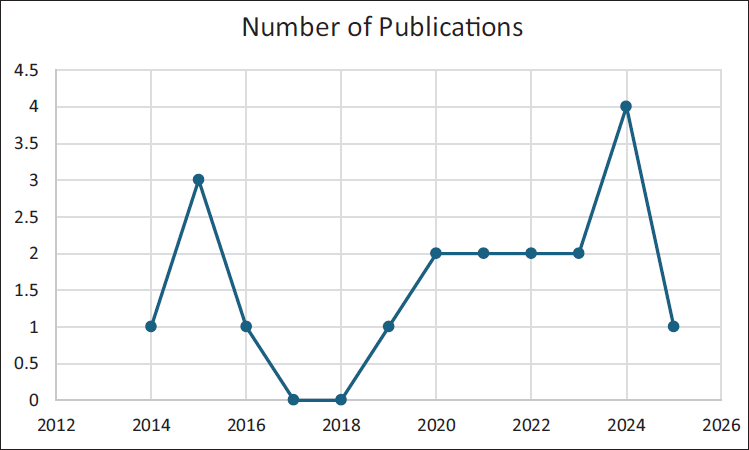
The reviewed publications demonstrate a gradual expansion of scholarship on EE and EI within the examined Southern African scholarly network between 2014 and 2025. As illustrated in Figure 1, publication activity was initially limited between 2014 and 2018, with research concentrating primarily on foundational questions concerning the relevance of EE within higher education institutions. During this early phase, studies focused on integrating EE into university curricula, the role of entrepreneurship in youth empowerment and institutional preparedness to deliver EE (Gwija et al., 2014; Tengeh et al., 2015).
Number of Publications by Year.
Selected Works (2014–2025): Entrepreneurship Education and Entrepreneurial Intention
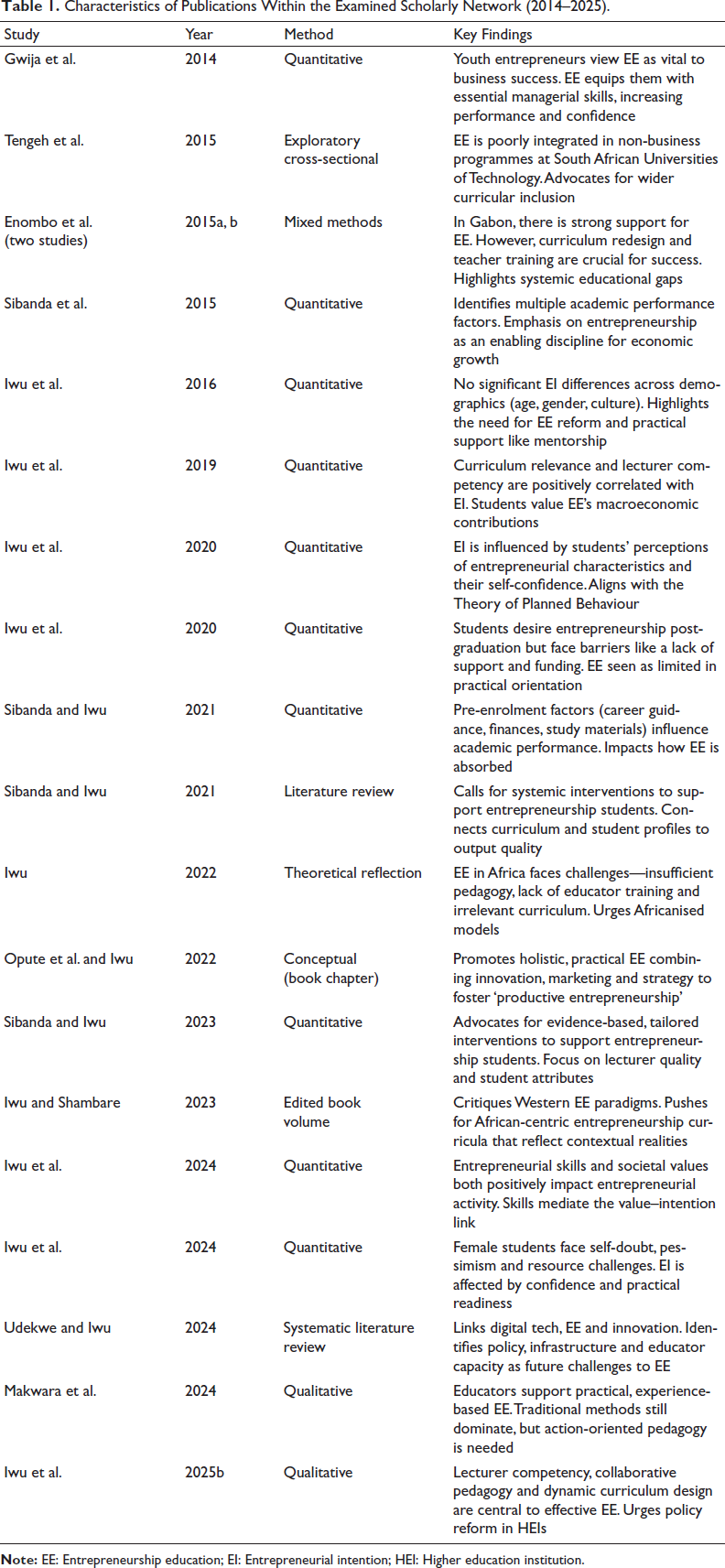
As illustrated in Figure 1, publication activity increased more consistently from 2019 onwards, reflecting the growing institutionalisation of entrepreneurship research within the network. This period also reveals increased collaboration among scholars in Professor Chux Gervase Iwu’s network in South Africa and other Southern African contexts (see Table 1). The growth in publication output suggests the emergence of a more consolidated research cluster focusing on EE as a developmental and policy-oriented intervention. The continuity of collaborations across multiple studies further indicates sustained scholarly relationships rather than isolated publication activity.
Characteristics of Publications Within the Examined Scholarly Network (2014–2025).
Additionally, the network analysis reveals an expansion of the research scope between 2014 and 2025. Earlier publications focused primarily on entrepreneurship awareness and curriculum inclusion (Enombo et al., 2015b; Tengeh et al., 2015), whereas later studies increasingly addressed pedagogical effectiveness, experiential learning, digital entrepreneurship, societal values and EES (Iwu & Opute, 2021; Udekwe & Iwu, 2024). This shift suggests an expanding conceptualisation of EE beyond narrow business training toward broader developmental and socio-economic concerns.
Thematic Evolution of Entrepreneurship Education and Entrepreneurial Intention Research
Thematic analysis of the reviewed studies indicates that EE and EI scholarship within the network evolved through several identifiable phases.
Figure 2 illustrates the progression of dominant thematic concentrations between 2014 and 2025, with the first phase (2014–2016) centred on the legitimacy and institutionalisation of EE within higher education systems. Studies during this period highlighted weak curricular integration, limited entrepreneurial exposure outside business faculties and insufficient institutional support for entrepreneurship development (Gwija et al., 2014; Tengeh et al., 2015). They also emphasised entrepreneurship as a response to youth unemployment and socio-economic exclusion.
Thematic Concentrations.
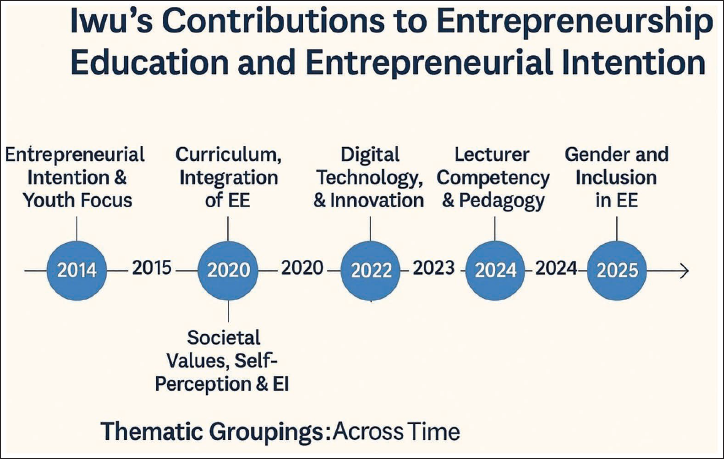
The second phase (2017–2020) increasingly focused on EI and its determinants among university students, examining factors such as entrepreneurial self-confidence, entrepreneurial attitudes, perceived behavioural control and curriculum relevance (Iwu et al., 2016; Iwu et al., 2020). These thematic developments shifted emphasis toward understanding how EE influences entrepreneurial aspirations and behavioural intentions in African university contexts.
From 2021 onwards (third thematic phase), the focus shifted to interrogating pedagogical quality, experiential learning, digital entrepreneurship and contextualised models of EE. Studies increasingly questioned the effectiveness of theory-driven entrepreneurship teaching approaches and advocated for experiential, practice-oriented and collaborative pedagogies (Iwu et al., 2025a; Machingambi & Iwu, 2025; Makwara et al., 2024). Related themes relating to digital technology integration, educator competency and EES also became more prominent (Udekwe & Iwu, 2024). Other studies also addressed concerns about inclusion, gender and contextual inequality in EE. Thus, research examining female EI, institutional barriers and sociocultural constraints suggests broadening the entrepreneurship discourse beyond curriculum delivery to address issues of equity, access and structural disadvantage (Ezeuduji et al., 2025; Iwu et al., 2024). Collectively, the thematic trajectory shows a gradual shift from foundational concerns in EE to more complex, context-sensitive research agendas.
Dominant Theoretical Frameworks
The analysis reveals a strong reliance on Ajzen’s TPB as the dominant theoretical framework underpinning EI research within the network. Several studies have applied TPB to explain the relationships among attitudes, subjective norms, perceived behavioural control and EI among students (Iwu et al., 2020; Mwiya et al., 2017; Neneh, 2019). The serial application of TPB across multiple studies suggests its continued relevance within Southern African entrepreneurship scholarship. It is also observed that studies frequently incorporate theoretical concepts of entrepreneurial self-efficacy, experiential learning and human capital development, particularly in studies examining pedagogical effectiveness and the development of entrepreneurship skills (Ajani et al., 2023; Makwara et al., 2024; Mlotshwa et al., 2025). Specifically, the emergence of experiential learning perspectives reinforces the recognition that effective EI formation through EE requires practical engagement and exposure to entrepreneurship practice in addition to theoretical instruction. However, notwithstanding the general acceptance of these theoretical premises, some studies challenge the direct transferability of Western entrepreneurship models to African contexts. They advocate for pedagogical frameworks that are contextually relevant and incorporate indigenous realities, socio-economic conditions and local entrepreneurial experiences (Iwu & Shambare, 2023), which models like Ajzen’s TPB may overlook. In that sense, the reviewed works demonstrate attempts to critique and theorise dominant theories from an African perspective in EE research. However, despite this shift toward contextualisation, the network’s scholarship remains theoretically concentrated around a relatively narrow range of dominant entrepreneurship theories.
Methodological Patterns Within the Scholarly Network
The analysis in Table 1 reveals a methodological concentration on quantitative research designs among the reviewed publications. These quantitative approaches were primarily used to examine relationships among EE, EI, self-efficacy and behavioural predictors (e.g., Gwija et al., 2014; Sibanda & Iwu, 2021). Also, most empirical studies relied on cross-sectional survey methods targeting university students within higher education institutions (Iwu et al., 2016; Iwu et al., 2021), while qualitative and mixed-methods studies appeared less frequently, but became more visible in later years. These studies focused on educator perspectives, curriculum delivery and pedagogical practices (Makwara et al., 2024).
Conceptual and review-based publications also increased over time, particularly regarding Africanisation debates, digital entrepreneurship and entrepreneurship pedagogy (Iwu & Shambare, 2023; Udekwe & Iwu, 2024). The methodological analysis additionally reveals several recurring limitations across the network. First, most studies relied exclusively on student samples within university environments, with limited engagement with entrepreneurs outside formal educational institutions. Second, most studies employed cross-sectional designs, limiting the ability to assess long-term entrepreneurial outcomes or transitions from intention to entrepreneurial behaviour. Third, there was relatively limited comparative analysis across Southern African countries, despite broader regional claims within some publications.
Emerging Gaps and Contradictions in the Literature
The network analysis reveals several unresolved tensions and research gaps within Southern African EE and EI scholarship. One recurring contradiction concerns the relationship between EE and actual entrepreneurial behaviour. While many studies report positive associations between EE and EI, Neneh and Dzomonda (2024) argue that evidence regarding the successful transition from intention to venture creation remains limited. Research findings also demonstrate persistent concerns regarding the dominance of theory-oriented entrepreneurship curricula in universities despite increasing advocacy for experiential and practice-based approaches. Thus, although multiple studies recommend practical entrepreneurial exposure, mentorship and incubation support, institutional implementation appears inconsistent across higher education contexts (Makwara et al., 2024; Ndlovu et al., 2025; Otache, 2019).
Another identifiable gap relates to entrepreneurship ecosystems and structural support mechanisms (Dlamini et al., 2022). While some studies acknowledge the influence of funding limitations, institutional inefficiencies and socio-economic barriers, ecosystem-level analysis remains comparatively underdeveloped within the network. Similarly, limited attention has been given to rural entrepreneurship, informal entrepreneurship and longitudinal entrepreneurial outcomes beyond student intention formation. Finally, the analysis indicates that although Africanisation discourse is becoming more visible within EE scholarship, much of the empirical work continues to rely on dominant Western theoretical frameworks and conventional EI models. This suggests an ongoing tension between contextual adaptation and theoretical dependence within Southern African entrepreneurship research.
Discussion
This study analysed the development of EE and EI research in Africa between 2014 and 2025 using an egocentric single-author network trace analysis, with Professor Chux Gervase Iwu as a central figure. Key findings demonstrate that EE and EI scholarship within the examined scholarly network in Southern Africa evolved from foundational concerns about curriculum integration to context-sensitive, practice-oriented entrepreneurship discourse in the defined time frame. Patterns show an earlier focus on legitimising EE in higher education institutions and positioning entrepreneurship as a response to unemployment and socio-economic exclusion. Later, the research trajectory expanded to experiential learning, digital entrepreneurship, entrepreneurial self-efficacy and African-centred pedagogical approaches. This evolution captures broader global shifts in EE research while simultaneously highlighting region-specific developmental priorities.
The analysis further reveals the continued dominance of the TPB in EI studies, particularly in explaining the relationships among attitudes, perceived behavioural control and entrepreneurial behaviour. While the repeated application of TPB demonstrates its analytical relevance within Southern African contexts, the findings also suggest limited theoretical diversification across the reviewed network. Much of the research remains focused on the formation of student intentions rather than on longitudinal entrepreneurial outcomes or ecosystem-level entrepreneurial development.
A significant contribution emerging from the reviewed scholarship is the increasing emphasis on contextualised and Africanised EE models. Several studies critique the direct transplantation of Western EE frameworks into African contexts and instead advocate for curricula that reflect local socio-economic realities, informality, resource constraints and indigenous entrepreneurial experiences. This reflects a growing recognition that EE in Africa requires contextual adaptation rather than universal pedagogical standardisation.
Despite these contributions, the findings reveal several persistent limitations within the network’s scholarship. Most studies rely heavily on cross-sectional quantitative designs and university student samples, limiting their generalisability to broader entrepreneurial populations. In addition, relatively limited attention has been given to rural entrepreneurship, informal EES and the long-term transition from EI to actual venture creation. These gaps suggest the need for greater methodological diversification, comparative regional studies and longitudinal research on entrepreneurship within African contexts.
Overall, the analysis demonstrates that EE and EI scholarship in Southern Africa is gradually transitioning from foundational entrepreneurship awareness toward more sophisticated debates concerning pedagogy, contextual relevance, inclusion and EES. The examined scholarly network, therefore, provides insight into the evolving intellectual structure of entrepreneurship research within the region while simultaneously revealing areas requiring further theoretical and empirical development.
Conclusion
This study examined the evolution of EE and EI scholarship within a Southern African scholarly network by analysing publications produced between 2014 and 2025 using an egocentric co-authorship analysis. The findings indicate that the network’s research evolved from foundational concerns about integrating entrepreneurship curriculum to broader discussions of experiential learning, digital entrepreneurship, contextualised pedagogy and inclusion in EE.
The study further demonstrates that entrepreneurship scholarship within Southern Africa remains strongly influenced by the TPB and related self-efficacy frameworks, although increasing efforts are being made to contextualise EE within African socio-economic realities. At the same time, the analysis identified persistent limitations in methodological focus, overreliance on student samples and insufficient longitudinal evidence on entrepreneurial outcomes.
By combining thematic synthesis with egocentric co-authorship network analysis, the study contributes to understanding how regional scholarly collaborations shape entrepreneurship knowledge production within Africa. The findings highlight the importance of context-sensitive EE frameworks and identify opportunities for greater theoretical diversification, ecosystem-level analysis and comparative African entrepreneurship research. Future studies should therefore expand beyond intention-focused models to examine entrepreneurial action, sustainability and the long-term developmental impact of EE across diverse African contexts.
Footnotes
Acknowledgement
The authors acknowledge contributions by Lucky Sibanda during the formative works analysis stage.
Declaration of Conflict of Interests
The authors declared no potential conflicts of interest with respect to the research, authorship and/or publication of this article.
Funding
The authors received no financial support for the research, authorship and/or publication of this article.
